
Market Overview:
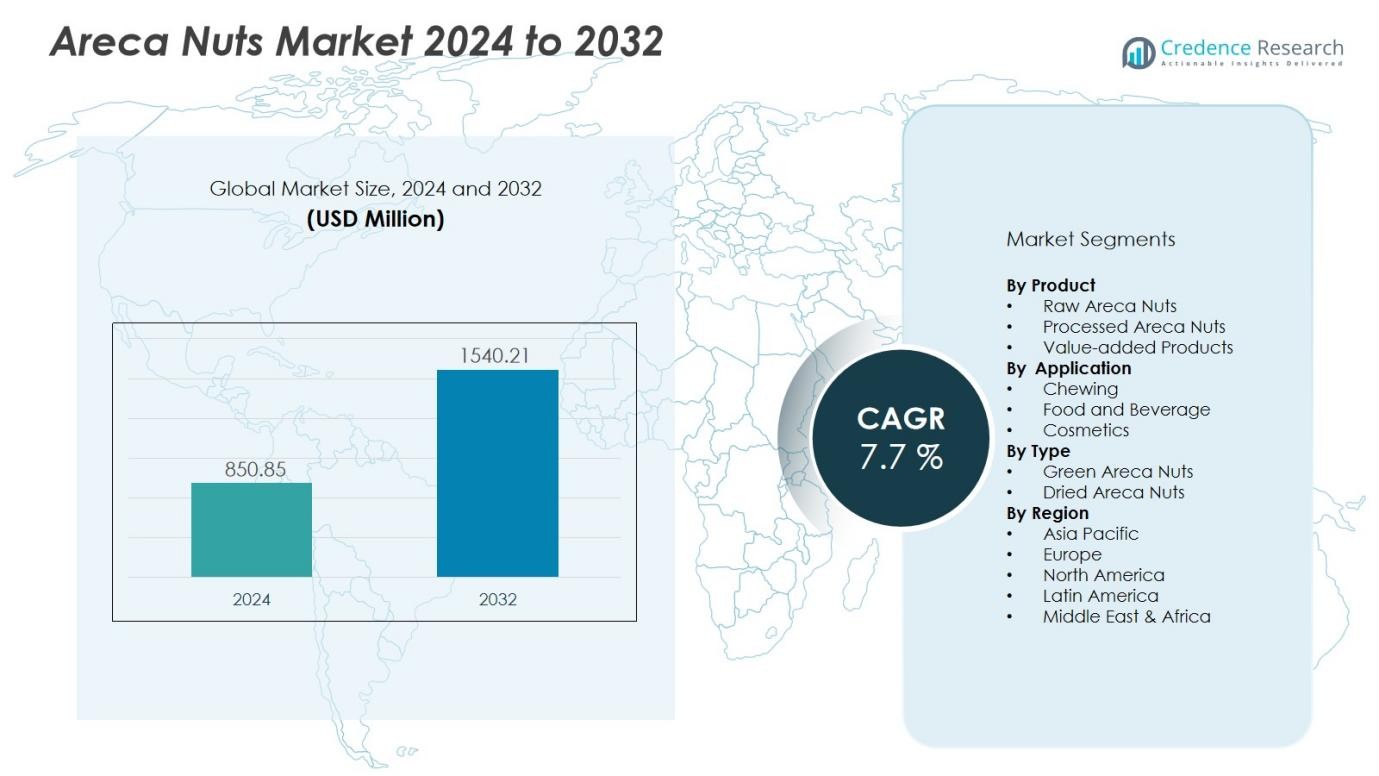
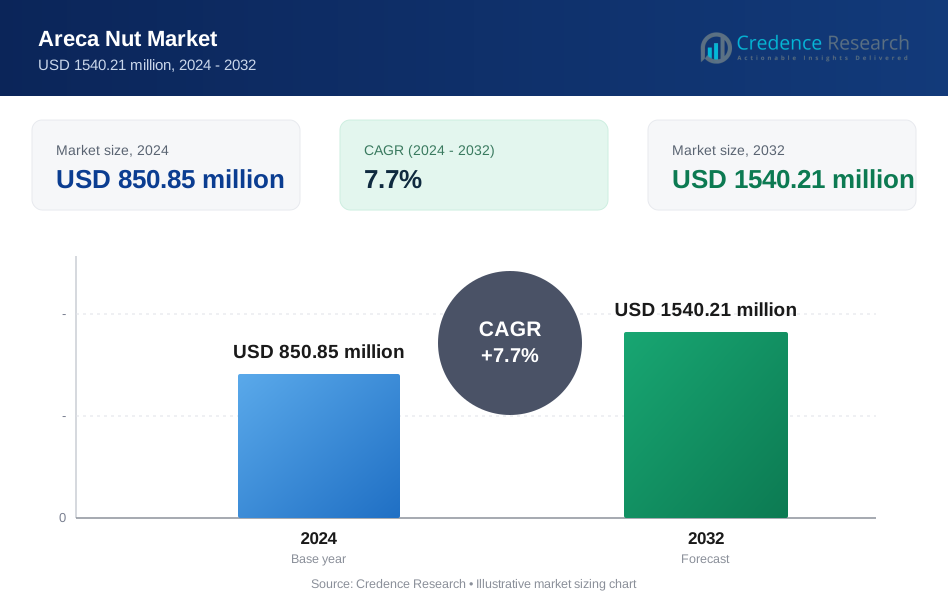
The Areca Nuts Market size was valued at USD 850.85 million in 2024 and is anticipated to reach USD 1540.21 million by 2032, at a CAGR of 7.7% during the forecast period.
| REPORT ATTRIBUTE | DETAILS |
|---|---|
| Historical Period | 2020-2023 |
| Base Year | 2024 |
| Forecast Period | 2025-2032 |
| Areca Nuts Market Size 2024 | USD 850.85 Million |
| Areca Nuts Market, CAGR | 7.7% |
| Areca Nuts Market Size 2032 | USD 1540.21 Million |
Key drivers include the enduring cultural and social use of areca nut in South and Southeast Asia, growing export opportunities to ethnic consumer bases in Europe and North America, and the emergence of value-added formulations (e.g., scented supari, processed snacks) that broaden applications beyond traditional chewing forms.
Regionally, the Asia-Pacific area dominates both production and consumption, with India supplying more than 45% of global output and serving as the largest domestic market. Meanwhile, North America is emerging as a notable growth region, albeit from a smaller base, with regulatory and supply-chain factors shaping development.
Market Insights:
- The Areca Nuts Market was valued at USD 850.85 million in 2024 and is anticipated to reach USD 1540.21 million by 2032, growing at a CAGR of 7.7% during the forecast period.
- The Asia-Pacific region dominates the Areca Nuts Market, holding roughly 90% of the global share, driven by strong cultural practices in countries like India and Thailand.
- North America is the fastest-growing region, with a modest single-digit percentage share, fueled by increasing demand from ethnic consumer bases and wellness trends.
- Raw areca nuts hold the largest share in the market due to their traditional use in chewing practices, while processed and value-added products are growing segments, contributing to diversification.
- The Areca Nuts Market’s export-driven growth is driven by expanding ethnic retail channels, particularly in North America and Europe, while the Asia-Pacific region ensures steady demand through cultural consumption.
Market Drivers:
Cultural and Social Significance in Asia-Pacific
The Areca Nuts Market is primarily driven by the long-standing cultural and social use of areca nuts in countries like India, Thailand, and Indonesia. It is a key ingredient in traditional practices such as betel chewing, which is a common cultural ritual in these regions. This widespread consumption ensures a consistent demand for areca nuts, maintaining its relevance and demand across generations.
- For instance, India exported precisely 10,636.87 metric tons of betel nuts and areca nuts globally in 2023-24, reflecting the integral role of areca nuts in traditional and cultural activities there.
Expanding Export Opportunities
The Areca Nuts Market is seeing a rise in export opportunities, particularly to regions with large ethnic populations, such as North America and Europe. As these populations grow, there is an increasing demand for authentic and culturally significant products, including areca nuts. The availability of diverse areca nut-based products, like flavored and processed variations, is boosting its export potential to global markets.
- For instance, in the 2023-2024 period, Indian exporters shipped a total volume of over 10,630 metric tons of areca nuts to various global destinations, including the United States, United Arab Emirates, and the United Kingdom, reflecting continued international demand for the product lines.
Health Benefits and Product Diversification
Areca nuts are gaining popularity for their potential health benefits, including improved digestion and antioxidant properties. As the demand for functional foods increases globally, it presents a unique opportunity for areca nuts to be incorporated into various health products. Product diversification, such as the introduction of areca nut-based snacks and supplements, further drives its market growth.
Government Support and Regulation
In key producing regions like India, the government has introduced various policies that support areca nut production, including subsidies and regulatory frameworks for sustainable farming practices. These initiatives enhance the market’s ability to meet both domestic and international demand while ensuring a stable supply chain. The growing recognition of areca nuts as an agricultural commodity fosters further investment in the sector.
Market Trends:
Emergence of Value‑Added Product Innovation
The Areca Nuts Market has seen increased focus on product innovation and diversification. Manufacturers now introduce flavored versions and processed snacks using areca nut components, expanding beyond traditional chewing formats. It adapts to evolving consumer preferences that demand more convenience and variety. Technology in processing, such as improved drying methods and quality control, also contributes. These developments strengthen supply chains and elevate product appeal in newer segments.
- For Instance, Farmonaut's AI-driven monitoring and precision agriculture platform enables farmers to gain real-time crop health insights through satellite data analysis. The platform provides tools for early detection of pests and diseases, irrigation management, and overall farm optimization, aiming to improve yield and efficiency for various crops.
Growth in Ethnic Retail Channels and International Access
The Areca Nuts Market also benefits from enhanced ethnic retail access and global distribution. Retailers in North America and Europe offer areca nut‑based products through specialty grocery stores and e‑commerce platforms, leveraging diaspora demand. It helps tap into niche markets where cultural practices maintain consumption. Simultaneously, producers scale export operations and refine logistics to serve distant markets. Improved trade flows and distribution networks amplify market reach and customer engagement globally.
- For Instance, For instance, the Indian-American retailer Patel Brothers currently operates over 50 U.S. locations (sources vary between 51 and 57 stores) and is known for its wide range of Indian grocery products, including its proprietary SWAD brand.
Market Challenges Analysis:
Production Instability due to Climatic and Agronomic Constraints
The Areca Nuts Market faces significant production risks from weather volatility and cultivation challenges. Heavy rainfall, droughts and pest infestations reduce yield and lower nut quality. Soil fertility decline and outdated farming practices hinder consistent output and raise costs. Producers struggle to secure reliable supply and must invest in modern agronomic techniques to maintain volumes. These constraints pressure margins and limit the market’s ability to scale efficiently.
Regulatory Pressure and Health‑Driven Demand Decline
The Areca Nuts Market must contend with growing regulatory scrutiny and shifting consumer behaviour linked to health concerns. Health agencies highlight risks associated with areca nut consumption, which prompts bans or restricted use in some countries. Importers and retailers face tighter oversight, which raises barriers to trade and distribution. Demand in traditional segments falls as consumers opt for safer alternatives. Market participants must adapt by exploring processed forms or repositioning products to mitigate reputational and regulatory risk.
Market Opportunities:
Expansion into Health, Wellness and Cosmetic Applications
The Areca Nuts Market offers strong scope through the launch of functional‑food products and natural cosmetic extracts. It appeals to the health‑conscious consumer base when areca‑nut derivatives show antioxidant and antimicrobial functions. Health‑product manufacturers may incorporate these derivatives into supplements, skincare lines or topical applications. Farming operations that adopt organic and sustainable practices may access premium pricing and differentiate their offerings. Export businesses that align with international wellness trends will unlock new revenue streams. Innovation in extraction and formulation applies areca nut in a broader context beyond traditional consumption.
Growth of Global Export Channels and Sustainable Supply Chains
The Areca Nuts Market can leverage rising demand in non‑traditional regions by strengthening export pathways and supply chain resilience. It makes sense for producers to target diaspora markets in North America and Europe where cultural demand exists. Firms that optimize logistics and meet regulatory standards will enhance cross‑border trade viability. Cultivation bases that adopt modern agronomic methods and invest in traceability will attract international buyers seeking assured quality. Online retail expansions also give access to niche consumer groups globally. By integrating technology and data‑driven farming, the market can scale sustainably and penetrate new geographies.
Market Segmentation Analysis:
By Product
The Areca Nuts Market is segmented by product type into raw, processed, and value-added products. Raw areca nuts remain the dominant product category due to their traditional use in chewing practices across Asia-Pacific. Processed areca nuts, such as flavored and dried variants, have gained traction in global markets. These processed forms cater to evolving consumer preferences for convenience and taste. Value-added products, including areca nut-based snacks and supplements, are emerging as popular alternatives, expanding the market scope beyond traditional forms.
- For Instance, Indonesia is one of the world's leading areca nut suppliers, consistently ranking as a top global exporter, including in 2023 when its exports were valued at over $127 million.
By Application
The market finds its primary applications in chewing, food and beverage, and cosmetics. Chewing remains the dominant application, driven by cultural traditions in countries like India and Southeast Asia. The demand for areca nuts in the food and beverage sector is growing, where it is used in flavoring agents and traditional preparations. The cosmetic application of areca nuts is expanding, particularly in skincare products, as its antimicrobial and antioxidant properties gain recognition. This diversification is opening up new opportunities for market players.
- For Instance, PANSARI Group, a leading Indian Fast-Moving Consumer Goods (FMCG) company with a 60-year legacy, focuses on manufacturing and exporting high-quality edible oils (such as mustard and canola oil), spices, flour (atta), and rice.
By Type
Areca nuts are classified into two main types: green and dried. Green areca nuts are primarily used in their raw form for chewing purposes and are largely consumed in local markets. Dried areca nuts are processed into various forms, including slices, powder, and flavored products. The drying process extends the shelf life of the product and enables its global distribution, thus increasing its market reach and appeal. Both types play a significant role in catering to regional and international demand.
Segmentations:
By Product
- Raw Areca Nuts
- Processed Areca Nuts
- Value-added Products
By Application
- Chewing
- Food and Beverage
- Cosmetics
By Type
- Green Areca Nuts
- Dried Areca Nuts
By Region
- North America
- U.S.
- Canada
- Mexico
- Europe
- Germany
- France
- U.K.
- Italy
- Spain
- Rest of Europe
- Asia Pacific
- China
- Japan
- India
- South Korea
- South-east Asia
- Rest of Asia Pacific
- Latin America
- Brazil
- Argentina
- Rest of Latin America
- Middle East & Africa
- GCC Countries
- South Africa
- Rest of the Middle East and Africa
Regional Analysis:
Asia‑Pacific Dominance and Supportive Consumption Base
The Asia‑Pacific region holds roughly 90% of the global share in the Areca Nuts Market. It leads production, consumption and export operations due to deep cultural traditions in countries like India and Bangladesh. It sustains steady demand through chewing practices, rituals and social customs. Indian production accounts for significant global output and supply to neighbouring countries. Large domestic consumption keeps producers focused on yield, quality and logistics. Urbanisation and retail expansion in this region further support distribution and product availability. Exporters based in Asia‑Pacific increasingly target overseas markets, leveraging local strengths and scale.
Emerging Growth in North America and Europe
North America and Europe together account for a modest single‑digit percentage of the Areca Nuts Market share. Demand in these regions draws largely from diaspora communities and niche health‑ or wellness‑driven segments. It shifts away from traditional chewing applications toward processed variants such as snacks or functional ingredients. Regulatory concerns and stricter import standards challenge market expansion in these geographies. Producers must ensure compliance with health and safety norms to gain access. Growth hinges on consumer education, product adaptation and tailored marketing.
Latin America and Middle East & Africa: Potential and Challenges
Latin America and Middle East & Africa each make up a small portion of the Areca Nuts Market share. These regions present untapped potential due to rising cultural awareness and changing consumption patterns. It opens opportunities for producers to introduce value‑added offerings and export‑oriented supply chains. Supply‑chain hurdles, infrastructure gaps and regulatory oversight limit growth speed. Investments in logistics, quality assurance and local partnerships will be critical. Firms that engage early in these regions may gain first‑mover advantage and build new revenue streams.
Key Player Analysis:
- Ashapura Agrocomm
- GM Group
- Godrej Agrovet
- KRBL
- Mangalam Group
- Ruby Privatindo
- Saaha Agro Industries
- Surya Exim
- The Campco
- VIETDELTA INDUSTRIAL
- Vimal Agro Products
Competitive Analysis:
The competitive landscape of the Areca Nuts Market features prominent agribusiness and processing firms, including Ashapura Agrocomm, GM Group, Godrej Agrovet, KRBL, Mangalam Group, and PT. Ruby Privatindo. These companies pursue vertical integration and supply‑chain control to strengthen market position. Each firm secures production sources, manages processing capacity, and refines logistics networks. It supports cost stability and responsiveness to export demand. Some firms invest in product innovation and packaging improvements to meet evolving tastes and international standards. They also emphasize quality certification and compliance to overcome regulatory hurdles in import markets. Competition intensifies around securing farmer contracts, adopting efficient agronomic practices, and differentiating processed product offerings. Emerging firms and regional players create niche competition by focusing on specialty grades and localized channels. It pressures large players to broaden their product portfolios and adjust pricing strategies. Suppliers must respond rapidly to raw‑material volume fluctuations and quality disruptions. Firms driving scale and differentiation gain an advantage in winning export contracts and setting premium price points. Continuous investment in traceability, sustainability, and farm‑to‑export integration defines the next phase of competitive strength.
Recent Developments:
- In August 2025, Godrej Agrovet launched a new herbicide named “Ashitaka,” adding to its agricultural solutions product range.
- In February 2025, KRBL Limited launched two variants of multi-source edible oil under the sub-brand "India Gate Uplife," marking its strategic entry into health-focused FMCG products.
Report Coverage:
The research report offers an in-depth analysis based on Product, Application, Type and Region. It details leading Market players, providing an overview of their business, product offerings, investments, revenue streams, and key applications. Additionally, the report includes insights into the competitive environment, SWOT analysis, current Market trends, as well as the primary drivers and constraints. Furthermore, it discusses various factors that have driven Market expansion in recent years. The report also explores Market dynamics, regulatory scenarios, and technological advancements that are shaping the industry. It assesses the impact of external factors and global economic changes on Market growth. Lastly, it provides strategic recommendations for new entrants and established companies to navigate the complexities of the Market.
Future Outlook:
- The Areca Nuts Market is expected to witness steady growth as traditional chewing habits continue to drive demand.
- Innovation in processed and value-added products will create new market opportunities.
- Sustainability in farming practices and eco-friendly packaging will become critical competitive factors.
- Expansion into global markets, particularly in North America and Europe, will open new revenue streams.
- There will be increased emphasis on organic and traceable production to meet rising consumer demand for clean products.
- Technological advancements in processing, such as improved drying techniques, will enhance product quality and shelf life.
- The rise of health-conscious consumers will lead to more functional areca nut-based products in the food and beverage sector.
- Regulatory scrutiny will likely increase, requiring producers to adapt to stricter standards for imports and exports.
- The market will see greater consolidation as major players seek to strengthen their supply chains and distribution networks.
- Consumer education campaigns will help mitigate health concerns and boost awareness about the nutritional and cultural value of areca nuts.
Request a Free Sample
Fill in your details and we'll send you a free sample report.
- Sample data tables & charts
- Research methodology
Need a Custom Version of This Report?
Tailor the scope, geography, or segments to your exact requirements.
- Custom geography or segment scope
- Direct access to our analyst team
Frequently Asked Questions
What is the current market size for the Areca Nuts Market, and what is its projected size in 2032?
At what Compound Annual Growth Rate (CAGR) is the Areca Nuts Market projected to grow between 2024 and 2032?
Which Areca Nuts Market segment held the largest share in 2024?
What are the primary factors fueling the growth of the Areca Nuts Market?
Who are the leading companies in the Areca Nuts Market?
What challenges does the Areca Nuts Market face?
Table of Content
Chapter 1. Report Introduction
- 1.1 Report Description & Purpose
- 1.1.1 Report Title & Market Definition
- 1.1.2 Unique Selling Propositions (USP) & Key Differentiators
- 1.1.3 Value Proposition for Stakeholders
- 1.2 Research Objectives
- 1.2.1 Market Sizing Objectives (Volume & Revenue) (Volume Where Applicable)
- 1.2.2 Segmentation Objectives
- 1.2.3 Competitive Intelligence Objectives
- 1.2.4 Forecast & Scenario Objectives
- 1.3 Report Scope
- 1.3.1 Areca Nut Scope – Segments & Subsegments Covered
- 1.3.2 Geographic Scope – Regions & Countries Covered
- 1.3.3 Historical Period, Base Year & Forecast Period (2024; forecast to 2032)
- 1.3.4 Inclusions & Exclusions
- 1.4 Industry Classification & Applicable Codes
- 1.5 Currency, Measurement Units & Valuation Basis
- 1.6 Target Stakeholders
- 1.7 Limitations & Assumptions
Chapter 2. Executive Summary
- 2.1 Global Areca Nut Market Snapshot
- 2.1.1 Market Size – Historical (2024) & Forecast (2024-2032) (2024: USD 850.85 million → 2032: USD 1540.21 million)
- 2.1.2 Volume & Revenue – Global Totals (Volume Where Applicable)
- 2.1.3 Key Market Highlights – Top Five Facts
- 2.2 Areca Nut Market Segmentation Snapshot
- 2.2.1 Market Split by Region – 2024 vs. 2032
- 2.3 Competitive Snapshot
- 2.3.1 Top 10 Players by Revenue Share – 2024
- 2.3.2 Top 10 Players by Volume Share – 2024 (Volume Where Applicable)
- 2.3.3 Recent Strategic Developments (18-Month Summary)
- 2.4 Key Investment Highlights & Strategic Conclusions
Chapter 3. Areca Nut Market Dynamics & Industry Analysis
- 3.1 Market Overview & Context
- 3.1.1 Areca Nut Market Position in the Broader Industry Value Chain
- 3.1.2 Demand Structure & Purchasing Dynamics
- 3.1.3 Market Maturity & Development Stage by Region
- 3.2 Areca Nut Market Drivers
- 3.3 Areca Nut Market Restraints & Challenges
- 3.4 Areca Nut Market Opportunities
- 3.5 Porter's Five Forces Analysis
- 3.5.1 Threat of New Entrants
- 3.5.2 Bargaining Power of Suppliers
- 3.5.3 Bargaining Power of Buyers
- 3.5.4 Threat of Substitutes
- 3.5.5 Competitive Rivalry – Intensity Assessment
- 3.6 Areca Nut Value Chain Analysis
- 3.6.1 Upstream – Key Inputs, Resources & Suppliers
- 3.6.1.1 Key Input/Resource 1
- 3.6.1.2 Key Input/Resource 2
- 3.6.1.3 Key Input/Resource 3
- 3.6.2 Midstream – Core Operations & Value Creation
- 3.6.2.1 Operating Model & Process Overview
- 3.6.2.2 Key Operating Locations & Capabilities by Company
- 3.6.3 Downstream – Market Channels & End Users
- 3.6.3.1 Direct Sales & Customer Engagement Channels
- 3.6.3.2 Indirect Sales, Intermediaries & Partner Channels
- 3.6.4 Value Chain Profitability Analysis
- 3.6.1 Upstream – Key Inputs, Resources & Suppliers
- 3.7 PESTEL Analysis
- 3.7.1 Political Factors
- 3.7.2 Economic Factors
- 3.7.3 Social Factors
- 3.7.4 Technological Factors
- 3.7.5 Environmental Factors
- 3.7.6 Legal Factors
- 3.8 Areca Nut Supply Chain Analysis
- 3.8.1 Critical Input & Resource Availability Risk Assessment
- 3.8.2 Supplier & Operational Concentration Risk (Geographic Exposure)
- 3.8.3 Supply & Service Disruption Impact Analysis
- 3.9 Regulatory & Policy Landscape
Note: The regulatory and policy landscape section covers regulations based on their applicability to the market, Areca Nut category, geography, and scope of the study. Only regulatory frameworks with a material impact on operations, compliance, trade, sustainability, or market access are analyzed in detail.
Chapter 4. Key Investment Pockets & Opportunity Analysis
- 4.1 Areca Nut Market Attractiveness Analysis
- 4.1.1 By Region – Investment Attractiveness Matrix (Market Size × CAGR)
- 4.2 Absolute Revenue Growth Opportunity
- 4.2.1 By Region – Absolute Revenue Growth Through 2032
- 4.3 Incremental Demand Opportunity
- 4.3.1 By Region – Incremental Demand Through 2032
- 4.3.2 Segment – Incremental Demand
- 4.4 Emerging Submarket Opportunity Deep Dive (Subject to Applicability)
- 4.5 Priority Market Opportunity Scorecards
- 4.5.1 United States
- 4.5.2 Europe
- 4.5.3 Asia
- 4.5.4 Middle East & Africa
Note: Priority market opportunity scorecards reflect the geographic scope and strategic relevance of the study. Listed markets are indicative and may be adapted to the industry.
Chapter 5. Areca Nut Cross-Border Trade & Market Access Analysis
- 5.1 International Trade & Cross-Border Activity Overview
- 5.1.1 Global Export Value by Country (2024)
- 5.1.2 Global Export Volume by Country (2024) (Volume Where Applicable)
- 5.1.3 Global Import Value by Country (2024)
- 5.1.4 Global Import Volume by Country (2024) (Volume Where Applicable)
- 5.1.5 Net Trade Balance by Country (2024)
- 5.2 Export Analysis – Segment
- 5.2.1 Category 1 (Applicable Classification Code)
- 5.2.2 Category 2 (Applicable Classification Code)
- 5.2.3 Category 3 (Applicable Classification Code)
- 5.2.4 Category 4 (Applicable Classification Code)
- 5.2.5 Category 5 (Applicable Classification Code)
- 5.3 Import Analysis – Segment
- 5.3.1 Category 1 (Applicable Classification Code)
- 5.3.2 Category 2 (Applicable Classification Code)
- 5.3.3 Category 3 (Applicable Classification Code)
- 5.3.4 Category 4 (Applicable Classification Code)
- 5.3.5 Category 5 (Applicable Classification Code)
- 5.4 Cross-Border Pricing & Transaction Benchmarks
- 5.4.1 Export Pricing – Segment & Country
- 5.4.2 Import Pricing – Segment & Source Country
- 5.4.3 Price Trends (2024)
- 5.5 Key Cross-Border Trade & Delivery Routes
- 5.5.1 Cross-Border Trade/Delivery Route 1
- 5.5.2 Cross-Border Trade/Delivery Route 2
- 5.5.3 Cross-Border Trade/Delivery Route 3
- 5.5.4 Cross-Border Trade/Delivery Route 4
- 5.5.5 Cross-Border Trade/Delivery Route 5
- 5.6 Trade Policy & Market Access Impact Assessment
- 5.6.1 Tariff & Non-Tariff Barriers
- 5.6.2 Regional Trade & Economic Integration Frameworks
- 5.6.3 Bilateral & Multilateral Trade Agreements
- 5.6.4 Cross-Border Operating, Licensing & Localization Requirements
Note: This chapter applies where cross-border trade or delivery is relevant to Areca Nut. Goods, services, and digital offerings are assessed using applicable classifications and transaction measures. Import-export volumes, trade balances, and route analyses are included only where meaningful to the market.
Chapter 6. Competitive Landscape & Company Benchmarking
- 6.1 Areca Nut Market Concentration & Structure
- 6.1.1 Herfindahl-Hirschman Index (HHI) – vs. 2024
- 6.1.2 Leading, Mid-Sized & Emerging Player Structure
- 6.1.3 Global, Regional & Local Player Dynamics
- 6.2 Areca Nut Market Share Analysis – 2024
- 6.2.1 Global Revenue Share by Company
- 6.2.2 Global Volume Share by Company (Volume Where Applicable)
- 6.2.3 Regional Revenue Share
- 6.2.4 Market Share Evolution ( vs. 2024)
- 6.2.5 Company Market Share by Key Segment
- 6.2.6 Company Market Share by Customer Group
- 6.3 Operating Scale, Capacity & Infrastructure Analysis
- 6.3.1 Global Operating Scale & Supply Capacity
- 6.3.2 Resource Utilization & Operating Efficiency
- 6.3.3 Output, Service Delivery & Activity Metrics
- 6.3.4 Operating Footprint & Infrastructure Map
- 6.3.5 Planned Operational & Capacity Expansion
- 6.4 Areca Nut Competitive Benchmarking Matrix
- 6.4.1 Revenue, Growth, Profitability & Operating Metric Comparison
- 6.4.2 Channel Revenue Mix
- 6.4.3 Geographic Revenue Exposure
- 6.4.4 R&D Intensity
- 6.4.5 Sustainability Maturity
- 6.5 Strategic Developments in Areca Nut (Last 24 Months)
- 6.5.1 Mergers, Acquisitions & Divestments
- 6.5.2 New Products, Services & Solutions in Areca Nut
- 6.5.3 Operational & Infrastructure Expansions
- 6.5.4 Strategic Alliances, Joint Ventures & Partnerships
- 6.5.5 Distribution Expansion & Market Entry
- 6.5.6 Sustainability & ESG Initiatives
- 6.6 Competitive Strategy Mapping
- 6.6.1 Leader, Challenger, Follower & Niche Classification
- 6.6.2 Pricing Strategy Comparison
- 6.6.3 Channel Strategy Matrix
Note: Strategic developments are included based on their materiality and the availability of reliable information.
Chapter 7. Global Areca Nut Market – By Sales & Delivery Channel
- 7.1 Segment Overview
- 7.1.1 Volume & Revenue Split by Channel (2024 & 2032) (Volume Where Applicable)
- 7.1.2 Channel Mix Evolution (2024-2032)
Chapter 8. Regional Market Analysis – Global Overview
- 8.1 Global Regional Overview
- 8.1.1 Regional Volume Share (Volume Where Applicable)
- 8.1.2 Regional Revenue Share
- 8.1.3 Regional Volume by Region (Volume Where Applicable)
- 8.1.4 Regional Revenue by Region
- 8.1.5 Regional Forecast Through 2032
- 8.2 Cross-Regional Segment Analysis
- 8.2.1 By Sales & Delivery Channel
- 8.2.2 By Competitive Positioning & Price Tier
Chapter 9. North America Areca Nut Market
- 9.1 United States
- 9.2 Canada
- 9.3 Mexico
Chapter 10. Europe Areca Nut Market
- 10.1 Germany
- 10.2 France
- 10.3 Italy
- 10.4 United Kingdom
- 10.5 Spain
- 10.6 Poland
- 10.7 Russia
- 10.8 Netherlands
- 10.9 Belgium
- 10.10 Sweden
- 10.11 Denmark
- 10.12 Norway
- 10.13 Rest of Europe
Chapter 11. Asia Pacific Areca Nut Market
- 11.1 China
- 11.2 India
- 11.3 Japan
- 11.4 South Korea
- 11.5 Thailand
- 11.6 Indonesia
- 11.7 Vietnam
- 11.8 Malaysia
- 11.9 Australia
- 11.10 Rest of Asia Pacific
Chapter 12. Latin America Areca Nut Market
- 12.1 Brazil
- 12.2 Argentina
- 12.3 Colombia
- 12.4 Chile
- 12.5 Rest of Latin America
Chapter 13. Middle East Areca Nut Market
- 13.1 Saudi Arabia
- 13.2 United Arab Emirates
- 13.3 Turkey
- 13.4 Israel
- 13.5 Iran
- 13.6 Rest of the Middle East
Chapter 14. Africa Areca Nut Market
- 14.1 South Africa
- 14.2 Egypt
- 14.3 Nigeria
- 14.4 Morocco
- 14.5 Rest of Africa
Chapter 15. Areca Nut Company Profiles
- 15.1 [Company 01]
- 15.1.1 Company Overview
- 15.1.2 Key Management Personnel
- 15.1.3 Products & Services Portfolio
- 15.1.4 Financial Performance
- 15.1.5 Key Market Focus & Geographic Presence
- 15.1.6 Recent Developments & Strategic Initiatives
Note: The company profile list is preliminary and may change based on research findings, market developments, data availability, and client requirements.
Chapter 16. Appendices
- Appendix A – List of Abbreviations & Acronyms
- Appendix B – Industry Classification Code Reference – Full Series
- Appendix C – Supply, Output & Operating Capacity Data Tables
- Appendix D – End-Use & Demand Base Tables
- Appendix E – Demand, Adoption & Usage Assumptions
- Appendix F – Pricing & Revenue Metric Reference Tables
- Appendix G – Company Operations & Infrastructure Database
- Appendix H – Cross-Border Trade & Activity Data Tables (Where Applicable)
- Appendix I – Regulatory Summary Tables
- Appendix J – Primary Research Participant List (Anonymized)
- Appendix K – Primary Research Questionnaire Framework
- Appendix L – Data Sources & Bibliography
- Appendix M – Market Size Divergence & Source Comparison
Chapter 17. Research Methodology
- 17.1 Research Framework & Philosophy
- 17.2 Secondary Research – Sources, Hierarchy & Data Extraction
- 17.3 Data Modeling – Bottom-Up & Top-Down Market Sizing
- 17.4 Primary Research – Stakeholder Framework, LOI & Sample Sizes
- 17.5 Forecast Methodology – Regression, Scenario & Sensitivity Analysis
- 17.6 Quality Control – Four-Layer Validation Framework
- 17.7 Limitations & Standard Assumptions
- 17.8 Disclaimer
