Articaine Hydrochloride Market Overview:
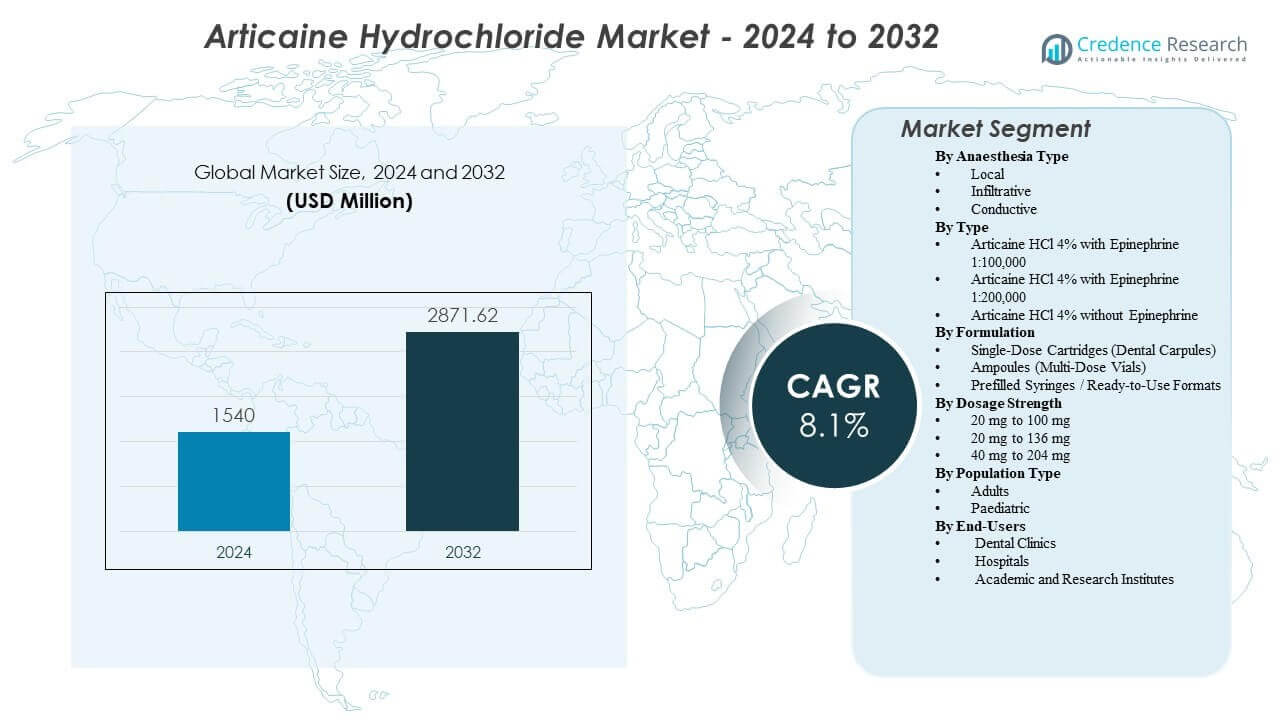
The Articaine Hydrochloride Market is projected to grow from USD 1540 million in 2024 to an estimated USD 2871.62 million by 2032, with a compound annual growth rate (CAGR) of 8.1% from 2024 to 2032.
| REPORT ATTRIBUTE |
DETAILS |
| Historical Period |
2020-2023 |
| Base Year |
2024 |
| Forecast Period |
2025-2032 |
| Articaine Hydrochloride Market Size 2024 |
USD 1540 million |
| Articaine Hydrochloride Market, CAGR |
8.1% |
| Articaine Hydrochloride Market Size 2032 |
USD 2871.62 million |
Demand in the Articaine Hydrochloride Market is driven by the growing burden of oral diseases, rising adoption of minimally invasive dentistry, and strong preference for anesthetics that offer rapid onset. Clinicians select articaine for its superior penetration and reliable performance across restorative, surgical, and periodontal workflows. Higher awareness of oral health encourages patients to seek timely treatment, increasing procedure volumes across clinics and hospitals. Advancements in dental imaging and digital workflows require dependable anesthetic stability. Product innovation, expanding training programs, and strong regulatory clarity further support market growth across diverse clinical environments.
The Articaine Hydrochloride Market shows strong geographic variation, with North America leading due to advanced dental infrastructure, high procedure rates, and broad practitioner acceptance. Europe follows closely, supported by standardized anesthetic protocols and strong presence of key manufacturers. Asia-Pacific emerges rapidly as growing populations, expanding dental chains, and increased access to oral care drive demand. Latin America sees rising clinical adoption supported by urban treatment centers, while the Middle East and Africa experience gradual growth through infrastructure upgrades and practitioner training. Each region strengthens market presence through evolving healthcare systems and expanding dental service capacity.
Articaine Hydrochloride Market Insights:
- The Articaine Hydrochloride Market is projected to grow from USD 1540 million in 2024 to USD 2871.62 million by 2032, supported by an expected 8.1% CAGR driven by rising dental procedure volumes.
- Demand strengthens due to increased preference for fast-acting anesthetics that offer reliable diffusion, making articaine the favored choice for restorative, surgical, and periodontal treatments.
- Growth faces restraints from regulatory variations across regions, product safety considerations for specific patient groups, and the need for trained practitioners to ensure correct administration.
- North America leads the market due to strong dental infrastructure and high usage rates, while Europe maintains significant adoption supported by established clinical protocols.
- Asia-Pacific emerges as a high-growth region due to expanding dental networks, rising awareness of oral health, and increased access to advanced anesthesia tools across urban centers.
Access crucial information at unmatched prices!
Request your sample report today & start making informed decisions powered by Credence Research Inc.!
Download Sample
Articaine Hydrochloride Market Drivers
Growing Adoption of Fast-Acting Local Anesthetics Across Dental Procedures
The Articaine Hydrochloride Market expands because dentists prefer agents with rapid onset and strong diffusion. Clinics choose this compound for routine fillings, extractions, and complex oral surgery. It supports predictable numbness that improves patient comfort. Rising dental visits strengthen the overall demand trend. Consumers seek shorter chair time, which increases preference for efficient anesthetics. Training programs encourage wider use among early-career clinicians. Product consistency builds confidence among dental specialists. Regulatory clarity across major regions supports stable market access.
- For instance, clinical trials published by Septodont show that articaine achieves pulpal anesthesia in approximately 1–3 minutes, significantly faster than several lidocaine formulations.
Rising Burden of Oral Diseases Driving Frequent Clinical Interventions in Key Regions
The Articaine Hydrochloride Market gains traction because oral diseases lead to higher treatment rates. Dentists rely on this anesthetic to manage pain during restorative and periodontal work. It supports safe delivery during long procedures. Growing sugar consumption across many countries increases dental decay. Patients seek early intervention to avoid complex complications. Modern imaging tools allow faster diagnosis, which boosts procedure volumes. Public awareness campaigns highlight the need for timely oral care. Expanding insurance coverage improves the number of treated cases.
- For instance, Dentsply Sirona’s CBCT systems are installed in more than 25,000 practices worldwide, enabling earlier detection of oral pathologies requiring anesthetic-supported treatment.
Growing Shift Toward Minimally Invasive Dentistry Supporting Wider Anesthetic Use
The Articaine Hydrochloride Market gains momentum through rising demand for less invasive techniques. Dentists select this anesthetic because it supports precision in targeted procedures. It enables better tissue penetration compared with older alternatives. Patients expect quicker recovery with minimal discomfort. Clinics adopt modern restorative tools that often require effective local anesthesia. Higher focus on cosmetic dentistry accelerates demand for reliable pain control. Research groups explore improved formulations for complex workflows. Manufacturers enhance supply to match expanding clinical needs.
Rising Per-Person Dental Spending and Strong Growth of Private Dental Clinics
The Articaine Hydrochloride Market benefits from higher household spending on oral care. Patients accept premium clinical options when pain control is assured. Dentists introduce upgraded anesthetic protocols to support advanced treatments. It remains preferred because it supports predictable outcomes across age groups. Private clinics invest in broad anesthetic inventories to meet expanding service lines. Urban populations demand faster and more comfortable procedures. Dental tourism expands in developing regions and boosts product use. Strong investment in oral healthcare infrastructure pushes long-term demand.
Articaine Hydrochloride Market Trends
Increased Use of Buffered and Optimized Formulations in Modern Dental Settings
The Articaine Hydrochloride Market grows through rising interest in buffered versions that support smoother injections. Dentists focus on patient comfort and stable anesthetic performance. It aligns well with digital workflow adoption in clinics. Manufacturers explore improved pH-balanced formulations. Clinicians demand precision during endodontic and periodontal work. Research groups evaluate newer delivery devices that increase efficiency. Consumers expect minimal discomfort during injections. Expanded product portfolios reflect this shift in clinical preference.
Integration of Digital Dentistry and Image-Guided Procedures Boosting Usage Patterns
The Articaine Hydrochloride Market supports advanced dental workflows where accuracy is vital. Dentists use imaging and navigation tools that require dependable anesthetic stability. It aligns with complex restorative treatments that rely on digital planning. Clinics invest in scanners and guided systems to improve outcomes. Higher adoption of CAD/CAM increases treatment volumes. Professionals pursue training that relies on consistent anesthesia performance. Patient expectations rise with broader adoption of digital tools. Supply chain improvements ensure steady availability across regions.
- For instance, Dentsply Sirona’s Axeos 3D imaging system delivers a resolution of 0.08 mm, improving precision during anesthetized procedures.
Rising Preference for Multi-Application Anesthetics Across Expanding Dental Specialties
The Articaine Hydrochloride Market benefits from broader use across implantology, orthodontics, and pediatric care. Dentists select versatile anesthetics that adapt to diverse case needs. It supports complex procedures that require reliable soft-tissue diffusion. Clinicians value flexibility when handling short and extended sessions. Specialty practices expand in urban areas and increase consumption. Dental service organizations standardize anesthetic protocols. Patients favor clinics that offer comfortable care experiences. Manufacturers respond through targeted formulations for specialty use.
- For instance, Pacific Dental Services operates over 1,000 affiliated practices in the U.S., increasing anesthetic demand across multiple specialty workflows.
Shift Toward Sustainability and Compliance-Oriented Production Standards in Pharma Manufacturing
The Articaine Hydrochloride Market follows rising focus on sustainable production and strong regulatory alignment. Manufacturers adopt greener processes to meet global environmental guidelines. It supports confidence among buyers seeking high-quality anesthetics. Pharma firms invest in compliant packaging upgrades. Clinics prefer products with strong traceability. Global supply partners adjust to evolving safety rules. Quality certifications strengthen brand reliability. Growing awareness of safe disposal practices influences procurement behavior.
Articaine Hydrochloride Market Challenges Analysis
Supply Chain Vulnerabilities and Rising Compliance Requirements Across Manufacturing Ecosystems
The Articaine Hydrochloride Market faces challenges from strict pharmaceutical rules. Producers must maintain high purity and consistent quality in every batch. It demands advanced facilities that require significant investment. Supply chains face delays when raw materials decline in availability. Regulatory inspections require constant documentation and process upgrades. Clinics face temporary shortages when production gaps occur. Competitive pressure limits pricing flexibility. New entrants experience difficulty when meeting global compliance standards.
Growing Clinical Preference for Alternative Anesthetic Options and Safety Concerns in Specific Populations
The Articaine Hydrochloride Market encounters competition from other anesthetics with longer clinical histories. Dentists switch products when safety concerns arise for sensitive patients. It prompts firms to strengthen post-market surveillance. Some regions promote older molecules through established guidelines. Training gaps reduce uniform adoption across rural areas. Clinics expect clear safety data for pediatric or medically complex patients. Manufacturers must address ongoing research findings. Market penetration slows when clinical hesitancy rises.
Articaine Hydrochloride Market Opportunities
Expansion of Dental Infrastructure and Strong Uptake of Advanced Restorative Procedures Across Emerging Regions
The Articaine Hydrochloride Market gains opportunities from rapid growth in new dental clinics. Many countries expand healthcare spending to improve oral care access. It supports rising adoption of specialized anesthetics. Urban centers attract private investments for advanced dental setups. Cosmetic dentistry grows among young populations. Dental tourism expands across Asia and Latin America. Higher disposable income increases acceptance of premium clinical solutions. Product availability improves through stronger distribution networks.
Rising Innovation in Formulation Science and Broader Integration of Technology in Pain Management
The Articaine Hydrochloride Market benefits from research aimed at safer and more efficient delivery formats. Developers explore needle-free systems and improved buffering techniques. It aligns with the global shift toward patient-centered care. Clinics adopt digital tools that rely on stable anesthetic performance. Cross-industry collaborations accelerate product innovation. Training institutions integrate advanced anesthesia modules. Pharma firms explore new packaging that reduces waste. Broader practitioner education supports long-term expansion.
Articaine Hydrochloride Market Segmentation Analysis:
By Anaesthesia Type
The Articaine Hydrochloride Market expands across local, infiltrative, and conductive anesthesia use. Local anesthesia supports routine restorative procedures and offers predictable pain control. Infiltrative use gains wider adoption because clinicians depend on strong soft-tissue penetration. Conductive anesthesia covers complex interventions that require deeper nerve targeting. Each type aligns with different clinical workflows. Dental teams choose the mode that ensures reliable numbness and patient comfort. It strengthens clinical flexibility across diverse case loads. Market adoption rises with broader practitioner training.
By Type
The Articaine Hydrochloride Market grows through strong demand for epinephrine-based variants. The 1:100,000 concentration supports quick onset during common procedures. The 1:200,000 option offers extended working time with controlled vasoconstriction. The non-epinephrine formulation serves patients with specific medical sensitivities. Dentists match each type with patient needs and procedure length. Clinics maintain multiple strengths to ensure treatment readiness. It supports efficient workflow planning across dental practices. Broader clinical acceptance sustains steady product uptake.
By Formulation
The Articaine Hydrochloride Market benefits from rising use of single-dose cartridges that support safe and efficient delivery. Cartridges dominate chairside applications due to convenience. Ampoules remain relevant in hospital and multi-dose settings. Prefilled syringes appeal to clinics prioritizing speed and simplicity. Each format aligns with different operational environments. Dental teams choose the formulation that enhances safety and waste reduction. It integrates well with modern injection systems. Consistent performance strengthens product preference.
- For instance, Inibsa Dental produces over 300 million dental anesthetic cartridges annually, reinforcing widespread adoption.
By Dosage Strength
The Articaine Hydrochloride Market includes dosage ranges that support varied clinical demands. Lower strengths cover brief restorative procedures. Mid-range strengths help clinicians manage moderate treatments. Higher strengths match extended or complex dental work. Dentists select doses that maintain patient safety. Reliable pharmacological behavior supports confident use. It ensures alignment with clinical guidelines. Diverse strength options improve treatment adaptability across patient groups.
By Population Type
The Articaine Hydrochloride Market addresses adult and paediatric needs across dental care. Adults drive most procedure volumes through routine and surgical interventions. Paediatric use requires careful dosing and controlled onset. Clinicians rely on structured guidelines to ensure safe delivery. Dedicated training supports appropriate use across age groups. Patient comfort remains a priority in both categories. It expands adoption across general and specialty practices. Demographic growth strengthens long-term demand.
- For instance, the American Academy of Pediatric Dentistry notes that articaine demonstrates high safety when limited to children over four years of age in compliance with clinical guidelines.
By End-Users
The Articaine Hydrochloride Market serves dental clinics, hospitals, and academic institutes. Dental clinics lead consumption due to high patient throughput. Hospitals rely on anesthetics for oral surgery and emergency interventions. Academic institutes support training and research that shape future clinical use. Each end-user category influences procurement trends. Stable supply supports operational continuity. It reinforces confidence among healthcare providers. Growing infrastructure investment strengthens market penetration.
Segmentation:
By Anaesthesia Type
- Local
- Infiltrative
- Conductive
By Type
- Articaine HCl 4% with Epinephrine 1:100,000
- Articaine HCl 4% with Epinephrine 1:200,000
- Articaine HCl 4% without Epinephrine
By Formulation
- Single-Dose Cartridges (Dental Carpules)
- Ampoules (Multi-Dose Vials)
- Prefilled Syringes / Ready-to-Use Formats
By Dosage Strength
- 20 mg to 100 mg
- 20 mg to 136 mg
- 40 mg to 204 mg
By Population Type
By End-Users
- Dental Clinics
- Hospitals
- Academic and Research Institutes
By Distribution Channel
- Direct Tender
- Hospital Pharmacy
- Retail Pharmacy
- Online Pharmacy
- Others
By Region
- North America
- Europe
- Germany
- France
- U.K.
- Italy
- Spain
- Rest of Europe
- Asia Pacific
- China
- Japan
- India
- South Korea
- South-east Asia
- Rest of Asia Pacific
- Latin America
- Brazil
- Argentina
- Rest of Latin America
- Middle East & Africa
- GCC Countries
- South Africa
- Rest of the Middle East and Africa
Regional Analysis:
The Articaine Hydrochloride Market holds a strong presence in North America, which captures nearly 35% of the global share due to high procedure volumes and broad adoption of advanced dental anesthetics. The United States leads with strong clinical infrastructure and consistent product availability. Canada supports demand through expanding dental coverage and increased preventive care. Clinics across the region depend on reliable anesthetic options for restorative and surgical work. It gains steady traction through established distribution channels. Market conditions remain favorable with continuous investment in oral healthcare.
Europe represents about 30% of the Articaine Hydrochloride Market share and maintains a strong position due to widespread use of articaine as a primary dental anesthetic. Germany, France, Italy, and the UK drive demand through large networks of dental practices. Regulatory standards encourage adoption of high-purity formulations. Regional manufacturers strengthen product innovation and supply reliability. Clinics prefer standardized anesthetic protocols across private and public care settings. It supports sustained presence in routine and advanced procedures.
Asia-Pacific accounts for nearly 25% of the Articaine Hydrochloride Market share and demonstrates the fastest expansion. China, India, Japan, and South Korea lead growth through rising oral disease burden and expanding dental infrastructure. Urban centers invest in modern clinics that rely on high-performance anesthetics. Patient demand for restorative and cosmetic procedures accelerates market penetration. Growing training programs improve practitioner confidence in articaine use. It gains momentum as healthcare spending strengthens and distribution networks expand across emerging economies.
Shape Your Report to Specific Countries or Regions & Enjoy 30% Off!
Key Player Analysis:
- 3M Company
- Anhui BBCA Pharmaceutical Co., Ltd.
- Dentsply Sirona
- Septodont
- Pierrel S.p.A.
- Sanofi
- Siegfried AG
- Sigma-Aldrich (Merck)
- Inibsa Dental S.L.U
- Jinan Chenghui Shuangda Chemical Co., Ltd.
- Manus Aktteva Biopharma LLP
- Nortec Quimica
- Benco Dental
- Patterson Dental
- Suyog Life Sciences
Competitive Analysis:
The Articaine Hydrochloride Market features a mix of global pharmaceutical companies and specialized dental manufacturers competing through formulation quality, regulatory compliance, and distribution strength. Established firms such as 3M, Septodont, Dentsply Sirona, and Pierrel maintain strong positions through broad product portfolios and long-standing clinical trust. It gains competitive intensity when regional suppliers expand capacity to serve cost-sensitive markets. Suppliers focus on high-purity synthesis, improved packaging, and flexible concentrations to meet diverse clinical needs. Mergers, partnerships, and contract manufacturing agreements influence competitive shifts. Companies strengthen market presence through targeted launches and improved supply reliability across dental networks.
Recent Developments:
- In April 2024, Inibsa Dental reported the completion of a modernization project at its anesthetic manufacturing unit, improving sterility standards and scalable output. The upgrade supports strong demand for its articaine cartridge formulations across Europe and Latin America.
Report Coverage:
The research report offers an in-depth analysis based on Anaesthesia Type, Type, Formulation, Dosage Strength, Population Type, End-Users, and Distribution Channel. It details leading market players, providing an overview of their business, product offerings, investments, revenue streams, and key applications. Additionally, the report includes insights into the competitive environment, SWOT analysis, current market trends, as well as the primary drivers and constraints. Furthermore, it discusses various factors that have driven market expansion in recent years. The report also explores market dynamics, regulatory scenarios, and technological advancements that are shaping the industry. It assesses the impact of external factors and global economic changes on market growth. Lastly, it provides strategic recommendations for new entrants and established companies to navigate the complexities of the market.
Future Outlook:
- The Articaine Hydrochloride Market is expected to advance through rising demand for reliable dental anesthetics across both routine and complex procedures.
- Broader adoption in emerging regions will strengthen opportunities for suppliers entering fast-growing dental care ecosystems.
- Growth in cosmetic and restorative dentistry will support consistent usage across private clinics and advanced specialty centers.
- Innovations in formulation science will enable improved stability, safer delivery formats, and stronger patient tolerance.
- Expansion of digital dentistry will increase the need for precise anesthesia that aligns with guided and minimally invasive workflows.
- Investment in training programs will improve practitioner confidence and elevate the adoption rate of articaine-based products.
- Strengthened distribution frameworks will support faster product availability across both hospital and retail channels.
- Regulatory harmonization across regions will simplify market entry for new formulations and international suppliers.
- Increased focus on patient comfort will push clinics to choose anesthetics with predictable onset and strong diffusion.
- Rising healthcare spending and infrastructure growth will reinforce long-term demand across multiple end-user categories.



