
| REPORT ATTRIBUTE | DETAILS |
|---|---|
| Historical Period | 2019-2022 |
| Base Year | 2023 |
| Forecast Period | 2024-2032 |
| Asia Pacific underground mining equipment Market Size 2023 | USD 13518.2 million |
| Asia Pacific underground mining equipment Market, CAGR | 32.30% |
| Asia Pacific underground mining equipment Market Size 2032 | USD 167863.96 million |
Market Insights
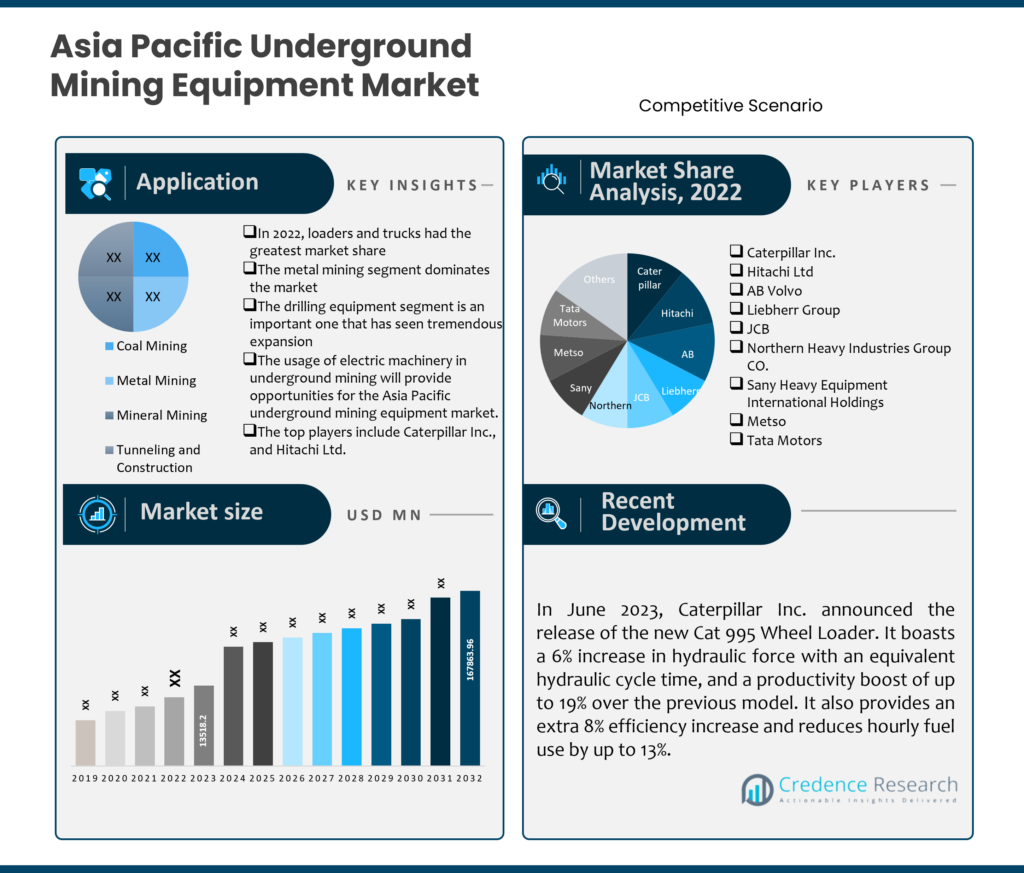
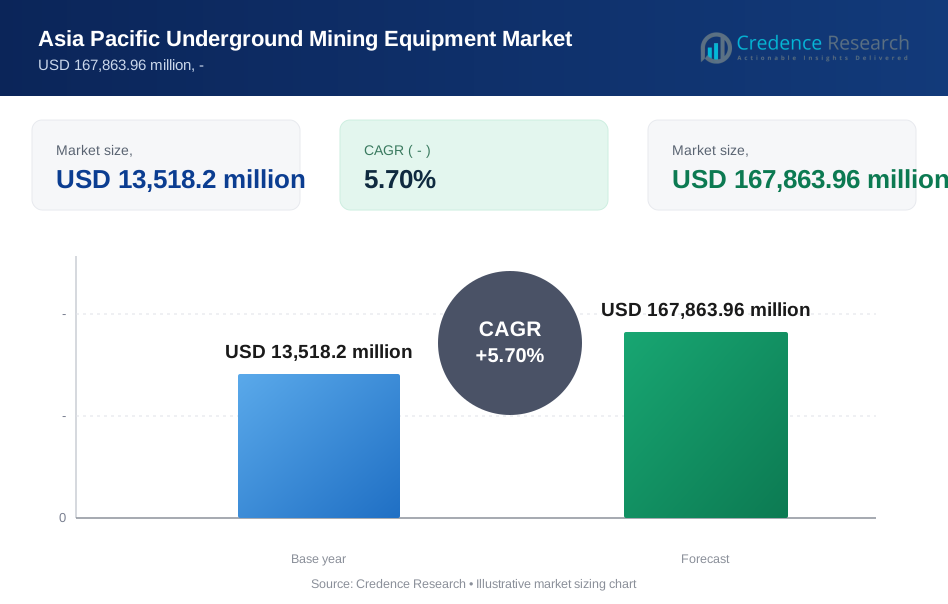
- Between 2024 and 2032, the market for Asia Pacific underground mining equipment is projected to rise at a compound annual growth rate (CAGR) of 32.30%, from an estimated USD 13518.2 million in 2023 to USD 167863.96 million in 2032.
- The largest category is loaders and trucks. Drilling equipment, on the other hand, is expected to grow at a strong CAGR.
- The metal mining category will expand at a rapid rate of growth.
- China governed the Asia Pacific underground mining equipment market.
- Regarding the market share of Asia Pacific underground mining equipment, India is expected to come second.
- In the Asia Pacific underground mining equipment market, Japan is anticipated to grow fastest.
- The robust economic growth in the Asia-Pacific region and the rising demand for metals and minerals are the main drivers of market expansion.
- Rapid urbanization has led to a rise in the need for building materials as well as the expansion of the manufacturing and industrial sectors, which has contributed to the Asia Pacific underground mining equipment market.
Executive Summary
Market Definition
Harvesting valuable minerals, resources, and commodities from under the surface of the earth involves the use of machinery in underground mining. To remove coal, metals, and minerals from below the surface of the earth, underground mining is used. For underground mining operations, equipment such as loaders, trucks, bolters, drills, scalers, and underground trains are utilized. Mining companies use these systems to remove ores and minerals. Coal, metal, and mineral mining are among the industries that use underground mining equipment.
Market Overview
The Asia Pacific underground mining equipment sector is predicted to continue its upward trend between 2024 and 2032, growing at a compound annual growth rate (CAGR) of 32.30%. From its projected USD 13518.2 million in 2023 to USD 167863.96 million in 2032, the market will continue to grow.
The supply of cutting-edge equipment for a range of applications, including metal, coal, and mineral mining, by major companies like Sandvik AB, AB Volvo, Komatsu Ltd., Caterpillar Inc., and others drives the expansion of the market. Eco-friendly and sustainable mining methods are becoming more and more important to lessen their negative effects on the environment. As a result, underground mining operations are increasingly using electric-powered machinery. Several benefits come with driving an electric car, such as decreased noise pollution, lower pollutants, and increased energy economy.
Observing real-time monitoring techniques in mining equipment, in addition to automation, Industry 4.0 penetration, Internet of Things (IoT), GPS sensing, and 3D imagination in these equipment, drives the market expansion. Equipment used in underground mining emphasizes greater operational efficiency and minimizes equipment damage. Additionally, big businesses are attempting to introduce battery- and hybrid-powered devices to the market. The expansion of the Asia Pacific underground mining equipment market is primarily driven by all of these factors.
Segmentation by Type of Equipment
- The loaders and trucks category is the market leader in terms of equipment type. The need for loaders and trucks is greatly impacted by the amount of mining activities in nations such as China, India, Australia, Indonesia, and others. These tools are more necessary as exploration, development, and manufacturing operations rise.
- The drilling equipment category will exhibit a sizable CAGR during the projected period. Mineral resources abound in the Asia-Pacific area, including coal, iron ore, copper, gold, and other materials. Exploration drilling to find new deposits and production drilling to extract minerals are the main drivers of the drilling equipment sector.
- Other types of equipment, including haulage equipment, drilling support equipment, tunneling equipment, ventilation systems, and crushing and grinding equipment, also support the need for Asia Pacific underground mining equipment.
Segmentation by Application
- Metal mining is considered the best application category. The Asia-Pacific area plays an important role in the world's mineral and metal supply lines. Major producers and exporters of metals, such as Australia, China, Indonesia, and India, provide raw materials to international markets.
- The coal mining category will likely register a significant CAGR during forecasting. Coal mining operations depend heavily on underground mining equipment to extract coal resources from below the surface of the earth.
- Other applications, such as mineral mining and tunneling and construction, also contribute to the demand for Asia Pacific underground mining equipment.
Segmentation by Country
- China leads the Asia Pacific underground mining equipment industry. China has been progressively inviting international investment and involvement in its mining industry. The entry of foreign businesses into the market stimulates innovation and competition in the underground mining equipment sector by bringing superior technology, skills, and capital.
- India is estimated to rank second in Asia Pacific in the underground mining equipment market size.
- The Asia Pacific underground mining equipment industry is predicted to flourish rapidly in Japan.
- Countries including South Korea, Southeast Asia, and the rest of Asia Pacific cover the remaining need for Asia Pacific underground mining equipment.
Based on projections, China is anticipated to control the Asia Pacific underground mining equipment market. China is the biggest producer and user of coal worldwide. The nation primarily uses coal for heating, industrial activities, and the production of power. Because of this, there is a continuous need for underground mining equipment to securely and effectively recover coal from underground mines.
The market for Asia Pacific underground mining equipment in India is anticipated to expand quickly throughout the forecast period. To encourage the expansion of the mining industry, draw in foreign investment, and boost domestic output, the Indian government has launched a number of programs and regulations. The goal of initiatives like "Make in India," "Atmanirbhar Bharat," and mining regulation reforms is to establish a favorable environment for the market for underground mining equipment.
Key Highlights of the Report
The Asia Pacific underground mining equipment market is segmented by type of equipment, application, and country. The loaders and trucks category is the market spearhead in terms of type of equipment, and metal mining is the top application category. The market is expanding mostly in China.
The increasing demand for metals and minerals has surged due to industrial development in a number of industries, including manufacturing, electronics, and the automobile industry. For these businesses to generate items and satisfy consumer demand, a consistent supply of raw materials is necessary. Furthermore, the implementation of laws and incentives by governments across the Asia Pacific has stimulated activities, leading to an increase in the exploration and extraction of minerals and metals. Substantial quantities of metals and minerals are also needed for large-scale infrastructure projects like building roads, bridges, and railroads, which increases the need for underground mining equipment to remove these materials from subterranean locations.
China is expected to account for the largest Asia Pacific underground mining equipment market. The requirement for raw materials and energy resources is supported by China's continuous economic growth and industrialization. In order to provide these resources for the industrial sectors of manufacturing, building, energy production, and others, underground mining equipment is necessary. It is also anticipated that the market will develop at the fastest rate in India. This is due to the rising demand for underground mining equipment from various industries in India.
Which Key Factors Are Driving The Asia Pacific Underground Mining Equipment Market?
Investment in the mining industry is encouraged by advancements in mining technology, funding for infrastructure projects like energy and transportation grids, and favorable laws and subsidies from the government. These reasons are driving the growth of the underground mining equipment market in Asia Pacific.
What Are The Main Challenges Confronting The Asia Pacific Underground Mining Equipment Market?
The factors preventing the market from expanding are technological limits, difficulties in creating sophisticated underground mining equipment, and disruptions in the mining equipment supply chain.
What Market Opportunities Exist For Asia Pacific Underground Mining Equipment?
Several factors, including the liberalization of mining regulations that draw foreign investment, the use of energy-efficient equipment that lowers operating costs, and the influence of mining operations on local communities and stakeholders, are influencing the Asia Pacific underground mining equipment market.
Market Drivers
Usage of Electric Machinery in Underground Mining Is Growing
The use of diesel engines in underground mining equipment can make the already uncomfortable working conditions worse because of the noise, heat, and pollutants they emit. Furthermore, adequate ventilation needs to be ensured while utilizing diesel-powered mining equipment. Because electric or battery-powered mining equipment produces no emissions and has minimal operating expenses, it ensures safer working conditions. It resolves the subterranean mine ventilation problem. For example, there is a reduction in temperature, noise, and air pollution when subterranean loaders driven by batteries are used. To continue underground mining, other batteries can be replaced by high-energy-density batteries. Without putting their health in peril, the operator can work in demanding subterranean situations in a calm, ergonomic cabin with easy, safe access to all service points.
Electric mining equipment is becoming more and more common in deep mines due to collaborations, agreements, new product releases, and supply orders between mining firms and producers of mining equipment. For example, the autonomous electric dump truck XDR80TE-AT was introduced by XCMG Group (China) in April 2023. Likewise, at Bauma Conexpo India 2023 in March 2023, Liugong India debuted the 856HEMax, an electric wheel loader.
Market Restraints
High Operating Costs and Capital Expenditure to Restrain Market Growth
The cost of buying and maintaining equipment for underground mining can be high. For mining firms, particularly smaller ones, the initial outlay needed for equipment like drills, loaders, and trucks can be a major obstacle. The expenses associated with operating and maintaining such equipment might be high. The cumulative cost of labor, fuel, energy, and maintenance can have an impact on profitability. In the area, growing knowledge of how mining affects the ecosystem has led to serious concerns.
Furthermore, the cost of underground mining equipment varies based on the type of underground mining, from USD 500,000 to USD 1.5 million. Small and medium-sized businesses are likewise unable to absorb this enormous expense. All of the above-listed reasons limit the market's ability to grow.
Opportunities
The Asia Pacific underground mining equipment sector has a plethora of promising opportunities. Among these are the following:
Use of Self-Contained Mining Equipment
The mining industry has advanced significantly, especially with the advent of autonomous mining machinery. Because mining processes are repetitive, physically demanding, precise, and time-sensitive, autonomous technology is a perfect fit for this industry. Autonomous mining trucks have to travel a predetermined path each time in order to meet material handling capacity regulations. As a result, manufacturing time is cut down, human error is less likely, safety is raised, production volume is increased, and accuracy and repeatability are improved.
Manufacturers are developing autonomous mining equipment that can report status, receive commands, and block radio signals from other equipment over a wireless connection. It guarantees higher productivity, more security, and less unplanned maintenance. Among the leading manufacturers of autonomous mining trucks that are in use are Komatsu Ltd. and Caterpillar Inc.
Competitive Landscape
Key Players
In the highly competitive Asia Pacific underground mining equipment market, there are a number of significant rivals. A few of the top market players are shown below, together with their respective market shares:
- Caterpillar Inc.
- Hitachi Ltd
- AB Volvo
- Liebherr Group
- JCB
- Northern Heavy Industries Group CO.
- Sany Heavy Equipment International Holdings
- Metso
- Tata Motors
- Others
To stay competitive, these businesses give priority to product innovation, expanding their distribution networks, and completing mergers and acquisitions.
The biggest vendors in the Asia Pacific underground mining equipment market consistently strive to keep one step ahead of the competition by creating cutting-edge ideas and goods.
In March 2023, In an effort to promote a more sustainable mining sector and cut CO2 emissions by more than 25%, Volvo Trucks and the Swedish mining company Boliden teamed up to launch battery-electric trucks for heavy underground transport in Boliden's Kankberg mine.
In December 2022, A new DD322i drill for use in underground mining was introduced by Sandvik Mining and Rock Solutions, a division of Sandvik AB. For smart tunneling and subterranean development, it is an automated, twin-boom drill that is incredibly compact. This kind of drill is utilized in mining and tunneling operations. Furthermore, it is less expensive than other systems.
How are Companies Performing in the Asia Pacific Underground Mining Equipment Market?
Several remarkable factors have contributed to the notable performance of companies in the Asia Pacific underground mining equipment market. Companies are making significant investments in R&D in an effort to produce cutting-edge products and technologies that could support future technological advancements. For example, Caterpillar has introduced a trolley assist system for mining trucks with electric drives. This is a step in the direction of stricter regulations from the government and campaigners to prevent mining-related pollution from rising.
Companies in the market, including AB Volvo, Hitachi Construction Machinery, Caterpillar Inc., and others, are launching cutting-edge underground mining equipment to boost competition and enhance the supply chain of these systems, which encourages market expansion. For example, MacLean introduced the ML5 Multi-Lift in April 2023. It is a specially designed-mining vehicle that provides productivity, safety, and versatility for underground operations. The battery-operated device boasted a 45-tonne payload capacity and a working height of 6.5 meters. Its improved features and design made it easy to use and guaranteed increased operator safety.
To diversify their product offerings and increase their market share, companies in the Asia Pacific underground mining equipment market are acquiring other businesses. For example, Energy-as-a-service (EaaS) provider Tangent Energy Solutions (US) was purchased by Caterpillar Inc. (US) in May 2022. Tangent Energy Solutions provides clients with full turnkey solutions to reduce energy costs, increase energy efficiency, reduce emissions, monetize grid support, and guarantee operational resilience. The acquisition of Tangent Energy was done in order to generate additional revenue streams. Solution's EaaS services complement Caterpillar's wide range of electric power supply, offering. Caterpillar Inc. will be able to more effectively provide its customers with energy solutions that are connected, sustainable, dependable, and efficient.
Summary of Key Findings
- Competition between equipment suppliers and manufacturers drives innovation, cost savings, and quality enhancements in underground mining equipment.
- The market is segmented by type of equipment, application, and country.
- The loaders and trucks category is estimated to develop at a significant CAGR over the forecast period.
- Metal mining is the foremost application category.
- China is leading market development; the market is highly competitive with key players including Caterpillar Inc., Hitachi Ltd, AB Volvo, Liebherr Group, JCB, Northern Heavy Industries Group CO., Sany Heavy Equipment International Holdings, Metso, Tata Motors, and Others.
Future Outlook
- The outlook is favorable for the Asia Pacific underground mining equipment market, with a notable growth predicted in China.
- The transfer of technology and experience from developed to developing markets promotes the adoption of modern equipment and strengthens capacities.
- Fluctuations in commodity prices can impact the profitability of mining projects and the demand for underground mining equipment.
- To remain competitive, major corporations must develop new products, expand their customer base, and keep their prices low.
How the Credence Research Asia Pacific Underground Mining Equipment Market Report Can Help CXOs
The Credence Research Asia Pacific Underground Mining Equipment Market Report provides CXOs with an extensive market overview and comprises the following:
- Market size and growth forecast: The study offers comprehensive market estimations for Asia Pacific underground mining equipment, broken down by type of equipment, application, and country. In addition, projections for the market through 2032 based on significant drivers and trends are included.
- Market segmentation: The Asia Pacific underground mining equipment market is divided into segments by type of equipment, application, and country in the research report. CXOs are given a detailed grasp of the market and the potential inside each sector due to this segmentation.
- Competitive landscape: The study report provides a thorough analysis of the leading businesses in the Asia Pacific underground mining equipment sector, together with details on their revenue streams, product lines, and business strategies. This information can help CXOs assess and identify their competitors.
- Key trends and drivers: The study report analyzes and highlights the key developments and elements driving the market for Asia Pacific underground mining equipment. CXOs can utilize this information to make well-informed choices regarding their plans and investments.
The Credence Research Asia Pacific Underground Mining Equipment Market Report provides CXOs with insights that they may utilize to:
- Identify growth opportunities: This analysis is likely to help CXOs find fresh growth prospects in the Asia Pacific underground mining equipment sector. For example, the research recognizes the increasing requirement for underground mining equipment from the coal mining sector as a crucial opportunity.
- Make informed investment decisions: The study aids CXOs in making informed decisions about underground mining equipment. For example, it delivers information on the key variables to consider while picking solutions and evaluating suppliers.
- Develop competitive strategies: CXOs can utilize the research report to establish competitive strategies for their Asia Pacific underground mining equipment firms. The study paper explores the primary tactics employed by Asia Pacific underground mining equipment providers to set themselves apart from their rivals.
- Track market developments: By tracking market advancements, this research report could assist CXOs in remaining ahead of the curve. For example, it provides information about the latest advancements and patterns in the Asia Pacific underground mining equipment industry.
The Credence Research Asia Pacific Underground Mining Equipment Market Report is helpful for CXOs who want to learn more about the market and identify potential opportunities.
Segmentation
-
By Type of Equipment
- Drilling Equipment
- Loaders and Trucks
- Haulage Equipment
- Drilling Support Equipment
- Tunneling Equipment
- Ventilation Systems
- Crushing and Grinding Equipment
-
By Application
- Coal Mining
- Metal Mining
- Mineral Mining
- Tunneling and Construction
-
By Country
- China
- Japan
- India
- South Korea
- South-east Asia
- Rest of Asia Pacific
Adjacent Markets
Several adjacent markets in the Asia Pacific underground mining equipment market have high revenue growth opportunities. The key adjacent markets for the Asia Pacific underground mining equipment market -
Adjacent Markets |
||
| Surface Mining Equipment | Construction Equipment | Mining Machinery Parts and Components |
| Mining Software and Technology Solutions | Industrial Automation and Robotics | Material Handling Equipment |
| Energy and Power Systems | Metal and Mineral Processing Equipment | Geotechnical Services and Engineering |
Request a Free Sample
Fill in your details and we'll send you a free sample report.
- Sample data tables & charts
- Research methodology
Need a Custom Version of This Report?
Tailor the scope, geography, or segments to your exact requirements.
- Custom geography or segment scope
- Direct access to our analyst team
Frequently Asked Questions
How much does the Asia Pacific market currently hold for underground mining equipment?
What is the Asia Pacific underground mining equipment market's projected growth rate between 2024 and 2032?
What is the most significant market segment in terms of equipment type?
Regarding the application, which market category is in the lead?
Which type of equipment is anticipated to grow at the fastest rate throughout the projected period?
In which country is the market for Asia Pacific underground mining equipment expanding?
Who are the main players in the Asia Pacific underground mining equipment industry?
Which market factors are the primary drivers of the Asia Pacific underground mining equipment industry?
What main market challenges prevent the growth of the Asia Pacific underground mining equipment sector?
What are the main market opportunities for the Asia Pacific underground mining equipment sector?
Table of Content
Chapter 1. Report Introduction
- 1.1 Report Description & Purpose
- 1.1.1 Report Title & Market Definition
- 1.1.2 Unique Selling Propositions (USP) & Key Differentiators
- 1.1.3 Value Proposition for Stakeholders
- 1.2 Research Objectives
- 1.2.1 Market Sizing Objectives (Volume & Revenue)
- 1.2.2 Segmentation Objectives
- 1.2.3 Competitive Intelligence Objectives
- 1.2.4 Forecast & Scenario Objectives
- 1.3 Report Scope
- 1.3.1 Asia Pacific Underground Mining Equipment Scope – Types & Subtypes Covered
- 1.3.2 Geographic Scope – Regions & Countries Covered
- 1.3.3 Historical Period, Base Year & Forecast Period (the historical period; forecast to the forecast period)
- 1.3.4 Inclusions & Exclusions
- 1.4 HS Code & Classification Framework
- 1.5 Currency, Units & Pricing Basis
- 1.6 Target Stakeholders
- 1.7 Limitations & Assumptions
Chapter 2. Executive Summary
- 2.1 Global Asia Pacific Underground Mining Equipment Market Snapshot
- 2.1.1 Market Size – Historical (the historical period) & Forecast (the forecast period) (base year: USD 13,518.2 million → forecast year: USD 167,863.96 million)
- 2.1.2 Volume & Revenue – Global Totals
- 2.1.3 Key Market Highlights – Top Five Facts
- 2.2 Asia Pacific Underground Mining Equipment Market Segmentation Snapshot
- 2.2.1 Market Split by Region – vs.
- 2.3 Competitive Snapshot
- 2.3.1 Top 10 Players by Revenue Share –
- 2.3.2 Top 10 Players by Volume Share –
- 2.3.3 Recent Strategic Developments (18-Month Summary)
- 2.4 Key Investment Highlights & Strategic Conclusions
Chapter 3. Asia Pacific Underground Mining Equipment Market Dynamics & Industry Analysis
- 3.1 Market Overview & Context
- 3.1.1 Asia Pacific Underground Mining Equipment Market Position in the Broader Automotive Value Chain
- 3.1.2 OEM vs. Replacement Market Dynamics
- 3.1.3 Market Maturity & Development Stage by Region
- 3.2 Asia Pacific Underground Mining Equipment Market Drivers
- 3.3 Asia Pacific Underground Mining Equipment Market Restraints & Challenges
- 3.4 Asia Pacific Underground Mining Equipment Market Opportunities
- 3.5 Porter's Five Forces Analysis
- 3.5.1 Threat of New Entrants
- 3.5.2 Bargaining Power of Suppliers
- 3.5.3 Bargaining Power of Buyers
- 3.5.4 Threat of Substitutes
- 3.5.5 Competitive Rivalry – Intensity Assessment
- 3.6 Asia Pacific Underground Mining Equipment Value Chain Analysis
- 3.6.1 Upstream – Raw Material/Input Suppliers
- 3.6.1.1 Raw Material/Input 1
- 3.6.1.2 Raw Material/Input 2
- 3.6.1.3 Raw Material/Input 3
- 3.6.2 Midstream – Production/Manufacturing/Service Delivery
- 3.6.2.1 Production/Process Overview
- 3.6.2.2 Key Facility Locations & Capacity by Manufacturer
- 3.6.3 Downstream – Distribution & End Consumer
- 3.6.3.1 Primary Channel – B2B/OEM
- 3.6.3.2 Secondary Channels – Dealer, Retail, Online, Direct
- 3.6.4 Value Chain Profitability Analysis
- 3.6.1 Upstream – Raw Material/Input Suppliers
- 3.7 PESTEL Analysis
- 3.7.1 Political Factors
- 3.7.2 Economic Factors
- 3.7.3 Social Factors
- 3.7.4 Technological Factors
- 3.7.5 Environmental Factors
- 3.7.6 Legal Factors
- 3.8 Asia Pacific Underground Mining Equipment Supply Chain Analysis
- 3.8.1 Raw Material/Input Supply Risk Assessment
- 3.8.2 Manufacturing Concentration Risk (Geographic Exposure)
- 3.8.3 Trade Disruption Impact Analysis
- 3.9 Regulatory & Policy Landscape
Note: The regulatory and policy landscape section covers regulations based on their applicability to the market, Asia Pacific Underground Mining Equipment category, geography, and scope of the study. Only regulatory frameworks with a material impact on operations, compliance, trade, sustainability, or market access are analyzed in detail.
Chapter 4. Key Investment Pockets & Opportunity Analysis
- 4.1 Asia Pacific Underground Mining Equipment Market Attractiveness Analysis
- 4.1.1 By Region – Investment Attractiveness Matrix (Volume × CAGR)
- 4.2 Absolute Revenue Growth Opportunity
- 4.2.1 By Region – Absolute USD Growth Through the forecast period
- 4.3 Incremental Volume Opportunity
- 4.3.1 By Region – Incremental Volume Through the forecast period
- 4.3.2 Segment – Incremental Volume
- 4.4 Emerging Submarket Opportunity Deep Dive (Subject to Applicability)
- 4.5 Emerging Market Opportunity Scorecards
- 4.5.1 United States
- 4.5.2 Europe
- 4.5.3 Asia
- 4.5.4 Middle East & Africa
Note: Emerging Market Opportunity Scorecards will be included based on relevance and strategic importance. Regions listed are indicative and may vary depending on data availability and market dynamics.
Chapter 5. Asia Pacific Underground Mining Equipment Import-Export Analysis & Trade Flows
- 5.1 Global Trade Overview
- 5.1.1 Global Export Value by Country (the historical period)
- 5.1.2 Global Export Volume by Country (the historical period)
- 5.1.3 Global Import Value by Country (the historical period)
- 5.1.4 Global Import Volume by Country (the historical period)
- 5.1.5 Net Trade Balance by Country (the historical period)
- 5.2 Export Analysis – Segment
- 5.2.1 Type 1 (HS Code)
- 5.2.2 Type 2 (HS Code)
- 5.2.3 Type 3 (HS Code)
- 5.2.4 Type 4 (HS Code)
- 5.2.5 Type 5 (HS Code)
- 5.3 Import Analysis – Segment
- 5.3.1 Type 1 (HS Code)
- 5.3.2 Type 2 (HS Code)
- 5.3.3 Type 3 (HS Code)
- 5.3.4 Type 4 (HS Code)
- 5.3.5 Type 5 (HS Code)
- 5.4 Average Unit Trade Prices
- 5.4.1 Average Export Price – Segment & Country
- 5.4.2 Average Import Price – Segment & Source Country
- 5.4.3 Price Trends (the historical period)
- 5.5 Key Trade Route Analysis
- 5.5.1 Trade Route 1
- 5.5.2 Trade Route 2
- 5.5.3 Trade Route 3
- 5.5.4 Trade Route 4
- 5.5.5 Trade Route 5
- 5.6 Trade Policy Impact Assessment
- 5.6.1 US Anti-Dumping & Section 301 Tariffs
- 5.6.2 EU Customs Union Impact
- 5.6.3 Major Free Trade Agreements
- 5.6.4 USMCA Rules of Origin
Note: Trade policy analysis will be included only where relevant to the Asia Pacific Underground Mining Equipment market.
Chapter 6. Competitive Landscape & Company Benchmarking
- 6.1 Asia Pacific Underground Mining Equipment Market Concentration & Structure
- 6.1.1 Herfindahl-Hirschman Index (HHI) – vs.
- 6.1.2 Tier 1, Tier 2 & Tier 3 Market Structure
- 6.1.3 Global, Regional & Local Player Dynamics
- 6.2 Asia Pacific Underground Mining Equipment Market Share Analysis –
- 6.2.1 Global Revenue Share by Company
- 6.2.2 Global Volume Share by Company
- 6.2.3 Regional Revenue Share
- 6.2.4 Market Share Evolution ( vs. )
- 6.2.5 OEM Segment Share by Company
- 6.2.6 Replacement Segment Share by Company
- 6.3 Production/Delivery Capacity & Facility Analysis
- 6.3.1 Global Installed Capacity
- 6.3.2 Capacity Utilization Rates
- 6.3.3 Production/Output Volume
- 6.3.4 Facility Locations & Capacity Map
- 6.3.5 Planned Capacity Additions
- 6.4 Asia Pacific Underground Mining Equipment Competitive Benchmarking Matrix
- 6.4.1 Revenue, Volume, CAGR & Profitability Comparison
- 6.4.2 Channel Revenue Mix
- 6.4.3 Geographic Revenue Exposure
- 6.4.4 R&D Intensity
- 6.4.5 Sustainability Maturity
- 6.5 Strategic Developments in Asia Pacific Underground Mining Equipment (Last 24 Months)
- 6.5.1 Mergers, Acquisitions & Divestments
- 6.5.2 New Asia Pacific Underground Mining Equipment Launches
- 6.5.3 Facility Expansions
- 6.5.4 Strategic Alliances, Joint Ventures & Partnerships
- 6.5.5 Distribution Expansion & Market Entry
- 6.5.6 Sustainability & ESG Initiatives
- 6.6 Competitive Strategy Mapping
- 6.6.1 Leader, Challenger, Follower & Niche Classification
- 6.6.2 Pricing Strategy Comparison
- 6.6.3 Channel Strategy Matrix
Note: Strategic developments are included based on their materiality and the availability of reliable information.
Chapter 7. Global Asia Pacific Underground Mining Equipment Market – By Distribution Channel
- 7.1 Segment Overview
- 7.1.1 Volume & Revenue Split by Channel ( & )
- 7.1.2 Channel Mix Evolution (the forecast period)
Chapter 8. Regional Market Analysis – Global Overview
- 8.1 Global Regional Overview
- 8.1.1 Regional Volume Share
- 8.1.2 Regional Revenue Share
- 8.1.3 Regional Volume by Region
- 8.1.4 Regional Revenue by Region
- 8.1.5 Regional Forecast Through the forecast period
- 8.2 Cross-Regional Segment Analysis
- 8.2.1 By Distribution Channel
- 8.2.2 By Brand/Price Tier
Chapter 9. North America Asia Pacific Underground Mining Equipment Market
- 9.1 United States
- 9.2 Canada
- 9.3 Mexico
Chapter 10. Europe Asia Pacific Underground Mining Equipment Market
- 10.1 Germany
- 10.2 France
- 10.3 Italy
- 10.4 United Kingdom
- 10.5 Spain
- 10.6 Poland
- 10.7 Russia
- 10.8 Netherlands
- 10.9 Belgium
- 10.10 Sweden
- 10.11 Denmark
- 10.12 Norway
- 10.13 Rest of Europe
Chapter 11. Asia Pacific Asia Pacific Underground Mining Equipment Market
- 11.1 China
- 11.2 India
- 11.3 Japan
- 11.4 South Korea
- 11.5 Thailand
- 11.6 Indonesia
- 11.7 Vietnam
- 11.8 Malaysia
- 11.9 Australia
- 11.10 Rest of Asia Pacific
Chapter 12. Latin America Asia Pacific Underground Mining Equipment Market
- 12.1 Brazil
- 12.2 Argentina
- 12.3 Colombia
- 12.4 Chile
- 12.5 Rest of Latin America
Chapter 13. Middle East Asia Pacific Underground Mining Equipment Market
- 13.1 Saudi Arabia
- 13.2 United Arab Emirates
- 13.3 Turkey
- 13.4 Israel
- 13.5 Iran
- 13.6 Rest of the Middle East
Chapter 14. Africa Asia Pacific Underground Mining Equipment Market
- 14.1 South Africa
- 14.2 Egypt
- 14.3 Nigeria
- 14.4 Morocco
- 14.5 Rest of Africa
Chapter 15. Asia Pacific Underground Mining Equipment Company Profiles
- 15.1 [Company 01]
- 15.1.1 Company Overview
- 15.1.2 Key Management Personnel
- 15.1.3 Products & Services Portfolio
- 15.1.4 Financial Performance
- 15.1.5 Key Market Focus & Geographic Presence
- 15.1.6 Recent Developments & Strategic Initiatives
Note: The company profile list is preliminary and may change based on research findings, market developments, data availability, and client requirements.
Chapter 16. Appendices
- Appendix A – List of Abbreviations & Acronyms
- Appendix B – Industry Classification Code Reference – Full Series
- Appendix C – Production & Capacity Data Tables
- Appendix D – End-Use & Demand Base Tables
- Appendix E – Consumption & Replacement Rate Assumptions
- Appendix F – ASP Reference Tables
- Appendix G – Manufacturing & Facility Database
- Appendix H – Import-Export Data Tables
- Appendix I – Regulatory Summary Tables
- Appendix J – Primary Research Participant List (Anonymized)
- Appendix K – Primary Research Questionnaire Framework
- Appendix L – Data Sources & Bibliography
- Appendix M – Market Size Divergence & Source Comparison
Chapter 17. Research Methodology
- 17.1 Research Framework & Philosophy
- 17.2 Secondary Research – Sources, Hierarchy & Data Extraction
- 17.3 Data Modeling – Bottom-Up & Top-Down Market Sizing
- 17.4 Primary Research – Stakeholder Framework, LOI & Sample Sizes
- 17.5 Forecast Methodology – Regression, Scenario & Sensitivity Analysis
- 17.6 Quality Control – Four-Layer Validation Framework
- 17.7 Limitations & Standard Assumptions
- 17.8 Disclaimer
