
| REPORT ATTRIBUTE | DETAILS |
|---|---|
| Historical Period | 2019-2022 |
| Base Year | 2023 |
| Forecast Period | 2024-2032 |
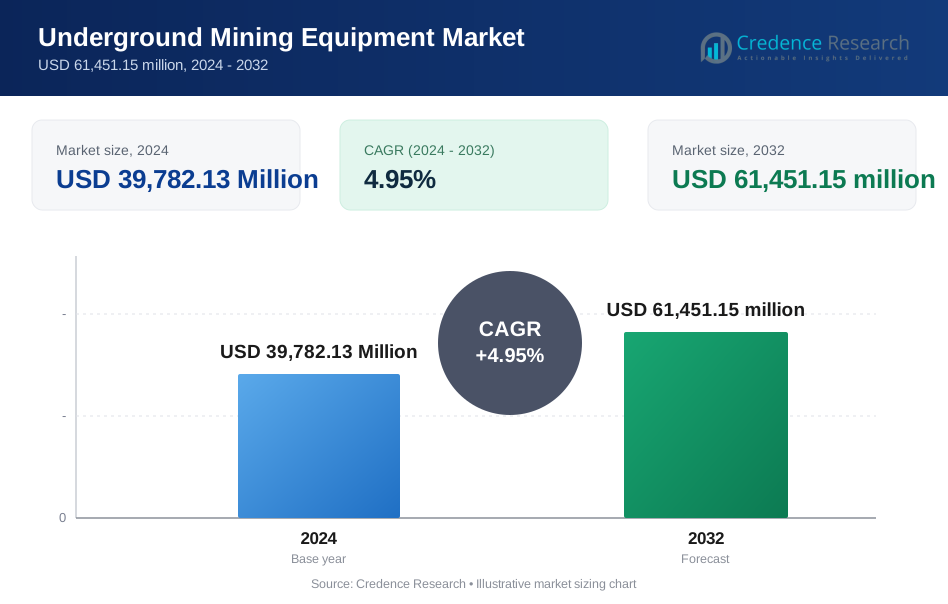
| Underground Mining Equipment Market Size 2024 | USD 39,782.13 Million |
| Underground Mining Equipment Market, CAGR | 4.95% |
| Underground Mining Equipment Market Size 2032 | USD 61,451.15 million |
Market Overview
The Global Underground Mining Equipment Market is projected to grow significantly, reaching an estimated USD 61,451.15 million by 2032, up from USD 39,782.13 Million in 2023. This growth reflects a steady compound annual growth rate (CAGR) of 4.95% from 2025 to 2032, driven by increasing demand for minerals and metals worldwide. The expanding adoption of automation and digital technologies in mining operations further propels the market, alongside rising investments in mining activities to meet industrial and energy needs.
Key market drivers include the surging global demand for raw materials across industries such as construction, electronics, and energy. The growing focus on sustainability has also led to the adoption of advanced underground mining technologies that enhance efficiency and reduce environmental impacts. Additionally, trends such as electrification of mining equipment and the integration of IoT and AI systems are shaping the future of this market, enabling safer and more productive operations.
Geographically, the Asia-Pacific region dominates the market, owing to significant mining activities in countries like China, India, and Australia. North America and Europe follow, driven by technological advancements and stringent regulations promoting sustainable practices. Key players driving innovation and competition include Caterpillar Inc., Komatsu Ltd., Sandvik AB, Joy Global Inc. (now part of Komatsu), and Atlas Copco AB. These companies are focusing on strategic partnerships, acquisitions, and product development to maintain their market positions and meet evolving customer demands.
Market Drivers
Rising Global Demand for Minerals and Metals
The increasing global demand for minerals and metals is one of the most significant drivers of the underground mining equipment market. Industries such as construction, electronics, automotive, and energy are reliant on the supply of critical raw materials, such as iron ore, coal, gold, and rare earth elements. For instance, by 2040, lithium demand is projected to increase significantly, driven primarily by the rising need for electric vehicle batteries and renewable energy technologies. Electric vehicles alone require substantial amounts of lithium, nickel, and cobalt, with a typical battery pack needing around 8 kilograms of lithium and 35 kilograms of nickel. Urbanization and industrialization, particularly in developing economies, have further amplified the need for resources. As surface reserves diminish, mining operations are shifting underground, necessitating advanced equipment to ensure efficient extraction. The growth of renewable energy technologies reinforces the reliance on underground mining activities.
Technological Advancements and Automation
The integration of cutting-edge technologies in underground mining is reshaping the industry and driving market growth. Automation and robotics are increasingly being adopted to enhance operational efficiency, safety, and productivity. For example, companies are utilizing autonomous haulage systems (AHS) and remote-controlled machinery in challenging environments, which minimizes human risk while maximizing productivity. Additionally, the deployment of sensors, Internet of Things (IoT) devices, and artificial intelligence (AI) enables predictive maintenance and optimized resource utilization. These advancements reduce downtime and lower costs; for instance, real-time monitoring solutions allow mining companies to operate with minimal human intervention while ensuring consistent performance. This makes underground mining equipment indispensable for modern operations.
Growing Emphasis on Environmental Sustainability
The mining industry is under growing pressure to adopt sustainable practices due to stricter environmental regulations and rising societal awareness. Underground mining is often considered more environmentally friendly than surface mining, as it reduces land disturbance and ecological impact. Modern underground mining equipment is designed to minimize emissions and energy consumption. For instance, the shift towards electric and battery-powered machinery not only reduces reliance on diesel fuel but also significantly lowers greenhouse gas emissions. Furthermore, sustainable practices in mining operations align with the corporate social responsibility goals of major companies, attracting investments and driving the demand for advanced equipment. This transition underscores the industry's commitment to reducing its environmental footprint while meeting the increasing demand for essential minerals.
Expanding Investments in Mining Projects
Global investments in mining projects are steadily increasing, propelled by the need to secure resources for growing industrial applications. Governments in resource-rich countries are implementing favorable policies to attract foreign investments, modernize mining infrastructure, and boost production capacities. Private players and multinational corporations are also investing in new mines and upgrading existing ones to remain competitive in the global market. For instance, significant exploration activities in regions such as Asia-Pacific, Africa, and Latin America are creating opportunities for underground mining equipment manufacturers. Additionally, the increasing focus on deep-sea and hard-rock mining is fostering the demand for specialized equipment capable of operating in complex environments. These market drivers collectively highlight the pivotal role of underground mining equipment in addressing global resource needs while adapting to modern technological, environmental, and economic challenges. Their influence is expected to sustain the growth trajectory of the market over the coming years.
Market Trends
Electrification of Mining Equipment
One of the most prominent trends in the global underground mining equipment market is the shift toward electrification. As concerns about environmental sustainability and worker safety intensify, mining companies are increasingly adopting electric and battery-powered machinery to replace traditional diesel-powered equipment. For instance, the transition to electric mining vehicles has been significantly driven by advancements in battery technology, which have improved energy density and charging speeds, making electric options more viable and cost-effective for operations. Electric mining vehicles, loaders, and haul trucks significantly reduce greenhouse gas emissions and improve air quality in underground environments, addressing key health and safety issues. The adoption of battery-electric vehicles (BEVs) can lead to substantial savings on ventilation costs, as these vehicles generate less heat compared to their diesel counterparts, thereby reducing the need for extensive ventilation systems that account for a large portion of underground energy costs. Moreover, the advancements in battery technology, including lithium-ion and solid-state batteries, have enhanced energy efficiency, equipment performance, and operational cost-effectiveness. This transition not only aligns with global sustainability goals but also complies with stricter environmental regulations being enforced in many countries. The electrification trend is driving innovation among leading manufacturers, encouraging the development of new products and solutions tailored for underground applications.
Adoption of Automation and Smart Technologies
The integration of automation and smart technologies is revolutionizing the underground mining sector. Mining companies are increasingly deploying autonomous equipment and digital solutions to enhance productivity, operational efficiency, and safety. For instance, the implementation of autonomous haulage systems (AHS) has allowed mining companies to operate machinery in hazardous conditions without direct human intervention, significantly mitigating risks associated with manual operations. Autonomous haulage systems (AHS), robotic drilling equipment, and remote-controlled machinery enable precise operations in hazardous and hard-to-reach environments, reducing human risk. Simultaneously, the use of Internet of Things (IoT) devices and artificial intelligence (AI) facilitates real-time monitoring, predictive maintenance, and data-driven decision-making. These technologies optimize resource utilization and minimize operational downtime, offering a competitive advantage. The integration of IoT devices facilitates real-time monitoring of equipment performance and predictive maintenance, which can prevent costly downtimes and optimize resource utilization. Moreover, technologies like digital twins and augmented reality (AR) are being utilized for training purposes, allowing workers to simulate operations in a risk-free environment before engaging with actual equipment. The rapid adoption of these innovations underscores the industry’s commitment to achieving higher efficiency and sustainable growth in underground mining operations.
Market Restraints and Challenges
High Capital Investment and Operating Costs
The significant capital investment required to acquire and maintain underground mining equipment remains a major restraint in the market. Advanced machinery equipped with automation and smart technologies often comes with a high price tag, making it a financial challenge for small and medium-sized enterprises (SMEs) in the mining sector. Moreover, the costs associated with training personnel, implementing maintenance programs, and upgrading existing equipment to meet modern standards further escalate operational expenses. These financial burdens can deter companies from adopting advanced underground mining equipment, especially in regions where mining profitability is low or where mineral prices are volatile. As a result, cost-related barriers often limit the market's growth potential, particularly in developing economies with budgetary constraints.
Stringent Regulatory and Environmental Compliance
The underground mining sector is increasingly subject to stringent environmental regulations and workplace safety standards, posing challenges for equipment manufacturers and operators. Governments and international organizations enforce strict guidelines on emissions, waste management, and ecological impact, which compel companies to invest in compliance measures. While these regulations encourage sustainable practices, they also increase operational complexity and costs. Additionally, safety standards require the adoption of advanced technologies and training programs, further straining resources. Non-compliance risks heavy fines, reputational damage, and project delays, adding pressure on mining companies to align with regulatory expectations. In regions with underdeveloped infrastructure and limited access to advanced technology, meeting these standards becomes even more challenging, creating hurdles for market expansion.
Market Segmentation Analysis
By Product Type
The underground equipment market is segmented by product type, with mining loaders holding a critical share due to their efficiency in moving excavated materials in confined spaces, driven by demand for high-capacity and fuel-efficient models, including automated and electric variants. Mining trucks are vital for hauling materials, with demand for heavy-duty vehicles focusing on improved fuel efficiency, load capacity, and safety features. Mining drills play a pivotal role in excavation and exploration, with rising demand for advanced, precise, and automated solutions. Mining bolters ensure operational safety by reinforcing rock walls and roofs, with increasing adoption of remote-controlled and automated systems. Mining shearers, used primarily in longwall mining, enhance productivity and see growing demand for high-performance, low-maintenance solutions driven by automation trends.
By Mining Technique
By mining technique, soft rock mining involves the extraction of materials such as coal and salt and typically causes less wear and tear on equipment, creating demand for specialized machinery optimized for these operations. Conversely, hard rock mining, which focuses on extracting minerals like gold, silver, and copper, requires robust and durable equipment capable of withstanding extreme conditions. The growing global demand for minerals and metals is driving increased investment in advanced underground equipment tailored for hard rock mining.
Segments
Based on Product Type
- Mining Loaders
- Mining Trucks
- Mining Drills
- Mining Bolters
- Mining Shearer
Based on Mining Technique
- Soft Rock Mining
- Hard Rock Mining
Based on End User
- Mining Operators
- Rental Service Providers
Based on Region
- North America
- U.S.
- Canada
- Mexico
- Europe
- Germany
- France
- U.K.
- Italy
- Spain
- Rest of Europe
- Asia Pacific
- China
- Japan
- India
- South Korea
- South-east Asia
- Rest of Asia Pacific
- Latin America
- Brazil
- Argentina
- Rest of Latin America
- Middle East & Africa
- GCC Countries
- South Africa
- Rest of the Middle East and Africa
Regional Analysis
North America (27%)
North America holds a substantial 27% market share, supported by the presence of established mining industries in the United States and Canada. The region benefits from the early adoption of automation and electric mining equipment, driven by strict regulatory frameworks promoting sustainability and worker safety. North American mining companies are heavily investing in advanced technologies such as IoT, AI, and autonomous systems to enhance operational efficiency. The growing demand for energy resources, including coal and metals, also drives the market in this region.
Europe (20%)
Europe accounts for 20% of the global market share, with a focus on sustainable mining practices and advanced technology integration. Countries like Germany, Sweden, and Russia lead in mining activities, particularly for coal, iron ore, and precious metals. The region’s stringent environmental regulations encourage the adoption of electric and battery-powered mining equipment, making it a key growth area for equipment manufacturers. European companies are also investing in research and development to enhance equipment efficiency and sustainability.
Key players
- AB Volvo (Volvo Construction Equipment)
- Caterpillar Inc.
- Deere & Company
- Doosan Corporation
- Atlas Copco AB (Epiroc AB)
- Hitachi, Ltd. (Hitachi Construction Machinery Co., Ltd.)
- Komatsu Ltd.
- Liebherr-International AG
- Metso Corporation
- Sandvik AB
Competitive Analysis
The Global Underground Mining Equipment Market is highly competitive, with key players driving innovation and shaping market dynamics. Caterpillar Inc. and Komatsu Ltd. lead the industry, offering a comprehensive range of advanced mining equipment with a focus on automation and sustainability. AB Volvo (Volvo Construction Equipment) and Deere & Company leverage their strong global presence and robust distribution networks to capture significant market shares. Atlas Copco AB (Epiroc AB) and Sandvik AB specialize in high-performance drilling and cutting equipment, catering to the growing demand for precision in mining operations. Hitachi Construction Machinery Co., Ltd. and Liebherr-International AG focus on innovation, integrating electric and autonomous technologies into their product lines. Doosan Corporation targets emerging markets with cost-effective and efficient solutions, while Metso Corporation emphasizes sustainability through its energy-efficient equipment and recycling solutions. Together, these players enhance market competition, offering diversified solutions to meet evolving industry needs.
Recent Developments
- In May 2024, Volvo CE unveiled a new product lineup at Volvo Days 2024, including the EWR150 Electric, the first electric wheeled excavator, and new electric wheel loaders (L90 Electric and L120 Electric). These additions further expand Volvo's electric offerings in the construction industry.
- In January 2022, Doosan Infracore North America launched three new pieces of construction equipment at World of Concrete 2022, including the DX140LCRIn7 crawler excavator, DX50ZIn7 mini excavator, and DL250In7 wheel loader. These machines are designed to improve productivity and efficiency in various applications.
- In July 2024, Komatsu completed its acquisition of GermanyInbased GHH Group GmbH, a manufacturer of underground mining equipment such as loaders (LHDs) and articulated dump trucks. This acquisition significantly expands Komatsu’s offerings in underground mining equipment.
- In September 2024, Metso announced two acquisitions—Diamond Z and Screen Machine Industries—to expand its mobile crushing and screening portfolio in North America. Diamond Z specializes in mobile grinders for recycling, while Screen Machine Industries focuses on crushing and screening solutions.
Market Concentration and Characteristics
The Global Underground Mining Equipment Market is moderately concentrated, with a mix of established multinational corporations and regional players competing to gain market share. Major players such as Caterpillar Inc., Komatsu Ltd., Sandvik AB, and Atlas Copco AB dominate the market through their extensive product portfolios, technological expertise, and strong global distribution networks. The market is characterized by high capital intensity, significant technological innovation, and a focus on sustainability, driven by stringent environmental regulations and the increasing adoption of electric and automated mining equipment. While large players lead in innovation and scale, smaller regional manufacturers often compete by offering cost-effective and customized solutions. The industry also exhibits high barriers to entry due to the substantial investment required for research, development, and manufacturing. Collaborative strategies, such as mergers, acquisitions, and joint ventures, are common among key players to enhance market positioning and cater to the growing demand for advanced underground mining solutions.
Report Coverage
The research report offers an in-depth analysis based on Product Type, Mining Technique, End User, and Region. It details leading market players, providing an overview of their business, product offerings, investments, revenue streams, and key applications. Additionally, the report includes insights into the competitive environment, SWOT analysis, current market trends, as well as the primary drivers and constraints. Furthermore, it discusses various factors that have driven market expansion in recent years. The report also explores market dynamics, regulatory scenarios, and technological advancements that are shaping the industry. It assesses the impact of external factors and global economic changes on market growth. Lastly, it provides strategic recommendations for new entrants and established companies to navigate the complexities of the market.
Future Outlook
- The market is expected to maintain a steady growth trajectory, driven by rising global demand for minerals and metals, with a projected CAGR of 5.21% from 2024 to 2032.
- Electric and battery-powered mining equipment will witness widespread adoption, aligning with environmental sustainability goals and reducing greenhouse gas emissions in underground operations.
- Automation will revolutionize mining operations, with increased deployment of autonomous haulage systems, remote-controlled machinery, and AI-driven solutions for enhanced efficiency and safety.
- Emerging markets in Asia-Pacific, Latin America, and Africa will drive demand, supported by growing investments in mining projects and government initiatives to boost the mining sector.
- The industry will prioritize sustainable practices, with manufacturers developing energy-efficient equipment and promoting eco-friendly mining technologies.
- The increasing reliance on renewable energy technologies and electric vehicles will boost demand for rare earth metals, driving the need for specialized underground mining equipment.
- The integration of IoT, big data, and real-time monitoring systems will enable predictive maintenance, optimize resource utilization, and improve overall mining productivity.
- Manufacturers will focus on providing tailored equipment solutions to meet the unique requirements of different geographies and mineral types.
- Strategic collaborations among mining companies, equipment manufacturers, and technology providers will foster innovation and expand market reach.
- Stringent environmental and safety regulations will continue to influence market dynamics, encouraging the development of advanced and compliant underground mining equipment.
Request a Free Sample
Fill in your details and we'll send you a free sample report.
- Sample data tables & charts
- Research methodology
Need a Custom Version of This Report?
Tailor the scope, geography, or segments to your exact requirements.
- Custom geography or segment scope
- Direct access to our analyst team
Frequently Asked Questions
What is the market size of the Global Underground Mining Equipment Market in 2023 and 2032, and what is the projected CAGR?
What drives the growth of the Global Underground Mining Equipment Market?
Which region dominates the Global Underground Mining Equipment Market?
What are the key trends shaping the Global Underground Mining Equipment Market?
Who are the major players in the Global Underground Mining Equipment Market?
Table of Content
Chapter 1. Report Introduction
- 1.1 Report Description & Purpose
- 1.1.1 Report Title & Market Definition
- 1.1.2 Unique Selling Propositions (USP) & Key Differentiators
- 1.1.3 Value Proposition for Stakeholders
- 1.2 Research Objectives
- 1.2.1 Market Sizing Objectives (Volume & Revenue)
- 1.2.2 Segmentation Objectives
- 1.2.3 Competitive Intelligence Objectives
- 1.2.4 Forecast & Scenario Objectives
- 1.3 Report Scope
- 1.3.1 Underground Mining Equipment Scope – Types & Subtypes Covered
- 1.3.2 Geographic Scope – Regions & Countries Covered
- 1.3.3 Historical Period, Base Year & Forecast Period (2024; forecast to 2032)
- 1.3.4 Inclusions & Exclusions
- 1.4 HS Code & Classification Framework
- 1.5 Currency, Units & Pricing Basis
- 1.6 Target Stakeholders
- 1.7 Limitations & Assumptions
Chapter 2. Executive Summary
- 2.1 Global Underground Mining Equipment Market Snapshot
- 2.1.1 Market Size – Historical (2024) & Forecast (2024-2032) (2024: USD 39,782.13 Million → 2032: USD 61,451.15 million)
- 2.1.2 Volume & Revenue – Global Totals
- 2.1.3 Key Market Highlights – Top Five Facts
- 2.2 Underground Mining Equipment Market Segmentation Snapshot
- 2.2.1 Market Split by Region – 2024 vs. 2032
- 2.3 Competitive Snapshot
- 2.3.1 Top 10 Players by Revenue Share – 2024
- 2.3.2 Top 10 Players by Volume Share – 2024
- 2.3.3 Recent Strategic Developments (18-Month Summary)
- 2.4 Key Investment Highlights & Strategic Conclusions
Chapter 3. Underground Mining Equipment Market Dynamics & Industry Analysis
- 3.1 Market Overview & Context
- 3.1.1 Underground Mining Equipment Market Position in the Broader Automotive Value Chain
- 3.1.2 OEM vs. Replacement Market Dynamics
- 3.1.3 Market Maturity & Development Stage by Region
- 3.2 Underground Mining Equipment Market Drivers
- 3.3 Underground Mining Equipment Market Restraints & Challenges
- 3.4 Underground Mining Equipment Market Opportunities
- 3.5 Porter's Five Forces Analysis
- 3.5.1 Threat of New Entrants
- 3.5.2 Bargaining Power of Suppliers
- 3.5.3 Bargaining Power of Buyers
- 3.5.4 Threat of Substitutes
- 3.5.5 Competitive Rivalry – Intensity Assessment
- 3.6 Underground Mining Equipment Value Chain Analysis
- 3.6.1 Upstream – Raw Material/Input Suppliers
- 3.6.1.1 Raw Material/Input 1
- 3.6.1.2 Raw Material/Input 2
- 3.6.1.3 Raw Material/Input 3
- 3.6.2 Midstream – Production/Manufacturing/Service Delivery
- 3.6.2.1 Production/Process Overview
- 3.6.2.2 Key Facility Locations & Capacity by Manufacturer
- 3.6.3 Downstream – Distribution & End Consumer
- 3.6.3.1 Primary Channel – B2B/OEM
- 3.6.3.2 Secondary Channels – Dealer, Retail, Online, Direct
- 3.6.4 Value Chain Profitability Analysis
- 3.6.1 Upstream – Raw Material/Input Suppliers
- 3.7 PESTEL Analysis
- 3.7.1 Political Factors
- 3.7.2 Economic Factors
- 3.7.3 Social Factors
- 3.7.4 Technological Factors
- 3.7.5 Environmental Factors
- 3.7.6 Legal Factors
- 3.8 Underground Mining Equipment Supply Chain Analysis
- 3.8.1 Raw Material/Input Supply Risk Assessment
- 3.8.2 Manufacturing Concentration Risk (Geographic Exposure)
- 3.8.3 Trade Disruption Impact Analysis
- 3.9 Regulatory & Policy Landscape
Note: The regulatory and policy landscape section covers regulations based on their applicability to the market, Underground Mining Equipment category, geography, and scope of the study. Only regulatory frameworks with a material impact on operations, compliance, trade, sustainability, or market access are analyzed in detail.
Chapter 4. Key Investment Pockets & Opportunity Analysis
- 4.1 Underground Mining Equipment Market Attractiveness Analysis
- 4.1.1 By Region – Investment Attractiveness Matrix (Volume × CAGR)
- 4.2 Absolute Revenue Growth Opportunity
- 4.2.1 By Region – Absolute USD Growth Through 2032
- 4.3 Incremental Volume Opportunity
- 4.3.1 By Region – Incremental Volume Through 2032
- 4.3.2 Segment – Incremental Volume
- 4.4 Emerging Submarket Opportunity Deep Dive (Subject to Applicability)
- 4.5 Emerging Market Opportunity Scorecards
- 4.5.1 United States
- 4.5.2 Europe
- 4.5.3 Asia
- 4.5.4 Middle East & Africa
Note: Emerging Market Opportunity Scorecards will be included based on relevance and strategic importance. Regions listed are indicative and may vary depending on data availability and market dynamics.
Chapter 5. Underground Mining Equipment Import-Export Analysis & Trade Flows
- 5.1 Global Trade Overview
- 5.1.1 Global Export Value by Country (2024)
- 5.1.2 Global Export Volume by Country (2024)
- 5.1.3 Global Import Value by Country (2024)
- 5.1.4 Global Import Volume by Country (2024)
- 5.1.5 Net Trade Balance by Country (2024)
- 5.2 Export Analysis – Segment
- 5.2.1 Type 1 (HS Code)
- 5.2.2 Type 2 (HS Code)
- 5.2.3 Type 3 (HS Code)
- 5.2.4 Type 4 (HS Code)
- 5.2.5 Type 5 (HS Code)
- 5.3 Import Analysis – Segment
- 5.3.1 Type 1 (HS Code)
- 5.3.2 Type 2 (HS Code)
- 5.3.3 Type 3 (HS Code)
- 5.3.4 Type 4 (HS Code)
- 5.3.5 Type 5 (HS Code)
- 5.4 Average Unit Trade Prices
- 5.4.1 Average Export Price – Segment & Country
- 5.4.2 Average Import Price – Segment & Source Country
- 5.4.3 Price Trends (2024)
- 5.5 Key Trade Route Analysis
- 5.5.1 Trade Route 1
- 5.5.2 Trade Route 2
- 5.5.3 Trade Route 3
- 5.5.4 Trade Route 4
- 5.5.5 Trade Route 5
- 5.6 Trade Policy Impact Assessment
- 5.6.1 US Anti-Dumping & Section 301 Tariffs
- 5.6.2 EU Customs Union Impact
- 5.6.3 Major Free Trade Agreements
- 5.6.4 USMCA Rules of Origin
Note: Trade policy analysis will be included only where relevant to the Underground Mining Equipment market.
Chapter 6. Competitive Landscape & Company Benchmarking
- 6.1 Underground Mining Equipment Market Concentration & Structure
- 6.1.1 Herfindahl-Hirschman Index (HHI) – vs. 2024
- 6.1.2 Tier 1, Tier 2 & Tier 3 Market Structure
- 6.1.3 Global, Regional & Local Player Dynamics
- 6.2 Underground Mining Equipment Market Share Analysis – 2024
- 6.2.1 Global Revenue Share by Company
- 6.2.2 Global Volume Share by Company
- 6.2.3 Regional Revenue Share
- 6.2.4 Market Share Evolution ( vs. 2024)
- 6.2.5 OEM Segment Share by Company
- 6.2.6 Replacement Segment Share by Company
- 6.3 Production/Delivery Capacity & Facility Analysis
- 6.3.1 Global Installed Capacity
- 6.3.2 Capacity Utilization Rates
- 6.3.3 Production/Output Volume
- 6.3.4 Facility Locations & Capacity Map
- 6.3.5 Planned Capacity Additions
- 6.4 Underground Mining Equipment Competitive Benchmarking Matrix
- 6.4.1 Revenue, Volume, CAGR & Profitability Comparison
- 6.4.2 Channel Revenue Mix
- 6.4.3 Geographic Revenue Exposure
- 6.4.4 R&D Intensity
- 6.4.5 Sustainability Maturity
- 6.5 Strategic Developments in Underground Mining Equipment (Last 24 Months)
- 6.5.1 Mergers, Acquisitions & Divestments
- 6.5.2 New Underground Mining Equipment Launches
- 6.5.3 Facility Expansions
- 6.5.4 Strategic Alliances, Joint Ventures & Partnerships
- 6.5.5 Distribution Expansion & Market Entry
- 6.5.6 Sustainability & ESG Initiatives
- 6.6 Competitive Strategy Mapping
- 6.6.1 Leader, Challenger, Follower & Niche Classification
- 6.6.2 Pricing Strategy Comparison
- 6.6.3 Channel Strategy Matrix
Note: Strategic developments are included based on their materiality and the availability of reliable information.
Chapter 7. Global Underground Mining Equipment Market – By Distribution Channel
- 7.1 Segment Overview
- 7.1.1 Volume & Revenue Split by Channel (2024 & 2032)
- 7.1.2 Channel Mix Evolution (2024-2032)
Chapter 8. Regional Market Analysis – Global Overview
- 8.1 Global Regional Overview
- 8.1.1 Regional Volume Share
- 8.1.2 Regional Revenue Share
- 8.1.3 Regional Volume by Region
- 8.1.4 Regional Revenue by Region
- 8.1.5 Regional Forecast Through 2032
- 8.2 Cross-Regional Segment Analysis
- 8.2.1 By Distribution Channel
- 8.2.2 By Brand/Price Tier
Chapter 9. North America Underground Mining Equipment Market
- 9.1 United States
- 9.2 Canada
- 9.3 Mexico
Chapter 10. Europe Underground Mining Equipment Market
- 10.1 Germany
- 10.2 France
- 10.3 Italy
- 10.4 United Kingdom
- 10.5 Spain
- 10.6 Poland
- 10.7 Russia
- 10.8 Netherlands
- 10.9 Belgium
- 10.10 Sweden
- 10.11 Denmark
- 10.12 Norway
- 10.13 Rest of Europe
Chapter 11. Asia Pacific Underground Mining Equipment Market
- 11.1 China
- 11.2 India
- 11.3 Japan
- 11.4 South Korea
- 11.5 Thailand
- 11.6 Indonesia
- 11.7 Vietnam
- 11.8 Malaysia
- 11.9 Australia
- 11.10 Rest of Asia Pacific
Chapter 12. Latin America Underground Mining Equipment Market
- 12.1 Brazil
- 12.2 Argentina
- 12.3 Colombia
- 12.4 Chile
- 12.5 Rest of Latin America
Chapter 13. Middle East Underground Mining Equipment Market
- 13.1 Saudi Arabia
- 13.2 United Arab Emirates
- 13.3 Turkey
- 13.4 Israel
- 13.5 Iran
- 13.6 Rest of the Middle East
Chapter 14. Africa Underground Mining Equipment Market
- 14.1 South Africa
- 14.2 Egypt
- 14.3 Nigeria
- 14.4 Morocco
- 14.5 Rest of Africa
Chapter 15. Underground Mining Equipment Company Profiles
- 15.1 [Company 01]
- 15.1.1 Company Overview
- 15.1.2 Key Management Personnel
- 15.1.3 Products & Services Portfolio
- 15.1.4 Financial Performance
- 15.1.5 Key Market Focus & Geographic Presence
- 15.1.6 Recent Developments & Strategic Initiatives
Note: The company profile list is preliminary and may change based on research findings, market developments, data availability, and client requirements.
Chapter 16. Appendices
- Appendix A – List of Abbreviations & Acronyms
- Appendix B – Industry Classification Code Reference – Full Series
- Appendix C – Production & Capacity Data Tables
- Appendix D – End-Use & Demand Base Tables
- Appendix E – Consumption & Replacement Rate Assumptions
- Appendix F – ASP Reference Tables
- Appendix G – Manufacturing & Facility Database
- Appendix H – Import-Export Data Tables
- Appendix I – Regulatory Summary Tables
- Appendix J – Primary Research Participant List (Anonymized)
- Appendix K – Primary Research Questionnaire Framework
- Appendix L – Data Sources & Bibliography
- Appendix M – Market Size Divergence & Source Comparison
Chapter 17. Research Methodology
- 17.1 Research Framework & Philosophy
- 17.2 Secondary Research – Sources, Hierarchy & Data Extraction
- 17.3 Data Modeling – Bottom-Up & Top-Down Market Sizing
- 17.4 Primary Research – Stakeholder Framework, LOI & Sample Sizes
- 17.5 Forecast Methodology – Regression, Scenario & Sensitivity Analysis
- 17.6 Quality Control – Four-Layer Validation Framework
- 17.7 Limitations & Standard Assumptions
- 17.8 Disclaimer
