
About this report
The research on the worldwide automated laminating machine market examines the industry's critical analysis utilizing important metrics. The research includes investment ideas, information on the need for investments in the market for automated laminating machines, and details on the numerous advantages for investors. This paper outlines significant modifications to international technical standards for the automated laminating machine sector, as well as how obstacles both economic and non-economic are promoting market expansion. Additionally, the paper examines historical and projected market sizes at the global, regional, and national levels. The paper also offers a thorough analysis of the most important investment propositions, the demand and supply gap, the positioning of the competition, and the STAR, SRC, and Tornado analyses. Important technology advancements and other assessments, like Porter's Five Forces, PESTEL, Value Chain, etc.
| REPORT ATTRIBUTE | DETAILS |
|---|---|
| Automatic Lamination Machine Market by Volume | Yes |
| Market by Value | Yes |
| Market, Tornado Analysis | Yes |
| Market, STAR Analysis | Yes |
| Market, SRC Analysis | Yes |
| Market, Import-Export Data | Yes (On Demand) |
| Market Pricing Analysis | Yes (On Demand) |
| Market Segment Analysis | By Product (Coating Laminating Machine and Pre-coated Laminating Machine) By Application (Printing Factory and Printing Shop) |
| Market, Regional Analysis | North America (US and Canada) Europe (Germany, UK, France, Italy, Spain, and the Rest of Europe) Asia Pacific (China, India, Japan, South Korea, South East Asia, and Rest of Asia Pacific) Latin America (Brazil, Mexico, and Rest of Latin America) Middle East and Africa (GCC Countries, South Africa, and Rest of Middle East and Africa) |
| Market Key Companies | Wenzhou Guangming, GMP, Zhejiang Liming, Shanghai Loretta, Beijing Kangdexin, Shanghai Dragon, Autobond, Guangdong Magnolia, KOMFI, and New Star |
| Market Competitive Landscape | Market Share Analysis Competitive Benchmarking Key Players Market Positioning Geographical Presence Analysis Major Strategies Adopted |
Key Highlights of the report
How are the major segments performing in the Automatic Lamination Machine market?
- In 2021, the pre-coated lamination segment accounted for the largest share of the market as it has high work adaptability.
- In 2021, the printing factory segment was anticipated to hold a prominent share in the automatic lamination machine market as it is widely used due to its relatively high efficiency.
Which region dominated the automatic lamination machine market?
In 2021, North America held a disproportionately large share of the worldwide market for automatic laminating machines because of its industrialization and technical development. Due to the significant demand for automatic laminating machines in the US, it is one of the major markets in North America. In 2021, Europe was expected to account for the second-largest market share for automatic laminating machines worldwide.
How is US Market performing in the automatic lamination machine market?
Due to increased disposable income, the US is anticipated to be the automatic laminating machine industry's largest market. Additionally, it is anticipated that the widespread usage of advertising and promotion in the US, including trade shows, flexible graphics, floor graphics, vehicle graphics, etc., will increase sales of automatic laminating equipment.
What is the competitive environment of the automatic lamination machine market?
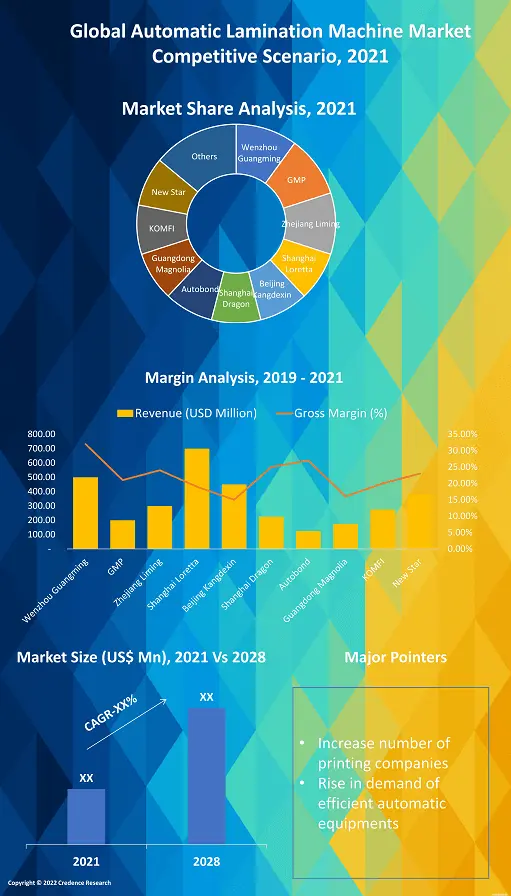
The global automatic lamination machine market share, the business organization summary, the introduction of new products, and the opportunities for the industrial automatic lamination machine market are all covered by the competitive environment of the automatic lamination machine industry. It also provides information on the total economic profit made by suppliers and businesses.
Executive Summary
What are automatic lamination machines?
The greatest automation and electronic components are integrated with the automatic laminator and an ergonomic touch screen for simple operation, accurate underlap management and the most dependable machine performance. A well-polished chrome plate roller guarantees the greatest quality outcomes in Thermal, Aqueous, or Dual lamination. Compared to hand feeding, an optional pre-loading system increases production by a factor of 4. The automatic lamination machine is rigorously designed to provide years of trouble-free operation, from the initial concept to the after-sales support.
Which are the key investments by the automatic lamination machine market players?
Leading players operating in the automatic lamination machine market are focusing on expansion in production capacities for automatic lamination machines. Players are concentrating on strategic mergers & acquisitions, and collaborations to gain a competitive edge. For instance, Hy-Tek Print Mac, a company, specializing in aqueous and thermal laminators, and Mark Engineering, known for auto feeders and stackers, worked together to create the automatic lamination machine AL 1.
Some major players in the automatic lamination market are Wenzhou Guangmin, GMP, Zhejiang Liming, Shanghai Loretta, Beijing Kangdexin, Shanghai Dragon, Autobond, Guangdong Magnolia, KOMFI, New Star, Shenzhen Modern Domhke, Beijing FULEI, Shanghai Tiancen, Wen Chyuan, and AUDLEY.
What are the Major Driving Factors for the Automatic Lamination Machine Market?
The factor expected to drive the market in the upcoming years is the rise in the deployment of automatic laminating machines in the healthcare sector. The market for automatic lamination machines is expected to be driven shortly by increased usage for new applications, including advertising and photography. Consumers' rising disposable income is anticipated to drive the industry in the upcoming years. It is projected that the demand for automatic laminating machines will increase due to the need to laminate components and products in aerospace, packaging, electronics, automotive, and other industries. The market for automatic laminating machines is expected to grow due to the creation of new products, the advancement of technology in all facets of life, and an increase in automation globally. This is largely because of the efficient, effective, faster, and safer applications expected to fuel market growth.
What are the Major Risks for the Automatic Lamination Machine Market?
The constant trend towards using cloud-based storage-free applications like Google Drive, DropBox, and others that supply any document whenever required without bringing the papers everywhere is a restraint on the growth of the thermal laminating machine market. Additionally, the advent of mobile wallets, bank applications, and net banking, which may prevent debit cards as these cards require a lamination solution, is another issue impeding the growth of the automatic laminating machine market. Additionally, the government's strict regulations on plastic usage for laminating are anticipated to impede the market's expansion for automatic.
Which is the key product in the automatic lamination machine market?
The pre-coated lamination machine segment is expected to hold a prominent share of the automatic lamination machine market during the forecast period. The work adaptability of an automatic pre-coated laminating machine is great. This equipment can provide exceptional versatility, allowing it to be printed in both tiny and big areas of the peritoneum. The stability of the in-use automatic pre-coating film machine is another factor. One is that different manufacturers' designs will be used in constructing this equipment, making it reasonable and easy to use.
How is the automatic lamination machine market performing in regions?
Due to its industrialization and technological advancement, North America held an excessively big share of the global market for automatic laminating machines in 2021. It is one of the most significant markets in North America because of the substantial demand for automatic laminating machines there. The second-largest market share for automatic laminating machines worldwide is predicted for Europe in 2021. During the projection period, demand for automatic laminating machines is anticipated to be at its highest in the Asia Pacific. The two biggest markets in the area are China and India. Due to the region's expanding industrial packaging and automotive healthcare infrastructure, the market in the Asia Pacific is expanding quickly.
What is the Market Size of Automatic Lamination Machines regarding value?
The global automatic lamination machine market is anticipated to grow at a substantial CAGR of XX% in the upcoming years. The global automatic lamination machine industry was estimated to be worth USD XX billion in 2021 and was expected to be worth USD XX billion by 2028.
What are the major players planning for the future of the automatic lamination machine market?
Leading industry players have announced the arrival of new goods with improved features. They have taken essential actions to enhance the device's overall performance and accuracy. More automation techniques are being used by businesses to increase the number of jobs that robots can complete, save labor costs, and create dependable and safe working conditions. Automatic laminator manufacturers must provide user-friendly interfaces to make their products more comfortable for customers and to get a foothold in the market.
Segmentation of Global Automatic Lamination Machine Market-
Global Automatic Lamination Machine Market – By Product
- Coating Laminating Machine
- Pre-coated Laminating Machine
Global Automatic Lamination Machine Market – By Application
- Printing Factory
- Printing Shop
Global Automatic Lamination Machine Market – By Region
- North America
- US
- Canada
- Europe
- Germany
- France
- UK.
- Italy
- Spain
- Rest of Europe
- Asia Pacific
- China
- Japan
- India
- South Korea
- South-east Asia
- Rest of Asia Pacific
- Latin America
- Brazil
- Mexico
- Rest of Latin America
- Middle East & Africa
- GCC Countries
- South Africa
- Rest of Middle East and Africa

Request a Free Sample
Fill in your details and we'll send you a free sample report.
- Sample data tables & charts
- Research methodology
Market Dynamics
Expansion of Industrial Printing and Packaging
The growing need for high-quality, durable printed materials in sectors such as packaging, advertising, and publishing is driving the adoption of automatic lamination machines, which offer efficiency and consistent output.
Technological Advancements and Automation
Continuous improvements in automation, touch-screen interfaces, and integration with digital workflows are making automatic lamination machines more user-friendly and productive, encouraging investment from printing businesses.
Growth in Disposable Income and Advertising Spend
Rising disposable incomes, especially in developed markets like the US, are increasing demand for premium printed products and promotional materials, boosting the need for advanced lamination solutions.
Diversification of End-Use Industries
The expansion of automatic lamination machine applications into sectors such as healthcare, electronics, automotive, and aerospace is broadening the market base, as these industries require laminated components for protection and durability.
Need a Custom Version of This Report?
Tailor the scope, geography, or segments to your exact requirements.
- Custom geography or segment scope
- Direct access to our analyst team
Frequently Asked Questions
How does COVID-19 Impact the global automatic lamination machine market?
Which region is the leading the market for automatic lamination machines?
What are the drivers for the growth of the automatic lamination machine market?
Which is the major segment in the automatic lamination machine market by product?
Which is the major segment in the automatic lamination machine market by application?
Table of Content
Chapter 1 Market Segmentation
- 1.1 Segmentation Framework
- 1.1.1 Product and Service Classification
- 1.1.2 Application and End-Use Classification
- 1.1.3 Technology and Solution Classification
- 1.1.4 Customer and Distribution Channel Classification
- 1.1.5 Geographic Segmentation
- 1.1.6 Market Segment Definitions and Boundaries
- 1.2 By Product
- 1.2.1 Coating Laminating Machine
- 1.2.2 Pre-coated Laminating Machine
- 1.3 By Application
- 1.3.1 Printing Factory
- 1.3.2 Printing Shop
Chapter 2 Introduction
- 2.1 Report Objectives and Scope
- 2.2 Product Definition and Industry Terminology
- 2.3 Market Inclusions and Exclusions
- 2.4 Research Process
- 2.4.1 Primary Research and Expert Interviews
- 2.4.2 Secondary Research and Source Review
- 2.4.3 Top-Down and Bottom-Up Estimation
- 2.4.4 Data Triangulation and Verification
- 2.5 Market Size Measurement Basis
- 2.5.1 Base year: USD 4,580.63 million → Forecast year: USD 8,536.83 million
- 2.6 Research Assumptions and Limitations
Chapter 3 Executive Summary
- 3.1 Market Snapshot and Key Findings
- 3.2 Base-Year Market Size
- 3.3 Forecast Market Size
- 3.4 Revenue and Volume Growth Outlook
- 3.5 Key Demand and Supply Indicators
- 3.6 Leading Market Segments
- 3.7 Fastest-Growing Market Opportunities
- 3.8 Regional Performance Highlights
- 3.9 Technology and Industry Transformation
- 3.10 Competitive Landscape Summary
- 3.11 Analyst View and Strategic Implications
Chapter 4 Global Automatic Lamination Machine Market Trends and Developments
- 4.1 Historical Industry Development
- 4.2 Recent Market Trends and Developments
- 4.3 Demand and Customer Behavior Trends
- 4.4 Technology and Product Innovation
- 4.5 Artificial Intelligence, Automation and Digitalization
- 4.6 Local Manufacturing and Supply Chain Realignment
- 4.7 Industry Partnerships, Mergers and Acquisitions
- 4.8 Sustainability and Circular Economy Developments
- 4.9 Government and Private Sector Investment Trends
- 4.10 Emerging Business Models and Commercialization
- 4.11 Industry Developments and Announcements
Chapter 5 Global Automatic Lamination Machine Market Production, Supply and Demand Analysis
- 5.1 Demand Trend and Consumption Analysis
- 5.2 Demand Forecast
- 5.3 Production and Output Trend
- 5.4 Production and Output Forecast
- 5.5 Installed Capacity and Capacity Utilization
- 5.6 Company-Wise Production Plants and Statistics
- 5.6.1 Installed Production Capacity
- 5.6.2 Actual Production
- 5.6.3 Planned Capacity and Expansion Targets
- 5.7 Supply Chain Structure and Procurement Trends
- 5.8 Supply-Demand Gap and Bottlenecks
- 5.9 Import Dependence and Sourcing Structure
- 5.10 Contract Manufacturing and Outsourcing
- 5.11 Regional Supply and Demand Concentration
Chapter 6 Global Automatic Lamination Machine Market Pricing Analysis
- 6.1 Pricing Structure and Measurement
- 6.2 Historical Pricing Trends
- 6.3 Pricing Outlook
- 6.4 Average Selling Price and Unit Economics
- 6.5 Pricing by Product and Market Segment
- 6.6 Geographic Pricing Differences
- 6.7 Key Input, Energy, Labor and Logistics Costs
- 6.8 Contract Pricing and Purchasing Models
- 6.9 Pricing Sensitivity and Competitive Positioning
- 6.10 Price, Margin and Profitability Implications
Chapter 7 Global Automatic Lamination Machine Market Dynamics
- 7.1 Market Growth Drivers
- 7.1.1 Demand-Side Drivers
- 7.1.2 Technology and Innovation Drivers
- 7.1.3 Infrastructure and Investment Drivers
- 7.1.4 Regulatory and Policy Drivers
- 7.2 Market Restraints
- 7.2.1 Cost and Affordability Constraints
- 7.2.2 Technology and Adoption Barriers
- 7.2.3 Supply Chain and Operational Constraints
- 7.3 Market Challenges
- 7.3.1 Competitive Pressure and Margin Erosion
- 7.3.2 Skills, Infrastructure and Implementation Gaps
- 7.4 Emerging Market Opportunities
- 7.5 Market Dynamics Impact and Time-Horizon Assessment
Chapter 8 Global Automatic Lamination Machine Value Chain Analysis
- 8.1 Industry Value Chain Overview
- 8.2 Upstream Suppliers and Critical Inputs
- 8.3 Technology and Component Providers
- 8.4 Manufacturing or Service Delivery
- 8.5 Distribution, Channel Partners and Integrators
- 8.6 Downstream Applications and End Users
- 8.7 Value Addition and Profit Pools
- 8.8 Vertical Integration and Outsourcing
- 8.9 Supplier Concentration and Risk
- 8.10 Supply Chain Localization and Resilience
Chapter 9 Global Automatic Lamination Machine Market Regulations and Policies
- 9.1 Relevant Laws, Standards and Compliance Frameworks
- 9.2 Product, Service, Safety and Quality Requirements
- 9.3 Government Policies, Incentives and Subsidies
- 9.4 Imports, Exports and Trade Barriers
- 9.5 Public Procurement and Local Content Requirements
- 9.6 Environmental and Sustainability Compliance
- 9.7 Upcoming Policy Changes and Market Implications
Chapter 10 Global Automatic Lamination Machine Market Hotspots and Opportunities
- 10.1 Market Opportunity Mapping and Growth Hotspots
- 10.2 High-Growth Applications and Customer Groups
- 10.3 Underserved Markets and White-Space Opportunities
- 10.4 Emerging Technology and Product Opportunities
- 10.5 New Capacity and Investment Hotspots
- 10.6 Market Entry and Expansion Opportunities
- 10.7 Distribution and Partnership Opportunities
- 10.8 Near-Term and Long-Term Commercial Potential
- 10.9 Opportunity Attractiveness and Execution Risks
Chapter 11 Global Automatic Lamination Machine Market Outlook
- 11.1 Market Size and Analysis
- 11.1.1 Revenue (Market Measurement: Base year: USD 4,580.63 million → Forecast year: USD 8,536.83 million)
- 11.1.2 Market Volume and Quantity Sold
- 11.1.3 Historical Market Size
- 11.1.4 Base-Year Market Size
- 11.2 Market Forecast
- 11.2.1 Revenue Forecast
- 11.2.2 Volume Forecast
- 11.2.3 CAGR and Year-on-Year Growth
- 11.2.4 Incremental Revenue Opportunity
- 11.3 Forecast Assumptions and Scenario Analysis
- 11.3.1 Base-Case Forecast
- 11.3.2 Optimistic and Conservative Scenarios
- 11.3.3 Technology, Pricing and Policy Sensitivities
- 11.4 Market Attractiveness and Growth Outlook
Chapter 12 Global Automatic Lamination Machine Market Segmentation and Outlook
- 12.1 Segmentation Summary and Market Shares
- 12.2 Largest and Fastest-Growing Segments
- 12.3 By Product - Market Size and Forecast
- 12.3.1 Segment Definition and Scope
- 12.3.2 Historical Market Size
- 12.3.3 Revenue Forecast
- 12.3.4 Volume Forecast
- 12.3.5 Base-Year Market Share
- 12.3.6 Segment CAGR and Growth Drivers
- 12.3.7 Subsegment Market Size and Forecast
- 12.3.7.1 Coating Laminating Machine
- 12.3.7.2 Pre-coated Laminating Machine
- 12.3.8 Subsegment Pricing and Adoption Trends
- 12.3.9 Leading Suppliers and Competition
- 12.3.10 Regional Demand and Opportunities
- 12.4 By Application - Market Size and Forecast
- 12.4.1 Segment Definition and Scope
- 12.4.2 Historical Market Size
- 12.4.3 Revenue Forecast
- 12.4.4 Volume Forecast
- 12.4.5 Base-Year Market Share
- 12.4.6 Segment CAGR and Growth Drivers
- 12.4.7 Subsegment Market Size and Forecast
- 12.4.7.1 Printing Factory
- 12.4.7.2 Printing Shop
- 12.4.8 Subsegment Pricing and Adoption Trends
- 12.4.9 Leading Suppliers and Competition
- 12.4.10 Regional Demand and Opportunities
- 12.5 Segment Growth Comparison
- 12.6 Segment Attractiveness and Priority Matrix
Chapter 13 Global Automatic Lamination Machine End-Use and Application Market Outlook
- 13.1 End-Use Industry and Customer Demand Structure
- 13.2 Leading Applications and Customer Groups
- 13.3 End-Use Market Size, Share and Forecast
- 13.4 Major End-Use Industry Deep Dives
- 13.4.1 Customer Requirements and Use Cases
- 13.4.2 Demand and Replacement Cycles
- 13.4.3 Technical and Regulatory Considerations
- 13.4.4 Purchasing and Procurement Models
- 13.4.5 Leading Vendors and Distribution Channels
- 13.4.6 Forecast and Commercial Opportunities
- 13.5 Emerging Applications and Cross-Segment Demand
- 13.6 End-Use Industry Investment Priorities
Chapter 14 Global Automatic Lamination Machine Geographic Market Outlook
- 14.1 Regional Market Size and Share
- 14.2 Regional Market Forecast
- 14.3 Regional Pricing, Production and Demand Differences
- 14.4 North America
- 14.4.1 United States
- 14.4.2 Canada
- 14.4.3 Mexico
- 14.5 Europe
- 14.5.1 Germany
- 14.5.2 France
- 14.5.3 Italy
- 14.5.4 United Kingdom
- 14.5.5 Spain
- 14.5.6 Poland
- 14.5.7 Russia
- 14.5.8 Netherlands
- 14.5.9 Belgium
- 14.5.10 Sweden
- 14.5.11 Denmark
- 14.5.12 Norway
- 14.5.13 Rest of Europe
- 14.6 Asia Pacific
- 14.6.1 China
- 14.6.2 India
- 14.6.3 Japan
- 14.6.4 South Korea
- 14.6.5 Thailand
- 14.6.6 Indonesia
- 14.6.7 Vietnam
- 14.6.8 Malaysia
- 14.6.9 Australia
- 14.6.10 Rest of Asia Pacific
- 14.7 Latin America
- 14.7.1 Brazil
- 14.7.2 Argentina
- 14.7.3 Colombia
- 14.7.4 Chile
- 14.7.5 Rest of Latin America
- 14.8 Middle East
- 14.8.1 Saudi Arabia
- 14.8.2 United Arab Emirates
- 14.8.3 Turkey
- 14.8.4 Israel
- 14.8.5 Iran
- 14.8.6 Rest of the Middle East
- 14.9 Africa
- 14.9.1 South Africa
- 14.9.2 Egypt
- 14.9.3 Nigeria
- 14.9.4 Morocco
- 14.9.5 Rest of Africa
- 14.10 Regional Investment, Policy and Supply Chain Differences
- 14.11 Regional Competitive Landscape
- 14.12 Geographic Growth Hotspots
Chapter 15 Global Automatic Lamination Machine Technology, Innovation and Sustainability Outlook
- 15.1 Technology Landscape and Maturity
- 15.2 Product, Process and Service Innovation
- 15.3 AI, Automation and Digital Tools in the Industry
- 15.4 Technology Adoption and Performance Benchmarking
- 15.5 Innovation Pipeline and R&D Investment
- 15.6 Patent and Intellectual Property Trends
- 15.7 Energy Efficiency and Resource Management
- 15.8 Sustainability, Recycling and Circularity
- 15.9 Technology Roadmap
- 15.10 Risks of Obsolescence and Technology Substitution
Chapter 16 Global Automatic Lamination Machine Market Key Strategic Imperatives
- 16.1 Growth and Market Entry Priorities
- 16.2 High-Return Products and Segments
- 16.3 Pricing, Profitability and Cost Optimization
- 16.4 Technology Investment and Product Differentiation
- 16.5 Supply Chain Localization and Resilience
- 16.6 Distribution and Customer Acquisition
- 16.7 Partnership, Acquisition and Capacity Strategy
- 16.8 Regional Expansion Priorities
- 16.9 Short-, Medium- and Long-Term Actions
Chapter 17 Competition Outlook
- 17.1 Industry Competition Characteristics
- 17.2 Market Structure and Concentration
- 17.3 Market Share and Competitive Positioning
- 17.4 Company-Wise Revenue and Product Benchmarking
- 17.5 Production and Service Capacity Benchmarking
- 17.6 Technology, Pricing and Differentiation
- 17.7 Regional Footprint and Distribution Strength
- 17.8 Mergers, Acquisitions and Strategic Alliances
- 17.9 New Entrants and Competitive Threats
- 17.10 Porter's Five Forces and Industry Attractiveness
- 17.11 Competitive Outlook
Chapter 18 Company Profiles
- 18.1 Company Coverage and Selection Criteria
- 18.2 Wenzhou Guangming
- 18.2.1 Business Description
- 18.2.2 Company Ownership and Geographic Presence
- 18.2.3 Product and Service Portfolio
- 18.2.4 Manufacturing and Operating Footprint
- 18.2.5 Production Capacity and Expansion Plans
- 18.2.6 Financial Performance and Investment
- 18.2.7 Market Share and Competitive Position
- 18.2.8 Technology and Innovation Capabilities
- 18.2.9 Strategic Alliances or Partnerships
- 18.2.10 Recent Developments
- 18.2.11 Growth Strategy and Outlook
- 18.3 GMP
- 18.4 Zhejiang Liming
- 18.5 Shanghai Loretta
- 18.6 Beijing Kangdexin
- 18.7 Shanghai Dragon
- 18.8 Autobond
- 18.9 Guangdong Magnolia
- 18.10 KOMFI
- 18.11 New Star
- 18.12 Other Relevant Market Participants
Note: Every listed company is profiled on the structure shown under the first company. The company list is preliminary and may change based on research findings, market developments, data availability and client requirements.
Chapter 19 Disclaimer
- 19.1 Research and Forecast Disclaimer
- 19.2 Data Source and Estimation Limitations
Note: The depth of individual sections depends on data availability for this market. Volume, capacity, trade and other unit-based metrics are included where applicable.

