
Market Insights
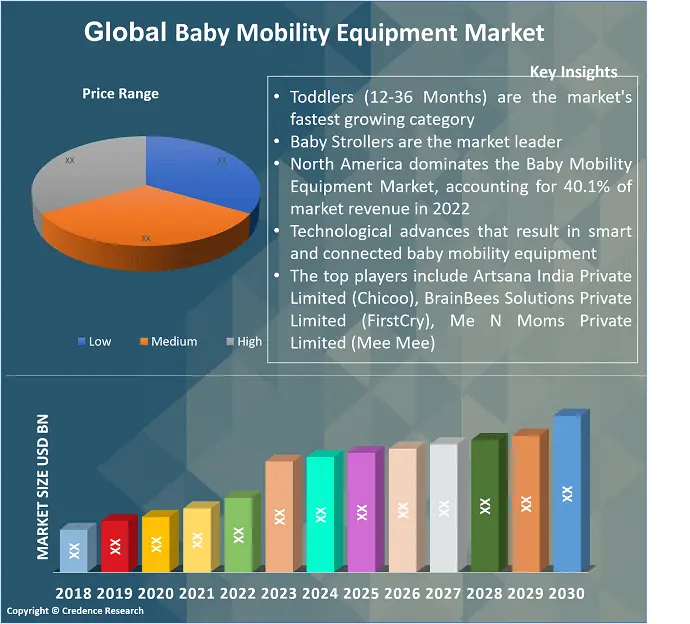
- The global demand for Baby Mobility Equipment was valued at USD XX Million in 2022 and is expected to reach USD XX Million in 2030, growing at a CAGR of 15.20% between 2023 and 2030.
- Baby Strollers are the market leader, while Baby Carriers are another key segment of the Baby Mobility Equipment industry, as are Baby Scooters and Ride-Ons, which are becoming increasingly popular.
- Toddlers (12-36 Months) are the fastest growing market segment, followed by Infants (0-12 Months).
- Traditional strollers are the most popular market segment, and convertible strollers are another important market segment.
- The largest segment of the Baby Mobility Equipment market is Safety Harnesses and Straps, and the second sector that drives market demand in the Baby Mobility Equipment market is Non-Toxic Materials.
- The Premium and High-End Products sector has the greatest Compound Annual Growth Rate (CAGR) in the Baby Mobility Equipment market, followed by the Mid-Range Products sector.
- The most important section of the Baby Mobility Equipment market is brick-and-mortar retail establishments, followed by online retailers.
- North America will account for 40.1% of market revenue in 2022, while the Asia Pacific region will have the fastest-growing Baby Mobility Equipment market.
- Market growth is being driven by rising demand for multi-functional products.
- Baby Walkers Threaten Market Growth
Executive Summary
Market Definition
The baby mobility equipment market is the industry that manufactures and distributes various goods that aid with the movement and transportation of newborns and young children. Strollers, car seats, baby carriers, and other similar items fall under this category. These goods are necessary for parents and caregivers to transfer their children securely and conveniently. Factors like as increased urbanization, rising disposable income, and greater awareness about child safety are driving the market for baby mobility equipment.
Market Overview
It is anticipated that between 2023 and 2030, the worldwide Baby Mobility Equipment Market will expand at a compound annual growth rate (CAGR) of 15.20%. From USD XX million in 2022, the market is projected to be worth USD XX million by 2030.
The global market for baby mobility devices is expanding rapidly. Factors such as increased urbanization, rising disposable income, and growing awareness about kid safety are driving the market. Some of the most popular products in this category are strollers, car seats, and baby carriers. Baby mobility equipment that is unique and technologically advanced is likewise in high demand. The industry is likely to grow more in the future years as parents prioritize convenience, safety, and comfort.
Segmentation by Type
- Baby Strollers are the market leader. Strollers are popular among parents as a handy and safe way to transfer their children. They are popular among parents because to features such as adjustable seats, storage compartments, and ease of manoeuvrability. In terms of sales and demand, baby strollers have the biggest market share.
- Baby Carriers are another important sector of the Baby Mobility Equipment market.
- Baby Scooters and Ride-Ons are one market area that is growing in popularity. Baby scooters and ride-ons allow newborns to explore their surroundings while developing their motor skills in a fun and engaging way.
Segmentation by Size
- Toddlers (12-36 Months) are the market's fastest growing category. As toddlers grow and develop, the need for products that cater to their individual needs and interests grows. This category contains a wide range of things such as educational toys, interactive games, and age-appropriate apparel that are intended to promote their learning and encourage the development of their motor abilities.
- Infants (0-12 Months) are another major market group. This category includes items such as baby bottles, pacifiers, diapers, and baby care necessities.
Segmentation by Application
- Traditional Strollers are the sector with the highest market demand in the Baby Mobility Equipment market. Traditional strollers are quite popular among parents because of their adaptability, ease of use, and extensive feature set.
- Convertible strollers are another market category that stands out. Convertible strollers provide for adaptability and transformation as the child develops. They may be converted from an infant carriage to a toddler seat, giving parents with a long-term option. This segment provides versatility and simplicity by removing the need for numerous strollers as the child progresses through the phases.
Segmentation by End-User Industry
- Safety Harnesses and Straps are the largest segment of the Baby Mobility Equipment market. Safety harnesses and straps are important components in baby mobility equipment because they assure the child's safety and security while using strollers or carriers. Parents emphasize their children's safety, making this market niche critical.
- Non-Toxic Materials is the second sector that determines market demand in the Baby Mobility Equipment market.
Segmentation by Protection Rating
- The Premium and High-End Products sector has the highest Compound Annual Growth Rate (CAGR) in the Baby Mobility Equipment market. Because of the increasing demand for high-quality, feature-rich, and luxurious baby mobility equipment, this category has seen tremendous expansion. Parents are eager to spend more money on quality products that provide increased comfort, durability, and advanced features.
- The Mid-Range Products sector is another key market segment. This area appeals to parents seeking a blend of quality and price. Mid-range items provide an excellent balance of features, durability, and affordability, making them a popular choice among a wide spectrum of consumers.
Segmentation by Customization and Accessories
- Brick-and-mortar retail stores are the most important segment of the Baby Mobility Equipment market. These physical establishments play an important role in the industry because they provide parents with a tactile buying experience.
- Online Retailers are another big market participant.
Segmentation by Region
- North America dominates the Baby Mobility Equipment Market, accounting for 40.1% of market revenue in 2022
- The Asia Pacific region has the fastest-growing Baby Mobility Equipment market.
- The rest of the world, including Latin America, the Middle East, and Africa, supplies the remaining demand for Baby Mobility Equipment.
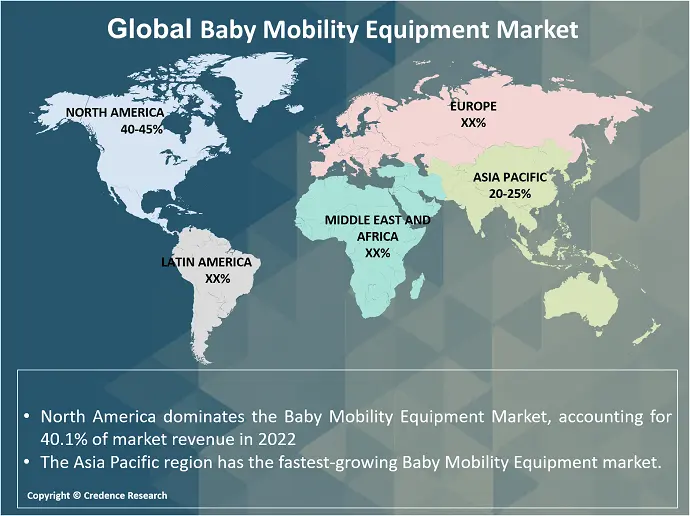
North America dominates the Baby Mobility Equipment Market in 2022. The region's growing trend of single parents has put the pressure of managing a work and a family on one person. As a result, baby strollers can simply travel with a baby without a spouse. As a result, manufacturers focus on incorporating features that allow a single person to control the pram. Cybex, for example, introduced the E-Priam electric pram. Furthermore, mothers' rising interest in physical health activities like as walking and jogging with their babies is expected to increase demand for such products in the region.
During the predicted period, Asia Pacific is expected to grow the fastest. Growing working populations and urbanization in developing countries such as India and China have driven the region's baby stroller market. Furthermore, the growing inclination for nuclear family structures has increased the need for baby strollers, as parents cannot leave their newborns alone at home. The demand for strollers in Europe is continuously increasing due to an increase in the number of working women in countries such as Iceland, Norway, Denmark, and Sweden.
Key Highlights of the Report
The global Baby Mobility Equipment Market is segmented by Type of Baby Mobility Equipment, Age Group, Product Features and Design, Safety Features, Price Range, Distribution Channel and region. Baby strollers dominate the market. Also, Toddlers (12-36 Months) are the market's fastest growing group. Also, the Baby Mobility Equipment market is led by Safety Harnesses and Straps, and the Premium and High-End Products sector has the greatest Compound Annual Growth Rate (CAGR), with North America leading the market growth.
Increasing urbanization and the demand for baby-friendly transportation Growing awareness of child safety and the significance of employing appropriate mobility equipment, as well as rising disposable income and technologically sophisticated baby mobility goods, are the primary market drivers. Moreover, the primary market limitations include the high cost of premium baby mobility equipment, stringent safety regulations and compliance requirements, and limited availability of specialist baby mobility equipment in certain countries.
Nonetheless, In 2022, North America will dominate the Baby Mobility Equipment Market. The region's growing trend of single parents has placed the burden of balancing career and family life on one person. Furthermore, Asia Pacific is likely to expand the fastest during the forecast period. Growing working populations and urbanization in developing nations like as India and China have propelled the baby stroller industry in the area.
What Elements Are Driving the Global Market for Baby Mobility Equipment?
One important cause is urbanization and changing lifestyles. As more people relocate to cities and lead busy lives, there is a greater demand for practical and portable baby mobility devices that may help parents negotiate crowded settings. Another motivator is an increasing understanding of the significance of early childhood development and the advantages of physical activity for babies. Parents are becoming more cognizant of giving chances for movement and exploration for their kids, which has resulted in a rise in demand for baby mobility equipment.
What Are The Main Obstacles That The Global Baby Mobility Equipment Market Faces?
The severe safety laws and standards that regulate the manufacture and sale of baby mobility devices are a big impediment. Manufacturers must ensure that their products conform with these standards, which might present compliance and certification problems. The expensive expense of modern newborn mobility equipment is another barrier. These products are frequently more expensive because they have premium features and materials. This can make particular consumer segments unaffordable, affecting total market demand.
What Market Development Prospects Are There For Baby Mobility Equipment Globally?
The growing emphasis on eco-friendly and sustainable infant items is a big opportunity. As environmental awareness rises, so does the need for baby mobility equipment created from sustainable materials and developed in environmentally beneficial ways. Manufacturers will be able to appeal to the environmentally concerned consumer group as a result of this. Another potential derives from the increasing need for multi-functional and adaptable baby mobility equipment. Parents want items that can adapt to their baby's changing demands and developmental phases, while also delivering long-term value. Manufacturers can benefit from this trend by providing diverse and adjustable baby mobility equipment.
Market Drivers
The global Baby Mobility Equipment Market is driven by several factors. The following are the key drivers of the global Baby Mobility Equipment Market:
Growing Demand for Multi-Functional Products Drives Market Growth
Growing urbanization and parents' desire for easy solutions have emerged as important market drivers in the baby walker sector. As more families relocate to cities, there is a larger demand for products that cater to the city's fast-paced lifestyle and restricted living space. Baby walkers provide parents a convenient solution by providing a transportable and compact means of assisting their child's growth while also saving space.
The unique walkers combine mobility assistance with interactive components that interest and delight the infant. For instance, the emergence of multi-functional baby walkers with additional entertainment functions has acquired commercial traction. This integration of entertainment aspects not only keeps the baby entertained, but also gives sensory stimulation and chances for cognitive growth. A renowned infant goods manufacturer's "Wonder Walkers Deluxe" is an example of such a product. This multi-purpose baby walker comes with adjustable height settings, a soft seat, and a detachable activity tray with interactive toys. The activity tray has music-playing buttons, lights that flash in response to movement, and a spinning toy panel.
Market Restraints
The global Baby Mobility Equipment Market faces some challenges that may hinder its growth. These include the following:
Risk of Baby Walkers Endangers Market Growth
Growing industry concerns about the risks related with baby walkers. Studies and publications have progressively emphasized the risks and accidents associated with the use of baby walker. The potential of falls and injuries is a major safety concern. Baby walkers with wheels allow newborns to move at rapid speeds and access locations that may be hazardous, such as stairs or uneven surfaces, increasing the probability of falls that result in serious injuries such as fractures or brain trauma.
Infants in walkers may fall over or hit with things, perhaps causing an accident. Increased knowledge of safety hazards, as well as tight safety rules such as the European Union's EN 1273:2005 standard for baby walkers, have resulted in a drop in the popularity of baby walkers in certain regions. The baby walker industry is still grappling with how to strike the correct balance between giving developmental benefits and protecting infants' safety during their early mobility stages.
Opportunities
The global Baby Mobility Equipment Market offers significant growth opportunities. These include the following:
Online Sales Provide A Market Potential For Growth
The growth of internet shopping platforms has created a promising market for the baby walker sector. Customers may now conveniently explore and compare many baby walker options from the comfort of their homes, thanks to the growing popularity of e-commerce and the growing preference for online buying. Parents may buy baby walkers with confidence thanks to the enhanced online buying experience provided by thorough product information, photographs, and user reviews.
Online platforms also give manufacturers and retailers the advantage of addressing a global client base, increasing their market reach beyond local regions, and entering international markets where baby walkers are in high demand. Prominent online baby goods shops have effectively capitalized on this opportunity by offering a diverse assortment of baby walkers from numerous brands at cheap prices. They attract and engage potential purchasers through focused marketing initiatives, customer reviews, and ratings, positioning themselves as trustworthy destinations for baby walkers. Online retail channels' ease, accessibility, and global reach, together with smart marketing methods, are boosting sales and growth in the baby walker market.
Competitive Landscape
Key Players
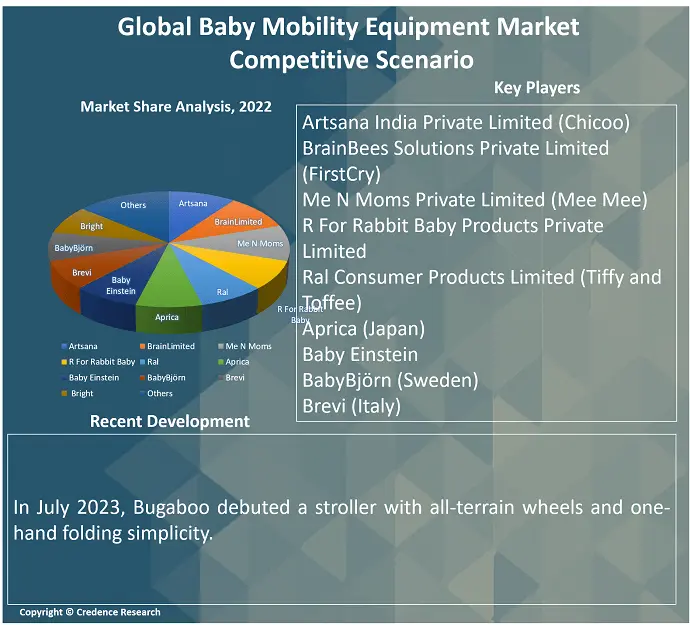
The global Baby Mobility Equipment Market is highly competitive, with several key players. Some of the major players in the market and their market share are as follows:
- Artsana India Private Limited (Chicoo)
- BrainBees Solutions Private Limited (FirstCry)
- Me N Moms Private Limited (Mee Mee)
- R For Rabbit Baby Products Private Limited
- Ral Consumer Products Limited (Tiffy and Toffee)
- Aprica (Japan)
- Baby Einstein
- BabyBjörn (Sweden)
- Brevi (Italy)
- Bright Starts
- CAM Il Mondo del Bambino (Italy)
- Chicco
- Combi
These organizations prioritize product innovation, Disease Area expansion, and mergers and acquisitions to stay competitive.
The global Baby Mobility Equipment Market's key players continually seek to stay ahead by offering new Types and developments.
In August 2023, Philips Avent introduced an intelligent baby monitor with Al-powered sleep counselling.
In July 2023, Nanit released a baby monitor with breathing monitoring features.
In July 13, 2023., Nuna released a new car seat with an integrated rotating base
In July 2023, Graco announced a high chair featuring a magnetic tray and one-handed folding mechanism.
Summary of Key Findings
- Online sales offer market expansion potential.
- Market segmented by Type of Baby Mobility Equipment, Age Group, Product Features and Design, Safety Features, Price Range, Distribution Channel and region
- Toddlers (12-36 Months) are the fastest growing market segment
- The Premium and High-End Products sector has the greatest Compound Annual Growth Rate (CAGR) in the Baby Mobility Equipment market
- North America is leading market growth; the market is highly competitive with key players including Artsana India Private Limited (Chicoo), BrainBees Solutions Private Limited (FirstCry), Me N Moms Private Limited (Mee Mee), R For Rabbit Baby Products Private Limited, Ral Consumer Products Limited (Tiffy and Toffee)
Future Outlook
- There is a growing need for lightweight, compact strollers.
- Increasing popularity of multi-functional and modular infant carriers.
- Increased use of modern safety features in vehicle seats.
- Technological advances that result in smart and connected baby mobility equipment.
- A growing emphasis on environmentally friendly and sustainable products.
- Market expansion in developing countries as disposable income rises.
- A greater emphasis is being placed on ergonomic designs to improve comfort.
- Inclusion of novel features such as all-terrain wheels and adjustable grips.
Segmentation
By Type of Baby Mobility Equipment:
- Baby Strollers
- Baby Walkers
- Baby Carriers
- Baby Swings and Bouncers
- Baby Playpens and Playards
- Baby Jumpers and Exercisers
- Baby Scooters and Ride-Ons
- Other Equipment
By Age Group:
- Infants (0-12 Months)
- Toddlers (12-36 Months)
- Preschoolers (3-6 Years)
By Product Features and Design:
- Traditional Strollers
- Convertible Strollers
- Jogging Strollers
- Ergonomic Baby Carriers
- Foldable and Compact Equipment
- Customizable and Modular Equipment
By Safety Features:
- Safety Harnesses and Straps
- Lockable Wheels
- Non-Toxic Materials
- Certifications
By Price Range:
- Economy and Budget Products
- Mid-Range Products
- Premium and High-End Products
By Distribution Channel:
- Brick-and-Mortar Retail Stores
- Online Retailers
- By Region
- North America
- US
- Canada
- Mexico
- Europe
- Germany
- France
- UK.
- Italy
- Spain
- Rest of Europe
- Asia Pacific
- China
- Japan
- India
- South Korea
- South-east Asia
- Rest of Asia Pacific
- Latin America
- Brazil
- Argentina
- Rest of Latin America
- Middle East & Africa
- GCC Countries
- South Africa
- Rest of Middle East and Africa
- North America
Adjacent Markets
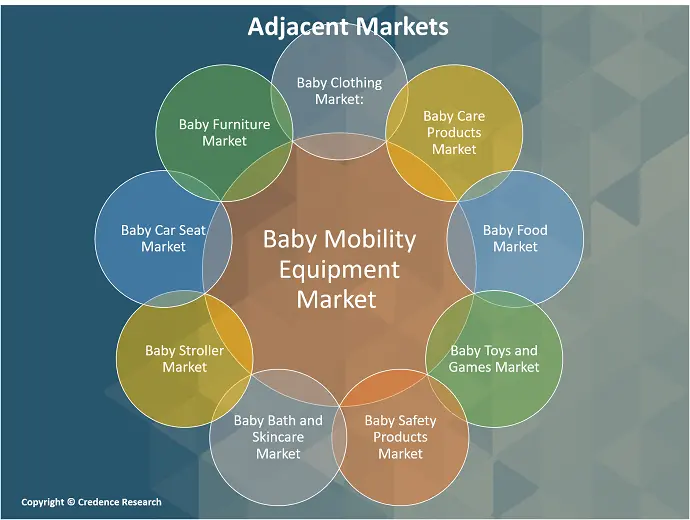
In the Baby Mobility Equipment Market, there are several adjacent markets which has high revenue growth opportunities. The key adjacent markets for Baby Mobility Equipment Market-
Request a Free Sample
Fill in your details and we'll send you a free sample report.
- Sample data tables & charts
- Research methodology
Need a Custom Version of This Report?
Tailor the scope, geography, or segments to your exact requirements.
- Custom geography or segment scope
- Direct access to our analyst team
Frequently Asked Questions
What is the current Type of the worldwide Baby Mobility Equipment Market?
What is the predicted growth rate of the Baby Mobility Equipment Market between 2023 and 2030?
Which segment has the most market share in terms of type of baby mobability equipment ?
Which product features and design industry segment governs the market demand for Baby Mobility Equipment?
Which age groups segment is predicted to grow at the fastest growing segment over the forecast period?
Which region is driving the Baby Mobility Equipment industry forward?
Who are the major players in the global Baby Mobility Equipment Market?
What are the major market drivers of the Baby Mobility Equipment industry?
What are the major market restraints of the Baby Mobility Equipment industry?
What are the major market opportunities of the Baby Mobility Equipment industry?
Table of Content
Chapter 1. Report Introduction
- 1.1 Report Description & Purpose
- 1.1.1 Report Title & Market Definition
- 1.1.2 Unique Selling Propositions (USP) & Key Differentiators
- 1.1.3 Value Proposition for Stakeholders
- 1.2 Research Objectives
- 1.2.1 Market Sizing Objectives (Volume & Revenue) (Volume Where Applicable)
- 1.2.2 Segmentation Objectives
- 1.2.3 Competitive Intelligence Objectives
- 1.2.4 Forecast & Scenario Objectives
- 1.3 Report Scope
- 1.3.1 Baby Mobility Equipment Scope – Segments & Subsegments Covered
- 1.3.2 Geographic Scope – Regions & Countries Covered
- 1.3.3 Historical Period, Base Year & Forecast Period (the historical period; forecast to the forecast period)
- 1.3.4 Inclusions & Exclusions
- 1.4 Industry Classification & Applicable Codes
- 1.5 Currency, Measurement Units & Valuation Basis
- 1.6 Target Stakeholders
- 1.7 Limitations & Assumptions
Chapter 2. Executive Summary
- 2.1 Global Baby Mobility Equipment Market Snapshot
- 2.1.1 Market Size – Historical (the historical period) & Forecast (the forecast period) (base year: NULL → forecast year: NULL)
- 2.1.2 Volume & Revenue – Global Totals (Volume Where Applicable)
- 2.1.3 Key Market Highlights – Top Five Facts
- 2.2 Baby Mobility Equipment Market Segmentation Snapshot
- 2.2.1 Market Split by Region – vs.
- 2.3 Competitive Snapshot
- 2.3.1 Top 10 Players by Revenue Share –
- 2.3.2 Top 10 Players by Volume Share – (Volume Where Applicable)
- 2.3.3 Recent Strategic Developments (18-Month Summary)
- 2.4 Key Investment Highlights & Strategic Conclusions
Chapter 3. Baby Mobility Equipment Market Dynamics & Industry Analysis
- 3.1 Market Overview & Context
- 3.1.1 Baby Mobility Equipment Market Position in the Broader Industry Value Chain
- 3.1.2 Demand Structure & Purchasing Dynamics
- 3.1.3 Market Maturity & Development Stage by Region
- 3.2 Baby Mobility Equipment Market Drivers
- 3.3 Baby Mobility Equipment Market Restraints & Challenges
- 3.4 Baby Mobility Equipment Market Opportunities
- 3.5 Porter's Five Forces Analysis
- 3.5.1 Threat of New Entrants
- 3.5.2 Bargaining Power of Suppliers
- 3.5.3 Bargaining Power of Buyers
- 3.5.4 Threat of Substitutes
- 3.5.5 Competitive Rivalry – Intensity Assessment
- 3.6 Baby Mobility Equipment Value Chain Analysis
- 3.6.1 Upstream – Key Inputs, Resources & Suppliers
- 3.6.1.1 Key Input/Resource 1
- 3.6.1.2 Key Input/Resource 2
- 3.6.1.3 Key Input/Resource 3
- 3.6.2 Midstream – Core Operations & Value Creation
- 3.6.2.1 Operating Model & Process Overview
- 3.6.2.2 Key Operating Locations & Capabilities by Company
- 3.6.3 Downstream – Market Channels & End Users
- 3.6.3.1 Direct Sales & Customer Engagement Channels
- 3.6.3.2 Indirect Sales, Intermediaries & Partner Channels
- 3.6.4 Value Chain Profitability Analysis
- 3.6.1 Upstream – Key Inputs, Resources & Suppliers
- 3.7 PESTEL Analysis
- 3.7.1 Political Factors
- 3.7.2 Economic Factors
- 3.7.3 Social Factors
- 3.7.4 Technological Factors
- 3.7.5 Environmental Factors
- 3.7.6 Legal Factors
- 3.8 Baby Mobility Equipment Supply Chain Analysis
- 3.8.1 Critical Input & Resource Availability Risk Assessment
- 3.8.2 Supplier & Operational Concentration Risk (Geographic Exposure)
- 3.8.3 Supply & Service Disruption Impact Analysis
- 3.9 Regulatory & Policy Landscape
Note: The regulatory and policy landscape section covers regulations based on their applicability to the market, Baby Mobility Equipment category, geography, and scope of the study. Only regulatory frameworks with a material impact on operations, compliance, trade, sustainability, or market access are analyzed in detail.
Chapter 4. Key Investment Pockets & Opportunity Analysis
- 4.1 Baby Mobility Equipment Market Attractiveness Analysis
- 4.1.1 By Region – Investment Attractiveness Matrix (Market Size × CAGR)
- 4.2 Absolute Revenue Growth Opportunity
- 4.2.1 By Region – Absolute Revenue Growth Through the forecast period
- 4.3 Incremental Demand Opportunity
- 4.3.1 By Region – Incremental Demand Through the forecast period
- 4.3.2 Segment – Incremental Demand
- 4.4 Emerging Submarket Opportunity Deep Dive (Subject to Applicability)
- 4.5 Priority Market Opportunity Scorecards
- 4.5.1 United States
- 4.5.2 Europe
- 4.5.3 Asia
- 4.5.4 Middle East & Africa
Note: Priority market opportunity scorecards reflect the geographic scope and strategic relevance of the study. Listed markets are indicative and may be adapted to the industry.
Chapter 5. Baby Mobility Equipment Cross-Border Trade & Market Access Analysis
- 5.1 International Trade & Cross-Border Activity Overview
- 5.1.1 Global Export Value by Country (the historical period)
- 5.1.2 Global Export Volume by Country (the historical period) (Volume Where Applicable)
- 5.1.3 Global Import Value by Country (the historical period)
- 5.1.4 Global Import Volume by Country (the historical period) (Volume Where Applicable)
- 5.1.5 Net Trade Balance by Country (the historical period)
- 5.2 Export Analysis – Segment
- 5.2.1 Category 1 (Applicable Classification Code)
- 5.2.2 Category 2 (Applicable Classification Code)
- 5.2.3 Category 3 (Applicable Classification Code)
- 5.2.4 Category 4 (Applicable Classification Code)
- 5.2.5 Category 5 (Applicable Classification Code)
- 5.3 Import Analysis – Segment
- 5.3.1 Category 1 (Applicable Classification Code)
- 5.3.2 Category 2 (Applicable Classification Code)
- 5.3.3 Category 3 (Applicable Classification Code)
- 5.3.4 Category 4 (Applicable Classification Code)
- 5.3.5 Category 5 (Applicable Classification Code)
- 5.4 Cross-Border Pricing & Transaction Benchmarks
- 5.4.1 Export Pricing – Segment & Country
- 5.4.2 Import Pricing – Segment & Source Country
- 5.4.3 Price Trends (the historical period)
- 5.5 Key Cross-Border Trade & Delivery Routes
- 5.5.1 Cross-Border Trade/Delivery Route 1
- 5.5.2 Cross-Border Trade/Delivery Route 2
- 5.5.3 Cross-Border Trade/Delivery Route 3
- 5.5.4 Cross-Border Trade/Delivery Route 4
- 5.5.5 Cross-Border Trade/Delivery Route 5
- 5.6 Trade Policy & Market Access Impact Assessment
- 5.6.1 Tariff & Non-Tariff Barriers
- 5.6.2 Regional Trade & Economic Integration Frameworks
- 5.6.3 Bilateral & Multilateral Trade Agreements
- 5.6.4 Cross-Border Operating, Licensing & Localization Requirements
Note: This chapter applies where cross-border trade or delivery is relevant to Baby Mobility Equipment. Goods, services, and digital offerings are assessed using applicable classifications and transaction measures. Import-export volumes, trade balances, and route analyses are included only where meaningful to the market.
Chapter 6. Competitive Landscape & Company Benchmarking
- 6.1 Baby Mobility Equipment Market Concentration & Structure
- 6.1.1 Herfindahl-Hirschman Index (HHI) – vs.
- 6.1.2 Leading, Mid-Sized & Emerging Player Structure
- 6.1.3 Global, Regional & Local Player Dynamics
- 6.2 Baby Mobility Equipment Market Share Analysis –
- 6.2.1 Global Revenue Share by Company
- 6.2.2 Global Volume Share by Company (Volume Where Applicable)
- 6.2.3 Regional Revenue Share
- 6.2.4 Market Share Evolution ( vs. )
- 6.2.5 Company Market Share by Key Segment
- 6.2.6 Company Market Share by Customer Group
- 6.3 Operating Scale, Capacity & Infrastructure Analysis
- 6.3.1 Global Operating Scale & Supply Capacity
- 6.3.2 Resource Utilization & Operating Efficiency
- 6.3.3 Output, Service Delivery & Activity Metrics
- 6.3.4 Operating Footprint & Infrastructure Map
- 6.3.5 Planned Operational & Capacity Expansion
- 6.4 Baby Mobility Equipment Competitive Benchmarking Matrix
- 6.4.1 Revenue, Growth, Profitability & Operating Metric Comparison
- 6.4.2 Channel Revenue Mix
- 6.4.3 Geographic Revenue Exposure
- 6.4.4 R&D Intensity
- 6.4.5 Sustainability Maturity
- 6.5 Strategic Developments in Baby Mobility Equipment (Last 24 Months)
- 6.5.1 Mergers, Acquisitions & Divestments
- 6.5.2 New Products, Services & Solutions in Baby Mobility Equipment
- 6.5.3 Operational & Infrastructure Expansions
- 6.5.4 Strategic Alliances, Joint Ventures & Partnerships
- 6.5.5 Distribution Expansion & Market Entry
- 6.5.6 Sustainability & ESG Initiatives
- 6.6 Competitive Strategy Mapping
- 6.6.1 Leader, Challenger, Follower & Niche Classification
- 6.6.2 Pricing Strategy Comparison
- 6.6.3 Channel Strategy Matrix
Note: Strategic developments are included based on their materiality and the availability of reliable information.
Chapter 7. Global Baby Mobility Equipment Market – By Sales & Delivery Channel
- 7.1 Segment Overview
- 7.1.1 Volume & Revenue Split by Channel ( & ) (Volume Where Applicable)
- 7.1.2 Channel Mix Evolution (the forecast period)
Chapter 8. Regional Market Analysis – Global Overview
- 8.1 Global Regional Overview
- 8.1.1 Regional Volume Share (Volume Where Applicable)
- 8.1.2 Regional Revenue Share
- 8.1.3 Regional Volume by Region (Volume Where Applicable)
- 8.1.4 Regional Revenue by Region
- 8.1.5 Regional Forecast Through the forecast period
- 8.2 Cross-Regional Segment Analysis
- 8.2.1 By Sales & Delivery Channel
- 8.2.2 By Competitive Positioning & Price Tier
Chapter 9. North America Baby Mobility Equipment Market
- 9.1 United States
- 9.2 Canada
- 9.3 Mexico
Chapter 10. Europe Baby Mobility Equipment Market
- 10.1 Germany
- 10.2 France
- 10.3 Italy
- 10.4 United Kingdom
- 10.5 Spain
- 10.6 Poland
- 10.7 Russia
- 10.8 Netherlands
- 10.9 Belgium
- 10.10 Sweden
- 10.11 Denmark
- 10.12 Norway
- 10.13 Rest of Europe
Chapter 11. Asia Pacific Baby Mobility Equipment Market
- 11.1 China
- 11.2 India
- 11.3 Japan
- 11.4 South Korea
- 11.5 Thailand
- 11.6 Indonesia
- 11.7 Vietnam
- 11.8 Malaysia
- 11.9 Australia
- 11.10 Rest of Asia Pacific
Chapter 12. Latin America Baby Mobility Equipment Market
- 12.1 Brazil
- 12.2 Argentina
- 12.3 Colombia
- 12.4 Chile
- 12.5 Rest of Latin America
Chapter 13. Middle East Baby Mobility Equipment Market
- 13.1 Saudi Arabia
- 13.2 United Arab Emirates
- 13.3 Turkey
- 13.4 Israel
- 13.5 Iran
- 13.6 Rest of the Middle East
Chapter 14. Africa Baby Mobility Equipment Market
- 14.1 South Africa
- 14.2 Egypt
- 14.3 Nigeria
- 14.4 Morocco
- 14.5 Rest of Africa
Chapter 15. Baby Mobility Equipment Company Profiles
- 15.1 [Company 01]
- 15.1.1 Company Overview
- 15.1.2 Key Management Personnel
- 15.1.3 Products & Services Portfolio
- 15.1.4 Financial Performance
- 15.1.5 Key Market Focus & Geographic Presence
- 15.1.6 Recent Developments & Strategic Initiatives
Note: The company profile list is preliminary and may change based on research findings, market developments, data availability, and client requirements.
Chapter 16. Appendices
- Appendix A – List of Abbreviations & Acronyms
- Appendix B – Industry Classification Code Reference – Full Series
- Appendix C – Supply, Output & Operating Capacity Data Tables
- Appendix D – End-Use & Demand Base Tables
- Appendix E – Demand, Adoption & Usage Assumptions
- Appendix F – Pricing & Revenue Metric Reference Tables
- Appendix G – Company Operations & Infrastructure Database
- Appendix H – Cross-Border Trade & Activity Data Tables (Where Applicable)
- Appendix I – Regulatory Summary Tables
- Appendix J – Primary Research Participant List (Anonymized)
- Appendix K – Primary Research Questionnaire Framework
- Appendix L – Data Sources & Bibliography
- Appendix M – Market Size Divergence & Source Comparison
Chapter 17. Research Methodology
- 17.1 Research Framework & Philosophy
- 17.2 Secondary Research – Sources, Hierarchy & Data Extraction
- 17.3 Data Modeling – Bottom-Up & Top-Down Market Sizing
- 17.4 Primary Research – Stakeholder Framework, LOI & Sample Sizes
- 17.5 Forecast Methodology – Regression, Scenario & Sensitivity Analysis
- 17.6 Quality Control – Four-Layer Validation Framework
- 17.7 Limitations & Standard Assumptions
- 17.8 Disclaimer
