
Market Overview
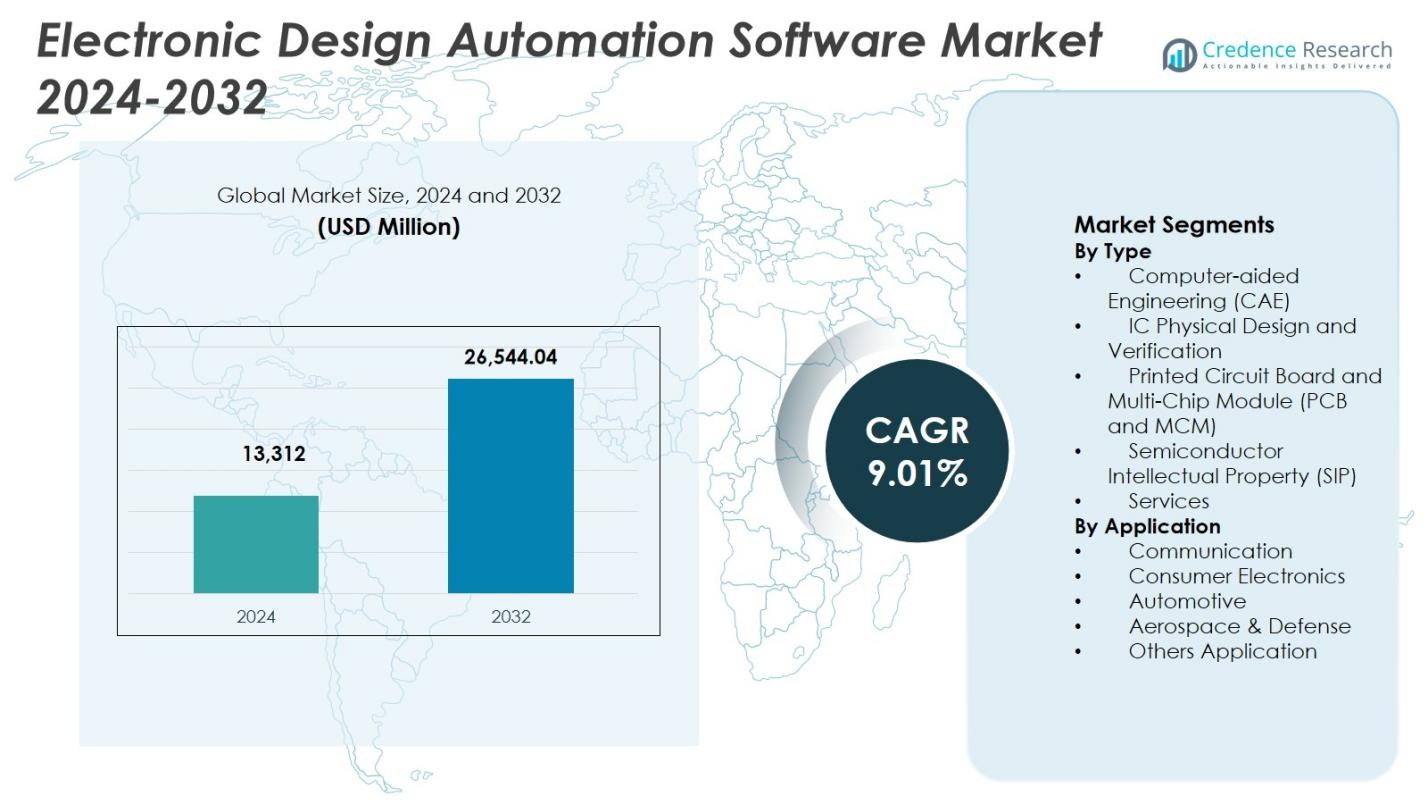
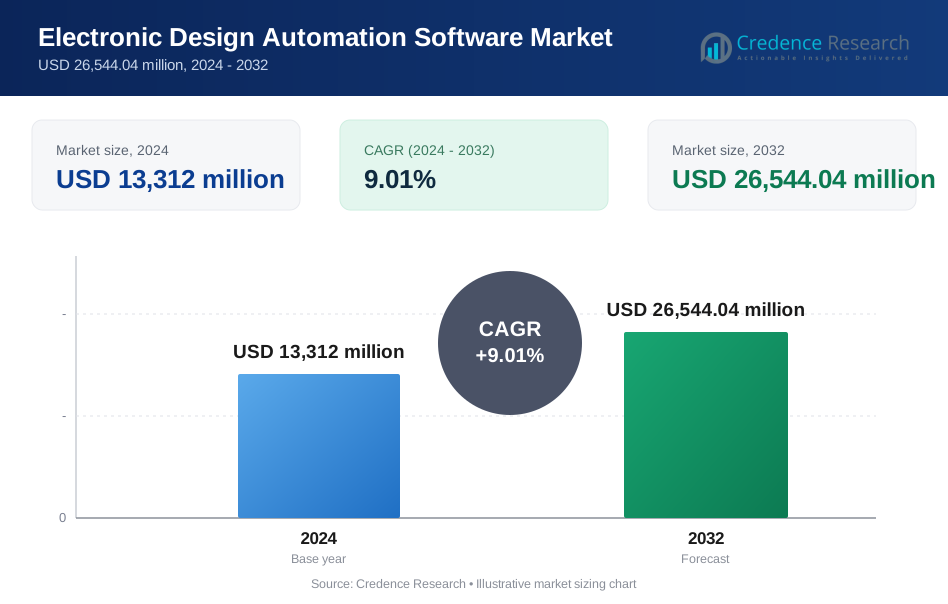
The Electronic Design Automation Software Market size was valued at USD 13,312 million in 2024 and is anticipated to reach USD 26,544.04 million by 2032, growing at a CAGR of 9.01% during the forecast period.
| REPORT ATTRIBUTE | DETAILS |
|---|---|
| Historical Period | 2020-2023 |
| Base Year | 2024 |
| Forecast Period | 2025-2032 |
| Electronic Design Automation Software Market Size 2024 | USD 13,312 Million |
| Electronic Design Automation Software Market, CAGR | 9.01% |
| Electronic Design Automation Software Market Size 2032 | USD 26,544.04 Million |
Electronic Design Automation Software Market is characterized by the strong presence of established technology providers such as Cadence Design Systems Inc., Synopsys Inc., Siemens, ANSYS Inc., Keysight Technologies Inc., SAP, Oracle Corp, Xilinx Inc., BluJay Solutions, and Werner Enterprises. These companies focus on advanced design, verification, simulation, and system-level integration solutions to support increasingly complex semiconductor architectures. Continuous investments in AI-enabled automation, cloud-based design platforms, and advanced packaging capabilities strengthen their market positions. Regionally, North America leads the Electronic Design Automation Software Market with a 39.8% market share, supported by a robust semiconductor ecosystem, high R&D spending, and strong demand from AI, data centers, automotive electronics, and aerospace applications.
Market Insights
- Electronic Design Automation Software Market was valued at USD 13,312 million in 2024 and is projected to grow at a CAGR of 9.01% through the forecast period, supported by rising semiconductor complexity and expanding electronics applications.
- Growing demand for advanced semiconductor nodes, AI accelerators, high-performance computing, and automotive electronics drives sustained adoption of Electronic Design Automation Software Market solutions across design and verification workflows.
- Increasing adoption of AI-enabled automation, cloud-based EDA platforms, and chiplet-based architectures represents a key trend, with IC Physical Design and Verification holding a 34.6% segment share due to advanced node requirements.
- High software costs, complex licensing models, and shortages of skilled design engineers restrain broader adoption, particularly among small and mid-sized firms, despite ongoing innovation by leading EDA vendors.
- North America leads with a 39.8% regional share, followed by Asia-Pacific at 29.4% and Europe at 24.6%, while strong demand from consumer electronics accounts for a 38.2% application segment share.
 Market Segmentation Analysis:
By Type:
Based on type, the Electronic Design Automation Software Market is led by IC Physical Design and Verification, which accounted for 34.6% market share in 2024. This dominance is driven by rising complexity of advanced semiconductor nodes, growing adoption of 5nm and 3nm process technologies, and increasing demand for design rule checking, timing analysis, and functional verification. The rapid expansion of AI accelerators, high-performance computing chips, and system-on-chip (SoC) designs further accelerates adoption. Continuous investments by foundries and fabless companies to reduce design errors and shorten time-to-market strengthen demand for physical design and verification solutions.
- For instance, Cadence's Innovus Implementation System supported imec in taping out a 5nm test chip using EUV lithography and self-aligned quadruple patterning, optimizing power, performance, and area through advanced place-and-route technology.
By Application:
Based on application, Consumer Electronics dominated the Electronic Design Automation Software Market with a 38.2% market share in 2024. Growth is driven by high-volume production of smartphones, wearables, smart home devices, and connected consumer products requiring compact, power-efficient, and high-performance integrated circuits. Frequent product refresh cycles and increasing integration of AI, 5G, and advanced display technologies intensify design complexity, boosting reliance on EDA tools. The strong presence of fabless semiconductor companies and OEMs focusing on rapid innovation and cost optimization further supports sustained demand in the consumer electronics application segment.
- For instance, Synopsys provides EDA tools like DSO.ai for optimizing smartphone processors, enabling autonomous exploration of power-performance-area trade-offs in complex SoCs.
Key Growth Drivers
Increasing Complexity of Advanced Semiconductor Designs
The Electronic Design Automation Software Market is strongly driven by the growing complexity of semiconductor designs. Advanced process nodes, multi-core architectures, and heterogeneous integration significantly increase design and verification requirements. Modern chips used in AI accelerators, high-performance computing, and data centers contain billions of transistors, requiring precise simulation and validation. EDA tools enable accurate timing analysis, power optimization, and functional verification, helping manufacturers manage design complexity. Continuous innovation in semiconductor manufacturing and rising demand for high-performance, energy-efficient chips sustain strong reliance on advanced EDA software platforms.
- For instance, Siemens Innovator3D IC supports heterogeneous 3D IC integration through rapid floorplan prototyping and analysis. It facilitates System Technology Co-optimization for chiplet-based designs on ASE's VIPack platform, handling FOCoS and TSV technologies for ultra-high density packaging.
Rapid Adoption of AI, 5G, and Automotive Electronics
Expanding adoption of AI, 5G, and automotive electronics is a major growth driver for the Electronic Design Automation Software Market. AI workloads require customized processor architectures, increasing demand for advanced design and verification tools. The deployment of 5G infrastructure drives complex RF and mixed-signal designs, while automotive electronics growth is supported by electric vehicles, ADAS, and autonomous driving technologies. These applications require safety-critical and high-reliability designs, reinforcing the need for robust EDA solutions across multiple industry verticals.
- For instance, Keysight's PathWave Advanced Design System (ADS) supports 5G by enabling 3D electromagnetic-circuit co-simulation on multi-technology modules and verifying performance against 5G modulation standards.
Need for Faster Time-to-Market
The pressure to shorten product development cycles significantly drives the Electronic Design Automation Software Market. Semiconductor and electronics manufacturers face intense competition and frequent product refreshes, making rapid innovation essential. EDA tools streamline design workflows through automation, design reuse, and early error detection. Cloud-based EDA platforms enhance collaboration and scalability, enabling faster design iterations. These capabilities help reduce development costs, improve first-pass success rates, and accelerate commercialization of advanced electronic products.
Key Trends and Opportunities
Adoption of AI-Enabled EDA Platforms
AI-enabled design automation represents a major trend in the Electronic Design Automation Software Market. Machine learning algorithms improve placement, routing, verification, and power optimization by learning from large design datasets. These tools reduce manual intervention, improve accuracy, and enhance productivity. AI-driven insights allow early detection of design flaws and performance bottlenecks. This trend creates opportunities for vendors to differentiate offerings with intelligent automation that supports increasingly complex and large-scale semiconductor designs.
- For instance, Siemens Solido provides 2-1000x faster simulation speeds for variation-aware design and verification. The tool supports characterization and IP validation using machine learning on large datasets.
Expansion of Advanced Packaging and Chiplet Designs
Advanced packaging and chiplet architectures create strong growth opportunities in the Electronic Design Automation Software Market. Chiplet-based designs require system-level co-design across silicon, package, and board domains. EDA tools support thermal analysis, signal integrity, and interconnect optimization for heterogeneous integration. As manufacturers adopt chiplets to improve performance and reduce costs, demand increases for EDA solutions that manage cross-domain complexity. Vendors offering integrated, end-to-end design capabilities are well positioned to benefit from this trend.
- For instance, Intel uses its Foveros and EMIB advanced packaging technologies to integrate heterogeneous chiplets, driving demand for EDA tools that support 3D IC thermal analysis, signal integrity, and die-to-die connectivity validation.
Key Challenges
High Cost of Software and Licensing Models
High acquisition and licensing costs remain a key challenge in the Electronic Design Automation Software Market. Advanced EDA tools involve substantial upfront investment, recurring subscription fees, and maintenance expenses. These costs limit adoption among small and mid-sized semiconductor firms and startups. Complex licensing structures also add operational burden. Cost sensitivity in emerging markets further restricts adoption, prompting demand for more flexible pricing models and scalable, cloud-based EDA solutions.
Shortage of Skilled Design and Verification Talent
The shortage of skilled professionals poses a significant challenge for the Electronic Design Automation Software Market. Advanced EDA platforms require expertise in semiconductor physics, system architecture, and complex software workflows. Limited availability of trained engineers increases development timelines and costs. As chip complexity continues to grow, the skills gap widens, placing pressure on organizations to invest in training and automation. Addressing talent shortages remains essential for sustaining long-term market expansion.
Regional Analysis
North America
North America held a 39.8% market share in 2024 in the Electronic Design Automation Software Market, driven by its strong semiconductor ecosystem and early adoption of advanced design technologies. The region benefits from the presence of leading fabless chip companies, integrated device manufacturers, and hyperscale data center operators. High investment in AI, high-performance computing, and cloud infrastructure sustains demand for advanced EDA tools. Continuous innovation in automotive electronics, aerospace systems, and defense technologies further supports growth. Strong R&D spending and close collaboration between EDA vendors and semiconductor manufacturers reinforce North America’s market leadership.
Europe
Europe accounted for a 24.6% market share in 2024 in the Electronic Design Automation Software Market, supported by strong demand from automotive, industrial automation, and aerospace sectors. The region’s focus on electric vehicles, ADAS, and functional safety standards increases reliance on robust design and verification tools. Government-backed semiconductor initiatives and investments in advanced manufacturing strengthen local chip development capabilities. Growing adoption of Industry 4.0, IoT, and smart manufacturing technologies further drives EDA software usage. Europe’s emphasis on quality, reliability, and regulatory compliance sustains steady demand across multiple end-use industries.
Asia-Pacific
Asia-Pacific captured a 29.4% market share in 2024 in the Electronic Design Automation Software Market, driven by its dominant role in semiconductor manufacturing and electronics production. Countries such as China, Taiwan, South Korea, and Japan host major foundries, OSAT providers, and consumer electronics manufacturers. High-volume production of smartphones, consumer devices, and networking equipment fuels demand for EDA tools. Government initiatives supporting domestic semiconductor development and rising investments in AI chips and automotive electronics further strengthen regional growth. Asia-Pacific remains the fastest-growing region due to expanding manufacturing capacity.
Latin America
Latin America represented a 3.6% market share in 2024 in the Electronic Design Automation Software Market, supported by gradual growth in electronics manufacturing and automotive assembly. Increasing adoption of digital technologies, IoT-enabled devices, and industrial automation drives demand for basic and mid-level EDA solutions. Regional semiconductor design activities remain limited, but rising interest in localized electronics production and smart infrastructure projects creates new opportunities. Expansion of automotive electronics and consumer device manufacturing in select countries supports steady growth, although high software costs continue to limit broader adoption.
Middle East & Africa
The Middle East & Africa accounted for a 2.6% market share in 2024 in the Electronic Design Automation Software Market. Growth is supported by increasing investments in smart cities, telecommunications infrastructure, and defense electronics. Governments in the region focus on digital transformation, aerospace development, and advanced manufacturing, creating demand for specialized electronic design tools. Semiconductor design activity remains at a developing stage, but rising adoption of AI, 5G networks, and data centers contributes to gradual market expansion. Limited local expertise and high costs restrain rapid adoption, keeping growth moderate.
Market Segmentations:
By Type
- Computer-aided Engineering (CAE)
- IC Physical Design and Verification
- Printed Circuit Board and Multi-Chip Module (PCB and MCM)
- Semiconductor Intellectual Property (SIP)
- Services
By Application
- Communication
- Consumer Electronics
- Automotive
- Aerospace & Defense
- Others Application
By Geography
- North America
- U.S.
- Canada
- Mexico
- Europe
- Germany
- France
- U.K.
- Italy
- Spain
- Rest of Europe
- Asia Pacific
- China
- Japan
- India
- South Korea
- South-east Asia
- Rest of Asia Pacific
- Latin America
- Brazil
- Argentina
- Rest of Latin America
- Middle East & Africa
- GCC Countries
- South Africa
- Rest of the Middle East and Africa
Competitive Landscape
Competitive landscape of the Electronic Design Automation Software Market is shaped by key players such as Cadence Design Systems Inc., Synopsys Inc., Siemens, ANSYS Inc., Keysight Technologies Inc., SAP, Oracle Corp, Xilinx Inc., BluJay Solutions, and Werner Enterprises. The market structure reflects high entry barriers due to complex technology requirements, long development cycles, and strong customer lock-in. Leading vendors focus on expanding end-to-end design platforms covering simulation, verification, physical design, and system-level analysis to address growing chip complexity. Strategic priorities include integration of AI-driven automation, cloud-enabled deployment models, and support for advanced packaging and chiplet architectures. Companies also invest heavily in R&D, partnerships with foundries and OEMs, and ecosystem development to strengthen tool interoperability. Continuous enhancement of scalability, accuracy, and productivity remains central as customers demand faster design cycles, higher first-pass success rates, and compliance with evolving performance and reliability standards.
Key Player Analysis
- Keysight Technologies Inc.
- SAP
- Cadence Design Systems Inc.
- Werner Enterprises
- Siemens
- Oracle Corp
- Xilinx Inc.
- BluJay Solutions
- ANSYS Inc.
- Synopsys Inc.
Recent Developments
- In December 2025, NVIDIA and Synopsys announced an expanded strategic partnership aimed at revolutionizing design and engineering workflows across industries, underpinned by a $2 billion NVIDIA investment in Synopsys common stock.
- In October 2025, Qiyunfang, a subsidiary of SiCarrier, officially launched two domestically developed Electronic Design Automation (EDA) software products at the SEMiBAY 2025 event, marking a major step toward China’s technological independence in EDA tools.
- In July 2025, Synopsys completed its acquisition of Ansys in a $35 billion deal, combining EDA and advanced simulation capabilities to strengthen its position in chip design and systems engineering software.
Report Coverage
The research report offers an in-depth analysis based on Type, Application and Geography. It details leading market players, providing an overview of their business, product offerings, investments, revenue streams, and key applications. Additionally, the report includes insights into the competitive environment, SWOT analysis, current market trends, as well as the primary drivers and constraints. Furthermore, it discusses various factors that have driven market expansion in recent years. The report also explores market dynamics, regulatory scenarios, and technological advancements that are shaping the industry. It assesses the impact of external factors and global economic changes on market growth. Lastly, it provides strategic recommendations for new entrants and established companies to navigate the complexities of the market.
Future Outlook
- The Electronic Design Automation Software Market will benefit from rising adoption of advanced semiconductor nodes and complex chip architectures.
- Increasing demand for AI, high-performance computing, and data center processors will strengthen long-term reliance on EDA platforms.
- Growing use of chiplet-based designs and advanced packaging will expand the scope of system-level design and verification tools.
- AI-driven automation will play a larger role in improving design efficiency, accuracy, and productivity across EDA workflows.
- Cloud-based EDA deployment will gain momentum due to scalability, collaboration, and cost optimization advantages.
- Automotive electronics growth, driven by electric vehicles and autonomous systems, will increase demand for safety-compliant EDA solutions.
- Expanding 5G and future wireless technologies will support continued demand for RF and mixed-signal design tools.
- Emerging semiconductor ecosystems in Asia-Pacific will contribute significantly to market expansion.
- Vendors will focus on integrated, end-to-end platforms to support faster time-to-market and design reuse.
- Ongoing skills development and automation will remain critical to address growing design complexity and talent shortages.
Request a Free Sample
Fill in your details and we'll send you a free sample report.
- Sample data tables & charts
- Research methodology
Need a Custom Version of This Report?
Tailor the scope, geography, or segments to your exact requirements.
- Custom geography or segment scope
- Direct access to our analyst team
Frequently Asked Questions
What is the current market size for the Electronic Design Automation Software Market, and what is its projected size in 2032?
At what Compound Annual Growth Rate is the Electronic Design Automation Software Market projected to grow between 2024 and 2032?
Which Electronic Design Automation Software Market segment held the largest share in 2024?
What are the primary factors fueling the growth of the Electronic Design Automation Software Market?
Who are the leading companies in the Electronic Design Automation Software Market?
Which region commanded the largest share of the Electronic Design Automation Software Market in 2024?
Table of Content
Chapter 1. Report Introduction
- 1.1 Report Description & Purpose
- 1.1.1 Report Title & Market Definition
- 1.1.2 Unique Selling Propositions (USP) & Key Differentiators
- 1.1.3 Value Proposition for Stakeholders
- 1.2 Research Objectives
- 1.2.1 Market Sizing Objectives (Volume & Revenue)
- 1.2.2 Segmentation Objectives
- 1.2.3 Competitive Intelligence Objectives
- 1.2.4 Forecast & Scenario Objectives
- 1.3 Report Scope
- 1.3.1 Electronic Design Automation Software Scope – Types & Subtypes Covered
- 1.3.2 Geographic Scope – Regions & Countries Covered
- 1.3.3 Historical Period, Base Year & Forecast Period (2024; forecast to 2032)
- 1.3.4 Inclusions & Exclusions
- 1.4 HS Code & Classification Framework
- 1.5 Currency, Units & Pricing Basis
- 1.6 Target Stakeholders
- 1.7 Limitations & Assumptions
Chapter 2. Executive Summary
- 2.1 Global Electronic Design Automation Software Market Snapshot
- 2.1.1 Market Size – Historical (2024) & Forecast (2024-2032) (2024: USD 13,312 million → 2032: USD 26,544.04 million)
- 2.1.2 Volume & Revenue – Global Totals
- 2.1.3 Key Market Highlights – Top Five Facts
- 2.2 Electronic Design Automation Software Market Segmentation Snapshot
- 2.2.1 Market Split by Region – 2024 vs. 2032
- 2.3 Competitive Snapshot
- 2.3.1 Top 10 Players by Revenue Share – 2024
- 2.3.2 Top 10 Players by Volume Share – 2024
- 2.3.3 Recent Strategic Developments (18-Month Summary)
- 2.4 Key Investment Highlights & Strategic Conclusions
Chapter 3. Electronic Design Automation Software Market Dynamics & Industry Analysis
- 3.1 Market Overview & Context
- 3.1.1 Electronic Design Automation Software Market Position in the Broader Automotive Value Chain
- 3.1.2 OEM vs. Replacement Market Dynamics
- 3.1.3 Market Maturity & Development Stage by Region
- 3.2 Electronic Design Automation Software Market Drivers
- 3.3 Electronic Design Automation Software Market Restraints & Challenges
- 3.4 Electronic Design Automation Software Market Opportunities
- 3.5 Porter's Five Forces Analysis
- 3.5.1 Threat of New Entrants
- 3.5.2 Bargaining Power of Suppliers
- 3.5.3 Bargaining Power of Buyers
- 3.5.4 Threat of Substitutes
- 3.5.5 Competitive Rivalry – Intensity Assessment
- 3.6 Electronic Design Automation Software Value Chain Analysis
- 3.6.1 Upstream – Raw Material/Input Suppliers
- 3.6.1.1 Raw Material/Input 1
- 3.6.1.2 Raw Material/Input 2
- 3.6.1.3 Raw Material/Input 3
- 3.6.2 Midstream – Production/Manufacturing/Service Delivery
- 3.6.2.1 Production/Process Overview
- 3.6.2.2 Key Facility Locations & Capacity by Manufacturer
- 3.6.3 Downstream – Distribution & End Consumer
- 3.6.3.1 Primary Channel – B2B/OEM
- 3.6.3.2 Secondary Channels – Dealer, Retail, Online, Direct
- 3.6.4 Value Chain Profitability Analysis
- 3.6.1 Upstream – Raw Material/Input Suppliers
- 3.7 PESTEL Analysis
- 3.7.1 Political Factors
- 3.7.2 Economic Factors
- 3.7.3 Social Factors
- 3.7.4 Technological Factors
- 3.7.5 Environmental Factors
- 3.7.6 Legal Factors
- 3.8 Electronic Design Automation Software Supply Chain Analysis
- 3.8.1 Raw Material/Input Supply Risk Assessment
- 3.8.2 Manufacturing Concentration Risk (Geographic Exposure)
- 3.8.3 Trade Disruption Impact Analysis
- 3.9 Regulatory & Policy Landscape
Note: The regulatory and policy landscape section covers regulations based on their applicability to the market, Electronic Design Automation Software category, geography, and scope of the study. Only regulatory frameworks with a material impact on operations, compliance, trade, sustainability, or market access are analyzed in detail.
Chapter 4. Key Investment Pockets & Opportunity Analysis
- 4.1 Electronic Design Automation Software Market Attractiveness Analysis
- 4.1.1 By Region – Investment Attractiveness Matrix (Volume × CAGR)
- 4.2 Absolute Revenue Growth Opportunity
- 4.2.1 By Region – Absolute USD Growth Through 2032
- 4.3 Incremental Volume Opportunity
- 4.3.1 By Region – Incremental Volume Through 2032
- 4.3.2 Segment – Incremental Volume
- 4.4 Emerging Submarket Opportunity Deep Dive (Subject to Applicability)
- 4.5 Emerging Market Opportunity Scorecards
- 4.5.1 United States
- 4.5.2 Europe
- 4.5.3 Asia
- 4.5.4 Middle East & Africa
Note: Emerging Market Opportunity Scorecards will be included based on relevance and strategic importance. Regions listed are indicative and may vary depending on data availability and market dynamics.
Chapter 5. Electronic Design Automation Software Import-Export Analysis & Trade Flows
- 5.1 Global Trade Overview
- 5.1.1 Global Export Value by Country (2024)
- 5.1.2 Global Export Volume by Country (2024)
- 5.1.3 Global Import Value by Country (2024)
- 5.1.4 Global Import Volume by Country (2024)
- 5.1.5 Net Trade Balance by Country (2024)
- 5.2 Export Analysis – Segment
- 5.2.1 Type 1 (HS Code)
- 5.2.2 Type 2 (HS Code)
- 5.2.3 Type 3 (HS Code)
- 5.2.4 Type 4 (HS Code)
- 5.2.5 Type 5 (HS Code)
- 5.3 Import Analysis – Segment
- 5.3.1 Type 1 (HS Code)
- 5.3.2 Type 2 (HS Code)
- 5.3.3 Type 3 (HS Code)
- 5.3.4 Type 4 (HS Code)
- 5.3.5 Type 5 (HS Code)
- 5.4 Average Unit Trade Prices
- 5.4.1 Average Export Price – Segment & Country
- 5.4.2 Average Import Price – Segment & Source Country
- 5.4.3 Price Trends (2024)
- 5.5 Key Trade Route Analysis
- 5.5.1 Trade Route 1
- 5.5.2 Trade Route 2
- 5.5.3 Trade Route 3
- 5.5.4 Trade Route 4
- 5.5.5 Trade Route 5
- 5.6 Trade Policy Impact Assessment
- 5.6.1 US Anti-Dumping & Section 301 Tariffs
- 5.6.2 EU Customs Union Impact
- 5.6.3 Major Free Trade Agreements
- 5.6.4 USMCA Rules of Origin
Note: Trade policy analysis will be included only where relevant to the Electronic Design Automation Software market.
Chapter 6. Competitive Landscape & Company Benchmarking
- 6.1 Electronic Design Automation Software Market Concentration & Structure
- 6.1.1 Herfindahl-Hirschman Index (HHI) – vs. 2024
- 6.1.2 Tier 1, Tier 2 & Tier 3 Market Structure
- 6.1.3 Global, Regional & Local Player Dynamics
- 6.2 Electronic Design Automation Software Market Share Analysis – 2024
- 6.2.1 Global Revenue Share by Company
- 6.2.2 Global Volume Share by Company
- 6.2.3 Regional Revenue Share
- 6.2.4 Market Share Evolution ( vs. 2024)
- 6.2.5 OEM Segment Share by Company
- 6.2.6 Replacement Segment Share by Company
- 6.3 Production/Delivery Capacity & Facility Analysis
- 6.3.1 Global Installed Capacity
- 6.3.2 Capacity Utilization Rates
- 6.3.3 Production/Output Volume
- 6.3.4 Facility Locations & Capacity Map
- 6.3.5 Planned Capacity Additions
- 6.4 Electronic Design Automation Software Competitive Benchmarking Matrix
- 6.4.1 Revenue, Volume, CAGR & Profitability Comparison
- 6.4.2 Channel Revenue Mix
- 6.4.3 Geographic Revenue Exposure
- 6.4.4 R&D Intensity
- 6.4.5 Sustainability Maturity
- 6.5 Strategic Developments in Electronic Design Automation Software (Last 24 Months)
- 6.5.1 Mergers, Acquisitions & Divestments
- 6.5.2 New Electronic Design Automation Software Launches
- 6.5.3 Facility Expansions
- 6.5.4 Strategic Alliances, Joint Ventures & Partnerships
- 6.5.5 Distribution Expansion & Market Entry
- 6.5.6 Sustainability & ESG Initiatives
- 6.6 Competitive Strategy Mapping
- 6.6.1 Leader, Challenger, Follower & Niche Classification
- 6.6.2 Pricing Strategy Comparison
- 6.6.3 Channel Strategy Matrix
Note: Strategic developments are included based on their materiality and the availability of reliable information.
Chapter 7. Global Electronic Design Automation Software Market – By Distribution Channel
- 7.1 Segment Overview
- 7.1.1 Volume & Revenue Split by Channel (2024 & 2032)
- 7.1.2 Channel Mix Evolution (2024-2032)
Chapter 8. Regional Market Analysis – Global Overview
- 8.1 Global Regional Overview
- 8.1.1 Regional Volume Share
- 8.1.2 Regional Revenue Share
- 8.1.3 Regional Volume by Region
- 8.1.4 Regional Revenue by Region
- 8.1.5 Regional Forecast Through 2032
- 8.2 Cross-Regional Segment Analysis
- 8.2.1 By Distribution Channel
- 8.2.2 By Brand/Price Tier
Chapter 9. North America Electronic Design Automation Software Market
- 9.1 United States
- 9.2 Canada
- 9.3 Mexico
Chapter 10. Europe Electronic Design Automation Software Market
- 10.1 Germany
- 10.2 France
- 10.3 Italy
- 10.4 United Kingdom
- 10.5 Spain
- 10.6 Poland
- 10.7 Russia
- 10.8 Netherlands
- 10.9 Belgium
- 10.10 Sweden
- 10.11 Denmark
- 10.12 Norway
- 10.13 Rest of Europe
Chapter 11. Asia Pacific Electronic Design Automation Software Market
- 11.1 China
- 11.2 India
- 11.3 Japan
- 11.4 South Korea
- 11.5 Thailand
- 11.6 Indonesia
- 11.7 Vietnam
- 11.8 Malaysia
- 11.9 Australia
- 11.10 Rest of Asia Pacific
Chapter 12. Latin America Electronic Design Automation Software Market
- 12.1 Brazil
- 12.2 Argentina
- 12.3 Colombia
- 12.4 Chile
- 12.5 Rest of Latin America
Chapter 13. Middle East Electronic Design Automation Software Market
- 13.1 Saudi Arabia
- 13.2 United Arab Emirates
- 13.3 Turkey
- 13.4 Israel
- 13.5 Iran
- 13.6 Rest of the Middle East
Chapter 14. Africa Electronic Design Automation Software Market
- 14.1 South Africa
- 14.2 Egypt
- 14.3 Nigeria
- 14.4 Morocco
- 14.5 Rest of Africa
Chapter 15. Electronic Design Automation Software Company Profiles
- 15.1 [Company 01]
- 15.1.1 Company Overview
- 15.1.2 Key Management Personnel
- 15.1.3 Products & Services Portfolio
- 15.1.4 Financial Performance
- 15.1.5 Key Market Focus & Geographic Presence
- 15.1.6 Recent Developments & Strategic Initiatives
Note: The company profile list is preliminary and may change based on research findings, market developments, data availability, and client requirements.
Chapter 16. Appendices
- Appendix A – List of Abbreviations & Acronyms
- Appendix B – Industry Classification Code Reference – Full Series
- Appendix C – Production & Capacity Data Tables
- Appendix D – End-Use & Demand Base Tables
- Appendix E – Consumption & Replacement Rate Assumptions
- Appendix F – ASP Reference Tables
- Appendix G – Manufacturing & Facility Database
- Appendix H – Import-Export Data Tables
- Appendix I – Regulatory Summary Tables
- Appendix J – Primary Research Participant List (Anonymized)
- Appendix K – Primary Research Questionnaire Framework
- Appendix L – Data Sources & Bibliography
- Appendix M – Market Size Divergence & Source Comparison
Chapter 17. Research Methodology
- 17.1 Research Framework & Philosophy
- 17.2 Secondary Research – Sources, Hierarchy & Data Extraction
- 17.3 Data Modeling – Bottom-Up & Top-Down Market Sizing
- 17.4 Primary Research – Stakeholder Framework, LOI & Sample Sizes
- 17.5 Forecast Methodology – Regression, Scenario & Sensitivity Analysis
- 17.6 Quality Control – Four-Layer Validation Framework
- 17.7 Limitations & Standard Assumptions
- 17.8 Disclaimer
