Market Overview
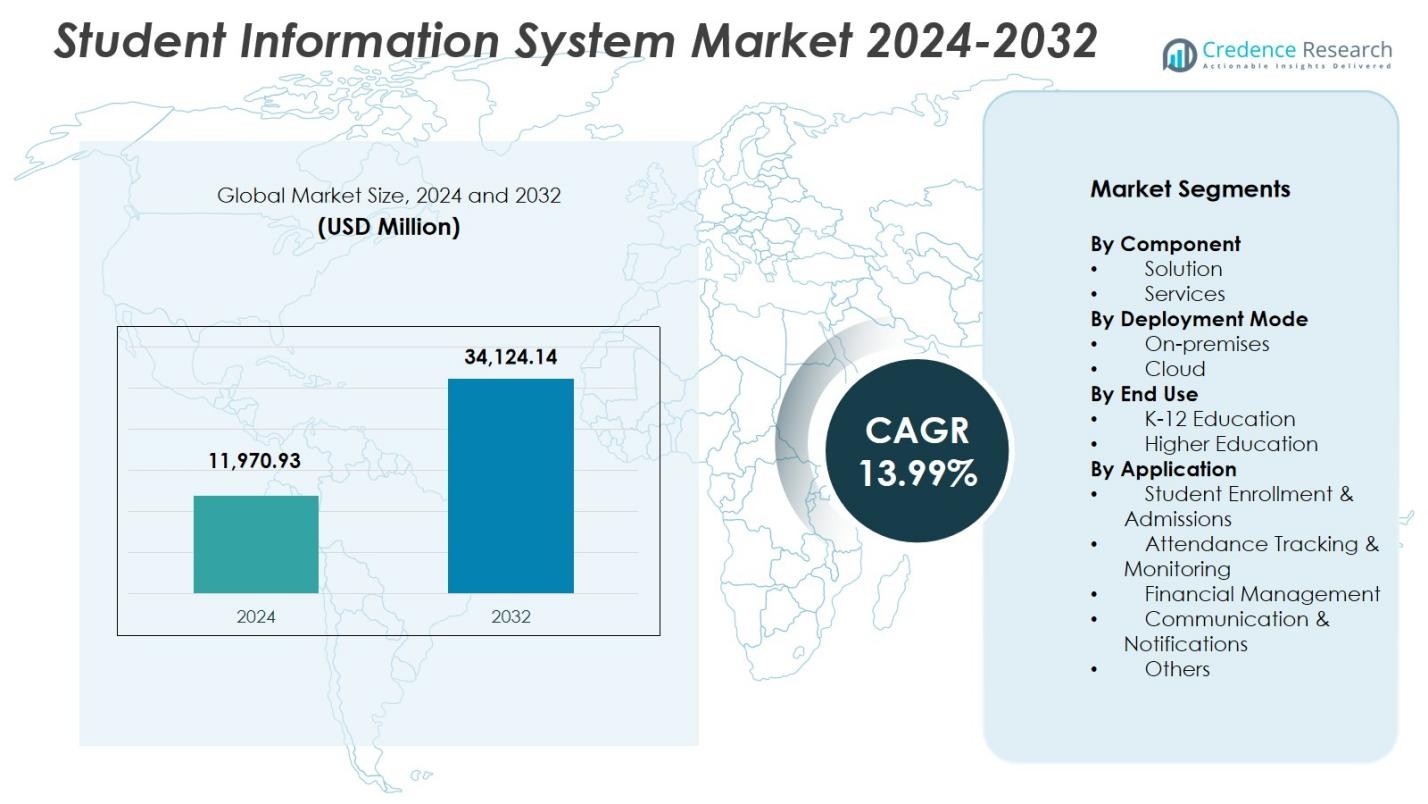
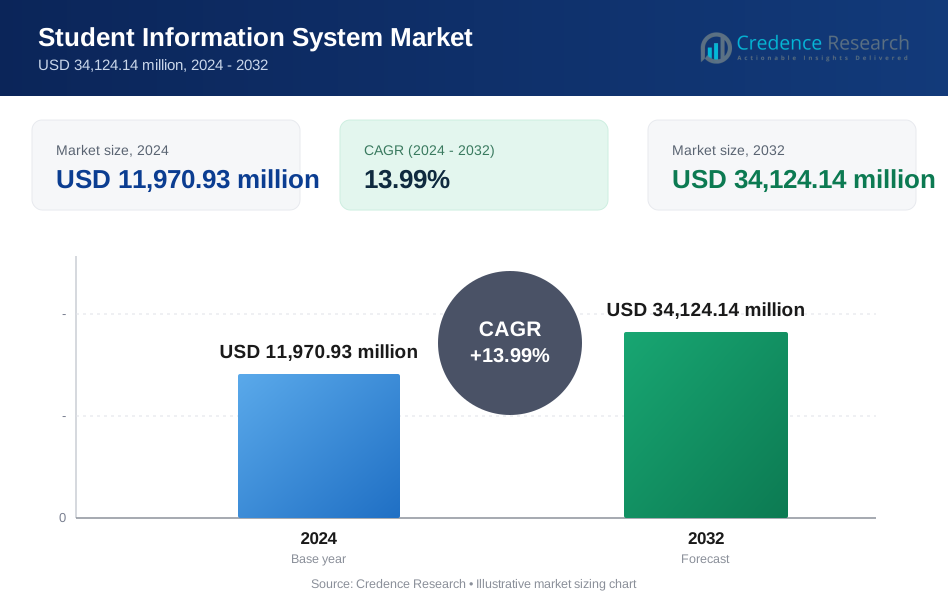
Student Information System Market size was valued at USD 11,970.93 million in 2024 and is anticipated to reach USD 34,124.14 million by 2032, at a CAGR of 13.99% during the forecast period.
| REPORT ATTRIBUTE | DETAILS |
|---|---|
| Historical Period | 2020-2023 |
| Base Year | 2024 |
| Forecast Period | 2025-2032 |
| Student Information System Market Size 2024 | USD 11,970.93 Million |
| Student Information System Market, CAGR | 13.99% |
| Student Information System Market Size 2032 | USD 34,124.14 Million |
Student Information System Market features major players including Campus Management, ComSpec International, Ellucian, Focus School Software, Jenzabar, SAP, Skyward, Tribal Group, Veracross, and Workday, each strengthening their presence through cloud-enabled platforms, analytics-driven modules, and enhanced integration capabilities. These companies focus on delivering scalable and user-centric SIS solutions that streamline enrollment, academic management, communication, and compliance processes across educational institutions. Regionally, North America leads the market with a 34.6% share, supported by strong digital adoption and advanced IT infrastructure, while Europe and Asia-Pacific follow, driven by modernization initiatives and increasing demand for centralized education management systems.
 Market Insights
- The Student Information System Market was valued at USD 11,970.93 million in 2024 and is projected to reach USD 34,124.14 million by 2032, growing at a CAGR of 13.99%.
- Growing demand for digital administration, centralized data management, and integrated academic workflows drives strong adoption of SIS solutions, with the Solution segment holding a 62.4% share.
- Cloud deployment remains the dominant trend, capturing 68.7% share as institutions shift toward scalable, secure, and mobile-accessible platforms supporting modern learning environments.
- Key players focus on enhancing interoperability, analytics, and automation to strengthen market presence, while high implementation costs and data security risks continue to restrain growth in some regions.
- North America leads with a 34.6% share, followed by Europe at 28.3% and Asia-Pacific at 24.7%, supported by rising digital initiatives; the Higher Education segment maintains leadership with a 57.9% share.
Market Segmentation Analysis:
By Component:
In the Student Information System Market, the Solution segment leads with a 62.4% share, driven by rising demand for integrated platforms that streamline enrollment, attendance tracking, grade management, and administrative workflows. Institutions increasingly prioritize automation and digital transformation, pushing adoption of robust SIS solutions that offer scalability and analytics capabilities. The Services segment, holding the remaining share, grows as schools seek implementation, customization, and support to optimize system performance. The dominance of the Solution segment reflects the sector’s shift toward centralized systems that enhance operational efficiency and real-time decision-making.
- For instance, Ellucian Banner powers more than 2,500 institutions across 50 countries, serving over 20 million students, with the Colorado School of Mines transitioning to its SaaS version in 2024 to streamline operations.
By Deployment Mode:
The Cloud segment dominates the Student Information System Market with a 68.7% share, supported by rapid migration toward SaaS-based education technologies offering flexibility, lower infrastructure costs, and remote accessibility. Cloud-deployed SIS platforms enable seamless updates, data security enhancements, and scalable storage, which are increasingly essential for digitally evolving institutions. The On-premises segment remains relevant for organizations prioritizing data control, but its share continues to decline as cloud adoption accelerates. The strong dominance of cloud deployment is driven by the need for mobile-enabled access, cost optimization, and improved collaboration across stakeholders.
- For instance, KIPP Memphis Collegiate Schools moved PowerSchool SIS to cloud hosting, automating updates to ease IT burdens, ensure timely state reporting for funding, and enable secure remote data access.
By End Use:
The Higher Education segment leads the Student Information System Market with a 57.9% share, propelled by growing enrollment volumes, diversified academic programs, and the need for advanced data management across student lifecycles. Universities adopt SIS platforms to support digital learning, automate complex administrative processes, and enable analytics-driven decision-making. While K-12 Education also demonstrates solid adoption, its share remains lower as schools transition more gradually to fully integrated digital systems. The dominance of Higher Education is driven by rising demand for multi-campus management, compliance reporting, and personalized student engagement solutions.
Key Growth Drivers
Rapid Digital Transformation in Educational Institutions
Educational institutions increasingly adopt digital solutions to streamline administrative processes, enhance student engagement, and modernize campus operations. This shift accelerates the deployment of Student Information Systems (SIS), which integrate enrollment, attendance, grading, and communication into a unified platform. The growing demand for automation, coupled with the need for real-time data accessibility, strengthens system adoption across K–12 schools and higher education. As institutions prioritize operational efficiency and data-driven decision-making, SIS platforms become essential infrastructure supporting long-term modernization strategies.
- For instance, Furman University adopted Workday Student SIS, reducing course registration processing time from weeks to 15 minutes through streamlined workflows for planning, advising, finances, and academics. Students access these features via a single mobile interface.
Rising Need for Centralized Data Management and Analytics
The surge in student enrollment, diverse learning models, and complex academic structures has increased the need for centralized data ecosystems. Student Information Systems enable institutions to consolidate academic, financial, and demographic data, ensuring seamless workflows and regulatory compliance. Advanced analytics capabilities further help administrators forecast performance trends, enhance resource planning, and support personalized learning pathways. As data-driven governance becomes integral to institutional success, SIS adoption grows rapidly, driven by its capacity to improve accuracy, transparency, and institutional accountability.
- For instance, Colorado School of Mines transitioned to Ellucian Banner SaaS to manage student data and operations across its campus. This implementation supports centralized handling of enrollment, financial aid, and academic records for improved efficiency.
Expanding Adoption of Cloud-Based and Mobile-Enabled Platforms
Cloud-based SIS platforms are witnessing strong growth due to their scalability, lower upfront investment, and enhanced accessibility for students, faculty, and administrators. Mobile-enabled features further improve user convenience by supporting remote learning, digital attendance, and on-the-go communication. Cloud deployments also ensure rapid updates, stronger cybersecurity protocols, and integration with learning management systems and ERP platforms. As institutions prioritize flexibility and cost optimization, the adoption of cloud and mobile-centric SIS solutions becomes a major driver propelling market expansion worldwide.
Key Trends & Opportunities
Integration of AI, Automation, and Predictive Analytics
A major trend shaping the Student Information System Market is the integration of AI-driven automation and predictive analytics. Institutions increasingly deploy AI tools to automate administrative tasks, monitor student performance, optimize scheduling, and flag at-risk learners. Predictive analytics also unlock opportunities for personalized academic planning and targeted interventions. As educational institutions shift toward proactive, data-led management approaches, SIS vendors integrating machine learning, chatbots, and intelligent dashboards gain a competitive advantage, creating new opportunities for enhanced student outcomes and operational efficiency.
- For instance, Salesforce Education Cloud incorporates Agentforce AI agents to automate tasks like course registration holds and deliver personalized nudges. These agents provide 24/7 support, guiding students through processes and improving retention through proactive interventions.
Growing Demand for Interoperable and Modular SIS Ecosystems
The market is witnessing rising demand for interoperable SIS platforms that integrate seamlessly with LMS, CRM, ERP, and curriculum management systems. Institutions increasingly prefer modular architectures that allow incremental adoption based on evolving needs, enabling cost-effective modernization. This trend creates strong opportunities for vendors offering API-driven platforms, microservices, and plug-and-play functionalities. As education systems move toward holistic digital ecosystems, interoperable SIS solutions enable institutions to enhance collaboration, improve data flow across departments, and build scalable long-term digital strategies.
- For instance, PowerSchool SIS integrates with Instructure's Canvas LMS via OneRoster 1.1 APIs, syncing rostering data to Canvas while posting assignments and grades back to PowerSchool's gradebook. This setup automates data flow for teachers, reducing manual entry.
Key Challenges
Data Privacy, Security Risks, and Compliance Requirements
Educational institutions face growing concerns around sensitive student data, making cybersecurity a major challenge in SIS adoption. Cloud deployments and extensive data integration heighten risks related to breaches, unauthorized access, and compliance with regulations such as FERPA and GDPR. Institutions must invest in advanced encryption, access controls, and security monitoring, which increases operational complexity and cost. Vendors must continuously enhance security frameworks to address evolving threats, as any vulnerability can undermine trust and slow system adoption across the sector.
High Implementation Costs and Integration Complexities
Despite growing interest, many institutions especially smaller schools and resource-constrained districts struggle with the high implementation, customization, and training costs associated with SIS solutions. Integrating SIS platforms with legacy systems, diverse databases, and third-party applications further complicates deployment timelines and increases support requirements. These challenges often delay digital transition and create adoption barriers in emerging regions. Vendors must focus on simplified deployment models, low-code integrations, and cost-effective service options to overcome these limitations and expand market penetration.
Regional Analysis
North America
North America leads the Student Information System Market with a 34.6% share, supported by strong digital adoption across K–12 districts and higher education institutions. Schools increasingly invest in SIS platforms to modernize operations, enhance compliance reporting, and strengthen student engagement. Government-backed initiatives promoting digital learning, combined with widespread use of cloud-based and mobile-enabled systems, accelerate market growth. The region benefits from the presence of major SIS vendors and advanced IT infrastructure that supports seamless integration with LMS, ERP, and analytics tools. Growing demand for data-driven academic management continues to reinforce North America’s dominance.
Europe
Europe holds a 28.3% share in the Student Information System Market, driven by growing emphasis on educational modernization and the increasing adoption of digital governance frameworks across universities and public schools. Institutions focus on enhancing transparency, improving administrative workflows, and complying with GDPR-driven data management standards, fueling SIS implementation. The rise of cross-border education programs and multi-campus institutions further strengthens demand for unified student data platforms. Cloud solutions gain traction due to scalability and cost efficiency, while ongoing digital transformation initiatives across Western and Northern Europe continue to expand the region’s SIS adoption.
Asia-Pacific
Asia-Pacific accounts for a 24.7% share of the Student Information System Market, supported by rapid growth in student enrollment, expanding private education sectors, and accelerated digitalization across emerging economies. Governments invest heavily in EdTech infrastructure, enabling widespread adoption of SIS platforms in schools and universities. Cloud-based systems are increasingly preferred due to affordability and ease of deployment across large-scale institutions. The region’s strong shift toward blended and online learning models drives demand for integrated SIS and LMS environments. Growing awareness of data analytics for academic planning further positions Asia-Pacific as the fastest-growing regional market.
Latin America
Latin America holds a 7.6% share of the Student Information System Market, with adoption steadily rising as educational institutions prioritize modernization and operational efficiency. Economic reforms and increased public investment in digital education accelerate system integration across schools and universities. Cloud-based SIS platforms attract strong demand due to lower infrastructure requirements and improved accessibility in remote areas. The region experiences growing partnerships between local governments and EdTech providers aimed at enhancing student performance tracking and administrative transparency. Despite infrastructure challenges in certain countries, SIS adoption continues to expand as institutions embrace digital transformation.
Middle East & Africa
The Middle East & Africa region captures a 4.8% share of the Student Information System Market, driven by increasing investments in digital education, expanding private schooling networks, and government-led modernization programs. Higher education institutions in the Gulf Cooperation Council (GCC) countries adopt SIS platforms to support internationalization, accreditation needs, and data-driven campus management. African nations are gradually integrating SIS solutions to improve administrative efficiency and support growing enrollment levels. Cloud-based deployments gain popularity due to their flexibility and cost efficiency. Rising focus on e-learning infrastructure continues to support steady SIS adoption across the region.
Market Segmentations:
By Component
- Solution
- Services
By Deployment Mode
- On-premises
- Cloud
By End Use
- K-12 Education
- Higher Education
By Application
- Student Enrollment & Admissions
- Attendance Tracking & Monitoring
- Financial Management
- Communication & Notifications
- Others
By Geography
- North America
- U.S.
- Canada
- Mexico
- Europe
- Germany
- France
- U.K.
- Italy
- Spain
- Rest of Europe
- Asia Pacific
- China
- Japan
- India
- South Korea
- South-east Asia
- Rest of Asia Pacific
- Latin America
- Brazil
- Argentina
- Rest of Latin America
- Middle East & Africa
- GCC Countries
- South Africa
- Rest of the Middle East and Africa
Competitive Landscape
Competitive landscape in the Student Information System Market features leading players such as Campus Management, ComSpec International, Ellucian, Focus School Software, Jenzabar, SAP, Skyward, Tribal Group, Veracross, and Workday, each strengthening their portfolios through innovation, cloud transformation, and modular system enhancements. Vendors increasingly focus on integrated platforms that unify academic, administrative, and communication functions to support institutional digitalization. Cloud-first architectures, API-driven interoperability, and mobile-enabled interfaces have become core differentiators as institutions demand scalable and user-centric systems. Many players invest in AI-driven analytics, predictive insights, and workflow automation to enhance decision-making and student outcomes. Strategic partnerships with universities, EdTech firms, and technology providers further boost market reach, while continuous upgrades in cybersecurity frameworks remain essential to address growing data protection concerns. The competitive environment continues to intensify as SIS vendors expand global footprints and develop flexible deployment models tailored to diverse institutional needs.
Key Player Analysis
- Focus School Software
- Veracross
- ComSpec International
- Campus Management
- Workday
- SAP
- Jenzabar
- Skyward
- Tribal Group
- Ellucian
Recent Developments
- In November 2025, Ellucian was named the successful bidder to acquire Anthology’s Student Information Systems (SIS) and ERP business, expanding its higher education solutions portfolio.
- In September 2025, Blackbaud introduced powerful updates and integrations, including Google Classroom integration and enhanced AI tools for its K–12 SIS offerings.
- In October 2025, Flywire expanded its partnership with Workday, integrating to support Workday Student’s financial and administrative workflows.
Report Coverage
The research report offers an in-depth analysis based on Component, Deployment Mode, End Use, Application and Geography. It details leading market players, providing an overview of their business, product offerings, investments, revenue streams, and key applications. Additionally, the report includes insights into the competitive environment, SWOT analysis, current market trends, as well as the primary drivers and constraints. Furthermore, it discusses various factors that have driven market expansion in recent years. The report also explores market dynamics, regulatory scenarios, and technological advancements that are shaping the industry. It assesses the impact of external factors and global economic changes on market growth. Lastly, it provides strategic recommendations for new entrants and established companies to navigate the complexities of the market.
Future Outlook
- The market will expand rapidly as institutions accelerate digital transformation across administrative and academic workflows.
- Cloud-based SIS platforms will gain stronger adoption due to scalability, lower maintenance needs, and remote accessibility.
- AI-driven analytics and automation will play a central role in enhancing student performance tracking and operational efficiency.
- Mobile-enabled SIS solutions will become essential as students and faculty demand seamless real-time access to academic information.
- Integration with LMS, ERP, CRM, and digital payment platforms will strengthen to support unified digital campus ecosystems.
- Personalization features will rise as institutions adopt data-driven approaches to improve student engagement and retention.
- Vendors will focus on modular architectures that allow schools to adopt SIS components in phases based on evolving needs.
- Cybersecurity investments will increase as institutions prioritize protection of sensitive student and institutional data.
- Emerging markets will witness significant adoption driven by government-led digital education initiatives.
- Partnerships between SIS providers and EdTech companies will intensify, fostering ecosystem expansion and innovation.
Request a Free Sample
Fill in your details and we'll send you a free sample report.
- Sample data tables & charts
- Research methodology
Need a Custom Version of This Report?
Tailor the scope, geography, or segments to your exact requirements.
- Custom geography or segment scope
- Direct access to our analyst team
Frequently Asked Questions
What is the current market size for Student Information System Market, and what is its projected size in 2032?
At what Compound Annual Growth Rate is the Student Information System Market projected to grow between 2024 and 2032?
Which Student Information System Market segment held the largest share in 2024?
What are the primary factors fueling the growth of the Student Information System Market?
Who are the leading companies in the Student Information System Market?
Which region commanded the largest share of the Student Information System Market in 2024?
Table of Content
Chapter 1 Market Segmentation
- 1.1 Segmentation Framework
- 1.1.1 Product and Service Classification
- 1.1.2 Application and End-Use Classification
- 1.1.3 Technology and Solution Classification
- 1.1.4 Customer and Distribution Channel Classification
- 1.1.5 Geographic Segmentation
- 1.1.6 Market Segment Definitions and Boundaries
Chapter 2 Introduction
- 2.1 Report Objectives and Scope
- 2.2 Product Definition and Industry Terminology
- 2.3 Market Inclusions and Exclusions
- 2.4 Research Process
- 2.4.1 Primary Research and Expert Interviews
- 2.4.2 Secondary Research and Source Review
- 2.4.3 Top-Down and Bottom-Up Estimation
- 2.4.4 Data Triangulation and Verification
- 2.5 Market Size Measurement Basis
- 2.5.1 2024: USD 11,970.93 million → 2032: USD 34,124.14 million
- 2.6 Historical and Forecast Reference Periods
- 2.6.1 Base Year: 2024
- 2.6.2 Forecast Period: 2024-2032
- 2.7 Research Assumptions and Limitations
Chapter 3 Executive Summary
- 3.1 Market Snapshot and Key Findings
- 3.2 Base-Year Market Size, 2024
- 3.3 Forecast Market Size, 2032
- 3.4 Revenue and Volume Growth Outlook
- 3.5 Key Demand and Supply Indicators
- 3.6 Leading Market Segments
- 3.7 Fastest-Growing Market Opportunities
- 3.8 Regional Performance Highlights
- 3.9 Technology and Industry Transformation
- 3.10 Competitive Landscape Summary
- 3.11 Analyst View and Strategic Implications
Chapter 4 Global Student Information System Market Trends and Developments
- 4.1 Historical Industry Development
- 4.2 Recent Market Trends and Developments
- 4.3 Demand and Customer Behavior Trends
- 4.4 Technology and Product Innovation
- 4.5 Artificial Intelligence, Automation and Digitalization
- 4.6 Local Manufacturing and Supply Chain Realignment
- 4.7 Industry Partnerships, Mergers and Acquisitions
- 4.8 Sustainability and Circular Economy Developments
- 4.9 Government and Private Sector Investment Trends
- 4.10 Emerging Business Models and Commercialization
- 4.11 Industry Developments and Announcements
Chapter 5 Global Student Information System Market Production, Supply and Demand Analysis
- 5.1 Demand Trend and Consumption Analysis
- 5.2 Demand Forecast, 2024-2032
- 5.3 Production and Output Trend
- 5.4 Production and Output Forecast, 2024-2032
- 5.5 Installed Capacity and Capacity Utilization
- 5.6 Company-Wise Production Plants and Statistics
- 5.6.1 Installed Production Capacity
- 5.6.2 Actual Production
- 5.6.3 Planned Capacity and Expansion Targets
- 5.7 Supply Chain Structure and Procurement Trends
- 5.8 Supply-Demand Gap and Bottlenecks
- 5.9 Import Dependence and Sourcing Structure
- 5.10 Contract Manufacturing and Outsourcing
- 5.11 Regional Supply and Demand Concentration
Chapter 6 Global Student Information System Market Pricing Analysis
- 6.1 Pricing Structure and Measurement
- 6.2 Historical Pricing Trends
- 6.3 Pricing Outlook, 2024-2032
- 6.4 Average Selling Price and Unit Economics
- 6.5 Pricing by Product and Market Segment
- 6.6 Geographic Pricing Differences
- 6.7 Key Input, Energy, Labor and Logistics Costs
- 6.8 Contract Pricing and Purchasing Models
- 6.9 Pricing Sensitivity and Competitive Positioning
- 6.10 Price, Margin and Profitability Implications
Chapter 7 Global Student Information System Market Dynamics
- 7.1 Market Growth Drivers
- 7.1.1 Demand-Side Drivers
- 7.1.2 Technology and Innovation Drivers
- 7.1.3 Infrastructure and Investment Drivers
- 7.1.4 Regulatory and Policy Drivers
- 7.2 Market Restraints
- 7.2.1 Cost and Affordability Constraints
- 7.2.2 Technology and Adoption Barriers
- 7.2.3 Supply Chain and Operational Constraints
- 7.3 Market Challenges
- 7.3.1 Competitive Pressure and Margin Erosion
- 7.3.2 Skills, Infrastructure and Implementation Gaps
- 7.4 Emerging Market Opportunities
- 7.5 Market Dynamics Impact and Time-Horizon Assessment
Chapter 8 Global Student Information System Value Chain Analysis
- 8.1 Industry Value Chain Overview
- 8.2 Upstream Suppliers and Critical Inputs
- 8.3 Technology and Component Providers
- 8.4 Manufacturing or Service Delivery
- 8.5 Distribution, Channel Partners and Integrators
- 8.6 Downstream Applications and End Users
- 8.7 Value Addition and Profit Pools
- 8.8 Vertical Integration and Outsourcing
- 8.9 Supplier Concentration and Risk
- 8.10 Supply Chain Localization and Resilience
Chapter 9 Global Student Information System Market Regulations and Policies
- 9.1 Relevant Laws, Standards and Compliance Frameworks
- 9.2 Product, Service, Safety and Quality Requirements
- 9.3 Government Policies, Incentives and Subsidies
- 9.4 Imports, Exports and Trade Barriers
- 9.5 Public Procurement and Local Content Requirements
- 9.6 Environmental and Sustainability Compliance
- 9.7 Data Protection, AI and Cybersecurity Compliance
- 9.8 Upcoming Policy Changes and Market Implications
Chapter 10 Global Student Information System Market Hotspots and Opportunities
- 10.1 Market Opportunity Mapping and Growth Hotspots
- 10.2 High-Growth Applications and Customer Groups
- 10.3 Underserved Markets and White-Space Opportunities
- 10.4 Emerging Technology and Product Opportunities
- 10.5 New Capacity and Investment Hotspots
- 10.6 Market Entry and Expansion Opportunities
- 10.7 Distribution and Partnership Opportunities
- 10.8 Near-Term and Long-Term Commercial Potential
- 10.9 Opportunity Attractiveness and Execution Risks
Chapter 11 Global Student Information System Market Outlook, 2024-2032
- 11.1 Market Size and Analysis
- 11.1.1 Revenue (Market Measurement: 2024: USD 11,970.93 million → 2032: USD 34,124.14 million)
- 11.1.2 Market Volume and Quantity Sold
- 11.1.3 Historical Market Size
- 11.1.4 Base-Year Market Size, 2024
- 11.2 Market Forecast, 2024-2032
- 11.2.1 Revenue Forecast to 2032
- 11.2.2 Volume Forecast to 2032
- 11.2.3 CAGR and Year-on-Year Growth
- 11.2.4 Incremental Revenue Opportunity
- 11.3 Forecast Assumptions and Scenario Analysis
- 11.3.1 Base-Case Forecast
- 11.3.2 Optimistic and Conservative Scenarios
- 11.3.3 Technology, Pricing and Policy Sensitivities
- 11.4 Market Attractiveness and Growth Outlook
Chapter 12 Global Student Information System Market Segmentation and Outlook
- 12.1 Segmentation Summary and Market Shares, 2024
- 12.2 Largest and Fastest-Growing Segments
- 12.3 Segment Growth Comparison
- 12.4 Segment Attractiveness and Priority Matrix
Chapter 13 Global Student Information System Geographic Market Outlook, 2024-2032
- 13.1 Regional Market Size and Share, 2024
- 13.2 Regional Market Forecast, 2024-2032
- 13.3 Regional Pricing, Production and Demand Differences
- 13.4 North America
- 13.4.1 United States
- 13.4.2 Canada
- 13.4.3 Mexico
- 13.5 Europe
- 13.5.1 Germany
- 13.5.2 France
- 13.5.3 Italy
- 13.5.4 United Kingdom
- 13.5.5 Spain
- 13.5.6 Poland
- 13.5.7 Russia
- 13.5.8 Netherlands
- 13.5.9 Belgium
- 13.5.10 Sweden
- 13.5.11 Denmark
- 13.5.12 Norway
- 13.5.13 Rest of Europe
- 13.6 Asia Pacific
- 13.6.1 China
- 13.6.2 India
- 13.6.3 Japan
- 13.6.4 South Korea
- 13.6.5 Thailand
- 13.6.6 Indonesia
- 13.6.7 Vietnam
- 13.6.8 Malaysia
- 13.6.9 Australia
- 13.6.10 Rest of Asia Pacific
- 13.7 Latin America
- 13.7.1 Brazil
- 13.7.2 Argentina
- 13.7.3 Colombia
- 13.7.4 Chile
- 13.7.5 Rest of Latin America
- 13.8 Middle East
- 13.8.1 Saudi Arabia
- 13.8.2 United Arab Emirates
- 13.8.3 Turkey
- 13.8.4 Israel
- 13.8.5 Iran
- 13.8.6 Rest of the Middle East
- 13.9 Africa
- 13.9.1 South Africa
- 13.9.2 Egypt
- 13.9.3 Nigeria
- 13.9.4 Morocco
- 13.9.5 Rest of Africa
- 13.10 Regional Investment, Policy and Supply Chain Differences
- 13.11 Regional Competitive Landscape
- 13.12 Geographic Growth Hotspots
Chapter 14 Global Student Information System Technology, Innovation and Sustainability Outlook
- 14.1 Technology Landscape and Maturity
- 14.2 Product, Process and Service Innovation
- 14.3 AI, Automation and Digital Tools in the Industry
- 14.4 Technology Adoption and Performance Benchmarking
- 14.5 Innovation Pipeline and R&D Investment
- 14.6 Patent and Intellectual Property Trends
- 14.7 Energy Efficiency and Resource Management
- 14.8 Sustainability, Recycling and Circularity
- 14.9 Technology Roadmap, 2024-2032
- 14.10 Risks of Obsolescence and Technology Substitution
Chapter 15 Global Student Information System Market Key Strategic Imperatives
- 15.1 Growth and Market Entry Priorities
- 15.2 High-Return Products and Segments
- 15.3 Pricing, Profitability and Cost Optimization
- 15.4 Technology Investment and Product Differentiation
- 15.5 Supply Chain Localization and Resilience
- 15.6 Distribution and Customer Acquisition
- 15.7 Partnership, Acquisition and Capacity Strategy
- 15.8 Regional Expansion Priorities
- 15.9 Short-, Medium- and Long-Term Actions
Chapter 16 Competition Outlook
- 16.1 Industry Competition Characteristics
- 16.2 Market Structure and Concentration
- 16.3 Market Share and Competitive Positioning, 2024
- 16.4 Company-Wise Revenue and Product Benchmarking
- 16.5 Production and Service Capacity Benchmarking
- 16.6 Technology, Pricing and Differentiation
- 16.7 Regional Footprint and Distribution Strength
- 16.8 Mergers, Acquisitions and Strategic Alliances
- 16.9 New Entrants and Competitive Threats
- 16.10 Porter's Five Forces and Industry Attractiveness
- 16.11 Competitive Outlook, 2024-2032
Chapter 17 Company Profiles
- 17.1 Company Coverage and Selection Criteria
- 17.2 Leading Market Participants – Standard Profile Structure
- 17.2.1 Business Description
- 17.2.2 Company Ownership and Geographic Presence
- 17.2.3 Product and Service Portfolio
- 17.2.4 Manufacturing and Operating Footprint
- 17.2.5 Production Capacity and Expansion Plans
- 17.2.6 Financial Performance and Investment
- 17.2.7 Market Share and Competitive Position
- 17.2.8 Technology and Innovation Capabilities
- 17.2.9 Strategic Alliances or Partnerships
- 17.2.10 Recent Developments
- 17.2.11 Growth Strategy and Outlook
- 17.3 Other Relevant Market Participants
Note: Every listed company is profiled on the structure shown under the first company. The company list is preliminary and may change based on research findings, market developments, data availability and client requirements.
Chapter 18 Disclaimer
- 18.1 Research and Forecast Disclaimer
- 18.2 Data Source and Estimation Limitations
Note: The depth of individual sections depends on data availability for this market. Volume, capacity, trade and other unit-based metrics are included where applicable.