
Market Overview:
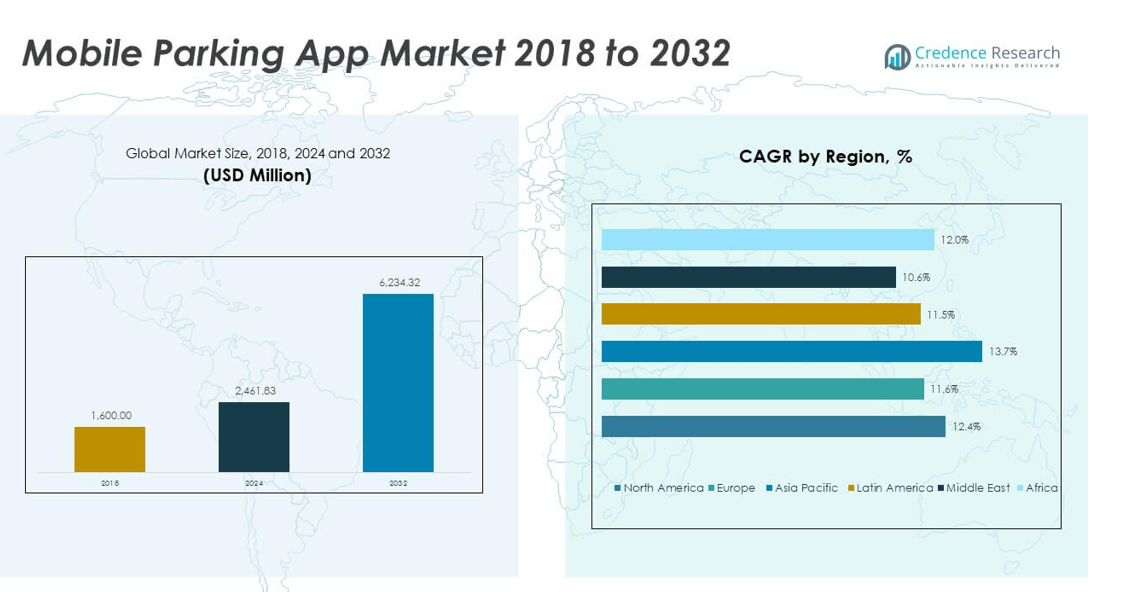
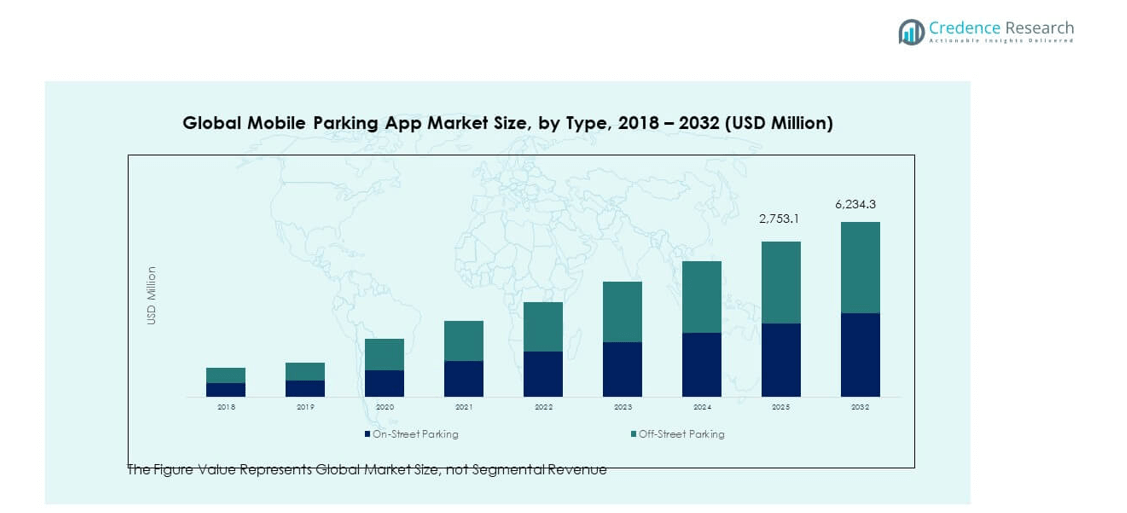
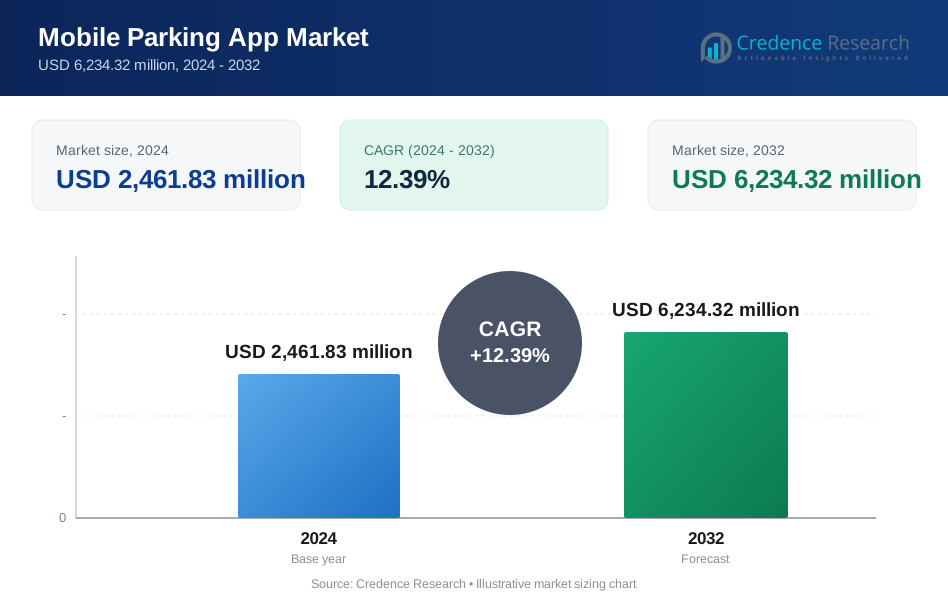
The Global Mobile Parking App Market size was valued at USD 1,600.00 million in 2018 to USD 2,461.83 million in 2024 and is anticipated to reach USD 6,234.32 million by 2032, at a CAGR of 12.39% during the forecast period.
| REPORT ATTRIBUTE | DETAILS |
|---|---|
| Historical Period | 2020-2023 |
| Base Year | 2024 |
| Forecast Period | 2025-2032 |
| Mobile Parking App Market Size 2024 | USD 2,461.83 million |
| Mobile Parking App Market, CAGR | `12.39% |
| Mobile Parking App Market Size 2032 | USD 6,234.32 million |
The market is driven by the rising need for efficient urban mobility solutions and growing adoption of digital payment systems. Increasing smartphone penetration and improved internet connectivity have accelerated the adoption of mobile parking applications. Cities are focusing on reducing traffic congestion, promoting cashless transactions, and enhancing user convenience, which further supports market expansion. Integration of features like real-time parking availability, automated payments, and navigation assistance continues to attract both private vehicle owners and municipal authorities.
Regionally, North America leads the Global Mobile Parking App Market due to early adoption of smart city initiatives and strong infrastructure support. Europe follows with high usage across urban centers driven by strict parking regulations and environmental policies. Asia-Pacific is emerging as a fast-growing market, supported by rapid urbanization, rising vehicle ownership, and government investments in smart mobility projects. Latin America and the Middle East are also showing growth potential, as urban populations expand and demand for smart parking solutions increases.
Market Insights:
- The Global Mobile Parking App Market was valued at USD 1,600 million in 2018, reached USD 2,461.83 million in 2024, and is projected to hit USD 6,234.32 million by 2032, growing at a CAGR of 12.39%.
- North America leads with a 21% share, driven by smart city projects, strong payment infrastructure, and early adoption. Europe follows with 19% due to strict parking regulations and advanced mobility systems, while Asia Pacific holds 29% owing to rapid urbanization and high smartphone penetration.
- Asia Pacific is the fastest-growing region, supported by smart city investments, rising vehicle ownership, and expanding digital payment adoption across China, India, and Southeast Asia.
- On-street parking accounts for about 43% of the market share in 2024, reflecting strong adoption in high-density urban areas.
- Off-street parking represents nearly 57% of the market in 2024, supported by commercial complexes, malls, and offices focusing on digitalized parking solutions.
Market Drivers:
Rising Smartphone Penetration and Widespread Internet Access Enhancing Market Expansion
The Global Mobile Parking App Market is strongly driven by growing smartphone usage and widespread internet access. Consumers increasingly rely on mobile applications for essential services, and parking is no exception. Mobile penetration in both developed and emerging economies has created a robust platform for app adoption. It enables real-time access to parking solutions that reduce waiting times and congestion. Internet-enabled smartphones help users quickly locate available spaces, driving convenience and efficiency. It also supports digital payments, which further enhance adoption across urban populations. Strong connectivity infrastructure in cities makes mobile parking apps a reliable tool for both consumers and operators. This dynamic has made technology integration a critical driver for continued market expansion.
- For instance, ParkMobile ended 2023 with 59 million users, representing a 17% user base increase over 2022, and launched services in over 200 new locations. The company offers digital access to parking in over 600 cities across the country.
Urbanization and Increasing Vehicle Ownership Creating Demand for Smart Parking Solutions
Rapid urbanization has significantly increased the number of vehicles in densely populated regions. With rising vehicle ownership, cities face mounting pressure to manage limited parking resources efficiently. The Global Mobile Parking App Market addresses this challenge by offering real-time parking space availability and automated payment systems. It reduces time spent searching for spaces, lowering congestion and emissions. Governments and municipalities are promoting smart parking projects to improve city mobility. Users benefit from lower frustration and better travel planning through app-based systems. It also enables operators to maximize space utilization and revenue. This demand for efficient urban transport solutions continues to fuel strong market growth.
- For instance, APCOA operates over 1.8 million parking spaces across 12 countries in Europe. The APCOA FLOW app is available in multiple countries, including Poland, and provides mobile payment and registration services at specific locations.
Integration of Digital Payment Ecosystems Boosting Adoption Across Consumer Segments
Digital payments have become a major driver supporting the Global Mobile Parking App Market. Consumers are increasingly preferring cashless transactions for safety and convenience. Parking apps integrate with mobile wallets, credit cards, and contactless systems, offering seamless payment experiences. It reduces operational costs for service providers by minimizing reliance on manual systems. Digital payments also help reduce risks of fraud and increase transparency for municipalities. Businesses benefit from accurate revenue collection and transaction records. Growing trust in fintech ecosystems has strengthened consumer willingness to adopt app-based services. This integration trend is enhancing user experience and expanding market penetration globally.
Government Initiatives and Smart City Projects Driving Market Expansion Globally
Governments worldwide are prioritizing smart city initiatives, which include intelligent parking management. Municipalities are adopting app-based systems to address congestion, reduce emissions, and improve mobility. The Global Mobile Parking App Market benefits directly from such policies, which promote digital urban infrastructure. It helps cities collect data, analyze patterns, and plan resources more effectively. Public-private partnerships are also creating new revenue opportunities for parking solution providers. Smart city projects encourage integration with IoT, AI, and data analytics, raising efficiency levels. Citizens benefit from streamlined parking services, enhancing trust in digital governance. These initiatives have established a strong foundation for future market growth.
Market Trends:
Growing Integration of Artificial Intelligence and IoT Enhancing Parking Efficiency
The Global Mobile Parking App Market is witnessing a trend toward integration with advanced technologies such as artificial intelligence and IoT. These solutions enable predictive analytics that helps users find spaces faster. IoT-enabled sensors provide real-time data on parking availability, reducing traffic caused by searching. It allows municipalities to plan more efficiently and reduce carbon emissions. AI-driven algorithms also personalize parking suggestions based on user behavior. App providers are focusing on smarter systems that optimize both convenience and cost. Businesses benefit from improved utilization rates and better customer satisfaction. This integration is reshaping the parking ecosystem toward higher efficiency.
- For instance, Bosch and APCOA deployed the world’s first highly automated driverless parking service at Stuttgart Airport’s P6 garage in late 2022, approved for commercial use of SAE Level 4 valet parking for Mercedes-Benz S-Class and EQS vehicles.
Expansion of Subscription-Based and Value-Added Services Driving Revenue Growth
A notable trend in the Global Mobile Parking App Market is the rise of subscription-based models. Service providers are offering monthly or annual plans with added benefits. It includes premium features such as reserved spaces, automatic billing, and loyalty rewards. Value-added services like EV charging integration and car wash bookings are also gaining traction. Consumers appreciate bundled convenience and are willing to pay extra for seamless experiences. Municipalities benefit from consistent revenue streams and improved user engagement. Businesses are exploring partnerships with automotive and retail sectors to expand offerings. This diversification of services is creating new revenue opportunities.
- For instance, following its merger with ParkHub in March 2024, JustPark announced new product suites like Insights, Reach, and Optimize, alongside its continued focus on providing frictionless payment experiences and enhanced integrations for facility management, as detailed in company blogs and press releases throughout 2024. This expanded focus reflects the combined company's ambition to create a seamless, end-to-end platform for the global parking ecosystem.
Adoption of Cloud-Based Platforms Enhancing Scalability and User Management
Cloud technology is becoming central to the Global Mobile Parking App Market. Cloud-based platforms allow providers to manage data securely and scale operations quickly. It supports high volumes of real-time transactions without compromising performance. Cloud integration improves mobile app reliability, making it easier for users to access services. Municipalities gain centralized control over parking resources with cloud-based dashboards. Service providers also benefit from lower infrastructure costs and easier maintenance. The flexibility of cloud platforms enables faster updates and improved user experience. This adoption trend continues to drive digital transformation across the parking industry.
Increased Focus on Sustainability and Green Mobility Solutions in Parking Ecosystems
Sustainability is a growing trend shaping the Global Mobile Parking App Market. Governments and businesses are aligning services with green mobility goals. It involves optimizing routes, reducing idle time, and cutting fuel consumption. Parking apps integrate with EV charging networks to support clean transportation. Consumers are more inclined toward services that reduce environmental impact. Municipalities use apps to promote eco-friendly practices and monitor emissions reduction. Businesses are also branding themselves as sustainable solution providers. This focus on green mobility is reinforcing the role of mobile apps in future smart cities.
Market Challenges Analysis:
Data Security Concerns and Privacy Risks Limiting Consumer Trust in App Adoption
The Global Mobile Parking App Market faces significant challenges related to cybersecurity and data protection. Consumers are cautious about sharing personal and financial data on digital platforms. It raises concerns about fraud, unauthorized access, and data misuse. Municipalities and providers must invest heavily in encryption and compliance frameworks. Regulatory pressure around data protection is adding complexity for global operations. Service providers need to balance innovation with robust security measures. Consumer trust can be undermined by even minor breaches. This issue continues to act as a restraint on widespread adoption in sensitive markets.
Fragmented Infrastructure and Limited Digital Readiness in Emerging Regions Slowing Growth
Another major challenge in the Global Mobile Parking App Market is the lack of uniform digital infrastructure. In many emerging economies, poor connectivity limits app reliability. It reduces user confidence in adopting digital parking solutions. Municipalities often lack funding or expertise to implement smart parking projects. Fragmented regulations and inconsistent policies across regions also create barriers. Businesses find it challenging to scale services in markets with limited readiness. Consumers in rural or less developed areas continue relying on traditional methods. This fragmentation slows global expansion and restricts seamless adoption of parking apps.
Market Opportunities:
Growing Adoption of Electric Vehicles Creating Demand for Integrated Parking Solutions
The Global Mobile Parking App Market has strong opportunities through integration with electric vehicle infrastructure. Rising EV adoption requires charging stations that can be managed via mobile platforms. It creates demand for parking apps that combine space booking with charging features. Municipalities are investing in EV-ready smart parking projects. Service providers can partner with automotive manufacturers to expand reach. Consumers appreciate single platforms that handle multiple mobility needs. It creates loyalty and long-term revenue opportunities. This alignment with EV adoption opens new avenues for global growth.
Expansion into Emerging Economies Offering Untapped Growth Potential for Service Providers
Emerging economies represent a major opportunity for the Global Mobile Parking App Market. Rapid urbanization in Asia, Latin America, and Africa is increasing parking challenges. It creates demand for scalable and cost-effective digital solutions. Governments are investing in smart city projects that include parking modernization. Businesses can leverage lower competition levels to establish strong market presence. Consumers in these regions are embracing digital payments and smartphone-based services. Service providers that adapt pricing and features to local needs will gain advantage. This expansion into high-growth markets promises long-term profitability and user adoption.
Market Segmentation Analysis:
By Type
The Global Mobile Parking App Market is segmented into on-street parking and off-street parking. On-street parking dominates due to high adoption in urban centers with limited space availability. Off-street parking apps are growing steadily, supported by commercial complexes and shopping malls seeking efficient solutions.
- For instance, in France, Flowbird, a major provider of parking systems, has actively participated in modernizing and digitizing parking infrastructure, supporting app-based payment and management through solutions like its mobile app, though a specific percentage of terminal upgrades has not been publicly verified.
By Application
Commercial applications account for a major share, driven by demand from retail outlets, offices, and entertainment hubs. The residential segment is expanding as gated communities adopt app-based solutions. Government use is also increasing with municipalities integrating digital platforms to manage public parking resources.
- For instance, PayByPhone expanded its mobile parking payment solutions to Germany and Italy in 2022, enabling digital payments in 470 new citiesacross both countries. In March 2022, PayByPhone first integrated Italy's existing service into its global app, making it available in 100 Italian cities. In May 2022, the company added 370 cities in Germany.
By End-User
Individual users form the largest customer base due to rising personal vehicle ownership and convenience needs. Corporate users are leveraging apps to manage employee and visitor parking. Governments are adopting mobile platforms to streamline traffic management and enhance urban mobility efficiency.
By Platform
Android leads the market due to its widespread user base and affordability. iOS users represent a premium segment with higher spending power, making it attractive for advanced features. Other platforms remain niche but serve specific regional markets where alternative operating systems persist.
By Payment Method
Mobile app payments dominate the Global Mobile Parking App Market, supported by strong digital wallet and card integration. SMS-based payments are still relevant in regions with limited internet connectivity. QR code, NFC, and contactless methods are gaining traction with rising cashless transactions. Other methods remain supplementary, offering flexibility for diverse user preferences.
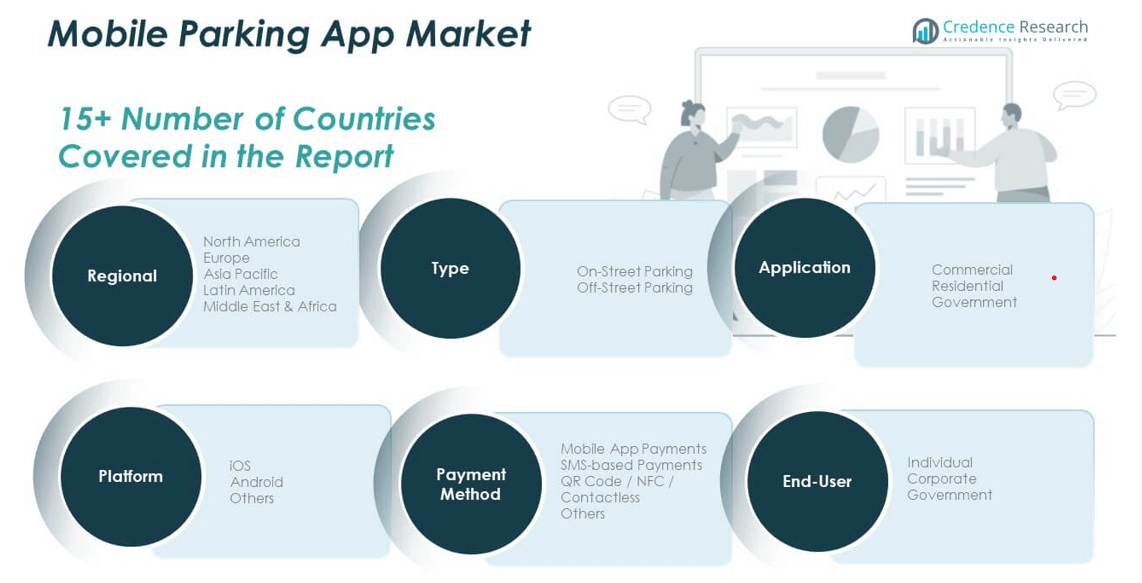
By Type
- On-Street Parking
- Off-Street Parking
By Application
- Commercial
- Residential
- Government
By End-User
- Individual
- Corporate
- Government
By Platform
- iOS
- Android
- Others
By Payment Method
- Mobile App Payments
- SMS-based Payments
- QR Code / NFC / Contactless
- Others
By Region
- North America
- U.S.
- Canada
- Mexico
- Europe
- Germany
- France
- U.K.
- Italy
- Spain
- Rest of Europe
- Asia Pacific
- China
- Japan
- India
- South Korea
- South-east Asia
- Rest of Asia Pacific
- Latin America
- Brazil
- Argentina
- Rest of Latin America
- Middle East & Africa
- GCC Countries
- South Africa
- Rest of the Middle East and Africa
Regional Analysis:
North America
The North America Global Mobile Parking App Market size was valued at USD 588.80 million in 2018 to USD 920.93 million in 2024 and is anticipated to reach USD 1,316.14 million by 2032, at a CAGR of 12.4% during the forecast period. North America holds around 21% share of the Global Mobile Parking App Market. It is driven by strong adoption of smart city initiatives and advanced digital infrastructure. High smartphone penetration and widespread use of mobile wallets have fueled consumer reliance on parking apps. Municipalities across the U.S. and Canada invest heavily in reducing congestion and improving urban mobility. It benefits from advanced fintech ecosystems that support seamless payments. The presence of leading companies enhances competition and innovation in the region. Corporate adoption is growing, with businesses integrating apps to manage employee parking. Government focus on sustainability is also supporting digital mobility solutions.
Europe
The Europe Global Mobile Parking App Market size was valued at USD 422.40 million in 2018 to USD 624.75 million in 2024 and is anticipated to reach USD 1,494.69 million by 2032, at a CAGR of 11.6% during the forecast period. Europe accounts for nearly 19% share of the Global Mobile Parking App Market. Strict parking regulations and urban planning policies have accelerated adoption. Countries like the UK, Germany, and France lead demand with advanced city infrastructures. It is supported by consumer preference for cashless payments and sustainable mobility. The integration of parking apps with EV charging infrastructure is strengthening growth. European governments focus on reducing emissions, which aligns with the expansion of smart parking. Businesses in the region leverage data analytics for better parking management. Public-private partnerships are also contributing to strong market performance.
Asia Pacific
The Asia Pacific Global Mobile Parking App Market size was valued at USD 406.40 million in 2018 to USD 652.01 million in 2024 and is anticipated to reach USD 1,816.06 million by 2032, at a CAGR of 13.7% during the forecast period. Asia Pacific represents nearly 29% share of the Global Mobile Parking App Market. Rapid urbanization and rising vehicle ownership are the primary drivers. Countries like China, India, and Japan are investing in smart city development. It benefits from high smartphone adoption and digital payment expansion. Governments across the region promote app-based services to address traffic congestion. The commercial sector, including malls and offices, is adopting digital parking systems rapidly. Startups and established firms are expanding service portfolios to meet consumer needs. The growth outlook remains the strongest among all regions, driven by both scale and policy support.
Latin America
The Latin America Global Mobile Parking App Market size was valued at USD 115.20 million in 2018 to USD 175.75 million in 2024 and is anticipated to reach USD 416.89 million by 2032, at a CAGR of 11.5% during the forecast period. Latin America accounts for nearly 7% share of the Global Mobile Parking App Market. Urban centers such as São Paulo, Mexico City, and Buenos Aires are key demand hubs. It is driven by growing smartphone adoption and the need to reduce traffic congestion. Governments are encouraging digital transformation in mobility services. Economic constraints pose challenges, but innovation in affordable solutions is supporting adoption. The commercial sector shows strong demand for app-based parking services. Consumers increasingly prefer cashless transactions, fueling the transition. Regional expansion strategies by global players are strengthening the market presence.
Middle East
The Middle East Global Mobile Parking App Market size was valued at USD 49.60 million in 2018 to USD 70.39 million in 2024 and is anticipated to reach USD 156.52 million by 2032, at a CAGR of 10.6% during the forecast period. The Middle East contributes nearly 3% share of the Global Mobile Parking App Market. It benefits from high investment in smart city projects in the UAE, Saudi Arabia, and Qatar. Governments are integrating parking apps into wider urban mobility platforms. Rising vehicle ownership and urbanization create demand for efficient solutions. It is supported by strong digital payment adoption in key cities. Public-private collaborations are boosting app deployment in commercial and government parking. Tourism-heavy cities also drive higher adoption due to visitor demand. Market growth remains steady with continued infrastructure investment.
Africa
The Africa Global Mobile Parking App Market size was valued at USD 17.60 million in 2018 to USD 28.00 million in 2024 and is anticipated to reach USD 54.02 million by 2032, at a CAGR of 12.0% during the forecast period. Africa accounts for around 2% share of the Global Mobile Parking App Market. Growth is supported by rising smartphone usage and improving connectivity in urban centers. It faces challenges from limited infrastructure and inconsistent regulatory frameworks. South Africa, Nigeria, and Egypt are leading demand with digital adoption. Governments are beginning to include parking digitization in urban development plans. It is gaining traction in commercial hubs where congestion is a critical issue. Consumers are gradually shifting toward app-based payment systems. Long-term opportunities lie in aligning with Africa’s broader digital transformation strategies.
Key Player Analysis:
- ParkMobile
- SpotHero
- ParkWhiz
- Passport Parking
- JustPark
- ParkMe
- PayByPhone
- Parkopedia
- EasyPark
- ParkNow
- RingGo
- ParkJockey
- ParkU
- ParkMate
- ParkChicago
Competitive Analysis:
The Global Mobile Parking App Market is highly competitive with the presence of established players and emerging startups. Companies such as ParkMobile, SpotHero, JustPark, PayByPhone, and EasyPark are leading with extensive user bases and strong regional footprints. It is marked by continuous investments in technology, partnerships, and product innovations to strengthen customer engagement. Firms are focusing on integration with digital payment platforms, IoT, and smart city infrastructure to expand offerings. Regional startups are gaining traction by tailoring services to local requirements. Mergers, acquisitions, and collaborations remain critical strategies to achieve scale and diversify revenue streams. The competition is intensifying as governments and private operators push for digital transformation in parking services. Innovation, convenience, and user trust are central to long-term market leadership.
Recent Developments:
- In July 2025, ParkMobile unveiled a major redesign of its mobile parking app, introducing intuitive features such as an updated interface, advanced mapping technology, and streamlined payment options, with new enhancements targeted at supporting smarter and faster parking sessions for users across North America.
- In September 2025, SpotHero entered a partnership with USA Fencing to offer convenient event parking solutions, enhancing access for drivers attending fencing events across the United States through its app-based reservation technology.
- In September 2025, PayByPhone, a leading mobile parking payment provider, signed a strategic global partnership with SKIDATA to integrate its mobile payment technology with SKIDATA Connect, with new services expected to launch in Q4 2025.
Report Coverage:
The research report offers an in-depth analysis based on segment type, application, end-user, platform, and payment method. It details leading market players, providing an overview of their business, product offerings, investments, revenue streams, and key applications. Additionally, the report includes insights into the competitive environment, SWOT analysis, current market trends, as well as the primary drivers and constraints. Furthermore, it discusses various factors that have driven market expansion in recent years. The report also explores market dynamics, regulatory scenarios, and technological advancements that are shaping the industry. It assesses the impact of external factors and global economic changes on market growth. Lastly, it provides strategic recommendations for new entrants and established companies to navigate the complexities of the market.
Future Outlook:
- Rising urbanization will increase demand for digital parking solutions across metropolitan areas.
- Smart city projects will drive integration of apps with wider mobility ecosystems.
- Artificial intelligence and IoT will improve accuracy of space availability predictions.
- Electric vehicle adoption will create strong demand for integrated charging features.
- Subscription-based models will expand recurring revenue streams for service providers.
- Contactless and cashless payment adoption will strengthen market penetration.
- Regional startups will emerge as strong competitors through localized offerings.
- Governments will continue to support app deployment through digital transformation policies.
- Data analytics and cloud platforms will enhance user personalization and operator efficiency.
- Sustainability goals will encourage parking apps to align with eco-friendly mobility initiatives.
Request a Free Sample
Fill in your details and we'll send you a free sample report.
- Sample data tables & charts
- Research methodology
Need a Custom Version of This Report?
Tailor the scope, geography, or segments to your exact requirements.
- Custom geography or segment scope
- Direct access to our analyst team
Frequently Asked Questions
What is the current market size for Global Mobile Parking App Market, and what is its projected size in 2032?
At what Compound Annual Growth Rate is the Global Mobile Parking App Market projected to grow between 2025 and 2032?
Which Global Mobile Parking App Market segment held the largest share in 2024?
What are the primary factors fueling the growth of the Global Mobile Parking App Market?
Who are the leading companies in the Global Mobile Parking App Market?
Table of Content
Chapter 1. Report Introduction
- 1.1 Report Description & Purpose
- 1.1.1 Report Title & Market Definition
- 1.1.2 Unique Selling Propositions (USP) & Key Differentiators
- 1.1.3 Value Proposition for Stakeholders
- 1.2 Research Objectives
- 1.2.1 Market Sizing Objectives (Volume & Revenue)
- 1.2.2 Segmentation Objectives
- 1.2.3 Competitive Intelligence Objectives
- 1.2.4 Forecast & Scenario Objectives
- 1.3 Report Scope
- 1.3.1 Mobile Parking App Scope – Types & Subtypes Covered
- 1.3.2 Geographic Scope – Regions & Countries Covered
- 1.3.3 Historical Period, Base Year & Forecast Period (2024; forecast to 2032)
- 1.3.4 Inclusions & Exclusions
- 1.4 HS Code & Classification Framework
- 1.5 Currency, Units & Pricing Basis
- 1.6 Target Stakeholders
- 1.7 Limitations & Assumptions
Chapter 2. Executive Summary
- 2.1 Global Mobile Parking App Market Snapshot
- 2.1.1 Market Size – Historical (2024) & Forecast (2024-2032) (2024: USD 2,461.83 million → 2032: USD 6,234.32 million)
- 2.1.2 Volume & Revenue – Global Totals
- 2.1.3 Key Market Highlights – Top Five Facts
- 2.2 Mobile Parking App Market Segmentation Snapshot
- 2.2.1 Market Split by Region – 2024 vs. 2032
- 2.3 Competitive Snapshot
- 2.3.1 Top 10 Players by Revenue Share – 2024
- 2.3.2 Top 10 Players by Volume Share – 2024
- 2.3.3 Recent Strategic Developments (18-Month Summary)
- 2.4 Key Investment Highlights & Strategic Conclusions
Chapter 3. Mobile Parking App Market Dynamics & Industry Analysis
- 3.1 Market Overview & Context
- 3.1.1 Mobile Parking App Market Position in the Broader Automotive Value Chain
- 3.1.2 OEM vs. Replacement Market Dynamics
- 3.1.3 Market Maturity & Development Stage by Region
- 3.2 Mobile Parking App Market Drivers
- 3.3 Mobile Parking App Market Restraints & Challenges
- 3.4 Mobile Parking App Market Opportunities
- 3.5 Porter's Five Forces Analysis
- 3.5.1 Threat of New Entrants
- 3.5.2 Bargaining Power of Suppliers
- 3.5.3 Bargaining Power of Buyers
- 3.5.4 Threat of Substitutes
- 3.5.5 Competitive Rivalry – Intensity Assessment
- 3.6 Mobile Parking App Value Chain Analysis
- 3.6.1 Upstream – Raw Material/Input Suppliers
- 3.6.1.1 Raw Material/Input 1
- 3.6.1.2 Raw Material/Input 2
- 3.6.1.3 Raw Material/Input 3
- 3.6.2 Midstream – Production/Manufacturing/Service Delivery
- 3.6.2.1 Production/Process Overview
- 3.6.2.2 Key Facility Locations & Capacity by Manufacturer
- 3.6.3 Downstream – Distribution & End Consumer
- 3.6.3.1 Primary Channel – B2B/OEM
- 3.6.3.2 Secondary Channels – Dealer, Retail, Online, Direct
- 3.6.4 Value Chain Profitability Analysis
- 3.6.1 Upstream – Raw Material/Input Suppliers
- 3.7 PESTEL Analysis
- 3.7.1 Political Factors
- 3.7.2 Economic Factors
- 3.7.3 Social Factors
- 3.7.4 Technological Factors
- 3.7.5 Environmental Factors
- 3.7.6 Legal Factors
- 3.8 Mobile Parking App Supply Chain Analysis
- 3.8.1 Raw Material/Input Supply Risk Assessment
- 3.8.2 Manufacturing Concentration Risk (Geographic Exposure)
- 3.8.3 Trade Disruption Impact Analysis
- 3.9 Regulatory & Policy Landscape
Note: The regulatory and policy landscape section covers regulations based on their applicability to the market, Mobile Parking App category, geography, and scope of the study. Only regulatory frameworks with a material impact on operations, compliance, trade, sustainability, or market access are analyzed in detail.
Chapter 4. Key Investment Pockets & Opportunity Analysis
- 4.1 Mobile Parking App Market Attractiveness Analysis
- 4.1.1 By Region – Investment Attractiveness Matrix (Volume × CAGR)
- 4.2 Absolute Revenue Growth Opportunity
- 4.2.1 By Region – Absolute USD Growth Through 2032
- 4.3 Incremental Volume Opportunity
- 4.3.1 By Region – Incremental Volume Through 2032
- 4.3.2 Segment – Incremental Volume
- 4.4 Emerging Submarket Opportunity Deep Dive (Subject to Applicability)
- 4.5 Emerging Market Opportunity Scorecards
- 4.5.1 United States
- 4.5.2 Europe
- 4.5.3 Asia
- 4.5.4 Middle East & Africa
Note: Emerging Market Opportunity Scorecards will be included based on relevance and strategic importance. Regions listed are indicative and may vary depending on data availability and market dynamics.
Chapter 5. Mobile Parking App Import-Export Analysis & Trade Flows
- 5.1 Global Trade Overview
- 5.1.1 Global Export Value by Country (2024)
- 5.1.2 Global Export Volume by Country (2024)
- 5.1.3 Global Import Value by Country (2024)
- 5.1.4 Global Import Volume by Country (2024)
- 5.1.5 Net Trade Balance by Country (2024)
- 5.2 Export Analysis – Segment
- 5.2.1 Type 1 (HS Code)
- 5.2.2 Type 2 (HS Code)
- 5.2.3 Type 3 (HS Code)
- 5.2.4 Type 4 (HS Code)
- 5.2.5 Type 5 (HS Code)
- 5.3 Import Analysis – Segment
- 5.3.1 Type 1 (HS Code)
- 5.3.2 Type 2 (HS Code)
- 5.3.3 Type 3 (HS Code)
- 5.3.4 Type 4 (HS Code)
- 5.3.5 Type 5 (HS Code)
- 5.4 Average Unit Trade Prices
- 5.4.1 Average Export Price – Segment & Country
- 5.4.2 Average Import Price – Segment & Source Country
- 5.4.3 Price Trends (2024)
- 5.5 Key Trade Route Analysis
- 5.5.1 Trade Route 1
- 5.5.2 Trade Route 2
- 5.5.3 Trade Route 3
- 5.5.4 Trade Route 4
- 5.5.5 Trade Route 5
- 5.6 Trade Policy Impact Assessment
- 5.6.1 US Anti-Dumping & Section 301 Tariffs
- 5.6.2 EU Customs Union Impact
- 5.6.3 Major Free Trade Agreements
- 5.6.4 USMCA Rules of Origin
Note: Trade policy analysis will be included only where relevant to the Mobile Parking App market.
Chapter 6. Competitive Landscape & Company Benchmarking
- 6.1 Mobile Parking App Market Concentration & Structure
- 6.1.1 Herfindahl-Hirschman Index (HHI) – vs. 2024
- 6.1.2 Tier 1, Tier 2 & Tier 3 Market Structure
- 6.1.3 Global, Regional & Local Player Dynamics
- 6.2 Mobile Parking App Market Share Analysis – 2024
- 6.2.1 Global Revenue Share by Company
- 6.2.2 Global Volume Share by Company
- 6.2.3 Regional Revenue Share
- 6.2.4 Market Share Evolution ( vs. 2024)
- 6.2.5 OEM Segment Share by Company
- 6.2.6 Replacement Segment Share by Company
- 6.3 Production/Delivery Capacity & Facility Analysis
- 6.3.1 Global Installed Capacity
- 6.3.2 Capacity Utilization Rates
- 6.3.3 Production/Output Volume
- 6.3.4 Facility Locations & Capacity Map
- 6.3.5 Planned Capacity Additions
- 6.4 Mobile Parking App Competitive Benchmarking Matrix
- 6.4.1 Revenue, Volume, CAGR & Profitability Comparison
- 6.4.2 Channel Revenue Mix
- 6.4.3 Geographic Revenue Exposure
- 6.4.4 R&D Intensity
- 6.4.5 Sustainability Maturity
- 6.5 Strategic Developments in Mobile Parking App (Last 24 Months)
- 6.5.1 Mergers, Acquisitions & Divestments
- 6.5.2 New Mobile Parking App Launches
- 6.5.3 Facility Expansions
- 6.5.4 Strategic Alliances, Joint Ventures & Partnerships
- 6.5.5 Distribution Expansion & Market Entry
- 6.5.6 Sustainability & ESG Initiatives
- 6.6 Competitive Strategy Mapping
- 6.6.1 Leader, Challenger, Follower & Niche Classification
- 6.6.2 Pricing Strategy Comparison
- 6.6.3 Channel Strategy Matrix
Note: Strategic developments are included based on their materiality and the availability of reliable information.
Chapter 7. Global Mobile Parking App Market – By Distribution Channel
- 7.1 Segment Overview
- 7.1.1 Volume & Revenue Split by Channel (2024 & 2032)
- 7.1.2 Channel Mix Evolution (2024-2032)
Chapter 8. Regional Market Analysis – Global Overview
- 8.1 Global Regional Overview
- 8.1.1 Regional Volume Share
- 8.1.2 Regional Revenue Share
- 8.1.3 Regional Volume by Region
- 8.1.4 Regional Revenue by Region
- 8.1.5 Regional Forecast Through 2032
- 8.2 Cross-Regional Segment Analysis
- 8.2.1 By Distribution Channel
- 8.2.2 By Brand/Price Tier
Chapter 9. North America Mobile Parking App Market
- 9.1 United States
- 9.2 Canada
- 9.3 Mexico
Chapter 10. Europe Mobile Parking App Market
- 10.1 Germany
- 10.2 France
- 10.3 Italy
- 10.4 United Kingdom
- 10.5 Spain
- 10.6 Poland
- 10.7 Russia
- 10.8 Netherlands
- 10.9 Belgium
- 10.10 Sweden
- 10.11 Denmark
- 10.12 Norway
- 10.13 Rest of Europe
Chapter 11. Asia Pacific Mobile Parking App Market
- 11.1 China
- 11.2 India
- 11.3 Japan
- 11.4 South Korea
- 11.5 Thailand
- 11.6 Indonesia
- 11.7 Vietnam
- 11.8 Malaysia
- 11.9 Australia
- 11.10 Rest of Asia Pacific
Chapter 12. Latin America Mobile Parking App Market
- 12.1 Brazil
- 12.2 Argentina
- 12.3 Colombia
- 12.4 Chile
- 12.5 Rest of Latin America
Chapter 13. Middle East Mobile Parking App Market
- 13.1 Saudi Arabia
- 13.2 United Arab Emirates
- 13.3 Turkey
- 13.4 Israel
- 13.5 Iran
- 13.6 Rest of the Middle East
Chapter 14. Africa Mobile Parking App Market
- 14.1 South Africa
- 14.2 Egypt
- 14.3 Nigeria
- 14.4 Morocco
- 14.5 Rest of Africa
Chapter 15. Mobile Parking App Company Profiles
- 15.1 [Company 01]
- 15.1.1 Company Overview
- 15.1.2 Key Management Personnel
- 15.1.3 Products & Services Portfolio
- 15.1.4 Financial Performance
- 15.1.5 Key Market Focus & Geographic Presence
- 15.1.6 Recent Developments & Strategic Initiatives
Note: The company profile list is preliminary and may change based on research findings, market developments, data availability, and client requirements.
Chapter 16. Appendices
- Appendix A – List of Abbreviations & Acronyms
- Appendix B – Industry Classification Code Reference – Full Series
- Appendix C – Production & Capacity Data Tables
- Appendix D – End-Use & Demand Base Tables
- Appendix E – Consumption & Replacement Rate Assumptions
- Appendix F – ASP Reference Tables
- Appendix G – Manufacturing & Facility Database
- Appendix H – Import-Export Data Tables
- Appendix I – Regulatory Summary Tables
- Appendix J – Primary Research Participant List (Anonymized)
- Appendix K – Primary Research Questionnaire Framework
- Appendix L – Data Sources & Bibliography
- Appendix M – Market Size Divergence & Source Comparison
Chapter 17. Research Methodology
- 17.1 Research Framework & Philosophy
- 17.2 Secondary Research – Sources, Hierarchy & Data Extraction
- 17.3 Data Modeling – Bottom-Up & Top-Down Market Sizing
- 17.4 Primary Research – Stakeholder Framework, LOI & Sample Sizes
- 17.5 Forecast Methodology – Regression, Scenario & Sensitivity Analysis
- 17.6 Quality Control – Four-Layer Validation Framework
- 17.7 Limitations & Standard Assumptions
- 17.8 Disclaimer
