
| REPORT ATTRIBUTE | DETAILS |
|---|---|
| Historical Period | 2020-2023 |
| Base Year | 2024 |
| Forecast Period | 2025-2032 |
| Brazil Gasket And Seals Market Size 2024 | USD 1,714.23 Million |
| Brazil Gasket And Seals Market, CAGR | 5.31% |
| Brazil Gasket And Seals Market Size 2032 | USD 2,593.55 Million |
Market Overview
The Brazil Gasket And Seals Market is projected to grow from USD 1,714.23 million in 2024 to an estimated USD 2,593.55 million by 2032, with a compound annual growth rate (CAGR) of 5.31% from 2025 to 2032. This steady growth is driven by increasing industrial applications and the demand for durable sealing solutions across various sectors, such as automotive, oil & gas, and manufacturing.
Key drivers of the Brazil Gasket and Seals Market include the expansion of the automotive sector, rising industrialization, and the growing need for effective sealing solutions to improve operational efficiency and safety. Additionally, trends such as the development of environmentally friendly sealing materials, customization of seals for specific applications, and increased awareness about maintenance and repair of equipment further contribute to market growth.
Geographically, Brazil holds a significant share of the gasket and seals market in the Latin American region. The country’s strong industrial base, coupled with key sectors like oil & gas, automotive, and construction, continues to drive demand for high-quality sealing products. Major players in the market include global and regional manufacturers such as Trelleborg, SKF, Freudenberg, and Dana Incorporated, who are focusing on product innovation and expanding their regional presence to capitalize on growth opportunities.
Market Insights
- The Brazil Gasket and Seals Market is projected to grow from USD 1,714.23 million in 2024 to USD 2,593.55 million by 2032, with a CAGR of 5.31% from 2025 to 2032.
- The market is driven by the expansion of the automotive sector, rising industrialization, and increased demand for sealing solutions in oil & gas, manufacturing, and construction.
- Innovations in material technology are contributing to the growth of high-performance sealing products that offer durability and resistance to extreme conditions.
- Growing demand for eco-friendly sealing materials and sustainable manufacturing practices is shaping the market landscape.
- Volatility in raw material prices and supply chain disruptions can hinder market growth, affecting production costs and availability of sealing solutions.
- The Southeast region dominates the market, accounting for nearly 45-50% of the market share, due to its strong industrial and automotive presence.
- Major players like Trelleborg, SKF, Freudenberg, and Dana are focusing on innovation and expanding their regional presence to capture market opportunities.
Market Drivers
Growing Demand from the Automotive Industry
The automotive industry is a significant contributor to the growth of the Brazil Gasket and Seals Market. As Brazil is one of the largest automotive markets in Latin America, the demand for gaskets and seals in automotive applications is steadily increasing. Gaskets and seals are essential components in vehicles, serving as sealing solutions for engines, exhaust systems, transmissions, and various other mechanical parts. They help to prevent leaks, control fluid flow, and ensure the integrity of the vehicle's components under extreme conditions. For instance, companies are investing in R&D to develop specialized gaskets and seals for electric vehicles, which require unique sealing solutions for battery systems and cooling systems. The growing adoption of electric vehicles further boosts the demand for these specialized components. Additionally, the need for aftermarket replacement parts as vehicle fleets increase, as well as growing concerns regarding vehicle performance, fuel efficiency, and emissions, are pushing for higher-quality sealing solutions in the automotive sector.
Expanding Industrial Sector and Infrastructure Development
Brazil's industrial sector, including manufacturing, energy, and construction, is a key driver of the gasket and seals market. The expansion of industrial activities, fueled by increased investments in infrastructure and industrialization, is raising the demand for sealing solutions that can withstand harsh operational environments. The oil and gas industry, in particular, requires high-performance gaskets and seals due to the rigorous demands of offshore and onshore operations. For instance, government initiatives to support infrastructure development projects, such as the construction of new factories and large-scale infrastructure, require a vast number of sealing products. These gaskets and seals are used in a variety of applications, including pumps, valves, pipelines, HVAC systems, and machinery, ensuring their proper functioning and reducing the risk of system failures. As Brazil continues to focus on modernizing its infrastructure, the market for sealing solutions in industrial applications is set to grow. Moreover, advancements in material technology are enabling the creation of seals that can endure extreme temperatures, pressure, and chemical exposure.
Rise in Oil & Gas Production and Demand for Sealing Solutions
Brazil is one of the largest oil producers in Latin America, and the oil and gas sector plays a critical role in the country's economic development. The country has been focusing on expanding its oil and gas exploration and production activities, particularly in offshore fields like the pre-salt reservoirs, which are located deep under the ocean. This expansion has significantly boosted the demand for high-quality gaskets and seals that can withstand the harsh environments and extreme pressures typical in these operations.Seals and gaskets are vital in ensuring the reliability and safety of equipment used in the oil and gas industry, including pipelines, drilling rigs, pressure vessels, and valves. As production in these fields increases, so does the demand for durable and high-performance sealing solutions to prevent leaks, ensure the safety of workers, and maintain system integrity. Furthermore, Brazil's commitment to increasing its oil exports and establishing itself as a leader in global energy markets is expected to further drive the need for advanced sealing solutions. With the growth of the oil and gas industry, manufacturers in the gasket and seals market are focusing on offering solutions that meet the unique challenges of the energy sector, such as resistance to high pressure, chemicals, and temperature extremes.
Technological Advancements in Sealing Materials and Product Innovation
Technological advancements in sealing materials and product innovation are key drivers in the Brazil Gasket and Seals Market. The constant demand for more durable and efficient sealing solutions has led to the development of new materials, such as expanded PTFE, composites, and specialty elastomers, that offer enhanced performance in extreme conditions. These innovations have enabled manufacturers to produce seals that offer improved resistance to heat, pressure, chemicals, and wear, making them ideal for use in a variety of industries, including automotive, oil & gas, and industrial manufacturing.Moreover, there is a growing trend toward customized sealing solutions that cater to specific industry needs. As industrial processes become more complex and the demand for precision increases, gasket and seal manufacturers are working closely with end-users to design bespoke sealing products that meet exact specifications. This trend toward product customization is expected to continue, driving the need for specialized seals that improve operational efficiency, reduce downtime, and lower maintenance costs. Additionally, the increasing focus on sustainability and the environment has led to the development of eco-friendly sealing materials that reduce the environmental impact of gaskets and seals, further driving market growth.
Market Trends
Sustainability and Environmentally Friendly Solutions
The focus on sustainability is a key trend in the Brazil Gasket and Seals Market, driven by increasing environmental awareness and the regulatory push for more eco-friendly products. Manufacturers are increasingly exploring materials and production processes that reduce environmental impact. For instance, there is a growing interest in biodegradable seals and gaskets made from sustainable materials, such as natural rubber, bio-based polymers, and recyclable compounds. These materials not only address the environmental concerns but also help companies meet stringent environmental regulations, which is especially important in industries like automotive and construction, where sustainability initiatives are becoming a priority.Additionally, the increasing adoption of eco-friendly seals is supported by growing consumer demand for greener products and the need for businesses to comply with environmental regulations that limit waste and pollution. This shift towards sustainability in the gasket and seals market aligns with broader trends in industrial manufacturing, where circular economy principles are being adopted to reduce waste and promote the reuse of materials. In Brazil, industries such as automotive and construction, which are major consumers of gaskets and seals, are under pressure to innovate and implement sustainable practices, further pushing the demand for environmentally friendly sealing solutions. Manufacturers are also focusing on reducing the carbon footprint of their production processes, which includes optimizing energy consumption and minimizing emissions during the manufacturing of seals and gaskets.
Growing Demand for Sealing Solutions in the Energy and Renewable Energy Sectors
The energy sector, particularly the renewable energy industry, is contributing significantly to the demand for gaskets and seals in Brazil. As the country focuses on diversifying its energy mix and increasing the share of renewable energy sources, such as wind, solar, and bioenergy, there is a corresponding rise in the need for sealing solutions to maintain the performance and efficiency of renewable energy infrastructure. In wind turbine applications, for instance, specialized seals are required to protect critical components, such as bearings and gearboxes, from dust, moisture, and contaminants. Similarly, solar power systems and bioenergy plants rely on gaskets and seals to prevent leakage in piping systems and enhance energy transfer efficiency.The energy sector is undergoing significant transformation in Brazil, as the government and private companies invest in cleaner energy solutions to meet sustainability targets. This shift is expected to increase the demand for sealing products used in renewable energy systems and equipment. Additionally, the ongoing development of Brazil's pre-salt oil fields, which are located offshore, continues to drive the need for high-performance sealing solutions in the oil and gas industry. As Brazil's energy landscape evolves, manufacturers of gaskets and seals are focusing on developing specialized sealing solutions that cater to the specific needs of these growing energy sectors, offering enhanced reliability, longer service life, and better resistance to environmental factors.
Adoption of Advanced Materials for Enhanced Performance
A major trend in the Brazil Gasket and Seals Market is the increasing adoption of advanced materials that offer superior performance characteristics. The demand for seals and gaskets that can withstand extreme conditions-such as high pressure, temperature fluctuations, and chemical exposure-has led manufacturers to focus on developing and utilizing innovative materials. For instance, surveys by industry leaders indicate a growing preference for materials like expanded PTFE (polytetrafluoroethylene) gaskets and fluorocarbon elastomers due to their ability to endure harsh operational environments. These advanced materials are particularly valuable in industries such as automotive, oil & gas, and chemicals, where sealing solutions must provide reliable performance over extended periods. As companies in Brazil and around the world continue to face evolving industrial challenges, the need for high-performance sealing solutions has driven ongoing research and development in materials technology.
Customization of Seals and Gaskets for Specific Applications
The trend towards greater customization in gasket and seal manufacturing is rapidly growing in Brazil. Industries like automotive, energy, and manufacturing are looking for more tailored solutions that meet the unique needs of their applications. Custom seals and gaskets are increasingly in demand because they offer better performance and efficiency for specific machinery, systems, and processes. For instance, government surveys highlight the automotive sector's need for gaskets and seals that are not only suited to the engine's operating conditions but are also optimized for fuel efficiency and emissions control. Similarly, in the oil and gas industry, seals are being customized to withstand the specific pressures and temperatures encountered in offshore drilling rigs or deep-water exploration. This trend towards tailored sealing solutions is also visible in the industrial manufacturing sector, where companies seek gaskets and seals that can handle high-performance machinery. As businesses in Brazil continue to modernize their production facilities and improve operational efficiency, the demand for custom gaskets and seals is expected to grow.
Market Challenges
Fluctuating Raw Material Costs and Supply Chain Disruptions
One of the major challenges faced by the Brazil Gasket and Seals Market is the volatility in raw material costs and disruptions in the supply chain. The production of gaskets and seals relies heavily on materials like rubber, metal, and advanced polymers, which are subject to price fluctuations due to factors such as global demand, geopolitical tensions, and supply chain inefficiencies. For instance, the price of rubber and synthetic elastomers can be impacted by agricultural trends, climate events, and the availability of oil and gas. These fluctuations often lead to increased production costs for manufacturers, which can, in turn, affect the pricing and competitiveness of gaskets and seals in the market. Furthermore, supply chain disruptions, particularly those related to international trade, have become more common due to the ongoing effects of the COVID-19 pandemic, global trade uncertainties, and logistical challenges. In Brazil, where a significant portion of raw materials and finished products are imported, these disruptions can cause delays in production schedules and shortages of key materials. This presents a significant challenge for gasket and seal manufacturers, as they must find ways to mitigate the impact of these disruptions, such as by securing alternative supply sources or adopting more localized production strategies.
Intense Competition and Price Pressure
The Brazil Gasket and Seals Market is also grappling with intense competition and price pressure, which poses a challenge for manufacturers aiming to maintain profitability. The market is characterized by the presence of both local and international players, each vying for a share of the growing demand for sealing solutions. This has led to increased competition, particularly in the low-cost segment, where manufacturers are forced to reduce prices to remain competitive. While cost reduction strategies are crucial to securing market share, they can also compromise product quality, which in turn affects customer satisfaction and brand loyalty. Additionally, the increasing focus on cost efficiency among end-users in industries such as automotive, oil and gas, and manufacturing has heightened price sensitivity, further intensifying the competitive pressures faced by gasket and seal manufacturers. Companies are forced to balance the need for competitive pricing with the demand for high-quality, durable products. This often results in the challenge of maintaining profit margins while meeting the expectations of price-conscious consumers. Manufacturers must continuously innovate, streamline operations, and optimize production processes to stay competitive while ensuring the quality of their products.
Market Opportunities
Expansion in Renewable Energy Sector
One of the most promising opportunities in the Brazil Gasket and Seals Market lies in the growing renewable energy sector. As Brazil continues to invest in cleaner and more sustainable energy sources, including wind, solar, and bioenergy, there is a rising demand for specialized sealing solutions. Seals and gaskets play a crucial role in maintaining the efficiency and reliability of renewable energy infrastructure. For example, in wind turbines, gaskets are essential to protecting critical components from environmental contaminants, ensuring longevity and performance. Similarly, in solar power systems, gaskets are used in sealing modules and electrical connections to prevent moisture ingress. This burgeoning sector offers manufacturers the opportunity to develop innovative sealing products tailored to the unique needs of renewable energy applications, positioning themselves as key suppliers in a rapidly expanding market.
Growth in Automotive and Electric Vehicle (EV) Market
The automotive sector, particularly the electric vehicle (EV) market, represents a significant growth opportunity for gasket and seal manufacturers in Brazil. With the increasing adoption of electric vehicles and a shift toward cleaner transportation options, the demand for high-quality sealing solutions is set to rise. Gaskets and seals are crucial components in EVs, ensuring proper sealing in the battery systems, cooling systems, and high-voltage components. As the Brazilian automotive industry continues to transition towards more sustainable and efficient technologies, manufacturers have the chance to develop specialized seals that meet the unique demands of EVs, further diversifying their product offerings and capturing a growing share of this emerging market. This trend is expected to drive substantial long-term growth opportunities in the gasket and seals market.
Market Segmentation Analysis
By Product
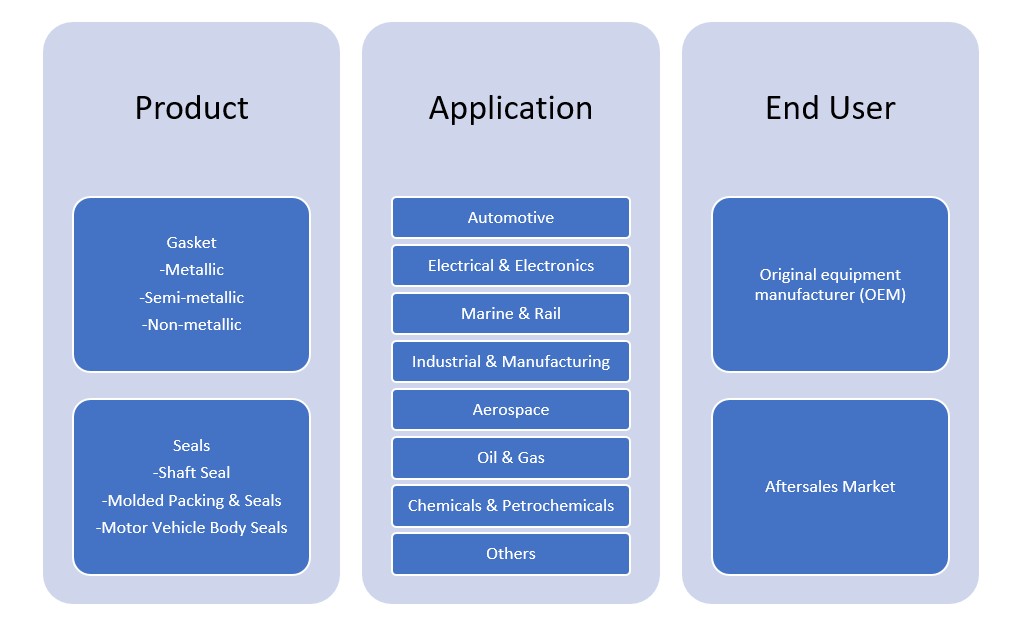
The market is broadly categorized into gaskets and seals. The gasket segment is further divided into metallic, semi-metallic, and non-metallic gaskets. Metallic gaskets are widely used in high-pressure and high-temperature environments, especially in industrial and petrochemical applications. Semi-metallic gaskets, offering a balance between strength and flexibility, are preferred in various mechanical systems. Non-metallic gaskets, often made from materials like rubber, PTFE, or graphite, dominate applications requiring chemical resistance and low compressive force.The seals segment includes shaft seals, molded packing and seals, and motor vehicle body seals. Shaft seals are extensively utilized in rotating equipment across automotive and manufacturing industries. Molded packing and seals are popular due to their adaptability in complex geometries, while motor vehicle body seals are crucial in enhancing vehicle durability and noise insulation, especially in passenger and commercial vehicles.
By Application
The market is segmented into automotive, electrical & electronics, marine & rail, industrial & manufacturing, aerospace, oil & gas, chemicals & petrochemicals, and others. The automotive sector holds a significant share, driven by the production and maintenance of conventional and electric vehicles. The oil & gas and chemicals & petrochemicals segments also generate high demand due to the need for high-performance sealing solutions in extreme operating conditions. Industrial and manufacturing applications remain a steady demand base due to continuous production processes requiring reliable sealing components.
Segments
Based on Product
- Gasket
- Metallic
- Semi-metallic
- Non-metallic
- Seals
- Shaft Seal
- Molded Packing & Seals
- Motor Vehicle Body Seals
Based on Application
- Automotive
- Electrical & Electronics
- Marine & Rail
- Industrial & Manufacturing
- Aerospace
- Oil & Gas
- Chemicals & Petrochemicals
- Others
Based on End User
- Original equipment manufacturer (OEM)
- Aftersales Market
Based on Region
- Southeast
- South
- Northeast
- North
- Central-West
Regional Analysis
Southeast Brazil (45-50%)
The Southeast region holds the largest market share in the Brazil Gasket and Seals Market, contributing approximately 45-50% of the total market. This region is the industrial powerhouse of the country, home to major automotive manufacturers, industrial plants, and energy companies. São Paulo, in particular, is a key hub for the automotive industry, driving significant demand for gaskets and seals used in vehicle production and aftermarket services. Additionally, the region is pivotal for oil & gas operations, especially in the offshore pre-salt fields, making it a critical area for high-performance sealing solutions. The diverse industrial base across this region supports the demand for a variety of gasket and seal types, including metallic and non-metallic gaskets, as well as shaft seals and molded packing.
South Brazil (25-30%)
The South region accounts for approximately 25-30% of the total market share. This region is known for its strong manufacturing sector, including automotive, machinery, and agricultural equipment production. The automotive industry is particularly significant here, with several domestic and international companies having production facilities in the region. The demand for gaskets and seals in this area is driven by both OEMs and the aftermarket sector. Additionally, the South region's growing focus on clean energy, particularly in wind power and bioenergy, is contributing to an increased need for specialized sealing solutions.
Key players
- VMI Sealing Solutions
- Sodecis
- Tecnoseal
- Dichtungstechnik
- Sealing Technology Brazil
Competitive Analysis
The Brazil Gasket and Seals Market is characterized by a diverse set of players offering a wide range of sealing solutions to meet the varied needs of industries such as automotive, oil & gas, and manufacturing. VMI Sealing Solutions stands out for its strong product portfolio and innovative sealing technologies, focusing on high-quality and high-performance seals and gaskets. Sodecis, known for its robust presence in the local market, offers competitive pricing and is focused on expanding its regional footprint. Tecnoseal is recognized for its custom-engineered sealing products and has built a reputation for reliability and precision, catering to both OEMs and the aftermarket segment. Dichtungstechnik offers specialized sealing solutions with a focus on high-end applications in industries like aerospace and automotive, while Sealing Technology Brazil focuses on delivering tailored solutions to meet the specific demands of the oil & gas and energy sectors. Together, these players form a highly competitive landscape where innovation, product quality, and customer service are key differentiators.
Recent Developments
- On February 12, 2025, SKF India Limited's Board of Directors approved the appointment of Ms. Surbhi Srivastava, Head of People Experience, to the Senior Management Team. Ms. Srivastava holds a Bachelor of Science from Fergusson College and an MBA from Symbiosis Institute of Business Management, Pune, with over 20 years of experience across various industries.
- In May 2024, Trelleborg announced plans to invest in a new production facility in Casablanca, Morocco, dedicated to aerospace sealing solutions. Construction commenced prior to January 2025, with operations expected to begin by the end of 2025.
- In November 2023, Freudenberg Sealing Technologies reported that sales of its Simriz perfluoroelastomeric (FFKM) compounds had more than doubled in North America over the preceding 24 months. This surge was attributed to the compounds' quality, performance, and availability during supply chain disruptions.
- On May 2, 2023, The Yokohama Rubber Co., Ltd. completed the acquisition of all outstanding shares of Trelleborg Wheel Systems Holding AB, expanding its presence in the off-highway tire sector.
Market Concentration and Characteristics
The Brazil Gasket and Seals Market exhibits a moderate to high level of concentration, with a mix of both local and international players competing for market share. Major global players such as VMI Sealing Solutions, Sodecis, and Tecnoseal dominate the market with their extensive product portfolios and strong distribution networks. However, the market also includes numerous regional and small-to-medium-sized enterprises that cater to specific niches and regional needs. The competitive landscape is characterized by innovation in sealing materials, customization of solutions for specialized applications, and a growing emphasis on sustainability. The market’s dynamics are also influenced by the increasing demand for high-performance gaskets and seals, particularly in industries such as automotive, oil & gas, and renewable energy. Despite competition, there remains ample opportunity for new entrants and regional players to expand, particularly through technological advancements and product differentiation.
Report Coverage
The research report offers an in-depth analysis based on Product, Application, End User and Region. It details leading market players, providing an overview of their business, product offerings, investments, revenue streams, and key applications. Additionally, the report includes insights into the competitive environment, SWOT analysis, current market trends, as well as the primary drivers and constraints. Furthermore, it discusses various factors that have driven market expansion in recent years. The report also explores market dynamics, regulatory scenarios, and technological advancements that are shaping the industry. It assesses the impact of external factors and global economic changes on market growth. Lastly, it provides strategic recommendations for new entrants and established companies to navigate the complexities of the market.
Future Outlook
- The automotive sector will continue to drive demand for gaskets and seals, particularly with the rise of electric vehicles. As vehicle production grows, the need for high-quality sealing solutions will increase.
- Brazil’s expanding oil and gas exploration, especially in offshore pre-salt fields, will increase the demand for specialized, high-performance sealing solutions. Seals will be essential in ensuring operational efficiency and safety in extreme conditions.
- The renewable energy sector, particularly wind and solar energy, will provide significant opportunities for gasket and seal manufacturers. Sealing solutions for energy infrastructure, including turbines and solar panels, will see a rise in demand.
- Advancements in material technology will lead to the development of more durable, heat-resistant, and chemical-resistant sealing products. These innovations will cater to industries requiring high-performance sealing solutions.
- There will be a growing demand for customized gaskets and seals tailored to specific applications in industries like automotive and aerospace. Manufacturers will focus on offering bespoke solutions to enhance product performance.
- Environmental considerations will drive the adoption of eco-friendly materials in gasket and seal production. Sustainable materials like biodegradable polymers and recycled compounds will become increasingly common.
- As Brazil continues to invest in infrastructure, the demand for sealing solutions in construction and industrial equipment will rise. Gaskets and seals will be needed to ensure the efficiency of machinery and systems.
- The aftersales market will continue to expand due to the growing number of vehicles and machinery requiring replacement seals and gaskets. This will create sustained demand for aftermarket sealing products.
- The gasket and seals market in Brazil will see increased competition as both global and regional players vie for market share. This could lead to market consolidation as companies seek to expand their regional presence.
- With industries demanding more reliable and long-lasting products, the market will see a shift towards seals that offer enhanced durability and longevity. Manufacturers will focus on delivering seals with better performance in extreme conditions, reducing maintenance costs.

Request a Free Sample
Fill in your details and we'll send you a free sample report.
- Sample data tables & charts
- Research methodology
Market Dynamics
Expansion of the Automotive Sector
Brazil's position as one of the largest automotive markets in Latin America is fueling demand for gaskets and seals, which are essential for vehicle assembly, maintenance, and the growing electric vehicle segment. The need for high-quality, durable sealing solutions in engines, transmissions, and battery systems is driving market growth.
Industrialization and Infrastructure Development
Ongoing investments in Brazil's manufacturing, construction, and energy sectors are increasing the need for reliable sealing solutions that can withstand harsh operational environments. Gaskets and seals are critical for ensuring the efficiency and safety of industrial equipment, pipelines, and machinery.
Growth in Oil & Gas Exploration
Brazil's expanding oil and gas industry, particularly in offshore pre-salt fields, requires advanced gaskets and seals capable of withstanding extreme pressures and temperatures. The sector's growth is directly increasing demand for specialized, high-performance sealing products.
Technological Advancements and Customization
Innovations in materials such as expanded PTFE, composites, and specialty elastomers are enabling the production of seals with superior resistance to heat, chemicals, and wear. Additionally, the trend toward customized sealing solutions for specific industrial and automotive applications is boosting market value.
Sustainability and Eco-friendly Materials
Rising environmental awareness and regulatory pressures are prompting manufacturers to develop gaskets and seals from biodegradable and recyclable materials. The shift toward sustainable production practices is opening new market opportunities and aligning with customer preferences for greener solutions.
Need a Custom Version of This Report?
Tailor the scope, geography, or segments to your exact requirements.
- Custom geography or segment scope
- Direct access to our analyst team
Frequently Asked Questions
What is the market size of the Brazil Gasket and Seals Market in 2023 and 2032?
What are the key drivers of the Brazil Gasket and Seals Market?
How does material technology impact the Brazil Gasket and Seals Market?
Which sectors are contributing to the growth of the Brazil Gasket and Seals Market?
Who are the major players in the Brazil Gasket and Seals Market?
Table of Content
Chapter 1 Market Segmentation
- 1.1 Segmentation Framework
- 1.1.1 Product and Service Classification
- 1.1.2 Application and End-Use Classification
- 1.1.3 Technology and Solution Classification
- 1.1.4 Customer and Distribution Channel Classification
- 1.1.5 Geographic Segmentation
- 1.1.6 Market Segment Definitions and Boundaries
- 1.2 By Product
- 1.2.1 Gasket
- 1.2.2 Metallic Gasket
- 1.2.3 Semi-metallic Gasket
- 1.2.4 Non-metallic Gasket
- 1.2.5 Seals
- 1.2.6 Shaft Seal
- 1.2.7 Molded Packing & Seals
- 1.2.8 Motor Vehicle Body Seals
- 1.3 By End User
- 1.3.1 Original Equipment Manufacturer (OEM)
- 1.3.2 Aftersales Market
- 1.4 By Application
- 1.4.1 Automotive
- 1.4.2 Electrical & Electronics
- 1.4.3 Marine & Rail
- 1.4.4 Industrial & Manufacturing
- 1.4.5 Aerospace
- 1.4.6 Oil & Gas
- 1.4.7 Chemicals & Petrochemicals
- 1.4.8 Others
Chapter 2 Introduction
- 2.1 Report Objectives and Scope
- 2.2 Product Definition and Industry Terminology
- 2.3 Market Inclusions and Exclusions
- 2.4 Research Process
- 2.4.1 Primary Research and Expert Interviews
- 2.4.2 Secondary Research and Source Review
- 2.4.3 Top-Down and Bottom-Up Estimation
- 2.4.4 Data Triangulation and Verification
- 2.5 Market Size Measurement Basis
- 2.5.1 2024: USD 1,714.23 million → 2032: USD 2,593.55 million
- 2.6 Historical and Forecast Reference Periods
- 2.6.1 Base Year: 2024
- 2.6.2 Forecast Period: 2024-2032
- 2.7 Research Assumptions and Limitations
Chapter 3 Executive Summary
- 3.1 Market Snapshot and Key Findings
- 3.2 Base-Year Market Size, 2024
- 3.3 Forecast Market Size, 2032
- 3.4 Revenue and Volume Growth Outlook
- 3.5 Key Demand and Supply Indicators
- 3.6 Leading Market Segments
- 3.7 Fastest-Growing Market Opportunities
- 3.8 Regional Performance Highlights
- 3.9 Technology and Industry Transformation
- 3.10 Competitive Landscape Summary
- 3.11 Analyst View and Strategic Implications
Chapter 4 Brazil Gasket and Seals Market Trends and Developments
- 4.1 Historical Industry Development
- 4.2 Recent Market Trends and Developments
- 4.3 Demand and Customer Behavior Trends
- 4.4 Technology and Product Innovation
- 4.5 Artificial Intelligence, Automation and Digitalization
- 4.6 Local Manufacturing and Supply Chain Realignment
- 4.7 Industry Partnerships, Mergers and Acquisitions
- 4.8 Sustainability and Circular Economy Developments
- 4.9 Government and Private Sector Investment Trends
- 4.10 Emerging Business Models and Commercialization
- 4.11 Industry Developments and Announcements
Chapter 5 Brazil Gasket and Seals Market Production, Supply and Demand Analysis
- 5.1 Demand Trend and Consumption Analysis
- 5.2 Demand Forecast, 2024-2032
- 5.3 Production and Output Trend
- 5.4 Production and Output Forecast, 2024-2032
- 5.5 Installed Capacity and Capacity Utilization
- 5.6 Company-Wise Production Plants and Statistics
- 5.6.1 Installed Production Capacity
- 5.6.2 Actual Production
- 5.6.3 Planned Capacity and Expansion Targets
- 5.7 Supply Chain Structure and Procurement Trends
- 5.8 Supply-Demand Gap and Bottlenecks
- 5.9 Import Dependence and Sourcing Structure
- 5.10 Contract Manufacturing and Outsourcing
- 5.11 Regional Supply and Demand Concentration
Chapter 6 Brazil Gasket and Seals Market Pricing Analysis
- 6.1 Pricing Structure and Measurement
- 6.2 Historical Pricing Trends
- 6.3 Pricing Outlook, 2024-2032
- 6.4 Average Selling Price and Unit Economics
- 6.5 Pricing by Product and Market Segment
- 6.6 Geographic Pricing Differences
- 6.7 Key Input, Energy, Labor and Logistics Costs
- 6.8 Contract Pricing and Purchasing Models
- 6.9 Pricing Sensitivity and Competitive Positioning
- 6.10 Price, Margin and Profitability Implications
Chapter 7 Brazil Gasket and Seals Market Dynamics
- 7.1 Market Growth Drivers
- 7.1.1 Demand-Side Drivers
- 7.1.2 Technology and Innovation Drivers
- 7.1.3 Infrastructure and Investment Drivers
- 7.1.4 Regulatory and Policy Drivers
- 7.2 Market Restraints
- 7.2.1 Cost and Affordability Constraints
- 7.2.2 Technology and Adoption Barriers
- 7.2.3 Supply Chain and Operational Constraints
- 7.3 Market Challenges
- 7.3.1 Competitive Pressure and Margin Erosion
- 7.3.2 Skills, Infrastructure and Implementation Gaps
- 7.4 Emerging Market Opportunities
- 7.5 Market Dynamics Impact and Time-Horizon Assessment
Chapter 8 Brazil Gasket and Seals Value Chain Analysis
- 8.1 Industry Value Chain Overview
- 8.2 Upstream Suppliers and Critical Inputs
- 8.3 Technology and Component Providers
- 8.4 Manufacturing or Service Delivery
- 8.5 Distribution, Channel Partners and Integrators
- 8.6 Downstream Applications and End Users
- 8.7 Value Addition and Profit Pools
- 8.8 Vertical Integration and Outsourcing
- 8.9 Supplier Concentration and Risk
- 8.10 Supply Chain Localization and Resilience
Chapter 9 Brazil Gasket and Seals Market Regulations and Policies
- 9.1 Relevant Laws, Standards and Compliance Frameworks
- 9.2 Product, Service, Safety and Quality Requirements
- 9.3 Government Policies, Incentives and Subsidies
- 9.4 Imports, Exports and Trade Barriers
- 9.5 Public Procurement and Local Content Requirements
- 9.6 Environmental and Sustainability Compliance
- 9.7 Upcoming Policy Changes and Market Implications
Chapter 10 Brazil Gasket and Seals Market Hotspots and Opportunities
- 10.1 Market Opportunity Mapping and Growth Hotspots
- 10.2 High-Growth Applications and Customer Groups
- 10.3 Underserved Markets and White-Space Opportunities
- 10.4 Emerging Technology and Product Opportunities
- 10.5 New Capacity and Investment Hotspots
- 10.6 Market Entry and Expansion Opportunities
- 10.7 Distribution and Partnership Opportunities
- 10.8 Near-Term and Long-Term Commercial Potential
- 10.9 Opportunity Attractiveness and Execution Risks
Chapter 11 Brazil Gasket and Seals Market Outlook, 2024-2032
- 11.1 Market Size and Analysis
- 11.1.1 Revenue (Market Measurement: 2024: USD 1,714.23 million → 2032: USD 2,593.55 million)
- 11.1.2 Market Volume and Quantity Sold
- 11.1.3 Historical Market Size
- 11.1.4 Base-Year Market Size, 2024
- 11.2 Market Forecast, 2024-2032
- 11.2.1 Revenue Forecast to 2032
- 11.2.2 Volume Forecast to 2032
- 11.2.3 CAGR and Year-on-Year Growth
- 11.2.4 Incremental Revenue Opportunity
- 11.3 Forecast Assumptions and Scenario Analysis
- 11.3.1 Base-Case Forecast
- 11.3.2 Optimistic and Conservative Scenarios
- 11.3.3 Technology, Pricing and Policy Sensitivities
- 11.4 Market Attractiveness and Growth Outlook
Chapter 12 Brazil Gasket and Seals Market Segmentation and Outlook
- 12.1 Segmentation Summary and Market Shares, 2024
- 12.2 Largest and Fastest-Growing Segments
- 12.3 By Product - Market Size and Forecast, 2024-2032
- 12.3.1 Segment Definition and Scope
- 12.3.2 Historical Market Size
- 12.3.3 Revenue Forecast, 2024-2032
- 12.3.4 Volume Forecast, 2024-2032
- 12.3.5 Base-Year Market Share, 2024
- 12.3.6 Segment CAGR and Growth Drivers
- 12.3.7 Subsegment Market Size and Forecast
- 12.3.7.1 Gasket
- 12.3.7.2 Metallic Gasket
- 12.3.7.3 Semi-metallic Gasket
- 12.3.7.4 Non-metallic Gasket
- 12.3.7.5 Seals
- 12.3.7.6 Shaft Seal
- 12.3.7.7 Molded Packing & Seals
- 12.3.7.8 Motor Vehicle Body Seals
- 12.3.8 Subsegment Pricing and Adoption Trends
- 12.3.9 Leading Suppliers and Competition
- 12.3.10 Regional Demand and Opportunities
- 12.4 By End User - Market Size and Forecast, 2024-2032
- 12.4.1 Segment Definition and Scope
- 12.4.2 Historical Market Size
- 12.4.3 Revenue Forecast, 2024-2032
- 12.4.4 Volume Forecast, 2024-2032
- 12.4.5 Base-Year Market Share, 2024
- 12.4.6 Segment CAGR and Growth Drivers
- 12.4.7 Subsegment Market Size and Forecast
- 12.4.7.1 Original Equipment Manufacturer (OEM)
- 12.4.7.2 Aftersales Market
- 12.4.8 Subsegment Pricing and Adoption Trends
- 12.4.9 Leading Suppliers and Competition
- 12.4.10 Regional Demand and Opportunities
- 12.5 By Application - Market Size and Forecast, 2024-2032
- 12.5.1 Segment Definition and Scope
- 12.5.2 Historical Market Size
- 12.5.3 Revenue Forecast, 2024-2032
- 12.5.4 Volume Forecast, 2024-2032
- 12.5.5 Base-Year Market Share, 2024
- 12.5.6 Segment CAGR and Growth Drivers
- 12.5.7 Subsegment Market Size and Forecast
- 12.5.7.1 Automotive
- 12.5.7.2 Electrical & Electronics
- 12.5.7.3 Marine & Rail
- 12.5.7.4 Industrial & Manufacturing
- 12.5.7.5 Aerospace
- 12.5.7.6 Oil & Gas
- 12.5.7.7 Chemicals & Petrochemicals
- 12.5.7.8 Others
- 12.5.8 Subsegment Pricing and Adoption Trends
- 12.5.9 Leading Suppliers and Competition
- 12.5.10 Regional Demand and Opportunities
- 12.6 Segment Growth Comparison
- 12.7 Segment Attractiveness and Priority Matrix
Chapter 13 Brazil Gasket and Seals End-Use and Application Market Outlook
- 13.1 End-Use Industry and Customer Demand Structure
- 13.2 Leading Applications and Customer Groups
- 13.3 End-Use Market Size, Share and Forecast
- 13.4 Major End-Use Industry Deep Dives
- 13.4.1 Customer Requirements and Use Cases
- 13.4.2 Demand and Replacement Cycles
- 13.4.3 Technical and Regulatory Considerations
- 13.4.4 Purchasing and Procurement Models
- 13.4.5 Leading Vendors and Distribution Channels
- 13.4.6 Forecast and Commercial Opportunities
- 13.5 Emerging Applications and Cross-Segment Demand
- 13.6 End-Use Industry Investment Priorities
Chapter 14 Brazil Gasket and Seals Geographic Market Outlook, 2024-2032
- 14.1 Domestic Market Distribution and Demand Clusters
- 14.2 State- or Province-Wise Market Size and Forecast, 2024-2032
- 14.3 City and Metropolitan Market Outlook
- 14.4 Industrial, Manufacturing and Commercial Clusters
- 14.5 Geographic Concentration of Key End Users
- 14.6 Local Pricing and Purchasing Differences
- 14.7 Domestic Production Facilities and Capacity Map
- 14.8 Local Infrastructure and Project Pipeline
- 14.9 State-Level Policy and Incentive Differences
- 14.10 Subnational Investment Hotspots and Opportunities
- 14.11 Distribution and Logistics Networks
- 14.12 Domestic Competitive Footprint
Chapter 15 Brazil Gasket and Seals Technology, Innovation and Sustainability Outlook
- 15.1 Technology Landscape and Maturity
- 15.2 Product, Process and Service Innovation
- 15.3 AI, Automation and Digital Tools in the Industry
- 15.4 Technology Adoption and Performance Benchmarking
- 15.5 Innovation Pipeline and R&D Investment
- 15.6 Patent and Intellectual Property Trends
- 15.7 Energy Efficiency and Resource Management
- 15.8 Sustainability, Recycling and Circularity
- 15.9 Technology Roadmap, 2024-2032
- 15.10 Risks of Obsolescence and Technology Substitution
Chapter 16 Brazil Gasket and Seals Market Key Strategic Imperatives
- 16.1 Growth and Market Entry Priorities
- 16.2 High-Return Products and Segments
- 16.3 Pricing, Profitability and Cost Optimization
- 16.4 Technology Investment and Product Differentiation
- 16.5 Supply Chain Localization and Resilience
- 16.6 Distribution and Customer Acquisition
- 16.7 Partnership, Acquisition and Capacity Strategy
- 16.8 Regional Expansion Priorities
- 16.9 Short-, Medium- and Long-Term Actions
Chapter 17 Competition Outlook
- 17.1 Industry Competition Characteristics
- 17.2 Market Structure and Concentration
- 17.3 Market Share and Competitive Positioning, 2024
- 17.4 Company-Wise Revenue and Product Benchmarking
- 17.5 Production and Service Capacity Benchmarking
- 17.6 Technology, Pricing and Differentiation
- 17.7 Regional Footprint and Distribution Strength
- 17.8 Mergers, Acquisitions and Strategic Alliances
- 17.9 New Entrants and Competitive Threats
- 17.10 Porter's Five Forces and Industry Attractiveness
- 17.11 Competitive Outlook, 2024-2032
Chapter 18 Company Profiles
- 18.1 Company Coverage and Selection Criteria
- 18.2 Trelleborg
- 18.2.1 Business Description
- 18.2.2 Company Ownership and Geographic Presence
- 18.2.3 Product and Service Portfolio
- 18.2.4 Manufacturing and Operating Footprint
- 18.2.5 Production Capacity and Expansion Plans
- 18.2.6 Financial Performance and Investment
- 18.2.7 Market Share and Competitive Position
- 18.2.8 Technology and Innovation Capabilities
- 18.2.9 Strategic Alliances or Partnerships
- 18.2.10 Recent Developments
- 18.2.11 Growth Strategy and Outlook
- 18.3 SKF
- 18.4 Freudenberg
- 18.5 Dana Incorporated
- 18.6 VMI Sealing Solutions
- 18.7 Sodecis
- 18.8 Tecnoseal
- 18.9 Dichtungstechnik
- 18.10 Sealing Technology Brazil
- 18.11 The Yokohama Rubber Co., Ltd.
- 18.12 Other Relevant Market Participants
Note: Every listed company is profiled on the structure shown under the first company. The company list is preliminary and may change based on research findings, market developments, data availability and client requirements.
Chapter 19 Disclaimer
- 19.1 Research and Forecast Disclaimer
- 19.2 Data Source and Estimation Limitations
Note: The depth of individual sections depends on data availability for this market. Volume, capacity, trade and other unit-based metrics are included where applicable.

