
Market overview
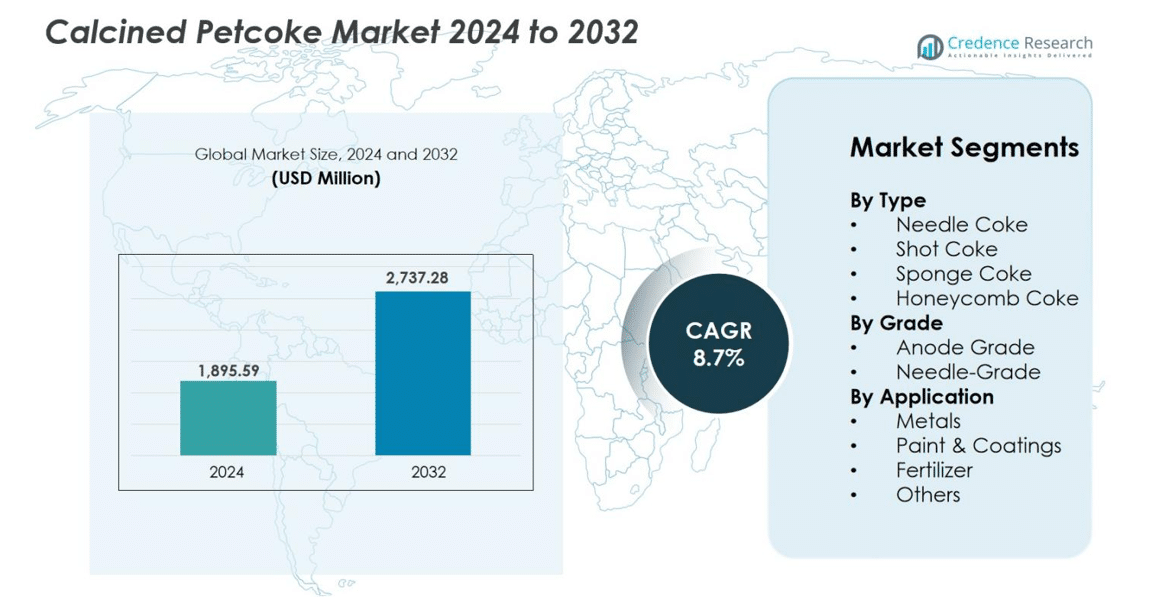
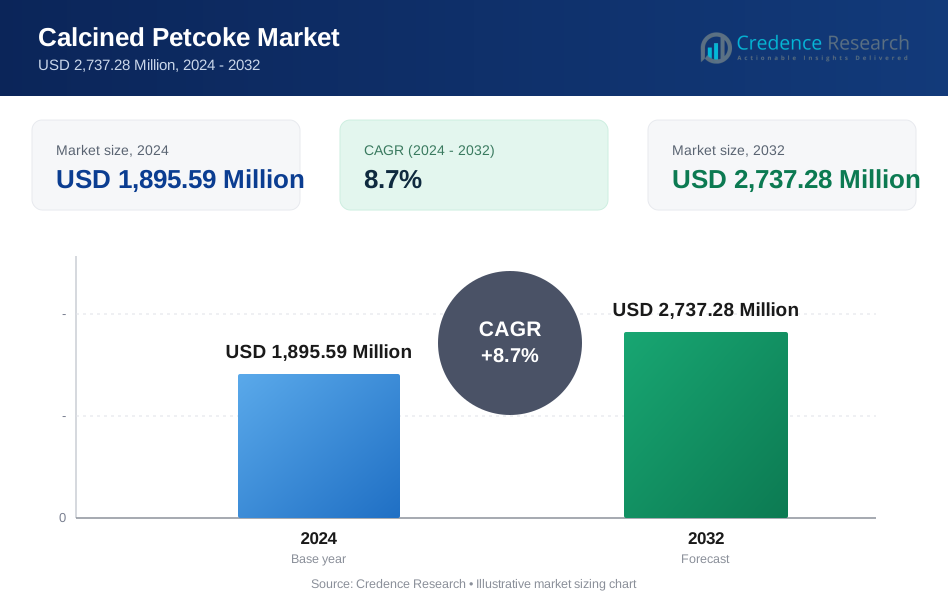
The Calcined Petcoke Market size was valued at USD 1,895.59 Million in 2024 and is anticipated to reach USD 2,737.28 Million by 2032, at a CAGR of 8.7% during the forecast period.
| REPORT ATTRIBUTE | DETAILS |
|---|---|
| Historical Period | 2020-2023 |
| Base Year | 2024 |
| Forecast Period | 2025-2032 |
| Calcined Petcoke Market Size 2024 | USD 1,895.59 Million |
| Calcined Petcoke Market, CAGR | 8.7% |
| Calcined Petcoke Market Size 2032 | USD 2,737.28 Million |
The Calcined Petcoke Market features leading companies such as Oxbow Corporation, Rain Industries Limited, Aluminium Bahrain BSC, Aminco Resources LLC, Asbury Carbons Inc., Atha Group, Carbograf Industrial S.A., Graphite India Limited, Goa Carbon Limited and Minmat Ferro Alloys Pvt Ltd, all of which maintain extensive production capacities, global supply‑chain linkages and long‑term offtake relationships with major aluminium and steel producers. The Asia‑Pacific region remains the dominant market with a share of 45.1 % in 2024, driven by rapid infrastructure growth, extensive aluminium smelting expansion and increasing electric‑arc furnace steelmaking activity.
Market Insights
- The Calcined Petcoke Market was valued at USD 1,895.59 Million in 2024 and is projected to grow at a CAGR of 8.7% through the forecast period.
- Market drivers include robust aluminium and steel industry expansion, where calcined petcoke serves as essential feedstock for anode production and electrode materials.
- Key trends feature a shift toward high‑purity grades like needle coke, rising battery and lithium‑ion applications, and geographic growth in emerging markets seeking infrastructure and industrial development.
- Restraints stem from feedstock volatility (green petroleum coke supply fluctuations), logistics challenges, and increasing regulatory pressure on emissions tied to calcination processes.
- Regionally, Asia‑Pacific commands approximately 1% of global demand, supported by dominant consumption in the aluminium sector; segment‑wise, the anode grade holds roughly 76.4% of market share in 2024.
Market Segmentation Analysis:
By Type
Within the Type segmentation of the calcined petcoke market, the Needle Coke sub‑segment emerges as the dominant player, capturing approximately 34.75% of the market in 2024. This leadership stems from its highly desirable properties namely, high thermal conductivity and low coefficient of thermal expansion making it essential for manufacturing graphite electrodes used in electric arc furnace steelmaking and lithium‑ion battery anodes. Drivers for this segment include the accelerating adoption of electric mobility and growing electrode demand, alongside increased investments in high-purity calcination technologies. In contrast, Shot, Sponge and Honeycomb Cokes occupy smaller shares, reflecting their more specialized or lower‑purity applications.
- For instance, in 2024, global crude steel production via electric arc furnaces (EAFs) accounted for approximately 29.1% of total steel production, a volume estimated to be over 650 million tonnes. This process necessitated an estimated 800,000 to 850,000 tonnes of high-power and ultra-high-power graphite electrodes, with an average consumption rate of 1.4 kg to 2.5 kg per ton of steel produced.
By Grade
In the Grade segmentation, the Anode Grade calcined petcoke sub‑segment holds dominance with over 76.4% share of the market in 2024. This grade is tailored for aluminium smelting operations, providing the necessary low‑sulphur, high‑carbon feedstock for carbon anodes. The dominant position is driven by the robust global aluminium industry demand, growth in primary aluminium production (especially in Asia‑Pacific), and stringent requirements on carbon feedstock quality. Meanwhile, the Needle‑Grade (though smaller in share) is gaining traction for specialty carbon products and electrode manufacture, but its share remains modest relative to the anode grade core.
- For instance,Aluminium Bahrain BSC, which relies on high-quality anode-grade petcoke as a key feedstock for its carbon anode production, critical to its aluminum smelting operations.
By Application
Under the Application segmentation, the Metals sub‑segment (encompassing aluminium and steel) is dominant, holding over 45.4% of the market in 2024. This prominence is due to calcined petcoke’s role as a critical carbon additive in aluminium smelting (anode feedstock) and steelmaking (recarburiser, electrode feed). Key drivers include ongoing global infrastructure and construction activity boosting steel demand, expansion of aluminium capacity, and increasing electric arc furnace penetration. Other segments such as Paint & Coatings (30.2%) and Fertilizer (15.9%) represent meaningful, but significantly smaller, shares of the market.
Key Growth Drivers
Expansion of Aluminium and Steel Industries
The global expansion of the aluminium and steel sectors fuels growth in the calcined petcoke market. As the aluminium industry scales, demand for high‑carbon anode feedstock namely calcined petcoke rises significantly. Similarly, the steel sector, especially its electric arc furnace (EAF) segment, requires calcined petcoke for electrode manufacture and carburising. This dual‑end‑use surge underpins market momentum. For instance, increased aluminium smelter capacities and EAF conversions in Asia‑Pacific drive stable uptake. Additionally, infrastructure investments in emerging economies further boost raw material throughput and feedstock consumption.
- For instance, in Indonesia, East Hope Group is launching a 6 million metric ton alumina and 2.4 million metric ton aluminum project in West Kalimantan, leveraging advanced smelting technology and creating a closed-loop supply chain that will significantly increase regional demand for calcined petcoke.
Urbanisation and Infrastructure Development
Rapid urbanisation across Asia‑Pacific, Latin America and parts of Africa is boosting infrastructure demand for buildings, roads and energy systems, which in turn elevates consumption of aluminium, steel, cement and associated products. Calcined petcoke benefits as a critical input into aluminium smelting, steel electrodes and cement production fuels. Government‑led programmes and housing initiatives amplify this effect by stimulating new capacity installations and thereby increasing raw material demand. As urban density and per‑capita metal usage rise, the feed‑through to the calcined petcoke market strengthens accordingly.
- For instance, Aluminium Bahrain BSC relies heavily on high-quality anode-grade calcined petcoke for its carbon anode production, which is essential in efficient aluminium smelting operations.
Technological Advancement and Quality Improvement
Ongoing technological advancement in refining, coking and calcination processes enhances the yield, purity and performance of calcined petcoke, thereby widening its adoption. Improved calcination kilns deliver higher carbon content, lower sulphur and ash levels, meeting stricter anode‑grade and needle‑grade specifications. These quality gains open growth pathways into high‑end applications such as graphite electrodes and lithium‑ion battery anodes. Concurrently, manufacturers’ investments in supply‑chain integration and capacity expansion support stable throughput and competitive pricing, further propelling market growth.
Key Trends & Opportunities
Shift towards High‑Purity Needle Coke and Battery Applications
A prominent trend is the shift towards high‑purity variants of calcined petcoke especially needle coke for advanced applications including graphite electrodes and emerging battery technologies. As demand for electric vehicles (EVs) grows, so does the need for high‑performance carbon materials. This transition offers opportunity for players to diversify product portfolios and target niche segments with premium pricing. Partnerships between coke producers, battery manufacturers and electrode suppliers are increasingly common, further reinforcing the growth potential of this high‑purity branch.
- For instance,Companies like Phillips 66 have formed strategic partnerships with battery manufacturers such as Faradion to advance anode materials for emerging sodium-ion batteries, reflecting the growing collaboration between coke producers and battery firms.
Geographical Expansion into Emerging Markets
Emerging economies—particularly in Asia‑Pacific, Africa and Latin America—are presenting sizeable opportunities for calcined petcoke producers. With rising industrialisation, rising aluminium and steel output and increasing infrastructure spend, these regions are becoming high‑growth markets. Local production of aluminium and steel is complemented by expanding refining capacity, which improves feedstock availability for petcoke. Strategic investments in regional manufacturing, downstream processing and logistic networks allow established players to capture incremental share in these expanding geographies.
- For instance, India's infrastructure push backed by government initiatives aims to boost construction and manufacturing, indirectly stimulating demand for calcined petcoke, with major domestic players such as Vedanta and Hindalco expanding capacity to meet rising aluminum output.
Key Challenges
Raw Material Price Volatility and Supply Constraints
The calcined petcoke market is challenged by volatility in the price and supply of its primary input—green petroleum coke, derived from crude oil refining residues. Fluctuations in crude oil prices, refining output and regulatory shifts can disrupt feedstock availability or raise cost structures significantly. Such volatility threatens profit margins, reduces planning reliability and may force producers into long‑term contracts or alternative sourcing at disadvantageous terms. These supply chain uncertainties hinder consistent growth execution and may deter new entrant commitments.
Environmental Regulation and Emission Concerns
The production and use of calcined petcoke face increasing scrutiny from environmental regulators and stakeholders because of high‑temperature calcination processes and the potential for sulphur, ash and greenhouse gas emissions. Stricter emission norms, sustainability mandates and potential carbon pricing increase compliance costs and may limit production expansion. Moreover, competition from alternative carbon materials with lower environmental footprints poses a risk. Companies must invest in cleaner technologies and sustainable sourcing to maintain market access and reputation.
Regional Analysis
Asia Pacific
The Asia Pacific region commanded a market share of 45.1 % in 2024, clearly leading global demand for calcined petcoke. Drivers include expansive aluminium smelting in China and India and robust growth in electric arc furnace steelmaking across Southeast Asia. As infrastructure investment escalates, the need for high‑carbon raw materials such as calcined petcoke rises proportionately. The region’s refining capacity continues to expand, delivering greater feedstock volumes and enabling suppliers to scale production. Market players prioritise Asia Pacific to capitalise on both mature anode‑grade demand and emerging battery‑related applications.
North America
North America held a market share of 25 % in 2023 and remains a key region for calcined petcoke consumption. This dominance is rooted in its mature aluminium smelting industry and substantial export capability of high‑purity coke. Demand stability stems from anode‑grade requirements and increasing electrification in the automotive sector. U.S. and Canadian producers are investing in enhanced calcination and logistics infrastructure to support efficient supply. Regulatory clarity and advanced downstream industries help sustain consistent uptake, enabling regional manufacturers to secure long‑term offtake agreements with major metal‑producing customers.
Europe
Europe accounted for 15 % of the market share in 2023, with steady demand derived from aluminium, steel and titanium dioxide applications. Growth is moderated by stringent environmental regulations and competition from alternative carbon materials, yet the region continues to invest in high‑quality anode‑grade calcined petcoke to meet metal‑industry standards. Producers active in Europe focus on low‑sulphur, low‑ash profiles and secure supply chains within the trade‑sensitive import environment. The alignment of European smelters with sustainability goals may further shift feedstock preferences toward premium coke grades.
Latin America
Latin America contributed 10 % of the global calcined petcoke market in 2023 and presents moderate growth potential. Infrastructure development, rapid urbanisation, and expanding aluminium production capacity in countries such as Brazil support demand. However, the region faces logistic challenges and feedstock constraints which limit throughput expansion. Local producers are exploring partnerships to establish downstream calcination facilities closer to smelters, thereby reducing import dependency and freight risk. As regional metal‑industry capacity increases, Latin America’s share is expected to climb gradually in the forecast period.
Middle East & Africa (MEA)
The Middle East & Africa region represented 5 % of the market share in 2023, making it the smallest among the major regional market segments. Demand originates from aluminium smelters in the Gulf region and steel‑recycling applications in South Africa. Despite relatively low baseline volumes, MEA offers attractive upside through greenfield smelter projects and rising power‑sector electrification, which could push calcined petcoke uptake. Key challenges include feedstock sourcing, transportation logistics, and regulatory clarity. Strategic investments in local calcination capacity may assist regional suppliers in capturing incremental share in the coming years.
Market Segmentations:
By Type
- Needle Coke
- Shot Coke
- Sponge Coke
- Honeycomb Coke
By Grade
- Anode Grade
- Needle-Grade
By Application
- Metals
- Paint & Coatings
- Fertilizer
- Others
By Region
- North America
- U.S.
- Canada
- Mexico
- Europe
- Germany
- France
- U.K.
- Italy
- Spain
- Rest of Europe
- Asia Pacific
- China
- Japan
- India
- South Korea
- South-east Asia
- Rest of Asia Pacific
- Latin America
- Brazil
- Argentina
- Rest of Latin America
- Middle East & Africa
- GCC Countries
- South Africa
- Rest of the Middle East and Africa
Competitive Landscape
The competitive landscape in the global calcined petcoke market features key players such as Oxbow Corporation, Rain Industries Limited, Aluminium Bahrain BSC, Aminco Resources LLC, Asbury Carbons Inc., Atha Group, Carbograf Industrial S.A., Graphite India Limited, Goa Carbon Limited and Minmat Ferro Alloys Pvt Ltd. These companies anchor the market through large‑scale capacity, global supply‑chain networks, and long‑term offtake agreements with aluminium and steel producers. They differentiate by investing in improved calcination technologies, targeting low‑sulphur and low‑ash petcoke grades suitable for high‑end applications. Key strategic priorities include vertical integration from green petroleum coke sourcing to downstream anode or electrode production and regional expansion into Asia‑Pacific and the Middle East to capitalise on rising industrial demand. Competitive pressures remain high due to feedstock volatility and regulatory constraints, prompting firms to secure supply contracts and enhance logistics efficiency to defend and grow market share.
Key Player Analysis
- Atha Group
- Asbury Carbons Inc.
- Aminco
- Oxbow Corporation
- Rain Industries Limited
- Graphite India Limited
- Aluminium Bahrain
- Goa Carbon Limited
- Carbograf Industrial S.A.
- Minmat Ferro Alloys Pvt Ltd
Recent Developments
- In May 2025, ADNOC Refining and Emirates Global Aluminium (EGA) signed a five‑year supply agreement valued at USD 500 million for up to 1.5 million tonnes of calcined petroleum coke.
- In November 2025, Emirates Global Aluminium (EGA) announced a strategic partnership with BP p.l.c. to optimize the quality and reduce carbon emissions associated with calcined petroleum coke (CPC) used in aluminum production, focusing on sustainable sourcing and emissions reduction initiatives.
- In November 2025, Abu Dhabi National Oil Company (ADNOC) and Emirates Global Aluminium (EGA) signed a landmark five-year supply agreement worth $500 million for up to 1.5 million tonnes of calcined petroleum coke from ADNOC's Ruwais Refinery to support aluminum production and localize the supply chain in the UAE
Report Coverage
The research report offers an in-depth analysis based on Type, Grade, Application and Region. It details leading market players, providing an overview of their business, product offerings, investments, revenue streams, and key applications. Additionally, the report includes insights into the competitive environment, SWOT analysis, current market trends, as well as the primary drivers and constraints. Furthermore, it discusses various factors that have driven market expansion in recent years. The report also explores market dynamics, regulatory scenarios, and technological advancements that are shaping the industry. It assesses the impact of external factors and global economic changes on market growth. Lastly, it provides strategic recommendations for new entrants and established companies to navigate the complexities of the market.
Future Outlook
- Demand will increasingly shift toward higher‑purity grades (such as needle‑grade) to support advanced applications in electrodes and battery materials.
- Growth in aluminium smelting and electric arc furnace steelmaking will continue to underpin the market’s expansion.
- Emerging economies in Asia‑Pacific and Africa will capture rising share as infrastructure investment and metal‑consumption per capita accelerate.
- Producers will invest in improved calcination technologies and vertical integration to achieve lower sulphur/ash levels and enhance product differentiation.
- Suppliers will pursue long‑term feed‑stock contracts and geographic diversification to mitigate volatility in green petroleum coke availability.
- Scrutiny on carbon footprints and emissions will push firms to adopt more sustainable calcination processes and improve environmental compliance.
- Adjacencies such as titanium dioxide, refractories and specialty coatings will emerge as growth pockets beyond traditional metallurgical uses
- Price pressures may persist as oil, coal and coke markets interlink; competitive advantage will hinge on cost‑efficiency and logistics optimisation.
- Strategic partnerships between petcoke producers and large end‑users (e.g., aluminium smelters, battery‑materials firms) will become increasingly prevalent.
- Substitute carbon materials and regulatory constraints could gradually erode lower‑grade petcoke demand, forcing a shift to premium segments.
Request a Free Sample
Fill in your details and we'll send you a free sample report.
- Sample data tables & charts
- Research methodology
Need a Custom Version of This Report?
Tailor the scope, geography, or segments to your exact requirements.
- Custom geography or segment scope
- Direct access to our analyst team
Frequently Asked Questions
What is the current market size for the Calcined Petcoke Market, and what is its projected size in 2032?
At what Compound Annual Growth Rate is the Calcined Petcoke Market projected to grow between 2025 and 2032?
Which is the leading region of the market for calcined petcoke?
What are the key drivers for the growth of the calcined petcoke market?
Which is the major segment in the calcined petcoke by application?
Who are the leading companies in the Calcined Petcoke Market
Table of Content
Chapter 1. Report Introduction
- 1.1 Report Description & Purpose
- 1.1.1 Report Title & Market Definition
- 1.1.2 Unique Selling Propositions (USP) & Key Differentiators
- 1.1.3 Value Proposition for Stakeholders
- 1.2 Research Objectives
- 1.2.1 Market Sizing Objectives (Volume & Revenue)
- 1.2.2 Segmentation Objectives
- 1.2.3 Competitive Intelligence Objectives
- 1.2.4 Forecast & Scenario Objectives
- 1.3 Report Scope
- 1.3.1 Calcined Petcoke Scope – Types & Subtypes Covered
- 1.3.2 Geographic Scope – Regions & Countries Covered
- 1.3.3 Historical Period, Base Year & Forecast Period (2024; forecast to 2032)
- 1.3.4 Inclusions & Exclusions
- 1.4 HS Code & Classification Framework
- 1.5 Currency, Units & Pricing Basis
- 1.6 Target Stakeholders
- 1.7 Limitations & Assumptions
Chapter 2. Executive Summary
- 2.1 Global Calcined Petcoke Market Snapshot
- 2.1.1 Market Size – Historical (2024) & Forecast (2024-2032) (2024: USD 1,895.59 Million → 2032: USD 2,737.28 Million)
- 2.1.2 Volume & Revenue – Global Totals
- 2.1.3 Key Market Highlights – Top Five Facts
- 2.2 Calcined Petcoke Market Segmentation Snapshot
- 2.2.1 Market Split by Region – 2024 vs. 2032
- 2.3 Competitive Snapshot
- 2.3.1 Top 10 Players by Revenue Share – 2024
- 2.3.2 Top 10 Players by Volume Share – 2024
- 2.3.3 Recent Strategic Developments (18-Month Summary)
- 2.4 Key Investment Highlights & Strategic Conclusions
Chapter 3. Calcined Petcoke Market Dynamics & Industry Analysis
- 3.1 Market Overview & Context
- 3.1.1 Calcined Petcoke Market Position in the Broader Automotive Value Chain
- 3.1.2 OEM vs. Replacement Market Dynamics
- 3.1.3 Market Maturity & Development Stage by Region
- 3.2 Calcined Petcoke Market Drivers
- 3.3 Calcined Petcoke Market Restraints & Challenges
- 3.4 Calcined Petcoke Market Opportunities
- 3.5 Porter's Five Forces Analysis
- 3.5.1 Threat of New Entrants
- 3.5.2 Bargaining Power of Suppliers
- 3.5.3 Bargaining Power of Buyers
- 3.5.4 Threat of Substitutes
- 3.5.5 Competitive Rivalry – Intensity Assessment
- 3.6 Calcined Petcoke Value Chain Analysis
- 3.6.1 Upstream – Raw Material/Input Suppliers
- 3.6.1.1 Raw Material/Input 1
- 3.6.1.2 Raw Material/Input 2
- 3.6.1.3 Raw Material/Input 3
- 3.6.2 Midstream – Production/Manufacturing/Service Delivery
- 3.6.2.1 Production/Process Overview
- 3.6.2.2 Key Facility Locations & Capacity by Manufacturer
- 3.6.3 Downstream – Distribution & End Consumer
- 3.6.3.1 Primary Channel – B2B/OEM
- 3.6.3.2 Secondary Channels – Dealer, Retail, Online, Direct
- 3.6.4 Value Chain Profitability Analysis
- 3.6.1 Upstream – Raw Material/Input Suppliers
- 3.7 PESTEL Analysis
- 3.7.1 Political Factors
- 3.7.2 Economic Factors
- 3.7.3 Social Factors
- 3.7.4 Technological Factors
- 3.7.5 Environmental Factors
- 3.7.6 Legal Factors
- 3.8 Calcined Petcoke Supply Chain Analysis
- 3.8.1 Raw Material/Input Supply Risk Assessment
- 3.8.2 Manufacturing Concentration Risk (Geographic Exposure)
- 3.8.3 Trade Disruption Impact Analysis
- 3.9 Regulatory & Policy Landscape
Note: The regulatory and policy landscape section covers regulations based on their applicability to the market, Calcined Petcoke category, geography, and scope of the study. Only regulatory frameworks with a material impact on operations, compliance, trade, sustainability, or market access are analyzed in detail.
Chapter 4. Key Investment Pockets & Opportunity Analysis
- 4.1 Calcined Petcoke Market Attractiveness Analysis
- 4.1.1 By Region – Investment Attractiveness Matrix (Volume × CAGR)
- 4.2 Absolute Revenue Growth Opportunity
- 4.2.1 By Region – Absolute USD Growth Through 2032
- 4.3 Incremental Volume Opportunity
- 4.3.1 By Region – Incremental Volume Through 2032
- 4.3.2 Segment – Incremental Volume
- 4.4 Emerging Submarket Opportunity Deep Dive (Subject to Applicability)
- 4.5 Emerging Market Opportunity Scorecards
- 4.5.1 United States
- 4.5.2 Europe
- 4.5.3 Asia
- 4.5.4 Middle East & Africa
Note: Emerging Market Opportunity Scorecards will be included based on relevance and strategic importance. Regions listed are indicative and may vary depending on data availability and market dynamics.
Chapter 5. Calcined Petcoke Import-Export Analysis & Trade Flows
- 5.1 Global Trade Overview
- 5.1.1 Global Export Value by Country (2024)
- 5.1.2 Global Export Volume by Country (2024)
- 5.1.3 Global Import Value by Country (2024)
- 5.1.4 Global Import Volume by Country (2024)
- 5.1.5 Net Trade Balance by Country (2024)
- 5.2 Export Analysis – Segment
- 5.2.1 Type 1 (HS Code)
- 5.2.2 Type 2 (HS Code)
- 5.2.3 Type 3 (HS Code)
- 5.2.4 Type 4 (HS Code)
- 5.2.5 Type 5 (HS Code)
- 5.3 Import Analysis – Segment
- 5.3.1 Type 1 (HS Code)
- 5.3.2 Type 2 (HS Code)
- 5.3.3 Type 3 (HS Code)
- 5.3.4 Type 4 (HS Code)
- 5.3.5 Type 5 (HS Code)
- 5.4 Average Unit Trade Prices
- 5.4.1 Average Export Price – Segment & Country
- 5.4.2 Average Import Price – Segment & Source Country
- 5.4.3 Price Trends (2024)
- 5.5 Key Trade Route Analysis
- 5.5.1 Trade Route 1
- 5.5.2 Trade Route 2
- 5.5.3 Trade Route 3
- 5.5.4 Trade Route 4
- 5.5.5 Trade Route 5
- 5.6 Trade Policy Impact Assessment
- 5.6.1 US Anti-Dumping & Section 301 Tariffs
- 5.6.2 EU Customs Union Impact
- 5.6.3 Major Free Trade Agreements
- 5.6.4 USMCA Rules of Origin
Note: Trade policy analysis will be included only where relevant to the Calcined Petcoke market.
Chapter 6. Competitive Landscape & Company Benchmarking
- 6.1 Calcined Petcoke Market Concentration & Structure
- 6.1.1 Herfindahl-Hirschman Index (HHI) – vs. 2024
- 6.1.2 Tier 1, Tier 2 & Tier 3 Market Structure
- 6.1.3 Global, Regional & Local Player Dynamics
- 6.2 Calcined Petcoke Market Share Analysis – 2024
- 6.2.1 Global Revenue Share by Company
- 6.2.2 Global Volume Share by Company
- 6.2.3 Regional Revenue Share
- 6.2.4 Market Share Evolution ( vs. 2024)
- 6.2.5 OEM Segment Share by Company
- 6.2.6 Replacement Segment Share by Company
- 6.3 Production/Delivery Capacity & Facility Analysis
- 6.3.1 Global Installed Capacity
- 6.3.2 Capacity Utilization Rates
- 6.3.3 Production/Output Volume
- 6.3.4 Facility Locations & Capacity Map
- 6.3.5 Planned Capacity Additions
- 6.4 Calcined Petcoke Competitive Benchmarking Matrix
- 6.4.1 Revenue, Volume, CAGR & Profitability Comparison
- 6.4.2 Channel Revenue Mix
- 6.4.3 Geographic Revenue Exposure
- 6.4.4 R&D Intensity
- 6.4.5 Sustainability Maturity
- 6.5 Strategic Developments in Calcined Petcoke (Last 24 Months)
- 6.5.1 Mergers, Acquisitions & Divestments
- 6.5.2 New Calcined Petcoke Launches
- 6.5.3 Facility Expansions
- 6.5.4 Strategic Alliances, Joint Ventures & Partnerships
- 6.5.5 Distribution Expansion & Market Entry
- 6.5.6 Sustainability & ESG Initiatives
- 6.6 Competitive Strategy Mapping
- 6.6.1 Leader, Challenger, Follower & Niche Classification
- 6.6.2 Pricing Strategy Comparison
- 6.6.3 Channel Strategy Matrix
Note: Strategic developments are included based on their materiality and the availability of reliable information.
Chapter 7. Global Calcined Petcoke Market – By Distribution Channel
- 7.1 Segment Overview
- 7.1.1 Volume & Revenue Split by Channel (2024 & 2032)
- 7.1.2 Channel Mix Evolution (2024-2032)
Chapter 8. Regional Market Analysis – Global Overview
- 8.1 Global Regional Overview
- 8.1.1 Regional Volume Share
- 8.1.2 Regional Revenue Share
- 8.1.3 Regional Volume by Region
- 8.1.4 Regional Revenue by Region
- 8.1.5 Regional Forecast Through 2032
- 8.2 Cross-Regional Segment Analysis
- 8.2.1 By Distribution Channel
- 8.2.2 By Brand/Price Tier
Chapter 9. North America Calcined Petcoke Market
- 9.1 United States
- 9.2 Canada
- 9.3 Mexico
Chapter 10. Europe Calcined Petcoke Market
- 10.1 Germany
- 10.2 France
- 10.3 Italy
- 10.4 United Kingdom
- 10.5 Spain
- 10.6 Poland
- 10.7 Russia
- 10.8 Netherlands
- 10.9 Belgium
- 10.10 Sweden
- 10.11 Denmark
- 10.12 Norway
- 10.13 Rest of Europe
Chapter 11. Asia Pacific Calcined Petcoke Market
- 11.1 China
- 11.2 India
- 11.3 Japan
- 11.4 South Korea
- 11.5 Thailand
- 11.6 Indonesia
- 11.7 Vietnam
- 11.8 Malaysia
- 11.9 Australia
- 11.10 Rest of Asia Pacific
Chapter 12. Latin America Calcined Petcoke Market
- 12.1 Brazil
- 12.2 Argentina
- 12.3 Colombia
- 12.4 Chile
- 12.5 Rest of Latin America
Chapter 13. Middle East Calcined Petcoke Market
- 13.1 Saudi Arabia
- 13.2 United Arab Emirates
- 13.3 Turkey
- 13.4 Israel
- 13.5 Iran
- 13.6 Rest of the Middle East
Chapter 14. Africa Calcined Petcoke Market
- 14.1 South Africa
- 14.2 Egypt
- 14.3 Nigeria
- 14.4 Morocco
- 14.5 Rest of Africa
Chapter 15. Calcined Petcoke Company Profiles
- 15.1 [Company 01]
- 15.1.1 Company Overview
- 15.1.2 Key Management Personnel
- 15.1.3 Products & Services Portfolio
- 15.1.4 Financial Performance
- 15.1.5 Key Market Focus & Geographic Presence
- 15.1.6 Recent Developments & Strategic Initiatives
Note: The company profile list is preliminary and may change based on research findings, market developments, data availability, and client requirements.
Chapter 16. Appendices
- Appendix A – List of Abbreviations & Acronyms
- Appendix B – Industry Classification Code Reference – Full Series
- Appendix C – Production & Capacity Data Tables
- Appendix D – End-Use & Demand Base Tables
- Appendix E – Consumption & Replacement Rate Assumptions
- Appendix F – ASP Reference Tables
- Appendix G – Manufacturing & Facility Database
- Appendix H – Import-Export Data Tables
- Appendix I – Regulatory Summary Tables
- Appendix J – Primary Research Participant List (Anonymized)
- Appendix K – Primary Research Questionnaire Framework
- Appendix L – Data Sources & Bibliography
- Appendix M – Market Size Divergence & Source Comparison
Chapter 17. Research Methodology
- 17.1 Research Framework & Philosophy
- 17.2 Secondary Research – Sources, Hierarchy & Data Extraction
- 17.3 Data Modeling – Bottom-Up & Top-Down Market Sizing
- 17.4 Primary Research – Stakeholder Framework, LOI & Sample Sizes
- 17.5 Forecast Methodology – Regression, Scenario & Sensitivity Analysis
- 17.6 Quality Control – Four-Layer Validation Framework
- 17.7 Limitations & Standard Assumptions
- 17.8 Disclaimer
