Market Overview:
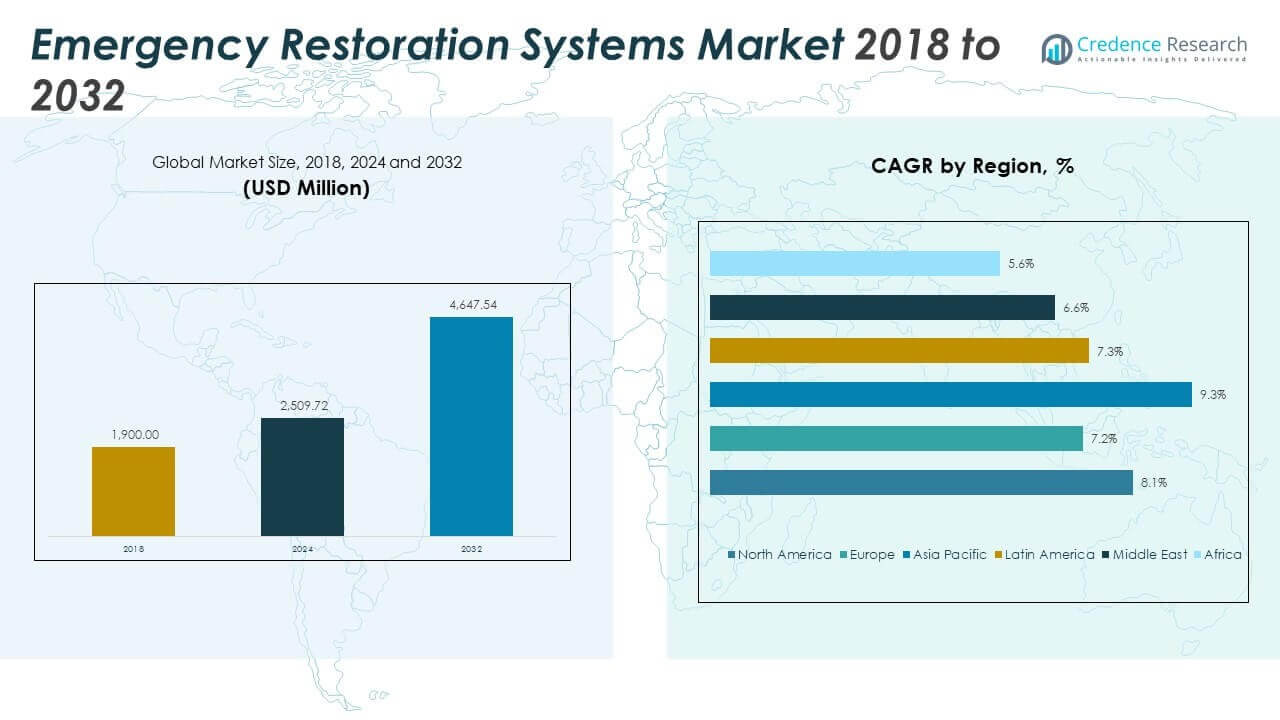
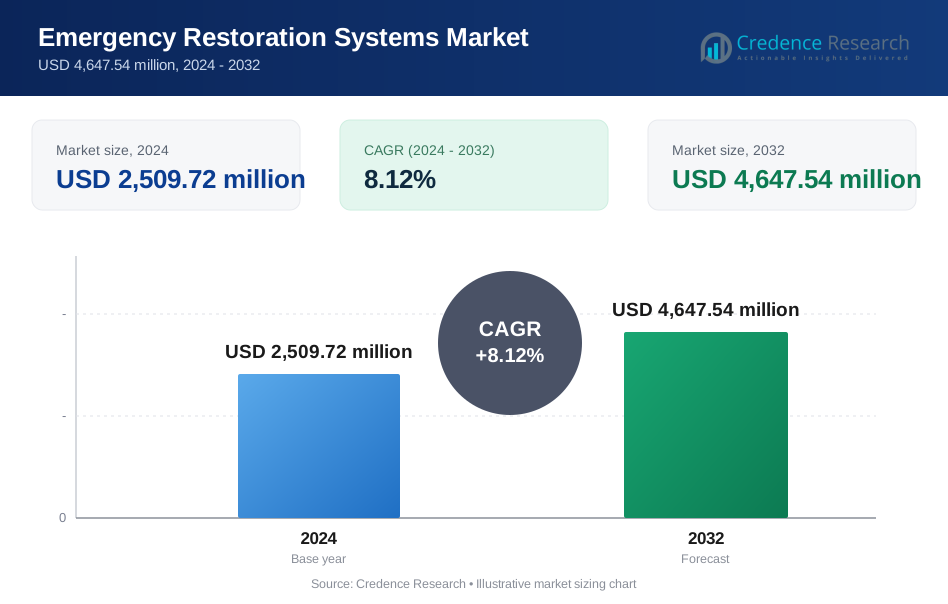
The Emergency Restoration Systems Market size was valued at USD 1,900.00 million in 2018 to USD 2,509.72 million in 2024 and is anticipated to reach USD 4,647.54 million by 2032, at a CAGR of 8.12% during the forecast period.
| REPORT ATTRIBUTE | DETAILS |
|---|---|
| Historical Period | 2020-2023 |
| Base Year | 2024 |
| Forecast Period | 2025-2032 |
| Emergency Restoration Systems Market Size 2024 | USD 2,509.72 million |
| Emergency Restoration Systems Market, CAGR | 8.12% |
| Emergency Restoration Systems Market Size 2032 | USD 4,647.54 million |
The market is growing due to the rising frequency of climate-related disasters and the aging of global utility infrastructure. Power outages, floods, fires, and industrial accidents are prompting governments and private sectors to invest in rapid-deployment restoration solutions. Utilities, data centers, and critical public facilities prioritize mobile equipment and modular systems for continuity and safety. Regulatory pressure to reduce downtime and restore services quickly also supports growth. Vendors offering advanced monitoring, faster deployment, and multi-utility systems are gaining traction. Insurance-backed restoration services further fuel demand across urban and industrial zones.
North America dominates the market due to strong disaster recovery infrastructure, frequent climate events, and high public and private investments. Europe follows with a strong push toward grid resilience and compliance-driven restoration deployments. Asia Pacific is emerging rapidly, driven by fast urbanization and recurring extreme weather. Latin America and the Middle East show steady adoption, led by flood and fire risks. Africa remains nascent but is gradually seeing progress through aid-driven projects and infrastructure upgrades. Growth dynamics vary by region based on climate exposure, utility stability, and regulatory frameworks.
Market Insights:
- The Emergency Restoration Systems Market expanded from USD 1,900.00 million in 2018 to USD 2,509.72 million in 2024 and is projected to reach USD 4,647.54 million by 2032, registering a CAGR of 8.12% over the forecast period.
- North America (36.4%), Asia Pacific (30.0%), and Europe (20.3%) together dominated the market in 2024 due to high disaster exposure, strong utility infrastructure, and structured recovery frameworks.
- Asia Pacific is the fastest-growing region with a CAGR of 3% and a 30.0% market share, driven by rapid urbanization, frequent natural disasters, and rising public investment in emergency infrastructure.
- By end user, Infrastructure & Public Facilities accounted for nearly 35% share in 2024, supported by government-led restoration programs and critical service continuity needs.
- Commercial facilities held around 30% share, followed by industrial users at ~20% and residential at ~15%, reflecting higher restoration demand from business operations and public assets.
Market Drivers
Growing Frequency of Natural Disasters Elevating Demand for Fast-Deployable Restoration Equipment
Frequent natural disasters such as hurricanes, floods, wildfires, and earthquakes continue to strain existing utility infrastructure. These events damage power lines, substations, water pipelines, and communication towers. The Emergency Restoration Systems Market benefits from rising demand for mobile and modular solutions that restore operations quickly. Utilities and municipalities adopt trailers, switchgear, and modular substations to reduce downtime and mitigate economic losses. Emergency response protocols now include pre-positioning of restoration equipment. Climate change is intensifying weather volatility, increasing restoration system deployment. Fast-acting recovery systems are becoming critical assets in government disaster management strategies. This driver supports sustained investment from both public and private sectors.
- For instance, after Hurricane Ida in 2021, Entergy utilized a mobile substation to restore power to South Lafourche High School and Lady of the Sea Hospital in Louisiana within days of landfall, prioritizing critical facilities amid outages affecting nearly 950,000 customers.
Aging Infrastructure in Developed Economies Creating Strong Replacement and Retrofit Demand
Many countries in North America and Europe operate on infrastructure that exceeds 40–50 years in age. Deteriorating utility assets present higher risks of failure during peak demand or extreme weather. Emergency Restoration Systems Market demand rises from the need to modernize outdated components quickly. Utilities deploy temporary restoration systems while permanent upgrades or repairs take place. These solutions help maintain power flow, prevent cascading failures, and manage customer service continuity. Regulatory bodies enforce stricter grid reliability targets, encouraging utilities to invest in rapid-response restoration tools. The aging grid situation also leads to increased outages due to maintenance backlogs. Emergency systems provide a vital bridge between old infrastructure and long-term modernization efforts.
Regulatory Mandates for Service Continuity and Emergency Preparedness Supporting Procurement
Governments and utility regulators now mandate improved grid resilience and emergency response. Restoration systems help organizations comply with outage duration limits and emergency preparedness requirements. Electric utilities face fines for failing to restore power within set timeframes. Emergency Restoration Systems Market players benefit from this compliance-driven procurement environment. Organizations integrate emergency systems into their continuity planning, asset management, and disaster protocols. Public service commissions allocate budgets for grid reliability and quick restoration capabilities. Telecom providers and water utilities also face pressure to maintain uptime under crisis. Regulatory push ensures stable funding for mobile restoration units and trailer-mounted systems.
- For instance, PG&E has deployed mobile substations during Public Safety Power Shutoff (PSPS) events since 2020 to maintain power for critical facilities and communities in California. These units help reduce disruption during planned outages by supporting grid stability and emergency readiness.
Critical Infrastructure and Data Centers Requiring Minimal Downtime Fuels System Integration
Data centers, airports, hospitals, and defense facilities cannot afford extended downtimes. These mission-critical sites invest in emergency restoration systems for backup during failures. The Emergency Restoration Systems Market supports this segment with solutions like mobile transformers, quick-connect substations, and pre-engineered switchgear. Downtime leads to major financial loss, safety issues, and reputational damage. Organizations seek systems that can be rapidly deployed and integrated into backup networks. The growth of hyperscale and edge data centers also drives demand for localized emergency readiness. Private sector operators adopt restoration systems as part of their business continuity strategy. High-dependence industries continue expanding their investment in fast-deploy restoration technologies.
Market Trends
Shift Toward Modular and Pre-Engineered Systems Enabling Rapid Deployment and Scalability
The market is witnessing strong demand for modular restoration systems that allow plug-and-play deployment. Utilities and critical facilities prefer pre-engineered solutions that reduce installation time during crises. The Emergency Restoration Systems Market benefits from compact and containerized units that scale easily based on need. Mobile switchgear, trailer-mounted transformers, and prefabricated substations reduce dependency on site civil work. These systems simplify logistics and ensure faster restoration after major outages. They can be standardized across networks to improve operational familiarity. Vendors now offer modular kits tailored for rural, urban, and industrial use cases. Standardization trends are reshaping product development and procurement preferences.
- For instance, in 2023, China's State Grid deployed a 110 kV modular mobile substation from TGOOD for a coal mine project, enabling full operation within 24 hours using prefabricated containerized units without site civil work.
Integration of IoT and Remote Monitoring for Real-Time Visibility and Performance Control
Remote control and live data monitoring are transforming emergency system operations. Integration of IoT sensors, SCADA, and remote diagnostic tools improves restoration speed and reduces manual labor. The Emergency Restoration Systems Market is shifting toward smart solutions that offer predictive failure alerts and live equipment status. Utilities track voltage, frequency, and thermal conditions to detect abnormal loads or faults. Cloud-based dashboards enable centralized control over multiple deployed assets. These technologies also support asset tracking, maintenance planning, and usage analytics. Utilities use real-time insights to prioritize deployments during multi-site disruptions. Digital upgrades are becoming key differentiators in product offerings.
- For instance, CHINT's 2025 mobile substations in Europe feature integrated IoT for real-time voltage and thermal monitoring, allowing remote control of 72.5 kV units from cloud dashboards during grid upgrades.
Growing Emphasis on Multi-Utility Restoration Capabilities Across Energy, Water, and Telecom
The market is evolving to support integrated emergency response across utilities. Hybrid systems now address electricity, water supply, and telecom restoration in combined formats. Emergency Restoration Systems Market vendors develop solutions that work across infrastructure segments. These cross-functional systems allow municipal agencies to manage power and water restoration from a single mobile unit. Telecom towers gain support from battery and generator modules embedded within restoration trailers. Utility convergence in emergency response reduces operational delays and simplifies training. Standardized platforms enable wider use of restoration systems across urban services. Cities focus on coordinated disaster recovery models that require multi-utility solutions.
Product Rental and Leasing Models Gaining Momentum Among Utilities and Municipal Agencies
Rising capital costs and uncertainty around disaster frequency push organizations to prefer rentals. Vendors offer emergency restoration systems on flexible leasing and subscription plans. This model lowers upfront cost and improves access to advanced systems. The Emergency Restoration Systems Market sees growth in pay-as-you-use arrangements for mobile units. Public agencies avoid idle asset costs by outsourcing storage and maintenance. Rental systems are pre-positioned in high-risk zones for quicker dispatch. Equipment-as-a-service allows users to access the latest upgrades without full ownership. The shift toward operational expenditure over capital investment is transforming vendor strategies.
Market Challenges Analysis
High Capital Costs and Limited Budget Allocation Constraining Procurement in Emerging Regions
Emergency restoration systems involve high upfront costs for procurement, transport, and maintenance. Many governments in low- and middle-income countries struggle to justify such capital investments. The Emergency Restoration Systems Market faces adoption gaps where disaster preparedness is not prioritized in annual budgets. Procurement cycles often delay due to limited funding, policy approvals, and competing infrastructure needs. Smaller utilities lack access to financing schemes or lease-based models. This leads to higher dependence on traditional repair methods, prolonging outage durations. High import duties on trailer systems and electrical gear further raise costs. Vendors find it challenging to scale in these markets without government or donor-backed programs.
Logistics, Storage, and Skilled Manpower Remain Bottlenecks in Emergency Deployment
Emergency systems must be rapidly mobilized, installed, and integrated during critical failures. Logistics remain a major challenge, especially in remote, disaster-prone, or conflict areas. The Emergency Restoration Systems Market contends with limited skilled manpower for electrical integration and high-voltage safety. Storage infrastructure is also lacking in many countries, limiting readiness. Without proper pre-positioning, equipment arrives late or damaged during emergencies. Transportation challenges increase for larger modular systems, especially across mountainous or flooded regions. Even well-funded utilities face delays without practiced drills and trained teams. Gaps in workforce availability and operational protocols hinder full utilization of restoration solutions.
Market Opportunities
Government Resilience Programs and Infrastructure Recovery Funds Boost Emergency System Demand
Recovery-focused stimulus packages and climate resilience programs create large-scale procurement opportunities. Governments prioritize restoration systems as part of national disaster response frameworks. The Emergency Restoration Systems Market gains from new funding flows for critical infrastructure. Development agencies and climate funds also co-finance emergency deployment capabilities. Public-private partnerships accelerate system availability in disaster-prone zones.
Rise in Data Centers and Industrial Parks Encouraging Private Sector Adoption
Rapid expansion of data centers, manufacturing zones, and logistics hubs increases demand for reliable backup systems. Organizations adopt mobile restoration units to minimize revenue loss during outages. The Emergency Restoration Systems Market grows as private facilities integrate these tools into business continuity planning. Vendors customize compact, site-specific systems to meet high-availability requirements.
Market Segmentation Analysis:
The Emergency Restoration Systems Market is segmented into system type, component, disaster type, and end-user, each driving distinct adoption patterns.
By system type, water damage restoration systems hold a significant share due to frequent pipe bursts, floods, and residential leaks. Fire & smoke restoration systems follow closely, with high demand from wildfire-prone and industrial zones. Mold remediation systems are gaining traction in humid regions where indoor air quality is a concern. Storm & flood restoration systems support large-scale recovery during natural disasters, especially in coastal areas.
- For instance, SERVPRO frequently deploys truck-mounted water extraction systems during major flood and storm events across the U.S., including Florida, to support rapid residential and commercial recovery. Their teams are trained for 24/7 emergency response, helping minimize structural damage and mold risk.
By component, services dominate due to rising demand for emergency response, cleanup, structural drying, and remediation. Equipment such as dehumidifiers, air movers, extractors, and HEPA systems also sees strong uptake across professional restoration providers and commercial buildings.
By disaster type, flooding leads the market, followed by fire-related incidents and damage caused by storms and cyclones. Industrial accidents contribute a smaller yet steady demand, particularly in manufacturing clusters.
By end-user, commercial facilities including offices, retail centers, and hospitality venues are key adopters due to compliance and operational continuity needs. Residential use is rising due to increasing weather-driven damages. Industrial users focus on minimizing downtime and product loss, while infrastructure and public facilities invest in rapid restoration to ensure community service continuity.
- For instance, PuroClean regularly responds to pipe burst emergencies in commercial properties, including hotels, using extractors and antimicrobial treatments to restore water-damaged areas. Their rapid-response teams often help facilities resume operations within 1–2 days, reducing downtime and health risks.
Segmentation:
By System Type
- Water Damage Restoration Systems
- Fire & Smoke Restoration Systems
- Mold Remediation Systems
- Storm & Flood Restoration Systems
By Component
- Equipment (Dehumidifiers, Air Movers, Extractors, HEPA Systems)
- Services (Emergency Response, Cleanup, Structural Drying, Remediation)
By Disaster Type
- Flooding
- Fire
- Storms & Cyclones
- Industrial Accidents
By End-User
- Residential
- Commercial (Offices, Retail, Hospitality)
- Industrial
- Infrastructure & Public Facilities
By Region
- North America
- U.S.
- Canada
- Mexico
- Europe
- Germany
- France
- U.K.
- Italy
- Spain
- Rest of Europe
- Asia Pacific
- China
- Japan
- India
- South Korea
- South-east Asia
- Rest of Asia Pacific
- Latin America
- Brazil
- Argentina
- Rest of Latin America
- Middle East & Africa
- GCC Countries
- South Africa
- Rest of the Middle East and Africa
Regional Analysis:
North America
The North America Emergency Restoration Systems Market size was valued at USD 700.15 million in 2018 to USD 913.77 million in 2024 and is anticipated to reach USD 1,689.85 million by 2032, at a CAGR of 8.1% during the forecast period. North America accounted for approximately 36.4% of the global market in 2024. The region leads due to frequent hurricanes, snowstorms, wildfires, and aging grid infrastructure. The U.S. drives growth through strong federal and state disaster recovery funding. Utilities in the region actively invest in mobile transformers, modular substations, and advanced restoration services. Public and private collaboration enhances emergency readiness. Insurance-backed restoration services also support large-scale deployments. Canada sees increased demand in regions prone to floods and wildfires.
Europe
The Europe Emergency Restoration Systems Market size was valued at USD 404.70 million in 2018 to USD 508.90 million in 2024 and is anticipated to reach USD 877.24 million by 2032, at a CAGR of 7.2% during the forecast period. Europe accounted for around 20.3% of the global share in 2024. Regulatory focus on energy resilience, especially in countries like Germany, France, and the UK, drives adoption. Flooding and winter storms lead to high restoration system demand in northern and central Europe. EU climate adaptation programs fund restoration and preparedness infrastructure. Advanced utilities implement modular and IoT-enabled solutions. Residential and commercial segments adopt fire and mold restoration technologies.
Asia Pacific
The Asia Pacific Emergency Restoration Systems Market size was valued at USD 549.48 million in 2018 to USD 753.03 million in 2024 and is anticipated to reach USD 1,517.43 million by 2032, at a CAGR of 9.3% during the forecast period. The region holds about 30.0% of the global market in 2024. Frequent natural disasters including typhoons, floods, and earthquakes drive high demand in countries like China, India, Japan, and the Philippines. Rapid urbanization and industrialization increase vulnerability and infrastructure risks. Governments invest in emergency preparedness and mobile utility assets. Smart cities integrate restoration systems into core urban management strategies. Budget constraints and awareness remain a challenge in some developing markets.
Latin America
The Latin America Emergency Restoration Systems Market size was valued at USD 140.60 million in 2018 to USD 184.19 million in 2024 and is anticipated to reach USD 320.08 million by 2032, at a CAGR of 7.3% during the forecast period. The region accounted for 7.3% of the global share in 2024. Market growth is influenced by flood-prone geographies and unstable electricity grids. Countries like Brazil, Mexico, and Chile experience high vulnerability to weather disruptions and forest fires. Governments are gradually improving investment in disaster recovery assets. Public infrastructure projects and grid modernization efforts include emergency restoration systems. Vendor expansion into the region remains cautious due to economic and policy risks.
Middle East
The Middle East Emergency Restoration Systems Market size was valued at USD 66.50 million in 2018 to USD 81.80 million in 2024 and is anticipated to reach USD 135.27 million by 2032, at a CAGR of 6.6% during the forecast period. It represents 3.3% of the global market in 2024. Harsh climate conditions, sandstorms, and infrastructure stress contribute to regional demand. Gulf countries invest in grid reliability and civil defense mechanisms. Urban growth and digital infrastructure expansion increase the importance of rapid restoration. Water damage and fire restoration services lead the market. Oil & gas and industrial sectors demand site-specific emergency solutions. Vendor penetration improves via regional distribution alliances and equipment rentals.
Africa
The Africa Emergency Restoration Systems Market size was valued at USD 38.57 million in 2018 to USD 68.02 million in 2024 and is anticipated to reach USD 107.68 million by 2032, at a CAGR of 5.6% during the forecast period. Africa contributes about 2.7% to the global market. Infrastructure vulnerabilities, limited grid reliability, and exposure to climate hazards drive the need for emergency solutions. Sub-Saharan Africa faces frequent floods, droughts, and energy disruptions. Restoration services are largely driven by donor-supported and government-funded programs. Adoption remains slow due to high costs, lack of trained technicians, and low system availability. International aid and public-private partnerships begin to improve restoration preparedness. Some urban centers integrate mobile equipment for utilities and telecom recovery.
Key Player Analysis:
- ServiceMaster Restore
- BELFOR Group
- Paul Davis Restoration
- SBB
- Lindsey
Competitive Analysis:
The Emergency Restoration Systems Market features a fragmented yet competitive landscape with global leaders and strong regional service providers. Key players compete on response speed, service coverage, equipment availability, and technical expertise. Large companies leverage nationwide and cross-border networks to support rapid deployment during large-scale disasters. It favors firms with diversified service portfolios across water, fire, mold, and storm restoration. Strategic acquisitions help expand geographic reach and customer bases. Partnerships with insurance companies and utilities strengthen contract pipelines. Companies invest in advanced equipment, digital job management tools, and trained response teams. Service quality, compliance capability, and recovery turnaround time shape competitive positioning. Regional players maintain relevance through localized expertise and faster on-site access.
Recent Developments:
- In December 2024, Insurcomm acquired Theraclean Restoration strengthening its disaster restoration presence in the mid-Atlantic region, particularly New Jersey. This expansion aligns with Insurcomm's focus on high-quality, comprehensive property restoration solutions.
- In August 2024, Frontier Services Group acquired Restoration XP bolstering its emergency restoration capabilities in Texas with expertise in fire restoration, water mitigation, and mold remediation. The partnership leverages advanced equipment to extend Frontier's geographic reach and service offerings.
Report Coverage:
The research report offers an in-depth analysis based on system type, component, disaster type, and end-user. It details leading market players, providing an overview of their business, product offerings, investments, revenue streams, and key applications. Additionally, the report includes insights into the competitive environment, SWOT analysis, current market trends, as well as the primary drivers and constraints. Furthermore, it discusses various factors that have driven market expansion in recent years. The report also explores market dynamics, regulatory scenarios, and technological advancements that are shaping the industry. It assesses the impact of external factors and global economic changes on market growth. Lastly, it provides strategic recommendations for new entrants and established companies to navigate the complexities of the market.
Future Outlook:
- The Emergency Restoration Systems Market will grow steadily with rising climate-related disruptions requiring faster response infrastructure.
- Mobile and modular restoration units will see higher adoption across utilities and critical infrastructure sectors.
- Investment in IoT-enabled equipment will expand to support remote tracking, diagnostics, and predictive maintenance.
- Equipment-as-a-service and rental models will dominate among mid-sized commercial users and municipalities.
- Data centers, industrial parks, and healthcare facilities will expand their budgets for on-site emergency restoration systems.
- AI-based restoration planning tools will support smarter deployment logistics and post-disaster asset prioritization.
- Integration of restoration equipment with utility SCADA and BMS systems will enhance system interoperability.
- Regional disaster preparedness programs will unlock new public-sector funding in Asia Pacific and Latin America.
- Strong vendor competition will drive innovation in compact, fast-installation restoration modules.
- Standardization of protocols and modular designs will improve system reuse across disaster scenarios.
Request a Free Sample
Fill in your details and we'll send you a free sample report.
- Sample data tables & charts
- Research methodology
Market Dynamics
Growing Frequency of Natural Disasters
Increasing occurrences of hurricanes, floods, wildfires, and earthquakes are straining utility infrastructure and driving demand for rapid-deployment emergency restoration systems to minimize downtime and economic loss.
Aging Utility Infrastructure
Many developed regions operate on infrastructure that is over 40–50 years old, leading to higher risks of failure and outages. This creates strong demand for temporary restoration systems to bridge the gap during repairs and upgrades.
Regulatory Mandates for Service Continuity
Governments and utility regulators are enforcing stricter grid reliability and emergency preparedness requirements, compelling utilities and critical facilities to invest in restoration systems to comply with outage duration limits and emergency protocols.
Critical Infrastructure and Data Center Resilience
Data centers, hospitals, airports, and other mission-critical facilities require minimal downtime, fueling investment in mobile and modular restoration systems that can be rapidly deployed to ensure operational continuity.
Adoption of Modular, IoT-Enabled, and Rental Solutions
The shift toward modular, pre-engineered, and IoT-integrated restoration systems, along with the rise of rental and equipment-as-a-service models, is making advanced emergency restoration solutions more accessible and scalable for utilities and commercial users.
Need a Custom Version of This Report?
Tailor the scope, geography, or segments to your exact requirements.
- Custom geography or segment scope
- Direct access to our analyst team
Frequently Asked Questions
What is the current market size for Emergency Restoration Systems Market, and what is its projected size in 2032?
At what Compound Annual Growth Rate is the Emergency Restoration Systems Market projected to grow between 2024 and 2032?
Which Emergency Restoration Systems Market segment held the largest share in 2024?
What are the primary factors fueling the growth of the Emergency Restoration Systems Market?
Who are the leading companies in the Emergency Restoration Systems Market?
Which region commanded the largest share of the Emergency Restoration Systems Market in 2024?
Table of Content
Chapter 1 Market Segmentation
- 1.1 Segmentation Framework
- 1.1.1 Product and Service Classification
- 1.1.2 Application and End-Use Classification
- 1.1.3 Technology and Solution Classification
- 1.1.4 Customer and Distribution Channel Classification
- 1.1.5 Geographic Segmentation
- 1.1.6 Market Segment Definitions and Boundaries
- 1.2 By End-User
- 1.2.1 Residential
- 1.2.2 Commercial (Offices, Retail, Hospitality)
- 1.2.3 Industrial
- 1.2.4 Infrastructure & Public Facilities
- 1.3 By Component
- 1.3.1 Equipment (Dehumidifiers, Air Movers, Extractors, HEPA Systems)
- 1.3.2 Services (Emergency Response, Cleanup, Structural Drying, Remediation)
- 1.4 By System Type
- 1.4.1 Water Damage Restoration Systems
- 1.4.2 Fire & Smoke Restoration Systems
- 1.4.3 Mold Remediation Systems
- 1.4.4 Storm & Flood Restoration Systems
- 1.5 By Disaster Type
- 1.5.1 Flooding
- 1.5.2 Fire
- 1.5.3 Storms & Cyclones
- 1.5.4 Industrial Accidents
Chapter 2 Introduction
- 2.1 Report Objectives and Scope
- 2.2 Product Definition and Industry Terminology
- 2.3 Market Inclusions and Exclusions
- 2.4 Research Process
- 2.4.1 Primary Research and Expert Interviews
- 2.4.2 Secondary Research and Source Review
- 2.4.3 Top-Down and Bottom-Up Estimation
- 2.4.4 Data Triangulation and Verification
- 2.5 Market Size Measurement Basis
- 2.5.1 2024: USD 2,509.72 million → 2032: USD 4,647.54 million
- 2.6 Historical and Forecast Reference Periods
- 2.6.1 Base Year: 2024
- 2.6.2 Forecast Period: 2024-2032
- 2.7 Research Assumptions and Limitations
Chapter 3 Executive Summary
- 3.1 Market Snapshot and Key Findings
- 3.2 Base-Year Market Size, 2024
- 3.3 Forecast Market Size, 2032
- 3.4 Revenue and Volume Growth Outlook
- 3.5 Key Demand and Supply Indicators
- 3.6 Leading Market Segments
- 3.7 Fastest-Growing Market Opportunities
- 3.8 Regional Performance Highlights
- 3.9 Technology and Industry Transformation
- 3.10 Competitive Landscape Summary
- 3.11 Analyst View and Strategic Implications
Chapter 4 Global Emergency Restoration Systems Market Trends and Developments
- 4.1 Historical Industry Development
- 4.2 Recent Market Trends and Developments
- 4.3 Demand and Customer Behavior Trends
- 4.4 Technology and Product Innovation
- 4.5 Artificial Intelligence, Automation and Digitalization
- 4.6 Local Manufacturing and Supply Chain Realignment
- 4.7 Industry Partnerships, Mergers and Acquisitions
- 4.8 Sustainability and Circular Economy Developments
- 4.9 Government and Private Sector Investment Trends
- 4.10 Emerging Business Models and Commercialization
- 4.11 Industry Developments and Announcements
Chapter 5 Global Emergency Restoration Systems Market Production, Supply and Demand Analysis
- 5.1 Demand Trend and Consumption Analysis
- 5.2 Demand Forecast, 2024-2032
- 5.3 Production and Output Trend
- 5.4 Production and Output Forecast, 2024-2032
- 5.5 Installed Capacity and Capacity Utilization
- 5.6 Company-Wise Production Plants and Statistics
- 5.6.1 Installed Production Capacity
- 5.6.2 Actual Production
- 5.6.3 Planned Capacity and Expansion Targets
- 5.7 Supply Chain Structure and Procurement Trends
- 5.8 Supply-Demand Gap and Bottlenecks
- 5.9 Import Dependence and Sourcing Structure
- 5.10 Contract Manufacturing and Outsourcing
- 5.11 Regional Supply and Demand Concentration
Chapter 6 Global Emergency Restoration Systems Market Pricing Analysis
- 6.1 Pricing Structure and Measurement
- 6.2 Historical Pricing Trends
- 6.3 Pricing Outlook, 2024-2032
- 6.4 Average Selling Price and Unit Economics
- 6.5 Pricing by Product and Market Segment
- 6.6 Geographic Pricing Differences
- 6.7 Key Input, Energy, Labor and Logistics Costs
- 6.8 Contract Pricing and Purchasing Models
- 6.9 Pricing Sensitivity and Competitive Positioning
- 6.10 Price, Margin and Profitability Implications
Chapter 7 Global Emergency Restoration Systems Market Dynamics
- 7.1 Market Growth Drivers
- 7.1.1 Demand-Side Drivers
- 7.1.2 Technology and Innovation Drivers
- 7.1.3 Infrastructure and Investment Drivers
- 7.1.4 Regulatory and Policy Drivers
- 7.2 Market Restraints
- 7.2.1 Cost and Affordability Constraints
- 7.2.2 Technology and Adoption Barriers
- 7.2.3 Supply Chain and Operational Constraints
- 7.3 Market Challenges
- 7.3.1 Competitive Pressure and Margin Erosion
- 7.3.2 Skills, Infrastructure and Implementation Gaps
- 7.4 Emerging Market Opportunities
- 7.5 Market Dynamics Impact and Time-Horizon Assessment
Chapter 8 Global Emergency Restoration Systems Value Chain Analysis
- 8.1 Industry Value Chain Overview
- 8.2 Upstream Suppliers and Critical Inputs
- 8.3 Technology and Component Providers
- 8.4 Manufacturing or Service Delivery
- 8.5 Distribution, Channel Partners and Integrators
- 8.6 Downstream Applications and End Users
- 8.7 Value Addition and Profit Pools
- 8.8 Vertical Integration and Outsourcing
- 8.9 Supplier Concentration and Risk
- 8.10 Supply Chain Localization and Resilience
Chapter 9 Global Emergency Restoration Systems Market Regulations and Policies
- 9.1 Relevant Laws, Standards and Compliance Frameworks
- 9.2 Product, Service, Safety and Quality Requirements
- 9.3 Government Policies, Incentives and Subsidies
- 9.4 Imports, Exports and Trade Barriers
- 9.5 Public Procurement and Local Content Requirements
- 9.6 Environmental and Sustainability Compliance
- 9.7 Upcoming Policy Changes and Market Implications
Chapter 10 Global Emergency Restoration Systems Market Hotspots and Opportunities
- 10.1 Market Opportunity Mapping and Growth Hotspots
- 10.2 High-Growth Applications and Customer Groups
- 10.3 Underserved Markets and White-Space Opportunities
- 10.4 Emerging Technology and Product Opportunities
- 10.5 New Capacity and Investment Hotspots
- 10.6 Market Entry and Expansion Opportunities
- 10.7 Distribution and Partnership Opportunities
- 10.8 Near-Term and Long-Term Commercial Potential
- 10.9 Opportunity Attractiveness and Execution Risks
Chapter 11 Global Emergency Restoration Systems Market Outlook, 2024-2032
- 11.1 Market Size and Analysis
- 11.1.1 Revenue (Market Measurement: 2024: USD 2,509.72 million → 2032: USD 4,647.54 million)
- 11.1.2 Market Volume and Quantity Sold
- 11.1.3 Historical Market Size
- 11.1.4 Base-Year Market Size, 2024
- 11.2 Market Forecast, 2024-2032
- 11.2.1 Revenue Forecast to 2032
- 11.2.2 Volume Forecast to 2032
- 11.2.3 CAGR and Year-on-Year Growth
- 11.2.4 Incremental Revenue Opportunity
- 11.3 Forecast Assumptions and Scenario Analysis
- 11.3.1 Base-Case Forecast
- 11.3.2 Optimistic and Conservative Scenarios
- 11.3.3 Technology, Pricing and Policy Sensitivities
- 11.4 Market Attractiveness and Growth Outlook
Chapter 12 Global Emergency Restoration Systems Market Segmentation and Outlook
- 12.1 Segmentation Summary and Market Shares, 2024
- 12.2 Largest and Fastest-Growing Segments
- 12.3 By End-User - Market Size and Forecast, 2024-2032
- 12.3.1 Segment Definition and Scope
- 12.3.2 Historical Market Size
- 12.3.3 Revenue Forecast, 2024-2032
- 12.3.4 Volume Forecast, 2024-2032
- 12.3.5 Base-Year Market Share, 2024
- 12.3.6 Segment CAGR and Growth Drivers
- 12.3.7 Subsegment Market Size and Forecast
- 12.3.7.1 Residential
- 12.3.7.2 Commercial (Offices, Retail, Hospitality)
- 12.3.7.3 Industrial
- 12.3.7.4 Infrastructure & Public Facilities
- 12.3.8 Subsegment Pricing and Adoption Trends
- 12.3.9 Leading Suppliers and Competition
- 12.3.10 Regional Demand and Opportunities
- 12.4 By Component - Market Size and Forecast, 2024-2032
- 12.4.1 Segment Definition and Scope
- 12.4.2 Historical Market Size
- 12.4.3 Revenue Forecast, 2024-2032
- 12.4.4 Volume Forecast, 2024-2032
- 12.4.5 Base-Year Market Share, 2024
- 12.4.6 Segment CAGR and Growth Drivers
- 12.4.7 Subsegment Market Size and Forecast
- 12.4.7.1 Equipment (Dehumidifiers, Air Movers, Extractors, HEPA Systems)
- 12.4.7.2 Services (Emergency Response, Cleanup, Structural Drying, Remediation)
- 12.4.8 Subsegment Pricing and Adoption Trends
- 12.4.9 Leading Suppliers and Competition
- 12.4.10 Regional Demand and Opportunities
- 12.5 By System Type - Market Size and Forecast, 2024-2032
- 12.5.1 Segment Definition and Scope
- 12.5.2 Historical Market Size
- 12.5.3 Revenue Forecast, 2024-2032
- 12.5.4 Volume Forecast, 2024-2032
- 12.5.5 Base-Year Market Share, 2024
- 12.5.6 Segment CAGR and Growth Drivers
- 12.5.7 Subsegment Market Size and Forecast
- 12.5.7.1 Water Damage Restoration Systems
- 12.5.7.2 Fire & Smoke Restoration Systems
- 12.5.7.3 Mold Remediation Systems
- 12.5.7.4 Storm & Flood Restoration Systems
- 12.5.8 Subsegment Pricing and Adoption Trends
- 12.5.9 Leading Suppliers and Competition
- 12.5.10 Regional Demand and Opportunities
- 12.6 By Disaster Type - Market Size and Forecast, 2024-2032
- 12.6.1 Segment Definition and Scope
- 12.6.2 Historical Market Size
- 12.6.3 Revenue Forecast, 2024-2032
- 12.6.4 Volume Forecast, 2024-2032
- 12.6.5 Base-Year Market Share, 2024
- 12.6.6 Segment CAGR and Growth Drivers
- 12.6.7 Subsegment Market Size and Forecast
- 12.6.7.1 Flooding
- 12.6.7.2 Fire
- 12.6.7.3 Storms & Cyclones
- 12.6.7.4 Industrial Accidents
- 12.6.8 Subsegment Pricing and Adoption Trends
- 12.6.9 Leading Suppliers and Competition
- 12.6.10 Regional Demand and Opportunities
- 12.7 Segment Growth Comparison
- 12.8 Segment Attractiveness and Priority Matrix
Chapter 13 Global Emergency Restoration Systems End-Use and Application Market Outlook
- 13.1 End-Use Industry and Customer Demand Structure
- 13.2 Leading Applications and Customer Groups
- 13.3 End-Use Market Size, Share and Forecast
- 13.4 Major End-Use Industry Deep Dives
- 13.4.1 Customer Requirements and Use Cases
- 13.4.2 Demand and Replacement Cycles
- 13.4.3 Technical and Regulatory Considerations
- 13.4.4 Purchasing and Procurement Models
- 13.4.5 Leading Vendors and Distribution Channels
- 13.4.6 Forecast and Commercial Opportunities
- 13.5 Emerging Applications and Cross-Segment Demand
- 13.6 End-Use Industry Investment Priorities
Chapter 14 Global Emergency Restoration Systems Geographic Market Outlook, 2024-2032
- 14.1 Regional Market Size and Share, 2024
- 14.2 Regional Market Forecast, 2024-2032
- 14.3 Regional Pricing, Production and Demand Differences
- 14.4 North America
- 14.4.1 United States
- 14.4.2 Canada
- 14.4.3 Mexico
- 14.5 Europe
- 14.5.1 Germany
- 14.5.2 France
- 14.5.3 Italy
- 14.5.4 United Kingdom
- 14.5.5 Spain
- 14.5.6 Poland
- 14.5.7 Russia
- 14.5.8 Netherlands
- 14.5.9 Belgium
- 14.5.10 Sweden
- 14.5.11 Denmark
- 14.5.12 Norway
- 14.5.13 Rest of Europe
- 14.6 Asia Pacific
- 14.6.1 China
- 14.6.2 India
- 14.6.3 Japan
- 14.6.4 South Korea
- 14.6.5 Thailand
- 14.6.6 Indonesia
- 14.6.7 Vietnam
- 14.6.8 Malaysia
- 14.6.9 Australia
- 14.6.10 Rest of Asia Pacific
- 14.7 Latin America
- 14.7.1 Brazil
- 14.7.2 Argentina
- 14.7.3 Colombia
- 14.7.4 Chile
- 14.7.5 Rest of Latin America
- 14.8 Middle East
- 14.8.1 Saudi Arabia
- 14.8.2 United Arab Emirates
- 14.8.3 Turkey
- 14.8.4 Israel
- 14.8.5 Iran
- 14.8.6 Rest of the Middle East
- 14.9 Africa
- 14.9.1 South Africa
- 14.9.2 Egypt
- 14.9.3 Nigeria
- 14.9.4 Morocco
- 14.9.5 Rest of Africa
- 14.10 Regional Investment, Policy and Supply Chain Differences
- 14.11 Regional Competitive Landscape
- 14.12 Geographic Growth Hotspots
Chapter 15 Global Emergency Restoration Systems Technology, Innovation and Sustainability Outlook
- 15.1 Technology Landscape and Maturity
- 15.2 Product, Process and Service Innovation
- 15.3 AI, Automation and Digital Tools in the Industry
- 15.4 Technology Adoption and Performance Benchmarking
- 15.5 Innovation Pipeline and R&D Investment
- 15.6 Patent and Intellectual Property Trends
- 15.7 Energy Efficiency and Resource Management
- 15.8 Sustainability, Recycling and Circularity
- 15.9 Technology Roadmap, 2024-2032
- 15.10 Risks of Obsolescence and Technology Substitution
Chapter 16 Global Emergency Restoration Systems Market Key Strategic Imperatives
- 16.1 Growth and Market Entry Priorities
- 16.2 High-Return Products and Segments
- 16.3 Pricing, Profitability and Cost Optimization
- 16.4 Technology Investment and Product Differentiation
- 16.5 Supply Chain Localization and Resilience
- 16.6 Distribution and Customer Acquisition
- 16.7 Partnership, Acquisition and Capacity Strategy
- 16.8 Regional Expansion Priorities
- 16.9 Short-, Medium- and Long-Term Actions
Chapter 17 Competition Outlook
- 17.1 Industry Competition Characteristics
- 17.2 Market Structure and Concentration
- 17.3 Market Share and Competitive Positioning, 2024
- 17.4 Company-Wise Revenue and Product Benchmarking
- 17.5 Production and Service Capacity Benchmarking
- 17.6 Technology, Pricing and Differentiation
- 17.7 Regional Footprint and Distribution Strength
- 17.8 Mergers, Acquisitions and Strategic Alliances
- 17.9 New Entrants and Competitive Threats
- 17.10 Porter's Five Forces and Industry Attractiveness
- 17.11 Competitive Outlook, 2024-2032
Chapter 18 Company Profiles
- 18.1 Company Coverage and Selection Criteria
- 18.2 ServiceMaster Restore
- 18.2.1 Business Description
- 18.2.2 Company Ownership and Geographic Presence
- 18.2.3 Product and Service Portfolio
- 18.2.4 Manufacturing and Operating Footprint
- 18.2.5 Production Capacity and Expansion Plans
- 18.2.6 Financial Performance and Investment
- 18.2.7 Market Share and Competitive Position
- 18.2.8 Technology and Innovation Capabilities
- 18.2.9 Strategic Alliances or Partnerships
- 18.2.10 Recent Developments
- 18.2.11 Growth Strategy and Outlook
- 18.3 BELFOR Group
- 18.4 Paul Davis Restoration
- 18.5 SBB
- 18.6 Lindsey
- 18.7 Insurcomm
- 18.8 Frontier Services Group
- 18.9 PuroClean
- 18.10 CHINT
- 18.11 TGOOD
- 18.12 Other Relevant Market Participants
Note: Every listed company is profiled on the structure shown under the first company. The company list is preliminary and may change based on research findings, market developments, data availability and client requirements.
Chapter 19 Disclaimer
- 19.1 Research and Forecast Disclaimer
- 19.2 Data Source and Estimation Limitations
Note: The depth of individual sections depends on data availability for this market. Volume, capacity, trade and other unit-based metrics are included where applicable.