
Market Overview:
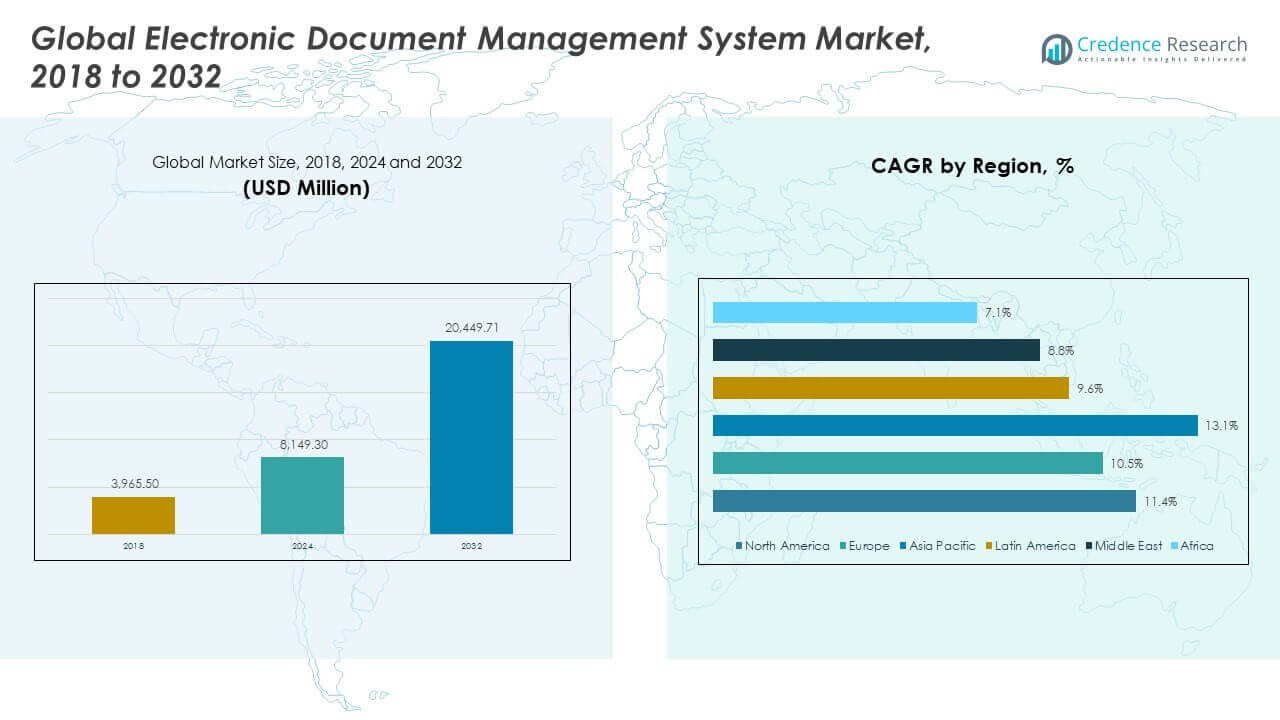
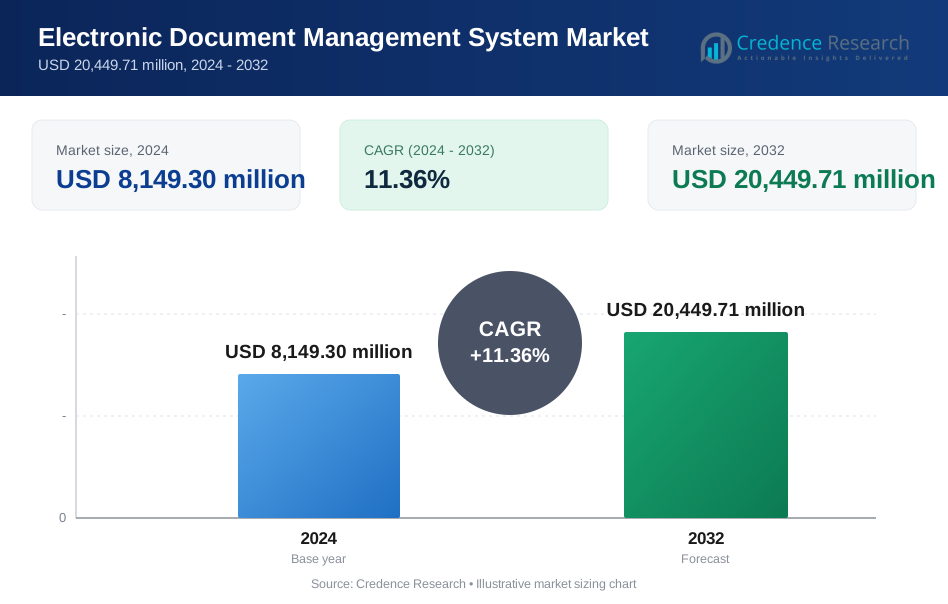
The Global Electronic Document Management System Market size was valued at USD 3,965.50 million in 2018 to USD 8,149.30 million in 2024 and is anticipated to reach USD 20,449.71 million by 2032, at a CAGR of 11.36% during the forecast period.
| REPORT ATTRIBUTE | DETAILS |
|---|---|
| Historical Period | 2020-2023 |
| Base Year | 2024 |
| Forecast Period | 2025-2032 |
| Electronic Document Management System Market Size 2024 | USD 3,965.50 million |
| Electronic Document Management System Market, CAGR | 11.36% |
| Electronic Document Management System Market Size 2032 | USD 8,149.30 million |
Demand grows due to rapid digital transformation across enterprises. Organizations seek secure document storage and fast retrieval. Regulatory pressure increases the need for audit-ready records. Remote work expands cloud-based document access needs. Automation improves workflow speed and reduces manual errors. Integration with enterprise software strengthens system adoption. Rising data volumes push firms toward structured document control. Cybersecurity concerns drive investment in controlled access systems. Cost savings from paper reduction support long-term use.
North America leads due to early cloud adoption and strict compliance needs. The United States shows strong enterprise spending. Europe follows with steady growth driven by data protection laws. Germany and the UK remain key contributors. Asia Pacific emerges as the fastest-growing region. China and India benefit from digital government programs. Southeast Asia gains traction among SMEs. Latin America and the Middle East show gradual uptake through public sector digitization.
Market Insights:
- The market rose from USD 3,965.50 million in 2018 to USD 8,149.30 million in 2024. The market will reach USD 20,449.71 million by 2032, at 11.36% CAGR.
- North America leads with ~44% share, due to strong cloud maturity and compliance needs. Europe follows at ~25% and Asia Pacific holds ~24%, supported by regulations and rapid digitization.
- Asia Pacific is the fastest-growing region with ~24% share. Growth comes from e-governance programs, SME cloud uptake, and rising data volumes.
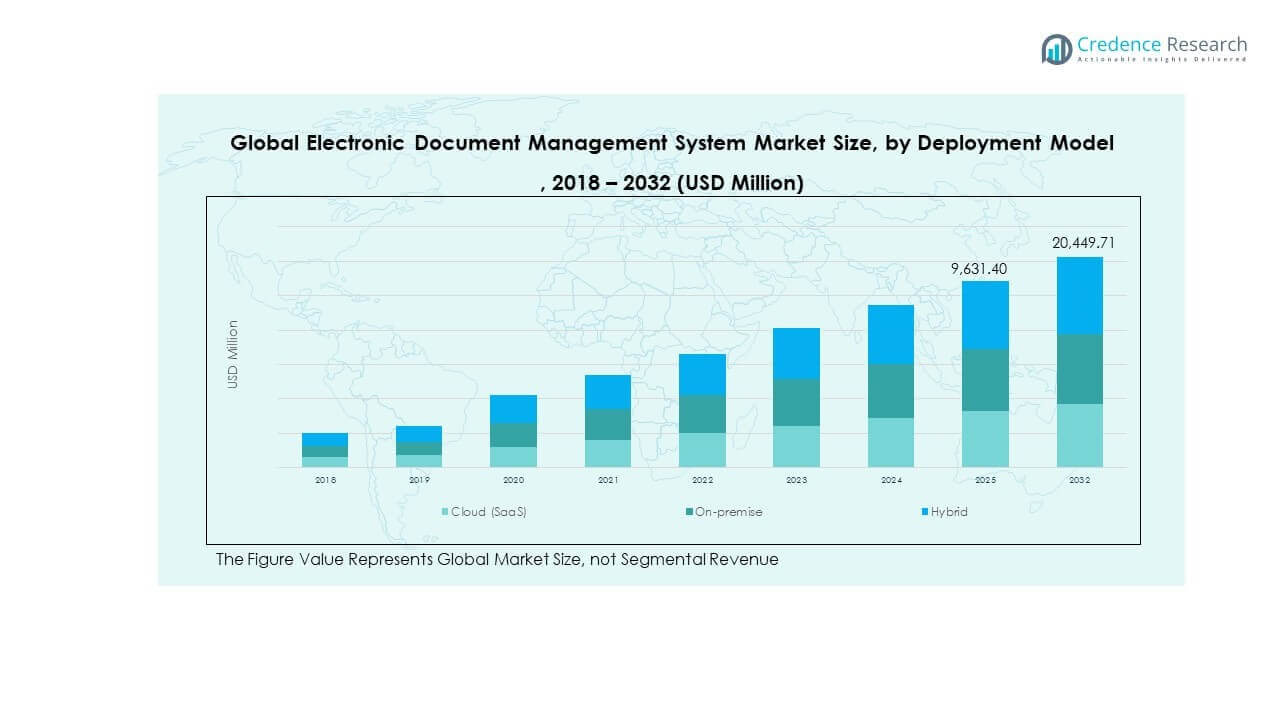
- Deployment mix in 2024 shows Cloud (SaaS) at ~41.2%, Hybrid at ~29.7%, and On-premise at ~29.1%. This reflects strong SaaS preference with sizable hybrid use.
- Deployment mix by 2032 shifts to Cloud (SaaS) at ~36.5%, Hybrid at ~32.3%, and On-premise at ~31.2%. The chart shows a more balanced split as hybrid expands.
Market Drivers:
Rising Enterprise Focus On Digital Record Control And Compliance Management
Organizations increase focus on structured document control systems. Regulatory mandates demand secure storage and traceable records. The Global Electronic Document Management System Market benefits from strict audit requirements. Enterprises reduce compliance risk through centralized repositories. Automated version control limits document misuse. Secure access rights support internal governance goals. Legal teams rely on accurate document retention policies. Compliance pressure sustains long-term system demand.
- For instance, Microsoft Purview’s Data Lifecycle Management system supports up to 1,000 custom retention labels and leverages 300+ built-in sensitive information types to trigger automatic labeling, helping large enterprises meet audit and e-discovery requirements as reported in Microsoft Purview documentation.
Expansion Of Remote Work And Distributed Workforce Models
Remote work expands document access needs across locations. Firms require secure file sharing beyond office networks. Central platforms support collaboration without data loss. The Global Electronic Document Management System Market gains from hybrid work policies. Cloud access ensures real-time document availability. Workflow automation supports remote approvals. Access logging improves accountability across teams. Workforce mobility reinforces system adoption.
- For instance, Box reported that its zero-trust architecture processes over 320 billion API calls yearly, enabling secure external collaboration for more than 115,000 organizations according to Box platform performance disclosures and investor relations reports.
Rising Data Volumes Across Business Operations And Functions
Business digitization increases document creation rates. Manual storage fails to handle high data loads. Enterprises seek scalable document classification tools. The Global Electronic Document Management System Market addresses data sprawl issues. Indexing improves retrieval speed. Metadata tagging enhances search accuracy. Archival tools support long-term storage needs. Data growth sustains steady demand.
Cost Reduction Pressure And Process Efficiency Objectives
Organizations aim to cut paper and storage costs. Manual filing consumes space and labor time. Digital systems reduce physical infrastructure needs. The Global Electronic Document Management System Market supports lean operations goals. Automated workflows shorten approval cycles. Error reduction improves process reliability. Staff productivity improves through faster access. Efficiency goals strengthen adoption rates.
Market Trends:
Integration Of Artificial Intelligence For Smart Document Handling
Vendors embed AI for document classification tasks. Systems extract data from unstructured files. Search functions improve through context recognition. The Global Electronic Document Management System Market reflects AI-led upgrades. Predictive tagging supports faster organization. Automated indexing reduces user effort. Accuracy improves with machine learning models. Smart features raise user adoption.
- For instance, Google Workspace’s AI Document Understanding models recognize over 200 document types and automate classification with more than 90% accuracy as noted in Google Cloud AI documentation.
Shift Toward Cloud-Native And Subscription-Based Deployment Models
Enterprises prefer cloud-native document platforms. Subscription pricing supports predictable IT budgets. Deployment time shortens without heavy infrastructure. The Global Electronic Document Management System Market aligns with SaaS adoption. Cloud models support rapid scaling needs. Vendors offer frequent feature updates. Maintenance burden shifts away from users. Flexibility drives cloud preference.
- For instance, OpenText Cloud Editions delivers quarterly updates across 30+ integrated services, and its cloud-native content suite handles more than 3 billion document transactions per month according to OpenText cloud performance reports.
Growing Demand For Industry-Specific Document Management Solutions
Vertical-focused solutions gain market attention. Healthcare needs secure patient document handling. Finance requires strict access control features. The Global Electronic Document Management System Market adapts through tailored offerings. Manufacturing seeks version control for technical files. Legal firms value document traceability tools. Sector focus improves relevance. Customization strengthens vendor differentiation.
Increased Focus On User Experience And Mobile Accessibility
Users expect simple and intuitive interfaces. Mobile access supports field and remote staff. Vendors redesign dashboards for ease of use. The Global Electronic Document Management System Market reflects usability improvements. Drag-and-drop features simplify uploads. Mobile approvals speed decision cycles. Interface upgrades reduce training needs. User-centric design supports retention.
Market Challenges Analysis:
High Initial Setup Complexity And System Integration Barriers
Deployment requires alignment with existing IT systems. Legacy infrastructure complicates integration efforts. Customization increases setup timelines and costs. The Global Electronic Document Management System Market faces resistance from complex rollouts. Skilled IT resources remain necessary. Integration risks delay project timelines. Smaller firms struggle with technical demands. Complexity limits rapid adoption.
Data Security Concerns And Change Resistance Among Users
Organizations worry about data breaches and access misuse. Cyber threats raise security investment needs. User resistance slows digital transition efforts. The Global Electronic Document Management System Market encounters cultural barriers. Staff prefer familiar manual processes. Training gaps affect system usage quality. Security incidents damage trust levels. Adoption pace slows under these risks.
Market Opportunities:
Growing Adoption Among Small And Medium Enterprises Worldwide
SMEs seek affordable document control solutions. Cloud pricing lowers entry barriers. Vendors target simplified deployment for smaller teams. The Global Electronic Document Management System Market expands through SME demand. Digital invoicing increases document volumes. Compliance awareness rises among small firms. Automation improves operational discipline. SME adoption opens new revenue streams.
Expansion Through Government Digitization And Public Sector Projects
Governments push paperless administration initiatives. Public agencies manage large document archives. Digital records improve transparency goals. The Global Electronic Document Management System Market benefits from e-governance programs. Procurement digitization increases system demand. Citizen service portals require document integration. Long project cycles ensure stable contracts. Public sector adoption creates sustained opportunities.
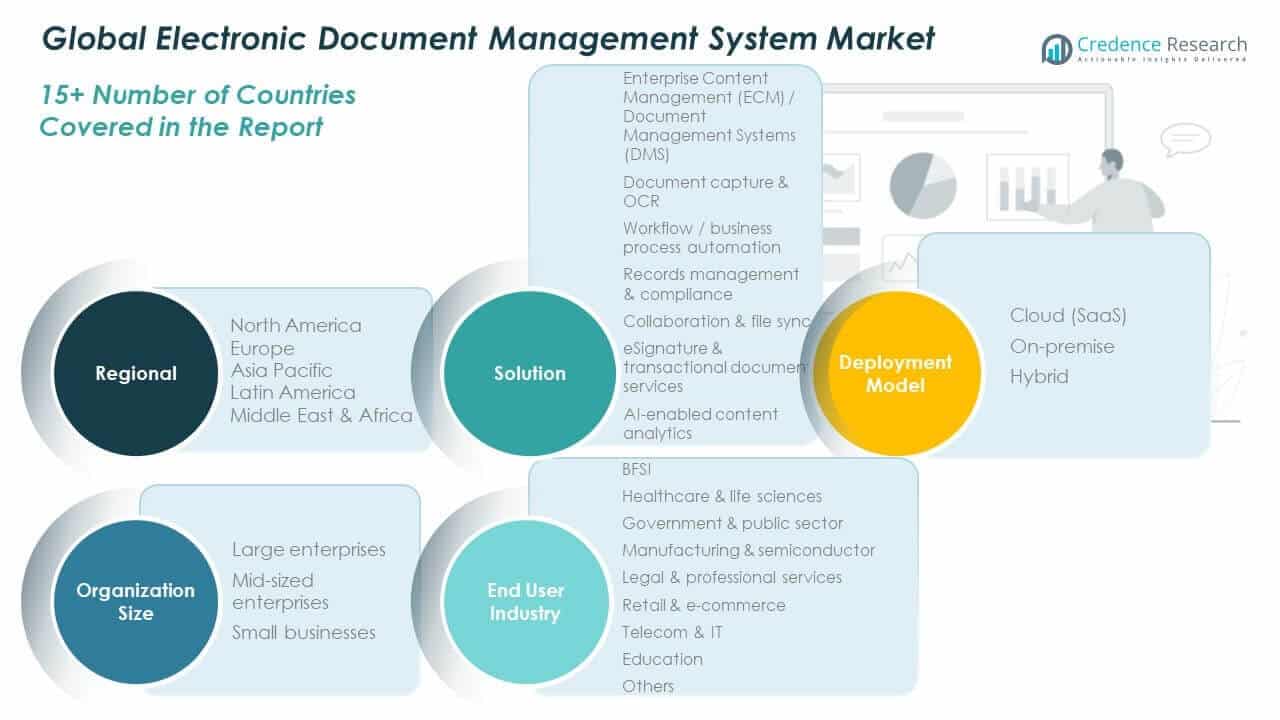
Market Segmentation Analysis:
By Solution
Document capture supports fast digitization of paper and electronic files. Document storage ensures centralized and secure repositories. Document retrieval improves access speed through indexing and search tools. Workflow management enables controlled approvals and task routing. Security and compliance protect sensitive records with access control and audit trails. These solutions support operational efficiency across departments. Enterprises select combinations based on compliance and volume needs. Solution depth shapes vendor differentiation in the Global Electronic Document Management System Market.
- For instance, IBM FileNet Content Manager can be configured for high-volume environments to ingest approximately 800 GB of data per hour supporting the throughput of millions of documents depending on size and integrates with IBM Automation Document Processing to utilize AI-driven extraction models validated by IBM's performance benchmarks.
By Deployment Model
On-premise deployment suits organizations with strict data control needs. Such models align with internal IT governance policies. Cloud-based deployment offers scalability and remote access benefits. Subscription pricing supports flexible budgeting. Cloud platforms reduce infrastructure burden for users. Faster deployment improves time to value. Security certifications strengthen trust in cloud models. Deployment choice depends on risk posture and scale.
- For instance, Oracle Content Management is built on Oracle Cloud Infrastructure, which meets over 100 global compliance standards and maintains a 99.95% service level agreement (SLA) for availability; however, as confirmed in the Oracle Cloud Services Pillar Document, the platform is scheduled to reach End of Life on December 31, 2025, requiring customers to migrate to alternative solutions before service concludes.
By Organization Size
Small and medium enterprises adopt systems to improve document control. SMEs value ease of use and lower upfront cost. Cloud platforms fit limited IT resources. Large enterprises require advanced integration and customization. Complex workflows demand strong governance features. High document volumes need scalable architecture. Enterprise adoption supports long-term contracts. Size-based needs guide product design.
By End User Industry
BFSI relies on compliance and audit readiness. Healthcare focuses on patient data security. Government and public sector adopt paperless records. IT and telecom manage large digital assets. Manufacturing controls technical documentation. Retail and e-commerce manage invoices and contracts. Education handles academic records securely. Legal services require version control and traceability.
Segmentation:
By Solution
- Document capture
- Document storage
- Document retrieval
- Workflow management
- Security and compliance
By Deployment Model
- On-premise
- Cloud-based
By Organization Size
- Small and medium enterprises
- Large enterprises
By End User Industry
- BFSI
- Healthcare
- Government and public sector
- IT and telecom
- Manufacturing
- Retail and e-commerce
- Education
- Legal services
By Region
- North America
- U.S.
- Canada
- Mexico
- Europe
- Germany
- France
- U.K.
- Italy
- Spain
- Rest of Europe
- Asia Pacific
- China
- Japan
- India
- South Korea
- South-east Asia
- Rest of Asia Pacific
- Latin America
- Brazil
- Argentina
- Rest of Latin America
- Middle East & Africa
- GCC Countries
- South Africa
- Rest of the Middle East and Africa
Regional Analysis:
North America
The North America Global Electronic Document Management System Market size was valued at USD 1,753.68 million in 2018 to USD 3,566.94 million in 2024 and is anticipated to reach USD 8,975.36 million by 2032, at a CAGR of 11.4 during the forecast period. North America holds the largest regional share, close to 44% by 2032. The United States leads due to strong enterprise digitization. Large organizations adopt advanced document control platforms. Regulatory compliance drives consistent demand. Cloud adoption supports remote access needs. Mature IT infrastructure accelerates deployment. Vendor presence remains strong across sectors. High cybersecurity awareness sustains investment levels.
Europe
The Europe Global Electronic Document Management System Market size was valued at USD 1,099.81 million in 2018 to USD 2,176.82 million in 2024 and is anticipated to reach USD 5,135.28 million by 2032, at a CAGR of 10.5 during the forecast period. Europe accounts for nearly 25% market share by 2032. Germany, the UK, and France lead adoption. Data protection laws drive secure document systems. Enterprises prioritize audit readiness. Public sector digitization supports growth. Cloud adoption rises steadily across industries. Cross-border operations require structured document control. Regional vendors focus on compliance-led solutions.
Asia Pacific
The Asia Pacific Global Electronic Document Management System Market size was valued at USD 782.57 million in 2018 to USD 1,739.71 million in 2024 and is anticipated to reach USD 4,930.84 million by 2032, at a CAGR of 13.1 during the forecast period. Asia Pacific holds around 24% market share by 2032. China, India, and Japan drive regional growth. Government digitization programs expand usage. SMEs adopt cloud-based platforms rapidly. Rising data volumes support demand. IT services growth strengthens adoption. Cost-efficient solutions gain preference. The region shows the fastest expansion pace.
Latin America
The Latin America Global Electronic Document Management System Market size was valued at USD 179.38 million in 2018 to USD 363.84 million in 2024 and is anticipated to reach USD 803.40 million by 2032, at a CAGR of 9.6 during the forecast period. Latin America contributes about 4% market share by 2032. Brazil and Mexico lead regional demand. Enterprises improve internal process control. Cloud deployment supports affordability needs. Regulatory frameworks evolve steadily. Banking and retail drive adoption. Digital transformation initiatives expand gradually. Vendor penetration remains selective.
Middle East
The Middle East Global Electronic Document Management System Market size was valued at USD 104.03 million in 2018 to USD 194.18 million in 2024 and is anticipated to reach USD 405.47 million by 2032, at a CAGR of 8.8 during the forecast period. The Middle East holds nearly 2% market share by 2032. Government-led digitization supports demand. Public sector agencies adopt paperless systems. Enterprise compliance needs grow steadily. Cloud adoption increases across GCC countries. Infrastructure modernization drives usage. Vendor partnerships support deployment. Growth remains stable across industries.
Africa
The Africa Global Electronic Document Management System Market size was valued at USD 46.03 million in 2018 to USD 107.81 million in 2024 and is anticipated to reach USD 199.37 million by 2032, at a CAGR of 7.1 during the forecast period. Africa represents about 1% market share by 2032. South Africa leads regional adoption. Government digitization projects support demand. SMEs seek basic document control tools. Cloud platforms lower entry barriers. IT infrastructure improves gradually. Vendor presence remains limited. Long-term digital reforms create future potential.
Key Player Analysis:
Competitive Analysis:
The Global Electronic Document Management System Market features strong competition among global software providers. Leading players focus on platform scalability and security depth. Vendors compete through cloud-native architecture and integration strength. Product portfolios address compliance-heavy industries. Strategic acquisitions expand workflow and content capabilities. Partnerships support regional reach and sector access. Innovation centers on automation and analytics. Brand trust influences enterprise buying decisions. Competitive intensity remains high due to low switching tolerance.
Recent Developments:
- In August 2025, Adobe launched Acrobat Studio, a new AI-powered platform that combines Acrobat Pro, Adobe Express, and agentic AI into a single integrated workspace, transforming PDFs into conversational knowledge hubs via a feature called "PDF Spaces." This followed the February 2025 introduction of new intelligent contract capabilities in Acrobat AI Assistant, which uses generative AI to help users instantly understand, compare, and verify complex contract terms. These tools are designed to streamline document workflows by allowing users to spot discrepancies across multiple agreements and request e-signatures within a unified app.
- In April 2025, DocuSign announced the upcoming release of AI-powered "contact agents" for its Intelligent Agreement Management (IAM) platform, designed to autonomously flag risks in contracts and streamline review workflows. This builds upon the company's major strategic pivot in April 2024, when it officially unveiled the DocuSign IAM platform, creating a new SaaS category dedicated to "Intelligent Agreement Management." The IAM platform connects disconnected agreement data with business systems, leveraging a proprietary AI engine called "DocuSign Iris" to transform how organizations create, commit to, and manage their agreements.
Report Coverage:
The research report offers an in-depth analysis based on By Solution, By Deployment Model, By Organization Size, and By End User Industry segments. It details leading market players, providing an overview of their business, product offerings, investments, revenue streams, and key applications. Additionally, the report includes insights into the competitive environment, SWOT analysis, current market trends, as well as the primary drivers and constraints. Furthermore, it discusses various factors that have driven market expansion in recent years. The report also explores market dynamics, regulatory scenarios, and technological advancements that are shaping the industry. It assesses the impact of external factors and global economic changes on market growth. Lastly, it provides strategic recommendations for new entrants and established companies to navigate the complexities of the market.
Future Outlook:
- Enterprises will expand cloud-first document strategies.
- AI-driven automation will gain wider enterprise trust.
- Compliance-led features will guide product upgrades.
- Integration with ERP and CRM platforms will deepen.
- SME adoption will rise through simplified SaaS models.
- Mobile document access will support workforce flexibility.
- Cybersecurity investment will remain a core priority.
- Vertical-specific solutions will grow in relevance.
- Vendor consolidation will reshape competition.
- Emerging regions will show steady adoption momentum.
Request a Free Sample
Fill in your details and we'll send you a free sample report.
- Sample data tables & charts
- Research methodology
Need a Custom Version of This Report?
Tailor the scope, geography, or segments to your exact requirements.
- Custom geography or segment scope
- Direct access to our analyst team
Frequently Asked Questions
What is the current market size for Global Electronic Document Management System Market, and what is its projected size in 2032?
At what Compound Annual Growth Rate is the Global Electronic Document Management System Market projected to grow between 2025 and 2032?
Which Global Electronic Document Management System Market segment held the largest share in 2024?
What are the primary factors fueling the growth of the Global Electronic Document Management System Market?
Who are the leading companies in the Global Electronic Document Management System Market?
Which region commanded the largest share of the Global Electronic Document Management System Market in 2024?
Table of Content
Chapter 1. Report Introduction
- 1.1 Report Description & Purpose
- 1.1.1 Report Title & Market Definition
- 1.1.2 Unique Selling Propositions (USP) & Key Differentiators
- 1.1.3 Value Proposition for Stakeholders
- 1.2 Research Objectives
- 1.2.1 Market Sizing Objectives (Volume & Revenue)
- 1.2.2 Segmentation Objectives
- 1.2.3 Competitive Intelligence Objectives
- 1.2.4 Forecast & Scenario Objectives
- 1.3 Report Scope
- 1.3.1 Electronic Document Management System Scope – Types & Subtypes Covered
- 1.3.2 Geographic Scope – Regions & Countries Covered
- 1.3.3 Historical Period, Base Year & Forecast Period (2024; forecast to 2032)
- 1.3.4 Inclusions & Exclusions
- 1.4 HS Code & Classification Framework
- 1.5 Currency, Units & Pricing Basis
- 1.6 Target Stakeholders
- 1.7 Limitations & Assumptions
Chapter 2. Executive Summary
- 2.1 Global Electronic Document Management System Market Snapshot
- 2.1.1 Market Size – Historical (2024) & Forecast (2024-2032) (2024: USD 8,149.30 million → 2032: USD 20,449.71 million)
- 2.1.2 Volume & Revenue – Global Totals
- 2.1.3 Key Market Highlights – Top Five Facts
- 2.2 Electronic Document Management System Market Segmentation Snapshot
- 2.2.1 Market Split by Region – 2024 vs. 2032
- 2.3 Competitive Snapshot
- 2.3.1 Top 10 Players by Revenue Share – 2024
- 2.3.2 Top 10 Players by Volume Share – 2024
- 2.3.3 Recent Strategic Developments (18-Month Summary)
- 2.4 Key Investment Highlights & Strategic Conclusions
Chapter 3. Electronic Document Management System Market Dynamics & Industry Analysis
- 3.1 Market Overview & Context
- 3.1.1 Electronic Document Management System Market Position in the Broader Automotive Value Chain
- 3.1.2 OEM vs. Replacement Market Dynamics
- 3.1.3 Market Maturity & Development Stage by Region
- 3.2 Electronic Document Management System Market Drivers
- 3.3 Electronic Document Management System Market Restraints & Challenges
- 3.4 Electronic Document Management System Market Opportunities
- 3.5 Porter's Five Forces Analysis
- 3.5.1 Threat of New Entrants
- 3.5.2 Bargaining Power of Suppliers
- 3.5.3 Bargaining Power of Buyers
- 3.5.4 Threat of Substitutes
- 3.5.5 Competitive Rivalry – Intensity Assessment
- 3.6 Electronic Document Management System Value Chain Analysis
- 3.6.1 Upstream – Raw Material/Input Suppliers
- 3.6.1.1 Raw Material/Input 1
- 3.6.1.2 Raw Material/Input 2
- 3.6.1.3 Raw Material/Input 3
- 3.6.2 Midstream – Production/Manufacturing/Service Delivery
- 3.6.2.1 Production/Process Overview
- 3.6.2.2 Key Facility Locations & Capacity by Manufacturer
- 3.6.3 Downstream – Distribution & End Consumer
- 3.6.3.1 Primary Channel – B2B/OEM
- 3.6.3.2 Secondary Channels – Dealer, Retail, Online, Direct
- 3.6.4 Value Chain Profitability Analysis
- 3.6.1 Upstream – Raw Material/Input Suppliers
- 3.7 PESTEL Analysis
- 3.7.1 Political Factors
- 3.7.2 Economic Factors
- 3.7.3 Social Factors
- 3.7.4 Technological Factors
- 3.7.5 Environmental Factors
- 3.7.6 Legal Factors
- 3.8 Electronic Document Management System Supply Chain Analysis
- 3.8.1 Raw Material/Input Supply Risk Assessment
- 3.8.2 Manufacturing Concentration Risk (Geographic Exposure)
- 3.8.3 Trade Disruption Impact Analysis
- 3.9 Regulatory & Policy Landscape
Note: The regulatory and policy landscape section covers regulations based on their applicability to the market, Electronic Document Management System category, geography, and scope of the study. Only regulatory frameworks with a material impact on operations, compliance, trade, sustainability, or market access are analyzed in detail.
Chapter 4. Key Investment Pockets & Opportunity Analysis
- 4.1 Electronic Document Management System Market Attractiveness Analysis
- 4.1.1 By Region – Investment Attractiveness Matrix (Volume × CAGR)
- 4.2 Absolute Revenue Growth Opportunity
- 4.2.1 By Region – Absolute USD Growth Through 2032
- 4.3 Incremental Volume Opportunity
- 4.3.1 By Region – Incremental Volume Through 2032
- 4.3.2 Segment – Incremental Volume
- 4.4 Emerging Submarket Opportunity Deep Dive (Subject to Applicability)
- 4.5 Emerging Market Opportunity Scorecards
- 4.5.1 United States
- 4.5.2 Europe
- 4.5.3 Asia
- 4.5.4 Middle East & Africa
Note: Emerging Market Opportunity Scorecards will be included based on relevance and strategic importance. Regions listed are indicative and may vary depending on data availability and market dynamics.
Chapter 5. Electronic Document Management System Import-Export Analysis & Trade Flows
- 5.1 Global Trade Overview
- 5.1.1 Global Export Value by Country (2024)
- 5.1.2 Global Export Volume by Country (2024)
- 5.1.3 Global Import Value by Country (2024)
- 5.1.4 Global Import Volume by Country (2024)
- 5.1.5 Net Trade Balance by Country (2024)
- 5.2 Export Analysis – Segment
- 5.2.1 Type 1 (HS Code)
- 5.2.2 Type 2 (HS Code)
- 5.2.3 Type 3 (HS Code)
- 5.2.4 Type 4 (HS Code)
- 5.2.5 Type 5 (HS Code)
- 5.3 Import Analysis – Segment
- 5.3.1 Type 1 (HS Code)
- 5.3.2 Type 2 (HS Code)
- 5.3.3 Type 3 (HS Code)
- 5.3.4 Type 4 (HS Code)
- 5.3.5 Type 5 (HS Code)
- 5.4 Average Unit Trade Prices
- 5.4.1 Average Export Price – Segment & Country
- 5.4.2 Average Import Price – Segment & Source Country
- 5.4.3 Price Trends (2024)
- 5.5 Key Trade Route Analysis
- 5.5.1 Trade Route 1
- 5.5.2 Trade Route 2
- 5.5.3 Trade Route 3
- 5.5.4 Trade Route 4
- 5.5.5 Trade Route 5
- 5.6 Trade Policy Impact Assessment
- 5.6.1 US Anti-Dumping & Section 301 Tariffs
- 5.6.2 EU Customs Union Impact
- 5.6.3 Major Free Trade Agreements
- 5.6.4 USMCA Rules of Origin
Note: Trade policy analysis will be included only where relevant to the Electronic Document Management System market.
Chapter 6. Competitive Landscape & Company Benchmarking
- 6.1 Electronic Document Management System Market Concentration & Structure
- 6.1.1 Herfindahl-Hirschman Index (HHI) – vs. 2024
- 6.1.2 Tier 1, Tier 2 & Tier 3 Market Structure
- 6.1.3 Global, Regional & Local Player Dynamics
- 6.2 Electronic Document Management System Market Share Analysis – 2024
- 6.2.1 Global Revenue Share by Company
- 6.2.2 Global Volume Share by Company
- 6.2.3 Regional Revenue Share
- 6.2.4 Market Share Evolution ( vs. 2024)
- 6.2.5 OEM Segment Share by Company
- 6.2.6 Replacement Segment Share by Company
- 6.3 Production/Delivery Capacity & Facility Analysis
- 6.3.1 Global Installed Capacity
- 6.3.2 Capacity Utilization Rates
- 6.3.3 Production/Output Volume
- 6.3.4 Facility Locations & Capacity Map
- 6.3.5 Planned Capacity Additions
- 6.4 Electronic Document Management System Competitive Benchmarking Matrix
- 6.4.1 Revenue, Volume, CAGR & Profitability Comparison
- 6.4.2 Channel Revenue Mix
- 6.4.3 Geographic Revenue Exposure
- 6.4.4 R&D Intensity
- 6.4.5 Sustainability Maturity
- 6.5 Strategic Developments in Electronic Document Management System (Last 24 Months)
- 6.5.1 Mergers, Acquisitions & Divestments
- 6.5.2 New Electronic Document Management System Launches
- 6.5.3 Facility Expansions
- 6.5.4 Strategic Alliances, Joint Ventures & Partnerships
- 6.5.5 Distribution Expansion & Market Entry
- 6.5.6 Sustainability & ESG Initiatives
- 6.6 Competitive Strategy Mapping
- 6.6.1 Leader, Challenger, Follower & Niche Classification
- 6.6.2 Pricing Strategy Comparison
- 6.6.3 Channel Strategy Matrix
Note: Strategic developments are included based on their materiality and the availability of reliable information.
Chapter 7. Global Electronic Document Management System Market – By Distribution Channel
- 7.1 Segment Overview
- 7.1.1 Volume & Revenue Split by Channel (2024 & 2032)
- 7.1.2 Channel Mix Evolution (2024-2032)
Chapter 8. Regional Market Analysis – Global Overview
- 8.1 Global Regional Overview
- 8.1.1 Regional Volume Share
- 8.1.2 Regional Revenue Share
- 8.1.3 Regional Volume by Region
- 8.1.4 Regional Revenue by Region
- 8.1.5 Regional Forecast Through 2032
- 8.2 Cross-Regional Segment Analysis
- 8.2.1 By Distribution Channel
- 8.2.2 By Brand/Price Tier
Chapter 9. North America Electronic Document Management System Market
- 9.1 United States
- 9.2 Canada
- 9.3 Mexico
Chapter 10. Europe Electronic Document Management System Market
- 10.1 Germany
- 10.2 France
- 10.3 Italy
- 10.4 United Kingdom
- 10.5 Spain
- 10.6 Poland
- 10.7 Russia
- 10.8 Netherlands
- 10.9 Belgium
- 10.10 Sweden
- 10.11 Denmark
- 10.12 Norway
- 10.13 Rest of Europe
Chapter 11. Asia Pacific Electronic Document Management System Market
- 11.1 China
- 11.2 India
- 11.3 Japan
- 11.4 South Korea
- 11.5 Thailand
- 11.6 Indonesia
- 11.7 Vietnam
- 11.8 Malaysia
- 11.9 Australia
- 11.10 Rest of Asia Pacific
Chapter 12. Latin America Electronic Document Management System Market
- 12.1 Brazil
- 12.2 Argentina
- 12.3 Colombia
- 12.4 Chile
- 12.5 Rest of Latin America
Chapter 13. Middle East Electronic Document Management System Market
- 13.1 Saudi Arabia
- 13.2 United Arab Emirates
- 13.3 Turkey
- 13.4 Israel
- 13.5 Iran
- 13.6 Rest of the Middle East
Chapter 14. Africa Electronic Document Management System Market
- 14.1 South Africa
- 14.2 Egypt
- 14.3 Nigeria
- 14.4 Morocco
- 14.5 Rest of Africa
Chapter 15. Electronic Document Management System Company Profiles
- 15.1 [Company 01]
- 15.1.1 Company Overview
- 15.1.2 Key Management Personnel
- 15.1.3 Products & Services Portfolio
- 15.1.4 Financial Performance
- 15.1.5 Key Market Focus & Geographic Presence
- 15.1.6 Recent Developments & Strategic Initiatives
Note: The company profile list is preliminary and may change based on research findings, market developments, data availability, and client requirements.
Chapter 16. Appendices
- Appendix A – List of Abbreviations & Acronyms
- Appendix B – Industry Classification Code Reference – Full Series
- Appendix C – Production & Capacity Data Tables
- Appendix D – End-Use & Demand Base Tables
- Appendix E – Consumption & Replacement Rate Assumptions
- Appendix F – ASP Reference Tables
- Appendix G – Manufacturing & Facility Database
- Appendix H – Import-Export Data Tables
- Appendix I – Regulatory Summary Tables
- Appendix J – Primary Research Participant List (Anonymized)
- Appendix K – Primary Research Questionnaire Framework
- Appendix L – Data Sources & Bibliography
- Appendix M – Market Size Divergence & Source Comparison
Chapter 17. Research Methodology
- 17.1 Research Framework & Philosophy
- 17.2 Secondary Research – Sources, Hierarchy & Data Extraction
- 17.3 Data Modeling – Bottom-Up & Top-Down Market Sizing
- 17.4 Primary Research – Stakeholder Framework, LOI & Sample Sizes
- 17.5 Forecast Methodology – Regression, Scenario & Sensitivity Analysis
- 17.6 Quality Control – Four-Layer Validation Framework
- 17.7 Limitations & Standard Assumptions
- 17.8 Disclaimer
