Sodium warning labels turn Canadian buyers toward umami
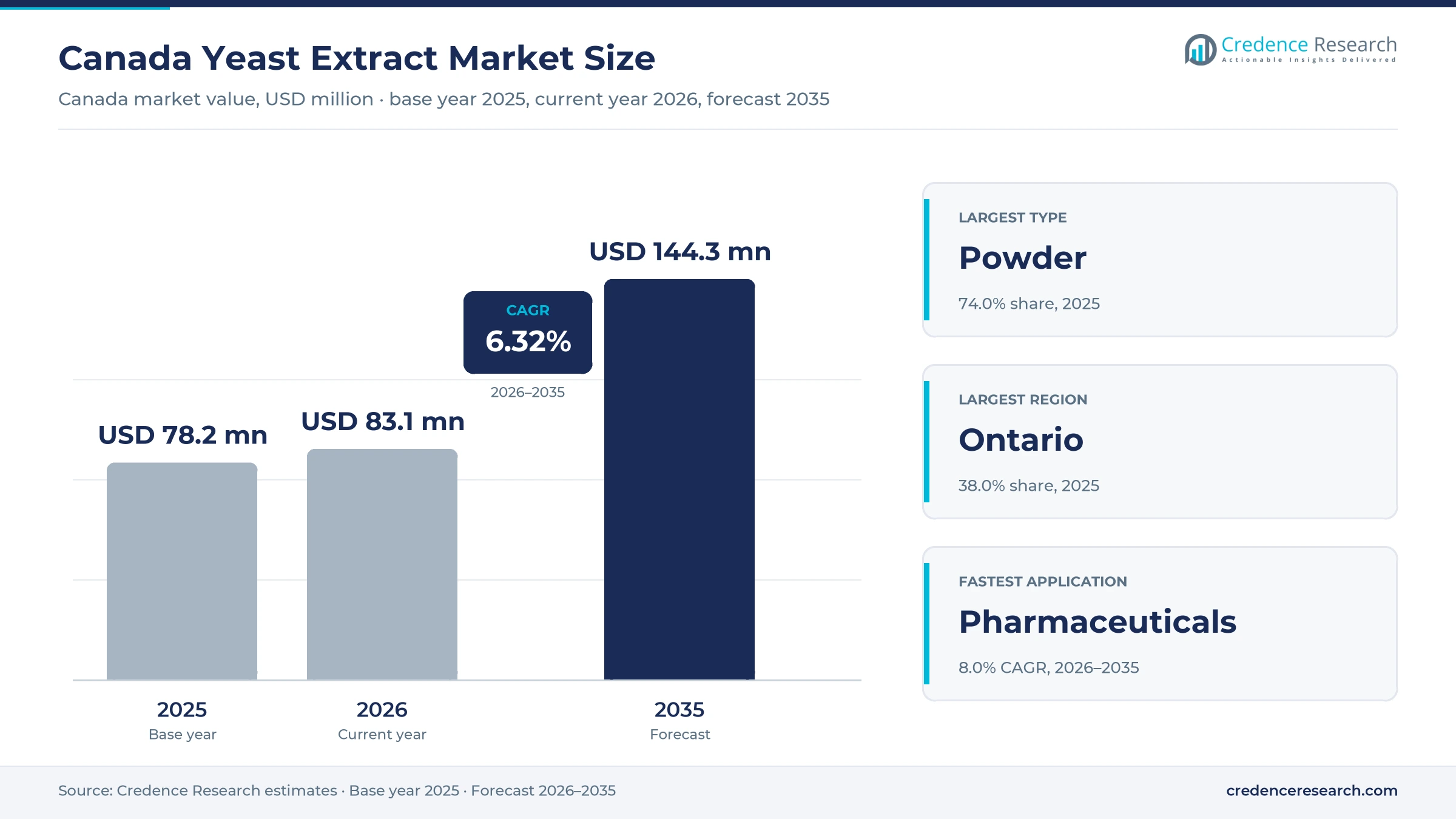
The Canada yeast extract market was valued at USD 78.2 million in 2025 and is projected to increase from USD 83.1 million in 2026 to USD 144.3 million by 2035, registering a CAGR of 6.32% during 2026–2035. Buyers are makers of soups, bouillon concentrates, snack seasonings, processed meats and plant-based foods that need savory depth at lower salt, together with feed mills, pet food plants and fermentation sites that buy nutrient grades. Ontario held the largest share, 38.0% in 2025, because it hosts the largest food manufacturing base and the main domestic yeast extract plant, at Cornwall. Western Canada grows fastest at 6.8% a year, as Alberta meat, snack and grain processors expand. The main regulatory change is the front-of-package nutrition symbol, which became mandatory on Jan. 1, 2026, for prepackaged foods high in sodium, sugars or saturated fat, and which gives brand owners a visible reason to replace salt with yeast-based taste.
A domestic plant and U.S. imports serve savory food makers
The market counts soluble extracts made by breaking down baker's, brewer's or torula yeast cells through autolysis, plasmolysis or added enzymes, then separating the cell walls and concentrating or drying the soluble fraction. Food manufacturers buy powders and pastes on annual contracts, while feed formulators and fermentation plants buy specification grades with a certificate of analysis for each lot.
Fresh and dried baker's yeast, nutritional yeast flakes, yeast cell walls and yeast probiotics sit outside this market, although the same groups make them in the same plants. Finished bouillon concentrates and seasonings are counted only for their yeast extract content, so the value stays at ingredient level and excludes retail markups.
Canada Yeast Extract Market Insights
- The Canada yeast extract market was valued at USD 78.2 million in 2025 and is projected to reach USD 144.3 million by 2035, growing at a 6.32% CAGR during 2026–2035.
- Ontario held 38.0% of 2025 value, because it has the largest provincial food manufacturing base and the Lallemand yeast extract plant at Cornwall.
- Powder held 74.0% of 2025 value, because soup bases, snack seasonings and meat binders all take dry, free-flowing enhancer systems.
- Front-of-package symbols became mandatory on Jan. 1, 2026, for prepackaged foods at or above 15% of the daily value for sodium.
- Pharmaceuticals grow fastest among applications at 8.0% a year during 2026–2035, as precision fermentation capacity opens in Atlantic Canada.
Powder and food uses lead as biotech fermentation grows
Powder leads and grows fastest on dry seasoning use
Based on type, the market is categorized into powder and paste. Powder led with 74.0% of 2025 value because soup bases, snack seasonings and meat binders are blended dry, and Health Canada's 2025 targets cap chips and popcorn at a sales-weighted 400 milligrams of sodium per 100 grams, which pushes snack makers toward dry umami blends. Powder also grows fastest at 6.4% a year, as seasoning houses favor free-flowing grades that dose accurately on coating lines. Paste serves bouillon concentrates, gravies and retail spreads, a smaller pool because most Canadian plants dose dry blends.
Food leads while biotech fermentation grows fastest
Based on application, the market is categorized into food and beverages, pharmaceuticals, animal feed and others. Food & Beverages led with 66.0% of 2025 value because soups, bouillons, snacks and processed meats carry most savory dosing, and meat product manufacturing alone sold CAD 43.8 billion of goods in 2024, the largest food subsector. Pharmaceutical and biotech use grows fastest at 8.0% a year from a small base, as the Dartmouth precision fermentation center described under opportunities adds demand for documented nutrient grades.
Baker's yeast leads on molasses-grown domestic capacity
Based on source, the market is categorized into baker's yeast and brewer's yeast. Baker's Yeast led with 80.0% of 2025 value and also grows fastest, because molasses-grown yeast gives producers uniform feedstock. Domestic beet molasses is scarce, because the Taber factory supplies only about 8% of Canadian sugar, The Western Producer reported in September 2025, so yeast makers rely on imported cane molasses, which ties extract costs to world sugar prices. Brewer's grades depend on a shrinking brewing pool, noted under challenges.
| Segment Group | Leading Sub-segment | Share, 2025 | Fastest-growing Sub-segment | CAGR, 2026–2035 |
|---|---|---|---|---|
| By Type | Powder | 74.0% | Powder | 6.4% |
| By Application | Food & Beverages | 66.0% | Pharmaceuticals | 8.0% |
| By Source | Baker's Yeast | 80.0% | Baker's Yeast | 6.4% |
Grade, purity and dose efficiency set what buyers pay
Food-grade yeast extract sells to Canadian plants on annual contracts priced per kilogram, often in U.S. dollars because much of the volume crosses the border, so the exchange rate moves delivered cost as much as list price. The premium over basic autolysates depends on nucleotide content, salt level and masking performance, while glutamate anchors the lower end. Fermentation and biotech grades carry the highest prices, because buyers pay for lot documentation, low endotoxin levels and animal-free status. Molasses, energy at the drying stage and freight move supplier costs, and the small number of suppliers limits price competition at renewal.
| Product or grade | Typical price or fee | Basis |
|---|---|---|
| Savory yeast extract powder, bulk delivered to food plants | USD 5.5 to 9 per kg | Credence Research estimate from North American grade prices and freight |
| Feed-grade yeast extract and autolysate, bulk | USD 2.5 to 5 per kg | Credence Research estimate from feed ingredient price ranges |
| Fermentation-grade yeast extract, bulk | USD 15 to 40 per kg | Credence Research estimate from grade premiums over food grades |
| Bovril chicken bouillon concentrate with yeast extract, 750 mL retail bottle | CAD 12.99 per bottle | Costco Canada listing, November 2026 |
Request a Free Sample
Fill in your details and we'll send you a free sample report.
- Sample data tables & charts
- Research methodology
Front-of-pack symbols and missed salt targets lift dosing
Front-of-package sodium symbols push reformulation
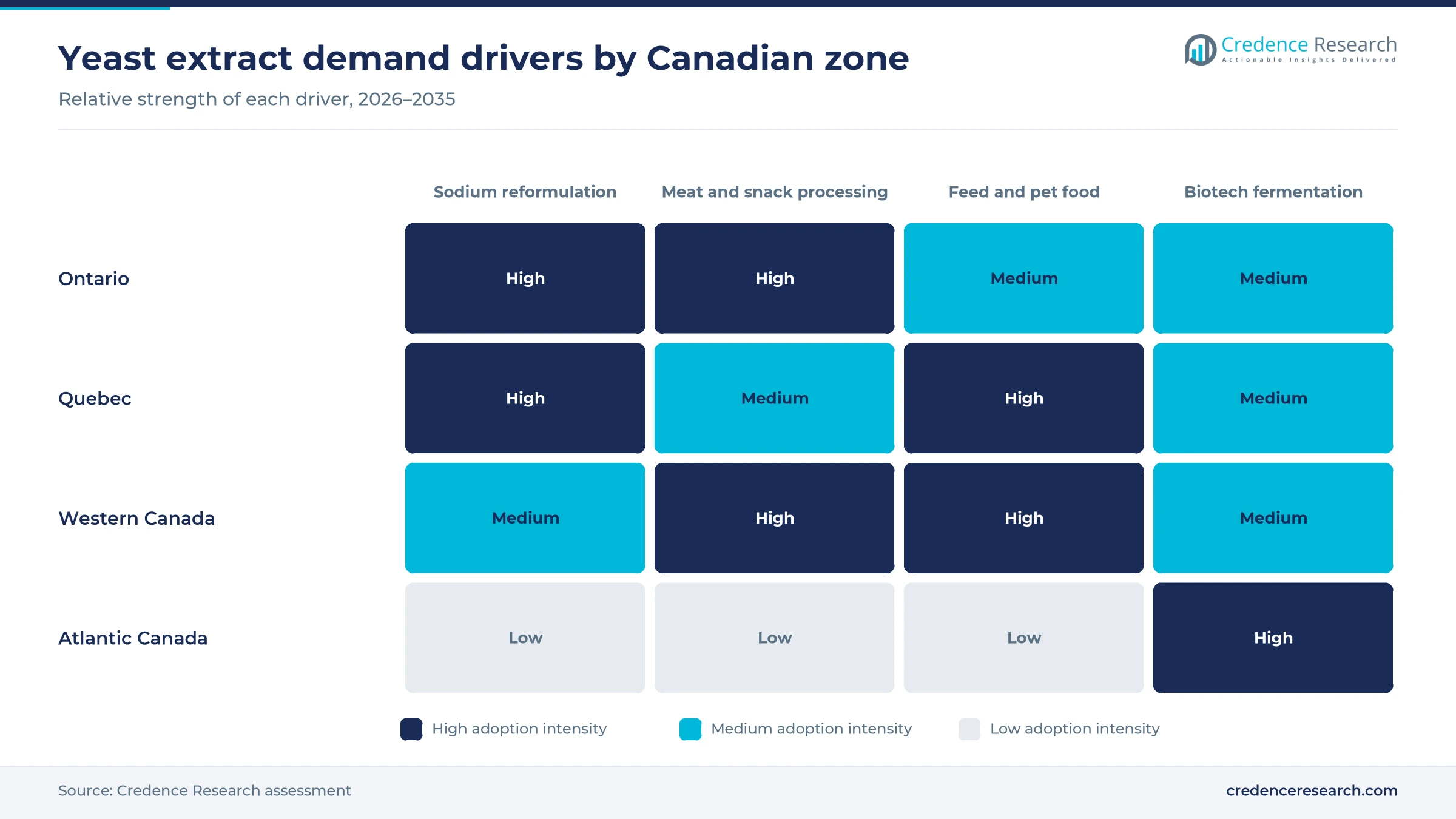
Mandatory front-of-package warnings make sodium a visible sales variable, so brand owners now reformulate to stay below the trigger rather than to meet a voluntary goal. Prepackaged foods must carry the magnifying-glass symbol when sodium reaches 15% of the daily value per serving, 10% for small reference amounts and 30% for main dishes, and the industry had until Jan. 1, 2026, to comply, Health Canada states. Deli meats, soups, salad dressings and frozen pizza are among the examples named. Health Canada also cites Chilean data showing 37% less sodium in household purchases after a similar label. Suppliers of low-sodium savory systems gain, because yeast extract restores salty and meaty perception at lower salt.
Missed voluntary salt targets keep pressure on processors
Voluntary sodium targets have not delivered the cuts Health Canada set, and reformulation briefs stay open across soups, sauces and breads. Canadians consume an estimated 2,760 milligrams of sodium a day against a 2,300 milligram goal, Health Canada says. Its interim assessment of June 2025 found only modest progress, as ready-to-serve soups averaged 277 milligrams per 100 grams against a 240 milligram target, and tomato sauce carried more sodium than in 2017. Demand from soup and sauce makers will track whatever follow-up measures Health Canada sets once the 2025 targets lapse. Makers of sodium reduction ingredients with measured taste data stand to win these briefs.
A large meat and bakery base sustains savory dosing
Canada's food processing scale gives yeast extract a broad installed base, because meat, bakery and prepared-food lines use savory enhancers in marinades, binders, crusts and seasonings. Food and beverage processing sold CAD 173.4 billion of goods in 2024 and was the largest manufacturing industry by production value, Agriculture and Agri-Food Canada reports. Meat product manufacturing alone sold CAD 43.8 billion, about a quarter of the total, and bakeries and tortilla makers CAD 18.5 billion. Health Canada set a sales-weighted target of 830 milligrams of sodium per 100 grams for cooked sausages and wieners. Processed meat plants that must hold flavor at lower salt are the largest single buyer group.
Feed mills and livestock herds widen nutrient demand
Feed and young-animal nutrition form a second demand base, because yeast extracts supply nucleotides, peptides and palatability that help piglets, calves and poultry start eating early. Canada has 429 commercial feed mills supplying roughly 19.3 million metric tons of feed, and livestock consumed 28.9 million metric tons in 2024 excluding forages, the Animal Nutrition Association of Canada says. Statistics Canada counted about 13.9 million hogs on Jan. 1, 2026. Animal food manufacturing shipped CAD 11.2 billion of goods in 2023, ISED data show. Lesaffre added a dryer at its Cedar Rapids yeast extract plant in 2023 for its Phileo animal unit, a sign that suppliers are building feed capacity close to North American mills that also buy feed additives.
Masking grades and supplier deals reshape Canadian supply
Food makers are shifting to masking and texture yeast grades
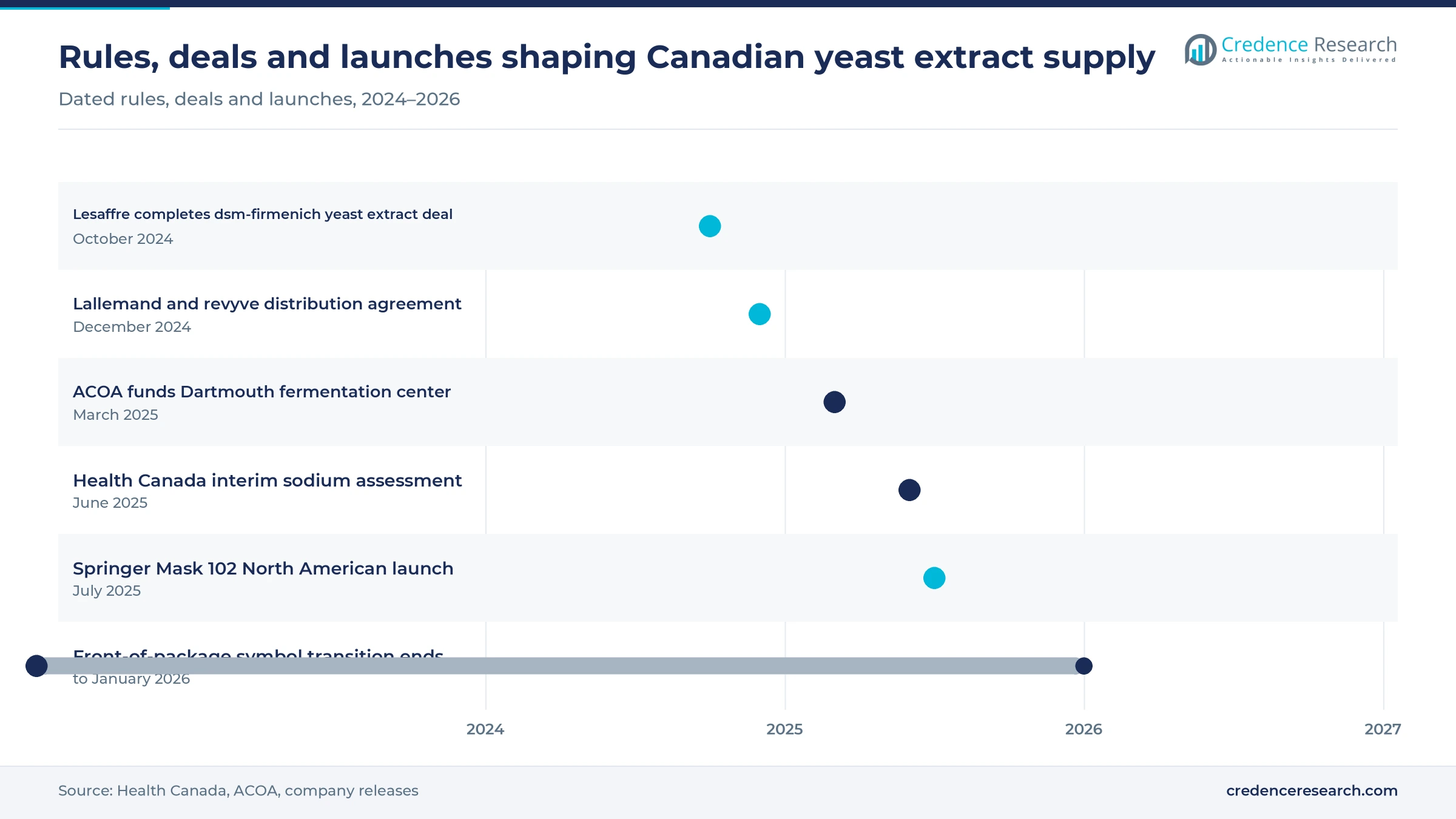
Canadian formulators are shifting toward yeast-based masking and texturizing grades to address bitter notes from sweeteners and plant proteins, creating openings for specialty extracts beyond basic umami. Biospringer launched Springer Mask 102, a yeast-based bitter blocker, for the North American market at IFT First in Chicago in July 2025. Lallemand Bio-Ingredients signed in December 2024 to become the exclusive distributor of revyve yeast-based texturizers in the U.S., Canada and Mexico, with first rollouts planned for 2025. Demand is moving toward whole plant proteins, as tofu dollar sales rose 10% over 52 weeks, NielsenIQ data cited by Canadian Grocer show. Suppliers with masking data for pea, soy and fava bases win reformulation projects.
Supplier consolidation is concentrating North American capacity
Yeast groups are shifting toward broader portfolios to address customer demand for one supplier across enhancers, masking agents, enzymes and fermentation nutrients, which concentrates the supply that Canadian buyers can choose from. Lesaffre completed its purchase of the dsm-firmenich yeast extract business in October 2024, after announcing it on June 12, 2024, and 46 dsm-firmenich yeast extract employees moved to Biospringer. Lallemand Bio-Ingredients announced the purchase of French enzyme maker Solyve in July 2025, and Lallemand completed its acquisition of BIO-CAT, with sites in Virginia and Minnesota, on July 31, 2026. Each deal widens the range of two leading suppliers to Canadian buyers. Buyers gain one-stop technical support, but they face fewer independent price references at contract renewal.
Precision fermentation opens demand for nutrient grades
Precision fermentation is an opening for nutrient-grade yeast extract, because microbes that make proteins, enzymes and food ingredients need nitrogen, peptides and vitamins with full lot documentation. The Atlantic Canada Opportunities Agency committed CAD 5 million in March 2025 to a Dartmouth, Nova Scotia, bioinnovation center in a 51,000-square-foot building, with precision fermentation capacity of up to 100,000 liters. Lallemand has made its Fermentation Nutrient range for biotech users at Cornwall, Ontario, since mid-2019, which shortens supply lines for these sites and gives buyers a domestic qualification route. Suppliers with animal-free, low-endotoxin grades gain the highest margins in this outlet, where buyers audit every lot before approval.
Export-led processors open demand for clean-label savory
Export processors are an opening for clean-label yeast extract, because buyers in the U.S., Japan and other markets ask for short labels and lower sodium in Canadian meat, snack and prepared foods. Canadian food and beverage exports reached a record CAD 59.8 billion in 2024, up 3.8% and equal to 34.5% of production value, Agriculture and Agri-Food Canada reports. The U.S. took 80% of those exports, so U.S. retail sodium and label expectations reach Canadian plants directly. Japan took 4%, a market where yeast-based umami is long established. Suppliers that pair yeast extract with export label support gain share in plants that serve several markets at once.
Falling beer volume and soft plant-based sales weigh
Falling beer volume thins brewer's yeast supply
Brewer's yeast extract depends on spent yeast from domestic brewing, and that pool is contracting. Beer sales fell 4.5% to 1,950 million liters in the 2023/2024 fiscal year, Statistics Canada reports, although domestic brands still took 88.0% of beer dollar sales. Processors of brewer's grades and feed buyers that specify them face scattered collection and higher logistics cost, so brewer's-source grades are more likely to come from larger U.S. and European brewing clusters.
Flat plant-based sales slow masking volume
Plant-based foods were expected to be a fast outlet for masking and savory grades, but Canadian sales have stalled. Retail sales of plant-based foods reached CAD 1.23 billion over 52 weeks and fell 1% in both dollars and units, NielsenIQ data cited by Canadian Grocer in July 2026 show. Suppliers that invested in plant-based meat applications are most exposed, and they must redirect technical effort toward tofu, tempeh, dairy alternatives and hybrid meat products.
Glutamate and salt blends cap standard grade prices
Low-cost glutamate and salt blends remain the price reference for savory taste, which limits what buyers pay for standard autolysates. The Bovril chicken concentrate sold by Costco Canada at CAD 12.99 for 750 milliliters lists monosodium glutamate ahead of yeast extract on its label, showing that mainstream brands still combine both. Suppliers of basic grades are most exposed at renewal, while masking and low-sodium grades defend price through measured salt savings.
Small processors lack reformulation resources
Most Canadian food plants are small, which slows reformulation work that yeast extract suppliers depend on. About 8,800 food and beverage processing establishments have employees, and about 92% of them employ fewer than one hundred people, Agriculture and Agri-Food Canada data for 2024 show. Few such firms run in-house sensory panels or sodium modeling, so front-of-package compliance can default to smaller portions or salt substitutes rather than yeast-based systems. Suppliers that bundle application lab support reach this group, while others stay with large brand owners.
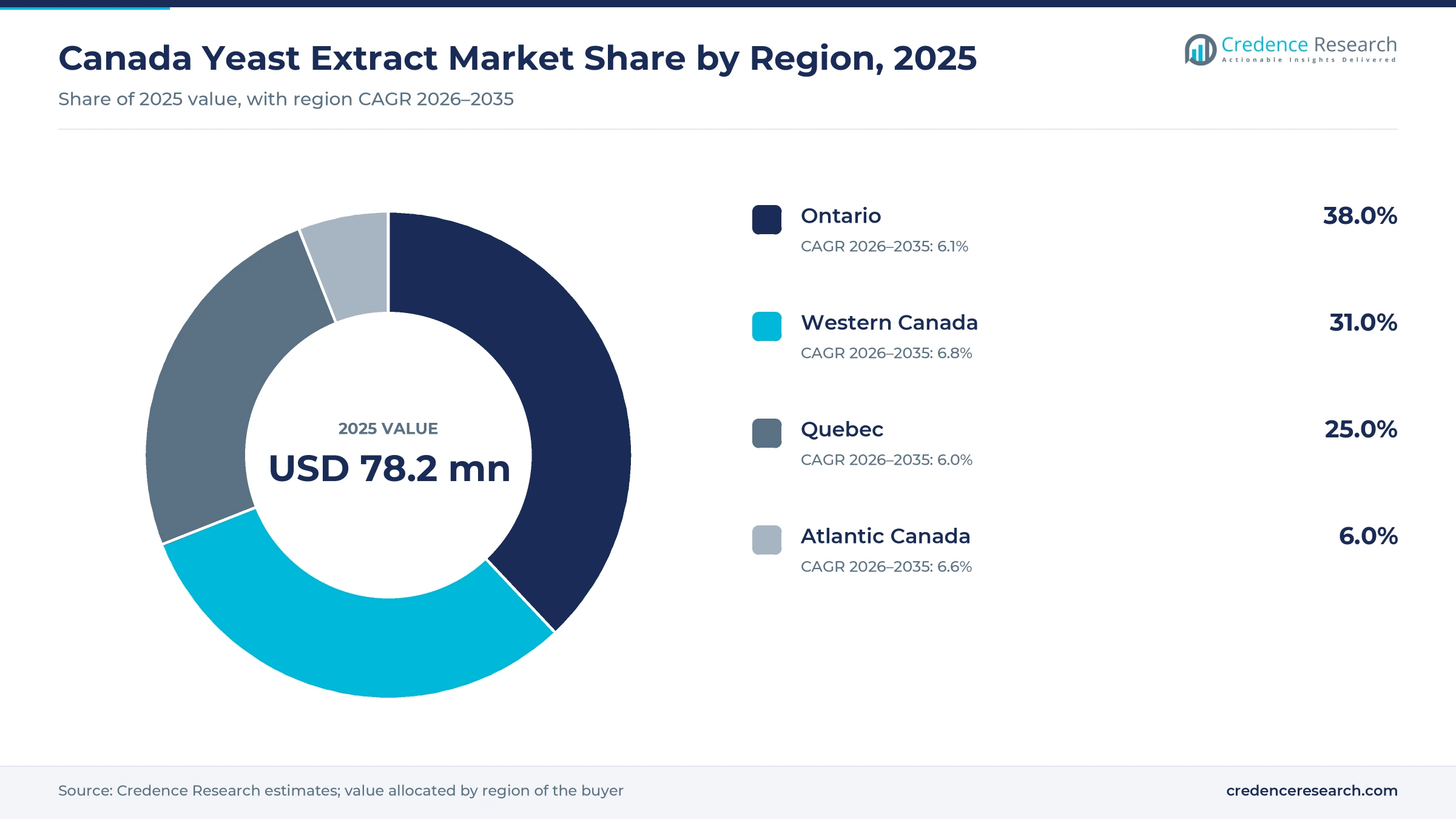
Ontario plants anchor demand while Prairie processors gain
| Region | Value, 2025 (USD million) | Share, 2025 | CAGR, 2026–2035 |
|---|---|---|---|
| Ontario | 29.7 | 38.0% | 6.1% |
| Western Canada | 24.2 | 31.0% | 6.8% |
| Quebec | 19.5 | 25.0% | 6.0% |
| Atlantic Canada | 4.7 | 6.0% | 6.6% |
Ontario leads on food plants and Cornwall supply
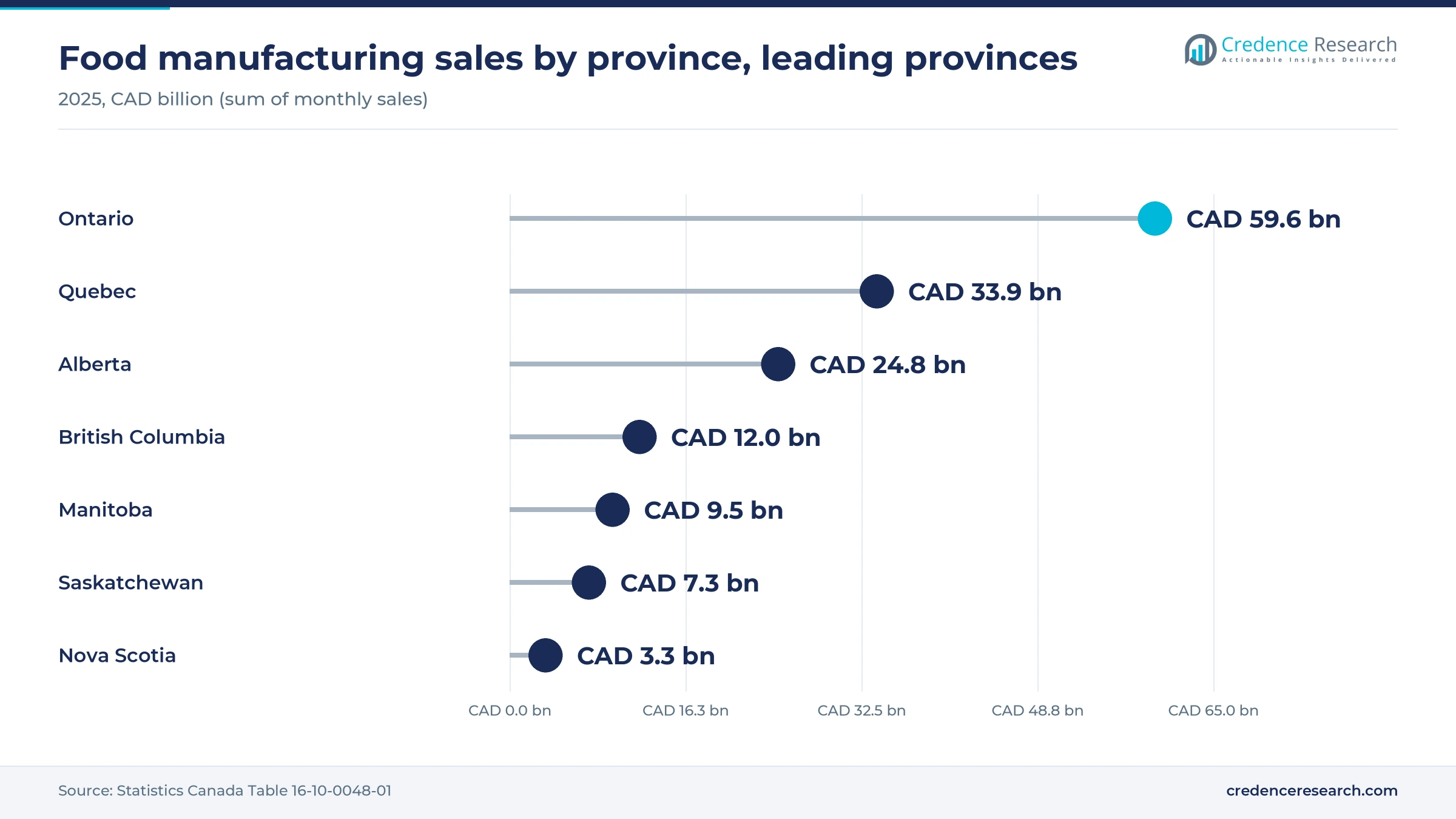
Ontario held 38.0% of 2025 value and grows at 6.1% a year. The province sold about CAD 59.6 billion of food manufactured goods in 2025, the largest provincial total in Statistics Canada monthly manufacturing data, with meat, bakery, snack and prepared-food plants concentrated around Toronto and southwestern Ontario. Lallemand Bio-Ingredients converted a site at Cornwall, near the U.S. border, and began making yeast extracts there in mid-2019, giving Ontario buyers the shortest domestic supply line.
Western Canada grows fastest on Prairie processing
Western Canada, covering British Columbia, Alberta, Saskatchewan and Manitoba, held 31.0% of 2025 value and grows fastest at 6.8% a year. Alberta food manufacturing revenue rose 10.3% in 2024 and led that province's manufacturing growth, Statistics Canada reported in December 2025. Alberta sold about CAD 24.8 billion of food manufactured goods in 2025, British Columbia CAD 12.0 billion and Manitoba CAD 9.5 billion. Meat packing, snack and pulse processing give the zone a broad base of savory buyers.
Quebec combines yeast production with food processing
Quebec held 25.0% of 2025 value and grows at 6.0% a year. The province sold about CAD 33.9 billion of food manufactured goods in 2025, and Lallemand runs its headquarters and a yeast plant in Montreal. Quebec food manufacturing revenue fell by CAD 0.6 billion in 2024, Statistics Canada reported, which tempers growth even though the yeast base keeps sampling and technical support close to Quebec buyers.
Atlantic Canada stays smallest but adds fermentation demand
Atlantic Canada, covering Nova Scotia, New Brunswick, Prince Edward Island and Newfoundland and Labrador, held 6.0% of 2025 value and grows at 6.6% a year. Nova Scotia sold about CAD 3.3 billion of food manufactured goods in 2025, and seafood and potato processing dominate the zone rather than savory food plants. The Dartmouth fermentation center adds a new nutrient-grade outlet, but published provincial data are suppressed for several Atlantic provinces, so the zone share is a Credence Research estimate.
Labeling rules, deals and fermentation funding, 2024 to 2026
| Development | Status and market relevance |
|---|---|
| In October 2024, Lesaffre completed its purchase of the dsm-firmenich yeast extract business and folded it into Biospringer. | Completed acquisition; it widens the savory yeast range that a U.S.-based supplier ships into Canada and removes one independent seller. |
| In December 2024, Lallemand Bio-Ingredients agreed to become the exclusive U.S., Canadian and Mexican distributor of revyve yeast texturizers. | Distribution agreement with rollouts planned for 2025; it extends yeast-based ingredients from taste into egg and texture replacement. |
| In March 2025, the Atlantic Canada Opportunities Agency committed CAD 5 million to a Dartmouth precision fermentation center. | Approved public funding; the opening date was not stated, and the site will need documented fermentation nutrients once running. |
| In June 2025, Health Canada published its interim assessment of progress toward the 2025 sodium reduction targets. | Published monitoring; its finding of only modest progress leaves sodium reformulation work open for soups, sauces and breads. |
| In July 2025, Biospringer launched Springer Mask 102 for the North American market at IFT First in Chicago. | Commercial launch; it gives Canadian formulators a yeast-based bitter blocker for sweeteners and plant proteins. |
Autolysis, nuclease steps and drying set grade costs
- Controlled autolysis uses the yeast's own enzymes at set heat and pH, which keeps costs low and gives the rounded savory base used in soups.
- Nuclease treatment converts yeast RNA into 5'-ribonucleotides, which suppliers use to sell high-umami grades at lower dose.
- Spray drying turns concentrate into free-flowing powder, and drying energy is the largest variable cost after the yeast itself.
- Lot documentation records feedstock, Non-GMO status, endotoxin and allergen data for each batch, which biotech and feed buyers require.
Need a Custom Version of This Report?
Tailor the scope, geography, or segments to your exact requirements.
- Custom geography or segment scope
- Direct access to our analyst team
One Canadian producer competes with U.S.-based plants
Competition turns on application support, grade breadth and the ability to deliver low-sodium, masking and documented grades on short lead times. Lallemand, a privately held Canadian group, leads through Lallemand Bio-Ingredients, which makes savory yeast extracts and Fermentation Nutrient grades at Cornwall and holds Non-GMO Project verification for that production. Lesaffre competes through Biospringer from Cedar Rapids and launched Springer Mask 102 for North America in July 2025. Associated British Foods competes through Ohly yeast extracts from Wisconsin. Angel Yeast sells savory grades such as Angeoboost through Angel Yeast North America, which has named the U.S. and Canadian markets as targets for clean-label grades. Kerry supplies yeast-based umami and kokumi taste systems to food makers.
One Canadian producer and a few U.S. plants shape supply
The supply side is concentrated, because Lallemand, headquartered in Montreal, runs the main yeast extract plant in Canada at Cornwall, Ontario and imports fill the rest. Biospringer supplies North America from Cedar Rapids, Iowa and Ohly ships from Boyceville, Wisconsin. Angel Yeast sells through its North American arm and distributors, while Kerry supplies yeast-based taste systems. Entry barriers are high, because a new plant needs fermenters, effluent treatment, drying energy and steady molasses. Margins sit with producers of masking, low-sodium and fermentation grades.
Five suppliers that Canadian buyers shortlist
| Company | Type | Role in the market |
|---|---|---|
| Lallemand Inc. (Lallemand Bio-Ingredients) | Local manufacturer | Savory and fermentation-nutrient yeast extracts made at Cornwall, Ontario |
| Lesaffre Group (Biospringer) | Full-line supplier | Savory and masking yeast extracts from Cedar Rapids, including Springer Mask 102 |
| Associated British Foods plc (Ohly) | Specialist | Ohly savory yeast extracts shipped from Boyceville, Wisconsin |
| Angel Yeast Co., Ltd. | Full-line supplier | Savory yeast extracts such as Angeoboost sold through Angel Yeast North America |
| Kerry Group plc | Taste and ingredient supplier | Yeast-based umami and kokumi taste systems for food makers |
Value shifts toward low-sodium and fermentation grades
Credence Research's view is that value in Canada is moving from basic autolysates toward low-sodium, masking and fermentation-grade extracts, where measured performance earns higher prices. The front-of-package symbol gives reformulation a fixed commercial trigger for the first time, but small processors will adopt yeast-based systems only with supplier lab support. Buyers should qualify a second source for critical grades, because the deals of 2024 to 2026 leave fewer independent suppliers and much of the volume crosses the U.S. border. Low-sodium and fermentation grades should take about a third of value share by 2035 in the base case, a Credence Research estimate resting on the labeling and biotech evidence above.
Sodium monitoring, food sales and feed data anchor the model
The report uses 2025 as the base year and 2026 to 2035 as the forecast period. Market values come from the Credence Research model, checked against Health Canada sodium monitoring, front-of-package rules, food manufacturing sales, feed and livestock statistics, beer sales, retail listings and company disclosures. Zone, type, application and source splits are Credence Research estimates built from these public sources and Statistics Canada provincial manufacturing data. The estimates do not rely on interviews or surveys conducted by Credence Research, and no national yeast extract production or trade statistics specific to the product were available.
Label compliance and biotech scale-up carry growth to 2035
Value rises from USD 83.1 million in 2026 to USD 144.3 million by 2035, with low-sodium, masking and fermentation grades adding a growing share. Ontario keeps the largest base, while Western Canada adds volume as Alberta meat, snack and grain processors expand. Pharmaceutical and biotech demand rises fastest at 8.0% a year, the quickest pace of any application through 2035. The reach of front-of-package compliance, the next phase of sodium policy and the pace of fermentation scale-up will decide where growth lands within the scenario range. Suppliers with documented specialty grades and application labs in Canada are best placed to 2035.
Label compliance and biotech scale-up decide the range
The base case assumes that front-of-package symbols drive steady sodium reformulation, Health Canada keeps monitoring targets and fermentation sites in Nova Scotia scale up gradually. The downside follows if processors meet the symbol threshold mainly through smaller portions or potassium salts, and if beer and plant-based volumes keep falling. The upside requires binding sodium limits after the voluntary phase and faster commercial use of precision fermentation. In the base case, demand compounds at 6.32% a year from the 2026 base, and the other two cases shift that rate by little more than one point.
| Scenario | CAGR, 2026–2035 | Value, 2035 | What has to hold |
|---|---|---|---|
| Downside | 4.8% | USD 127.0 million | Processors meet label thresholds with portions and potassium salts, and beer volume keeps falling |
| Base | 6.32% | USD 144.3 million | Front-of-package compliance drives steady reformulation while fermentation sites scale up on plan |
| Upside | 7.6% | USD 161.0 million | Binding sodium limits follow the voluntary phase, and precision fermentation scales faster |
Frequently Asked Questions
How big is the Canada yeast extract market?
Why do Canadian food makers use yeast extract?
Who makes yeast extract in Canada?
Which type and source lead the market?
Which region of Canada buys the most yeast extract?
How much does yeast extract cost in Canada?
Is yeast extract used in Canadian animal feed?
What limits growth in Canadian yeast extract demand?
Table of Content
Chapter 1 Market Segmentation
- 1.1 Segmentation Framework
- 1.1.1 Product and Service Classification
- 1.1.2 Application and End-Use Classification
- 1.1.3 Technology and Solution Classification
- 1.1.4 Customer and Distribution Channel Classification
- 1.1.5 Geographic Segmentation
- 1.1.6 Market Segment Definitions and Boundaries
- 1.2 By Type
- 1.2.1 Powder
- 1.2.2 Paste
- 1.3 By Application
- 1.3.1 Food & Beverages
- 1.3.2 Pharmaceuticals
- 1.3.3 Animal Feed
- 1.3.4 Others
- 1.4 By Source
- 1.4.1 Baker's Yeast
- 1.4.2 Brewer's Yeast
Chapter 2 Introduction
- 2.1 Report Objectives and Scope
- 2.2 Product Definition and Industry Terminology
- 2.3 Market Inclusions and Exclusions
- 2.4 Research Process
- 2.4.1 Primary Research and Expert Interviews
- 2.4.2 Secondary Research and Source Review
- 2.4.3 Top-Down and Bottom-Up Estimation
- 2.4.4 Data Triangulation and Verification
- 2.5 Market Size Measurement Basis
- 2.5.1 2025: USD 78.2 million → 2035: USD 144.3 million
- 2.6 Historical and Forecast Reference Periods
- 2.6.1 Historical Period: 2018-2025
- 2.6.2 Base Year: 2025
- 2.6.3 Forecast Period: 2025-2035
- 2.7 Research Assumptions and Limitations
Chapter 3 Executive Summary
- 3.1 Market Snapshot and Key Findings
- 3.2 Base-Year Market Size, 2025
- 3.3 Forecast Market Size, 2035
- 3.4 Revenue and Volume Growth Outlook
- 3.5 Key Demand and Supply Indicators
- 3.6 Leading Market Segments
- 3.7 Fastest-Growing Market Opportunities
- 3.8 Regional Performance Highlights
- 3.9 Technology and Industry Transformation
- 3.10 Competitive Landscape Summary
- 3.11 Analyst View and Strategic Implications
Chapter 4 Canada Yeast Extract Market Trends and Developments
- 4.1 Historical Industry Development, 2018-2025
- 4.2 Recent Market Trends and Developments
- 4.3 Demand and Customer Behavior Trends
- 4.4 Technology and Product Innovation
- 4.5 Artificial Intelligence, Automation and Digitalization
- 4.6 Local Manufacturing and Supply Chain Realignment
- 4.7 Industry Partnerships, Mergers and Acquisitions
- 4.8 Sustainability and Circular Economy Developments
- 4.9 Government and Private Sector Investment Trends
- 4.10 Emerging Business Models and Commercialization
- 4.11 Industry Developments and Announcements
Chapter 5 Canada Yeast Extract Market Production, Supply and Demand Analysis
- 5.1 Demand Trend and Consumption Analysis, 2018-2025
- 5.2 Demand Forecast, 2025-2035
- 5.3 Production and Output Trend, 2018-2025
- 5.4 Production and Output Forecast, 2025-2035
- 5.5 Installed Capacity and Capacity Utilization
- 5.6 Company-Wise Production Plants and Statistics
- 5.6.1 Installed Production Capacity
- 5.6.2 Actual Production
- 5.6.3 Planned Capacity and Expansion Targets
- 5.7 Supply Chain Structure and Procurement Trends
- 5.8 Supply-Demand Gap and Bottlenecks
- 5.9 Import Dependence and Sourcing Structure
- 5.10 Contract Manufacturing and Outsourcing
- 5.11 Regional Supply and Demand Concentration
Chapter 6 Canada Yeast Extract Market Pricing Analysis
- 6.1 Pricing Structure and Measurement
- 6.2 Historical Pricing Trends, 2018-2025
- 6.3 Pricing Outlook, 2025-2035
- 6.4 Average Selling Price and Unit Economics
- 6.5 Pricing by Product and Market Segment
- 6.6 Geographic Pricing Differences
- 6.7 Key Input, Energy, Labor and Logistics Costs
- 6.8 Contract Pricing and Purchasing Models
- 6.9 Pricing Sensitivity and Competitive Positioning
- 6.10 Price, Margin and Profitability Implications
Chapter 7 Canada Yeast Extract Market Dynamics
- 7.1 Market Growth Drivers
- 7.1.1 Demand-Side Drivers
- 7.1.2 Technology and Innovation Drivers
- 7.1.3 Infrastructure and Investment Drivers
- 7.1.4 Regulatory and Policy Drivers
- 7.2 Market Restraints
- 7.2.1 Cost and Affordability Constraints
- 7.2.2 Technology and Adoption Barriers
- 7.2.3 Supply Chain and Operational Constraints
- 7.3 Market Challenges
- 7.3.1 Competitive Pressure and Margin Erosion
- 7.3.2 Skills, Infrastructure and Implementation Gaps
- 7.4 Emerging Market Opportunities
- 7.5 Market Dynamics Impact and Time-Horizon Assessment
Chapter 8 Canada Yeast Extract Value Chain Analysis
- 8.1 Industry Value Chain Overview
- 8.2 Upstream Suppliers and Critical Inputs
- 8.3 Technology and Component Providers
- 8.4 Manufacturing or Service Delivery
- 8.5 Distribution, Channel Partners and Integrators
- 8.6 Downstream Applications and End Users
- 8.7 Value Addition and Profit Pools
- 8.8 Vertical Integration and Outsourcing
- 8.9 Supplier Concentration and Risk
- 8.10 Supply Chain Localization and Resilience
Chapter 9 Canada Yeast Extract Market Regulations and Policies
- 9.1 Relevant Laws, Standards and Compliance Frameworks
- 9.2 Product, Service, Safety and Quality Requirements
- 9.3 Government Policies, Incentives and Subsidies
- 9.4 Imports, Exports and Trade Barriers
- 9.5 Public Procurement and Local Content Requirements
- 9.6 Environmental and Sustainability Compliance
- 9.7 Upcoming Policy Changes and Market Implications
Chapter 10 Canada Yeast Extract Market Hotspots and Opportunities
- 10.1 Market Opportunity Mapping and Growth Hotspots
- 10.2 High-Growth Applications and Customer Groups
- 10.3 Underserved Markets and White-Space Opportunities
- 10.4 Emerging Technology and Product Opportunities
- 10.5 New Capacity and Investment Hotspots
- 10.6 Market Entry and Expansion Opportunities
- 10.7 Distribution and Partnership Opportunities
- 10.8 Near-Term and Long-Term Commercial Potential
- 10.9 Opportunity Attractiveness and Execution Risks
Chapter 11 Canada Yeast Extract Market Outlook, 2025-2035
- 11.1 Market Size and Analysis
- 11.1.1 Revenue (Market Measurement: 2025: USD 78.2 million → 2035: USD 144.3 million)
- 11.1.2 Market Volume and Quantity Sold
- 11.1.3 Historical Market Size, 2018-2025
- 11.1.4 Base-Year Market Size, 2025
- 11.2 Market Forecast, 2025-2035
- 11.2.1 Revenue Forecast to 2035
- 11.2.2 Volume Forecast to 2035
- 11.2.3 CAGR and Year-on-Year Growth
- 11.2.4 Incremental Revenue Opportunity
- 11.3 Forecast Assumptions and Scenario Analysis
- 11.3.1 Base-Case Forecast
- 11.3.2 Optimistic and Conservative Scenarios
- 11.3.3 Technology, Pricing and Policy Sensitivities
- 11.4 Market Attractiveness and Growth Outlook
Chapter 12 Canada Yeast Extract Market Segmentation and Outlook
- 12.1 Segmentation Summary and Market Shares, 2025
- 12.2 Largest and Fastest-Growing Segments
- 12.3 By Type - Market Size and Forecast, 2025-2035
- 12.3.1 Segment Definition and Scope
- 12.3.2 Historical Market Size, 2018-2025
- 12.3.3 Revenue Forecast, 2025-2035
- 12.3.4 Volume Forecast, 2025-2035
- 12.3.5 Base-Year Market Share, 2025
- 12.3.6 Segment CAGR and Growth Drivers
- 12.3.7 Subsegment Market Size and Forecast
- 12.3.7.1 Powder
- 12.3.7.2 Paste
- 12.3.8 Subsegment Pricing and Adoption Trends
- 12.3.9 Leading Suppliers and Competition
- 12.3.10 Regional Demand and Opportunities
- 12.4 By Application - Market Size and Forecast, 2025-2035
- 12.4.1 Segment Definition and Scope
- 12.4.2 Historical Market Size, 2018-2025
- 12.4.3 Revenue Forecast, 2025-2035
- 12.4.4 Volume Forecast, 2025-2035
- 12.4.5 Base-Year Market Share, 2025
- 12.4.6 Segment CAGR and Growth Drivers
- 12.4.7 Subsegment Market Size and Forecast
- 12.4.7.1 Food & Beverages
- 12.4.7.2 Pharmaceuticals
- 12.4.7.3 Animal Feed
- 12.4.7.4 Others
- 12.4.8 Subsegment Pricing and Adoption Trends
- 12.4.9 Leading Suppliers and Competition
- 12.4.10 Regional Demand and Opportunities
- 12.5 By Source - Market Size and Forecast, 2025-2035
- 12.5.1 Segment Definition and Scope
- 12.5.2 Historical Market Size, 2018-2025
- 12.5.3 Revenue Forecast, 2025-2035
- 12.5.4 Volume Forecast, 2025-2035
- 12.5.5 Base-Year Market Share, 2025
- 12.5.6 Segment CAGR and Growth Drivers
- 12.5.7 Subsegment Market Size and Forecast
- 12.5.7.1 Baker's Yeast
- 12.5.7.2 Brewer's Yeast
- 12.5.8 Subsegment Pricing and Adoption Trends
- 12.5.9 Leading Suppliers and Competition
- 12.5.10 Regional Demand and Opportunities
- 12.6 Segment Growth Comparison
- 12.7 Segment Attractiveness and Priority Matrix
Chapter 13 Canada Yeast Extract End-Use and Application Market Outlook
- 13.1 End-Use Industry and Customer Demand Structure
- 13.2 Leading Applications and Customer Groups
- 13.3 End-Use Market Size, Share and Forecast
- 13.4 Major End-Use Industry Deep Dives
- 13.4.1 Customer Requirements and Use Cases
- 13.4.2 Demand and Replacement Cycles
- 13.4.3 Technical and Regulatory Considerations
- 13.4.4 Purchasing and Procurement Models
- 13.4.5 Leading Vendors and Distribution Channels
- 13.4.6 Forecast and Commercial Opportunities
- 13.5 Emerging Applications and Cross-Segment Demand
- 13.6 End-Use Industry Investment Priorities
Chapter 14 Canada Yeast Extract Geographic Market Outlook, 2025-2035
- 14.1 Domestic Market Distribution and Demand Clusters
- 14.2 State- or Province-Wise Market Size and Forecast, 2025-2035
- 14.3 City and Metropolitan Market Outlook
- 14.4 Industrial, Manufacturing and Commercial Clusters
- 14.5 Geographic Concentration of Key End Users
- 14.6 Local Pricing and Purchasing Differences
- 14.7 Domestic Production Facilities and Capacity Map
- 14.8 Local Infrastructure and Project Pipeline
- 14.9 State-Level Policy and Incentive Differences
- 14.10 Subnational Investment Hotspots and Opportunities
- 14.11 Distribution and Logistics Networks
- 14.12 Domestic Competitive Footprint
Chapter 15 Canada Yeast Extract Technology, Innovation and Sustainability Outlook
- 15.1 Technology Landscape and Maturity
- 15.2 Product, Process and Service Innovation
- 15.3 AI, Automation and Digital Tools in the Industry
- 15.4 Technology Adoption and Performance Benchmarking
- 15.5 Innovation Pipeline and R&D Investment
- 15.6 Patent and Intellectual Property Trends
- 15.7 Energy Efficiency and Resource Management
- 15.8 Sustainability, Recycling and Circularity
- 15.9 Technology Roadmap, 2025-2035
- 15.10 Risks of Obsolescence and Technology Substitution
Chapter 16 Canada Yeast Extract Market Key Strategic Imperatives
- 16.1 Growth and Market Entry Priorities
- 16.2 High-Return Products and Segments
- 16.3 Pricing, Profitability and Cost Optimization
- 16.4 Technology Investment and Product Differentiation
- 16.5 Supply Chain Localization and Resilience
- 16.6 Distribution and Customer Acquisition
- 16.7 Partnership, Acquisition and Capacity Strategy
- 16.8 Regional Expansion Priorities
- 16.9 Short-, Medium- and Long-Term Actions
Chapter 17 Competition Outlook
- 17.1 Industry Competition Characteristics
- 17.2 Market Structure and Concentration
- 17.3 Market Share and Competitive Positioning, 2025
- 17.4 Company-Wise Revenue and Product Benchmarking
- 17.5 Production and Service Capacity Benchmarking
- 17.6 Technology, Pricing and Differentiation
- 17.7 Regional Footprint and Distribution Strength
- 17.8 Mergers, Acquisitions and Strategic Alliances
- 17.9 New Entrants and Competitive Threats
- 17.10 Porter's Five Forces and Industry Attractiveness
- 17.11 Competitive Outlook, 2025-2035
Chapter 18 Company Profiles
- 18.1 Company Coverage and Selection Criteria
- 18.2 Lallemand Inc. (Lallemand Bio-Ingredients)
- 18.2.1 Business Description
- 18.2.2 Company Ownership and Geographic Presence
- 18.2.3 Product and Service Portfolio
- 18.2.4 Manufacturing and Operating Footprint
- 18.2.5 Production Capacity and Expansion Plans
- 18.2.6 Financial Performance and Investment
- 18.2.7 Market Share and Competitive Position
- 18.2.8 Technology and Innovation Capabilities
- 18.2.9 Strategic Alliances or Partnerships
- 18.2.10 Recent Developments
- 18.2.11 Growth Strategy and Outlook
- 18.3 Lesaffre Group (Biospringer)
- 18.4 Associated British Foods plc (Ohly)
- 18.5 Angel Yeast Co., Ltd.
- 18.6 Kerry Group plc
- 18.7 Other Relevant Market Participants
Note: Every listed company is profiled on the structure shown under the first company. The company list is preliminary and may change based on research findings, market developments, data availability and client requirements.
Chapter 19 Disclaimer
- 19.1 Research and Forecast Disclaimer
- 19.2 Data Source and Estimation Limitations
Note: The depth of individual sections depends on data availability for this market. Volume, capacity, trade and other unit-based metrics are included where applicable.