
Canine Vaccine Market Overview:
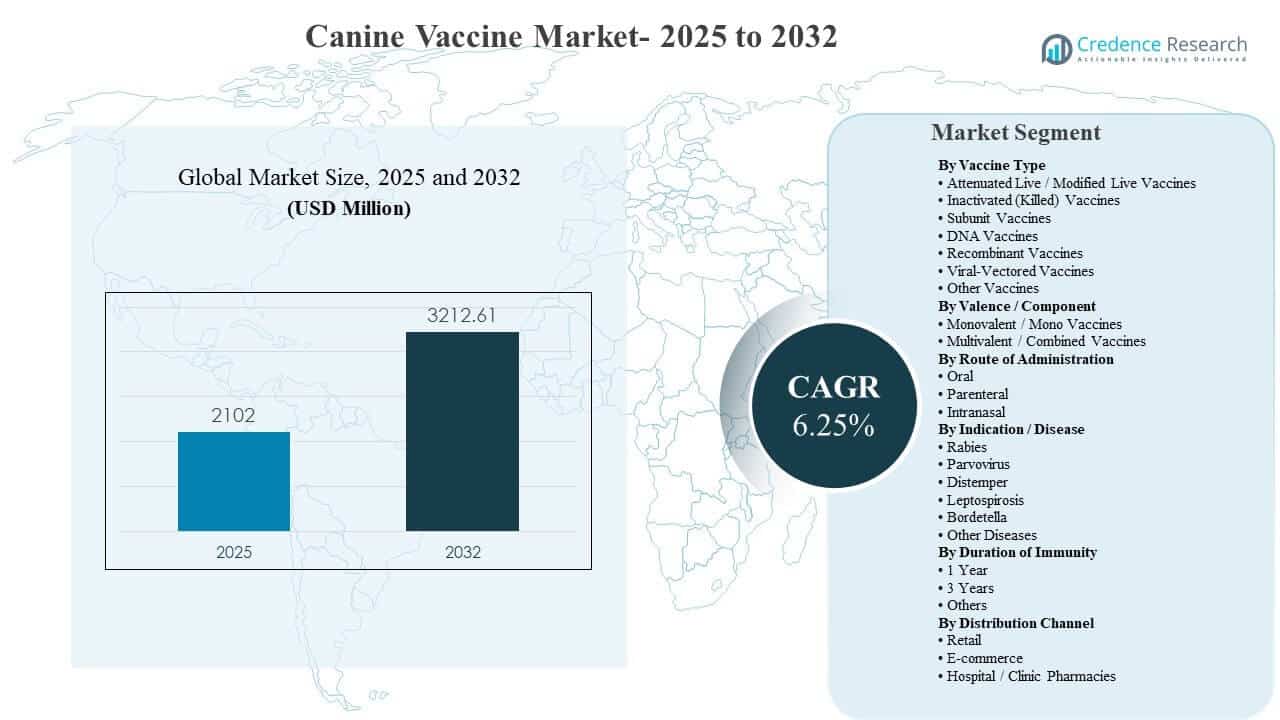
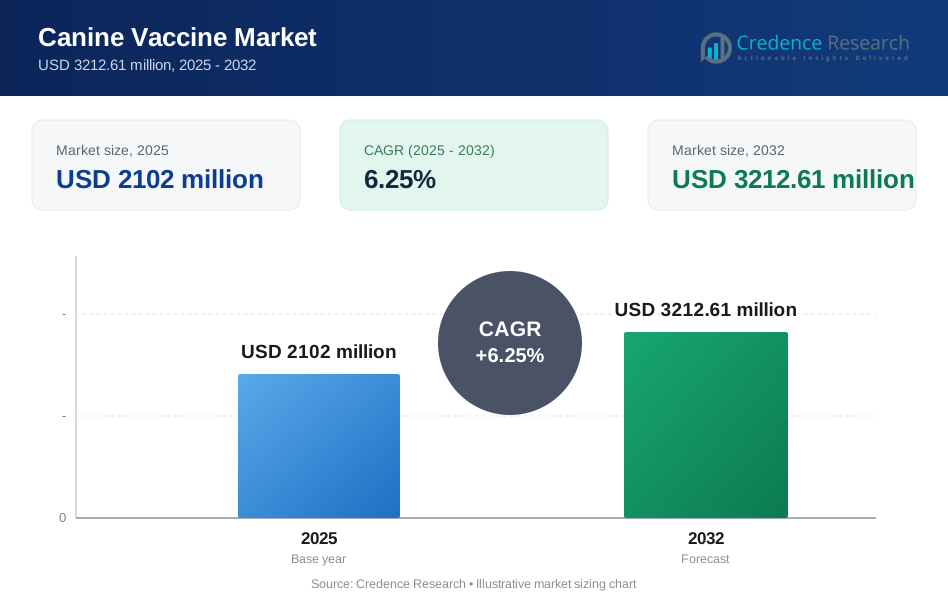
The global Canine Vaccine Market size was estimated at USD 2102 million in 2025 and is expected to reach USD 3212.61 million by 2032, growing at a CAGR of 6.25% from 2025 to 2032. Demand expansion is primarily driven by higher compliance with routine immunization schedules as veterinary clinics and pet owners prioritize prevention for core and lifestyle diseases across urban and semi-urban settings. Wider availability of combination vaccines and improving access to veterinary services across emerging economies are also strengthening annual vaccination volumes and booster adherence across the forecast period.
| REPORT ATTRIBUTE | DETAILS |
|---|---|
| Historical Period | 2020-2024 |
| Base Year | 2025 |
| Forecast Period | 2026-2032 |
| Canine Vaccine Market Size 2025 | USD 2102 million |
| Canine Vaccine Market, CAGR | 6.25% |
| Canine Vaccine Market Size 2032 | USD 3212.61 million |
Key Market Trends & Insights
- The Canine Vaccine Market is projected to expand from USD 2102 million in 2025 to USD 3212.61 million by 2032, reflecting a 6.25% CAGR during 2025–2032.
- Attenuated Live / Modified Live Vaccines accounted for the largest share of 41.6% in 2025, supported by established clinical familiarity and broad availability in routine protocols.
- Multivalent / Combined Vaccines led the valence mix with a 61.9% share in 2025, as clinics favor fewer injections per visit and standardized bundled protection.
- Parenteral administration represented 66.2% share in 2025, reflecting dominant use of injectable dosing in routine primary series and booster delivery.
- North America accounted for 42.7% of Canine Vaccine Market revenue in 2025, supported by higher preventive-care penetration and dense companion animal clinic networks.
Segment Analysis
The Canine Vaccine Market demand profile is shaped by clinic-led prevention protocols and owner preference for predictable, schedule-based protection across core diseases and lifestyle risks. Multivalent adoption supports appointment efficiency by reducing the number of injections per visit, which can improve adherence and follow-up completion for boosters. Respiratory protection is gaining emphasis in practice workflows, particularly for dogs involved in boarding, daycare, grooming, and multi-dog environments where exposure risk rises.
Route and format preferences also reflect practical administration and compliance factors. Injectable vaccination remains the routine standard for primary series programs, with intranasal formats strengthening acceptance in respiratory prevention where rapid mucosal response and handling convenience matter. Across emerging markets, growth is supported by expanding clinic footprints, improving cold-chain capabilities, and increasing awareness of preventive veterinary care among first-time dog owners.
By Vaccine Type Insights
Attenuated Live / Modified Live Vaccines accounted for the largest share of 41.6% in 2025. The Canine Vaccine Market benefits from the long-standing clinical confidence associated with established live/modified-live platforms used in routine immunization schedules. Broad product availability across core indications supports consistent procurement by clinics and hospital pharmacies. Live/modified-live options also remain embedded in protocol-based vaccination programs that prioritize reliable coverage and predictable scheduling.
By Valence / Component Insights
Multivalent / Combined Vaccines accounted for the largest share of 61.9% in 2025. The Canine Vaccine Market continues to favor combined protection formats because fewer injections per visit improves owner acceptance and supports higher protocol completion rates. Clinic workflow efficiency improves when multi-disease protection is delivered within a single appointment framework. Multivalent product portfolios also support premiumization strategies where bundled coverage aligns with preventive-care packages.
By Route of Administration Insights
Parenteral accounted for the largest share of 66.2% in 2025. The Canine Vaccine Market maintains injectable dosing as the standard approach for primary series delivery and booster scheduling within clinics. Parenteral vaccination aligns with cold-chain handling practices and recordkeeping requirements managed in veterinary settings. Injectable administration also supports consistent dosing and monitoring, which reinforces clinical preference in routine programs.
By Indication / Disease Insights
Rabies accounted for the largest share of 31.3% in 2025. The Canine Vaccine Market demand for rabies vaccination is sustained by public-health relevance and regulatory or compliance-driven requirements in many geographies. Rabies protocols are often standardized at clinic level, which supports predictable annual volumes and booster cadence. Strong awareness among owners and veterinarians reinforces continued prioritization of rabies coverage within preventive care plans.
By Duration of Immunity Insights
The Canine Vaccine Market shows clear differentiation across products labeled for 1-year and 3-year protection, with selection shaped by local guidelines, clinic protocol, and patient risk stratification. Longer-duration labeling can improve owner acceptance by reducing visit frequency where permitted by regulators. Clinic-level decisions also account for disease-specific booster recommendations and the practicality of aligning vaccination timing with wellness visits.
By Distribution Channel Insights
The Canine Vaccine Market continues to be strongly supported by hospital and clinic pharmacies because vaccination is frequently administered under veterinary supervision with cold-chain control and documentation. Retail access can contribute where national regulations allow broader dispensing, especially for boosters and preventive bundles linked to wellness programs. E-commerce is expanding in markets with developed pet pharmacy logistics and stronger online purchasing behavior, though channel growth remains dependent on compliance and storage requirements.
Canine Vaccine Market Drivers
Rising Preventive Veterinary Care Adoption
The Canine Vaccine Market is expanding as preventive care becomes a routine expectation among pet owners and veterinary providers. Higher awareness of vaccine-preventable diseases increases appointment frequency for primary series and booster schedules. Veterinary clinics also reinforce compliance through reminder systems and bundled wellness plans. Improved access to companion animal healthcare in developing urban centers further expands the addressable base for routine vaccination.
- For instance, Intervet reported that in a 39-month challenge study, 23 seronegative pups vaccinated with its multivalent Continuum DAPP at 7 and 11 weeks of age showed 100% protection against virulent CAV-1, CPV, and CDV challenge for a minimum of 3 years after the second vaccination.
Strong Demand for Combination Protection
The Canine Vaccine Market is supported by clinic preference for multivalent dosing because fewer injections can improve owner acceptance and reduce stress during visits. Combined protection aligns with standard protocols that target multiple pathogens across core and lifestyle categories. Vaccination efficiency also improves clinic throughput, supporting consistent utilization. Expanded multivalent portfolios from leading manufacturers strengthen availability across indications and patient profiles.
- For instance, Boehringer Ingelheim’s Eurican L4 targets 4 Leptospira serogroups, and the company stated that dogs can benefit from its efficacy profile as early as 2 weeks after primary vaccination; it also highlighted Australis at 13% among serogroups circulating in European dogs.
Regulatory and Public-Health Relevance of Core Indications
The Canine Vaccine Market demand is reinforced by the essential role of rabies and other core vaccines in public-health risk management. Vaccination requirements linked to travel, boarding, and municipal programs strengthen baseline demand across regions. Standardized clinic protocols also sustain predictable ordering and stock management. Public awareness campaigns and enforcement intensity can further elevate routine coverage across both owned and community dog populations.
Expanding Veterinary Infrastructure and Pet Ownership Base
The Canine Vaccine Market benefits from the expansion of veterinary hospitals, clinics, and diagnostic networks across emerging economies. Rising dog ownership and higher spending on companion animal health increase the willingness to adopt routine preventive schedules. More frequent use of daycare and boarding services also elevates vaccination compliance for respiratory and lifestyle diseases. Improving cold-chain logistics supports broader geographic distribution and consistent vaccine availability.
Canine Vaccine Market Challenges
The Canine Vaccine Market faces affordability pressure in price-sensitive regions, where owners may delay non-urgent veterinary spending and reduce adherence to booster schedules. Cost sensitivity can shift demand toward lower-priced options, tightening margins for manufacturers and distributors. Uneven clinic density and limited cold-chain capabilities in rural areas can also constrain access and inventory continuity. Vaccine hesitancy among select owner segments may require stronger clinic communication and reminder programs.
- For instance, MSD Animal Health’s Nobivac Rabies contains at least 2 IU of rabies virus per 1 ml dose, achieves an adequate serological response of at least 0.5 IU within 2 to 3 weeks after vaccination, and provides a 3-year duration of immunity in dogs, a profile that can support longer revaccination intervals where owners are highly cost sensitive.
The Canine Vaccine Market also experiences operational complexity related to storage, distribution, and regulatory compliance across countries. Product registration timelines and localized labeling rules can slow introductions of newer platforms and combinations. Supply continuity can be affected by batch release timing, procurement cycles, and inventory forecasting at clinic level. Adverse-event concerns, even when infrequent, can influence owner decision-making and increase the need for monitoring and counseling.
Canine Vaccine Market Trends and Opportunities
The Canine Vaccine Market is seeing stronger interest in next-generation vaccine technologies and platform upgrades that aim to improve immune response and administration convenience. Manufacturers are expanding respiratory disease portfolios as multi-dog environments increase exposure risk. Intranasal adoption is improving for selected indications due to handling convenience and perceived rapid onset benefits. Portfolio refresh cycles and lifecycle management strategies are increasing product differentiation in mature regions.
- For instance, Merck Animal Health’s NOBIVAC Intra-Trac 3 provides protection against three respiratory agents Bordetella bronchiseptica, canine parainfluenza virus, and canine adenovirus type 2 can be used in puppies as young as 3 weeks of age, and is administered as a 0.5 mL single-nostril intranasal dose, highlighting how administration-focused product upgrades are being used to strengthen respiratory vaccine differentiation.
The Canine Vaccine Market opportunity landscape is expanding in emerging economies where veterinary infrastructure is scaling and formal preventive-care adoption is rising. Clinic chains and organized veterinary networks create opportunities for standardized procurement and protocol-led vaccination programs. Digital reminders and subscription-like wellness plans can improve completion rates for multi-dose series and boosters. Growth in regulated e-commerce and pet pharmacy logistics can also widen access where cold-chain and compliance requirements are met.
Regional Insights
North America
North America accounted for 42.7% of Canine Vaccine Market revenue in 2025. The region benefits from strong preventive-care penetration supported by dense veterinary clinic networks and high awareness of routine vaccination schedules. Protocolized care pathways support consistent primary series completion and booster adherence. Adoption of combination vaccines is also supported by clinic workflow optimization and owner demand for convenience. Ongoing focus on respiratory protection in multi-dog settings strengthens demand for lifestyle vaccines.
Europe
Europe represented 26.1% of Canine Vaccine Market revenue in 2025. Demand is supported by established companion animal healthcare infrastructure and widespread use of standard vaccination protocols across major countries. Clinics emphasize preventive care and structured booster scheduling, which sustains steady procurement volumes. Combination vaccine utilization supports fewer injections per visit and improves compliance in routine wellness appointments. Country-level regulation and guideline differences influence product mix and duration-of-immunity preferences.
Asia Pacific
Asia Pacific accounted for 18.4% of Canine Vaccine Market revenue in 2025. Growth is supported by rising dog ownership, expanding clinic availability, and improving awareness of vaccine-preventable diseases in urban centers. Veterinary service modernization is increasing the use of protocol-driven immunization programs. Increasing use of daycare, grooming, and boarding services strengthens demand for respiratory and lifestyle protection. Supply chain expansion and better cold-chain coverage are improving product availability across more cities.
Latin America
Latin America contributed 8.9% of Canine Vaccine Market revenue in 2025. Demand patterns reflect improving preventive-care adoption alongside affordability constraints in parts of the region. Clinic expansion in major cities supports higher vaccination volumes and improved booster adherence. Public-health and municipal focus on core protection supports steady baseline demand. Distribution effectiveness and cold-chain reach remain important determinants of access outside major urban areas.
Middle East & Africa
Middle East & Africa represented 3.9% of Canine Vaccine Market revenue in 2025. Market development is supported by gradual expansion of veterinary services and rising awareness of preventive care among dog owners in urban areas. Core vaccination demand is strengthened by public-health relevance and organized programs in selected countries. Access challenges remain in markets with limited clinic density and uneven cold-chain logistics. Growth opportunities are linked to infrastructure buildout and expanding companion animal healthcare spending.
Competitive Landscape
The Canine Vaccine Market shows competitive intensity around portfolio breadth, multivalent formulation capability, cold-chain distribution reach, and clinical trust built through long-term protocol adoption. Leading companies emphasize lifecycle management through new combinations, route improvements, and coverage expansion across core and lifestyle indications. Differentiation also depends on manufacturing scale, consistent batch supply, and strong veterinary engagement across clinic networks. Strategic partnerships and regional distributors strengthen market access and improve channel coverage across developing markets.
Zoetis Inc. maintains a strong competitive position in the Canine Vaccine Market through a broad companion animal vaccine portfolio and ongoing product refinement aligned with clinic workflows. The company’s approach emphasizes protocol-fit coverage across core and lifestyle diseases, supporting high utilization in routine veterinary settings. Vaccine portfolio breadth supports cross-selling within preventive-care bundles and improves clinic procurement efficiency. Continued investment in veterinary engagement and distribution capability strengthens market reach across high-volume clinic channels.
The industry research and growth report includes detailed analyses of the competitive landscape of the market and information about key companies, including:
- Zoetis Inc.
- Boehringer Ingelheim International GmbH
- Merck Animal Health / Merck & Co., Inc.
- Ceva Santé Animale
- Vetoquinol
- Elanco Animal Health Incorporated
- Virbac
- Bioveta, a.s.
- Hester Biosciences Limited
- Brilliant Bio Pharma Limited
- Heska Corporation
- Zendal Group
Qualitative and quantitative analysis of companies has been conducted to help clients understand the wider business environment as well as the strengths and weaknesses of key industry players. Data is qualitatively analyzed to categorize companies as pure play, category-focused, industry-focused, and diversified; it is quantitatively analyzed to categorize companies as dominant, leading, strong, tentative, and weak.
Recent Developments
- In June 2024, Merck Animal Health said the USDA approved NOBIVAC NXT Canine Flu H3N2, which the company described as the first and only RNA-particle technology vaccine for canine influenza, with U.S. availability expected later that summer.
- In September 2024, Boehringer Ingelheim confirmed its acquisition of Saiba Animal Health AG, saying the deal builds on earlier development and licensing collaborations and strengthens its animal health R&D pipeline in pet therapeutics, including novel vaccine platform technology for companion animals.
- In July 2025, Elanco Animal Health said the USDA approved TruCan Ultra CIV H3N2/H3N8, a bivalent canine influenza vaccine designed to provide broad respiratory disease protection and complete the company’s Tru Portfolio vaccine line.
Report Scope
| Report Attribute | Details |
| Market size value in 2025 | USD 2102 million |
| Revenue forecast in 2032 | USD 3212.61 million |
| Growth rate (CAGR) | 6.25% (2025–2032) |
| Base year | 2025 |
| Forecast period | 2026-2032 |
| Quantitative units | USD million |
| Segments covered | By Vaccine Type Outlook: Attenuated Live / Modified Live Vaccines, Inactivated (Killed) Vaccines, Subunit Vaccines, DNA Vaccines, Recombinant Vaccines, Viral-Vectored Vaccines, Other Vaccines; By Valence / Component Outlook: Monovalent / Mono Vaccines, Multivalent / Combined Vaccines; By Route of Administration Outlook: Oral, Parenteral, Intranasal; By Indication / Disease Outlook: Rabies, Parvovirus, Distemper, Leptospirosis, Bordetella, Other Diseases; By Duration of Immunity Outlook: 1 Year, 3 Year, Others; By Distribution Channel Outlook: Retail, E-commerce, Hospital / Clinic Pharmacies |
| Regional scope | North America, Europe, Asia Pacific, Latin America, Middle East & Africa |
| Key companies profiled | Zoetis Inc.; Boehringer Ingelheim International GmbH; Merck Animal Health / Merck & Co., Inc.; Ceva Santé Animale; Vetoquinol; Elanco Animal Health Incorporated; Virbac; Bioveta, a.s.; Hester Biosciences Limited; Brilliant Bio Pharma Limited; Heska Corporation; Zendal Group |
| No.of Pages | 342 |
By Segmentation
By Vaccine Type
- Attenuated Live / Modified Live Vaccines
- Inactivated (Killed) Vaccines
- Subunit Vaccines
- DNA Vaccines
- Recombinant Vaccines
- Viral-Vectored Vaccines
- Other Vaccines
By Valence / Component
- Monovalent / Mono Vaccines
- Multivalent / Combined Vaccines
By Route Of Administration
- Oral
- Parenteral
- Intranasal
By Indication / Disease
- Rabies
- Parvovirus
- Distemper
- Leptospirosis
- Bordetella
- Other Diseases
By Duration Of Immunity
- 1 Year
- 3 Year
- Others
Distribution Channel
- Retail
- E-commerce
- Hospital / Clinic Pharmacies
By Region
- North America
- U.S.
- Canada
- Mexico
- Europe
- Germany
- France
- U.K.
- Italy
- Spain
- Rest of Europe
- Asia Pacific
- China
- Japan
- India
- South Korea
- South-east Asia
- Rest of Asia Pacific
- Latin America
- Brazil
- Argentina
- Rest of Latin America
- Middle East & Africa
- GCC Countries
- South Africa
- Rest of the Middle East and Africa
Request a Free Sample
Fill in your details and we'll send you a free sample report.
- Sample data tables & charts
- Research methodology
Need a Custom Version of This Report?
Tailor the scope, geography, or segments to your exact requirements.
- Custom geography or segment scope
- Direct access to our analyst team
Frequently Asked Questions
What is the current size and forecast size of the Canine Vaccine Market?
What is the CAGR for the Canine Vaccine Market during 2025–2032?
Which segment is the largest in the Canine Vaccine Market?
What factors are driving growth in the Canine Vaccine Market?
Who are the leading companies in the Canine Vaccine Market?
Which region leads the Canine Vaccine Market?
Table of Content
Chapter 1. Report Introduction
- 1.1 Report Description & Purpose
- 1.1.1 Report Title & Market Definition
- 1.1.2 Unique Selling Propositions (USP) & Key Differentiators
- 1.1.3 Value Proposition for Stakeholders
- 1.2 Research Objectives
- 1.2.1 Market Sizing Objectives (Volume & Revenue)
- 1.2.2 Segmentation Objectives
- 1.2.3 Competitive Intelligence Objectives
- 1.2.4 Forecast & Scenario Objectives
- 1.3 Report Scope
- 1.3.1 Canine Vaccine Scope – Types & Subtypes Covered
- 1.3.2 Geographic Scope – Regions & Countries Covered
- 1.3.3 Historical Period, Base Year & Forecast Period (2025; forecast to 2032)
- 1.3.4 Inclusions & Exclusions
- 1.4 HS Code & Classification Framework
- 1.5 Currency, Units & Pricing Basis
- 1.6 Target Stakeholders
- 1.7 Limitations & Assumptions
Chapter 2. Executive Summary
- 2.1 Global Canine Vaccine Market Snapshot
- 2.1.1 Market Size – Historical (2025) & Forecast (2025-2032) (2025: USD 2102 million → 2032: USD 3212.61 million)
- 2.1.2 Volume & Revenue – Global Totals
- 2.1.3 Key Market Highlights – Top Five Facts
- 2.2 Canine Vaccine Market Segmentation Snapshot
- 2.2.1 Market Split by Region – 2025 vs. 2032
- 2.3 Competitive Snapshot
- 2.3.1 Top 10 Players by Revenue Share – 2025
- 2.3.2 Top 10 Players by Volume Share – 2025
- 2.3.3 Recent Strategic Developments (18-Month Summary)
- 2.4 Key Investment Highlights & Strategic Conclusions
Chapter 3. Canine Vaccine Market Dynamics & Industry Analysis
- 3.1 Market Overview & Context
- 3.1.1 Canine Vaccine Market Position in the Broader Automotive Value Chain
- 3.1.2 OEM vs. Replacement Market Dynamics
- 3.1.3 Market Maturity & Development Stage by Region
- 3.2 Canine Vaccine Market Drivers
- 3.3 Canine Vaccine Market Restraints & Challenges
- 3.4 Canine Vaccine Market Opportunities
- 3.5 Porter's Five Forces Analysis
- 3.5.1 Threat of New Entrants
- 3.5.2 Bargaining Power of Suppliers
- 3.5.3 Bargaining Power of Buyers
- 3.5.4 Threat of Substitutes
- 3.5.5 Competitive Rivalry – Intensity Assessment
- 3.6 Canine Vaccine Value Chain Analysis
- 3.6.1 Upstream – Raw Material/Input Suppliers
- 3.6.1.1 Raw Material/Input 1
- 3.6.1.2 Raw Material/Input 2
- 3.6.1.3 Raw Material/Input 3
- 3.6.2 Midstream – Production/Manufacturing/Service Delivery
- 3.6.2.1 Production/Process Overview
- 3.6.2.2 Key Facility Locations & Capacity by Manufacturer
- 3.6.3 Downstream – Distribution & End Consumer
- 3.6.3.1 Primary Channel – B2B/OEM
- 3.6.3.2 Secondary Channels – Dealer, Retail, Online, Direct
- 3.6.4 Value Chain Profitability Analysis
- 3.6.1 Upstream – Raw Material/Input Suppliers
- 3.7 PESTEL Analysis
- 3.7.1 Political Factors
- 3.7.2 Economic Factors
- 3.7.3 Social Factors
- 3.7.4 Technological Factors
- 3.7.5 Environmental Factors
- 3.7.6 Legal Factors
- 3.8 Canine Vaccine Supply Chain Analysis
- 3.8.1 Raw Material/Input Supply Risk Assessment
- 3.8.2 Manufacturing Concentration Risk (Geographic Exposure)
- 3.8.3 Trade Disruption Impact Analysis
- 3.9 Regulatory & Policy Landscape
Note: The regulatory and policy landscape section covers regulations based on their applicability to the market, Canine Vaccine category, geography, and scope of the study. Only regulatory frameworks with a material impact on operations, compliance, trade, sustainability, or market access are analyzed in detail.
Chapter 4. Key Investment Pockets & Opportunity Analysis
- 4.1 Canine Vaccine Market Attractiveness Analysis
- 4.1.1 By Region – Investment Attractiveness Matrix (Volume × CAGR)
- 4.2 Absolute Revenue Growth Opportunity
- 4.2.1 By Region – Absolute USD Growth Through 2032
- 4.3 Incremental Volume Opportunity
- 4.3.1 By Region – Incremental Volume Through 2032
- 4.3.2 Segment – Incremental Volume
- 4.4 Emerging Submarket Opportunity Deep Dive (Subject to Applicability)
- 4.5 Emerging Market Opportunity Scorecards
- 4.5.1 United States
- 4.5.2 Europe
- 4.5.3 Asia
- 4.5.4 Middle East & Africa
Note: Emerging Market Opportunity Scorecards will be included based on relevance and strategic importance. Regions listed are indicative and may vary depending on data availability and market dynamics.
Chapter 5. Canine Vaccine Import-Export Analysis & Trade Flows
- 5.1 Global Trade Overview
- 5.1.1 Global Export Value by Country (2025)
- 5.1.2 Global Export Volume by Country (2025)
- 5.1.3 Global Import Value by Country (2025)
- 5.1.4 Global Import Volume by Country (2025)
- 5.1.5 Net Trade Balance by Country (2025)
- 5.2 Export Analysis – Segment
- 5.2.1 Type 1 (HS Code)
- 5.2.2 Type 2 (HS Code)
- 5.2.3 Type 3 (HS Code)
- 5.2.4 Type 4 (HS Code)
- 5.2.5 Type 5 (HS Code)
- 5.3 Import Analysis – Segment
- 5.3.1 Type 1 (HS Code)
- 5.3.2 Type 2 (HS Code)
- 5.3.3 Type 3 (HS Code)
- 5.3.4 Type 4 (HS Code)
- 5.3.5 Type 5 (HS Code)
- 5.4 Average Unit Trade Prices
- 5.4.1 Average Export Price – Segment & Country
- 5.4.2 Average Import Price – Segment & Source Country
- 5.4.3 Price Trends (2025)
- 5.5 Key Trade Route Analysis
- 5.5.1 Trade Route 1
- 5.5.2 Trade Route 2
- 5.5.3 Trade Route 3
- 5.5.4 Trade Route 4
- 5.5.5 Trade Route 5
- 5.6 Trade Policy Impact Assessment
- 5.6.1 US Anti-Dumping & Section 301 Tariffs
- 5.6.2 EU Customs Union Impact
- 5.6.3 Major Free Trade Agreements
- 5.6.4 USMCA Rules of Origin
Note: Trade policy analysis will be included only where relevant to the Canine Vaccine market.
Chapter 6. Competitive Landscape & Company Benchmarking
- 6.1 Canine Vaccine Market Concentration & Structure
- 6.1.1 Herfindahl-Hirschman Index (HHI) – vs. 2025
- 6.1.2 Tier 1, Tier 2 & Tier 3 Market Structure
- 6.1.3 Global, Regional & Local Player Dynamics
- 6.2 Canine Vaccine Market Share Analysis – 2025
- 6.2.1 Global Revenue Share by Company
- 6.2.2 Global Volume Share by Company
- 6.2.3 Regional Revenue Share
- 6.2.4 Market Share Evolution ( vs. 2025)
- 6.2.5 OEM Segment Share by Company
- 6.2.6 Replacement Segment Share by Company
- 6.3 Production/Delivery Capacity & Facility Analysis
- 6.3.1 Global Installed Capacity
- 6.3.2 Capacity Utilization Rates
- 6.3.3 Production/Output Volume
- 6.3.4 Facility Locations & Capacity Map
- 6.3.5 Planned Capacity Additions
- 6.4 Canine Vaccine Competitive Benchmarking Matrix
- 6.4.1 Revenue, Volume, CAGR & Profitability Comparison
- 6.4.2 Channel Revenue Mix
- 6.4.3 Geographic Revenue Exposure
- 6.4.4 R&D Intensity
- 6.4.5 Sustainability Maturity
- 6.5 Strategic Developments in Canine Vaccine (Last 24 Months)
- 6.5.1 Mergers, Acquisitions & Divestments
- 6.5.2 New Canine Vaccine Launches
- 6.5.3 Facility Expansions
- 6.5.4 Strategic Alliances, Joint Ventures & Partnerships
- 6.5.5 Distribution Expansion & Market Entry
- 6.5.6 Sustainability & ESG Initiatives
- 6.6 Competitive Strategy Mapping
- 6.6.1 Leader, Challenger, Follower & Niche Classification
- 6.6.2 Pricing Strategy Comparison
- 6.6.3 Channel Strategy Matrix
Note: Strategic developments are included based on their materiality and the availability of reliable information.
Chapter 7. Global Canine Vaccine Market – By Distribution Channel
- 7.1 Segment Overview
- 7.1.1 Volume & Revenue Split by Channel (2025 & 2032)
- 7.1.2 Channel Mix Evolution (2025-2032)
Chapter 8. Regional Market Analysis – Global Overview
- 8.1 Global Regional Overview
- 8.1.1 Regional Volume Share
- 8.1.2 Regional Revenue Share
- 8.1.3 Regional Volume by Region
- 8.1.4 Regional Revenue by Region
- 8.1.5 Regional Forecast Through 2032
- 8.2 Cross-Regional Segment Analysis
- 8.2.1 By Distribution Channel
- 8.2.2 By Brand/Price Tier
Chapter 9. North America Canine Vaccine Market
- 9.1 United States
- 9.2 Canada
- 9.3 Mexico
Chapter 10. Europe Canine Vaccine Market
- 10.1 Germany
- 10.2 France
- 10.3 Italy
- 10.4 United Kingdom
- 10.5 Spain
- 10.6 Poland
- 10.7 Russia
- 10.8 Netherlands
- 10.9 Belgium
- 10.10 Sweden
- 10.11 Denmark
- 10.12 Norway
- 10.13 Rest of Europe
Chapter 11. Asia Pacific Canine Vaccine Market
- 11.1 China
- 11.2 India
- 11.3 Japan
- 11.4 South Korea
- 11.5 Thailand
- 11.6 Indonesia
- 11.7 Vietnam
- 11.8 Malaysia
- 11.9 Australia
- 11.10 Rest of Asia Pacific
Chapter 12. Latin America Canine Vaccine Market
- 12.1 Brazil
- 12.2 Argentina
- 12.3 Colombia
- 12.4 Chile
- 12.5 Rest of Latin America
Chapter 13. Middle East Canine Vaccine Market
- 13.1 Saudi Arabia
- 13.2 United Arab Emirates
- 13.3 Turkey
- 13.4 Israel
- 13.5 Iran
- 13.6 Rest of the Middle East
Chapter 14. Africa Canine Vaccine Market
- 14.1 South Africa
- 14.2 Egypt
- 14.3 Nigeria
- 14.4 Morocco
- 14.5 Rest of Africa
Chapter 15. Canine Vaccine Company Profiles
- 15.1 [Company 01]
- 15.1.1 Company Overview
- 15.1.2 Key Management Personnel
- 15.1.3 Products & Services Portfolio
- 15.1.4 Financial Performance
- 15.1.5 Key Market Focus & Geographic Presence
- 15.1.6 Recent Developments & Strategic Initiatives
Note: The company profile list is preliminary and may change based on research findings, market developments, data availability, and client requirements.
Chapter 16. Appendices
- Appendix A – List of Abbreviations & Acronyms
- Appendix B – Industry Classification Code Reference – Full Series
- Appendix C – Production & Capacity Data Tables
- Appendix D – End-Use & Demand Base Tables
- Appendix E – Consumption & Replacement Rate Assumptions
- Appendix F – ASP Reference Tables
- Appendix G – Manufacturing & Facility Database
- Appendix H – Import-Export Data Tables
- Appendix I – Regulatory Summary Tables
- Appendix J – Primary Research Participant List (Anonymized)
- Appendix K – Primary Research Questionnaire Framework
- Appendix L – Data Sources & Bibliography
- Appendix M – Market Size Divergence & Source Comparison
Chapter 17. Research Methodology
- 17.1 Research Framework & Philosophy
- 17.2 Secondary Research – Sources, Hierarchy & Data Extraction
- 17.3 Data Modeling – Bottom-Up & Top-Down Market Sizing
- 17.4 Primary Research – Stakeholder Framework, LOI & Sample Sizes
- 17.5 Forecast Methodology – Regression, Scenario & Sensitivity Analysis
- 17.6 Quality Control – Four-Layer Validation Framework
- 17.7 Limitations & Standard Assumptions
- 17.8 Disclaimer
