
Market Overview:
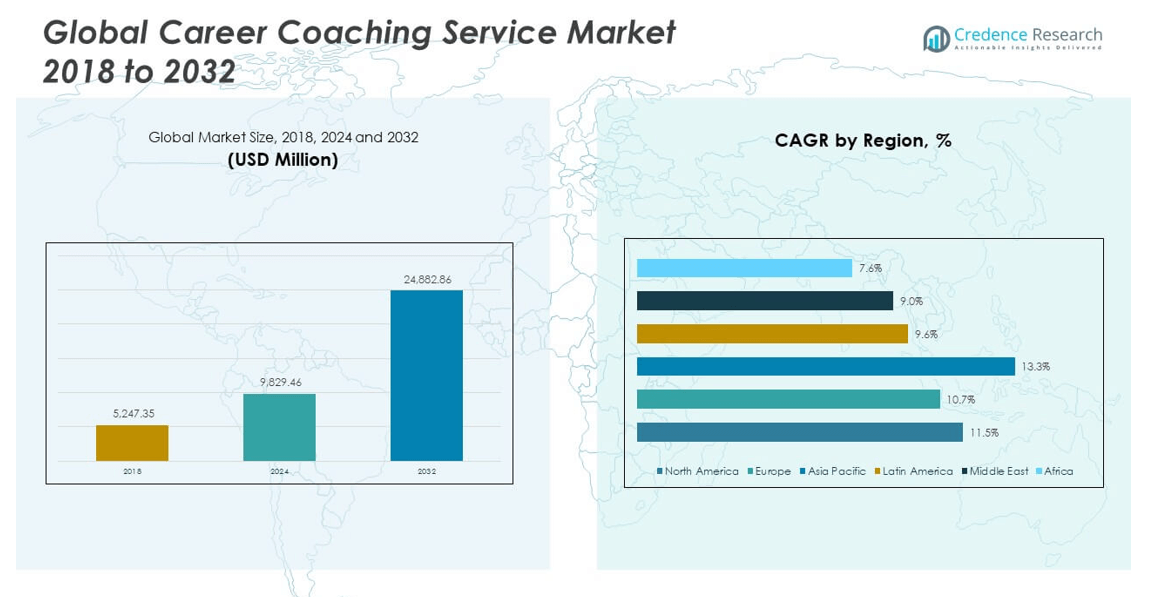
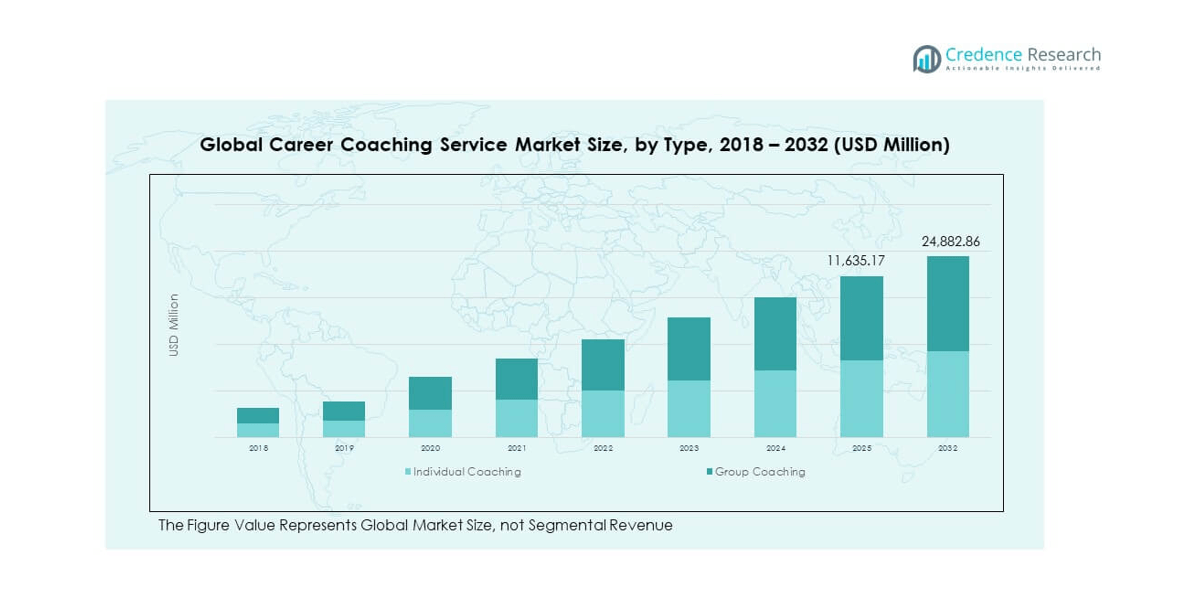
The Global Career Coaching Service Market size was valued at USD 5,247.35 million in 2018 to USD 9,829.46 million in 2024 and is anticipated to reach USD 24,882.86 million by 2032, at a CAGR of 11.47% during the forecast period.
| REPORT ATTRIBUTE | DETAILS |
|---|---|
| Historical Period | 2020-2023 |
| Base Year | 2024 |
| Forecast Period | 2025-2032 |
| Career Coaching Service Market Size 2024 | USD 9,829.46 million |
| Career Coaching Service Market, CAGR | 11.47% |
| Career Coaching Service Market Size 2032 | USD 24,882.86 million |
The market is witnessing significant growth due to increasing demand for personalized career development strategies, rising competition in the job market, and evolving employment trends driven by digital transformation. Professionals and students are increasingly seeking expert guidance to navigate career transitions, upskill for future roles, and align their goals with industry demands. The adoption of virtual coaching platforms and AI-driven career tools is further expanding accessibility and engagement. Moreover, organizations are investing in coaching services to improve employee retention, enhance leadership capabilities, and support workforce planning in a rapidly shifting global employment landscape.
North America currently leads the Career Coaching Service Market, driven by a mature corporate training ecosystem, high awareness levels, and widespread use of digital coaching platforms. Europe follows closely, particularly in countries emphasizing lifelong learning and workforce reskilling. Meanwhile, the Asia-Pacific region is emerging as a high-growth market, supported by a large working-age population, expanding professional services sector, and increasing educational attainment. Countries like India, China, and Australia are witnessing growing adoption due to rising career aspirations, globalization of workforces, and enhanced focus on employability.
Market Insights:
- The Global Career Coaching Service Market was valued at USD 9,829.46 million in 2024 and is projected to reach USD 24,882.86 million by 2032, growing at a CAGR of 11.47%.
- Rising workforce mobility and frequent career transitions are fueling demand for structured, personalized coaching services across industries.
- Increasing corporate investment in leadership development and succession planning is expanding the market's enterprise segment.
- Integration of virtual platforms and AI tools is enhancing accessibility, user engagement, and service personalization.
- High service costs and lack of standardization in coach certification remain key restraints limiting adoption in cost-sensitive regions.
- North America dominates the Global Career Coaching Service Market due to a strong corporate ecosystem and early technology adoption.
- The Asia Pacific region is witnessing the fastest growth, supported by a large working-age population, urbanization, and increased focus on career development.
Market Drivers:
Rising Workforce Mobility and Career Transitions Across Diverse Sectors
The growing frequency of job transitions and career shifts is driving the demand for structured career guidance. Professionals are changing roles more often due to shifting industry demands and evolving job roles. Career coaching services provide clarity and direction, making transitions smoother and more strategic. The Global Career Coaching Service Market benefits from this trend as individuals seek personalized support to evaluate new opportunities. It helps clients align personal goals with market realities and long-term career growth. Remote work and gig economy models also push professionals to redefine their career paths. Organizations are encouraging employees to pursue coaching during internal role changes. This pattern sustains the need for flexible, cross-functional coaching models.
Increasing Pressure on Students and Graduates to Optimize Employability
Higher education graduates face intense competition and unclear career paths, increasing demand for career coaching at an early stage. Institutions are integrating coaching services to boost graduate outcomes and employability rankings. Students rely on expert advice to choose degrees aligned with market needs. The Global Career Coaching Service Market is expanding with the growing emphasis on career readiness from high school onward. Coaching helps students develop soft skills, interview techniques, and personal branding. Parents and institutions invest in these services to ensure return on educational investments. Coaching bridges the gap between academic learning and market expectations. It strengthens student confidence and decision-making skills.
- For example, Kaplan’s Career Core, launched with Purdue University in 2023, delivered career coaching services to over 13,000 students, with 92% reporting improved clarity in career path selection after leveraging its proprietary Career Navigation Analytics.
Corporate Investment in Leadership Development and Employee Retention
Companies recognize coaching as a strategic tool to develop leadership and retain high-potential talent. Structured programs help employees overcome performance plateaus and prepare for leadership roles. The Global Career Coaching Service Market is supported by HR departments adopting coaching to improve succession planning and workplace satisfaction. Coaching increases engagement, reduces turnover, and builds internal capabilities. It aligns individual aspirations with organizational goals, creating a motivated workforce. Large enterprises now allocate specific budgets for external coaching providers. Coaching also supports diversity and inclusion by addressing unique employee challenges. It promotes a culture of continuous learning and career ownership.
Technological Integration Expanding Coaching Access and Personalization
Digital platforms and AI tools are transforming how coaching is delivered and consumed. Virtual sessions enable global access and convenience for busy professionals. The Global Career Coaching Service Market leverages technology to offer customized assessments, chatbots, and performance tracking. It enables coaches to monitor progress and deliver insights in real-time. Gamification and e-learning integration boost engagement and retention. Subscription-based platforms make services more affordable and scalable. Technology enables data-driven coaching, helping clients visualize growth paths. It also supports multilingual access, expanding reach in emerging regions.
- For instance, CoachHub launched AIMY™, an AI-powered coaching platform designed to deliver personalized coaching experiences across more than 90 countries and 80 languages, using behavioral science and advanced AI to enhance accessibility and scalability of coaching services.
Market Trends:
Expansion of Niche Coaching Services for Specific Career Segments
Service providers are specializing in coaching for targeted professions, such as tech, finance, healthcare, and creative industries. These niche services address industry-specific challenges and growth paths. Clients value tailored insights that align with job roles and sector expectations. The Global Career Coaching Service Market is shifting toward deeper specialization to match workforce diversity. It creates opportunities for certified coaches with domain expertise. Organizations prefer sector-specific coaches for role-based development. Niche platforms also attract users seeking expert-led guidance in their field. This trend supports premium pricing and differentiated offerings.
- For instance, BetterUp introduced “BetterUp Grow” in January 2025 a coaching platform blending machine learning, behavioral science, and expert human support to deliver real‑time, tailored guidance across entire organizations. Early user feedback showed 95% satisfaction with the AI coaching experience and a 16% boost in workplace confidence.
Growing Use of Data Analytics for Career Planning and Progress Tracking
Career coaching now includes detailed analytics to help clients map goals and benchmark progress. Tools track skill acquisition, job fit, and professional growth metrics. The Global Career Coaching Service Market is integrating these insights to support more measurable outcomes. Clients engage more when they can visualize development milestones. Analytics also support ROI measurement for corporate clients. Coaches use dashboards to adjust plans based on real-time feedback. These tools build accountability and transparency in the coaching journey. The trend enhances service value and client satisfaction.
Rise of Group Coaching Models in Corporate and Educational Settings
Group coaching formats are gaining traction for their collaborative learning benefits and cost efficiency. Institutions and companies use this model to scale development programs across teams. The Global Career Coaching Service Market sees increased adoption of peer-based sessions that build community and shared insights. These sessions encourage participants to learn from diverse experiences. Group dynamics often accelerate progress and motivate accountability. Online group models reduce delivery costs while increasing impact. Coaches can address common challenges in a single session. This format also supports inclusion and fosters team alignment.
Increasing Globalization of Coaching Standards and Certifications
International standards are evolving to ensure quality and consistency in coaching services. Certification bodies like ICF and EMCC are expanding their presence and membership. The Global Career Coaching Service Market reflects this shift, with clients seeking credentialed professionals. Certified coaches gain more credibility and access to high-value opportunities. Standardization improves client trust and enables cross-border service delivery. Global companies require uniform coaching protocols across locations. These developments support regulatory alignment and industry recognition. Certification also creates a benchmark for emerging market providers.
- For instance, according to the ICF’s 2023 Global Coaching Study, the worldwide number of coach practitioners exceeded 109,200 in 2022 marking a 54% increase from 2019-while total coaching industry revenue reached approximately USD 4.564 billion, highlighting substantial growth and demand for credentialed coaching professionals worldwide.
Market Challenges Analysis:
Lack of Standardization and Oversight in Coaching Credentials and Quality
The Global Career Coaching Service Market faces fragmentation due to varying coaching methodologies and credentialing standards. Clients often struggle to assess coach quality without universal benchmarks. Unregulated service offerings dilute the perceived value of coaching. Some providers lack formal training, creating inconsistency in outcomes. This issue limits client trust, especially in price-sensitive segments. Differentiating qualified coaches from informal consultants becomes difficult. Organizations hesitate to scale programs without clear quality assurance mechanisms. Market growth depends on stronger governance and verified certification systems.
Affordability and Accessibility Gaps in Underserved Regions and Segments
High costs limit coaching adoption in low- and middle-income populations. Many individuals and students cannot access professional guidance due to pricing or digital barriers. The Global Career Coaching Service Market encounters adoption challenges in regions lacking broadband infrastructure or awareness. Language and cultural differences also hinder standardized delivery. Limited local expertise in emerging economies restricts penetration. Without subsidies or institutional support, these gaps persist. Scaling inclusive models remains a challenge for global service providers. Market leaders must innovate to serve cost-sensitive segments.
Market Opportunities:
Rising Demand for Coaching Services in Emerging Economies and Tier-2 Cities
Urbanization, educational advancement, and increasing aspirations in emerging regions open new frontiers for service expansion. The Global Career Coaching Service Market can grow by offering localized solutions in native languages. Regional partnerships and mobile-based platforms can improve accessibility. Institutions in developing economies seek structured career support for students. Local demand creates room for certified coaches to scale operations.
Strategic Collaborations Between EdTech and Coaching Platforms for Hybrid Offerings
Education technology firms are partnering with coaching service providers to build end-to-end career enablement ecosystems. These partnerships blend learning content with personalized guidance. Clients benefit from an integrated approach to skill development and career planning. The Global Career Coaching Service Market can capitalize on these hybrid models to boost engagement and retention. Institutions and enterprises prefer bundled solutions.
Market Segmentation Analysis:
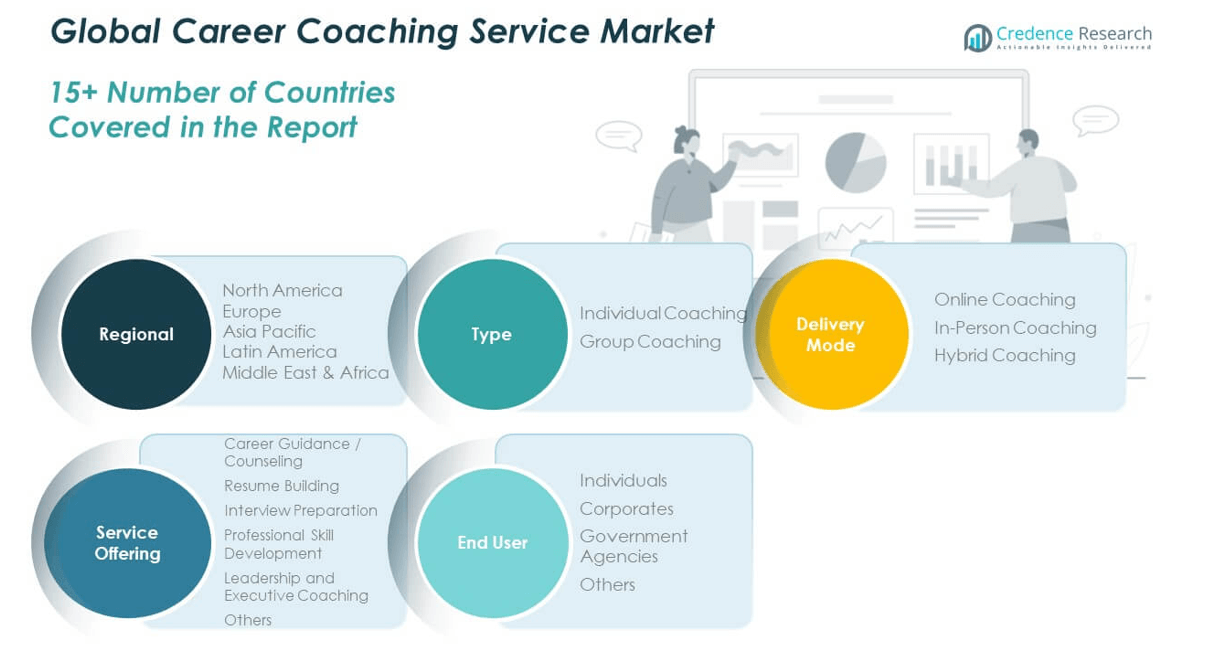
The Global Career Coaching Service Market is segmented by type, delivery mode, service offering, and end user, each contributing to the market’s expansion across diverse applications.
By type, individual coaching dominates due to the rising demand for personalized guidance, especially among professionals undergoing career transitions. Group coaching is gaining traction in corporate and educational settings where collaborative learning offers cost efficiency and shared insights.
By delivery mode, online coaching leads due to its accessibility, scalability, and ability to serve remote clients. In-person coaching continues to appeal to executive-level clients seeking one-on-one engagement, while hybrid coaching models are emerging as flexible solutions for varied client preferences.
- Heidrick & Struggles, a leading global leadership advisory firm, has documented demand for in-person coaching at the executive level. Their 2023 Leadership Consulting review notes that top-tier clients particularly in the C-suite continue to request face-to-face sessions for confidential, high-impact executive coaching.
By service offering, career guidance and counseling form the foundation of most programs, while resume building and interview preparation remain key services for job seekers. Professional skill development and leadership coaching are critical for employee upskilling and succession planning.
By end user, individuals form the largest segment, followed by corporates investing in workforce development. Government agencies adopt coaching services for employment support and workforce planning. Others, including NGOs and academic institutions, represent a growing user base as career readiness becomes a priority. The Global Career Coaching Service Market continues to expand across these segments due to rising awareness and a shift toward lifelong career support.
- For example, in the United States, the Department of Labor’s Employment and Training Administration funded the CareerOneStop coaching initiative, which provided career coaching and skills training resources to more than 2.5 million job seekers in 2023, reflecting substantial government adoption.
Segmentation:
By Type
- Individual Coaching
- Group Coaching
By Delivery Mode
- Online Coaching
- In-Person Coaching
- Hybrid Coaching
By Service Offering
- Career Guidance / Counseling
- Resume Building
- Interview Preparation
- Professional Skill Development
- Leadership and Executive Coaching
- Others
By End User
- Individuals
- Corporates
- Government Agencies
- Others
By Region
- North America
- U.S.
- Canada
- Mexico
- Europe
- Germany
- France
- U.K.
- Italy
- Spain
- Rest of Europe
- Asia Pacific
- China
- Japan
- India
- South Korea
- South-east Asia
- Rest of Asia Pacific
- Latin America
- Brazil
- Argentina
- Rest of Latin America
- Middle East & Africa
- GCC Countries
- South Africa
- Rest of the Middle East and Africa
Regional Analysis:
North America
The North America Global Career Coaching Service Market size was valued at USD 2,294.88 million in 2018 to USD 4,254.24 million in 2024 and is anticipated to reach USD 10,799.28 million by 2032, at a CAGR of 11.5% during the forecast period. North America accounted for 43.28% of the global market share in 2024. It remains the largest regional market, supported by a well-developed corporate sector and high levels of awareness around career development services. Employers actively invest in coaching for leadership development, succession planning, and employee retention. The region benefits from advanced digital infrastructure that enables virtual coaching solutions across geographies. Universities and business schools integrate coaching into their career services, boosting early adoption among students. High-income levels and widespread acceptance of coaching as a professional tool further support market expansion. Key players operate from the U.S., driving innovation and setting industry benchmarks. The region continues to attract premium coaching providers catering to executives and skilled professionals.
Europe
The Europe Global Career Coaching Service Market size was valued at USD 1,592.89 million in 2018 to USD 2,883.30 million in 2024 and is anticipated to reach USD 6,900.83 million by 2032, at a CAGR of 10.7% during the forecast period. Europe held 29.34% of the global market share in 2024. The market benefits from policy-led initiatives emphasizing reskilling and lifelong learning across EU member states. Government-backed employment programs often integrate coaching to aid job seekers and those undergoing career transitions. The corporate sector uses coaching to improve organizational culture and drive diversity. Europe sees strong demand from mid-career professionals and those impacted by automation. Germany, the UK, and France lead in adoption due to mature labor markets. The region also supports a regulated coaching environment, encouraging certification and ethics in service delivery. Online platforms are gaining traction in urban and semi-urban regions. Multilingual services help penetrate diverse linguistic markets across Europe.
Asia Pacific
The Asia Pacific Global Career Coaching Service Market size was valued at USD 925.89 million in 2018 to USD 1,893.01 million in 2024 and is anticipated to reach USD 5,479.83 million by 2032, at a CAGR of 13.3% during the forecast period. Asia Pacific captured 19.25% of the global market share in 2024. It represents the fastest-growing region, fueled by a large working-age population and increasing professional aspirations. Countries such as India, China, Japan, and Australia are investing in coaching to enhance workforce productivity. Growing demand for career clarity among graduates and early professionals supports strong institutional adoption. The corporate sector is also incorporating coaching into employee development programs. Mobile-first platforms and AI-driven services help providers scale rapidly in cost-sensitive markets. Educational institutions integrate coaching for better placement outcomes. Urban centers act as hubs for premium coaching services targeting the competitive exam and corporate employment segments.
Latin America
The Latin America Global Career Coaching Service Market size was valued at USD 223.33 million in 2018 to USD 412.57 million in 2024 and is anticipated to reach USD 911.03 million by 2032, at a CAGR of 9.6% during the forecast period. Latin America represented 4.20% of the global market share in 2024. The region is witnessing growing adoption among youth and mid-career professionals seeking stable career trajectories. Brazil and Mexico are the leading contributors, with rising investments in professional development tools. The startup ecosystem is promoting digital coaching platforms to support entrepreneurial skill-building. Economic uncertainties in the region push individuals to seek structured career support. Government and nonprofit employment initiatives also include career counseling services. Universities and vocational centers are key enablers of early-stage coaching adoption. However, affordability remains a barrier in certain markets. The region shows potential for hybrid models combining tech platforms with human coaching support.
Middle East
The Middle East Global Career Coaching Service Market size was valued at USD 143.49 million in 2018 to USD 245.13 million in 2024 and is anticipated to reach USD 521.01 million by 2032, at a CAGR of 9.0% during the forecast period. The Middle East held 2.49% of the global market share in 2024. Career coaching demand in the region is driven by national workforce localization strategies such as Saudization and Emiratization. Public and private institutions collaborate to equip citizens with employability skills through personalized guidance. Corporate players use coaching to identify leadership pipelines and build future-ready talent. The region experiences a strong push toward digital literacy and entrepreneurial development. UAE, Saudi Arabia, and Qatar lead regional adoption, supported by favorable government policies. Career transitions among expatriates also contribute to market demand. The rise of women in the workforce brings additional interest in targeted coaching services. Digital coaching models are gaining acceptance due to convenience and access.
Africa
The Africa Global Career Coaching Service Market size was valued at USD 66.88 million in 2018 to USD 141.21 million in 2024 and is anticipated to reach USD 270.88 million by 2032, at a CAGR of 7.6% during the forecast period. Africa accounted for 1.44% of the global market share in 2024. The region is at an early stage of market development, with adoption centered in urban areas. Youth unemployment and skill mismatches remain critical challenges. Coaching is slowly gaining traction through NGO-led and education-focused initiatives. South Africa, Nigeria, and Kenya are leading adoption due to stronger educational ecosystems and startup cultures. Awareness campaigns and partnerships with global coaching bodies are building service credibility. The focus is on career readiness, employability, and small business development. Mobile technology plays a key role in expanding reach to underserved populations. Coaching demand is expected to grow with rising internet penetration and regional workforce development goals.
Key Player Analysis:
- IGotAnOffer
- Career Contessa
- FindMyProfession
- Intoo USA (Gi Group Holdings)
- Torch
- The Muse
- Mentor Cruise
- CloseCohen
- BetterUp
- Pathrise
Competitive Analysis:
The Global Career Coaching Service Market is characterized by a mix of established firms, boutique agencies, and tech-enabled startups competing to deliver personalized career solutions. Leading players focus on executive coaching, leadership development, and digital integration to strengthen their market presence. Key companies such as Korn Ferry, Randstad RiseSmart, Lee Hecht Harrison, and Right Management continue to expand their service portfolios through partnerships, acquisitions, and platform innovations. It benefits from low entry barriers, which attract new entrants offering niche and cost-effective coaching models. The market remains fragmented, with regional players holding significant influence in Asia-Pacific and Latin America. Technology-driven platforms enhance scalability and reach, increasing competition across pricing and delivery formats. Players invest in AI, data analytics, and content curation to improve client outcomes and engagement. Certification and coach credentials remain key differentiators in client acquisition strategies.
Recent Developments:
- In January 2025, BetterUp launched a powerful new AI coaching solution branded BetterUp Grow. The platform blends machine learning, behavioral science, and human coaching to deliver personalized, on-demand guidance to employees at scale. Early users reported 95% satisfaction with the AI coaching features and a 16% increase in workplace confidence.
Market Concentration & Characteristics:
The Global Career Coaching Service Market exhibits moderate concentration, with several global firms dominating the enterprise segment while regional and specialized players thrive in consumer-focused domains. It demonstrates strong fragmentation in developing regions due to local language needs and pricing sensitivities. The market relies heavily on human capital, experience-based delivery, and personal branding. Technology adoption is reshaping service accessibility, allowing scalable solutions for both individuals and businesses. Demand spans diverse sectors, with coaching becoming essential for workforce development, transitions, and retention strategies. The market favors flexible formats such as virtual sessions, app-based tracking, and group coaching models. Professional certifications and affiliations impact brand reputation and client trust. Growth continues to be driven by a mix of innovation, specialization, and global expansion.
Report Coverage:
The research report offers an in-depth analysis based on type, delivery mode, service offering, and end user. It details leading market players, providing an overview of their business, product offerings, investments, revenue streams, and key applications. Additionally, the report includes insights into the competitive environment, SWOT analysis, current market trends, as well as the primary drivers and constraints. Furthermore, it discusses various factors that have driven market expansion in recent years. The report also explores market dynamics, regulatory scenarios, and technological advancements that are shaping the industry. It assesses the impact of external factors and global economic changes on market growth. Lastly, it provides strategic recommendations for new entrants and established companies to navigate the complexities of the market.
Future Outlook:
- The market will experience growing demand from mid-career professionals seeking skill realignment and leadership roles.
- Integration of AI and machine learning will enhance personalization and progress tracking in coaching platforms.
- Corporate spending on coaching services will rise to support succession planning and talent retention.
- Educational institutions will increasingly adopt career coaching to improve graduate employability outcomes.
- Virtual coaching models will dominate due to flexibility, scalability, and cross-border access.
- Certified coaching programs will become more important as clients demand validated expertise.
- Emerging economies will drive significant growth with expanding middle-class and digital infrastructure.
- Hybrid models combining coaching with e-learning and assessment tools will gain popularity.
- Specialized coaching for freelancers, entrepreneurs, and remote workers will create niche opportunities.
- Data analytics will play a larger role in measuring coaching impact and return on investment.

Request a Free Sample
Fill in your details and we'll send you a free sample report.
- Sample data tables & charts
- Research methodology
Market Dynamics
Rising Workforce Mobility and Career Transitions
Frequent job changes and evolving industry demands are prompting professionals to seek structured, personalized coaching to navigate transitions, align goals, and upskill for new roles, thereby fueling market growth.
Increasing Pressure on Students and Graduates to Optimize Employability
Intense competition and unclear career paths are driving students and recent graduates to utilize coaching services for career planning, skill development, and improved employability outcomes, expanding the market's reach.
Corporate Investment in Leadership Development and Employee Retention
Organizations are allocating greater budgets to coaching services to develop leadership pipelines, enhance employee engagement, and reduce turnover, significantly boosting demand in the enterprise segment.
Technological Integration Expanding Coaching Access and Personalization
The adoption of virtual platforms and AI-driven tools is making coaching more accessible, scalable, and personalized, attracting a broader client base and enabling service providers to reach underserved regions.
Expansion in Emerging Economies and Tier-2 Cities
Urbanization, rising educational attainment, and growing career aspirations in emerging markets are creating new opportunities for localized and affordable coaching solutions, driving rapid market expansion.
Need a Custom Version of This Report?
Tailor the scope, geography, or segments to your exact requirements.
- Custom geography or segment scope
- Direct access to our analyst team
Frequently Asked Questions
What is the current market size for the Global Career Coaching Service Market, and what is its projected size in 2032?
Which Global Career Coaching Service Market segment held the largest share in 2024?
Who are the leading companies in the Global Career Coaching Service Market?
Which region commanded the largest share of the Global Career Coaching Service Market in 2024?
Table of Content
Chapter 1 Market Segmentation
- 1.1 Segmentation Framework
- 1.1.1 Product and Service Classification
- 1.1.2 Application and End-Use Classification
- 1.1.3 Technology and Solution Classification
- 1.1.4 Customer and Distribution Channel Classification
- 1.1.5 Geographic Segmentation
- 1.1.6 Market Segment Definitions and Boundaries
- 1.2 By Type
- 1.2.1 Individual Coaching
- 1.2.2 Group Coaching
- 1.3 By End User
- 1.3.1 Individuals
- 1.3.2 Corporates
- 1.3.3 Government Agencies
- 1.3.4 Others
- 1.4 By Delivery Mode
- 1.4.1 Online Coaching
- 1.4.2 In-Person Coaching
- 1.4.3 Hybrid Coaching
- 1.5 By Service Offering
- 1.5.1 Career Guidance / Counseling
- 1.5.2 Resume Building
- 1.5.3 Interview Preparation
- 1.5.4 Professional Skill Development
- 1.5.5 Leadership and Executive Coaching
- 1.5.6 Others
Chapter 2 Introduction
- 2.1 Report Objectives and Scope
- 2.2 Product Definition and Industry Terminology
- 2.3 Market Inclusions and Exclusions
- 2.4 Research Process
- 2.4.1 Primary Research and Expert Interviews
- 2.4.2 Secondary Research and Source Review
- 2.4.3 Top-Down and Bottom-Up Estimation
- 2.4.4 Data Triangulation and Verification
- 2.5 Market Size Measurement Basis
- 2.5.1 2024: USD 9,829.46 million → 2032: USD 24,882.86 million
- 2.6 Historical and Forecast Reference Periods
- 2.6.1 Base Year: 2024
- 2.6.2 Forecast Period: 2024-2032
- 2.7 Research Assumptions and Limitations
Chapter 3 Executive Summary
- 3.1 Market Snapshot and Key Findings
- 3.2 Base-Year Market Size, 2024
- 3.3 Forecast Market Size, 2032
- 3.4 Revenue and Volume Growth Outlook
- 3.5 Key Demand and Supply Indicators
- 3.6 Leading Market Segments
- 3.7 Fastest-Growing Market Opportunities
- 3.8 Regional Performance Highlights
- 3.9 Technology and Industry Transformation
- 3.10 Competitive Landscape Summary
- 3.11 Analyst View and Strategic Implications
Chapter 4 Global Career Coaching Service Market Trends and Developments
- 4.1 Historical Industry Development
- 4.2 Recent Market Trends and Developments
- 4.3 Demand and Customer Behavior Trends
- 4.4 Technology and Product Innovation
- 4.5 Artificial Intelligence, Automation and Digitalization
- 4.6 Local Manufacturing and Supply Chain Realignment
- 4.7 Industry Partnerships, Mergers and Acquisitions
- 4.8 Sustainability and Circular Economy Developments
- 4.9 Government and Private Sector Investment Trends
- 4.10 Emerging Business Models and Commercialization
- 4.11 Industry Developments and Announcements
Chapter 5 Global Career Coaching Service Market Supply and Demand Analysis
- 5.1 Demand Trend and Consumption Analysis
- 5.2 Demand Forecast, 2024-2032
- 5.3 Supply Chain Structure and Procurement Trends
- 5.4 Supply-Demand Gap and Bottlenecks
- 5.5 Import Dependence and Sourcing Structure
- 5.6 Regional Supply and Demand Concentration
Chapter 6 Global Career Coaching Service Market Pricing Analysis
- 6.1 Pricing Structure and Measurement
- 6.2 Historical Pricing Trends
- 6.3 Pricing Outlook, 2024-2032
- 6.4 Pricing by Product and Market Segment
- 6.5 Geographic Pricing Differences
- 6.6 Key Input, Energy, Labor and Logistics Costs
- 6.7 Contract Pricing and Purchasing Models
- 6.8 Pricing Sensitivity and Competitive Positioning
- 6.9 Price, Margin and Profitability Implications
Chapter 7 Global Career Coaching Service Market Dynamics
- 7.1 Market Growth Drivers
- 7.1.1 Demand-Side Drivers
- 7.1.2 Technology and Innovation Drivers
- 7.1.3 Infrastructure and Investment Drivers
- 7.1.4 Regulatory and Policy Drivers
- 7.2 Market Restraints
- 7.2.1 Cost and Affordability Constraints
- 7.2.2 Technology and Adoption Barriers
- 7.2.3 Supply Chain and Operational Constraints
- 7.3 Market Challenges
- 7.3.1 Competitive Pressure and Margin Erosion
- 7.3.2 Skills, Infrastructure and Implementation Gaps
- 7.4 Emerging Market Opportunities
- 7.5 Market Dynamics Impact and Time-Horizon Assessment
Chapter 8 Global Career Coaching Service Value Chain Analysis
- 8.1 Industry Value Chain Overview
- 8.2 Upstream Suppliers and Critical Inputs
- 8.3 Technology and Component Providers
- 8.4 Manufacturing or Service Delivery
- 8.5 Distribution, Channel Partners and Integrators
- 8.6 Downstream Applications and End Users
- 8.7 Value Addition and Profit Pools
- 8.8 Vertical Integration and Outsourcing
- 8.9 Supplier Concentration and Risk
- 8.10 Supply Chain Localization and Resilience
Chapter 9 Global Career Coaching Service Market Regulations and Policies
- 9.1 Relevant Laws, Standards and Compliance Frameworks
- 9.2 Product, Service, Safety and Quality Requirements
- 9.3 Government Policies, Incentives and Subsidies
- 9.4 Imports, Exports and Trade Barriers
- 9.5 Public Procurement and Local Content Requirements
- 9.6 Data Protection, AI and Cybersecurity Compliance
- 9.7 Upcoming Policy Changes and Market Implications
Chapter 10 Global Career Coaching Service Market Hotspots and Opportunities
- 10.1 Market Opportunity Mapping and Growth Hotspots
- 10.2 High-Growth Applications and Customer Groups
- 10.3 Underserved Markets and White-Space Opportunities
- 10.4 Emerging Technology and Product Opportunities
- 10.5 New Capacity and Investment Hotspots
- 10.6 Market Entry and Expansion Opportunities
- 10.7 Distribution and Partnership Opportunities
- 10.8 Near-Term and Long-Term Commercial Potential
- 10.9 Opportunity Attractiveness and Execution Risks
Chapter 11 Global Career Coaching Service Market Outlook, 2024-2032
- 11.1 Market Size and Analysis
- 11.1.1 Revenue (Market Measurement: 2024: USD 9,829.46 million → 2032: USD 24,882.86 million)
- 11.1.2 Historical Market Size
- 11.1.3 Base-Year Market Size, 2024
- 11.2 Market Forecast, 2024-2032
- 11.2.1 Revenue Forecast to 2032
- 11.2.2 CAGR and Year-on-Year Growth
- 11.2.3 Incremental Revenue Opportunity
- 11.3 Forecast Assumptions and Scenario Analysis
- 11.3.1 Base-Case Forecast
- 11.3.2 Optimistic and Conservative Scenarios
- 11.3.3 Technology, Pricing and Policy Sensitivities
- 11.4 Market Attractiveness and Growth Outlook
Chapter 12 Global Career Coaching Service Market Segmentation and Outlook
- 12.1 Segmentation Summary and Market Shares, 2024
- 12.2 Largest and Fastest-Growing Segments
- 12.3 By Type - Market Size and Forecast, 2024-2032
- 12.3.1 Segment Definition and Scope
- 12.3.2 Historical Market Size
- 12.3.3 Revenue Forecast, 2024-2032
- 12.3.4 Base-Year Market Share, 2024
- 12.3.5 Segment CAGR and Growth Drivers
- 12.3.6 Subsegment Market Size and Forecast
- 12.3.6.1 Individual Coaching
- 12.3.6.2 Group Coaching
- 12.3.7 Subsegment Pricing and Adoption Trends
- 12.3.8 Leading Suppliers and Competition
- 12.3.9 Regional Demand and Opportunities
- 12.4 By End User - Market Size and Forecast, 2024-2032
- 12.4.1 Segment Definition and Scope
- 12.4.2 Historical Market Size
- 12.4.3 Revenue Forecast, 2024-2032
- 12.4.4 Base-Year Market Share, 2024
- 12.4.5 Segment CAGR and Growth Drivers
- 12.4.6 Subsegment Market Size and Forecast
- 12.4.6.1 Individuals
- 12.4.6.2 Corporates
- 12.4.6.3 Government Agencies
- 12.4.6.4 Others
- 12.4.7 Subsegment Pricing and Adoption Trends
- 12.4.8 Leading Suppliers and Competition
- 12.4.9 Regional Demand and Opportunities
- 12.5 By Delivery Mode - Market Size and Forecast, 2024-2032
- 12.5.1 Segment Definition and Scope
- 12.5.2 Historical Market Size
- 12.5.3 Revenue Forecast, 2024-2032
- 12.5.4 Base-Year Market Share, 2024
- 12.5.5 Segment CAGR and Growth Drivers
- 12.5.6 Subsegment Market Size and Forecast
- 12.5.6.1 Online Coaching
- 12.5.6.2 In-Person Coaching
- 12.5.6.3 Hybrid Coaching
- 12.5.7 Subsegment Pricing and Adoption Trends
- 12.5.8 Leading Suppliers and Competition
- 12.5.9 Regional Demand and Opportunities
- 12.6 By Service Offering - Market Size and Forecast, 2024-2032
- 12.6.1 Segment Definition and Scope
- 12.6.2 Historical Market Size
- 12.6.3 Revenue Forecast, 2024-2032
- 12.6.4 Base-Year Market Share, 2024
- 12.6.5 Segment CAGR and Growth Drivers
- 12.6.6 Subsegment Market Size and Forecast
- 12.6.6.1 Career Guidance / Counseling
- 12.6.6.2 Resume Building
- 12.6.6.3 Interview Preparation
- 12.6.6.4 Professional Skill Development
- 12.6.6.5 Leadership and Executive Coaching
- 12.6.6.6 Others
- 12.6.7 Subsegment Pricing and Adoption Trends
- 12.6.8 Leading Suppliers and Competition
- 12.6.9 Regional Demand and Opportunities
- 12.7 Segment Growth Comparison
- 12.8 Segment Attractiveness and Priority Matrix
Chapter 13 Global Career Coaching Service End-Use and Application Market Outlook
- 13.1 End-Use Industry and Customer Demand Structure
- 13.2 Leading Applications and Customer Groups
- 13.3 End-Use Market Size, Share and Forecast
- 13.4 Major End-Use Industry Deep Dives
- 13.4.1 Customer Requirements and Use Cases
- 13.4.2 Demand and Replacement Cycles
- 13.4.3 Technical and Regulatory Considerations
- 13.4.4 Purchasing and Procurement Models
- 13.4.5 Leading Vendors and Distribution Channels
- 13.4.6 Forecast and Commercial Opportunities
- 13.5 Emerging Applications and Cross-Segment Demand
- 13.6 End-Use Industry Investment Priorities
Chapter 14 Global Career Coaching Service Geographic Market Outlook, 2024-2032
- 14.1 Regional Market Size and Share, 2024
- 14.2 Regional Market Forecast, 2024-2032
- 14.3 Regional Pricing, Production and Demand Differences
- 14.4 North America
- 14.4.1 United States
- 14.4.2 Canada
- 14.4.3 Mexico
- 14.5 Europe
- 14.5.1 Germany
- 14.5.2 France
- 14.5.3 Italy
- 14.5.4 United Kingdom
- 14.5.5 Spain
- 14.5.6 Poland
- 14.5.7 Russia
- 14.5.8 Netherlands
- 14.5.9 Belgium
- 14.5.10 Sweden
- 14.5.11 Denmark
- 14.5.12 Norway
- 14.5.13 Rest of Europe
- 14.6 Asia Pacific
- 14.6.1 China
- 14.6.2 India
- 14.6.3 Japan
- 14.6.4 South Korea
- 14.6.5 Thailand
- 14.6.6 Indonesia
- 14.6.7 Vietnam
- 14.6.8 Malaysia
- 14.6.9 Australia
- 14.6.10 Rest of Asia Pacific
- 14.7 Latin America
- 14.7.1 Brazil
- 14.7.2 Argentina
- 14.7.3 Colombia
- 14.7.4 Chile
- 14.7.5 Rest of Latin America
- 14.8 Middle East
- 14.8.1 Saudi Arabia
- 14.8.2 United Arab Emirates
- 14.8.3 Turkey
- 14.8.4 Israel
- 14.8.5 Iran
- 14.8.6 Rest of the Middle East
- 14.9 Africa
- 14.9.1 South Africa
- 14.9.2 Egypt
- 14.9.3 Nigeria
- 14.9.4 Morocco
- 14.9.5 Rest of Africa
- 14.10 Regional Investment, Policy and Supply Chain Differences
- 14.11 Regional Competitive Landscape
- 14.12 Geographic Growth Hotspots
Chapter 15 Global Career Coaching Service Technology, Innovation and Sustainability Outlook
- 15.1 Technology Landscape and Maturity
- 15.2 Product, Process and Service Innovation
- 15.3 AI, Automation and Digital Tools in the Industry
- 15.4 Technology Adoption and Performance Benchmarking
- 15.5 Innovation Pipeline and R&D Investment
- 15.6 Energy Efficiency and Resource Management
- 15.7 Sustainability, Recycling and Circularity
- 15.8 Technology Roadmap, 2024-2032
- 15.9 Risks of Obsolescence and Technology Substitution
Chapter 16 Global Career Coaching Service Market Key Strategic Imperatives
- 16.1 Growth and Market Entry Priorities
- 16.2 High-Return Products and Segments
- 16.3 Pricing, Profitability and Cost Optimization
- 16.4 Technology Investment and Product Differentiation
- 16.5 Supply Chain Localization and Resilience
- 16.6 Distribution and Customer Acquisition
- 16.7 Partnership, Acquisition and Capacity Strategy
- 16.8 Regional Expansion Priorities
- 16.9 Short-, Medium- and Long-Term Actions
Chapter 17 Competition Outlook
- 17.1 Industry Competition Characteristics
- 17.2 Market Structure and Concentration
- 17.3 Market Share and Competitive Positioning, 2024
- 17.4 Company-Wise Revenue and Product Benchmarking
- 17.5 Production and Service Capacity Benchmarking
- 17.6 Technology, Pricing and Differentiation
- 17.7 Regional Footprint and Distribution Strength
- 17.8 Mergers, Acquisitions and Strategic Alliances
- 17.9 New Entrants and Competitive Threats
- 17.10 Porter's Five Forces and Industry Attractiveness
- 17.11 Competitive Outlook, 2024-2032
Chapter 18 Company Profiles
- 18.1 Company Coverage and Selection Criteria
- 18.2 BetterUp
- 18.2.1 Business Description
- 18.2.2 Company Ownership and Geographic Presence
- 18.2.3 Product and Service Portfolio
- 18.2.4 Manufacturing and Operating Footprint
- 18.2.5 Financial Performance and Investment
- 18.2.6 Market Share and Competitive Position
- 18.2.7 Technology and Innovation Capabilities
- 18.2.8 Strategic Alliances or Partnerships
- 18.2.9 Recent Developments
- 18.2.10 Growth Strategy and Outlook
- 18.3 Korn Ferry
- 18.4 Randstad RiseSmart
- 18.5 Lee Hecht Harrison
- 18.6 Right Management
- 18.7 IGotAnOffer
- 18.8 Career Contessa
- 18.9 FindMyProfession
- 18.10 Intoo USA (Gi Group Holdings)
- 18.11 The Muse
- 18.12 Other Relevant Market Participants
Note: Every listed company is profiled on the structure shown under the first company. The company list is preliminary and may change based on research findings, market developments, data availability and client requirements.
Chapter 19 Disclaimer
- 19.1 Research and Forecast Disclaimer
- 19.2 Data Source and Estimation Limitations
Note: The depth of individual sections depends on data availability for this market. Volume, capacity, trade and other unit-based metrics are included where applicable.

