Market Overview
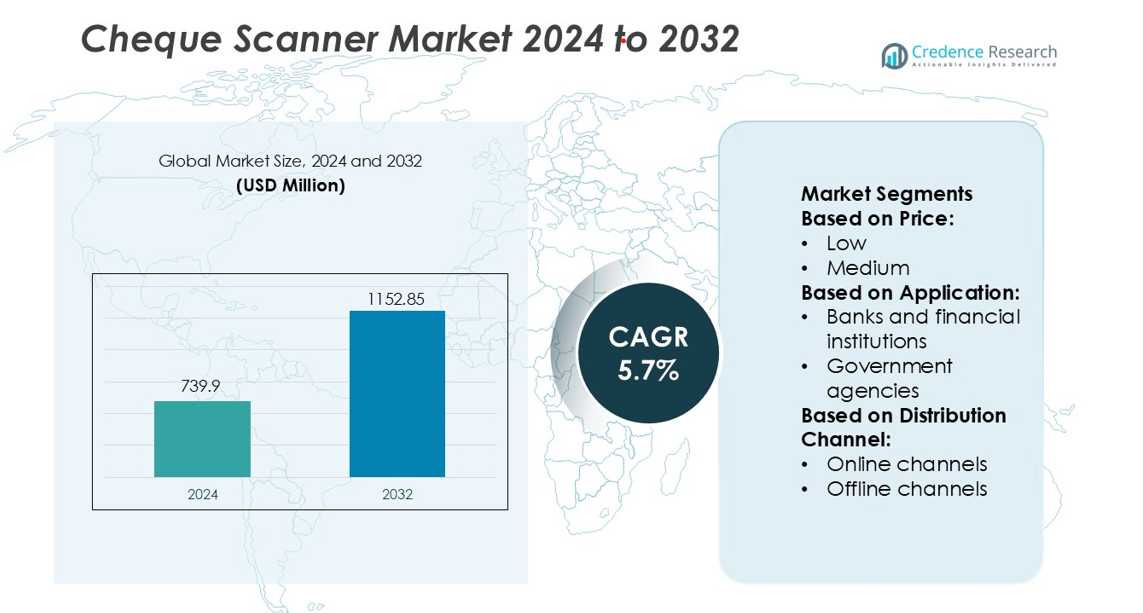
Cheque Scanner Market size was valued USD 739.9 million in 2024 and is anticipated to reach USD 1152.85 million by 2032, at a CAGR of 5.7% during the forecast period.
| REPORT ATTRIBUTE | DETAILS |
|---|---|
| Historical Period | 2020-2023 |
| Base Year | 2024 |
| Forecast Period | 2025-2032 |
| Cheque Scanner Market Size 2024 | USD 739.9 million |
| Cheque Scanner Market, CAGR | 5.7% |
| Cheque Scanner Market Size 2032 | USD 1152.85 million |
The cheque scanner market features strong participation from global and specialized manufacturers, with companies focusing on speed, accuracy, and secure data handling for digital clearing systems. North America leads the market with a 32% share, driven by high cheque volumes in commercial payments and strong adoption of image-based processing across banks and enterprises. Vendors invest in advanced MICR reading, UV-based fraud detection, and cloud-linked document management to support faster reconciliation and regulatory compliance. Growing demand for multi-feed scanners among financial institutions and compact devices for SMEs strengthens competition, while service contracts and software integration continue to influence long-term customer retention.
Market Insights
- The Cheque Scanner Market was valued at USD 739.9 million in 2024 and will reach USD 1152.85 million by 2032 with a CAGR of 5.7%.
- Growth is driven by rising digitization of cheque clearing, demand for faster settlement, and secure MICR-based authentication across banks, enterprises, and government offices.
- A key trend is the adoption of multi-feed and compact cheque scanners, cloud-linked document storage, UV verification, and remote deposit capture for SMEs and retail counters.
- Competition increases as vendors offer high-speed scanning, software integration, and service contracts, but high equipment cost and rising shift to digital payments restrain long-term adoption.
- North America leads with a 32% regional share, while Asia-Pacific records the fastest growth; banks hold the dominant end-user share due to high cheque volumes in commercial transactions and regulatory push for image-based cheque truncation.
Market Segmentation Analysis:
By Price
Low-priced cheque scanners hold the dominant market share due to strong adoption among small businesses, retail counters, and regional financial institutions. Buyers in this segment prefer affordable devices that support basic MICR reading, image capture, and rapid cheque clearing without heavy investment. Bulk orders from cooperative banks and microfinance firms also strengthen sales. Medium-priced scanners gain demand from commercial banks and corporate entities that seek faster processing speed and higher scanning accuracy. High-priced scanners serve large enterprises handling heavy transaction loads, but the user base is smaller due to higher procurement and maintenance costs.
- For instance, Canon Inc. offers the compact imageFORMULA CR-L1 cheque scanner. It processes up to 45 cheques per minute (cpm) for black and white/grayscale images. The maximum optical scanning resolution is 300 dpi (dots per inch).
By Application
Banks and financial institutions lead the market with the largest share because cheque volumes remain high across loan processing, deposits, clearing services, and ATM cheque drop units. Automated cheque imaging, fraud detection tools, and secure data capture push banks toward modern compact scanners. Business organizations and government agencies adopt scanners to improve turnaround time and reduce manual errors in payment processing. Retailers deploy them to support in-store cheque acceptance and quick reconciliation. Other users include educational institutions and insurance companies requiring faster cheque verification and digital record creation.
- For instance, NCR has supplied the Digital Check-manufactured NCR TS215 and NCR TS230 models of check scanners. These scanners operate within the approximate speed range and resolution specified.
By Distribution Channel
Offline channels hold the dominant share, driven by procurement norms of banks, government bodies, and corporate customers that require demonstrations, service agreements, and long-term maintenance support. Vendors secure bulk deals through authorized distributors and system integrators, strengthening offline sales. Online channels grow steadily as SMEs and retailers prefer quick price comparison and doorstep delivery. E-commerce platforms promote compact, plug-and-play cheque scanners, attracting users that have lower integration needs and limited purchase volumes. Growing digital procurement behavior will continue improving online channel penetration.
Key Growth Drivers
Growing Digitization of Cheque Processing
Banks and financial institutions continue to digitize cheque clearing workflows to reduce manual handling, improve accuracy, and shorten settlement time. Cheque scanners support automated MICR reading, high-resolution image capture, and secure data transfer, enabling same-day or near-real-time clearance. Large banks deploy multi-feed scanners to manage high volumes, while SMEs adopt compact models for counter transactions. Regulatory support for image-based cheque clearing and rising customer expectations for faster fund availability further accelerate adoption. This shift allows institutions to reduce labor-intensive verification, minimize errors, and maintain strong audit trails.
- For instance, Burroughs, Inc. offers the SmartSource Elite 5 It uses a high-quality 600 dpi color image sensor. While the sensor's capability is 600 dpi, the standard resolution used for check image processing and transmission is typically 300 dpi (or 200 dpi)
Rising Banking Expansion in Developing Regions
Emerging economies see continuous banking expansion driven by rural financial inclusion, ATM cheque deposit deployments, and branch network growth. Cooperative banks, microfinance institutions, and payment banks invest in cheque scanners to improve service delivery and ensure secure document digitization. Government-backed initiatives promote cashless transactions, but cheque usage remains significant in business payments, insurance settlements, and public sector disbursements. The need for reliable verification and fraud prevention strengthens demand for scanners that combine OCR, UV scanning, and tamper detection. Expansion into underserved regions boosts the installed base across Asia, Africa, and Latin America.
- For instance, Digital Check Corporation offers the high-speed TellerScan TS500 check scanner. It processes up to 200 documents per minute (dpm).It incorporates a high-quality 600 dpi color image sensor (used for ID cards, standard check resolution is typically 300 dpi).
Automation and Workflow Efficiency in Enterprises
Corporates, insurers, and government agencies adopt cheque scanners to streamline payment reconciliation, reduce back-office workload, and improve compliance. High-speed multi-feed scanners help large organizations process bulk cheques for vendor payments, claims, and refunds. Integration with ERP and treasury management systems further shortens processing cycles and reduces human error. Automated audit trails and digital storage also support fraud mitigation and regulatory reporting. As enterprises seek faster financial closing and smoother cash flow management, scanners become essential tools for secure document capture and digital record retention.
Key Trends & Opportunities
Increase in Remote Deposit Capture and Mobile Cheque Scanning
Remote cheque deposits gain momentum as banks enable customers and field agents to scan cheques at branches, retail counters, or off-site locations. Compact scanners support remote banking kiosks, courier collection centers, and doorstep services for SMEs. Financial institutions deploy cloud-linked scanning platforms to speed clearing and eliminate physical transport of cheques. Vendors gain opportunities by offering lightweight scanners with API integration, secure data encryption, and smartphone-paired deposit systems. This trend supports cost reduction, faster capital access, and wider financial reach.
- For instance, MagTek, Inc. offers scanners such as the single-feed ImageSafe and the batch-feed Excella STX. The Excella STX model processes approximately 50 documents per minute (dpm). The ImageSafe is a single-feed device.
Demand for Multi-Function and High-Speed Scanning Systems
Organizations seek scanners that combine cheque reading with ID scanning, barcode capture, and document archiving. Multi-function devices reduce equipment cost and simplify workflow in banks and retail counters. High-speed multi-feed scanners attract large enterprises handling bulk payments and refunds. Manufacturers explore compact designs, low noise operation, and long-life feeder mechanisms to reduce maintenance needs. The rise of cloud-based document storage and automated verification tools creates room for value-added software bundles and subscription-based scanning platforms.
- For instance, CTS Electronics (now part of Arca) offers the multi-function scanner LS150. It processes documents at speeds up to 150 documents per minute (dpm). It captures dual-side images at a maximum optical resolution of 300 dpi (with typical settings of 100/200 dpi).
Growing Focus on Fraud Detection and Compliance
Rising cheque fraud and regulatory scrutiny drive demand for scanners equipped with UV detection, watermark verification, and image enhancement algorithms. Banks prefer devices that flag tampering, duplicate cheques, and signature inconsistencies in real time. Integration with analytics tools and risk engines helps institutions detect anomalies quickly and maintain compliance with anti-money laundering frameworks. Vendors see strong opportunities in offering scanners with built-in encryption, audit logs, and secure transmission protocols to support safe digital cheque handling.
Key Challenges
Rising Shift Toward Real-Time Digital Payments
Real-time payment platforms and mobile wallets reduce cheque usage in retail and consumer transactions. Businesses shift to electronic transfers for vendor payments due to faster processing and lower handling cost. This growing preference for digital payments can restrict long-term scanner demand, especially in developed economies where paper-based transactions decline. Vendors must focus on niche markets like government disbursements, insurance payouts, and corporate transactions where cheques remain relevant.
High Equipment and Maintenance Cost for Large Deployments
High-speed and feature-rich scanners require significant upfront investment and ongoing maintenance. Banks and large enterprises purchasing devices in bulk face additional costs in AMC contracts, integration, and staff training. Smaller institutions often prefer manual processes or low-cost scanners with limited features. Without cost reduction or flexible financing, adoption may slow in price-sensitive regions. Manufacturers need to offer tiered pricing, leasing models, and modular features to improve accessibility across customer categories.
Regional Analysis
North America
North America holds 32% of the market share due to strong cheque usage in commercial payments, advanced banking infrastructure, and wide adoption of image-based clearing. U.S. banks deploy high-speed scanners to handle bulk processing and reduce human verification. Remote deposit capture continues to rise among enterprises and customers. Financial institutions also integrate fraud analytics, UV detection, and encrypted data transmission to meet regulatory needs. Consistent modernization of branch and back-office systems keeps North America the leading revenue contributor.
Europe
Europe accounts for 27% of the market share, supported by mature banking networks and regulatory standards for digital cheque clearing. Banks invest in multi-feed scanners to enhance settlement speed and reduce physical handling. Countries such as the UK, Germany, and France lead adoption of secure imaging systems with tamper-detection and long-term digital archiving. Corporate and government users apply cheque scanners to speed reimbursement, tax settlements, and insurance payouts. Steady demand from enterprises and fintech-enabled platforms sustains regional growth.
Asia-Pacific
Asia-Pacific holds 24% of the market share and shows the fastest growth. Banks in India, China, and Southeast Asia adopt cheque truncation systems, driving higher procurement of compact and multi-feed scanners. Rural banking expansion and large public-sector disbursements keep cheque volumes strong despite rising digital payments. Microfinance institutions favor low-cost scanners for branch counters. Increasing fraud prevention needs promote devices with watermark and UV verification. Rapid digitization and financial inclusion programs continue to expand market penetration across developing economies.
Latin America
Latin America commands 10% of the market share as banks transition from manual clearance to image-based processing. Brazil, Mexico, and Chile lead adoption through digital cheque clearing rules, remote deposit features, and ATM-based depositing. Retailers and enterprises integrate scanners to speed vendor payments and reconciliation. Cost remains a key factor, pushing demand for compact devices rather than high-end systems. Expanding internet connectivity and growth of digital banking services support gradual market development.
Middle East & Africa
Middle East & Africa account for 7% of the market share, driven by ongoing banking modernization and government efforts to digitize cheque-dependent services. Gulf countries adopt high-speed scanners for corporate and cross-border transactions, while African microfinance institutions invest in low-cost models for rural branch digitization. Infrastructure and regulatory gaps slow migration from manual processing in some nations. However, rising financial inclusion, secure document imaging, and demand for fraud detection features gradually improve regional adoption.
Market Segmentations:
By Price:
- Low
- Medium
By Application:
- Banks and financial institutions
- Government agencies
By Distribution Channel:
- Online channels
- Offline channels
By Geography
- North America
- U.S.
- Canada
- Mexico
- Europe
- Germany
- France
- U.K.
- Italy
- Spain
- Rest of Europe
- Asia Pacific
- China
- Japan
- India
- South Korea
- South-east Asia
- Rest of Asia Pacific
- Latin America
- Brazil
- Argentina
- Rest of Latin America
- Middle East & Africa
- GCC Countries
- South Africa
- Rest of the Middle East and Africa
Competitive Landscape
The cheque scanner market includes key players such as MiTek Systems, Inc., Canon Inc., NCR Corporation, Burroughs, Inc., Digital Check Corporation, MagTek, Inc., CTS Electronics, ARCA, IBML, and Burroughs Smart Source. The cheque scanner market features a mix of global technology vendors and specialized financial hardware manufacturers. Competition centers on delivering faster cheque processing, higher MICR accuracy, and secure image capture to support digital clearing systems. Vendors focus on compact, multi-feed scanners that reduce manual verification and improve branch workflow efficiency. Software-driven innovation plays a major role, with automated image correction, fraud detection algorithms, and encrypted data transmission becoming standard features. Companies also strengthen their offerings through remote deposit capture solutions and integration with banking, ERP, and treasury platforms. Price-sensitive regions encourage development of low-cost scanners with basic imaging, while advanced markets demand high-speed, tamper-resistant systems with long-term storage compliance. Strong customer service, extended warranties, and maintenance contracts help vendors retain large financial institutions. As banks digitize back-office operations and enterprises automate reconciliation, competition intensifies around performance reliability, reduced downtime, cloud-based document management, and seamless IT integration.
Key Player Analysis
- MiTek Systems, Inc.
- Canon Inc.
- NCR Corporation
- Burroughs, Inc.
- Digital Check Corporation
- MagTek, Inc.
- CTS Electronics
- ARCA
- IBML
- Burroughs Smart Source
Recent Developments
- In April 2025, SmartSource Expert Elite adds SimpleSwitch for USB/network convertibility with a button press; shipments with this capability began in March 2025, easing branch and RDC deployments across Windows, macOS, and Linux via IP/Ethernet-over-USB options.
- In April 2025, Hyland Software, Inc. expanded its product portfolio with enhanced AI capabilities to elevate intelligent content management. Through powerful updates to Hyland Automate, Hyland Knowledge Discovery, and significant improvements to Hyland OnBase and Hyland Alfresco, the company is equipping organizations with advanced tools to optimize content, process, and application intelligence.
- In March 2025, IBM Corporation introduced IBM Storage Ceph as a Service, expanding its portfolio of flexible on-premises infrastructure solutions. This new offering complements IBM Power delivered as a service, providing a distributed compute platform with various form factors and flexible consumption models.
- In February 2025, Genesys Technologies deployment of AES‑256 encryption via MagTek’s Reader Management API for DynaProx contactless readers; while not a new check scanner, it reflects MagTek’s current security stack (Magensa, AES‑256, DUKPT) that also underpins its encrypting check scanners used in banking and retail environments
Report Coverage
The research report offers an in-depth analysis based on Price, Application, Distribution Channel and Geography. It details leading market players, providing an overview of their business, product offerings, investments, revenue streams, and key applications. Additionally, the report includes insights into the competitive environment, SWOT analysis, current market trends, as well as the primary drivers and constraints. Furthermore, it discusses various factors that have driven market expansion in recent years. The report also explores market dynamics, regulatory scenarios, and technological advancements that are shaping the industry. It assesses the impact of external factors and global economic changes on market growth. Lastly, it provides strategic recommendations for new entrants and established companies to navigate the complexities of the market.
Future Outlook
- Demand will rise as banks continue shifting to image-based cheque clearing for faster settlement.
- Remote deposit capture will expand across SMEs, field agents, and branchless banking models.
- Multi-feed and high-speed scanners will gain preference in enterprises handling bulk payments.
- Compact, plug-and-play scanners will see higher adoption in retail counters and microfinance institutions.
- Integration with cloud storage and automated reconciliation software will become more common.
- Fraud detection features such as UV scanning and watermark verification will become standard.
- Subscription-based software and service bundles will grow as banks seek lower upfront ownership costs.
- Developing regions will contribute strongly as cheque truncation systems and digital banking expand.
- Eco-friendly, low-maintenance designs will gain traction as institutions reduce operational cost and downtime.
- Long-term demand will remain in corporate, government, and insurance segments even as digital payments rise.

Request a Free Sample
Fill in your details and we'll send you a free sample report.
- Sample data tables & charts
- Research methodology
Need a Custom Version of This Report?
Tailor the scope, geography, or segments to your exact requirements.
- Custom geography or segment scope
- Direct access to our analyst team
Frequently Asked Questions
What is the current market size for the Cheque Scanner Market, and what is its projected size in 2032?
At what Compound Annual Growth Rate is the Cheque Scanner Market projected to grow between 2025 and 2032?
Which Cheque Scanner Market segment held the largest share in 2024?
What are the primary factors fueling the growth of the Cheque Scanner Market?
Who are the leading companies in the Cheque Scanner Market?
Which region commanded the largest share of the Cheque Scanner Market in 2024?
Table of Content
Chapter 1 Market Segmentation
- 1.1 Segmentation Framework
- 1.1.1 Product and Service Classification
- 1.1.2 Application and End-Use Classification
- 1.1.3 Technology and Solution Classification
- 1.1.4 Customer and Distribution Channel Classification
- 1.1.5 Geographic Segmentation
- 1.1.6 Market Segment Definitions and Boundaries
Chapter 2 Introduction
- 2.1 Report Objectives and Scope
- 2.2 Product Definition and Industry Terminology
- 2.3 Market Inclusions and Exclusions
- 2.4 Research Process
- 2.4.1 Primary Research and Expert Interviews
- 2.4.2 Secondary Research and Source Review
- 2.4.3 Top-Down and Bottom-Up Estimation
- 2.4.4 Data Triangulation and Verification
- 2.5 Market Size Measurement Basis
- 2.5.1 2024: USD 739.9 million → 2032: USD 1152.85 million
- 2.6 Historical and Forecast Reference Periods
- 2.6.1 Base Year: 2024
- 2.6.2 Forecast Period: 2024-2032
- 2.7 Research Assumptions and Limitations
Chapter 3 Executive Summary
- 3.1 Market Snapshot and Key Findings
- 3.2 Base-Year Market Size, 2024
- 3.3 Forecast Market Size, 2032
- 3.4 Revenue and Volume Growth Outlook
- 3.5 Key Demand and Supply Indicators
- 3.6 Leading Market Segments
- 3.7 Fastest-Growing Market Opportunities
- 3.8 Regional Performance Highlights
- 3.9 Technology and Industry Transformation
- 3.10 Competitive Landscape Summary
- 3.11 Analyst View and Strategic Implications
Chapter 4 Global Cheque Scanner Market Trends and Developments
- 4.1 Historical Industry Development
- 4.2 Recent Market Trends and Developments
- 4.3 Demand and Customer Behavior Trends
- 4.4 Technology and Product Innovation
- 4.5 Artificial Intelligence, Automation and Digitalization
- 4.6 Local Manufacturing and Supply Chain Realignment
- 4.7 Industry Partnerships, Mergers and Acquisitions
- 4.8 Sustainability and Circular Economy Developments
- 4.9 Government and Private Sector Investment Trends
- 4.10 Emerging Business Models and Commercialization
- 4.11 Industry Developments and Announcements
Chapter 5 Global Cheque Scanner Market Supply and Demand Analysis
- 5.1 Demand Trend and Consumption Analysis
- 5.2 Demand Forecast, 2024-2032
- 5.3 Supply Chain Structure and Procurement Trends
- 5.4 Supply-Demand Gap and Bottlenecks
- 5.5 Import Dependence and Sourcing Structure
- 5.6 Regional Supply and Demand Concentration
Chapter 6 Global Cheque Scanner Market Pricing Analysis
- 6.1 Pricing Structure and Measurement
- 6.2 Historical Pricing Trends
- 6.3 Pricing Outlook, 2024-2032
- 6.4 Pricing by Product and Market Segment
- 6.5 Geographic Pricing Differences
- 6.6 Key Input, Energy, Labor and Logistics Costs
- 6.7 Contract Pricing and Purchasing Models
- 6.8 Pricing Sensitivity and Competitive Positioning
- 6.9 Price, Margin and Profitability Implications
Chapter 7 Global Cheque Scanner Market Dynamics
- 7.1 Market Growth Drivers
- 7.1.1 Demand-Side Drivers
- 7.1.2 Technology and Innovation Drivers
- 7.1.3 Infrastructure and Investment Drivers
- 7.1.4 Regulatory and Policy Drivers
- 7.2 Market Restraints
- 7.2.1 Cost and Affordability Constraints
- 7.2.2 Technology and Adoption Barriers
- 7.2.3 Supply Chain and Operational Constraints
- 7.3 Market Challenges
- 7.3.1 Competitive Pressure and Margin Erosion
- 7.3.2 Skills, Infrastructure and Implementation Gaps
- 7.4 Emerging Market Opportunities
- 7.5 Market Dynamics Impact and Time-Horizon Assessment
Chapter 8 Global Cheque Scanner Value Chain Analysis
- 8.1 Industry Value Chain Overview
- 8.2 Upstream Suppliers and Critical Inputs
- 8.3 Technology and Component Providers
- 8.4 Manufacturing or Service Delivery
- 8.5 Distribution, Channel Partners and Integrators
- 8.6 Downstream Applications and End Users
- 8.7 Value Addition and Profit Pools
- 8.8 Vertical Integration and Outsourcing
- 8.9 Supplier Concentration and Risk
- 8.10 Supply Chain Localization and Resilience
Chapter 9 Global Cheque Scanner Market Regulations and Policies
- 9.1 Relevant Laws, Standards and Compliance Frameworks
- 9.2 Product, Service, Safety and Quality Requirements
- 9.3 Government Policies, Incentives and Subsidies
- 9.4 Imports, Exports and Trade Barriers
- 9.5 Public Procurement and Local Content Requirements
- 9.6 Data Protection, AI and Cybersecurity Compliance
- 9.7 Upcoming Policy Changes and Market Implications
Chapter 10 Global Cheque Scanner Market Hotspots and Opportunities
- 10.1 Market Opportunity Mapping and Growth Hotspots
- 10.2 High-Growth Applications and Customer Groups
- 10.3 Underserved Markets and White-Space Opportunities
- 10.4 Emerging Technology and Product Opportunities
- 10.5 New Capacity and Investment Hotspots
- 10.6 Market Entry and Expansion Opportunities
- 10.7 Distribution and Partnership Opportunities
- 10.8 Near-Term and Long-Term Commercial Potential
- 10.9 Opportunity Attractiveness and Execution Risks
Chapter 11 Global Cheque Scanner Market Outlook, 2024-2032
- 11.1 Market Size and Analysis
- 11.1.1 Revenue (Market Measurement: 2024: USD 739.9 million → 2032: USD 1152.85 million)
- 11.1.2 Historical Market Size
- 11.1.3 Base-Year Market Size, 2024
- 11.2 Market Forecast, 2024-2032
- 11.2.1 Revenue Forecast to 2032
- 11.2.2 CAGR and Year-on-Year Growth
- 11.2.3 Incremental Revenue Opportunity
- 11.3 Forecast Assumptions and Scenario Analysis
- 11.3.1 Base-Case Forecast
- 11.3.2 Optimistic and Conservative Scenarios
- 11.3.3 Technology, Pricing and Policy Sensitivities
- 11.4 Market Attractiveness and Growth Outlook
Chapter 12 Global Cheque Scanner Market Segmentation and Outlook
- 12.1 Segmentation Summary and Market Shares, 2024
- 12.2 Largest and Fastest-Growing Segments
- 12.3 Segment Growth Comparison
- 12.4 Segment Attractiveness and Priority Matrix
Chapter 13 Global Cheque Scanner Geographic Market Outlook, 2024-2032
- 13.1 Regional Market Size and Share, 2024
- 13.2 Regional Market Forecast, 2024-2032
- 13.3 Regional Pricing, Production and Demand Differences
- 13.4 North America
- 13.4.1 United States
- 13.4.2 Canada
- 13.4.3 Mexico
- 13.5 Europe
- 13.5.1 Germany
- 13.5.2 France
- 13.5.3 Italy
- 13.5.4 United Kingdom
- 13.5.5 Spain
- 13.5.6 Poland
- 13.5.7 Russia
- 13.5.8 Netherlands
- 13.5.9 Belgium
- 13.5.10 Sweden
- 13.5.11 Denmark
- 13.5.12 Norway
- 13.5.13 Rest of Europe
- 13.6 Asia Pacific
- 13.6.1 China
- 13.6.2 India
- 13.6.3 Japan
- 13.6.4 South Korea
- 13.6.5 Thailand
- 13.6.6 Indonesia
- 13.6.7 Vietnam
- 13.6.8 Malaysia
- 13.6.9 Australia
- 13.6.10 Rest of Asia Pacific
- 13.7 Latin America
- 13.7.1 Brazil
- 13.7.2 Argentina
- 13.7.3 Colombia
- 13.7.4 Chile
- 13.7.5 Rest of Latin America
- 13.8 Middle East
- 13.8.1 Saudi Arabia
- 13.8.2 United Arab Emirates
- 13.8.3 Turkey
- 13.8.4 Israel
- 13.8.5 Iran
- 13.8.6 Rest of the Middle East
- 13.9 Africa
- 13.9.1 South Africa
- 13.9.2 Egypt
- 13.9.3 Nigeria
- 13.9.4 Morocco
- 13.9.5 Rest of Africa
- 13.10 Regional Investment, Policy and Supply Chain Differences
- 13.11 Regional Competitive Landscape
- 13.12 Geographic Growth Hotspots
Chapter 14 Global Cheque Scanner Technology, Innovation and Sustainability Outlook
- 14.1 Technology Landscape and Maturity
- 14.2 Product, Process and Service Innovation
- 14.3 AI, Automation and Digital Tools in the Industry
- 14.4 Technology Adoption and Performance Benchmarking
- 14.5 Innovation Pipeline and R&D Investment
- 14.6 Energy Efficiency and Resource Management
- 14.7 Sustainability, Recycling and Circularity
- 14.8 Technology Roadmap, 2024-2032
- 14.9 Risks of Obsolescence and Technology Substitution
Chapter 15 Global Cheque Scanner Market Key Strategic Imperatives
- 15.1 Growth and Market Entry Priorities
- 15.2 High-Return Products and Segments
- 15.3 Pricing, Profitability and Cost Optimization
- 15.4 Technology Investment and Product Differentiation
- 15.5 Supply Chain Localization and Resilience
- 15.6 Distribution and Customer Acquisition
- 15.7 Partnership, Acquisition and Capacity Strategy
- 15.8 Regional Expansion Priorities
- 15.9 Short-, Medium- and Long-Term Actions
Chapter 16 Competition Outlook
- 16.1 Industry Competition Characteristics
- 16.2 Market Structure and Concentration
- 16.3 Market Share and Competitive Positioning, 2024
- 16.4 Company-Wise Revenue and Product Benchmarking
- 16.5 Production and Service Capacity Benchmarking
- 16.6 Technology, Pricing and Differentiation
- 16.7 Regional Footprint and Distribution Strength
- 16.8 Mergers, Acquisitions and Strategic Alliances
- 16.9 New Entrants and Competitive Threats
- 16.10 Porter's Five Forces and Industry Attractiveness
- 16.11 Competitive Outlook, 2024-2032
Chapter 17 Company Profiles
- 17.1 Company Coverage and Selection Criteria
- 17.2 Leading Market Participants – Standard Profile Structure
- 17.2.1 Business Description
- 17.2.2 Company Ownership and Geographic Presence
- 17.2.3 Product and Service Portfolio
- 17.2.4 Manufacturing and Operating Footprint
- 17.2.5 Financial Performance and Investment
- 17.2.6 Market Share and Competitive Position
- 17.2.7 Technology and Innovation Capabilities
- 17.2.8 Strategic Alliances or Partnerships
- 17.2.9 Recent Developments
- 17.2.10 Growth Strategy and Outlook
- 17.3 Other Relevant Market Participants
Note: Every listed company is profiled on the structure shown under the first company. The company list is preliminary and may change based on research findings, market developments, data availability and client requirements.
Chapter 18 Disclaimer
- 18.1 Research and Forecast Disclaimer
- 18.2 Data Source and Estimation Limitations
Note: The depth of individual sections depends on data availability for this market. Volume, capacity, trade and other unit-based metrics are included where applicable.