Market Overview
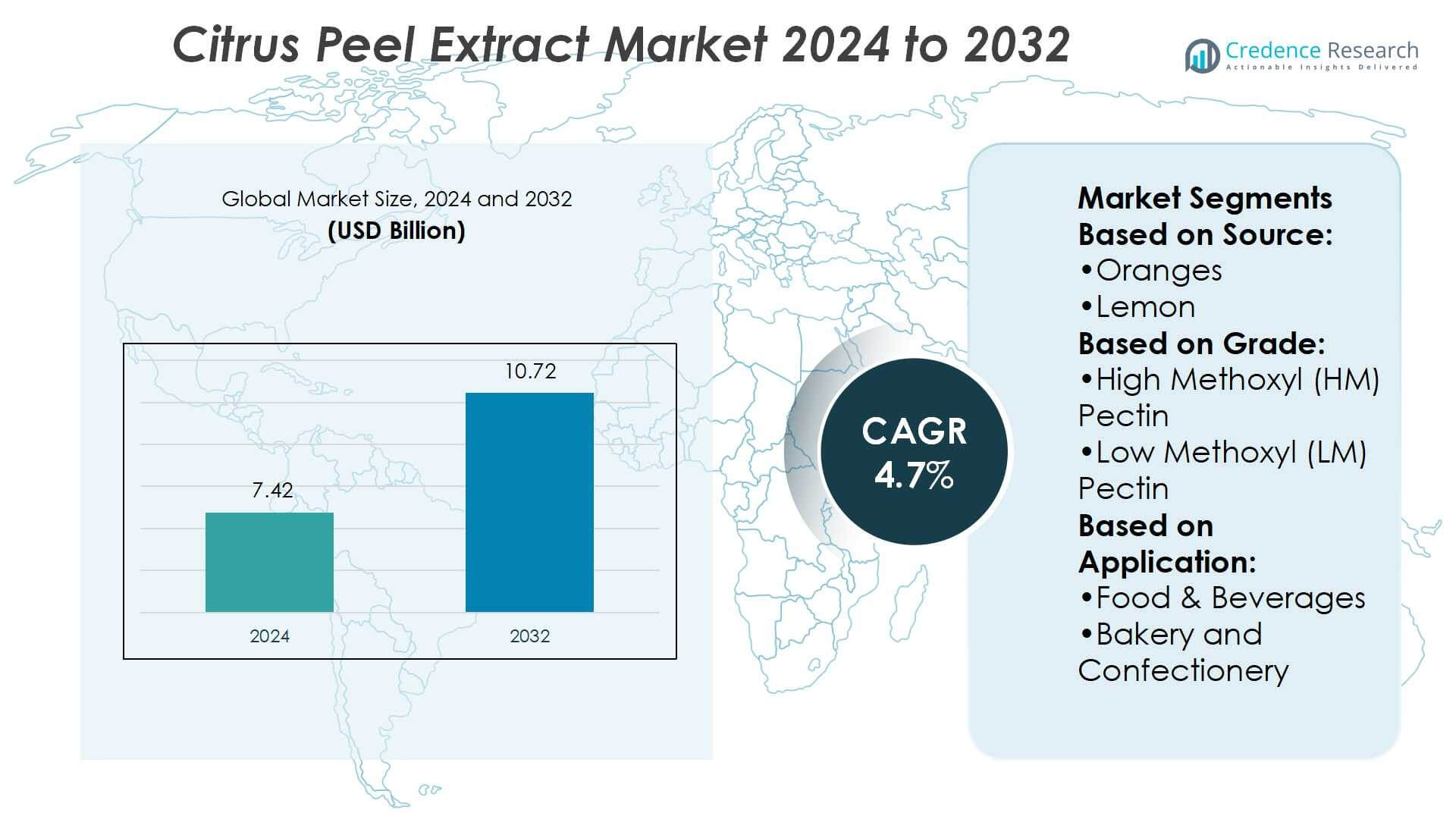
Citrus Peel Extract Market size was valued at USD 7.42 billion in 2024 and is anticipated to reach USD 10.72 billion by 2032, at a CAGR of 4.7% during the forecast period.
| REPORT ATTRIBUTE | DETAILS |
|---|---|
| Historical Period | 2020-2023 |
| Base Year | 2024 |
| Forecast Period | 2025-2032 |
| Citrus Peel Extract Market Size 2024 | USD 7.42 Billion |
| Citrus Peel Extract Market, CAGR | 4.7% |
| Citrus Peel Extract Market Size 2032 | USD 10.72 Billion |
The Citrus Peel Extract Market is driven by rising demand for natural ingredients in food, beverages, pharmaceuticals, and cosmetics, supported by consumer preference for clean-label and functional products. It benefits from increasing use of bioflavonoids, pectin, and essential oils in nutraceuticals and preventive healthcare. Sustainability and waste valorization practices, turning citrus byproducts into valuable extracts, further strengthen growth. Key trends include advancements in extraction technologies for higher yield and stability, expansion into eco-friendly personal care products, and growing adoption in fortified foods. The market continues to align with health, wellness, and sustainability-focused consumer behavior worldwide.
The Citrus Peel Extract Market shows strong regional presence with North America holding the largest share, followed by Europe with its established food and pharmaceutical industries. Asia-Pacific is emerging as the fastest-growing region, supported by rising consumer demand for functional foods and natural cosmetics. Latin America benefits from abundant citrus production, while the Middle East and Africa display gradual adoption. Key players driving the market include Cargill, DuPont de Nemours, CP Kelco, Naturex (Givaudan), CEAMSA, Silvateam, and Herbstreith & Fox KG.
Market Insights
- Citrus Peel Extract Market size was valued at USD 7.42 billion in 2024 and will reach USD 10.72 billion by 2032 at a CAGR of 4.7%.
- Rising demand for natural, clean-label ingredients in food, beverages, pharmaceuticals, and cosmetics drives market growth.
- Increasing use of bioflavonoids, pectin, and essential oils in nutraceuticals supports preventive healthcare applications.
- Advancements in extraction technologies improve yield, consistency, and stability across multiple product segments.
- Competition is defined by innovation, sustainability practices, and global distribution networks of leading manufacturers.
- Market restraints include supply chain fluctuations, seasonal raw material dependence, and strict regulatory compliance requirements.
- North America holds the largest share, Europe follows with mature industries, Asia-Pacific grows fastest, while Latin America and Middle East & Africa expand steadily.
Market Drivers
Rising Demand for Natural Ingredients in Food and Beverages
The growing consumer shift toward natural and clean-label products is a major driver in the Citrus Peel Extract Market. Food and beverage manufacturers are replacing synthetic additives with citrus-derived bioactive compounds that offer flavor enhancement and functional benefits. It supports innovation in juices, carbonated drinks, and confectionery by providing natural antioxidants and preservatives. Companies also utilize it to improve shelf life and maintain product stability without chemical preservatives. Growing awareness of natural nutrition strengthens consumer preference for citrus-based ingredients. This demand encourages consistent sourcing and expansion of extract processing facilities.
- For instance, Silvateam operates a production capacity of 2,000 tons per year for pectin from citrus peels at its facility in Rende, Italy. The company also produces other natural extracts, including Tara gum, tannins, and citrus fiber.
Expanding Applications in Pharmaceuticals and Nutraceuticals
The pharmaceutical and nutraceutical industries strongly influence the Citrus Peel Extract Market through rising use of bioflavonoids and essential oils. These compounds provide anti-inflammatory, antimicrobial, and cholesterol-reducing properties, making them suitable for supplements and therapeutic formulations. It supports research into cardiovascular health and immune system enhancement, creating opportunities for new product launches. Companies continue to invest in standardized extracts that guarantee consistent potency and efficacy. Increasing global focus on preventive healthcare expands adoption of citrus-based nutraceuticals. Clinical validation of bioactive benefits further strengthens market acceptance and regulatory compliance.
- For instance, Silvateam, an Italian company, operates a modern manufacturing plant in Rende, southern Italy, for the production of pectin from citrus peels.The facility has a stated production capacity of 2,000 tons per year.
Growing Adoption in Personal Care and Cosmetics
Rising consumer preference for natural and sustainable skincare products is another key driver in the Citrus Peel Extract Market. Extracts are used in formulations for skin brightening, anti-aging, and cleansing due to high vitamin C and antioxidant content. It helps cosmetic manufacturers develop eco-friendly alternatives to synthetic ingredients, improving product appeal among health-conscious consumers. The extract is applied in creams, serums, shampoos, and soaps to enhance skin texture and protect against environmental stressors. Companies are promoting sustainable sourcing practices to align with green cosmetic trends. This growing integration in personal care significantly widens the customer base.
Increasing Focus on Waste Valorization and Sustainability
Sustainability and circular economy initiatives play a vital role in shaping the Citrus Peel Extract Market. Citrus peel, traditionally a waste byproduct of juice processing, is now processed into high-value extracts. It reduces food waste while creating an additional revenue stream for processors. Governments and industries encourage waste valorization practices that support environmental goals and resource efficiency. Companies investing in advanced extraction technologies can optimize yield and maintain consistent quality. This sustainability-driven approach not only lowers environmental impact but also strengthens competitiveness in global markets.
 Market Trends
Rising Demand for Clean-Label and Functional Ingredients
The Citrus Peel Extract Market is witnessing a strong trend toward clean-label and functional products. Consumers increasingly prefer natural ingredients that provide both flavor and health benefits. It supports product development in beverages, snacks, and dietary supplements where functional claims enhance appeal. Food producers highlight natural antioxidants and flavonoids to meet evolving customer expectations. The emphasis on transparency and reduced synthetic additives further accelerates this adoption. This trend strengthens the positioning of citrus-based extracts in mainstream applications.
- For instance, Cargill has a large and expanding network of innovation centers around the world. A company source from 2025 states that Cargill operates over 20 such centers.
Expansion of Sustainable and Circular Economy Practices
Sustainability initiatives are shaping new practices in the Citrus Peel Extract Market. Manufacturers transform citrus peel waste into value-added extracts, aligning with circular economy goals. It reduces environmental burdens and maximizes resource efficiency in juice and beverage industries. Companies are investing in eco-friendly extraction technologies that lower energy use and improve yields. Regulatory support for waste valorization also stimulates adoption across regions. This approach positions citrus extracts as both sustainable and commercially viable solutions.
Advancements in Extraction and Processing Technologies
Technological innovations are enhancing the scalability and quality of the Citrus Peel Extract Market. Advanced methods such as supercritical fluid extraction and cold-pressing deliver higher yields of bioactive compounds. It ensures stable potency and consistency across food, cosmetic, and pharmaceutical applications. Automation and process optimization also reduce operational costs for manufacturers. These improvements expand opportunities for premium-grade extracts with verified functional properties. The trend underscores the role of innovation in maintaining competitiveness.
- For instance, CEAMSA operates multiple hydrocolloid production lines, including citrus-based pectin, with a documented productive capacity of 115 tons per month of pectin and 150 tons per month of fiber.
Growing Penetration in Cosmetics and Personal Care
Cosmetic and personal care manufacturers are expanding their use of citrus peel extracts due to natural wellness trends. It provides skin-brightening, cleansing, and anti-aging properties that resonate with eco-conscious consumers. The extract is increasingly featured in serums, creams, shampoos, and natural soaps. Companies highlight vitamin C content and antioxidant performance to differentiate products. Marketing strategies focus on sustainability and safe alternatives to synthetic chemicals. This trend broadens the consumer base and reinforces the extract’s premium positioning.
Market Challenges Analysis
Supply Chain Volatility and Raw Material Dependence
The Citrus Peel Extract Market faces challenges from raw material supply fluctuations and seasonal dependencies. Citrus peel is largely a byproduct of juice and beverage processing, creating reliance on fruit harvest cycles. It often leads to irregular availability and pricing instability, especially during adverse weather conditions or crop diseases. Rising global demand for citrus fruits also increases competition between food, beverage, and extraction industries. Transportation and storage limitations further complicate consistent raw material procurement. These supply chain constraints directly impact production planning and cost efficiency for manufacturers.
Quality Standardization and Regulatory Compliance
Maintaining consistent quality and meeting strict regulations pose significant challenges in the Citrus Peel Extract Market. Extracts require standardization of bioactive content to satisfy pharmaceutical, cosmetic, and food industry demands. It becomes complex due to variations in fruit type, origin, and processing method. Meeting international safety and labeling standards adds to operational costs for producers. Strict regulations around natural health claims and additives can delay product approvals. Companies investing in advanced testing and quality assurance face higher costs, which affect market competitiveness. These barriers limit rapid expansion and create pressure on smaller players to sustain operations.
Market Opportunities
Expanding Role in Functional Foods and Nutraceuticals
The Citrus Peel Extract Market offers strong opportunities through its integration into functional foods and nutraceuticals. Rising consumer focus on preventive healthcare and natural supplementation drives demand for citrus-derived bioflavonoids, flavanones, and essential oils. It enables the development of products targeting cardiovascular health, immunity, and digestive wellness. Food and nutraceutical brands can leverage clinical evidence supporting antioxidant and anti-inflammatory benefits to enhance credibility. Growing popularity of fortified beverages, gummies, and dietary supplements further expands application scope. This creates pathways for manufacturers to diversify portfolios and capture health-conscious segments.
Increasing Demand in Sustainable Cosmetics and Personal Care
The cosmetics sector presents significant growth opportunities for the Citrus Peel Extract Market. Rising preference for eco-friendly skincare, haircare, and personal hygiene products elevates demand for natural vitamin C and antioxidant-rich ingredients. It supports the creation of formulations for brightening, anti-aging, and protective benefits. Brands focusing on green beauty trends can position citrus extracts as safe alternatives to synthetic chemicals. Sustainable sourcing practices also strengthen brand reputation among environmentally conscious consumers. Expanding distribution through e-commerce platforms enhances visibility and accelerates adoption in global beauty markets.
Market Segmentation Analysis:
By Source
The Citrus Peel Extract Market is segmented by source into oranges, lemon, grapefruit, and others. Orange peel dominates due to its wide availability from juice processing and strong concentration of pectin and flavonoids. It finds large-scale application in food and beverage formulations where natural flavor and bioactive properties are in demand. Lemon peel holds significant share, supported by its use in pharmaceuticals and cosmetics for antimicrobial and antioxidant benefits. Grapefruit peel extracts are valued for high naringin content, contributing to nutraceutical and functional food applications. Other citrus sources such as mandarin and lime expand diversity in product offerings and allow manufacturers to address regional flavor preferences.
- For instance, their own website states an annual manufacturing capacity of 40,000 MT, though this may not be the cumulative figure for all facilities. Lucid Colloids is recognized for its broad product portfolio, extensive experience, and wide distribution network.
By Grade
Segmentation by grade includes high methoxyl (HM) pectin and low methoxyl (LM) pectin. HM pectin leads due to its functional role in jams, jellies, and confectionery, where sugar and acid conditions support effective gelling. It enables cost-effective solutions for large-scale bakery and beverage industries. LM pectin is gaining momentum, particularly in low-sugar or sugar-free applications, driven by health-conscious consumer demand. It performs well in dairy, frozen desserts, and pharmaceutical formulations requiring calcium-mediated gelation. Manufacturers continue investing in advanced processing to improve pectin stability and application flexibility. This grade-based differentiation strengthens opportunities for targeted product development.
- For instance, CP Kelco’s facility in Matão, Brazil, has completed a significant expansion, adding a second production line for its NUTRAVA™ Citrus Fiber, bringing the total capacity to approximately 5,000 metric tons per year.
By Application
Application segmentation covers food and beverages, bakery and confectionery, pharmaceuticals, and cosmetics and personal care. Food and beverages represent the largest share due to high demand for natural stabilizers, flavor enhancers, and preservatives. It supports innovation in juices, functional drinks, and processed foods. Bakery and confectionery utilize citrus peel extract for gelling, thickening, and flavor enhancement, meeting both premium and mass-market needs. Pharmaceutical applications are expanding as extracts provide bioflavonoids with cardiovascular, antimicrobial, and anti-inflammatory benefits. Cosmetics and personal care show strong growth through natural formulations for skin brightening, anti-aging, and haircare, aligned with sustainability and green beauty trends. Together, these applications highlight the extract’s multi-sector versatility and growing commercial relevance.
Segments:
Based on Source:
- Oranges
- Lemon
Based on Grade:
- High Methoxyl (HM) Pectin
- Low Methoxyl (LM) Pectin
Based on Application:
- Food & Beverages
- Bakery and Confectionery
Based on the Geography:
- North America
- U.S.
- Canada
- Mexico
- Europe
- UK
- France
- Germany
- Italy
- Spain
- Russia
- Rest of Europe
- Asia Pacific
- China
- Japan
- South Korea
- India
- Australia
- Southeast Asia
- Rest of Asia Pacific
- Latin America
- Brazil
- Argentina
- Rest of Latin America
- Middle East
- GCC Countries
- Israel
- Turkey
- Rest of Middle East
- Africa
- South Africa
- Egypt
- Rest of Africa
Regional Analysis
North America
North America accounted for 32% share of the Citrus Peel Extract Market in 2024, making it the leading regional market. Strong demand for clean-label food and beverage products drives growth across the United States and Canada. It benefits from the presence of advanced food processing industries and established nutraceutical manufacturers that rely on citrus-derived bioflavonoids and pectin. High consumer awareness about natural health supplements strengthens adoption of extracts in functional beverages, gummies, and fortified foods. The cosmetics sector also contributes through natural vitamin C-based formulations, reflecting strong interest in sustainable skincare. Regulatory frameworks supporting natural ingredient use further create a favorable environment for market expansion. Growing research collaborations and investments in extraction technologies secure the region’s dominant position.
Europe
Europe held 28% share of the Citrus Peel Extract Market in 2024, supported by strong food quality regulations and consumer preference for natural ingredients. The region is home to leading bakery and confectionery industries that depend on citrus pectin for gelling and stabilizing applications. It is also influenced by high adoption of citrus-derived compounds in pharmaceutical formulations, especially in cardiovascular and digestive health supplements. The cosmetics and personal care sector adds momentum, with brands focusing on green beauty products featuring citrus antioxidants. Countries such as Germany, France, and Italy act as key hubs for citrus processing and extract development. EU regulations on sustainability encourage manufacturers to adopt waste valorization practices, strengthening competitiveness. These dynamics reinforce Europe’s role as a mature yet innovative regional market.
Asia-Pacific
Asia-Pacific captured 25% share of the Citrus Peel Extract Market in 2024 and is projected to grow at the fastest pace. Expanding middle-class populations in China, India, and Southeast Asia drive demand for fortified beverages, dietary supplements, and bakery products. It benefits from rising investments in citrus farming and large-scale fruit processing, ensuring raw material availability. The region also shows increasing integration of citrus extracts in personal care products, reflecting consumer preference for herbal and natural solutions. Strong government initiatives in preventive healthcare and nutrition support further market adoption. Multinational players are expanding operations in the region to capture this growing demand. Local companies also play a critical role by offering cost-effective citrus extract solutions tailored to regional preferences.
Latin America
Latin America accounted for 9% share of the Citrus Peel Extract Market in 2024, driven by abundant citrus cultivation across Brazil, Mexico, and Argentina. The region has a strong base for raw material supply, with citrus peel being a byproduct of large-scale juice processing industries. It provides opportunities for both domestic and international players to invest in sustainable extraction facilities. Growing use of citrus-based ingredients in traditional medicine and dietary supplements further enhances demand. The food and beverage sector increasingly incorporates citrus peel extracts for natural flavoring and preservation. Regulatory efforts promoting sustainability and waste utilization also support industry development. It positions Latin America as a region with high potential for long-term growth.
Middle East and Africa
The Middle East and Africa held 6% share of the Citrus Peel Extract Market in 2024, reflecting its emerging role. Limited local citrus production restricts large-scale extraction; however, the region imports extracts to meet rising demand. Food and beverage applications dominate, supported by urbanization and growing preference for fortified products. It also sees gradual adoption in cosmetics and personal care, especially in Gulf countries with strong demand for premium natural skincare. Pharmaceutical applications are expanding in South Africa and parts of North Africa, aided by growing nutraceutical industries. Regional governments are encouraging diversification of agriculture and food processing, which may strengthen raw material availability in the future. Increasing consumer awareness about health and sustainability creates space for gradual but steady market expansion.
Key Player Analysis
- Silvateam
- DuPont de Nemours
- B&V
- Cargill
- Quadra Chemicals
- Compañía Española de Algas Marinas (CEAMSA)
- Lucid Colloids
- Naturex (Givaudan)
- CP Kelco
- Herbstreith & Fox KG Pektin-Fabriken
Competitive Analysis
The competitive landscape of the Citrus Peel Extract Market players include Cargill, DuPont de Nemours, Herbstreith & Fox KG Pektin-Fabriken, Naturex (Givaudan), CP Kelco, Compañía Española de Algas Marinas (CEAMSA), Silvateam, Quadra Chemicals, B&V, and Lucid Colloids. The Citrus Peel Extract Market is highly competitive, shaped by continuous innovation, sustainability initiatives, and expanding applications across multiple industries. Companies focus on developing advanced extraction techniques that improve yield, consistency, and bioactive compound stability to strengthen their product portfolios. The market emphasizes clean-label and functional solutions, driving adoption in food, beverages, pharmaceuticals, and personal care. Sustainability plays a central role, with producers investing in circular economy practices that convert citrus byproducts into valuable ingredients. Global and regional firms compete by diversifying applications, expanding distribution networks, and tailoring products to health-conscious and eco-aware consumers. Strategic collaborations and research-driven product development further define the competitive dynamics of this growing market.
Recent Developments
- In November 2024, Tate & Lyle, a prominent player in the food and beverage sector, finalized acquisition of CP Kelco, a US-based manufacturer renowned for its nature-derived specialty ingredients. This acquisition not only bolstered Tate & Lyle's offerings but also brought CP Kelco's esteemed portfolio, including products such as pectin and citrus fiber, under its umbrella.
- In October 2024, Lesaffre announced that it had completed the acquisition of the yeast extract business division of dsm-firmenich, which is a major name in the health, nutrition, and beauty segments. The development is expected to strengthen Lesaffre's presence in the savory ingredients market.
- In January 2024, IFF has introduced Grindsted Pectin FB 420, tailored specifically for baking applications. This new offering boasts unique sensory attributes, making it perfect for bake-stable fruit fillings, all while being label-friendly and process-efficient.
- In February 2023, AngelYeast Co., Ltd. announced its brand development strategy by delivering innovative offerings to the market. This brand development strategy also comprises the development of strategic partnerships and investments to expand its research and development capabilities and global supply chain.
Report Coverage
The research report offers an in-depth analysis based on Source, Grade, Application and Geography. It details leading market players, providing an overview of their business, product offerings, investments, revenue streams, and key applications. Additionally, the report includes insights into the competitive environment, SWOT analysis, current market trends, as well as the primary drivers and constraints. Furthermore, it discusses various factors that have driven market expansion in recent years. The report also explores market dynamics, regulatory scenarios, and technological advancements that are shaping the industry. It assesses the impact of external factors and global economic changes on market growth. Lastly, it provides strategic recommendations for new entrants and established companies to navigate the complexities of the market.
Future Outlook
- The market will expand with rising demand for natural and clean-label ingredients.
- Food and beverage applications will continue to drive consistent adoption globally.
- Nutraceuticals will gain traction due to growing focus on preventive healthcare.
- Cosmetic and personal care products will see higher use of citrus-based extracts.
- Advanced extraction technologies will improve yield and product quality.
- Sustainability and waste valorization practices will remain central to market strategies.
- Regulatory frameworks will influence product approvals and labeling standards.
- Asia-Pacific will emerge as the fastest-growing regional market.
- Strategic partnerships and mergers will strengthen global supply chains.
- Innovation in functional formulations will enhance competitiveness across industries.

Request a Free Sample
Fill in your details and we'll send you a free sample report.
- Sample data tables & charts
- Research methodology
Market Dynamics
Shift Toward Natural and Clean-Label Ingredients
Consumers and manufacturers are increasingly seeking natural alternatives to synthetic additives, driving demand for citrus peel extracts as clean-label solutions in food, beverages, and personal care products. This trend is reinforced by growing health awareness and regulatory support for natural ingredients.
Expansion in Nutraceuticals and Preventive Healthcare
Bioflavonoids, pectin, and essential oils from citrus peel are being adopted in nutraceuticals and supplements for their anti-inflammatory and immune-boosting properties. The global focus on preventive healthcare and clinical validation of bioactive benefits are accelerating market growth in this segment.
Advancements in Extraction Technologies
Innovations such as supercritical fluid extraction and cold-pressing are improving the yield, consistency, and stability of citrus peel extracts. These technological advancements enable manufacturers to produce higher-quality extracts for diverse applications, enhancing competitiveness and expanding market reach.
Sustainability and Waste Valorization Initiatives
The transformation of citrus peel, a byproduct of juice processing, into valuable extracts supports circular economy goals and reduces food waste. Sustainability-driven practices are increasingly adopted by manufacturers, appealing to eco-conscious consumers and strengthening the market’s environmental credentials.
Rising Demand in Cosmetics and Personal Care
Citrus peel extracts are being integrated into skincare and haircare products for their natural vitamin C and antioxidant content. The trend toward green beauty and sustainable personal care is broadening the customer base and driving adoption in premium and mass-market segments alike.
Need a Custom Version of This Report?
Tailor the scope, geography, or segments to your exact requirements.
- Custom geography or segment scope
- Direct access to our analyst team
Frequently Asked Questions
What is the current market size for Citrus Peel Extract Market, and what is its projected size in 2032?
At what Compound Annual Growth Rate is the Citrus Peel Extract Market projected to grow between 2025 and 2032?
Which Citrus Peel Extract Market segment held the largest share in 2024?
What are the primary factors fueling the growth of the Citrus Peel Extract Market?
Who are the leading companies in the Citrus Peel Extract Market?
Which region commanded the largest share of the Citrus Peel Extract Market in 2024?
Table of Content
Chapter 1 Market Segmentation
- 1.1 Segmentation Framework
- 1.1.1 Product and Service Classification
- 1.1.2 Application and End-Use Classification
- 1.1.3 Technology and Solution Classification
- 1.1.4 Customer and Distribution Channel Classification
- 1.1.5 Geographic Segmentation
- 1.1.6 Market Segment Definitions and Boundaries
- 1.2 By Grade
- 1.2.1 High Methoxyl (HM) Pectin
- 1.2.2 Low Methoxyl (LM) Pectin
- 1.3 By Source
- 1.3.1 Oranges
- 1.3.2 Lemon
- 1.3.3 Grapefruit
- 1.3.4 Others (Mandarin, Lime)
- 1.4 By Application
- 1.4.1 Food & Beverages
- 1.4.2 Bakery and Confectionery
- 1.4.3 Pharmaceuticals
- 1.4.4 Cosmetics and Personal Care
Chapter 2 Introduction
- 2.1 Report Objectives and Scope
- 2.2 Product Definition and Industry Terminology
- 2.3 Market Inclusions and Exclusions
- 2.4 Research Process
- 2.4.1 Primary Research and Expert Interviews
- 2.4.2 Secondary Research and Source Review
- 2.4.3 Top-Down and Bottom-Up Estimation
- 2.4.4 Data Triangulation and Verification
- 2.5 Market Size Measurement Basis
- 2.5.1 2024: USD 7.42 billion → 2032: USD 10.72 billion
- 2.6 Historical and Forecast Reference Periods
- 2.6.1 Base Year: 2024
- 2.6.2 Forecast Period: 2024-2032
- 2.7 Research Assumptions and Limitations
Chapter 3 Executive Summary
- 3.1 Market Snapshot and Key Findings
- 3.2 Base-Year Market Size, 2024
- 3.3 Forecast Market Size, 2032
- 3.4 Revenue and Volume Growth Outlook
- 3.5 Key Demand and Supply Indicators
- 3.6 Leading Market Segments
- 3.7 Fastest-Growing Market Opportunities
- 3.8 Regional Performance Highlights
- 3.9 Technology and Industry Transformation
- 3.10 Competitive Landscape Summary
- 3.11 Analyst View and Strategic Implications
Chapter 4 Global Citrus Peel Extract Market Trends and Developments
- 4.1 Historical Industry Development
- 4.2 Recent Market Trends and Developments
- 4.3 Demand and Customer Behavior Trends
- 4.4 Technology and Product Innovation
- 4.5 Artificial Intelligence, Automation and Digitalization
- 4.6 Local Manufacturing and Supply Chain Realignment
- 4.7 Industry Partnerships, Mergers and Acquisitions
- 4.8 Sustainability and Circular Economy Developments
- 4.9 Government and Private Sector Investment Trends
- 4.10 Emerging Business Models and Commercialization
- 4.11 Industry Developments and Announcements
Chapter 5 Global Citrus Peel Extract Market Production, Supply and Demand Analysis
- 5.1 Demand Trend and Consumption Analysis
- 5.2 Demand Forecast, 2024-2032
- 5.3 Production and Output Trend
- 5.4 Production and Output Forecast, 2024-2032
- 5.5 Installed Capacity and Capacity Utilization
- 5.6 Company-Wise Production Plants and Statistics
- 5.6.1 Installed Production Capacity
- 5.6.2 Actual Production
- 5.6.3 Planned Capacity and Expansion Targets
- 5.7 Supply Chain Structure and Procurement Trends
- 5.8 Supply-Demand Gap and Bottlenecks
- 5.9 Import Dependence and Sourcing Structure
- 5.10 Contract Manufacturing and Outsourcing
- 5.11 Regional Supply and Demand Concentration
Chapter 6 Global Citrus Peel Extract Market Pricing Analysis
- 6.1 Pricing Structure and Measurement
- 6.2 Historical Pricing Trends
- 6.3 Pricing Outlook, 2024-2032
- 6.4 Average Selling Price and Unit Economics
- 6.5 Pricing by Product and Market Segment
- 6.6 Geographic Pricing Differences
- 6.7 Key Input, Energy, Labor and Logistics Costs
- 6.8 Contract Pricing and Purchasing Models
- 6.9 Pricing Sensitivity and Competitive Positioning
- 6.10 Price, Margin and Profitability Implications
Chapter 7 Global Citrus Peel Extract Market Dynamics
- 7.1 Market Growth Drivers
- 7.1.1 Demand-Side Drivers
- 7.1.2 Technology and Innovation Drivers
- 7.1.3 Infrastructure and Investment Drivers
- 7.1.4 Regulatory and Policy Drivers
- 7.2 Market Restraints
- 7.2.1 Cost and Affordability Constraints
- 7.2.2 Technology and Adoption Barriers
- 7.2.3 Supply Chain and Operational Constraints
- 7.3 Market Challenges
- 7.3.1 Competitive Pressure and Margin Erosion
- 7.3.2 Skills, Infrastructure and Implementation Gaps
- 7.4 Emerging Market Opportunities
- 7.5 Market Dynamics Impact and Time-Horizon Assessment
Chapter 8 Global Citrus Peel Extract Value Chain Analysis
- 8.1 Industry Value Chain Overview
- 8.2 Upstream Suppliers and Critical Inputs
- 8.3 Technology and Component Providers
- 8.4 Manufacturing or Service Delivery
- 8.5 Distribution, Channel Partners and Integrators
- 8.6 Downstream Applications and End Users
- 8.7 Value Addition and Profit Pools
- 8.8 Vertical Integration and Outsourcing
- 8.9 Supplier Concentration and Risk
- 8.10 Supply Chain Localization and Resilience
Chapter 9 Global Citrus Peel Extract Market Regulations and Policies
- 9.1 Relevant Laws, Standards and Compliance Frameworks
- 9.2 Product, Service, Safety and Quality Requirements
- 9.3 Government Policies, Incentives and Subsidies
- 9.4 Imports, Exports and Trade Barriers
- 9.5 Public Procurement and Local Content Requirements
- 9.6 Environmental and Sustainability Compliance
- 9.7 Upcoming Policy Changes and Market Implications
Chapter 10 Global Citrus Peel Extract Market Hotspots and Opportunities
- 10.1 Market Opportunity Mapping and Growth Hotspots
- 10.2 High-Growth Applications and Customer Groups
- 10.3 Underserved Markets and White-Space Opportunities
- 10.4 Emerging Technology and Product Opportunities
- 10.5 New Capacity and Investment Hotspots
- 10.6 Market Entry and Expansion Opportunities
- 10.7 Distribution and Partnership Opportunities
- 10.8 Near-Term and Long-Term Commercial Potential
- 10.9 Opportunity Attractiveness and Execution Risks
Chapter 11 Global Citrus Peel Extract Market Outlook, 2024-2032
- 11.1 Market Size and Analysis
- 11.1.1 Revenue (Market Measurement: 2024: USD 7.42 billion → 2032: USD 10.72 billion)
- 11.1.2 Market Volume and Quantity Sold
- 11.1.3 Historical Market Size
- 11.1.4 Base-Year Market Size, 2024
- 11.2 Market Forecast, 2024-2032
- 11.2.1 Revenue Forecast to 2032
- 11.2.2 Volume Forecast to 2032
- 11.2.3 CAGR and Year-on-Year Growth
- 11.2.4 Incremental Revenue Opportunity
- 11.3 Forecast Assumptions and Scenario Analysis
- 11.3.1 Base-Case Forecast
- 11.3.2 Optimistic and Conservative Scenarios
- 11.3.3 Technology, Pricing and Policy Sensitivities
- 11.4 Market Attractiveness and Growth Outlook
Chapter 12 Global Citrus Peel Extract Market Segmentation and Outlook
- 12.1 Segmentation Summary and Market Shares, 2024
- 12.2 Largest and Fastest-Growing Segments
- 12.3 By Grade - Market Size and Forecast, 2024-2032
- 12.3.1 Segment Definition and Scope
- 12.3.2 Historical Market Size
- 12.3.3 Revenue Forecast, 2024-2032
- 12.3.4 Volume Forecast, 2024-2032
- 12.3.5 Base-Year Market Share, 2024
- 12.3.6 Segment CAGR and Growth Drivers
- 12.3.7 Subsegment Market Size and Forecast
- 12.3.7.1 High Methoxyl (HM) Pectin
- 12.3.7.2 Low Methoxyl (LM) Pectin
- 12.3.8 Subsegment Pricing and Adoption Trends
- 12.3.9 Leading Suppliers and Competition
- 12.3.10 Regional Demand and Opportunities
- 12.4 By Source - Market Size and Forecast, 2024-2032
- 12.4.1 Segment Definition and Scope
- 12.4.2 Historical Market Size
- 12.4.3 Revenue Forecast, 2024-2032
- 12.4.4 Volume Forecast, 2024-2032
- 12.4.5 Base-Year Market Share, 2024
- 12.4.6 Segment CAGR and Growth Drivers
- 12.4.7 Subsegment Market Size and Forecast
- 12.4.7.1 Oranges
- 12.4.7.2 Lemon
- 12.4.7.3 Grapefruit
- 12.4.7.4 Others (Mandarin, Lime)
- 12.4.8 Subsegment Pricing and Adoption Trends
- 12.4.9 Leading Suppliers and Competition
- 12.4.10 Regional Demand and Opportunities
- 12.5 By Application - Market Size and Forecast, 2024-2032
- 12.5.1 Segment Definition and Scope
- 12.5.2 Historical Market Size
- 12.5.3 Revenue Forecast, 2024-2032
- 12.5.4 Volume Forecast, 2024-2032
- 12.5.5 Base-Year Market Share, 2024
- 12.5.6 Segment CAGR and Growth Drivers
- 12.5.7 Subsegment Market Size and Forecast
- 12.5.7.1 Food & Beverages
- 12.5.7.2 Bakery and Confectionery
- 12.5.7.3 Pharmaceuticals
- 12.5.7.4 Cosmetics and Personal Care
- 12.5.8 Subsegment Pricing and Adoption Trends
- 12.5.9 Leading Suppliers and Competition
- 12.5.10 Regional Demand and Opportunities
- 12.6 Segment Growth Comparison
- 12.7 Segment Attractiveness and Priority Matrix
Chapter 13 Global Citrus Peel Extract End-Use and Application Market Outlook
- 13.1 End-Use Industry and Customer Demand Structure
- 13.2 Leading Applications and Customer Groups
- 13.3 End-Use Market Size, Share and Forecast
- 13.4 Major End-Use Industry Deep Dives
- 13.4.1 Customer Requirements and Use Cases
- 13.4.2 Demand and Replacement Cycles
- 13.4.3 Technical and Regulatory Considerations
- 13.4.4 Purchasing and Procurement Models
- 13.4.5 Leading Vendors and Distribution Channels
- 13.4.6 Forecast and Commercial Opportunities
- 13.5 Emerging Applications and Cross-Segment Demand
- 13.6 End-Use Industry Investment Priorities
Chapter 14 Global Citrus Peel Extract Geographic Market Outlook, 2024-2032
- 14.1 Regional Market Size and Share, 2024
- 14.2 Regional Market Forecast, 2024-2032
- 14.3 Regional Pricing, Production and Demand Differences
- 14.4 North America
- 14.4.1 United States
- 14.4.2 Canada
- 14.4.3 Mexico
- 14.5 Europe
- 14.5.1 Germany
- 14.5.2 France
- 14.5.3 Italy
- 14.5.4 United Kingdom
- 14.5.5 Spain
- 14.5.6 Poland
- 14.5.7 Russia
- 14.5.8 Netherlands
- 14.5.9 Belgium
- 14.5.10 Sweden
- 14.5.11 Denmark
- 14.5.12 Norway
- 14.5.13 Rest of Europe
- 14.6 Asia Pacific
- 14.6.1 China
- 14.6.2 India
- 14.6.3 Japan
- 14.6.4 South Korea
- 14.6.5 Thailand
- 14.6.6 Indonesia
- 14.6.7 Vietnam
- 14.6.8 Malaysia
- 14.6.9 Australia
- 14.6.10 Rest of Asia Pacific
- 14.7 Latin America
- 14.7.1 Brazil
- 14.7.2 Argentina
- 14.7.3 Colombia
- 14.7.4 Chile
- 14.7.5 Rest of Latin America
- 14.8 Middle East
- 14.8.1 Saudi Arabia
- 14.8.2 United Arab Emirates
- 14.8.3 Turkey
- 14.8.4 Israel
- 14.8.5 Iran
- 14.8.6 Rest of the Middle East
- 14.9 Africa
- 14.9.1 South Africa
- 14.9.2 Egypt
- 14.9.3 Nigeria
- 14.9.4 Morocco
- 14.9.5 Rest of Africa
- 14.10 Regional Investment, Policy and Supply Chain Differences
- 14.11 Regional Competitive Landscape
- 14.12 Geographic Growth Hotspots
Chapter 15 Global Citrus Peel Extract Technology, Innovation and Sustainability Outlook
- 15.1 Technology Landscape and Maturity
- 15.2 Product, Process and Service Innovation
- 15.3 AI, Automation and Digital Tools in the Industry
- 15.4 Technology Adoption and Performance Benchmarking
- 15.5 Innovation Pipeline and R&D Investment
- 15.6 Patent and Intellectual Property Trends
- 15.7 Energy Efficiency and Resource Management
- 15.8 Sustainability, Recycling and Circularity
- 15.9 Technology Roadmap, 2024-2032
- 15.10 Risks of Obsolescence and Technology Substitution
Chapter 16 Global Citrus Peel Extract Market Key Strategic Imperatives
- 16.1 Growth and Market Entry Priorities
- 16.2 High-Return Products and Segments
- 16.3 Pricing, Profitability and Cost Optimization
- 16.4 Technology Investment and Product Differentiation
- 16.5 Supply Chain Localization and Resilience
- 16.6 Distribution and Customer Acquisition
- 16.7 Partnership, Acquisition and Capacity Strategy
- 16.8 Regional Expansion Priorities
- 16.9 Short-, Medium- and Long-Term Actions
Chapter 17 Competition Outlook
- 17.1 Industry Competition Characteristics
- 17.2 Market Structure and Concentration
- 17.3 Market Share and Competitive Positioning, 2024
- 17.4 Company-Wise Revenue and Product Benchmarking
- 17.5 Production and Service Capacity Benchmarking
- 17.6 Technology, Pricing and Differentiation
- 17.7 Regional Footprint and Distribution Strength
- 17.8 Mergers, Acquisitions and Strategic Alliances
- 17.9 New Entrants and Competitive Threats
- 17.10 Porter's Five Forces and Industry Attractiveness
- 17.11 Competitive Outlook, 2024-2032
Chapter 18 Company Profiles
- 18.1 Company Coverage and Selection Criteria
- 18.2 Cargill
- 18.2.1 Business Description
- 18.2.2 Company Ownership and Geographic Presence
- 18.2.3 Product and Service Portfolio
- 18.2.4 Manufacturing and Operating Footprint
- 18.2.5 Production Capacity and Expansion Plans
- 18.2.6 Financial Performance and Investment
- 18.2.7 Market Share and Competitive Position
- 18.2.8 Technology and Innovation Capabilities
- 18.2.9 Strategic Alliances or Partnerships
- 18.2.10 Recent Developments
- 18.2.11 Growth Strategy and Outlook
- 18.3 DuPont de Nemours
- 18.4 CP Kelco
- 18.5 Naturex (Givaudan)
- 18.6 CEAMSA (Compañía Española de Algas Marinas)
- 18.7 Silvateam
- 18.8 Herbstreith & Fox KG
- 18.9 Lucid Colloids
- 18.10 Quadra Chemicals
- 18.11 B&V
- 18.12 Other Relevant Market Participants
Note: Every listed company is profiled on the structure shown under the first company. The company list is preliminary and may change based on research findings, market developments, data availability and client requirements.
Chapter 19 Disclaimer
- 19.1 Research and Forecast Disclaimer
- 19.2 Data Source and Estimation Limitations
Note: The depth of individual sections depends on data availability for this market. Volume, capacity, trade and other unit-based metrics are included where applicable.