
Market Overview:
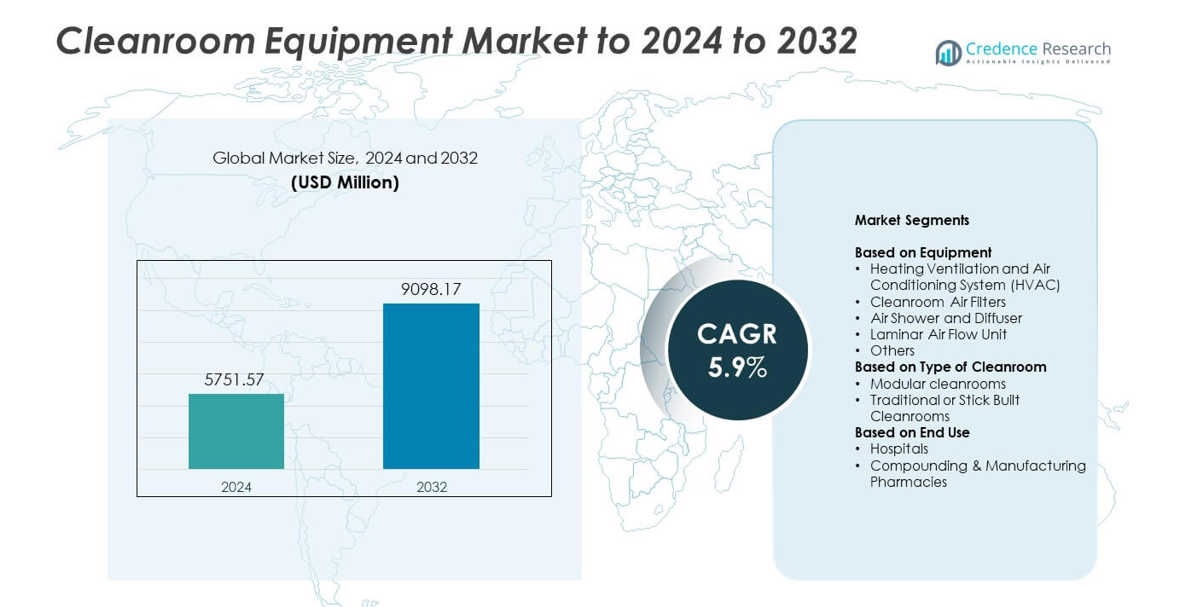
Cleanroom Equipment Market size was valued USD 5751.57 Million in 2024 and is anticipated to reach USD 9098.17 Million by 2032, at a CAGR of 5.9% during the forecast period.
| REPORT ATTRIBUTE | DETAILS |
|---|---|
| Historical Period | 2020-2023 |
| Base Year | 2024 |
| Forecast Period | 2025-2032 |
| Cleanroom Equipment Market Size 2024 | USD 5751.57 Million |
| Cleanroom Equipment Market, CAGR | 5.9% |
| Cleanroom Equipment Market Size 2032 | USD 9098.17 Million |
The cleanroom equipment market is led by prominent players such as Clean Air Products, Terra Universal, Inc., HVAX, Airomax Airborne LLC, Labconco, Integrated Cleanrooms Technologies Pvt. Ltd., MECART, Abtech, Angstrom Technology, and Cleanrooms Depot, Inc. These companies focus on developing advanced HVAC systems, filtration units, and modular cleanroom solutions that meet global contamination control standards. North America dominated the market with a 38.6% share in 2024, driven by strong demand from pharmaceutical, semiconductor, and biotechnology sectors. Europe followed with a 27.4% share, supported by stringent regulatory frameworks and technological advancements, while Asia Pacific captured 25.8%, fueled by rapid industrialization and growing healthcare investments.
Market Insights
- The cleanroom equipment market was valued at USD 5751.57 million in 2024 and is projected to reach USD 9098.17 million by 2032, registering a CAGR of 5.9% during the forecast period.
- Growing demand from pharmaceutical, biotechnology, and semiconductor sectors drives market expansion, supported by strict contamination control standards and rising investments in high-tech manufacturing facilities.
- Trends such as modular cleanroom adoption, IoT-enabled monitoring, and energy-efficient HVAC systems are reshaping industry operations and improving compliance efficiency.
- The market remains moderately consolidated, with key players focusing on automation, innovation, and regional expansion to strengthen competitiveness across diversified end-use industries.
- North America dominated the market with a 38.6% share in 2024, followed by Europe at 27.4% and Asia Pacific at 25.8%, while modular cleanrooms led by equipment type with a 63.4% share, reflecting a strong shift toward flexible and scalable infrastructure solutions.
Market Segmentation Analysis:
By Equipment
Heating Ventilation and Air Conditioning (HVAC) systems dominated the cleanroom equipment market with a 48.2% share in 2024. Their leadership stems from their essential role in maintaining temperature, humidity, and particulate control in critical environments. HVAC systems enable consistent airflow, filtration, and pressure regulation to ensure contamination-free operations in semiconductor, pharmaceutical, and biotechnology facilities. The demand for energy-efficient and digitally controlled HVAC units is rising as manufacturers prioritize sustainability and automation. Cleanroom air filters and laminar air flow units are also expanding due to tighter ISO standards and growing biopharma production capacity.
- For instance, Daikin Applied’s Custom Air Handler is rated up to 129,000 CFM, supporting high-airflow cleanroom HVAC needs.
By Type of Cleanroom
Modular cleanrooms accounted for 63.4% of the cleanroom equipment market in 2024, emerging as the dominant type. Their growth is driven by faster installation, scalability, and reduced operational downtime compared to traditional stick-built structures. Modular systems support flexible layouts and compliance with ISO and GMP standards, making them ideal for expanding production in pharmaceuticals and electronics. The increasing need for cost-efficient and easily upgradeable facilities further fuels adoption. Demand for modular solutions also benefits from growing investment in biologics and precision manufacturing sectors requiring rapid cleanroom deployment.
- For instance, Mecart, established in 1974, is a North American manufacturer specializing in controlled environments with a proven track record of more than 3,000 completed projects worldwide for various applications including cleanrooms, laboratories, and acoustic enclosures.
By End Use
Hospitals led the cleanroom equipment market with a 54.7% share in 2024. The dominance is attributed to the rising need for sterile environments in operating theaters, isolation wards, and diagnostic laboratories. Increased healthcare infrastructure spending and strict infection control regulations are propelling cleanroom installations. Additionally, the surge in compounding and manufacturing pharmacies is contributing to market growth as they adopt advanced air filtration and laminar flow systems for safe drug preparation. The emphasis on patient safety, contamination prevention, and regulatory compliance continues to strengthen hospital cleanroom demand globally.
Key Growth Drivers
Rising Demand from Pharmaceutical and Biotechnology Industries
The expansion of pharmaceutical and biotechnology sectors is a major driver of cleanroom equipment demand. Stringent regulatory standards from the FDA and EMA are pushing manufacturers to maintain sterile production environments. The increasing production of vaccines, biologics, and personalized medicines further accelerates cleanroom installations. Continuous investments in biopharmaceutical research and the rise of contract manufacturing organizations are enhancing the need for advanced HVAC, filtration, and monitoring systems to ensure contamination-free operations.
- For instance, Thermo Fisher’s Lebanon site includes 92,000 sq ft of cleanroom space for single-use bioprocess assemblies.
Increasing Semiconductor and Electronics Manufacturing Activities
The rapid growth of semiconductor and electronics manufacturing is boosting demand for cleanroom equipment globally. As chip fabrication requires ultra-clean environments, companies are expanding facilities with high-efficiency HVAC, laminar flow, and filtration units. The surge in demand for advanced chips used in AI, electric vehicles, and consumer electronics supports this trend. Technological innovation and government incentives for semiconductor self-reliance in Asia-Pacific and North America are further driving investments in controlled manufacturing spaces.
- For instance, Intel’s Ohio project phase includes 600,000 sq ft of cleanroom production space.
Expansion of Healthcare Infrastructure and Hospital Cleanrooms
Growing healthcare infrastructure investments worldwide are propelling the adoption of cleanroom equipment. Hospitals are increasingly installing sterile environments for surgical units, intensive care, and pharmaceutical compounding. Regulatory compliance with ISO and GMP standards is enhancing demand for air showers, diffusers, and air filtration systems. The rise in infectious diseases and medical research activities continues to emphasize the need for contamination control, making hospitals a key end-use sector for cleanroom technologies.
Key Trends and Opportunities
Integration of IoT and Automation in Cleanroom Systems
The adoption of IoT-enabled monitoring and automated systems is transforming cleanroom operations. Smart sensors are increasingly used to track air quality, pressure differentials, and particulate levels in real time. Automation enhances efficiency by reducing manual intervention and minimizing contamination risks. Manufacturers are leveraging data analytics to optimize energy use and predictive maintenance, reducing operational costs. The integration of digital control systems is creating new opportunities for vendors offering intelligent and energy-efficient cleanroom equipment.
- For instance, the TSI AeroTrak® 7110 remote particle counter operates at a 1 CFM flow rate, accurately measures particles from 0.1 to 10 µm, and supports both Ethernet (TCP/IP) and serial Modbus RTU connectivity for seamless facility monitoring system integration.
Rising Focus on Energy Efficiency and Sustainability
Sustainability is emerging as a major trend in cleanroom design and equipment manufacturing. Companies are prioritizing low-energy HVAC systems, recyclable materials, and modular setups to reduce carbon emissions. Governments and regulatory agencies are encouraging green certifications, promoting the use of energy recovery units and high-efficiency filters. The growing emphasis on sustainable manufacturing processes across industries presents long-term opportunities for cleanroom equipment suppliers focused on eco-friendly innovations.
- For instance, Camfil’s Absolute V HEPA range reaches H14 efficiency at 99.995% MPPS and handles airflows above 3,400 m³/h.
Increasing Adoption of Modular Cleanroom Solutions
The modular cleanroom trend continues to gain momentum due to flexibility and cost-effectiveness. Industries prefer modular systems for faster installation, scalability, and ease of maintenance. These setups allow seamless upgrades and reconfiguration to meet evolving production needs. The approach supports faster facility expansion in pharmaceuticals, electronics, and healthcare sectors. This growing shift toward modularity provides manufacturers with opportunities to deliver standardized yet customizable cleanroom equipment solutions worldwide.
Key Challenges
High Initial Investment and Maintenance Costs
The significant upfront costs associated with cleanroom construction and equipment installation pose a major challenge. Maintaining optimal operational standards also demands regular servicing and calibration of HVAC systems, filters, and monitoring devices. Small and mid-sized enterprises often face budget constraints, limiting adoption. Additionally, compliance with evolving ISO and GMP regulations adds to the cost burden. Balancing quality control with affordability remains a key barrier to broader market penetration, particularly in developing economies.
Shortage of Skilled Workforce for Cleanroom Operations
Operating and maintaining cleanroom environments requires trained professionals with technical expertise in contamination control and system management. The global shortage of skilled technicians is affecting operational efficiency across industries such as pharmaceuticals, electronics, and healthcare. Inadequate training programs and limited awareness of cleanroom protocols contribute to system inefficiencies. Companies are increasingly investing in workforce development and digital training platforms to overcome this talent gap, but the shortage continues to restrain market growth.
Regional Analysis
North America
North America dominated the cleanroom equipment market with a 38.6% share in 2024. The region’s growth is driven by strong pharmaceutical production, advanced semiconductor fabrication, and expanding biotechnology research. The United States leads with major investments in vaccine manufacturing, life sciences facilities, and chip fabrication plants supported by the CHIPS and Science Act. Increased adoption of energy-efficient HVAC systems and high-performance filtration units also supports market expansion. Canada’s growing medical device and pharmaceutical sectors further contribute to regional demand for modular and compliant cleanroom solutions.
Europe
Europe held a 27.4% share of the cleanroom equipment market in 2024, supported by the region’s focus on stringent regulatory compliance and technological advancement. Countries such as Germany, the United Kingdom, and France are leading in pharmaceutical and biomanufacturing cleanroom adoption. The European Union’s emphasis on GMP standards and clean production facilities strengthens equipment demand. Rising semiconductor production in countries like Ireland and the Netherlands is also boosting the need for precision air control systems. Investments in green and energy-efficient cleanroom solutions further shape regional market development.
Asia Pacific
Asia Pacific accounted for 25.8% of the cleanroom equipment market in 2024, emerging as one of the fastest-growing regions. The expansion of electronics, semiconductor, and pharmaceutical manufacturing in China, Japan, South Korea, and India is driving demand. Government incentives supporting chip fabrication and biopharma facilities fuel investments in advanced HVAC and filtration systems. Rapid industrialization, increasing healthcare infrastructure, and adoption of modular cleanrooms are strengthening regional market growth. The rise in foreign investments and partnerships is further supporting cleanroom equipment suppliers across major Asia Pacific economies.
Latin America
Latin America represented 5.2% of the cleanroom equipment market in 2024. The region’s growth is led by expanding pharmaceutical and healthcare sectors, particularly in Brazil and Mexico. Rising government initiatives to enhance drug manufacturing quality and export competitiveness are promoting cleanroom adoption. The increasing establishment of local production facilities for generics and vaccines supports equipment demand. Gradual adoption of modular cleanroom systems and growing awareness of contamination control practices are fostering steady market growth across Latin American countries despite budgetary constraints.
Middle East and Africa
The Middle East and Africa accounted for 3.0% of the cleanroom equipment market in 2024. The region is witnessing gradual growth due to expanding healthcare infrastructure and investments in biotechnology and pharmaceutical manufacturing. The United Arab Emirates and Saudi Arabia are leading in developing advanced medical facilities and research centers adhering to ISO cleanroom standards. Growing collaborations with international cleanroom suppliers are improving market accessibility. Although adoption remains limited compared to other regions, rising focus on healthcare modernization and industrial diversification is expected to drive future demand.
Market Segmentations:
By Equipment
- Heating Ventilation and Air Conditioning System (HVAC)
- Cleanroom Air Filters
- Air Shower and Diffuser
- Laminar Air Flow Unit
- Others
By Type of Cleanroom
- Modular cleanrooms
- Traditional or Stick Built Cleanrooms
By End Use
- Hospitals
- Compounding & Manufacturing Pharmacies
By Geography
- North America
- U.S.
- Canada
- Mexico
- Europe
- Germany
- France
- U.K.
- Italy
- Spain
- Rest of Europe
- Asia Pacific
- China
- Japan
- India
- South Korea
- South-east Asia
- Rest of Asia Pacific
- Latin America
- Brazil
- Argentina
- Rest of Latin America
- Middle East & Africa
- GCC Countries
- South Africa
- Rest of the Middle East and Africa
Competitive Landscape
The cleanroom equipment market features key players such as Clean Air Products, Terra Universal, Inc., HVAX, Airomax Airborne LLC, Labconco, Integrated Cleanrooms Technologies Pvt. Ltd., MECART, Abtech, Angstrom Technology, and Cleanrooms Depot, Inc. The market is characterized by strong competition focused on product innovation, compliance with ISO and GMP standards, and technological advancement in HVAC and air filtration systems. Companies are investing in modular equipment designs, energy-efficient solutions, and automation technologies to improve operational performance and sustainability. Strategic partnerships, mergers, and global expansions are helping vendors strengthen their supply chain capabilities and regional presence. Increasing demand from the pharmaceutical, semiconductor, and biotechnology sectors encourages continuous R&D to enhance cleanroom safety and precision. The integration of IoT-based monitoring systems and digital control technologies is emerging as a key differentiator, enabling real-time environmental management and predictive maintenance for improved reliability and efficiency in cleanroom operations.
Key Player Analysis
- Clean Air Products
- Terra Universal, Inc.
- HVAX
- Airomax Airborne LLC
- Labconco
- Integrated Cleanrooms Technologies Pvt. Ltd.
- MECART
- Abtech
- Angstrom Technology
- Cleanrooms Depot, Inc.
Recent Developments
- In 2024, Labconco launched redesigned Logic Biosafety Cabinets that feature an updated operating system (MyLogic OS or Logic OS) with status-lite airflow cues and airflow verification from the front window on an eye-level, line-of-sight touchscreen display, aimed at simpler, safer operation.
- In 2024, HVAX expanded its Mumbai HQ footprint and completed a landmark oncology cleanroom project in Nigeria.
- In 2023, Terra Universal launched a new line of pass-through cleanroom cabinets with integrated interlock systems, designed to reduce contamination during material transfers across clean zones.
Report Coverage
The research report offers an in-depth analysis based on Equipment, Type of Cleanroom, End-Use and Geography. It details leading market players, providing an overview of their business, product offerings, investments, revenue streams, and key applications. Additionally, the report includes insights into the competitive environment, SWOT analysis, current market trends, as well as the primary drivers and constraints. Furthermore, it discusses various factors that have driven market expansion in recent years. The report also explores market dynamics, regulatory scenarios, and technological advancements that are shaping the industry. It assesses the impact of external factors and global economic changes on market growth. Lastly, it provides strategic recommendations for new entrants and established companies to navigate the complexities of the market.
Future Outlook
- The cleanroom equipment market will continue expanding due to growth in semiconductor and pharmaceutical manufacturing.
- Increasing adoption of modular cleanroom systems will enhance flexibility and scalability across industries.
- Automation and IoT integration will improve real-time monitoring and operational efficiency in cleanroom facilities.
- Energy-efficient HVAC and filtration technologies will gain traction to meet sustainability goals.
- Rising investments in biologics and vaccine production will create consistent demand for sterile environments.
- Asia Pacific will emerge as a major hub for cleanroom equipment production and installation.
- Regulatory compliance and GMP standards will drive continuous upgrades in cleanroom infrastructure.
- Demand for contamination-free spaces in hospitals and laboratories will grow with healthcare advancements.
- Manufacturers will focus on AI-based predictive maintenance and smart air management systems.
- Strategic collaborations and mergers among key players will accelerate technological innovation and market expansion.

Request a Free Sample
Fill in your details and we'll send you a free sample report.
- Sample data tables & charts
- Research methodology
Need a Custom Version of This Report?
Tailor the scope, geography, or segments to your exact requirements.
- Custom geography or segment scope
- Direct access to our analyst team
Frequently Asked Questions
What is the current market size for Cleanroom Equipment Market, and what is its projected size in 2032?
At what Compound Annual Growth Rate is the Cleanroom Equipment Market projected to grow between 2025 and 2032?
Which Cleanroom Equipment Market segment held the largest share in 2024?
What are the primary factors fueling the growth of the Cleanroom Equipment Market?
Who are the leading companies in the Cleanroom Equipment Market?
Which region commanded the largest share of the Cleanroom Equipment Market in 2024?
Table of Content
Chapter 1 Market Segmentation
- 1.1 Segmentation Framework
- 1.1.1 Product and Service Classification
- 1.1.2 Application and End-Use Classification
- 1.1.3 Technology and Solution Classification
- 1.1.4 Customer and Distribution Channel Classification
- 1.1.5 Geographic Segmentation
- 1.1.6 Market Segment Definitions and Boundaries
Chapter 2 Introduction
- 2.1 Report Objectives and Scope
- 2.2 Product Definition and Industry Terminology
- 2.3 Market Inclusions and Exclusions
- 2.4 Research Process
- 2.4.1 Primary Research and Expert Interviews
- 2.4.2 Secondary Research and Source Review
- 2.4.3 Top-Down and Bottom-Up Estimation
- 2.4.4 Data Triangulation and Verification
- 2.5 Market Size Measurement Basis
- 2.5.1 2024: USD 5751.57 million → 2032: USD 9098.17 million
- 2.6 Historical and Forecast Reference Periods
- 2.6.1 Base Year: 2024
- 2.6.2 Forecast Period: 2024-2032
- 2.7 Research Assumptions and Limitations
Chapter 3 Executive Summary
- 3.1 Market Snapshot and Key Findings
- 3.2 Base-Year Market Size, 2024
- 3.3 Forecast Market Size, 2032
- 3.4 Revenue and Volume Growth Outlook
- 3.5 Key Demand and Supply Indicators
- 3.6 Leading Market Segments
- 3.7 Fastest-Growing Market Opportunities
- 3.8 Regional Performance Highlights
- 3.9 Technology and Industry Transformation
- 3.10 Competitive Landscape Summary
- 3.11 Analyst View and Strategic Implications
Chapter 4 Global Cleanroom Equipment Market Trends and Developments
- 4.1 Historical Industry Development
- 4.2 Recent Market Trends and Developments
- 4.3 Demand and Customer Behavior Trends
- 4.4 Technology and Product Innovation
- 4.5 Artificial Intelligence, Automation and Digitalization
- 4.6 Local Manufacturing and Supply Chain Realignment
- 4.7 Industry Partnerships, Mergers and Acquisitions
- 4.8 Sustainability and Circular Economy Developments
- 4.9 Government and Private Sector Investment Trends
- 4.10 Emerging Business Models and Commercialization
- 4.11 Industry Developments and Announcements
Chapter 5 Global Cleanroom Equipment Market Production, Supply and Demand Analysis
- 5.1 Demand Trend and Consumption Analysis
- 5.2 Demand Forecast, 2024-2032
- 5.3 Production and Output Trend
- 5.4 Production and Output Forecast, 2024-2032
- 5.5 Installed Capacity and Capacity Utilization
- 5.6 Company-Wise Production Plants and Statistics
- 5.6.1 Installed Production Capacity
- 5.6.2 Actual Production
- 5.6.3 Planned Capacity and Expansion Targets
- 5.7 Supply Chain Structure and Procurement Trends
- 5.8 Supply-Demand Gap and Bottlenecks
- 5.9 Import Dependence and Sourcing Structure
- 5.10 Contract Manufacturing and Outsourcing
- 5.11 Regional Supply and Demand Concentration
Chapter 6 Global Cleanroom Equipment Market Pricing Analysis
- 6.1 Pricing Structure and Measurement
- 6.2 Historical Pricing Trends
- 6.3 Pricing Outlook, 2024-2032
- 6.4 Average Selling Price and Unit Economics
- 6.5 Pricing by Product and Market Segment
- 6.6 Geographic Pricing Differences
- 6.7 Key Input, Energy, Labor and Logistics Costs
- 6.8 Contract Pricing and Purchasing Models
- 6.9 Pricing Sensitivity and Competitive Positioning
- 6.10 Price, Margin and Profitability Implications
Chapter 7 Global Cleanroom Equipment Market Dynamics
- 7.1 Market Growth Drivers
- 7.1.1 Demand-Side Drivers
- 7.1.2 Technology and Innovation Drivers
- 7.1.3 Infrastructure and Investment Drivers
- 7.1.4 Regulatory and Policy Drivers
- 7.2 Market Restraints
- 7.2.1 Cost and Affordability Constraints
- 7.2.2 Technology and Adoption Barriers
- 7.2.3 Supply Chain and Operational Constraints
- 7.3 Market Challenges
- 7.3.1 Competitive Pressure and Margin Erosion
- 7.3.2 Skills, Infrastructure and Implementation Gaps
- 7.4 Emerging Market Opportunities
- 7.5 Market Dynamics Impact and Time-Horizon Assessment
Chapter 8 Global Cleanroom Equipment Value Chain Analysis
- 8.1 Industry Value Chain Overview
- 8.2 Upstream Suppliers and Critical Inputs
- 8.3 Technology and Component Providers
- 8.4 Manufacturing or Service Delivery
- 8.5 Distribution, Channel Partners and Integrators
- 8.6 Downstream Applications and End Users
- 8.7 Value Addition and Profit Pools
- 8.8 Vertical Integration and Outsourcing
- 8.9 Supplier Concentration and Risk
- 8.10 Supply Chain Localization and Resilience
Chapter 9 Global Cleanroom Equipment Market Regulations and Policies
- 9.1 Relevant Laws, Standards and Compliance Frameworks
- 9.2 Product, Service, Safety and Quality Requirements
- 9.3 Government Policies, Incentives and Subsidies
- 9.4 Imports, Exports and Trade Barriers
- 9.5 Public Procurement and Local Content Requirements
- 9.6 Environmental and Sustainability Compliance
- 9.7 Upcoming Policy Changes and Market Implications
Chapter 10 Global Cleanroom Equipment Market Hotspots and Opportunities
- 10.1 Market Opportunity Mapping and Growth Hotspots
- 10.2 High-Growth Applications and Customer Groups
- 10.3 Underserved Markets and White-Space Opportunities
- 10.4 Emerging Technology and Product Opportunities
- 10.5 New Capacity and Investment Hotspots
- 10.6 Market Entry and Expansion Opportunities
- 10.7 Distribution and Partnership Opportunities
- 10.8 Near-Term and Long-Term Commercial Potential
- 10.9 Opportunity Attractiveness and Execution Risks
Chapter 11 Global Cleanroom Equipment Market Outlook, 2024-2032
- 11.1 Market Size and Analysis
- 11.1.1 Revenue (Market Measurement: 2024: USD 5751.57 million → 2032: USD 9098.17 million)
- 11.1.2 Market Volume and Quantity Sold
- 11.1.3 Historical Market Size
- 11.1.4 Base-Year Market Size, 2024
- 11.2 Market Forecast, 2024-2032
- 11.2.1 Revenue Forecast to 2032
- 11.2.2 Volume Forecast to 2032
- 11.2.3 CAGR and Year-on-Year Growth
- 11.2.4 Incremental Revenue Opportunity
- 11.3 Forecast Assumptions and Scenario Analysis
- 11.3.1 Base-Case Forecast
- 11.3.2 Optimistic and Conservative Scenarios
- 11.3.3 Technology, Pricing and Policy Sensitivities
- 11.4 Market Attractiveness and Growth Outlook
Chapter 12 Global Cleanroom Equipment Market Segmentation and Outlook
- 12.1 Segmentation Summary and Market Shares, 2024
- 12.2 Largest and Fastest-Growing Segments
- 12.3 Segment Growth Comparison
- 12.4 Segment Attractiveness and Priority Matrix
Chapter 13 Global Cleanroom Equipment Geographic Market Outlook, 2024-2032
- 13.1 Regional Market Size and Share, 2024
- 13.2 Regional Market Forecast, 2024-2032
- 13.3 Regional Pricing, Production and Demand Differences
- 13.4 North America
- 13.4.1 United States
- 13.4.2 Canada
- 13.4.3 Mexico
- 13.5 Europe
- 13.5.1 Germany
- 13.5.2 France
- 13.5.3 Italy
- 13.5.4 United Kingdom
- 13.5.5 Spain
- 13.5.6 Poland
- 13.5.7 Russia
- 13.5.8 Netherlands
- 13.5.9 Belgium
- 13.5.10 Sweden
- 13.5.11 Denmark
- 13.5.12 Norway
- 13.5.13 Rest of Europe
- 13.6 Asia Pacific
- 13.6.1 China
- 13.6.2 India
- 13.6.3 Japan
- 13.6.4 South Korea
- 13.6.5 Thailand
- 13.6.6 Indonesia
- 13.6.7 Vietnam
- 13.6.8 Malaysia
- 13.6.9 Australia
- 13.6.10 Rest of Asia Pacific
- 13.7 Latin America
- 13.7.1 Brazil
- 13.7.2 Argentina
- 13.7.3 Colombia
- 13.7.4 Chile
- 13.7.5 Rest of Latin America
- 13.8 Middle East
- 13.8.1 Saudi Arabia
- 13.8.2 United Arab Emirates
- 13.8.3 Turkey
- 13.8.4 Israel
- 13.8.5 Iran
- 13.8.6 Rest of the Middle East
- 13.9 Africa
- 13.9.1 South Africa
- 13.9.2 Egypt
- 13.9.3 Nigeria
- 13.9.4 Morocco
- 13.9.5 Rest of Africa
- 13.10 Regional Investment, Policy and Supply Chain Differences
- 13.11 Regional Competitive Landscape
- 13.12 Geographic Growth Hotspots
Chapter 14 Global Cleanroom Equipment Technology, Innovation and Sustainability Outlook
- 14.1 Technology Landscape and Maturity
- 14.2 Product, Process and Service Innovation
- 14.3 AI, Automation and Digital Tools in the Industry
- 14.4 Technology Adoption and Performance Benchmarking
- 14.5 Innovation Pipeline and R&D Investment
- 14.6 Patent and Intellectual Property Trends
- 14.7 Energy Efficiency and Resource Management
- 14.8 Sustainability, Recycling and Circularity
- 14.9 Technology Roadmap, 2024-2032
- 14.10 Risks of Obsolescence and Technology Substitution
Chapter 15 Global Cleanroom Equipment Market Key Strategic Imperatives
- 15.1 Growth and Market Entry Priorities
- 15.2 High-Return Products and Segments
- 15.3 Pricing, Profitability and Cost Optimization
- 15.4 Technology Investment and Product Differentiation
- 15.5 Supply Chain Localization and Resilience
- 15.6 Distribution and Customer Acquisition
- 15.7 Partnership, Acquisition and Capacity Strategy
- 15.8 Regional Expansion Priorities
- 15.9 Short-, Medium- and Long-Term Actions
Chapter 16 Competition Outlook
- 16.1 Industry Competition Characteristics
- 16.2 Market Structure and Concentration
- 16.3 Market Share and Competitive Positioning, 2024
- 16.4 Company-Wise Revenue and Product Benchmarking
- 16.5 Production and Service Capacity Benchmarking
- 16.6 Technology, Pricing and Differentiation
- 16.7 Regional Footprint and Distribution Strength
- 16.8 Mergers, Acquisitions and Strategic Alliances
- 16.9 New Entrants and Competitive Threats
- 16.10 Porter's Five Forces and Industry Attractiveness
- 16.11 Competitive Outlook, 2024-2032
Chapter 17 Company Profiles
- 17.1 Company Coverage and Selection Criteria
- 17.2 Leading Market Participants – Standard Profile Structure
- 17.2.1 Business Description
- 17.2.2 Company Ownership and Geographic Presence
- 17.2.3 Product and Service Portfolio
- 17.2.4 Manufacturing and Operating Footprint
- 17.2.5 Production Capacity and Expansion Plans
- 17.2.6 Financial Performance and Investment
- 17.2.7 Market Share and Competitive Position
- 17.2.8 Technology and Innovation Capabilities
- 17.2.9 Strategic Alliances or Partnerships
- 17.2.10 Recent Developments
- 17.2.11 Growth Strategy and Outlook
- 17.3 Other Relevant Market Participants
Note: Every listed company is profiled on the structure shown under the first company. The company list is preliminary and may change based on research findings, market developments, data availability and client requirements.
Chapter 18 Disclaimer
- 18.1 Research and Forecast Disclaimer
- 18.2 Data Source and Estimation Limitations
Note: The depth of individual sections depends on data availability for this market. Volume, capacity, trade and other unit-based metrics are included where applicable.
