Market Overview:
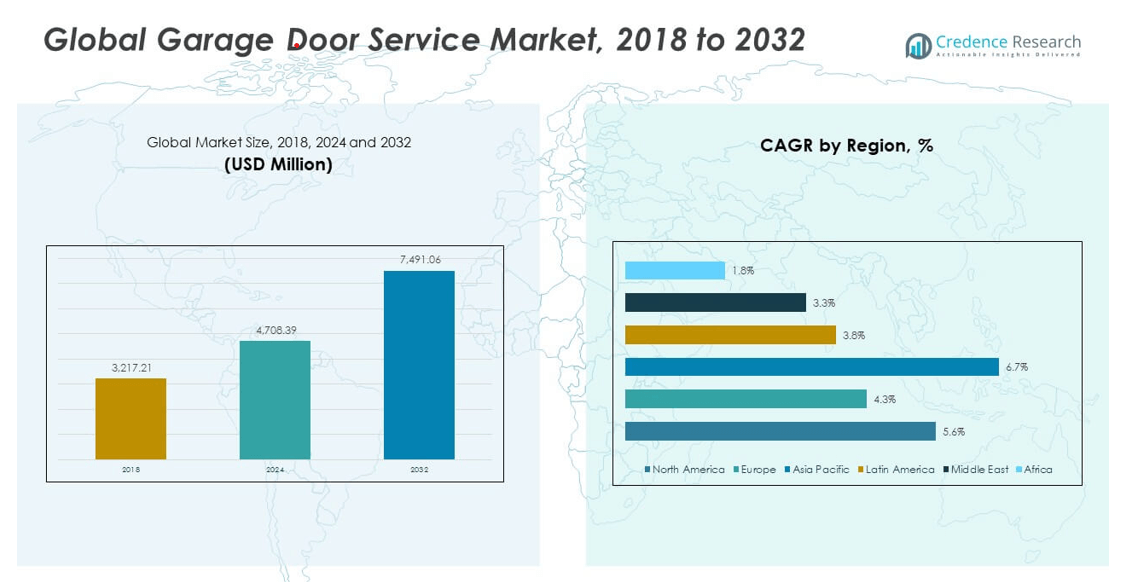
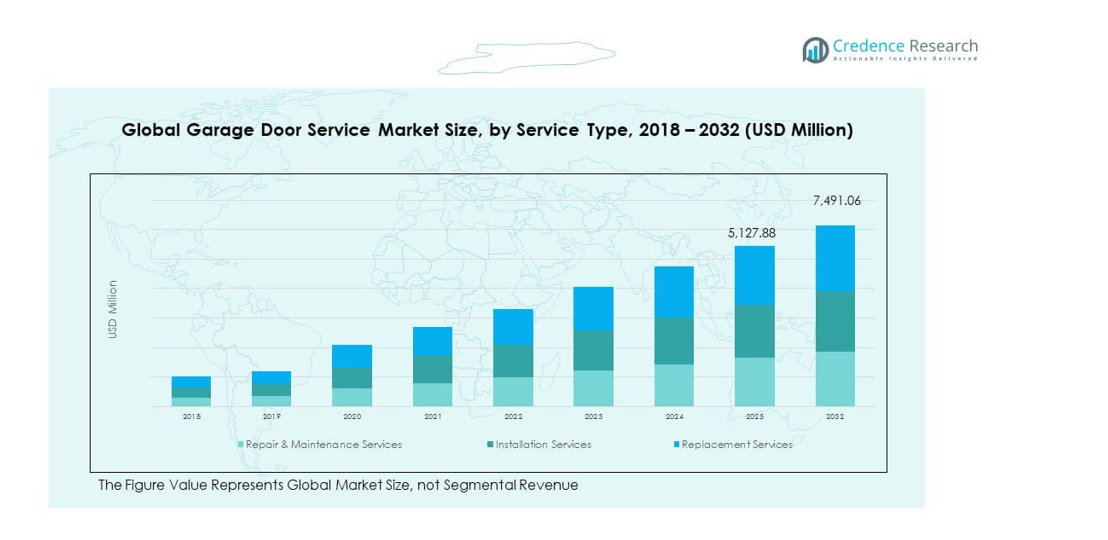
The Global Garage Door Service Market size was valued at USD 3,217.21 million in 2018, growing to USD 4,708.39 million in 2024, and is anticipated to reach USD 7,491.06 million by 2032, at a CAGR of 5.56% during the forecast period.
| REPORT ATTRIBUTE | DETAILS |
|---|---|
| Historical Period | 2020-2023 |
| Base Year | 2024 |
| Forecast Period | 2025-2032 |
| Garage Door Service Market Size 2024 | USD 4,708.39 million |
| Garage Door Service Market, CAGR | 5.56% |
| Garage Door Service Market Size 2032 | USD 7,491.06 million |
The market growth is driven by rising home renovation projects, expansion of residential construction, and demand for automated garage systems. Increasing urbanization and rising disposable incomes are encouraging property owners to invest in smart garage solutions. Service providers are expanding offerings like repair, installation, and preventive maintenance to meet safety and energy efficiency standards, supporting steady global demand for both residential and commercial users.
Regionally, North America dominates due to widespread smart home adoption and established maintenance networks. Europe follows with strong demand for energy-efficient and insulated garage systems. Asia-Pacific is emerging rapidly, supported by urban expansion, industrial development, and rising middle-class income in countries such as China, India, and Japan. Growing investments in infrastructure and real estate modernization continue to fuel demand across these regions.
Market Insights:
- The Global Garage Door Service Market was valued at USD 3,217.21 million in 2018, increased to USD 4,708.39 million in 2024, and is projected to reach USD 7,491.06 million by 2032, registering a CAGR of 5.56% during the forecast period.
- North America leads with 43.7% share due to advanced home automation, high renovation activity, and strong service infrastructure, followed by Asia Pacific (30%) and Europe (18.2%), supported by industrial expansion and safety compliance.
- Asia Pacific represents the fastest-growing region with a 6.7% CAGR, driven by rapid urbanization, expanding construction projects, and increasing adoption of smart and energy-efficient garage systems.
- Repair & Maintenance Services hold the largest share at 48%, supported by consistent demand for safety compliance, preventive upkeep, and equipment lifespan extension across residential and commercial facilities.
- Installation Services and Replacement Services collectively account for 52%, driven by rising automation adoption, energy-efficient upgrades, and growing construction of new residential and commercial complexes.
Market Drivers:
Rising Adoption of Smart Garage Systems and Automation Technologies
The Global Garage Door Service Market expands due to growing adoption of smart automation technologies across residential and commercial properties. Homeowners seek Wi-Fi-enabled systems offering mobile control, remote diagnostics, and real-time security alerts. Companies integrate sensors and AI-based modules for predictive maintenance and improved safety. Smart garages reduce manual operations, enhancing convenience for users. Technological improvements also drive upgrades from traditional models to modern connected units. Service providers gain recurring revenue through software integration and annual maintenance packages. Expansion of the smart home ecosystem supports increased installation demand. Consumer preference for connected living environments continues strengthening market momentum.
- For instance, the myQ platform now supports in-garage delivery partnerships with Walmart Inc., where one in five U.S. households already include myQ-smart garage technology.
Increasing Residential and Commercial Construction Activities Worldwide
Rising global construction activities strongly support the Global Garage Door Service Market. Growing urbanization leads to more residential complexes, commercial facilities, and industrial warehouses requiring maintenance services. Builders and contractors prefer long-term service agreements to ensure reliability and safety compliance. Expanding real estate development, especially in emerging economies, supports sustained service demand. Home improvement and renovation projects in developed markets create recurring opportunities for replacements and upgrades. Construction of logistics hubs, retail centers, and automotive workshops further fuels installation and maintenance requirements. Property owners focus on energy efficiency and operational longevity, increasing maintenance intervals. Service companies expand portfolios to address diverse structural and automation needs.
- For instance, the expansion of e-commerce logistics hubs drives installation of high-cycle doors with remote diagnostics-LiftMaster’s MAXUM line offers up-to 12-inch-per-second opening speed, addressing such logistical demands.
Growing Focus on Safety Standards and Preventive Maintenance Requirements
Regulatory authorities enforce strict safety norms, driving growth in the Global Garage Door Service Market. End users increasingly prioritize certified technicians for inspections, part replacements, and mechanical testing. Accidents caused by malfunctioning doors raise awareness about regular servicing. Preventive maintenance programs minimize equipment failures and extend operational life. Technicians rely on IoT-enabled monitoring systems for proactive fault detection. Insurance policies and safety audits often require proof of scheduled maintenance, supporting steady service demand. Facility managers in healthcare and hospitality sectors emphasize compliance to avoid disruptions. These factors collectively build long-term client relationships and ensure stable market growth.
Expansion of Aftermarket Services and Technological Upgrades by Leading Providers
Rising adoption of aftermarket solutions accelerates the Global Garage Door Service Market. Key providers introduce customized maintenance packages including predictive repair, remote monitoring, and performance analytics. Upgrades in control panels and mechanical systems extend operational lifespan of existing installations. Companies invest in digital platforms for appointment booking and service tracking. Online visibility enhances brand reliability and customer trust. Industrial users benefit from real-time alerts and scheduled inspection programs improving operational uptime. Automation integration in maintenance tools reduces manual intervention and improves diagnostic accuracy. These efforts position aftermarket services as an essential growth contributor.
Market Trends:
Integration of IoT and Cloud Connectivity in Maintenance Platforms
IoT and cloud technology integration defines the modern evolution of the Global Garage Door Service Market. Cloud-connected systems allow service providers to perform remote diagnostics and software updates efficiently. Predictive analytics identify wear patterns and recommend optimal service schedules. IoT sensors collect real-time data on door cycles, motor health, and temperature variations. Companies deploy cloud dashboards for clients to track performance and maintenance status. Integration improves transparency and reduces unplanned downtimes. Partnerships between hardware manufacturers and digital platforms enhance value-added services. Continuous innovation in connected technologies is reshaping operational standards across the sector.
- For instance, smart-home sensors track door cycles, motor health and temperature variations using cloud dashboards. IoT sensors collect real-time data, enabling technicians to monitor garage doors proactively. Companies deploy cloud dashboards for clients to track performance and maintenance status. Integration improves transparency and reduces unplanned downtimes.
Growing Demand for Eco-Friendly and Energy-Efficient Garage Systems
Environmental awareness shapes trends in the Global Garage Door Service Market. Consumers prefer insulated doors and energy-efficient openers that minimize heat loss and power consumption. Manufacturers introduce recyclable materials and low-emission coatings to align with sustainability goals. Service providers promote green retrofitting options to extend product lifespan. Eco-certification and environmental compliance increase customer preference for responsible brands. Energy-saving upgrades also lower operating costs for large facilities. Maintenance programs now include checks on insulation integrity and sensor calibration. The push toward sustainable infrastructure supports ongoing service innovation and product diversification.
Rising Popularity of Subscription-Based and Predictive Maintenance Models
Subscription and predictive maintenance models gain traction in the Global Garage Door Service Market. Businesses and homeowners seek cost predictability through fixed-rate service plans. These contracts include regular inspections, emergency support, and remote assistance. Predictive analytics detect mechanical stress before component failure, improving service efficiency. Digital monitoring tools record usage data and alert technicians in real time. Providers benefit from recurring revenue streams while customers gain enhanced safety assurance. The shift from reactive to predictive approaches reduces downtime and repair costs. Growing preference for continuous service relationships drives digital transformation across the industry.
Adoption of AI-Powered Diagnostics and Automated Service Tools
AI-based diagnostics are reshaping the operational framework of the Global Garage Door Service Market. Artificial intelligence identifies minor mechanical deviations that precede breakdowns. Automated systems support technicians with guided repair suggestions and component health scoring. Machine learning models improve accuracy of fault detection and inventory planning. Companies deploy AI chatbots and virtual assistants to schedule maintenance visits efficiently. Automated service management reduces operational delays and human error. Integration with augmented reality tools helps technicians perform complex tasks with precision. These digital advancements redefine service quality and customer experience standards.
Market Challenges Analysis:
High Installation Costs and Limited Skilled Workforce Availability
High initial installation and service costs present challenges for the Global Garage Door Service Market. Advanced automated systems require expensive components and specialized labor. Many small-scale property owners postpone upgrades due to affordability concerns. The shortage of certified technicians affects service timelines and quality consistency. Regional disparities in skill availability increase dependency on urban contractors. Training programs lag behind technological advancements, creating a service delivery gap. Companies must invest in technician certification and digital training tools. Rising operational costs in material sourcing and logistics also add pricing pressure across markets.
Cybersecurity Risks and Data Management Concerns in Connected Systems
Expanding digital integration exposes the Global Garage Door Service Market to cybersecurity challenges. IoT-enabled garage systems store sensitive access data vulnerable to hacking or unauthorized control. Inadequate encryption standards can lead to potential breaches affecting user trust. Service providers face increasing responsibility for secure data transmission and storage. Regulatory frameworks demand strict compliance with privacy laws and data protection standards. Companies must implement multi-layer authentication and regular software patching. Limited awareness among end users about security configurations heightens vulnerability risks. Strengthening digital infrastructure remains essential to ensure user safety and regulatory compliance.
Market Opportunities:
Expansion of Service Portfolios Across Emerging Residential and Industrial Regions
Emerging economies create strong growth prospects for the Global Garage Door Service Market. Urbanization drives residential projects requiring installation, repair, and automation services. Industrial development in logistics and manufacturing boosts demand for high-performance doors. Companies expanding into Asia-Pacific, Latin America, and Africa gain new customer bases. Partnerships with local distributors and builders improve accessibility and brand recognition. Government housing initiatives enhance large-scale service requirements. Market participants offering rapid response support and tailored solutions gain competitive advantage. Growing awareness of safety and energy efficiency further amplifies expansion potential.
Rising Investments in AI-Based Platforms and Digital Service Infrastructure
Investments in digital platforms and AI-driven analytics present major opportunities for the Global Garage Door Service Market. Companies leverage automation to optimize maintenance schedules and resource allocation. Real-time analytics improve accuracy of fault prediction and inventory control. Integration of customer portals enhances transparency and convenience. Collaboration with software providers strengthens data management and security standards. AI-enabled tools reduce manual intervention while improving diagnostic precision. Market players developing scalable service management platforms attract long-term enterprise clients. Growing preference for digital-first solutions is expected to reshape competitive dynamics in coming years.
Market Segmentation Analysis:
By Service Type
The Global Garage Door Service Market is segmented into repair & maintenance services, installation services, and replacement services. Repair & maintenance services hold a major share due to growing emphasis on preventive maintenance and safety compliance across residential and commercial facilities. Routine inspections, component lubrication, and spring balancing support extended product life and operational reliability. Installation services grow steadily with the increasing adoption of automated and smart garage systems in new buildings. The demand for energy-efficient and insulated doors also strengthens installation volumes. Replacement services expand with aging infrastructure and customer preference for modern designs with advanced security features. Service providers focus on quick response and quality assurance to retain customer loyalty. The diversification of offerings across these segments ensures stable growth across developed and emerging regions.
- For instance, Chamberlain Group reports supporting over 50 million homes globally through its myQ ecosystem, enabling faster returns and fewer service bottlenecks. Installation services grow steadily with the increasing adoption of automated and smart garage systems in new buildings.
By End-User
Residential users represent the leading segment driven by home renovation projects, urban housing expansion, and integration of smart access systems. Rising awareness of property safety and convenience boosts demand for automated maintenance programs. Homeowners seek reliable service providers for installation and upgrades to enhance aesthetic and operational value. The commercial segment records significant momentum due to the expansion of warehouses, retail spaces, and logistics centers. Facility managers invest in regular servicing to maintain uptime and reduce safety risks. It continues to gain traction through service contracts and technology-driven upgrades, ensuring sustained revenue across multiple verticals.
- For instance, LiftMaster markets its MAXUM commercial door operators with built-in Wi-Fi diagnostics and error logging tailored for high-cycle commercial use. Facility managers invest in regular servicing to maintain uptime and reduce safety risks.
Segmentation:
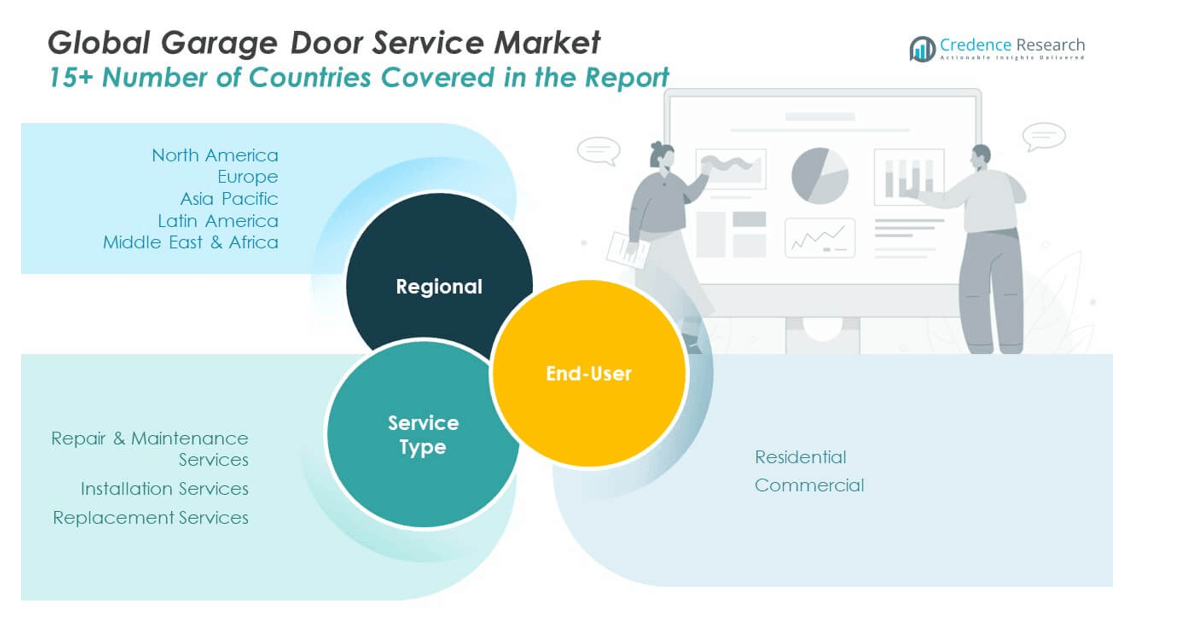
By Service Type
- Repair & Maintenance Services
- Installation Services
- Replacement Services
By End-User
- Residential
- Commercial
Country-Level Segments Include:
- North America
- U.S.
- Canada
- Mexico
- Europe
- Germany
- France
- U.K.
- Italy
- Spain
- Rest of Europe
- Asia Pacific
- China
- Japan
- India
- South Korea
- South-east Asia
- Rest of Asia Pacific
- Latin America
- Brazil
- Argentina
- Rest of Latin America
- Middle East & Africa
- GCC Countries
- South Africa
- Rest of the Middle East and Africa
Regional Analysis:
North America
The North America Garage Door Service Market size was valued at USD 1,419.54 million in 2018 to USD 2,056.15 million in 2024 and is anticipated to reach USD 3,280.33 million by 2032, at a CAGR of 5.6% during the forecast period. North America holds the largest share of the Global Garage Door Service Market, accounting for nearly 43.7% of the total revenue. The region benefits from high adoption of smart home technologies, frequent renovations, and strict building safety standards. The United States leads due to its mature housing sector and large base of automated garage installations. Service providers in Canada and Mexico expand through preventive maintenance and modernization programs. Demand for energy-efficient doors and connected access systems supports consistent market expansion. Strong networks of authorized service providers ensure reliability and quick turnaround times. Continuous investments in automation and retrofit projects strengthen the region’s long-term dominance.
Europe
The Europe Garage Door Service Market size was valued at USD 618.46 million in 2018 to USD 856.96 million in 2024 and is anticipated to reach USD 1,243.57 million by 2032, at a CAGR of 4.3% during the forecast period. Europe contributes 18.2% share to the Global Garage Door Service Market. It experiences steady growth supported by replacement demand in older housing and industrial facilities. Countries such as Germany, the UK, and France lead adoption due to high awareness of safety standards. The emphasis on energy efficiency and insulated structures drives retrofitting of garage systems. Service firms focus on sustainability and digital monitoring tools for remote maintenance. Strict compliance requirements under EU regulations promote certified repair and inspection services. The presence of established manufacturers and service networks enhances operational consistency across the region.
Asia Pacific
The Asia Pacific Garage Door Service Market size was valued at USD 911.58 million in 2018 to USD 1,410.07 million in 2024 and is anticipated to reach USD 2,450.48 million by 2032, at a CAGR of 6.7% during the forecast period. Asia Pacific holds 30% of the Global Garage Door Service Market share. Rapid urbanization, infrastructure expansion, and rising middle-class income fuel regional demand. China, Japan, and India drive growth through residential modernization and industrial development. Smart home integration and e-commerce warehousing encourage installation and maintenance activities. Service providers invest in local partnerships to expand after-sales coverage and reduce response times. Urban projects in Southeast Asia and Australia enhance market reach across new developments. It continues to evolve as a key growth region driven by automation and construction spending.
Latin America
The Latin America Garage Door Service Market size was valued at USD 139.81 million in 2018 to USD 201.85 million in 2024 and is anticipated to reach USD 280.99 million by 2032, at a CAGR of 3.8% during the forecast period. Latin America accounts for 4% of the Global Garage Door Service Market. Growth stems from urban renewal and rising commercial property investments. Brazil and Mexico dominate due to expanding logistics, automotive, and retail sectors. Maintenance demand increases with wider adoption of sectional and automated doors. Service providers prioritize affordable solutions to appeal to cost-sensitive customers. Local firms emphasize quick repair response and compliance with regional safety standards. The ongoing shift toward digital service management supports operational efficiency and customer retention.
Middle East
The Middle East Garage Door Service Market size was valued at USD 87.98 million in 2018 to USD 117.42 million in 2024 and is anticipated to reach USD 156.86 million by 2032, at a CAGR of 3.3% during the forecast period. The region contributes 2.2% to the Global Garage Door Service Market. Demand is supported by rapid construction across commercial, hospitality, and residential sectors. Gulf Cooperation Council (GCC) countries lead installations for luxury villas, retail centers, and business hubs. High exposure to extreme temperatures drives maintenance for insulated and corrosion-resistant doors. Technological upgrades and remote control systems gain popularity among premium users. Service firms collaborate with global manufacturers to enhance quality assurance. Smart automation trends and safety compliance programs expand opportunities across metropolitan cities.
Africa
The Africa Garage Door Service Market size was valued at USD 39.84 million in 2018 to USD 65.94 million in 2024 and is anticipated to reach USD 78.84 million by 2032, at a CAGR of 1.8% during the forecast period. Africa holds 1.1% of the Global Garage Door Service Market. Growth remains gradual due to limited adoption of automated systems and low infrastructure investment. Urban centers in South Africa and Egypt record moderate service expansion through housing upgrades and industrial installations. Awareness of maintenance benefits improves steadily among residential users. Service networks expand in urban areas to address demand from logistics and manufacturing facilities. International partnerships introduce modern garage technologies to local markets. It continues to show long-term potential with economic reforms and gradual construction development.
Key Player Analysis:
- Chamberlain Group
- Overhead Door Corporation
- Clopay Building Products Company
- Hormann Group
- H.I. Overhead Doors
- LiftMaster (Chamberlain Group)
- Genie Company
- Teckentrup
- Marantec
- Skylink
Competitive Analysis:
The Global Garage Door Service Market features a competitive environment driven by innovation, digital transformation, and regional expansion. Leading players such as Chamberlain Group, Overhead Door Corporation, and Hormann Group dominate through strong service networks and product diversification. Companies focus on integrating IoT-based diagnostics, mobile apps, and AI-driven maintenance tools to enhance customer satisfaction. Strategic mergers and partnerships help expand market presence and technology capabilities. New entrants target niche segments such as eco-friendly doors and predictive maintenance services. It continues to evolve with players emphasizing sustainability, remote monitoring, and high-performance materials. Competitive intensity remains high, with firms investing in brand reliability and service efficiency.
Recent Developments:
- In July 2025, Chamberlain Group announced a definitive agreement to acquire Arrow Tru-Line, a leading manufacturer and distributor of metal garage door components and hardware. The deal aims to expand CG’s product portfolio beyond openers into a broader garage door hardware offering, enhance manufacturing footprint, and create new revenue and cost synergies.
- In 2025, Hormann expanded its product ecosystem through partnerships with regional installers and enhanced its commercial offerings in North America, focusing on integrated access systems and energy-efficient door solutions.
Report Coverage:
The research report offers an in-depth analysis based on Service Type and End-User. It details leading market players, providing an overview of their business, product offerings, investments, revenue streams, and key applications. Additionally, the report includes insights into the competitive environment, SWOT analysis, current market trends, as well as the primary drivers and constraints. Furthermore, it discusses various factors that have driven market expansion in recent years. The report also explores market dynamics, regulatory scenarios, and technological advancements that are shaping the industry. It assesses the impact of external factors and global economic changes on market growth. Lastly, it provides strategic recommendations for new entrants and established companies to navigate the complexities of the market.
Future Outlook:
- Rising demand for smart, connected garage systems will drive service digitization.
- Increased urban development will boost installation and maintenance revenue.
- Preventive maintenance contracts will replace traditional on-demand servicing.
- Energy-efficient and insulated doors will create opportunities for retrofit projects.
- AI-powered diagnostics will become standard in professional service models.
- Asia Pacific will emerge as a major growth region driven by rapid construction.
- Cloud-based scheduling and analytics platforms will enhance operational efficiency.
- Mergers and acquisitions will expand company portfolios and regional coverage.
- Skilled workforce training will remain critical for meeting safety standards.
- Sustainability and eco-compliance will define future market competitiveness.

Request a Free Sample
Fill in your details and we'll send you a free sample report.
- Sample data tables & charts
- Research methodology
Need a Custom Version of This Report?
Tailor the scope, geography, or segments to your exact requirements.
- Custom geography or segment scope
- Direct access to our analyst team
Frequently Asked Questions
What is the current market size for the Global Garage Door Service Market, and what is its projected size in 2032?
At what Compound Annual Growth Rate is the Global Garage Door Service Market projected to grow between 2025 and 2032?
Which Global Garage Door Service Market segment held the largest share in 2024?
What are the primary factors fueling the growth of the Global Garage Door Service Market?
Who are the leading companies in the Global Garage Door Service Market?
Which region commanded the largest share of the Global Garage Door Service Market in 2024?
Table of Content
Chapter 1 Market Segmentation
- 1.1 Segmentation Framework
- 1.1.1 Product and Service Classification
- 1.1.2 Application and End-Use Classification
- 1.1.3 Technology and Solution Classification
- 1.1.4 Customer and Distribution Channel Classification
- 1.1.5 Geographic Segmentation
- 1.1.6 Market Segment Definitions and Boundaries
Chapter 2 Introduction
- 2.1 Report Objectives and Scope
- 2.2 Product Definition and Industry Terminology
- 2.3 Market Inclusions and Exclusions
- 2.4 Research Process
- 2.4.1 Primary Research and Expert Interviews
- 2.4.2 Secondary Research and Source Review
- 2.4.3 Top-Down and Bottom-Up Estimation
- 2.4.4 Data Triangulation and Verification
- 2.5 Market Size Measurement Basis
- 2.5.1 2024: USD 4,708.39 million → 2032: USD 7,491.06 million
- 2.6 Historical and Forecast Reference Periods
- 2.6.1 Base Year: 2024
- 2.6.2 Forecast Period: 2024-2032
- 2.7 Research Assumptions and Limitations
Chapter 3 Executive Summary
- 3.1 Market Snapshot and Key Findings
- 3.2 Base-Year Market Size, 2024
- 3.3 Forecast Market Size, 2032
- 3.4 Revenue and Volume Growth Outlook
- 3.5 Key Demand and Supply Indicators
- 3.6 Leading Market Segments
- 3.7 Fastest-Growing Market Opportunities
- 3.8 Regional Performance Highlights
- 3.9 Technology and Industry Transformation
- 3.10 Competitive Landscape Summary
- 3.11 Analyst View and Strategic Implications
Chapter 4 Global Garage Door Service Market Trends and Developments
- 4.1 Historical Industry Development
- 4.2 Recent Market Trends and Developments
- 4.3 Demand and Customer Behavior Trends
- 4.4 Technology and Product Innovation
- 4.5 Artificial Intelligence, Automation and Digitalization
- 4.6 Local Manufacturing and Supply Chain Realignment
- 4.7 Industry Partnerships, Mergers and Acquisitions
- 4.8 Sustainability and Circular Economy Developments
- 4.9 Government and Private Sector Investment Trends
- 4.10 Emerging Business Models and Commercialization
- 4.11 Industry Developments and Announcements
Chapter 5 Global Garage Door Service Market Supply and Demand Analysis
- 5.1 Demand Trend and Consumption Analysis
- 5.2 Demand Forecast, 2024-2032
- 5.3 Supply Chain Structure and Procurement Trends
- 5.4 Supply-Demand Gap and Bottlenecks
- 5.5 Import Dependence and Sourcing Structure
- 5.6 Regional Supply and Demand Concentration
Chapter 6 Global Garage Door Service Market Pricing Analysis
- 6.1 Pricing Structure and Measurement
- 6.2 Historical Pricing Trends
- 6.3 Pricing Outlook, 2024-2032
- 6.4 Pricing by Product and Market Segment
- 6.5 Geographic Pricing Differences
- 6.6 Key Input, Energy, Labor and Logistics Costs
- 6.7 Contract Pricing and Purchasing Models
- 6.8 Pricing Sensitivity and Competitive Positioning
- 6.9 Price, Margin and Profitability Implications
Chapter 7 Global Garage Door Service Market Dynamics
- 7.1 Market Growth Drivers
- 7.1.1 Demand-Side Drivers
- 7.1.2 Technology and Innovation Drivers
- 7.1.3 Infrastructure and Investment Drivers
- 7.1.4 Regulatory and Policy Drivers
- 7.2 Market Restraints
- 7.2.1 Cost and Affordability Constraints
- 7.2.2 Technology and Adoption Barriers
- 7.2.3 Supply Chain and Operational Constraints
- 7.3 Market Challenges
- 7.3.1 Competitive Pressure and Margin Erosion
- 7.3.2 Skills, Infrastructure and Implementation Gaps
- 7.4 Emerging Market Opportunities
- 7.5 Market Dynamics Impact and Time-Horizon Assessment
Chapter 8 Global Garage Door Service Value Chain Analysis
- 8.1 Industry Value Chain Overview
- 8.2 Upstream Suppliers and Critical Inputs
- 8.3 Technology and Component Providers
- 8.4 Manufacturing or Service Delivery
- 8.5 Distribution, Channel Partners and Integrators
- 8.6 Downstream Applications and End Users
- 8.7 Value Addition and Profit Pools
- 8.8 Vertical Integration and Outsourcing
- 8.9 Supplier Concentration and Risk
- 8.10 Supply Chain Localization and Resilience
Chapter 9 Global Garage Door Service Market Regulations and Policies
- 9.1 Relevant Laws, Standards and Compliance Frameworks
- 9.2 Product, Service, Safety and Quality Requirements
- 9.3 Government Policies, Incentives and Subsidies
- 9.4 Imports, Exports and Trade Barriers
- 9.5 Public Procurement and Local Content Requirements
- 9.6 Data Protection, AI and Cybersecurity Compliance
- 9.7 Upcoming Policy Changes and Market Implications
Chapter 10 Global Garage Door Service Market Hotspots and Opportunities
- 10.1 Market Opportunity Mapping and Growth Hotspots
- 10.2 High-Growth Applications and Customer Groups
- 10.3 Underserved Markets and White-Space Opportunities
- 10.4 Emerging Technology and Product Opportunities
- 10.5 New Capacity and Investment Hotspots
- 10.6 Market Entry and Expansion Opportunities
- 10.7 Distribution and Partnership Opportunities
- 10.8 Near-Term and Long-Term Commercial Potential
- 10.9 Opportunity Attractiveness and Execution Risks
Chapter 11 Global Garage Door Service Market Outlook, 2024-2032
- 11.1 Market Size and Analysis
- 11.1.1 Revenue (Market Measurement: 2024: USD 4,708.39 million → 2032: USD 7,491.06 million)
- 11.1.2 Historical Market Size
- 11.1.3 Base-Year Market Size, 2024
- 11.2 Market Forecast, 2024-2032
- 11.2.1 Revenue Forecast to 2032
- 11.2.2 CAGR and Year-on-Year Growth
- 11.2.3 Incremental Revenue Opportunity
- 11.3 Forecast Assumptions and Scenario Analysis
- 11.3.1 Base-Case Forecast
- 11.3.2 Optimistic and Conservative Scenarios
- 11.3.3 Technology, Pricing and Policy Sensitivities
- 11.4 Market Attractiveness and Growth Outlook
Chapter 12 Global Garage Door Service Market Segmentation and Outlook
- 12.1 Segmentation Summary and Market Shares, 2024
- 12.2 Largest and Fastest-Growing Segments
- 12.3 Segment Growth Comparison
- 12.4 Segment Attractiveness and Priority Matrix
Chapter 13 Global Garage Door Service Geographic Market Outlook, 2024-2032
- 13.1 Regional Market Size and Share, 2024
- 13.2 Regional Market Forecast, 2024-2032
- 13.3 Regional Pricing, Production and Demand Differences
- 13.4 North America
- 13.4.1 United States
- 13.4.2 Canada
- 13.4.3 Mexico
- 13.5 Europe
- 13.5.1 Germany
- 13.5.2 France
- 13.5.3 Italy
- 13.5.4 United Kingdom
- 13.5.5 Spain
- 13.5.6 Poland
- 13.5.7 Russia
- 13.5.8 Netherlands
- 13.5.9 Belgium
- 13.5.10 Sweden
- 13.5.11 Denmark
- 13.5.12 Norway
- 13.5.13 Rest of Europe
- 13.6 Asia Pacific
- 13.6.1 China
- 13.6.2 India
- 13.6.3 Japan
- 13.6.4 South Korea
- 13.6.5 Thailand
- 13.6.6 Indonesia
- 13.6.7 Vietnam
- 13.6.8 Malaysia
- 13.6.9 Australia
- 13.6.10 Rest of Asia Pacific
- 13.7 Latin America
- 13.7.1 Brazil
- 13.7.2 Argentina
- 13.7.3 Colombia
- 13.7.4 Chile
- 13.7.5 Rest of Latin America
- 13.8 Middle East
- 13.8.1 Saudi Arabia
- 13.8.2 United Arab Emirates
- 13.8.3 Turkey
- 13.8.4 Israel
- 13.8.5 Iran
- 13.8.6 Rest of the Middle East
- 13.9 Africa
- 13.9.1 South Africa
- 13.9.2 Egypt
- 13.9.3 Nigeria
- 13.9.4 Morocco
- 13.9.5 Rest of Africa
- 13.10 Regional Investment, Policy and Supply Chain Differences
- 13.11 Regional Competitive Landscape
- 13.12 Geographic Growth Hotspots
Chapter 14 Global Garage Door Service Technology, Innovation and Sustainability Outlook
- 14.1 Technology Landscape and Maturity
- 14.2 Product, Process and Service Innovation
- 14.3 AI, Automation and Digital Tools in the Industry
- 14.4 Technology Adoption and Performance Benchmarking
- 14.5 Innovation Pipeline and R&D Investment
- 14.6 Energy Efficiency and Resource Management
- 14.7 Sustainability, Recycling and Circularity
- 14.8 Technology Roadmap, 2024-2032
- 14.9 Risks of Obsolescence and Technology Substitution
Chapter 15 Global Garage Door Service Market Key Strategic Imperatives
- 15.1 Growth and Market Entry Priorities
- 15.2 High-Return Products and Segments
- 15.3 Pricing, Profitability and Cost Optimization
- 15.4 Technology Investment and Product Differentiation
- 15.5 Supply Chain Localization and Resilience
- 15.6 Distribution and Customer Acquisition
- 15.7 Partnership, Acquisition and Capacity Strategy
- 15.8 Regional Expansion Priorities
- 15.9 Short-, Medium- and Long-Term Actions
Chapter 16 Competition Outlook
- 16.1 Industry Competition Characteristics
- 16.2 Market Structure and Concentration
- 16.3 Market Share and Competitive Positioning, 2024
- 16.4 Company-Wise Revenue and Product Benchmarking
- 16.5 Production and Service Capacity Benchmarking
- 16.6 Technology, Pricing and Differentiation
- 16.7 Regional Footprint and Distribution Strength
- 16.8 Mergers, Acquisitions and Strategic Alliances
- 16.9 New Entrants and Competitive Threats
- 16.10 Porter's Five Forces and Industry Attractiveness
- 16.11 Competitive Outlook, 2024-2032
Chapter 17 Company Profiles
- 17.1 Company Coverage and Selection Criteria
- 17.2 Leading Market Participants – Standard Profile Structure
- 17.2.1 Business Description
- 17.2.2 Company Ownership and Geographic Presence
- 17.2.3 Product and Service Portfolio
- 17.2.4 Manufacturing and Operating Footprint
- 17.2.5 Financial Performance and Investment
- 17.2.6 Market Share and Competitive Position
- 17.2.7 Technology and Innovation Capabilities
- 17.2.8 Strategic Alliances or Partnerships
- 17.2.9 Recent Developments
- 17.2.10 Growth Strategy and Outlook
- 17.3 Other Relevant Market Participants
Note: Every listed company is profiled on the structure shown under the first company. The company list is preliminary and may change based on research findings, market developments, data availability and client requirements.
Chapter 18 Disclaimer
- 18.1 Research and Forecast Disclaimer
- 18.2 Data Source and Estimation Limitations
Note: The depth of individual sections depends on data availability for this market. Volume, capacity, trade and other unit-based metrics are included where applicable.