
Market Overview
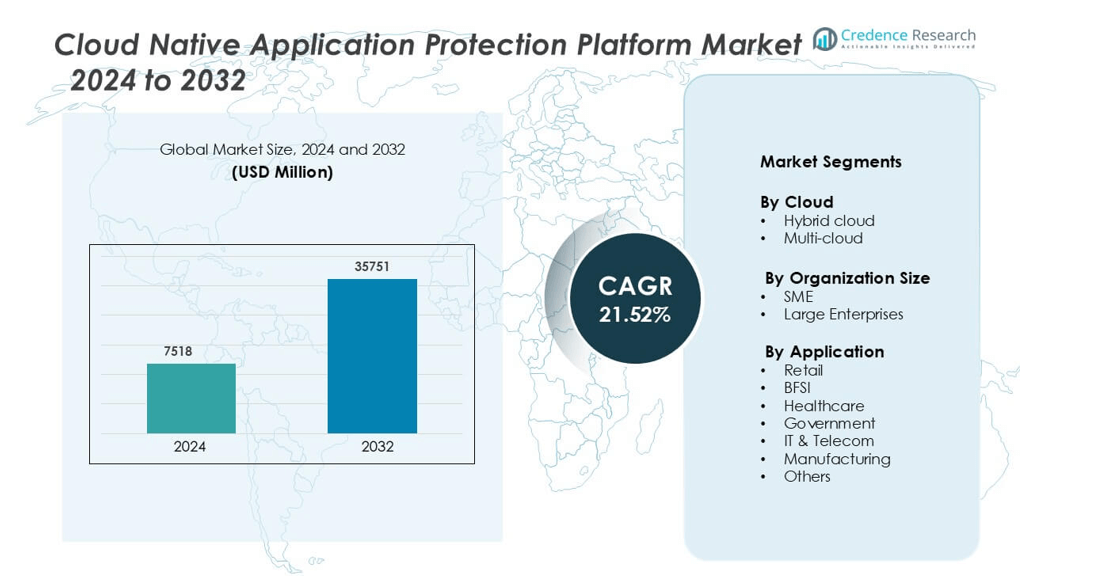
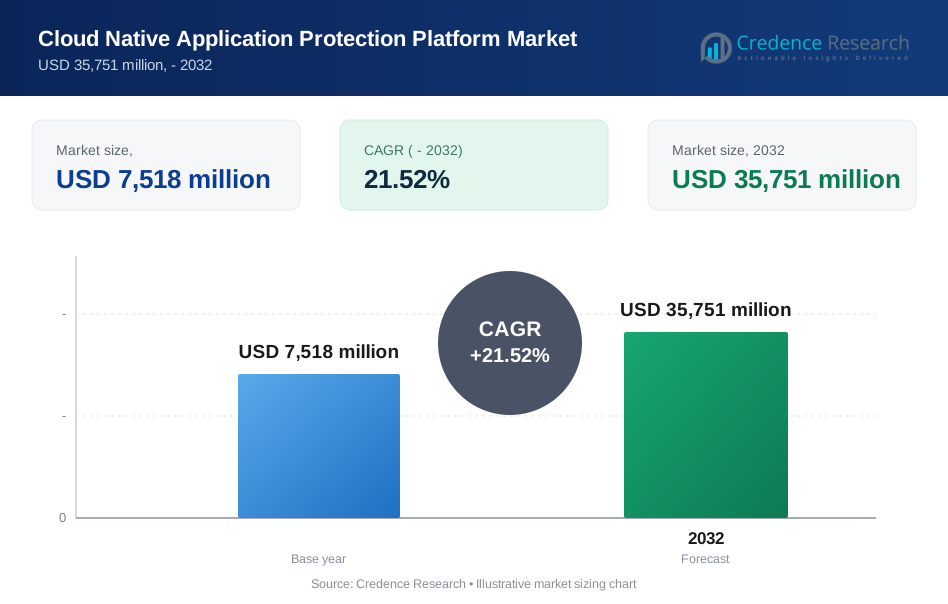
Cloud Native Application Protection Platform market was valued at USD 7518 million in 2024 and is anticipated to reach USD 35751 million by 2032, growing at a CAGR of 21.52% during the forecast period.
| REPORT ATTRIBUTE | DETAILS |
|---|---|
| Historical Period | 2020-2023 |
| Base Year | 2024 |
| Forecast Period | 2025-2032 |
| Cloud Native Application Protection Platform Market Size 2024 | USD 7518 million |
| Cloud Native Application Protection Platform Market, CAGR | 21.52% |
| Cloud Native Application Protection Platform Market Size 2032 | USD 35751 million |
Global leaders in the Cloud Native Application Protection Platform market include Palo Alto Networks, CrowdStrike, Fortinet, Trend Micro, Qualys, Tenable, LaceWorks, Zscaler, Checkpoint Security, and ABBYY. These companies compete by offering unified platforms that secure containers, APIs, multi-cloud workloads, and DevSecOps pipelines. Palo Alto Networks and CrowdStrike lead with strong cloud workload protection, AI-driven threat detection, and deep Kubernetes visibility, while Zscaler and Fortinet expand secure access and identity governance for distributed cloud environments. North America remains the leading region, holding 38% market share due to strong cloud adoption, compliance demands, and cybersecurity investments across BFSI, IT, telecom, and public sectors.
Market Insights
- The Cloud Native Application Protection Platform market reached USD 7518 million in 2024 and is projected to hit USD 35751 million by 2032, growing at a CAGR of 21.52%.
- Growing cloud adoption and rising cybersecurity risks drive deployment of CNAPP solutions, with large enterprises holding the biggest segment share due to complex workloads and stricter compliance demands.
- Multi-cloud and hybrid cloud trends accelerate adoption, as organizations require unified workload security, posture management, and API protection across AWS, Azure, and GCP environments.
- Competition remains strong among major players including Palo Alto Networks, CrowdStrike, Fortinet, Trend Micro, Zscaler, and LaceWorks, with vendors investing in AI-driven analytics, container security, and automated remediation.
- North America leads the market with 38% regional share, supported by high cloud spending and strong regulatory frameworks, while SMB adoption rises in Asia-Pacific, contributing to one of the fastest regional growth rates.
Market Segmentation Analysis:
By Cloud
Hybrid cloud holds the dominant share in the Cloud Native Application Protection Platform market. Enterprises adopt hybrid environments to balance data control, compliance, and scalability. The hybrid model supports legacy applications while enabling cloud-native workloads, creating strong transition flexibility. Companies prefer hybrid deployment to manage sensitive data on-premises and leverage public cloud resources for modern workloads. Multi-cloud is growing as organizations diversify cloud vendors to avoid lock-in and reduce downtime risks. Security automation and unified visibility across clouds drive demand for CNAPP solutions in both deployment models, but hybrid cloud remains the leading contributor to market revenue.
- For instance, Palo Alto Networks Prisma Cloud supports more than 5,000 built-in compliance rules and secures workloads across AWS, Azure, and GCP within a single dashboard.
By Organization Size
Large enterprises lead the market, holding the highest share due to complex IT infrastructure and wider attack surfaces. These organizations invest heavily in cloud security tools to protect microservices, APIs, containers, and Kubernetes workloads at scale. Stringent compliance requirements, especially in regulated industries, push large enterprises to deploy CNAPP platforms offering real-time threat detection and posture management. SMEs represent a rising segment, supported by cloud adoption and cost-effective SaaS-based security platforms. However, large enterprises remain the chief revenue generator due to higher security spending and advanced workload protection needs.
- For instance, CrowdStrike’s Falcon platform analyzes more than trillions security events per day and secures workloads across major clouds and on-premise infrastructure.
By Application
IT and Telecom is the dominant application segment, contributing the highest share. The sector runs large-scale distributed workloads, containerized applications, and multi-cloud deployments, increasing the need for workload protection and runtime security. Threat detection, API monitoring, and CI/CD pipeline security drive strong CNAPP demand in telecom and IT services. BFSI and healthcare follow due to strict regulatory frameworks and high data sensitivity. Government, manufacturing, retail, and others continue adopting cloud-native security to protect digital services and maintain uptime. Despite broad adoption, IT and Telecom remains the top revenue-contributing segment.
Key Growth Drivers
Rising Adoption of Cloud-Native Architectures
The shift from monolithic systems to microservices, containers, and Kubernetes clusters is a major growth driver for the Cloud Native Application Protection Platform market. Organizations move workloads to the cloud for agility, faster deployment, and scalable application delivery, but this transition increases attack surfaces. Traditional security tools cannot monitor dynamic, containerized environments, creating strong demand for CNAPP solutions that provide identity management, runtime protection, and threat detection at workload level. CNAPP platforms integrate DevSecOps practices and enable continuous vulnerability scanning across CI/CD pipelines. As companies expand digital services, the need to secure APIs, serverless functions, and multi-cloud workloads continues to accelerate adoption. This architectural shift ensures long-term demand for advanced cloud-native security platforms.
- For instance, the internal use of Prisma Cloud by Palo Alto Networks to secure a large and complex environment involving 100,000 containers and over 50,000 compute instances.
Increasing Compliance and Data Security Requirements
Strict data protection regulations drive enterprises to secure cloud workloads more aggressively. Industries such as BFSI, healthcare, and government handle sensitive data and face heavy penalties for breaches and compliance failures. CNAPP platforms offer continuous posture monitoring, policy enforcement, and automated compliance reporting across hybrid and multi-cloud infrastructures. Visibility into cloud configuration, identity access management, and audit trails further supports regulatory adherence. Unauthorized access, misconfigurations, and unmanaged identities remain key breach sources, pushing companies to invest in centralized cloud security solutions. As cloud adoption expands, data privacy frameworks such as GDPR, HIPAA, and industry-specific mandates reinforce the need for integrated CNAPP deployments.
- For instance, the Qualys Cloud Platform (recently renamed the Qualys Enterprise TruRisk™ Platform) processes more than 3 trillion security events each year and conducts more than 6 billion IP scans annually.
Rising Incidents of Cloud Security Breaches
Rapid digital transformation increases cyber risks, making cloud-native workloads prime targets for attacks. Vulnerabilities in containers, API misuse, and lateral movement within cloud environments create high exposure. CNAPP platforms deliver real-time threat detection, anomaly analysis, and automated remediation to reduce breach impact. Enterprises deploy workload segmentation, identity-based access, and runtime protection to counter advanced threats. As attacks become more automated and sophisticated, CNAPP tools with AI-driven detection gain strong demand. High-profile ransomware incidents, data exfiltration, and supply chain compromises further accelerate spending on cloud workload security. The rising cost of breaches and reputational damage ensures continued investment in proactive cloud-native defense.
Key Trend & Opportunity
Growth in Multi-Cloud and Hybrid Deployments
Organizations increasingly distribute workloads across multiple cloud vendors to improve resilience, cost efficiency, and vendor flexibility. However, multi-cloud and hybrid architectures create fragmented visibility and inconsistent security policies, driving adoption of CNAPP platforms. These platforms centralize monitoring, identity control, compliance tracking, and workload security across AWS, Azure, GCP, and on-premise environments. As edge computing and distributed applications expand, demand for unified CNAPP solutions continues to rise. Vendors offering deep integration, automated remediation, and container-aware scanning gain strong advantage. This shift presents a major long-term opportunity for CNAPP providers as multi-cloud becomes the standard operating model.
- For instance, Microsoft Defender for Cloud protects workloads spanning Azure, AWS, and GCP from a single console.
Integration of AI and Automation in Cloud Security
AI, machine learning, and automated remediation are transforming cloud-native security. Modern CNAPP solutions analyze behavioral patterns, detect anomalies, and block attacks in real time. Automation reduces manual effort, speeds incident response, and eliminates misconfigurations, which remain a key cause of cloud breaches. Security teams use AI-driven alerts, risk scoring, and policy recommendations to strengthen cloud governance. As organizations struggle with growing cloud complexity and cybersecurity skill shortages, automated CNAPP platforms present a major market opportunity. Vendors investing in predictive analytics, autonomous remediation, and intelligent threat monitoring hold strong competitive positioning.
- For instance, Palo Alto Networks Prisma Cloud uses machine learning models trained on more than 1 trillion cloud data points collected from customer deployments worldwide. The platform automatically detects misconfigurations and runtime threats and executes more than 5,000 policy checks across containers and serverless workloads.
Key Challenge
Lack of Skilled Cloud Security Professionals
The market faces a significant talent gap, slowing adoption of advanced cloud-native protection platforms. Many organizations lack teams trained in securing containers, Kubernetes clusters, CI/CD pipelines, and API interactions. As workloads scale, misconfigurations, weak IAM policies, and unmanaged cloud assets increase breach risks. Enterprises rely on CNAPP platforms, but implementation and policy optimization require expert knowledge. The shortage of cybersecurity specialists forces companies to outsource or adopt automated solutions, increasing operational burden. This skills gap remains a major barrier to large-scale and efficient deployment of cloud-native protection.
Complexity in Managing Distributed Workloads
Cloud-native environments involve dynamic workloads that continuously scale and update, creating complex security landscapes. Securing containers, microservices, serverless functions, and distributed data flows requires unified visibility and orchestration. Many companies struggle to integrate CNAPP with existing security systems, identity platforms, and compliance workflows. Managing multi-cloud infrastructure adds further complexity due to diverse configurations and vendor-specific architectures. Without coordinated policies, inconsistent security controls emerge, increasing risks. This challenge slows adoption and raises operational costs, making seamless integration critical for market expansion.
Regional Analysis
North America
North America holds the largest market share (38%) in the Cloud Native Application Protection Platform market. Organizations in the region are early adopters of cloud-native technologies, Kubernetes, and microservices, driving demand for advanced workload security. Strong presence of leading cloud providers, cybersecurity vendors, and mature DevSecOps practices further boosts adoption. High frequency of cyberattacks and strict regulations, particularly in BFSI and healthcare, increase spending on CNAPP platforms. Enterprises focus on securing multi-cloud operations, API traffic, and runtime environments. The U.S. remains the key revenue contributor due to large-scale digital transformation across enterprises and government sectors.
Europe
Europe accounts for a significant market share (18%), supported by strict regulatory frameworks such as GDPR and industry-specific compliance mandates. Enterprises in countries like Germany, the UK, and France deploy CNAPP platforms to prevent data breaches, secure containers, and maintain policy governance across hybrid environments. Digitalization of banking, healthcare, and public services creates strong opportunities for cloud-native security. Growing cloud investments and rising cyber risks drive adoption of CNAPP with automated compliance reporting and threat detection. Vendors expand partnerships and managed services to support European enterprises with limited cloud security workforce.
Asia-Pacific
Asia-Pacific demonstrates the fastest growth and increasing market share (27%) within the CNAPP market. Rapid cloud migration across IT, telecom, banking, and e-commerce industries drives demand for cloud-native security. Countries like China, India, Japan, and Singapore invest heavily in public and multi-cloud deployments to support digital services. However, rising ransomware cases, API attacks, and data privacy regulations push enterprises toward integrated CNAPP platforms. Expanding 5G infrastructure, digital payments, and start-up ecosystems further accelerate adoption. Local and global vendors form alliances to deliver scalable cloud workload protection across diverse and distributed environments.
Latin America
Latin America is emerging as a growing market, gaining a moderate share (7%) as enterprises expand cloud adoption. Countries such as Brazil, Mexico, and Chile invest in digital banking, e-commerce, and government cloud initiatives. However, limited cybersecurity skills and budget constraints slow large-scale deployments. Despite challenges, increasing cyberattacks and regulatory pressure encourage adoption of CNAPP for API security, identity management, and workload protection. Cloud service providers partner with local enterprises to deliver managed security services and SaaS-based solutions, supporting market growth across the region.
Middle East & Africa
The Middle East & Africa market holds a smaller share (5%) but shows steady expansion. Government-led digital transformation, fintech adoption, and cloud investments in the UAE, Saudi Arabia, and South Africa drive demand for CNAPP platforms. Organizations prioritize workload protection, identity governance, and compliance monitoring to secure public and hybrid cloud deployments. Energy, banking, and telecom sectors lead adoption due to rising cyber risks and reliance on distributed applications. Partnerships with global cybersecurity vendors and regional data centers further strengthen market potential, positioning the region for sustained growth.
Market Segmentations:
By Cloud
- Hybrid cloud
- Multi-cloud
By Organization Size
- SME
- Large Enterprises
By Application
- Retail
- BFSI
- Healthcare
- Government
- IT & Telecom
- Manufacturing
- Others
By Geography
- North America
- U.S.
- Canada
- Mexico
- Europe
- Germany
- France
- U.K.
- Italy
- Spain
- Rest of Europe
- Asia Pacific
- China
- Japan
- India
- South Korea
- South-east Asia
- Rest of Asia Pacific
- Latin America
- Brazil
- Argentina
- Rest of Latin America
- Middle East & Africa
- GCC Countries
- South Africa
- Rest of the Middle East and Africa
Competitive Landscape
The competitive landscape of the Cloud Native Application Protection Platform market features global cybersecurity leaders and specialized cloud-native security vendors. Companies such as Palo Alto Networks, CrowdStrike, Fortinet, Trend Micro, Qualys, and Tenable strengthen portfolios with CNAPP capabilities to secure workloads, APIs, containers, and Kubernetes environments. Vendors focus on unified platforms combining posture management, workload protection, identity governance, and runtime security. Strategic acquisitions, partnerships, and product integrations drive market competition as players expand into multi-cloud and hybrid deployments. Key providers invest in AI-based threat detection, automated incident response, and compliance reporting to meet enterprise security needs. Growing demand from regulated sectors pushes vendors to offer scalability, shared visibility for DevSecOps teams, and lower false positives. As cloud adoption accelerates across industries, competition intensifies between full-stack security platforms and niche CNAPP providers offering deep workload analysis and container-focused security.
Key Player Analysis
- Trend Micro
- Fortinet
- Qualys
- CrowdStrike
- Palo Alto Networks
- Zscaler
- ABBYY
- Tenable
- LaceWorks
- Checkpoint Security
Recent Developments
- In October 2024, Fortinet introduced Lacework FortiCNAPP, an AI-driven platform that secures everything from code to cloud through a single vendor. This platform enhances Lacework’s existing offerings by providing automated remediation, blocking active runtime threats, and offering detailed insights into FortiGuard Outbreak Alerts, which highlight new and emerging threats and their associated risks.
- In October 2023, Palo Alto Networks released Prisma Cloud Darwin, targeting the gap between developers and security professionals. The company asserts that securing applications from code to the cloud requires preventing risks from entering the development pipeline and avoiding breaches in production
Report Coverage
The research report offers an in-depth analysis based on Cloud, Organization Size, Application and Geography. It details leading market players, providing an overview of their business, product offerings, investments, revenue streams, and key applications. Additionally, the report includes insights into the competitive environment, SWOT analysis, current market trends, as well as the primary drivers and constraints. Furthermore, it discusses various factors that have driven market expansion in recent years. The report also explores market dynamics, regulatory scenarios, and technological advancements that are shaping the industry. It assesses the impact of external factors and global economic changes on market growth. Lastly, it provides strategic recommendations for new entrants and established companies to navigate the complexities of the market.
Future Outlook
- Adoption of CNAPP solutions will rise as enterprises shift deeper into cloud-native architectures.
- Multi-cloud and hybrid environments will drive demand for unified workload visibility and policy enforcement.
- AI and machine learning will enhance real-time threat detection and automated remediation.
- DevSecOps integration will become standard as security moves earlier into CI/CD pipelines.
- Identity-based access control will gain priority as misconfigurations and credential abuse remain major attack vectors.
- Container, serverless, and API security will grow faster than traditional cloud protection tools.
- Vendors will expand partnerships with cloud providers to offer native integrations and simplified deployment.
- Managed security services will increase as enterprises face skill shortages in cloud security teams.
- Regulations and data privacy laws will push organizations toward automated compliance monitoring.
- Asia-Pacific will continue to post the highest growth rate as digital transformation accelerates across banking, telecom, and e-commerce.
Request a Free Sample
Fill in your details and we'll send you a free sample report.
- Sample data tables & charts
- Research methodology
Need a Custom Version of This Report?
Tailor the scope, geography, or segments to your exact requirements.
- Custom geography or segment scope
- Direct access to our analyst team
Frequently Asked Questions
What is the market size of the Cloud-native Application Protection Platform (CNAPP) market?
At what Compound Annual Growth Rate is the Cloud Native Application Protection Platform market projected to grow between 2025 and 2032?
What factors are driving the growth of the CNAPP market?
How do CNAPP solutions protect cloud-native applications?
Which region holds the largest market share in the CNAPP market?
Which regions are expected to see significant growth in the CNAPP market?
Table of Content
Chapter 1. Report Introduction
- 1.1 Report Description & Purpose
- 1.1.1 Report Title & Market Definition
- 1.1.2 Unique Selling Propositions (USP) & Key Differentiators
- 1.1.3 Value Proposition for Stakeholders
- 1.2 Research Objectives
- 1.2.1 Market Sizing Objectives (Volume & Revenue)
- 1.2.2 Segmentation Objectives
- 1.2.3 Competitive Intelligence Objectives
- 1.2.4 Forecast & Scenario Objectives
- 1.3 Report Scope
- 1.3.1 Cloud Native Application Protection Platform Scope – Types & Subtypes Covered
- 1.3.2 Geographic Scope – Regions & Countries Covered
- 1.3.3 Historical Period, Base Year & Forecast Period (the historical period; forecast to 2032)
- 1.3.4 Inclusions & Exclusions
- 1.4 HS Code & Classification Framework
- 1.5 Currency, Units & Pricing Basis
- 1.6 Target Stakeholders
- 1.7 Limitations & Assumptions
Chapter 2. Executive Summary
- 2.1 Global Cloud Native Application Protection Platform Market Snapshot
- 2.1.1 Market Size – Historical (the historical period) & Forecast (2032) (base year: USD 7,518 million → 2032: USD 35,751 million)
- 2.1.2 Volume & Revenue – Global Totals
- 2.1.3 Key Market Highlights – Top Five Facts
- 2.2 Cloud Native Application Protection Platform Market Segmentation Snapshot
- 2.2.1 Market Split by Region – vs. 2032
- 2.3 Competitive Snapshot
- 2.3.1 Top 10 Players by Revenue Share –
- 2.3.2 Top 10 Players by Volume Share –
- 2.3.3 Recent Strategic Developments (18-Month Summary)
- 2.4 Key Investment Highlights & Strategic Conclusions
Chapter 3. Cloud Native Application Protection Platform Market Dynamics & Industry Analysis
- 3.1 Market Overview & Context
- 3.1.1 Cloud Native Application Protection Platform Market Position in the Broader Automotive Value Chain
- 3.1.2 OEM vs. Replacement Market Dynamics
- 3.1.3 Market Maturity & Development Stage by Region
- 3.2 Cloud Native Application Protection Platform Market Drivers
- 3.3 Cloud Native Application Protection Platform Market Restraints & Challenges
- 3.4 Cloud Native Application Protection Platform Market Opportunities
- 3.5 Porter's Five Forces Analysis
- 3.5.1 Threat of New Entrants
- 3.5.2 Bargaining Power of Suppliers
- 3.5.3 Bargaining Power of Buyers
- 3.5.4 Threat of Substitutes
- 3.5.5 Competitive Rivalry – Intensity Assessment
- 3.6 Cloud Native Application Protection Platform Value Chain Analysis
- 3.6.1 Upstream – Raw Material/Input Suppliers
- 3.6.1.1 Raw Material/Input 1
- 3.6.1.2 Raw Material/Input 2
- 3.6.1.3 Raw Material/Input 3
- 3.6.2 Midstream – Production/Manufacturing/Service Delivery
- 3.6.2.1 Production/Process Overview
- 3.6.2.2 Key Facility Locations & Capacity by Manufacturer
- 3.6.3 Downstream – Distribution & End Consumer
- 3.6.3.1 Primary Channel – B2B/OEM
- 3.6.3.2 Secondary Channels – Dealer, Retail, Online, Direct
- 3.6.4 Value Chain Profitability Analysis
- 3.6.1 Upstream – Raw Material/Input Suppliers
- 3.7 PESTEL Analysis
- 3.7.1 Political Factors
- 3.7.2 Economic Factors
- 3.7.3 Social Factors
- 3.7.4 Technological Factors
- 3.7.5 Environmental Factors
- 3.7.6 Legal Factors
- 3.8 Cloud Native Application Protection Platform Supply Chain Analysis
- 3.8.1 Raw Material/Input Supply Risk Assessment
- 3.8.2 Manufacturing Concentration Risk (Geographic Exposure)
- 3.8.3 Trade Disruption Impact Analysis
- 3.9 Regulatory & Policy Landscape
Note: The regulatory and policy landscape section covers regulations based on their applicability to the market, Cloud Native Application Protection Platform category, geography, and scope of the study. Only regulatory frameworks with a material impact on operations, compliance, trade, sustainability, or market access are analyzed in detail.
Chapter 4. Key Investment Pockets & Opportunity Analysis
- 4.1 Cloud Native Application Protection Platform Market Attractiveness Analysis
- 4.1.1 By Region – Investment Attractiveness Matrix (Volume × CAGR)
- 4.2 Absolute Revenue Growth Opportunity
- 4.2.1 By Region – Absolute USD Growth Through 2032
- 4.3 Incremental Volume Opportunity
- 4.3.1 By Region – Incremental Volume Through 2032
- 4.3.2 Segment – Incremental Volume
- 4.4 Emerging Submarket Opportunity Deep Dive (Subject to Applicability)
- 4.5 Emerging Market Opportunity Scorecards
- 4.5.1 United States
- 4.5.2 Europe
- 4.5.3 Asia
- 4.5.4 Middle East & Africa
Note: Emerging Market Opportunity Scorecards will be included based on relevance and strategic importance. Regions listed are indicative and may vary depending on data availability and market dynamics.
Chapter 5. Cloud Native Application Protection Platform Import-Export Analysis & Trade Flows
- 5.1 Global Trade Overview
- 5.1.1 Global Export Value by Country (the historical period)
- 5.1.2 Global Export Volume by Country (the historical period)
- 5.1.3 Global Import Value by Country (the historical period)
- 5.1.4 Global Import Volume by Country (the historical period)
- 5.1.5 Net Trade Balance by Country (the historical period)
- 5.2 Export Analysis – Segment
- 5.2.1 Type 1 (HS Code)
- 5.2.2 Type 2 (HS Code)
- 5.2.3 Type 3 (HS Code)
- 5.2.4 Type 4 (HS Code)
- 5.2.5 Type 5 (HS Code)
- 5.3 Import Analysis – Segment
- 5.3.1 Type 1 (HS Code)
- 5.3.2 Type 2 (HS Code)
- 5.3.3 Type 3 (HS Code)
- 5.3.4 Type 4 (HS Code)
- 5.3.5 Type 5 (HS Code)
- 5.4 Average Unit Trade Prices
- 5.4.1 Average Export Price – Segment & Country
- 5.4.2 Average Import Price – Segment & Source Country
- 5.4.3 Price Trends (the historical period)
- 5.5 Key Trade Route Analysis
- 5.5.1 Trade Route 1
- 5.5.2 Trade Route 2
- 5.5.3 Trade Route 3
- 5.5.4 Trade Route 4
- 5.5.5 Trade Route 5
- 5.6 Trade Policy Impact Assessment
- 5.6.1 US Anti-Dumping & Section 301 Tariffs
- 5.6.2 EU Customs Union Impact
- 5.6.3 Major Free Trade Agreements
- 5.6.4 USMCA Rules of Origin
Note: Trade policy analysis will be included only where relevant to the Cloud Native Application Protection Platform market.
Chapter 6. Competitive Landscape & Company Benchmarking
- 6.1 Cloud Native Application Protection Platform Market Concentration & Structure
- 6.1.1 Herfindahl-Hirschman Index (HHI) – vs.
- 6.1.2 Tier 1, Tier 2 & Tier 3 Market Structure
- 6.1.3 Global, Regional & Local Player Dynamics
- 6.2 Cloud Native Application Protection Platform Market Share Analysis –
- 6.2.1 Global Revenue Share by Company
- 6.2.2 Global Volume Share by Company
- 6.2.3 Regional Revenue Share
- 6.2.4 Market Share Evolution ( vs. )
- 6.2.5 OEM Segment Share by Company
- 6.2.6 Replacement Segment Share by Company
- 6.3 Production/Delivery Capacity & Facility Analysis
- 6.3.1 Global Installed Capacity
- 6.3.2 Capacity Utilization Rates
- 6.3.3 Production/Output Volume
- 6.3.4 Facility Locations & Capacity Map
- 6.3.5 Planned Capacity Additions
- 6.4 Cloud Native Application Protection Platform Competitive Benchmarking Matrix
- 6.4.1 Revenue, Volume, CAGR & Profitability Comparison
- 6.4.2 Channel Revenue Mix
- 6.4.3 Geographic Revenue Exposure
- 6.4.4 R&D Intensity
- 6.4.5 Sustainability Maturity
- 6.5 Strategic Developments in Cloud Native Application Protection Platform (Last 24 Months)
- 6.5.1 Mergers, Acquisitions & Divestments
- 6.5.2 New Cloud Native Application Protection Platform Launches
- 6.5.3 Facility Expansions
- 6.5.4 Strategic Alliances, Joint Ventures & Partnerships
- 6.5.5 Distribution Expansion & Market Entry
- 6.5.6 Sustainability & ESG Initiatives
- 6.6 Competitive Strategy Mapping
- 6.6.1 Leader, Challenger, Follower & Niche Classification
- 6.6.2 Pricing Strategy Comparison
- 6.6.3 Channel Strategy Matrix
Note: Strategic developments are included based on their materiality and the availability of reliable information.
Chapter 7. Global Cloud Native Application Protection Platform Market – By Distribution Channel
- 7.1 Segment Overview
- 7.1.1 Volume & Revenue Split by Channel ( & 2032)
- 7.1.2 Channel Mix Evolution (2032)
Chapter 8. Regional Market Analysis – Global Overview
- 8.1 Global Regional Overview
- 8.1.1 Regional Volume Share
- 8.1.2 Regional Revenue Share
- 8.1.3 Regional Volume by Region
- 8.1.4 Regional Revenue by Region
- 8.1.5 Regional Forecast Through 2032
- 8.2 Cross-Regional Segment Analysis
- 8.2.1 By Distribution Channel
- 8.2.2 By Brand/Price Tier
Chapter 9. North America Cloud Native Application Protection Platform Market
- 9.1 United States
- 9.2 Canada
- 9.3 Mexico
Chapter 10. Europe Cloud Native Application Protection Platform Market
- 10.1 Germany
- 10.2 France
- 10.3 Italy
- 10.4 United Kingdom
- 10.5 Spain
- 10.6 Poland
- 10.7 Russia
- 10.8 Netherlands
- 10.9 Belgium
- 10.10 Sweden
- 10.11 Denmark
- 10.12 Norway
- 10.13 Rest of Europe
Chapter 11. Asia Pacific Cloud Native Application Protection Platform Market
- 11.1 China
- 11.2 India
- 11.3 Japan
- 11.4 South Korea
- 11.5 Thailand
- 11.6 Indonesia
- 11.7 Vietnam
- 11.8 Malaysia
- 11.9 Australia
- 11.10 Rest of Asia Pacific
Chapter 12. Latin America Cloud Native Application Protection Platform Market
- 12.1 Brazil
- 12.2 Argentina
- 12.3 Colombia
- 12.4 Chile
- 12.5 Rest of Latin America
Chapter 13. Middle East Cloud Native Application Protection Platform Market
- 13.1 Saudi Arabia
- 13.2 United Arab Emirates
- 13.3 Turkey
- 13.4 Israel
- 13.5 Iran
- 13.6 Rest of the Middle East
Chapter 14. Africa Cloud Native Application Protection Platform Market
- 14.1 South Africa
- 14.2 Egypt
- 14.3 Nigeria
- 14.4 Morocco
- 14.5 Rest of Africa
Chapter 15. Cloud Native Application Protection Platform Company Profiles
- 15.1 [Company 01]
- 15.1.1 Company Overview
- 15.1.2 Key Management Personnel
- 15.1.3 Products & Services Portfolio
- 15.1.4 Financial Performance
- 15.1.5 Key Market Focus & Geographic Presence
- 15.1.6 Recent Developments & Strategic Initiatives
Note: The company profile list is preliminary and may change based on research findings, market developments, data availability, and client requirements.
Chapter 16. Appendices
- Appendix A – List of Abbreviations & Acronyms
- Appendix B – Industry Classification Code Reference – Full Series
- Appendix C – Production & Capacity Data Tables
- Appendix D – End-Use & Demand Base Tables
- Appendix E – Consumption & Replacement Rate Assumptions
- Appendix F – ASP Reference Tables
- Appendix G – Manufacturing & Facility Database
- Appendix H – Import-Export Data Tables
- Appendix I – Regulatory Summary Tables
- Appendix J – Primary Research Participant List (Anonymized)
- Appendix K – Primary Research Questionnaire Framework
- Appendix L – Data Sources & Bibliography
- Appendix M – Market Size Divergence & Source Comparison
Chapter 17. Research Methodology
- 17.1 Research Framework & Philosophy
- 17.2 Secondary Research – Sources, Hierarchy & Data Extraction
- 17.3 Data Modeling – Bottom-Up & Top-Down Market Sizing
- 17.4 Primary Research – Stakeholder Framework, LOI & Sample Sizes
- 17.5 Forecast Methodology – Regression, Scenario & Sensitivity Analysis
- 17.6 Quality Control – Four-Layer Validation Framework
- 17.7 Limitations & Standard Assumptions
- 17.8 Disclaimer
