
Commercial Landscape Lighting Market Overview:
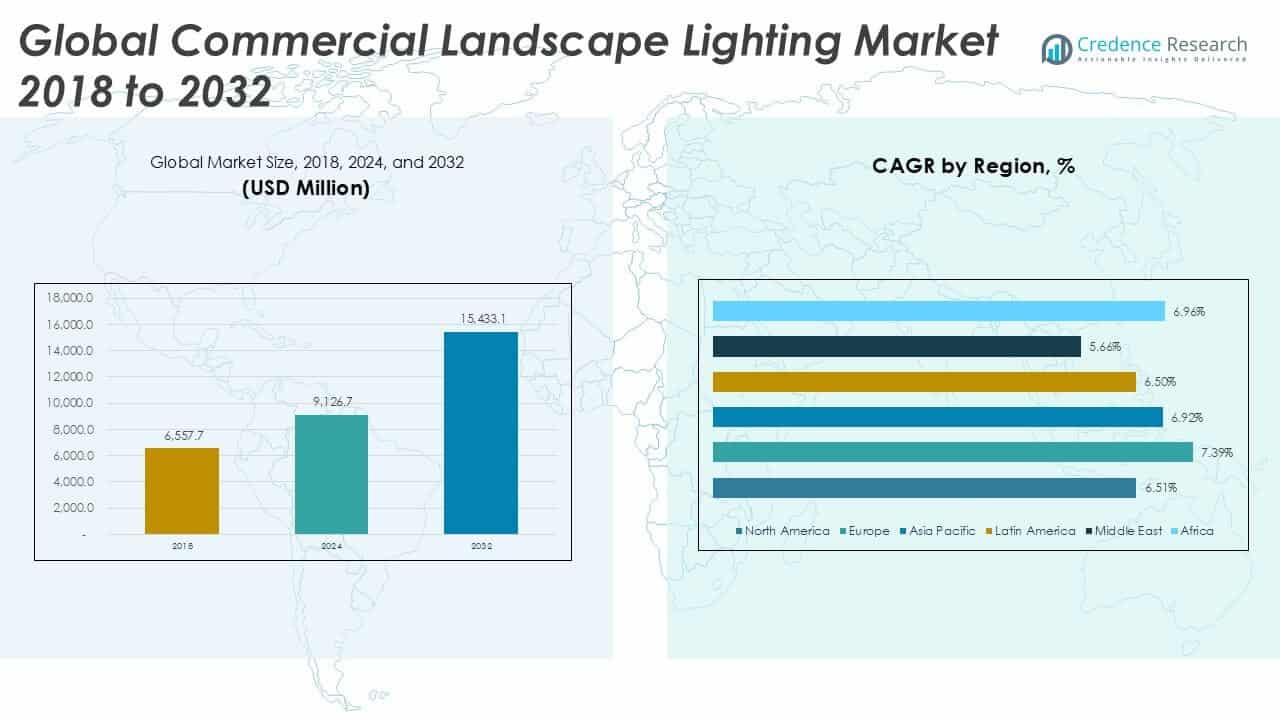
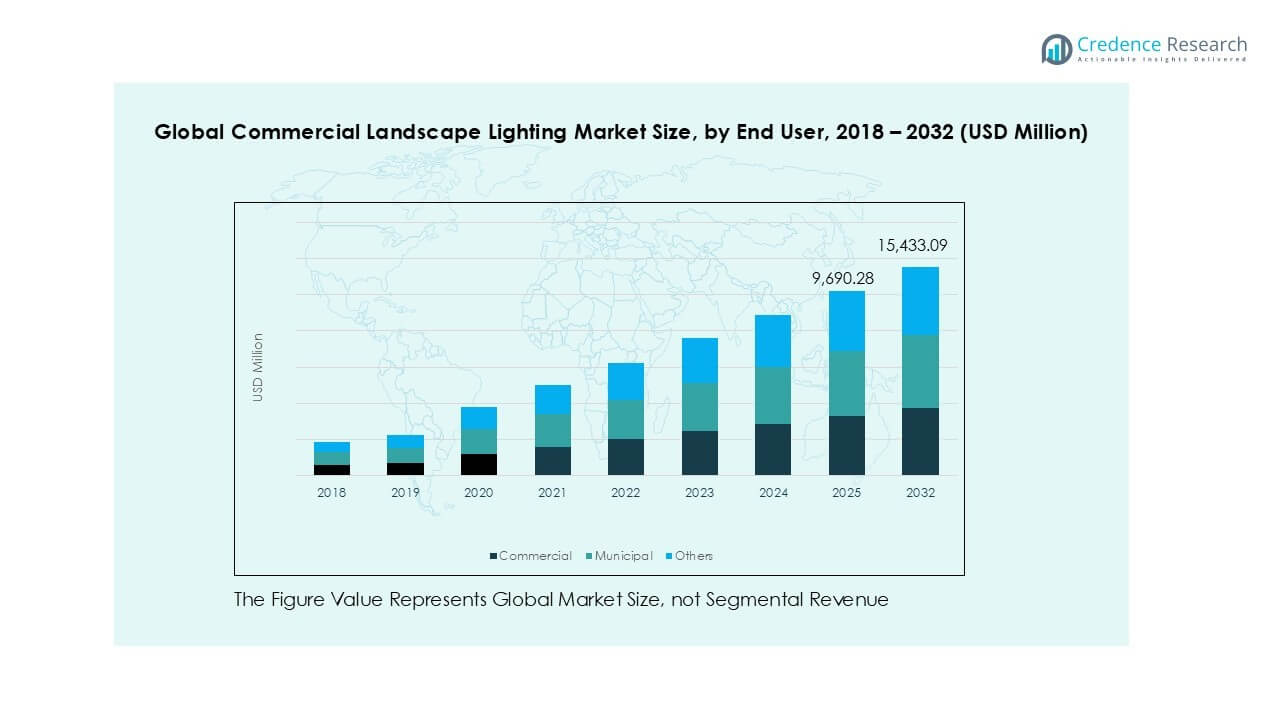
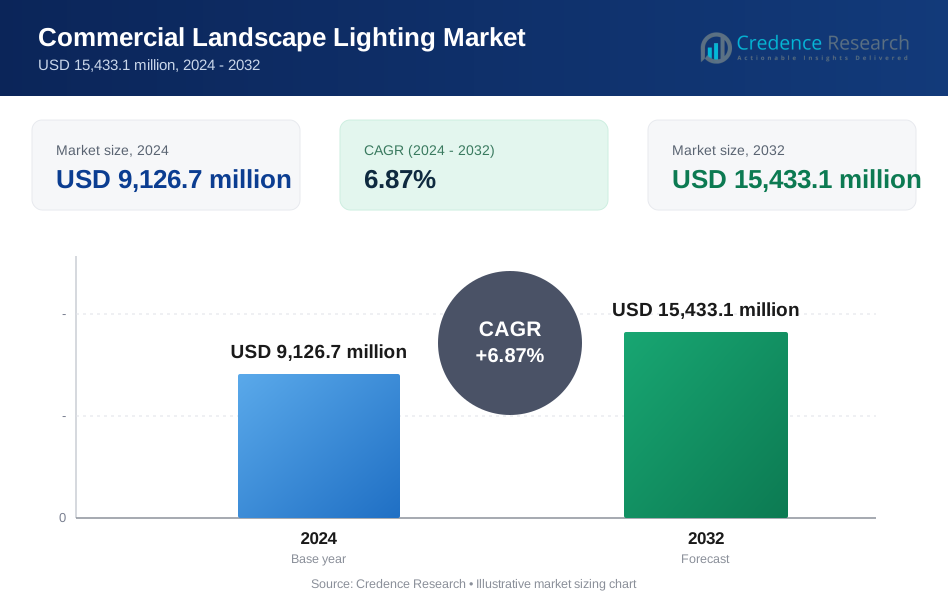
The Global Commercial Landscape Lighting market size was valued at USD 6,557.7 million in 2018, reached USD 9,126.7 million in 2024, and is anticipated to reach USD 15,433.1 million by 2032, growing at a CAGR of 6.87% during the forecast period.
| REPORT ATTRIBUTE | DETAILS |
|---|---|
| Historical Period | 2020-2023 |
| Base Year | 2024 |
| Forecast Period | 2025-2032 |
| Commercial Landscape Lighting Market Size 2024 | USD 9,126.7 million |
| Commercial Landscape Lighting Market, CAGR | 6.87% |
| Commercial Landscape Lighting Market Size 2032 | USD 15,433.1 million |
Top players in the global commercial landscape lighting market include Signify N.V., Acuity Brands, Zumtobel Group AG, Cree Lighting, GE Lighting, Eaton Corporation, and Havells, all of which lead through strong product portfolios, technological advancements, and expansive distribution networks. These companies focus on energy efficiency, smart lighting integration, and sustainable designs to meet global demand. Signify N.V. maintains a dominant position with advanced IoT-enabled solutions, while Acuity Brands excels in commercial and architectural lighting. Europe emerged as the leading region in 2024, capturing 27.8% of the global market share, driven by strict energy regulations, extensive infrastructure upgrades, and high adoption of smart public lighting systems. This regional leadership is supported by significant investments in green cities and lighting modernization projects across Germany, France, and the UK.
Commercial Landscape Lighting Market Insights
- The global commercial landscape lighting market was valued at USD 9,126.7 million in 2024 and is projected to reach USD 15,433.1 million by 2032, growing at a CAGR of 6.87% during the forecast period.
- Rising investments in smart city infrastructure and public safety initiatives are driving large-scale adoption of energy-efficient lighting systems across commercial and municipal sectors.
- Integration of IoT-based controls, solar-powered fixtures, and demand for aesthetic outdoor lighting are reshaping market trends, especially in high-end urban projects.
- Key players such as Signify N.V., Acuity Brands, and Zumtobel Group lead through innovation and wide distribution, while regional players compete on pricing and niche solutions.
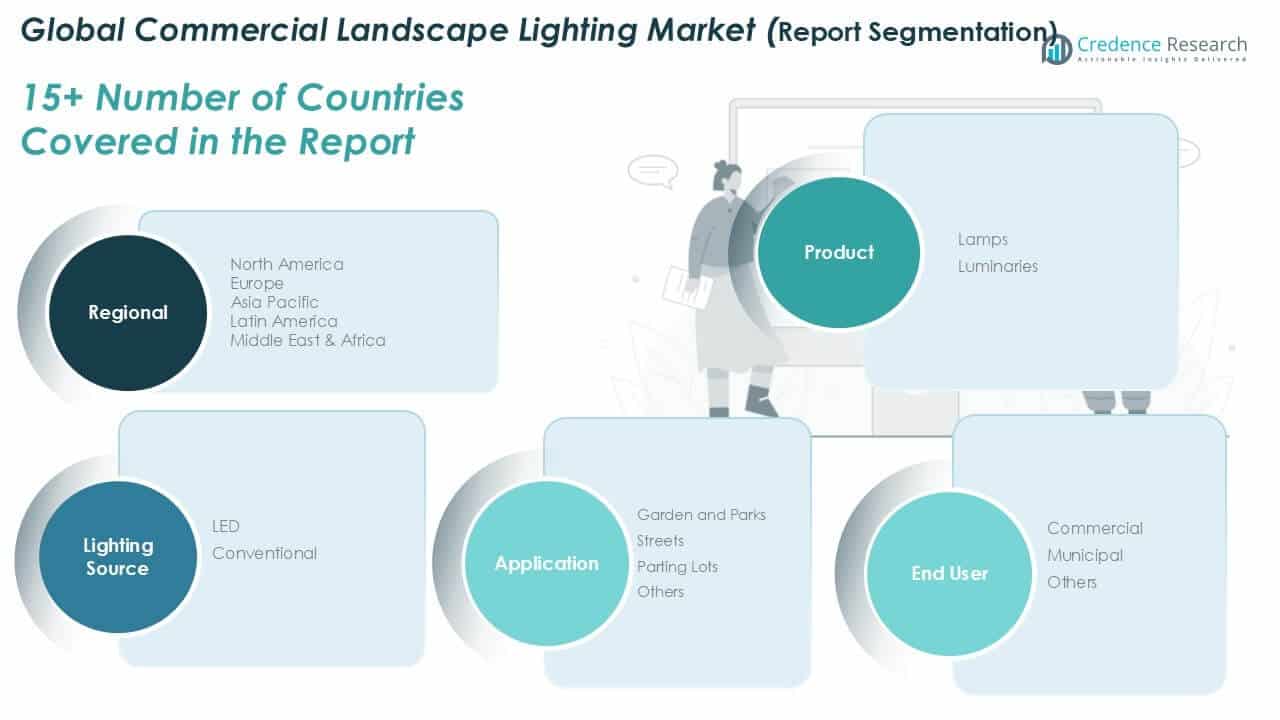
- High installation costs and infrastructure limitations in developing economies remain key restraints; however, Asia Pacific dominates with a 34.9% share, followed by Europe (27.8%) and North America (23.6%); by segment, LED lighting leads with over 80% share, and Luminaries hold over 65% of the product segment.
Commercial Landscape Lighting Market Segmentation Analysis:
By Product
The Luminaries segment dominates the global commercial landscape lighting market, accounting for over 65% of the revenue share in 2024. The demand for energy-efficient, aesthetically appealing, and durable lighting fixtures is fueling adoption across commercial outdoor spaces. Luminaries offer enhanced illumination coverage and design flexibility, making them ideal for architectural, park, and roadway applications. Their longer lifespan and compatibility with smart controls further boost their appeal in urban modernization projects. In contrast, the Lamps segment is witnessing steady demand for replacements and retrofits in cost-sensitive installations.
- For instance, Commercial Electric Residential Integrated LED Outdoor Light and Kadision LED Wall Pack Outdoor Light are integrated luminaire products that combine housing and light source in one unit, reducing installation time compared to standalone lamps.
By Lighting Source:
LED lighting leads the market with more than 80% share in 2024, driven by its energy savings, longevity, and low maintenance. Governments and municipalities prefer LEDs for large-scale public lighting due to their reduced carbon footprint and high lumen output per watt. Additionally, smart city programs and green building standards are accelerating the switch from Conventional lighting systems to LEDs. The latter, while still present in legacy systems, are gradually being phased out due to higher energy use and shorter operational life.
- For instance, outdoor LED sources such as Dreamlux 100W LED Street Light deliver high lumen output with long operational life suitable for commercial roadway lighting.
By Application:
The Streets segment holds the largest share at over 40% in 2024, as public infrastructure upgrades and safety concerns prompt widespread deployment of landscape lighting in roadways and urban corridors. Increasing investments in highway beautification, pedestrian-friendly walkways, and transit zones support this growth. Garden and Parks follow closely, benefiting from urban greening and recreational area developments. Meanwhile, Parking Lots see growing adoption due to rising commercial construction and mall expansions. The Others category includes campuses, hotels, and resorts, where landscape aesthetics and security are key drivers.
Commercial Landscape Lighting Market Key Growth Drivers
Urban Infrastructure Modernization and Smart City Development
The rapid pace of urbanization is a major growth catalyst for the commercial landscape lighting market. Governments worldwide are investing heavily in smart city initiatives, which include well-planned public lighting infrastructure. These projects aim to enhance urban aesthetics, public safety, and energy efficiency. Commercial landscape lighting plays a central role in illuminating parks, streets, pathways, and public plazas, contributing to citizen comfort and tourism appeal. Integration with smart controls, motion sensors, and connected systems further boosts adoption. Cities like Singapore, Dubai, and Amsterdam have made commercial lighting a core part of their smart infrastructure planning. In emerging economies, urban expansion and beautification of civic zones are increasing lighting deployment. The transition from conventional to energy-efficient systems, backed by supportive regulations and public-private partnerships, also reinforces market growth. As urban development scales, the demand for aesthetic and functional lighting solutions is set to grow significantly.
- For instance, Singapore’s I Light Marina Bay sustainable light art festival showcased over 29 dynamic light installations powered by energy‑efficient lighting and drew more than 685,000 visitors when focused on sustainable light use.
Growing Focus on Energy Efficiency and Sustainability
The global push toward reducing carbon emissions and energy consumption drives the widespread adoption of energy-efficient lighting in commercial landscapes. LED-based systems consume up to 80% less power than traditional lighting and offer significantly longer service life. This directly aligns with government mandates and corporate sustainability goals. Many municipalities and commercial property owners are replacing outdated lighting with LED-based smart systems to lower electricity bills and maintenance costs. Furthermore, green building certifications like LEED increasingly consider outdoor lighting efficiency in their ratings. Sustainable lighting solutions also reduce heat output and light pollution, enhancing their environmental appeal. Manufacturers are focusing on recyclable materials and solar-powered designs to meet evolving standards. With rising energy costs and stricter emission regulations, the shift toward sustainable commercial landscape lighting is no longer optional but essential. This focus on green infrastructure significantly accelerates market growth across developed and developing economies.
- For instance, smart public lighting deployments retrofit legacy streetlights to connected LED systems, achieving significant energy savings and enabling adaptive control.
Increasing Safety and Security Requirements in Public and Commercial Spaces
Public safety concerns are prompting higher investments in well-lit environments, especially in urban and semi-urban areas. Commercial landscape lighting enhances visibility and deters crime in outdoor spaces such as parks, pedestrian zones, parking lots, and building exteriors. Municipal authorities and commercial establishments recognize the critical role lighting plays in preventing accidents and ensuring round-the-clock surveillance. Advanced systems with motion sensors, dimming controls, and CCTV integration are gaining popularity in both public and private deployments. In transportation zones, proper illumination reduces traffic hazards and improves pedestrian movement. Educational campuses, malls, hospitals, and office parks also demand consistent and high-performance lighting to ensure safe nighttime operation. The trend is further supported by insurance standards and safety audits that now include lighting adequacy as a key evaluation criterion. This focus on lighting for safety and risk management significantly boosts demand across segments.
Commercial Landscape Lighting Market Key Trends & Opportunities
Integration of Smart Lighting and IoT-Based Control Systems
The commercial landscape lighting market is experiencing a strong trend toward smart lighting integration. IoT-enabled lighting systems allow remote monitoring, adaptive brightness control, fault detection, and predictive maintenance. These features improve energy efficiency while reducing operational costs. Smart lighting supports time-based or sensor-based illumination, which adapts to traffic flow or human presence, making it ideal for commercial zones and public pathways. Cities are increasingly investing in connected lighting networks that can be controlled via centralized dashboards or mobile apps. This trend creates opportunities for both lighting manufacturers and smart system integrators. Companies offering end-to-end smart lighting solutions are gaining traction, especially in markets undergoing digital infrastructure upgrades. As 5G and urban data networks expand, smart lighting becomes a critical part of broader city intelligence systems. This convergence of lighting with smart infrastructure presents substantial growth potential across urban, commercial, and recreational applications.
- For instance, IoT‑enabled systems integrate sensors, connectivity, and data analytics to allow remote monitoring, adaptive brightness control, fault detection, and predictive maintenance all from centralized dashboards or mobile platforms.
Rising Demand for Decorative and Aesthetic Lighting Solutions
The increasing importance of visual appeal in urban design is fueling demand for aesthetic commercial lighting. Public plazas, hospitality zones, cultural landmarks, shopping complexes, and gardens now use lighting to enhance ambiance and branding. Architectural lighting, color-tunable LEDs, and programmable designs allow custom effects for different seasons, festivals, or themes. This demand drives innovation in fixture design, modularity, and control features. Developers and city planners are prioritizing lighting as a core element of outdoor beautification strategies. Projects focused on heritage site enhancement or tourism promotion are incorporating artistic lighting solutions to draw attention and improve visitor experience. This trend offers manufacturers a new revenue stream through premium and customized lighting products. Additionally, entertainment venues and high-end commercial properties are using lighting to create immersive environments, contributing to brand differentiation. Aesthetic-focused lighting is thus evolving from a niche demand to a core requirement in premium and public-facing developments.
Commercial Landscape Lighting Market Key Challenges
High Initial Capital Investment and Installation Costs
Despite the long-term benefits of energy savings and low maintenance, the initial setup cost of commercial landscape lighting systems remains a barrier. Advanced LED fixtures, smart controls, and durable materials are more expensive than traditional lighting alternatives. The cost of civil works, trenching, wiring, and integration with building management systems adds to the financial burden. Many small businesses and municipal bodies face budget constraints, especially in developing markets, limiting the pace of adoption. Retrofitting older systems with modern lighting also involves complex upgrades and downtime. Although government incentives and utility rebates help offset costs in some regions, access to such programs is not uniform. The lack of short-term ROI discourages decision-makers in cost-sensitive environments. As a result, while demand exists, the upfront investment acts as a major constraint, particularly in small-scale or decentralized deployments.
Infrastructure Compatibility and Maintenance Challenges
Commercial landscape lighting installations often face challenges related to infrastructure compatibility and ongoing maintenance. Older urban areas with outdated electrical networks may not support modern lighting loads or smart grid connectivity. Harsh weather, soil conditions, and vandalism in outdoor environments increase wear and tear on lighting systems, driving up repair costs. Ensuring uniform brightness, color consistency, and performance across large and varied installations can also be technically complex. In some cases, the lack of trained personnel for installation and maintenance further complicates deployment. Lighting failures in high-footfall areas can lead to safety risks and public dissatisfaction. Remote or large-scale projects require robust monitoring and fast response mechanisms, which are still lacking in many regions. These practical challenges create roadblocks to consistent performance and increase total cost of ownership, particularly in regions without reliable infrastructure or skilled workforce.
Commercial Landscape Lighting Market Regional Analysis
North America
North America accounted for approximately 23.6% of the global commercial landscape lighting market in 2024, with a market size of USD 2,157.03 million, up from USD 1,581.06 million in 2018. The market is projected to reach USD 3,549.61 million by 2032, growing at a CAGR of 6.51%. Growth is driven by widespread adoption of smart lighting systems in commercial spaces and strong municipal investment in energy-efficient infrastructure. The U.S. leads regional demand due to rising urban revitalization projects, retail expansion, and smart city initiatives. Retrofit programs and sustainable urban planning continue to support future growth.
Europe
Europe represented 27.8% of the global market in 2024, with revenues rising from USD 1,770.58 million in 2018 to USD 2,538.53 million. It is forecast to reach USD 4,460.16 million by 2032, expanding at the highest regional CAGR of 7.39%. The region’s growth is fueled by stringent energy regulations, adoption of LED technologies, and large-scale public lighting projects in cities like Paris, Berlin, and Amsterdam. EU-backed sustainability targets and green building standards further push commercial and municipal users to upgrade lighting infrastructure, supporting continued demand across parks, public squares, and commercial campuses.
Asia Pacific
Asia Pacific led the global market with a 34.9% share in 2024, growing from USD 2,280.76 million in 2018 to USD 3,182.87 million. By 2032, the market is projected to reach USD 5,401.58 million, registering a CAGR of 6.92%. Growth is driven by rapid urbanization, commercial construction booms, and infrastructure upgrades in China, India, Japan, and Southeast Asia. Smart city programs and government funding for public space beautification support large-scale lighting deployments. The presence of regional manufacturers and cost-effective solutions makes Asia Pacific a hub for commercial lighting innovation and volume-based installations across urban and semi-urban areas.
Latin America
Latin America contributed 7.3% to the global market in 2024, with revenues increasing from USD 488.55 million in 2018 to USD 666.25 million. The market is expected to grow at a CAGR of 6.50%, reaching USD 1,095.75 million by 2032. Brazil and Mexico drive regional demand through commercial infrastructure developments, urban beautification, and tourism-centric projects. Investment in public safety lighting in city streets and parks adds to regional adoption. Although budget constraints exist, the growing preference for low-maintenance, energy-efficient lighting systems supports steady growth across retail, hospitality, and civic developments.
Middle East
The Middle East held a 4.5% share in 2024, rising from USD 313.46 million in 2018 to USD 409.66 million. It is projected to reach USD 632.76 million by 2032, registering a CAGR of 5.66%, the slowest among all regions. Growth is led by the UAE, Saudi Arabia, and Qatar, where infrastructure development and luxury commercial projects demand high-performance lighting. The region focuses on aesthetics and sustainability in public and hospitality sectors. However, high capital costs and limited local manufacturing present challenges. Government-led urban renewal and tourism projects are key drivers of future demand.
Africa
Africa accounted for the smallest regional share at 2.4% in 2024, with market size growing from USD 123.28 million in 2018 to USD 172.36 million. It is forecast to reach USD 293.23 million by 2032, with a CAGR of 6.96%. Urban expansion in countries like South Africa, Kenya, and Nigeria fuels demand for landscape lighting in public parks, malls, and transportation hubs. Despite infrastructure gaps and funding limitations, international development aid and government-led electrification programs promote lighting system adoption. The shift to solar-powered and LED-based solutions presents long-term opportunities in both urban and off-grid regions.
Commercial Landscape Lighting Market Segmentations:
By Product:
- Lamps
- Luminaries
By Lighting Source:
- LED
- Conventional
By Application:
- Garden and Parks
- Streets
- Parking Lots
- Others
By End User:
- Commercial
- Municipal
- Others
By Geography:
- North America
- U.S.
- Canada
- Mexico
- Europe
- Germany
- France
- U.K.
- Italy
- Spain
- Rest of Europe
- Asia Pacific
- China
- Japan
- India
- South Korea
- South-east Asia
- Rest of Asia Pacific
- Latin America
- Brazil
- Argentina
- Rest of Latin America
- Middle East & Africa
- GCC Countries
- South Africa
- Rest of the Middle East and Africa
Competitive Landscape
The global commercial landscape lighting market features a moderately fragmented competitive landscape, marked by the presence of both multinational corporations and emerging regional players. Leading companies such as Signify N.V., Acuity Brands, Zumtobel Group, Cree Lighting, and GE Lighting dominate through broad product portfolios, strong distribution networks, and continuous innovation. These players invest heavily in R&D to offer smart, energy-efficient, and durable lighting systems, often integrated with IoT and solar technologies. Regional brands like Havells, Siteco GmbH, and LITOM gain traction through cost-effective offerings and localized service support. Strategic partnerships, mergers, and product launches are key competitive strategies, aimed at capturing infrastructure and smart city projects. Companies also focus on sustainability, aiming to meet evolving regulatory norms and green building certifications. Market leaders differentiate through brand reputation, technology adoption, and project execution capabilities, while new entrants challenge with niche products and price competitiveness. The competition is expected to intensify as urban development scales globally.
Key Player Analysis
- Signify N.V.
- Acuity Brands, Inc.
- Zumtobel Group AG
- Cree Lighting
- Eaton Corporation
- GE Lighting
- Masco Corporation
- LITOM
- Havells
- Siteco GmbH
- Other Key Players
Recent Developments
- In October 2023, Hartranft Lighting Design, a woman-owned lighting business, acquired Gilmore Lighting Design, a lighting design firm specializing in creating custom lighting solutions. The strategic move was aimed at expanding the company’s customer base, improving their capabilities, and expanding their resource pool.
- In August 2023, Orion Energy Systems, Inc., a provider of energy-efficient LED lighting and controls, maintenance services, and electric vehicle (EV) charging station solutions, launched its TritonPro product category and Harris exterior LED lighting products.
- In August 2023, ETi Solid State Lighting Inc. (ETi), a player engaged in the LED lighting industry, announced its latest collection – a comprehensive line of Outdoor LED lighting products.
- In 2023, Cyclone Lighting, an established manufacturer of outdoor luminaires, released its Mochi luminaire, available in side or pendant mount.
Report Coverage
The research report offers an in-depth analysis based on Product, Lighting Source, Application, End-User and Geography. It details leading market players, providing an overview of their business, product offerings, investments, revenue streams, and key applications. Additionally, the report includes insights into the competitive environment, SWOT analysis, current market trends, as well as the primary drivers and constraints. Furthermore, it discusses various factors that have driven market expansion in recent years. The report also explores market dynamics, regulatory scenarios, and technological advancements that are shaping the industry. It assesses the impact of external factors and global economic changes on market growth. Lastly, it provides strategic recommendations for new entrants and established companies to navigate the complexities of the market.
Future Outlook
- The market will continue shifting toward smart and connected lighting systems integrated with IoT platforms.
- LED-based lighting will remain the dominant technology due to energy efficiency and long lifecycle advantages.
- Urbanization and infrastructure expansion will boost demand for outdoor commercial lighting across emerging economies.
- Government incentives and sustainability policies will accelerate replacement of conventional systems with eco-friendly solutions.
- Aesthetic lighting for parks, hotels, and cultural sites will gain traction in tourism-driven regions.
- Solar-powered and hybrid lighting systems will see increased deployment in remote and off-grid locations.
- Demand for motion-sensor and adaptive lighting will rise to enhance public safety and energy savings.
- Private sector investments in commercial real estate and retail zones will support steady growth in lighting installations.
- Product innovation and modular designs will drive competition among manufacturers targeting flexible project needs.
- Europe and Asia Pacific will remain key regions, supported by regulations and large-scale public infrastructure projects.
Request a Free Sample
Fill in your details and we'll send you a free sample report.
- Sample data tables & charts
- Research methodology
Need a Custom Version of This Report?
Tailor the scope, geography, or segments to your exact requirements.
- Custom geography or segment scope
- Direct access to our analyst team
Frequently Asked Questions
What is the current market size for the Global Commercial Landscape Lighting market, and what is its projected size in 2032?
At what Compound Annual Growth Rate is the Global Commercial Landscape Lighting market projected to grow between 2024 and 2032?
Which Global Commercial Landscape Lighting market segment held the largest share in 2024?
What are the primary factors fueling the growth of the Global Commercial Landscape Lighting market?
Who are the leading companies in the Global Commercial Landscape Lighting market?
Which region commanded the largest share of the Global Commercial Landscape Lighting market in 2024?
Table of Content
Chapter 1. Report Introduction
- 1.1 Report Description & Purpose
- 1.1.1 Report Title & Market Definition
- 1.1.2 Unique Selling Propositions (USP) & Key Differentiators
- 1.1.3 Value Proposition for Stakeholders
- 1.2 Research Objectives
- 1.2.1 Market Sizing Objectives (Volume & Revenue)
- 1.2.2 Segmentation Objectives
- 1.2.3 Competitive Intelligence Objectives
- 1.2.4 Forecast & Scenario Objectives
- 1.3 Report Scope
- 1.3.1 Commercial Landscape Lighting Scope – Types & Subtypes Covered
- 1.3.2 Geographic Scope – Regions & Countries Covered
- 1.3.3 Historical Period, Base Year & Forecast Period (2024; forecast to 2032)
- 1.3.4 Inclusions & Exclusions
- 1.4 HS Code & Classification Framework
- 1.5 Currency, Units & Pricing Basis
- 1.6 Target Stakeholders
- 1.7 Limitations & Assumptions
Chapter 2. Executive Summary
- 2.1 Global Commercial Landscape Lighting Market Snapshot
- 2.1.1 Market Size – Historical (2024) & Forecast (2024-2032) (2024: USD 9,126.7 million → 2032: USD 15,433.1 million)
- 2.1.2 Volume & Revenue – Global Totals
- 2.1.3 Key Market Highlights – Top Five Facts
- 2.2 Commercial Landscape Lighting Market Segmentation Snapshot
- 2.2.1 Market Split by Region – 2024 vs. 2032
- 2.3 Competitive Snapshot
- 2.3.1 Top 10 Players by Revenue Share – 2024
- 2.3.2 Top 10 Players by Volume Share – 2024
- 2.3.3 Recent Strategic Developments (18-Month Summary)
- 2.4 Key Investment Highlights & Strategic Conclusions
Chapter 3. Commercial Landscape Lighting Market Dynamics & Industry Analysis
- 3.1 Market Overview & Context
- 3.1.1 Commercial Landscape Lighting Market Position in the Broader Automotive Value Chain
- 3.1.2 OEM vs. Replacement Market Dynamics
- 3.1.3 Market Maturity & Development Stage by Region
- 3.2 Commercial Landscape Lighting Market Drivers
- 3.3 Commercial Landscape Lighting Market Restraints & Challenges
- 3.4 Commercial Landscape Lighting Market Opportunities
- 3.5 Porter's Five Forces Analysis
- 3.5.1 Threat of New Entrants
- 3.5.2 Bargaining Power of Suppliers
- 3.5.3 Bargaining Power of Buyers
- 3.5.4 Threat of Substitutes
- 3.5.5 Competitive Rivalry – Intensity Assessment
- 3.6 Commercial Landscape Lighting Value Chain Analysis
- 3.6.1 Upstream – Raw Material/Input Suppliers
- 3.6.1.1 Raw Material/Input 1
- 3.6.1.2 Raw Material/Input 2
- 3.6.1.3 Raw Material/Input 3
- 3.6.2 Midstream – Production/Manufacturing/Service Delivery
- 3.6.2.1 Production/Process Overview
- 3.6.2.2 Key Facility Locations & Capacity by Manufacturer
- 3.6.3 Downstream – Distribution & End Consumer
- 3.6.3.1 Primary Channel – B2B/OEM
- 3.6.3.2 Secondary Channels – Dealer, Retail, Online, Direct
- 3.6.4 Value Chain Profitability Analysis
- 3.6.1 Upstream – Raw Material/Input Suppliers
- 3.7 PESTEL Analysis
- 3.7.1 Political Factors
- 3.7.2 Economic Factors
- 3.7.3 Social Factors
- 3.7.4 Technological Factors
- 3.7.5 Environmental Factors
- 3.7.6 Legal Factors
- 3.8 Commercial Landscape Lighting Supply Chain Analysis
- 3.8.1 Raw Material/Input Supply Risk Assessment
- 3.8.2 Manufacturing Concentration Risk (Geographic Exposure)
- 3.8.3 Trade Disruption Impact Analysis
- 3.9 Regulatory & Policy Landscape
Note: The regulatory and policy landscape section covers regulations based on their applicability to the market, Commercial Landscape Lighting category, geography, and scope of the study. Only regulatory frameworks with a material impact on operations, compliance, trade, sustainability, or market access are analyzed in detail.
Chapter 4. Key Investment Pockets & Opportunity Analysis
- 4.1 Commercial Landscape Lighting Market Attractiveness Analysis
- 4.1.1 By Region – Investment Attractiveness Matrix (Volume × CAGR)
- 4.2 Absolute Revenue Growth Opportunity
- 4.2.1 By Region – Absolute USD Growth Through 2032
- 4.3 Incremental Volume Opportunity
- 4.3.1 By Region – Incremental Volume Through 2032
- 4.3.2 Segment – Incremental Volume
- 4.4 Emerging Submarket Opportunity Deep Dive (Subject to Applicability)
- 4.5 Emerging Market Opportunity Scorecards
- 4.5.1 United States
- 4.5.2 Europe
- 4.5.3 Asia
- 4.5.4 Middle East & Africa
Note: Emerging Market Opportunity Scorecards will be included based on relevance and strategic importance. Regions listed are indicative and may vary depending on data availability and market dynamics.
Chapter 5. Commercial Landscape Lighting Import-Export Analysis & Trade Flows
- 5.1 Global Trade Overview
- 5.1.1 Global Export Value by Country (2024)
- 5.1.2 Global Export Volume by Country (2024)
- 5.1.3 Global Import Value by Country (2024)
- 5.1.4 Global Import Volume by Country (2024)
- 5.1.5 Net Trade Balance by Country (2024)
- 5.2 Export Analysis – Segment
- 5.2.1 Type 1 (HS Code)
- 5.2.2 Type 2 (HS Code)
- 5.2.3 Type 3 (HS Code)
- 5.2.4 Type 4 (HS Code)
- 5.2.5 Type 5 (HS Code)
- 5.3 Import Analysis – Segment
- 5.3.1 Type 1 (HS Code)
- 5.3.2 Type 2 (HS Code)
- 5.3.3 Type 3 (HS Code)
- 5.3.4 Type 4 (HS Code)
- 5.3.5 Type 5 (HS Code)
- 5.4 Average Unit Trade Prices
- 5.4.1 Average Export Price – Segment & Country
- 5.4.2 Average Import Price – Segment & Source Country
- 5.4.3 Price Trends (2024)
- 5.5 Key Trade Route Analysis
- 5.5.1 Trade Route 1
- 5.5.2 Trade Route 2
- 5.5.3 Trade Route 3
- 5.5.4 Trade Route 4
- 5.5.5 Trade Route 5
- 5.6 Trade Policy Impact Assessment
- 5.6.1 US Anti-Dumping & Section 301 Tariffs
- 5.6.2 EU Customs Union Impact
- 5.6.3 Major Free Trade Agreements
- 5.6.4 USMCA Rules of Origin
Note: Trade policy analysis will be included only where relevant to the Commercial Landscape Lighting market.
Chapter 6. Competitive Landscape & Company Benchmarking
- 6.1 Commercial Landscape Lighting Market Concentration & Structure
- 6.1.1 Herfindahl-Hirschman Index (HHI) – vs. 2024
- 6.1.2 Tier 1, Tier 2 & Tier 3 Market Structure
- 6.1.3 Global, Regional & Local Player Dynamics
- 6.2 Commercial Landscape Lighting Market Share Analysis – 2024
- 6.2.1 Global Revenue Share by Company
- 6.2.2 Global Volume Share by Company
- 6.2.3 Regional Revenue Share
- 6.2.4 Market Share Evolution ( vs. 2024)
- 6.2.5 OEM Segment Share by Company
- 6.2.6 Replacement Segment Share by Company
- 6.3 Production/Delivery Capacity & Facility Analysis
- 6.3.1 Global Installed Capacity
- 6.3.2 Capacity Utilization Rates
- 6.3.3 Production/Output Volume
- 6.3.4 Facility Locations & Capacity Map
- 6.3.5 Planned Capacity Additions
- 6.4 Commercial Landscape Lighting Competitive Benchmarking Matrix
- 6.4.1 Revenue, Volume, CAGR & Profitability Comparison
- 6.4.2 Channel Revenue Mix
- 6.4.3 Geographic Revenue Exposure
- 6.4.4 R&D Intensity
- 6.4.5 Sustainability Maturity
- 6.5 Strategic Developments in Commercial Landscape Lighting (Last 24 Months)
- 6.5.1 Mergers, Acquisitions & Divestments
- 6.5.2 New Commercial Landscape Lighting Launches
- 6.5.3 Facility Expansions
- 6.5.4 Strategic Alliances, Joint Ventures & Partnerships
- 6.5.5 Distribution Expansion & Market Entry
- 6.5.6 Sustainability & ESG Initiatives
- 6.6 Competitive Strategy Mapping
- 6.6.1 Leader, Challenger, Follower & Niche Classification
- 6.6.2 Pricing Strategy Comparison
- 6.6.3 Channel Strategy Matrix
Note: Strategic developments are included based on their materiality and the availability of reliable information.
Chapter 7. Global Commercial Landscape Lighting Market – By Distribution Channel
- 7.1 Segment Overview
- 7.1.1 Volume & Revenue Split by Channel (2024 & 2032)
- 7.1.2 Channel Mix Evolution (2024-2032)
Chapter 8. Regional Market Analysis – Global Overview
- 8.1 Global Regional Overview
- 8.1.1 Regional Volume Share
- 8.1.2 Regional Revenue Share
- 8.1.3 Regional Volume by Region
- 8.1.4 Regional Revenue by Region
- 8.1.5 Regional Forecast Through 2032
- 8.2 Cross-Regional Segment Analysis
- 8.2.1 By Distribution Channel
- 8.2.2 By Brand/Price Tier
Chapter 9. North America Commercial Landscape Lighting Market
- 9.1 United States
- 9.2 Canada
- 9.3 Mexico
Chapter 10. Europe Commercial Landscape Lighting Market
- 10.1 Germany
- 10.2 France
- 10.3 Italy
- 10.4 United Kingdom
- 10.5 Spain
- 10.6 Poland
- 10.7 Russia
- 10.8 Netherlands
- 10.9 Belgium
- 10.10 Sweden
- 10.11 Denmark
- 10.12 Norway
- 10.13 Rest of Europe
Chapter 11. Asia Pacific Commercial Landscape Lighting Market
- 11.1 China
- 11.2 India
- 11.3 Japan
- 11.4 South Korea
- 11.5 Thailand
- 11.6 Indonesia
- 11.7 Vietnam
- 11.8 Malaysia
- 11.9 Australia
- 11.10 Rest of Asia Pacific
Chapter 12. Latin America Commercial Landscape Lighting Market
- 12.1 Brazil
- 12.2 Argentina
- 12.3 Colombia
- 12.4 Chile
- 12.5 Rest of Latin America
Chapter 13. Middle East Commercial Landscape Lighting Market
- 13.1 Saudi Arabia
- 13.2 United Arab Emirates
- 13.3 Turkey
- 13.4 Israel
- 13.5 Iran
- 13.6 Rest of the Middle East
Chapter 14. Africa Commercial Landscape Lighting Market
- 14.1 South Africa
- 14.2 Egypt
- 14.3 Nigeria
- 14.4 Morocco
- 14.5 Rest of Africa
Chapter 15. Commercial Landscape Lighting Company Profiles
- 15.1 [Company 01]
- 15.1.1 Company Overview
- 15.1.2 Key Management Personnel
- 15.1.3 Products & Services Portfolio
- 15.1.4 Financial Performance
- 15.1.5 Key Market Focus & Geographic Presence
- 15.1.6 Recent Developments & Strategic Initiatives
Note: The company profile list is preliminary and may change based on research findings, market developments, data availability, and client requirements.
Chapter 16. Appendices
- Appendix A – List of Abbreviations & Acronyms
- Appendix B – Industry Classification Code Reference – Full Series
- Appendix C – Production & Capacity Data Tables
- Appendix D – End-Use & Demand Base Tables
- Appendix E – Consumption & Replacement Rate Assumptions
- Appendix F – ASP Reference Tables
- Appendix G – Manufacturing & Facility Database
- Appendix H – Import-Export Data Tables
- Appendix I – Regulatory Summary Tables
- Appendix J – Primary Research Participant List (Anonymized)
- Appendix K – Primary Research Questionnaire Framework
- Appendix L – Data Sources & Bibliography
- Appendix M – Market Size Divergence & Source Comparison
Chapter 17. Research Methodology
- 17.1 Research Framework & Philosophy
- 17.2 Secondary Research – Sources, Hierarchy & Data Extraction
- 17.3 Data Modeling – Bottom-Up & Top-Down Market Sizing
- 17.4 Primary Research – Stakeholder Framework, LOI & Sample Sizes
- 17.5 Forecast Methodology – Regression, Scenario & Sensitivity Analysis
- 17.6 Quality Control – Four-Layer Validation Framework
- 17.7 Limitations & Standard Assumptions
- 17.8 Disclaimer
