
Market Overview:
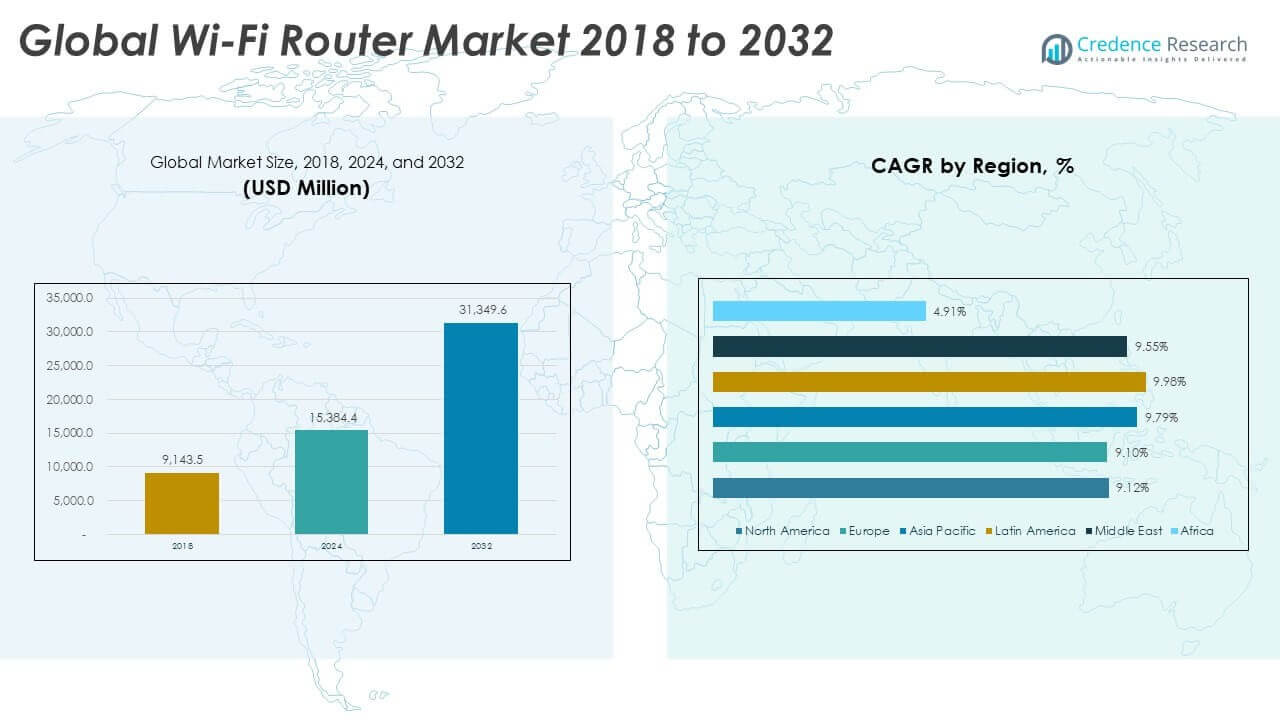
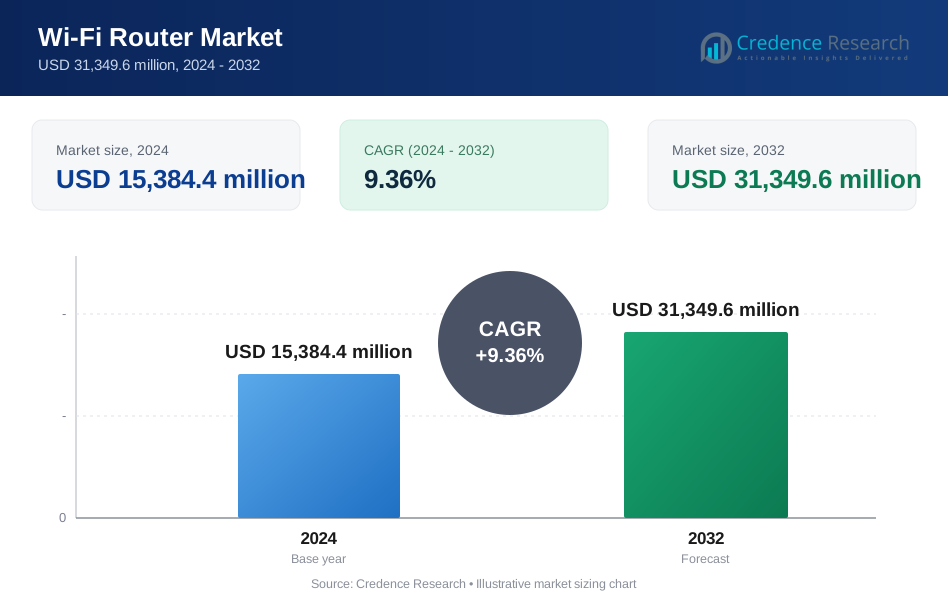
The Global Wi-Fi Router Market size was valued at USD 9,143.5 million in 2018 to USD 15,384.4 million in 2024 and is anticipated to reach USD 31,349.6 million by 2032, at a CAGR of 9.36% during the forecast period.
| REPORT ATTRIBUTE | DETAILS |
|---|---|
| Historical Period | 2020-2023 |
| Base Year | 2024 |
| Forecast Period | 2025-2032 |
| Wi-Fi Router Market Size 2024 | USD 15,384.4 million |
| Wi-Fi Router Market, CAGR | 9.36% |
| Wi-Fi Router Market Size 2032 | USD 31,349.6 million |
The market is driven by growing demand for high-speed wireless connectivity across homes, businesses, and public spaces. Remote work, online learning, and content streaming have pushed consumers to upgrade routers with better bandwidth and reliability. Enterprises deploy advanced routers to support hybrid offices, cloud-based tools, and secure remote access. The rise in connected devices, IoT systems, and smart homes fuels adoption of dual-band, tri-band, and mesh Wi-Fi routers. Vendors focus on integrating AI-based controls, mobile management apps, and enhanced security features to address evolving customer needs.
Asia Pacific leads the market due to widespread broadband penetration, digital infrastructure investments, and strong consumer electronics demand in countries like China, Japan, and India. North America follows with early adoption of Wi-Fi 6 and strong ISP partnerships. Europe shows steady growth supported by enterprise upgrades and home networking expansion. Latin America and the Middle East are emerging, driven by increasing internet access and mobile-first economies. Africa remains in early development, with potential tied to rural coverage and public-private broadband initiatives.
Market Insights:
- The Global Wi-Fi Router Market size was valued at USD 9,143.5 million in 2018, grew to USD 15,384.4 million in 2024, and is projected to reach USD 31,349.6 million by 2032, at a CAGR of 9.36%.
- Asia Pacific held the largest regional share in 2024 at 33.45%, followed by Europe at 26.61% and North America at 23.83%, driven by broadband penetration, enterprise upgrades, and smart home adoption respectively.
- Latin America is the fastest-growing region with a CAGR of 9.98%, supported by mobile-first usage, urban digitization, and rising internet access across Brazil, Mexico, and Argentina.
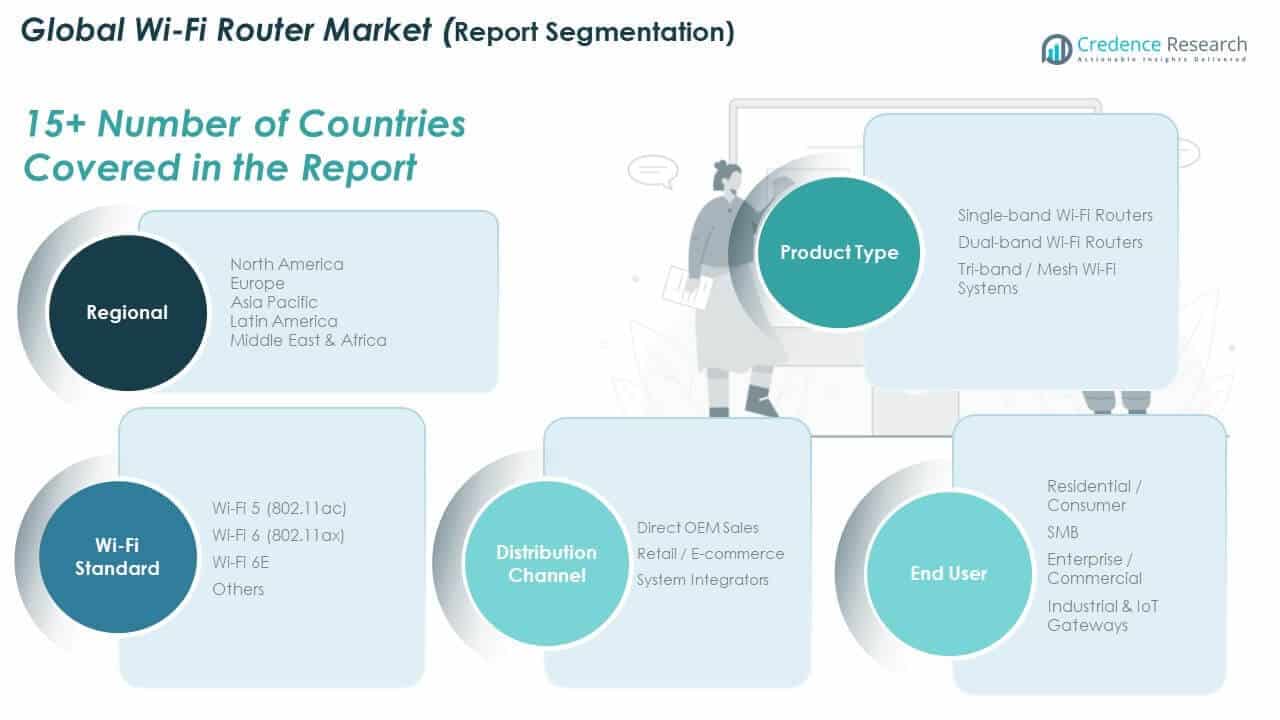
- In 2024, dual-band Wi-Fi routers contributed the highest revenue share among product types, driven by balanced performance for residential and SMB users.
- Tri-band and mesh Wi-Fi systems are showing rapid growth, projected to surpass single-band routers by 2032, due to their scalability and demand in large homes and smart environments.
Market Drivers
Rising Internet Penetration and Digital Infrastructure Expansion Across Emerging Markets
The growing number of internet users across developing economies is boosting router demand. Governments support broadband rollout to underserved regions through funding and public-private models. Consumers in rural and semi-urban zones seek stable internet access for education and work. ISPs expand infrastructure, creating new revenue streams through Wi-Fi router deployment. Smart city initiatives also involve network upgrades that include router provisioning. In the Global Wi-Fi Router Market, this expansion fuels mid-range and entry-level product uptake. It also creates scale for manufacturers focused on volume-based supply. Stable connectivity is now seen as essential infrastructure across geographies.
Home Connectivity Requirements Driven by Remote Work, Learning, and Entertainment
Work-from-home and hybrid work culture raise expectations for consistent high-speed connectivity. Students rely on virtual classrooms, while households stream video, attend virtual meetings, and manage smart home devices. These behaviors drive router replacements and upgrades in residential settings. Dual-band and mesh routers solve dead-zone problems in larger homes. The Global Wi-Fi Router Market benefits from consumers prioritizing network quality. Broadband providers also bundle routers into subscription plans to boost user experience. Product differentiation now depends on throughput, coverage, and device compatibility. Households increasingly view Wi-Fi routers as a utility device, not just electronics.
- For instance, Netgear’s Orbi mesh systems are designed to cover homes exceeding 5,000 square feet while supporting more than 100 simultaneous devices.
Demand Growth from Small and Medium Enterprises (SMEs) and Startups Worldwide
Global SMEs adopt cloud applications and online tools for daily operations. These include communication, payroll, CRM, and remote access platforms. SMEs require secure and scalable networking, driving demand for business-grade Wi-Fi routers. Enterprises adopt VLAN support, firewall features, and remote configuration. The Global Wi-Fi Router Market benefits from this segment due to volume purchases and recurring upgrades. Vendor support and easy installation matter more than customization. Low IT budgets push businesses to adopt high-value, feature-rich routers. SMEs also need compatibility with VPN tools and smart office devices.
Integration of Smart Features, AI, and Cybersecurity Capabilities into Routers
Wi-Fi routers now offer traffic prioritization, parental controls, and AI-driven bandwidth optimization. Firmware upgrades enable performance tuning and better device management. Cybersecurity threats push vendors to embed firewalls and threat detection systems in routers. The Global Wi-Fi Router Market sees strong demand for secure home and office networks. AI helps in auto-diagnostics and adaptive signal management. These smart features reduce service requests and increase satisfaction. Cloud-managed router platforms also appeal to enterprises for centralized control. Vendors position smart functionality as a core competitive feature.
- For instance, ASUS integrates AiProtection powered by Trend Micro, which blocks thousands of malicious sites daily at the router level. AI helps in auto‑diagnostics and adaptive signal management.
Market Trends
Adoption of Wi-Fi 6 and Wi-Fi 6E Standards to Enhance Network Efficiency and Speed
Wi-Fi 6 and 6E technologies enable faster data transfer, lower latency, and better performance under load. More devices per household increase network strain, making these upgrades critical. Gamers and content creators prefer routers supporting multi-gigabit speeds. Enterprises also adopt Wi-Fi 6 for collaborative workspaces and latency-sensitive applications. In the Global Wi-Fi Router Market, adoption of these standards signals a shift toward future-ready infrastructure. Product lines now differentiate based on OFDMA, MU-MIMO, and TWT features. Hardware support for these standards grows across smartphones, laptops, and smart TVs. This trend improves long-term value and network longevity.
- For instance, ASUS’s ROG Rapture GT-AXE16000 is a quad-band Wi-Fi 6E router offering speeds up to 16 Gbps, designed for high-bandwidth gaming and smart home environments.
Growth of Mesh Networking Systems for Large-Space and Multi-User Environments
Mesh routers use interconnected nodes to ensure seamless coverage across large or multi-story buildings. Consumers value flexibility, scalability, and aesthetics in mesh setups. E-commerce platforms report rising sales of mesh router bundles. Enterprises with distributed teams benefit from seamless roaming within buildings. The Global Wi-Fi Router Market supports mesh adoption across education, hospitality, and retail sectors. Major brands now release consumer-grade mesh systems with mobile app controls. Mesh routers also feature self-healing networks and simplified installation. Demand for whole-home coverage supports innovation in this segment.
- For instance, Netgear’s Orbi RBK963 Wi-Fi 6E mesh system provides 9,000 square feet of coverage and supports 200+ devices with tri-band connectivity and a dedicated 6 GHz backhaul.
Cloud-Based Router Management and Subscription-Based Firmware Support Models
Users expect control through mobile apps, browser dashboards, and cloud-based interfaces. Remote router management helps ISPs troubleshoot issues without on-site visits. Enterprises prefer routers with centralized controls and analytics capabilities. Cloud integration enables automatic updates and enhanced security patches. The Global Wi-Fi Router Market supports this shift through SaaS-based features and long-term firmware support. Subscription plans now offer malware protection, parental controls, and VPN services. Cloud dashboards appeal to non-technical users for basic troubleshooting. This trend reduces churn and increases customer engagement.
Retail and Telecom Collaboration to Offer Bundled Wi-Fi Solutions for Homes
Retail chains and telecom providers collaborate to offer bundled routers with broadband packages. Telecom companies integrate routers with service plans for easy customer onboarding. Device financing models make high-end routers more accessible to households. Partnerships with e-commerce firms increase reach and availability. The Global Wi-Fi Router Market benefits from multi-channel sales and service bundling. Bundled offerings often include installation and replacement support. Retail bundling allows better market penetration in price-sensitive regions. Telecom tie-ups strengthen brand loyalty and recurring revenue streams.
Market Challenges Analysis
Price Sensitivity in Developing Economies and Intense Cost-Based Competition
Consumers in emerging markets remain highly price-sensitive, limiting the uptake of premium routers. Many still opt for low-cost, single-band models despite performance limitations. Entry of new vendors intensifies price wars, reducing margins for established players. Brands compete on cost rather than features, weakening differentiation. In the Global Wi-Fi Router Market, this dynamic creates challenges in positioning mid-range and high-end devices. Currency volatility further impacts import-dependent supply chains. Local manufacturing often lacks the scale to compete with global leaders. Brands must balance affordability with performance to stay competitive.
Cybersecurity Threats and Regulatory Pressures on Network Devices
Routers often become targets for cyberattacks due to poor firmware updates or weak default settings. Regulatory bodies now require stronger security compliance and data protection standards. These mandates increase development and testing costs for vendors. In the Global Wi-Fi Router Market, firmware vulnerabilities and outdated models create long-term risks. Managing updates across millions of devices remains a challenge. Consumer awareness of network security is rising, increasing demand for transparency. Vendors must ensure secure onboarding, encryption, and timely patching. Compliance with multiple regional standards complicates global product rollouts.
Market Opportunities
Expansion of IoT Ecosystems and Smart Home Integration Drives Long-Term Router Demand
Smart homes require stable, multi-device connectivity for appliances, sensors, and entertainment systems. Consumers want routers that can manage dozens of devices without interference. In the Global Wi-Fi Router Market, this need drives innovation in traffic management, AI tuning, and mesh scalability. Vendors offering seamless integration with smart ecosystems gain an edge. Voice assistant compatibility also increases product appeal.
5G and Fiber Rollouts Create Opportunities for High-Speed Router Adoption
Telecom operators investing in 5G and fiber infrastructure stimulate parallel demand for advanced routers. New deployments require compatible hardware to leverage ultra-fast broadband speeds. The Global Wi-Fi Router Market gains from this shift by offering Wi-Fi 6 routers as future-ready access points. Carrier-grade routers with dual WAN ports and LTE failover features see rising traction.
Market Segmentation Analysis:
By product type, dual-band Wi-Fi routers lead due to their balance of cost and performance. They support both 2.4 GHz and 5 GHz bands, making them suitable for residential and SMB use. Single-band routers retain relevance in price-sensitive markets but face slow growth. Tri-band and mesh Wi-Fi systems are gaining traction in large homes and enterprise-grade networks needing seamless coverage and higher throughput.
By Wi-Fi standard, Wi-Fi 6 (802.11ax) dominates current adoption trends due to its efficiency, capacity, and lower latency. The Global Wi-Fi Router Market benefits from rapid device ecosystem upgrades supporting this standard. Wi-Fi 5 remains widely deployed in basic setups, especially in developing regions. Wi-Fi 6E is seeing interest from advanced users and businesses seeking interference-free performance on the 6 GHz band.
- For instance, the Netgear Nighthawk RAXE500 is a Wi-Fi 6E router offering tri-band connectivity and up to 10.8 Gbps speed, designed to reduce congestion in high-density households and enterprise setups using the newly available 6 GHz spectrum.
By distribution channel, retail and e-commerce drive volume due to increasing consumer purchases and bundled broadband offerings. Direct OEM sales support large enterprises and ISPs with custom configurations and bulk deployments. System integrators enable adoption in complex commercial environments requiring tailored networking solutions.
By end user, residential consumers form the largest segment driven by work-from-home, streaming, and smart home growth. SMBs and commercial enterprises adopt routers with higher security, scalability, and management tools. Industrial and IoT gateway applications are emerging as key segments with demand for rugged and intelligent network devices across factories and logistics hubs. The market shows clear diversification across usage profiles and deployment scales.
- For instance, Ubiquiti's UniFi Dream Machine Pro combines a gateway, security console, and managed switch, supporting over 100 concurrent clients and offering VLAN support for segmenting corporate networks, while Cisco’s ruggedized routers serve as edge devices in smart industrial environments.
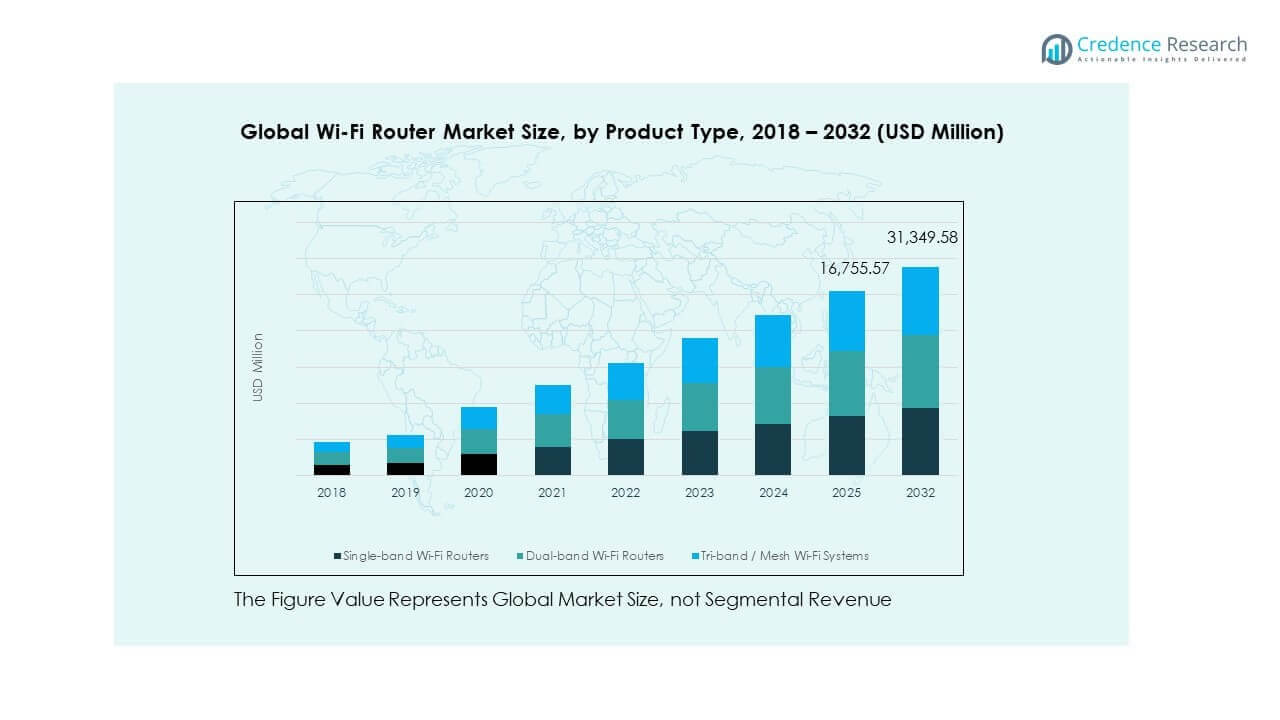
Segmentation:
By Product Type
- Single-band Wi-Fi Routers
- Dual-band Wi-Fi Routers
- Tri-band / Mesh Wi-Fi Systems
By Wi-Fi Standard
- Wi-Fi 5 (802.11ac)
- Wi-Fi 6 (802.11ax)
- Wi-Fi 6E
- Others
By Distribution Channel
- Direct OEM Sales
- Retail / E-commerce
- System Integrators
By End User
- Residential / Consumer
- Small and Medium Businesses (SMB)
- Enterprise / Commercial
- Industrial & IoT Gateways
By Region
- North America
- U.S.
- Canada
- Mexico
- Europe
- Germany
- France
- U.K.
- Italy
- Spain
- Rest of Europe
- Asia Pacific
- China
- Japan
- India
- South Korea
- South-east Asia
- Rest of Asia Pacific
- Latin America
- Brazil
- Argentina
- Rest of Latin America
- Middle East & Africa
- GCC Countries
- South Africa
- Rest of the Middle East and Africa
Regional Analysis:
North America
The North America Global Wi-Fi Router Market size was valued at USD 2,204.49 million in 2018 to USD 3,661.71 million in 2024 and is anticipated to reach USD 7,332.67 million by 2032, at a CAGR of 9.12% during the forecast period. North America holds a 23.83% share of the global market in 2024. High internet penetration and early adoption of Wi-Fi 6 standards support demand. The U.S. leads regional consumption due to enterprise-grade infrastructure and connected home ecosystems. Consumers prioritize high-speed routers for gaming, streaming, and work-from-home needs. Telecom players bundle routers with fiber and 5G offerings. Canada and Mexico show steady growth driven by broadband expansion. Enterprises across retail, healthcare, and education invest in high-throughput networking. The Global Wi-Fi Router Market benefits from strong channel distribution and high brand awareness across North America.
Europe
The Europe Global Wi-Fi Router Market size was valued at USD 2,468.74 million in 2018 to USD 4,094.46 million in 2024 and is anticipated to reach USD 8,182.24 million by 2032, at a CAGR of 9.10% during the forecast period. Europe accounts for 26.61% of the global market share in 2024. Germany, the UK, and France drive router demand across consumer and enterprise segments. EU-backed broadband rollouts and 5G readiness push infrastructure modernization. Smart home adoption in Western Europe supports dual-band and mesh system sales. Eastern Europe is catching up with affordable retail models and regional ISPs expanding coverage. Enterprises in finance and education deploy secure, cloud-managed Wi-Fi solutions. Public Wi-Fi zones and co-working spaces also raise product penetration. The Global Wi-Fi Router Market in Europe reflects growing reliance on fast and secure digital connectivity.
Asia Pacific
The Asia Pacific Global Wi-Fi Router Market size was valued at USD 2,987.18 million in 2018 to USD 5,147.41 million in 2024 and is anticipated to reach USD 10,818.74 million by 2032, at a CAGR of 9.79% during the forecast period. Asia Pacific commands the largest global share at 33.45% in 2024. China leads regional demand, supported by strong e-commerce, digital education, and government broadband programs. India sees fast growth in dual-band router usage across urban centers. Japan and South Korea focus on advanced Wi-Fi 6E deployment. Southeast Asia presents new opportunities through mobile-first digital adoption and fiber expansion. Consumers seek affordable, high-performance routers with app control features. Smart cities and 5G infrastructure further lift deployment volumes. The Global Wi-Fi Router Market in this region thrives on volume, price range diversity, and aggressive ISP partnerships.
Latin America
The Latin America Global Wi-Fi Router Market size was valued at USD 800.97 million in 2018 to USD 1,396.47 million in 2024 and is anticipated to reach USD 2,978.21 million by 2032, at a CAGR of 9.98% during the forecast period. Latin America captures 9.07% of the global market share in 2024. Brazil drives router sales in both residential and SMB segments. Mexico and Argentina follow with demand for dual-band devices and growing retail channels. Consumers rely on Wi-Fi for streaming, education, and social media access. ISPs partner with brands to offer routers with broadband subscriptions. Rural connectivity programs in countries like Colombia create new router demand. E-commerce platforms expand access to advanced mesh systems. The Global Wi-Fi Router Market in Latin America benefits from urban digitization and demand for cost-effective connectivity.
Middle East
The Middle East Global Wi-Fi Router Market size was valued at USD 437.06 million in 2018 to USD 743.29 million in 2024 and is anticipated to reach USD 1,536.13 million by 2032, at a CAGR of 9.55% during the forecast period. It holds a 4.83% market share in 2024. Gulf countries like UAE and Saudi Arabia lead with premium router adoption in smart homes and commercial spaces. Wi-Fi 6 deployment grows across enterprise parks and new infrastructure zones. ISPs offer bundled Wi-Fi solutions with higher speed plans. Mesh networks gain traction in villas and multi-floor buildings. Israel invests in secure enterprise routers for tech startups and R&D centers. Public sector modernization adds procurement volume for secure wireless networks. The Global Wi-Fi Router Market in the Middle East benefits from smart infrastructure and digital ecosystem upgrades.
Africa
The Africa Global Wi-Fi Router Market size was valued at USD 245.05 million in 2018 to USD 341.09 million in 2024 and is anticipated to reach USD 501.59 million by 2032, at a CAGR of 4.91% during the forecast period. Africa accounts for 2.22% of the global market in 2024. Growth remains moderate due to lower internet penetration and income constraints. South Africa leads in urban Wi-Fi deployment, followed by Egypt and Kenya. Demand is centered around basic single-band and entry-level dual-band routers. Local ISPs offer installment-based hardware access in partnership with retail chains. Network expansion efforts under government and NGO programs build future potential. Public Wi-Fi zones and internet cafes remain relevant in underserved areas. The Global Wi-Fi Router Market in Africa reflects gradual infrastructure build-out and rising digital access.
Key Player Analysis:
- TP-Link Technologies
- Netgear
- ASUS
- Huawei Technologies
- Ubiquiti
- D-Link Corporation
- Cisco Systems, Inc.
- Belkin International, Inc.
- Edimax Technology Co., Ltd
- Other Key Players
Competitive Analysis:
The Global Wi-Fi Router Market features intense competition among global and regional players focused on innovation, pricing, and distribution. TP-Link, Netgear, ASUS, Huawei, and Cisco lead in market share, offering a broad portfolio of dual-band, tri-band, and mesh systems. It remains fragmented with brands targeting specific end users and regions. Players invest in Wi-Fi 6 and 6E-enabled products to meet evolving performance standards. Strategic partnerships with telecom operators and e-commerce platforms expand customer reach. Ubiquiti and D-Link maintain strong visibility in the SMB and residential sectors. Companies use cloud management, cybersecurity integration, and app-based controls to differentiate offerings. The Global Wi-Fi Router Market rewards product lines with high reliability, ease of use, and competitive price-to-performance ratios. Vendor success depends on global supply chain agility and alignment with ISP growth strategies. Brands that address smart home and enterprise-grade connectivity needs continue to gain traction.
Recent Developments:
- In January 2025, TP-Link announced its expanded Wi-Fi 7 lineup at CES 2025, including the Archer BE900 quad-band router delivering up to 24.4 Gbps speeds and new mesh systems for home and outdoor use. These products target seamless 4K/8K streaming, AR/VR gaming, and portable connectivity, with availability rolling out throughout 2025.
- In September 2024 (with 2025 relevance), Netgear announced three new Wi-Fi 7 routers—the Nighthawk RS600, RS500, and RS200—offering ultra-fast speeds, low latency, and robust security for smart homes. In January 2026, Netgear opened pre-orders for the Nighthawk M7 portable Wi-Fi 7 hotspot, featuring enhanced security, eSIM marketplace support, and shipping starting January 27 for travelers.
Report Coverage:
The research report offers an in-depth analysis based on Product Type, Wi‑Fi Standard, Distribution Channel, End User, and Region. It details leading market players, providing an overview of their business, product offerings, investments, revenue streams, and key applications. Additionally, the report includes insights into the competitive environment, SWOT analysis, current market trends, as well as the primary drivers and constraints. Furthermore, it discusses various factors that have driven market expansion in recent years. The report also explores market dynamics, regulatory scenarios, and technological advancements that are shaping the industry. It assesses the impact of external factors and global economic changes on market growth. Lastly, it provides strategic recommendations for new entrants and established companies to navigate the complexities of the market.
Future Outlook:
- Growing demand for dual-band and tri-band routers will drive residential and commercial upgrades.
- Expansion of smart home devices and IoT systems will increase bandwidth and performance needs.
- Adoption of Wi-Fi 6 and Wi-Fi 6E standards will continue to shape product development cycles.
- Retail and e-commerce platforms will remain vital sales channels for consumer router models.
- Telecom bundling strategies will boost router penetration in fiber and 5G broadband markets.
- Cloud-managed routers will gain preference in enterprise and SMB networks for centralized control.
- Cybersecurity features and AI-based network optimization will differentiate premium offerings.
- Emerging economies will witness volume growth led by affordable single-band and dual-band units.
- Mesh systems will grow rapidly across larger homes, shared spaces, and smart office environments.
- Regional competition and low-cost manufacturing hubs will reshape global supply chain dynamics.
Request a Free Sample
Fill in your details and we'll send you a free sample report.
- Sample data tables & charts
- Research methodology
Need a Custom Version of This Report?
Tailor the scope, geography, or segments to your exact requirements.
- Custom geography or segment scope
- Direct access to our analyst team
Frequently Asked Questions
What is the current market size for Global Wi-Fi Router Market, and what is its projected size in 2032?
At what Compound Annual Growth Rate is the Global Wi-Fi Router Market projected to grow between 2024 and 2032?
Which Global Wi-Fi Router Market segment held the largest share in 2024?
What are the primary factors fueling the growth of the Global Wi-Fi Router Market?
Who are the leading companies in the Global Wi-Fi Router Market?
Which region commanded the largest share of the Global Wi-Fi Router Market in 2024?
Table of Content
Chapter 1. Report Introduction
- 1.1 Report Description & Purpose
- 1.1.1 Report Title & Market Definition
- 1.1.2 Unique Selling Propositions (USP) & Key Differentiators
- 1.1.3 Value Proposition for Stakeholders
- 1.2 Research Objectives
- 1.2.1 Market Sizing Objectives (Volume & Revenue)
- 1.2.2 Segmentation Objectives
- 1.2.3 Competitive Intelligence Objectives
- 1.2.4 Forecast & Scenario Objectives
- 1.3 Report Scope
- 1.3.1 Wi-Fi Router Scope – Types & Subtypes Covered
- 1.3.2 Geographic Scope – Regions & Countries Covered
- 1.3.3 Historical Period, Base Year & Forecast Period (2024; forecast to 2032)
- 1.3.4 Inclusions & Exclusions
- 1.4 HS Code & Classification Framework
- 1.5 Currency, Units & Pricing Basis
- 1.6 Target Stakeholders
- 1.7 Limitations & Assumptions
Chapter 2. Executive Summary
- 2.1 Global Wi-Fi Router Market Snapshot
- 2.1.1 Market Size – Historical (2024) & Forecast (2024-2032) (2024: USD 15,384.4 million → 2032: USD 31,349.6 million)
- 2.1.2 Volume & Revenue – Global Totals
- 2.1.3 Key Market Highlights – Top Five Facts
- 2.2 Wi-Fi Router Market Segmentation Snapshot
- 2.2.1 Market Split by Region – 2024 vs. 2032
- 2.3 Competitive Snapshot
- 2.3.1 Top 10 Players by Revenue Share – 2024
- 2.3.2 Top 10 Players by Volume Share – 2024
- 2.3.3 Recent Strategic Developments (18-Month Summary)
- 2.4 Key Investment Highlights & Strategic Conclusions
Chapter 3. Wi-Fi Router Market Dynamics & Industry Analysis
- 3.1 Market Overview & Context
- 3.1.1 Wi-Fi Router Market Position in the Broader Automotive Value Chain
- 3.1.2 OEM vs. Replacement Market Dynamics
- 3.1.3 Market Maturity & Development Stage by Region
- 3.2 Wi-Fi Router Market Drivers
- 3.3 Wi-Fi Router Market Restraints & Challenges
- 3.4 Wi-Fi Router Market Opportunities
- 3.5 Porter's Five Forces Analysis
- 3.5.1 Threat of New Entrants
- 3.5.2 Bargaining Power of Suppliers
- 3.5.3 Bargaining Power of Buyers
- 3.5.4 Threat of Substitutes
- 3.5.5 Competitive Rivalry – Intensity Assessment
- 3.6 Wi-Fi Router Value Chain Analysis
- 3.6.1 Upstream – Raw Material/Input Suppliers
- 3.6.1.1 Raw Material/Input 1
- 3.6.1.2 Raw Material/Input 2
- 3.6.1.3 Raw Material/Input 3
- 3.6.2 Midstream – Production/Manufacturing/Service Delivery
- 3.6.2.1 Production/Process Overview
- 3.6.2.2 Key Facility Locations & Capacity by Manufacturer
- 3.6.3 Downstream – Distribution & End Consumer
- 3.6.3.1 Primary Channel – B2B/OEM
- 3.6.3.2 Secondary Channels – Dealer, Retail, Online, Direct
- 3.6.4 Value Chain Profitability Analysis
- 3.6.1 Upstream – Raw Material/Input Suppliers
- 3.7 PESTEL Analysis
- 3.7.1 Political Factors
- 3.7.2 Economic Factors
- 3.7.3 Social Factors
- 3.7.4 Technological Factors
- 3.7.5 Environmental Factors
- 3.7.6 Legal Factors
- 3.8 Wi-Fi Router Supply Chain Analysis
- 3.8.1 Raw Material/Input Supply Risk Assessment
- 3.8.2 Manufacturing Concentration Risk (Geographic Exposure)
- 3.8.3 Trade Disruption Impact Analysis
- 3.9 Regulatory & Policy Landscape
Note: The regulatory and policy landscape section covers regulations based on their applicability to the market, Wi-Fi Router category, geography, and scope of the study. Only regulatory frameworks with a material impact on operations, compliance, trade, sustainability, or market access are analyzed in detail.
Chapter 4. Key Investment Pockets & Opportunity Analysis
- 4.1 Wi-Fi Router Market Attractiveness Analysis
- 4.1.1 By Region – Investment Attractiveness Matrix (Volume × CAGR)
- 4.2 Absolute Revenue Growth Opportunity
- 4.2.1 By Region – Absolute USD Growth Through 2032
- 4.3 Incremental Volume Opportunity
- 4.3.1 By Region – Incremental Volume Through 2032
- 4.3.2 Segment – Incremental Volume
- 4.4 Emerging Submarket Opportunity Deep Dive (Subject to Applicability)
- 4.5 Emerging Market Opportunity Scorecards
- 4.5.1 United States
- 4.5.2 Europe
- 4.5.3 Asia
- 4.5.4 Middle East & Africa
Note: Emerging Market Opportunity Scorecards will be included based on relevance and strategic importance. Regions listed are indicative and may vary depending on data availability and market dynamics.
Chapter 5. Wi-Fi Router Import-Export Analysis & Trade Flows
- 5.1 Global Trade Overview
- 5.1.1 Global Export Value by Country (2024)
- 5.1.2 Global Export Volume by Country (2024)
- 5.1.3 Global Import Value by Country (2024)
- 5.1.4 Global Import Volume by Country (2024)
- 5.1.5 Net Trade Balance by Country (2024)
- 5.2 Export Analysis – Segment
- 5.2.1 Type 1 (HS Code)
- 5.2.2 Type 2 (HS Code)
- 5.2.3 Type 3 (HS Code)
- 5.2.4 Type 4 (HS Code)
- 5.2.5 Type 5 (HS Code)
- 5.3 Import Analysis – Segment
- 5.3.1 Type 1 (HS Code)
- 5.3.2 Type 2 (HS Code)
- 5.3.3 Type 3 (HS Code)
- 5.3.4 Type 4 (HS Code)
- 5.3.5 Type 5 (HS Code)
- 5.4 Average Unit Trade Prices
- 5.4.1 Average Export Price – Segment & Country
- 5.4.2 Average Import Price – Segment & Source Country
- 5.4.3 Price Trends (2024)
- 5.5 Key Trade Route Analysis
- 5.5.1 Trade Route 1
- 5.5.2 Trade Route 2
- 5.5.3 Trade Route 3
- 5.5.4 Trade Route 4
- 5.5.5 Trade Route 5
- 5.6 Trade Policy Impact Assessment
- 5.6.1 US Anti-Dumping & Section 301 Tariffs
- 5.6.2 EU Customs Union Impact
- 5.6.3 Major Free Trade Agreements
- 5.6.4 USMCA Rules of Origin
Note: Trade policy analysis will be included only where relevant to the Wi-Fi Router market.
Chapter 6. Competitive Landscape & Company Benchmarking
- 6.1 Wi-Fi Router Market Concentration & Structure
- 6.1.1 Herfindahl-Hirschman Index (HHI) – vs. 2024
- 6.1.2 Tier 1, Tier 2 & Tier 3 Market Structure
- 6.1.3 Global, Regional & Local Player Dynamics
- 6.2 Wi-Fi Router Market Share Analysis – 2024
- 6.2.1 Global Revenue Share by Company
- 6.2.2 Global Volume Share by Company
- 6.2.3 Regional Revenue Share
- 6.2.4 Market Share Evolution ( vs. 2024)
- 6.2.5 OEM Segment Share by Company
- 6.2.6 Replacement Segment Share by Company
- 6.3 Production/Delivery Capacity & Facility Analysis
- 6.3.1 Global Installed Capacity
- 6.3.2 Capacity Utilization Rates
- 6.3.3 Production/Output Volume
- 6.3.4 Facility Locations & Capacity Map
- 6.3.5 Planned Capacity Additions
- 6.4 Wi-Fi Router Competitive Benchmarking Matrix
- 6.4.1 Revenue, Volume, CAGR & Profitability Comparison
- 6.4.2 Channel Revenue Mix
- 6.4.3 Geographic Revenue Exposure
- 6.4.4 R&D Intensity
- 6.4.5 Sustainability Maturity
- 6.5 Strategic Developments in Wi-Fi Router (Last 24 Months)
- 6.5.1 Mergers, Acquisitions & Divestments
- 6.5.2 New Wi-Fi Router Launches
- 6.5.3 Facility Expansions
- 6.5.4 Strategic Alliances, Joint Ventures & Partnerships
- 6.5.5 Distribution Expansion & Market Entry
- 6.5.6 Sustainability & ESG Initiatives
- 6.6 Competitive Strategy Mapping
- 6.6.1 Leader, Challenger, Follower & Niche Classification
- 6.6.2 Pricing Strategy Comparison
- 6.6.3 Channel Strategy Matrix
Note: Strategic developments are included based on their materiality and the availability of reliable information.
Chapter 7. Global Wi-Fi Router Market – By Distribution Channel
- 7.1 Segment Overview
- 7.1.1 Volume & Revenue Split by Channel (2024 & 2032)
- 7.1.2 Channel Mix Evolution (2024-2032)
Chapter 8. Regional Market Analysis – Global Overview
- 8.1 Global Regional Overview
- 8.1.1 Regional Volume Share
- 8.1.2 Regional Revenue Share
- 8.1.3 Regional Volume by Region
- 8.1.4 Regional Revenue by Region
- 8.1.5 Regional Forecast Through 2032
- 8.2 Cross-Regional Segment Analysis
- 8.2.1 By Distribution Channel
- 8.2.2 By Brand/Price Tier
Chapter 9. North America Wi-Fi Router Market
- 9.1 United States
- 9.2 Canada
- 9.3 Mexico
Chapter 10. Europe Wi-Fi Router Market
- 10.1 Germany
- 10.2 France
- 10.3 Italy
- 10.4 United Kingdom
- 10.5 Spain
- 10.6 Poland
- 10.7 Russia
- 10.8 Netherlands
- 10.9 Belgium
- 10.10 Sweden
- 10.11 Denmark
- 10.12 Norway
- 10.13 Rest of Europe
Chapter 11. Asia Pacific Wi-Fi Router Market
- 11.1 China
- 11.2 India
- 11.3 Japan
- 11.4 South Korea
- 11.5 Thailand
- 11.6 Indonesia
- 11.7 Vietnam
- 11.8 Malaysia
- 11.9 Australia
- 11.10 Rest of Asia Pacific
Chapter 12. Latin America Wi-Fi Router Market
- 12.1 Brazil
- 12.2 Argentina
- 12.3 Colombia
- 12.4 Chile
- 12.5 Rest of Latin America
Chapter 13. Middle East Wi-Fi Router Market
- 13.1 Saudi Arabia
- 13.2 United Arab Emirates
- 13.3 Turkey
- 13.4 Israel
- 13.5 Iran
- 13.6 Rest of the Middle East
Chapter 14. Africa Wi-Fi Router Market
- 14.1 South Africa
- 14.2 Egypt
- 14.3 Nigeria
- 14.4 Morocco
- 14.5 Rest of Africa
Chapter 15. Wi-Fi Router Company Profiles
- 15.1 [Company 01]
- 15.1.1 Company Overview
- 15.1.2 Key Management Personnel
- 15.1.3 Products & Services Portfolio
- 15.1.4 Financial Performance
- 15.1.5 Key Market Focus & Geographic Presence
- 15.1.6 Recent Developments & Strategic Initiatives
Note: The company profile list is preliminary and may change based on research findings, market developments, data availability, and client requirements.
Chapter 16. Appendices
- Appendix A – List of Abbreviations & Acronyms
- Appendix B – Industry Classification Code Reference – Full Series
- Appendix C – Production & Capacity Data Tables
- Appendix D – End-Use & Demand Base Tables
- Appendix E – Consumption & Replacement Rate Assumptions
- Appendix F – ASP Reference Tables
- Appendix G – Manufacturing & Facility Database
- Appendix H – Import-Export Data Tables
- Appendix I – Regulatory Summary Tables
- Appendix J – Primary Research Participant List (Anonymized)
- Appendix K – Primary Research Questionnaire Framework
- Appendix L – Data Sources & Bibliography
- Appendix M – Market Size Divergence & Source Comparison
Chapter 17. Research Methodology
- 17.1 Research Framework & Philosophy
- 17.2 Secondary Research – Sources, Hierarchy & Data Extraction
- 17.3 Data Modeling – Bottom-Up & Top-Down Market Sizing
- 17.4 Primary Research – Stakeholder Framework, LOI & Sample Sizes
- 17.5 Forecast Methodology – Regression, Scenario & Sensitivity Analysis
- 17.6 Quality Control – Four-Layer Validation Framework
- 17.7 Limitations & Standard Assumptions
- 17.8 Disclaimer
