Market Overview:
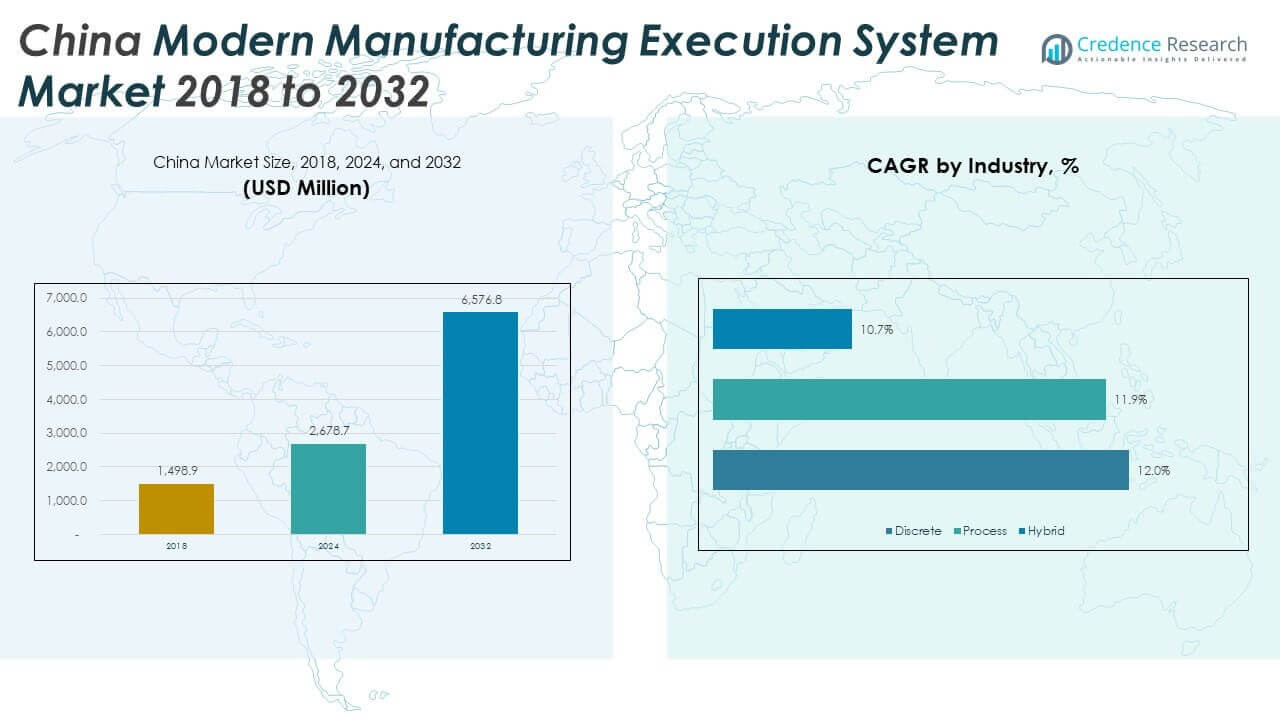
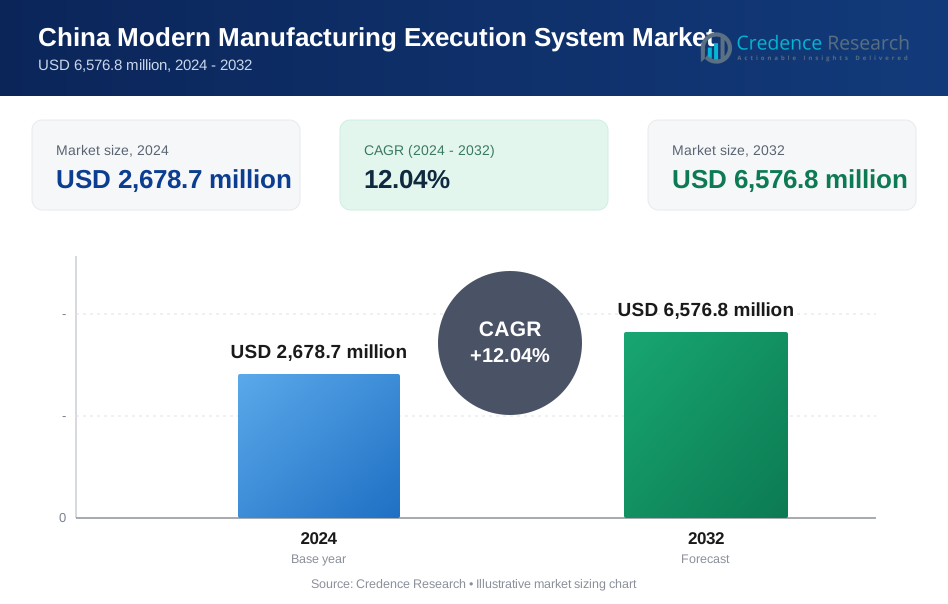
The China Modern Manufacturing Execution System Market size was valued at USD 1,498.9 million in 2018 to USD 2,678.7 million in 2024 and is anticipated to reach USD 6,576.8 million by 2032, at a CAGR of 12.04% during the forecast period.
| REPORT ATTRIBUTE | DETAILS |
|---|---|
| Historical Period | 2020-2023 |
| Base Year | 2024 |
| Forecast Period | 2025-2032 |
| China Modern Manufacturing Execution System Market Size 2024 | USD 2,678.7 million |
| China Modern Manufacturing Execution System Market , CAGR | 12.04% |
| China Modern Manufacturing Execution System Market Size 2032 | USD 6,576.8 million |
Growth in the China Modern Manufacturing Execution System Market is driven by national industrial transformation programs, increasing digitalization, and demand for real-time operational visibility. Enterprises are investing in MES platforms to optimize production, improve quality control, and reduce downtime across smart factories. High adoption in automotive, electronics, and pharmaceutical sectors reflects rising needs for scheduling, traceability, and analytics. Vendors are offering AI-integrated, cloud-ready solutions to support fast deployment and multi-site coordination. Government-backed smart manufacturing policies accelerate adoption across key manufacturing hubs.
Eastern China leads the China Modern Manufacturing Execution System Market due to its strong industrial base, digital infrastructure, and pilot smart factory zones. Regions like Jiangsu, Zhejiang, and Guangdong see higher MES penetration from large-scale manufacturers and multinational investments. Southern provinces follow with demand from export-oriented industries and electronics clusters. Central and western China are emerging as new growth regions, supported by industrial relocation, digital incentives, and expanding smart industrial parks. These areas are adopting modular MES systems to modernize operations and attract future-ready manufacturing investments.
Market Insights
- The China Modern Manufacturing Execution System Market grew from USD 1,498.9 million in 2018 to USD 2,678.7 million in 2024 and is projected to reach USD 6,576.8 million by 2032, expanding at a CAGR of 12.04% during the forecast period.
- Eastern China leads with about 45% share, followed by Southern China at 25% and Northern China at 15%, driven by dense manufacturing clusters, advanced digital infrastructure, and strong smart factory adoption.
- Central and Western China emerge as the fastest-growing region with a combined 15% share, supported by industrial relocation, government incentives, and rising investments in modern industrial parks.
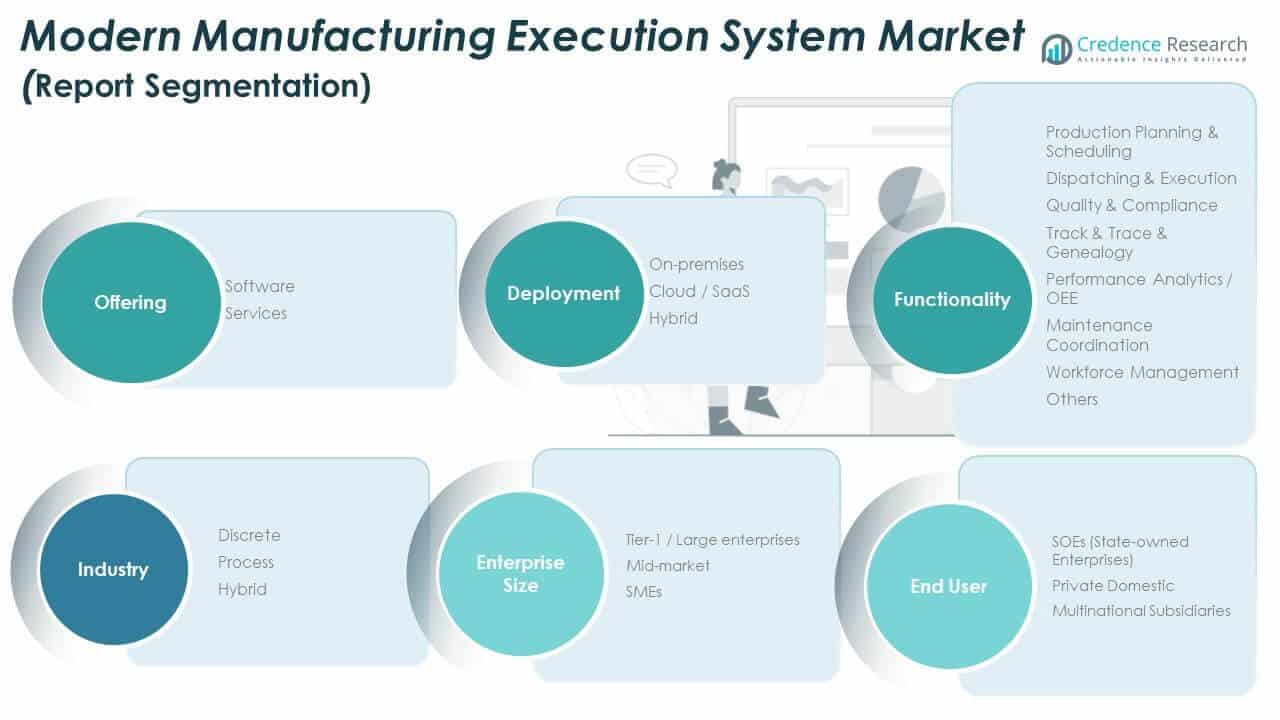
- By offering, software accounts for roughly 60% of the market share, reflecting strong demand for core MES platforms, real-time analytics, and production control capabilities.
- Services contribute close to 40% share, supported by growing needs for system integration, customization, training, and lifecycle support across diverse manufacturing environments.
Market Drivers
Smart Factory Policies and Government-Led Industrial Digitalization Initiatives
China Modern Manufacturing Execution System Market benefits from strong government push through programs like Made in China 2025. Policies encourage digital upgrades across heavy industry, electronics, and auto manufacturing clusters. MES platforms help factories meet targets for process transparency and equipment utilization. Central subsidies support MES adoption in pilot smart factories across eastern provinces. Regional authorities promote MES integration in supply chains and industrial parks. This coordinated policy environment accelerates vendor partnerships with SOEs and local governments. Manufacturers implement MES to qualify for incentives and tax rebates. Public funding de-risks digital transformation and shortens return on investment timelines. MES adoption expands steadily across second-tier cities.
- For instance, China’s Made in China 2025 strategy aimed to establish around 40 national manufacturing innovation centers by 2025 to advance intelligent manufacturing. These centers promote industrial digitalization and support technologies such as smart production systems and factory automation.
Accelerated Demand for Real-Time Production Visibility and Downtime Reduction
Real-time shop floor control remains a top priority across Chinese discrete manufacturing. The China Modern Manufacturing Execution System Market grows due to rising demand for traceability, operational transparency, and shift-level performance tracking. MES platforms offer real-time dashboards and analytics to supervisors and plant managers. Factories use MES to cut unplanned downtime through alerting, exception handling, and workflow enforcement. In high-speed electronics and automotive lines, downtime translates to large output losses. MES applications support proactive intervention through predictive signals. Local vendors emphasize integration with SCADA and sensors for real-time responsiveness. Decision-makers prioritize fast ROI tools that reduce production delays. MES gains preference over legacy ERP extensions for time-critical use cases.
Localized Solutions Supporting Language, Compliance, and Integration Needs
MES adoption benefits from localization tailored to China's regulatory and cultural landscape. Vendors design user interfaces in Mandarin and local dialects to support operator-level interaction. The China Modern Manufacturing Execution System Market includes players that offer compliance-ready templates for cGMP, ISO, and automotive traceability codes. Local MES solutions align with China’s Cybersecurity Law and data residency rules. Domestic platforms integrate with Chinese ERP systems, which dominate among SOEs and mid-sized firms. MES also adapts to region-specific production modes, like batch manufacturing in food or mixed-model assembly in EV plants. Support for WeChat-based access and local cloud hosting improves usability. This localized advantage improves deployment time and user acceptance.
- For example, Huawei’s FusionPlant platform offers on‑premises deployment options that help manufacturers host sensitive production data locally, supporting compliance with China’s data residency and cybersecurity policies.
Digital Maturity Across Key End-Use Sectors Accelerates MES Uptake
High MES penetration is visible across electronics, auto, and pharmaceutical industries. These sectors lead digital maturity levels and seek end-to-end shop floor integration. The China Modern Manufacturing Execution System Market gains momentum from their demand for digital twins, dynamic scheduling, and quality control automation. Automotive OEMs adopt MES to manage multi-variant production and test traceability. Electronics manufacturers use MES for defect tracking, changeover optimization, and inventory synchronization. Pharma firms use MES to enforce validation workflows and electronic batch records. Complex production chains in these sectors drive high reliance on real-time coordination. MES becomes a core layer between production and enterprise systems, enabling faster compliance and delivery execution.
Market Trends
Adoption of Cloud-Based and Hybrid MES Architectures Across Multi-Plant Operations
MES deployment is shifting toward flexible cloud and hybrid environments. Enterprises prefer scalable models to support regional and national expansion. The China Modern Manufacturing Execution System Market sees demand for SaaS and private-cloud MES among mid-market firms. These platforms lower upfront capex and reduce onsite IT overhead. Cloud-native MES allows central coordination across distributed plants. Manufacturers leverage cloud for centralized reporting, multi-site benchmarking, and remote troubleshooting. Hybrid models offer plant-level control while syncing to cloud analytics. Large vendors enable container-based deployment through Kubernetes for faster provisioning. It supports faster rollouts in brownfield and greenfield plants across different geographies.
Rise in AI and ML Integration for Predictive Insights and Dynamic Decision Support
AI and ML are gaining ground in modern MES platforms deployed in China. The China Modern Manufacturing Execution System Market reflects growing use of machine-learning models for predictive maintenance and dynamic dispatching. MES vendors embed ML to optimize resource utilization and spot recurring quality issues. AI-driven recommendations enable automatic process tuning based on past performance. MES tools track operator skill levels and reassign tasks dynamically. Manufacturers use AI to predict bottlenecks and adjust scheduling in real time. Deep learning improves defect classification during visual inspections. Data-driven insights reduce decision latency and improve responsiveness on shop floors. Smart MES modules shorten response times during anomalies.
Expansion of Edge Computing and IoT to Enable Faster Shop Floor Response
Edge computing supports real-time decision-making close to equipment and production zones. The China Modern Manufacturing Execution System Market benefits from IoT device integration across CNC machines, conveyors, and robotic cells. MES platforms process local data using embedded edge processors for ultra-low latency. This setup improves machine coordination, predictive alerting, and closed-loop control. Edge deployment reduces reliance on centralized servers, which can slow down time-sensitive tasks. Factory floors see improved performance during peak production hours. Decentralized architecture enables resilience during connectivity issues. Manufacturers benefit from local insights that feed central dashboards for long-term planning. Edge-ready MES enhances digital agility in dynamic environments.
- For example, Huawei’s FusionPlant platform has been deployed in automotive production environments to integrate shop‑floor devices and support real‑time data flow using 5G and industrial networking technologies.
Adoption of Digital Twin Models to Simulate and Optimize Production Environments
MES platforms increasingly feature digital twin modules that simulate production flows and asset behavior. The China Modern Manufacturing Execution System Market incorporates virtual replicas of machines, lines, and layouts to plan upgrades and reduce errors. MES uses these simulations to validate process changes before deployment. Digital twins help predict maintenance windows and cycle time improvements. Manufacturers use this feature to test capacity scenarios and energy consumption. MES vendors partner with CAD/CAM software providers to import models directly. Simulations support real-time deviation detection and line balancing strategies. This trend improves ROI by reducing testing downtime and speeding up process innovation.
- For instance, Xiangtan Iron & Steel deployed an intelligent bridge crane scheduling system that uses large‑model algorithms to generate a 30‑minute crane schedule in one minute, improving production coordination and response time.
Market Challenges Analysis
Integration Complexities Between MES, ERP, SCADA, and Legacy Systems
Integrating MES into existing plant environments remains a major obstacle for manufacturers. The China Modern Manufacturing Execution System Market faces technical barriers in aligning MES with legacy ERP and SCADA platforms. Many Chinese factories still use outdated infrastructure that lacks standard APIs or modular design. MES deployment often demands extensive customization and middleware development. Interfacing across disparate systems increases project costs and delays ROI realization. Data inconsistency across systems affects reporting accuracy and weakens end-to-end visibility. Smaller vendors struggle to offer integration templates for older protocols or proprietary devices. Even within large plants, siloed systems complicate holistic digitalization. Lack of interoperability reduces MES scalability across multi-line operations.
Skilled Workforce Shortage and Change Resistance at the Operational Level
Shortage of skilled IT and operations talent slows MES implementation progress in many provinces. The China Modern Manufacturing Execution System Market depends heavily on system integrators and vendor training teams. Operators unfamiliar with digital interfaces often resist MES workflows and dashboards. Training programs face low adoption when not customized to plant-specific tasks. Workforce aging in traditional industries adds pressure to retrain or replace legacy skill sets. Change management gaps lead to partial implementation or system abandonment. Resistance stems from fear of monitoring, job restructuring, or added reporting workload. Without proper alignment across management and operations, MES fails to reach full functionality in many rollouts.
Market Opportunities
Expansion into Mid-Sized Factories and Tier-2 Manufacturing Clusters Across Inland China
MES vendors are expanding beyond top-tier cities into mid-sized manufacturing hubs in inland provinces. The China Modern Manufacturing Execution System Market holds significant untapped demand from second-tier and third-tier factory clusters. These plants seek cost-effective MES with preconfigured modules for faster implementation. Local governments offer grants and industrial park incentives for digital upgrades. Vendors entering these regions gain first-mover advantage and strong referral pipelines. MES adoption supports modernization of supply chains in textile, machinery, and chemical sectors. Growth in this segment helps vendors balance competition in overserved coastal markets. Inland growth supports regional digital equity and nationwide MES diffusion.
MES-Driven Sustainability Compliance and Energy Optimization in Manufacturing
Sustainability compliance is becoming a major MES adoption trigger across China. The China Modern Manufacturing Execution System Market supports energy-efficient operations by offering tools to monitor carbon, water, and energy usage. Green factory certifications now require continuous emissions and consumption tracking. MES allows users to link energy data with production cycles to optimize consumption. Factories aim to reduce waste and improve yield through digitized process control. MES-based dashboards help leadership visualize environmental KPIs. Vendors add modules to support EHS compliance, carbon audits, and digital emissions logs. These capabilities position MES as an enabler of China’s broader green manufacturing goals.
Market Segmentation Analysis
By Offering
Software holds the largest share in the China Modern Manufacturing Execution System Market due to high demand for real-time monitoring, quality control, and advanced planning modules. Vendors focus on AI-powered, cloud-integrated software to serve large factories and multi-site operations. Services segment grows steadily with rising need for implementation, training, and system upgrades, particularly in mid-sized enterprises lacking in-house IT teams.
By Deployment
On-premises deployment dominates the China Modern Manufacturing Execution System Market due to security preferences in state-owned enterprises and industries with sensitive IP. Cloud/SaaS models gain traction among mid-sized and private firms seeking lower upfront costs and flexible scalability. Hybrid models attract manufacturers aiming to balance local control with centralized oversight and cloud analytics.
- For instance, Xiangtan Iron & Steel, with support from Huawei, deployed 23 intelligent application scenarios across its steel production lines, covering processes such as coking, sintering, ironmaking, and rolling. These deployments were part of its digital transformation using Huawei’s AI and industrial platforms.
By Functionality
Production planning and scheduling remains a core functionality, driving MES adoption in discrete industries. Dispatching and execution modules support shop floor coordination, especially in high-volume lines. Quality and compliance modules grow in pharma and electronics. Track & trace, OEE, and maintenance tools support regulatory needs and uptime optimization. Workforce and “others” functions see niche deployment in larger factories.
- For example, GE Digital’s Proficy Smart Factory MES manages real‑time production operations and quality workflows across automated manufacturing lines, supporting data capture, scheduling, and execution in both process and discrete environments.
By Enterprise Size
Tier-1 and large enterprises lead adoption in the China Modern Manufacturing Execution System Market due to digital transformation mandates and global integration needs. Mid-market firms show strong interest in modular solutions with lower capex. SMEs lag due to budget constraints and limited digital maturity, though entry-level cloud MES models are lowering barriers.
By End User
State-owned enterprises drive MES demand through central mandates and funding support. Private domestic manufacturers adopt MES for efficiency and export-readiness. Multinational subsidiaries deploy globally standardized MES platforms to maintain cross-border compliance and process alignment.
By Industry
Discrete industries dominate the China Modern Manufacturing Execution System Market, with strong activity in automotive, electronics, and machinery. Process industries, including chemicals and food, expand MES use to improve traceability and process control. Hybrid setups emerge in firms operating mixed production lines.
Segmentation
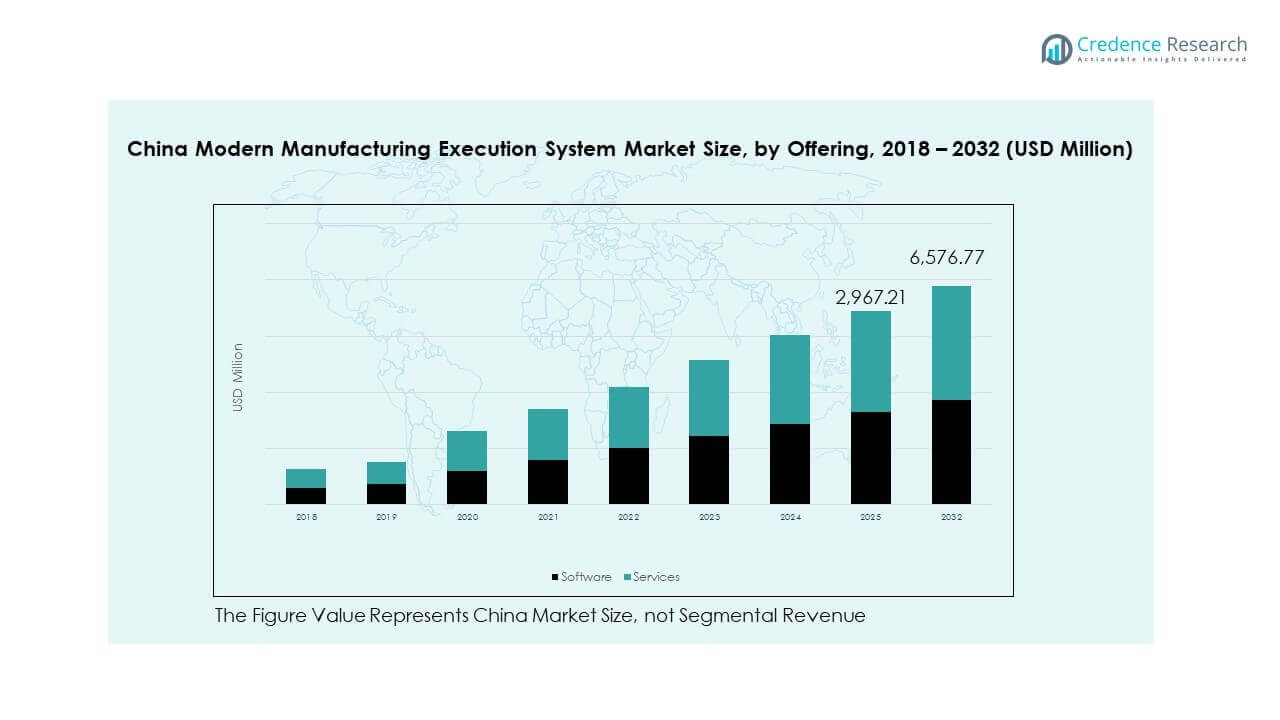
By Offering
- Software
- Services
By Deployment
- On-premises
- Cloud / SaaS
- Hybrid
By Functionality
- Production Planning & Scheduling
- Dispatching & Execution
- Quality & Compliance
- Track & Trace & Genealogy
- Performance Analytics / OEE
- Maintenance Coordination
- Workforce Management
- Others
By Enterprise Size
- Tier-1 / Large Enterprises
- Mid-market
- SMEs
By End User
- State-Owned Enterprises (SOEs)
- Private Domestic
- Multinational Subsidiaries
By Industry
- Discrete
- Process
- Hybrid
Regional Analysis
Eastern China
Eastern China holds the largest share of the China Modern Manufacturing Execution System Market, accounting for nearly 45% of total demand. Provinces such as Jiangsu, Zhejiang, and Shandong host dense manufacturing clusters across electronics, automotive, and machinery. High digital maturity and strong industrial infrastructure support early MES adoption. Enterprises in this subregion prioritize real-time visibility and multi-plant coordination. Local governments promote smart factory pilots and digital compliance programs. Strong presence of system integrators accelerates deployment cycles.
Southern China
Southern China represents around 25% of the market, led by Guangdong and Fujian. The China Modern Manufacturing Execution System Market gains momentum here due to electronics assembly, consumer goods, and export-oriented manufacturing. Manufacturers focus on MES to support high-mix, high-volume production models. Private domestic firms drive most deployments, favoring cloud and hybrid systems. Cross-border supply chain integration with Southeast Asia also influences adoption. Fast upgrade cycles define demand patterns in this subregion.
Northern, Central, and Western China
Northern China contributes close to 15%, supported by automotive, steel, and heavy equipment bases around Beijing and Tianjin. Central and western regions jointly account for about 15%, with rising investments in industrial parks and relocation projects. The China Modern Manufacturing Execution System Market expands here through government-backed digitalization programs. Manufacturers adopt MES to modernize legacy plants and attract new investments. Adoption rates remain lower than coastal regions but show steady improvement. Cost-sensitive deployments and modular MES platforms gain preference.
Key Player Analysis
- SUPCON
- HollySys
- Siemens Digital Industries
- Rockwell Automation
- Baosight
- Honeywell International
- Oracle
- ABB
- GE Digital
- Other Key Players
Competitive Analysis
The China Modern Manufacturing Execution System Market features a mix of strong domestic vendors and global automation leaders. Local players such as SUPCON, Hollysys, and Baosight maintain an advantage through deep industry knowledge and regulatory alignment. These firms offer highly customized MES platforms tailored to Chinese production workflows and compliance needs. Global companies like Siemens, Rockwell Automation, ABB, and Honeywell compete through advanced analytics, AI integration, and strong global references. It remains competitive on system integration capability and lifecycle service quality. Domestic vendors focus on price competitiveness, rapid deployment, and integration with local ERP systems. Global vendors emphasize scalability, cybersecurity, and alignment with multinational production standards. Strategic partnerships with system integrators play a critical role in winning large enterprise contracts. Product differentiation centers on real-time analytics, interoperability, and cloud readiness. Market leaders invest heavily in R&D to expand functionality across digital twins and edge computing. Competitive intensity remains high, with innovation speed and localization defining long-term positioning.
Recent Developments
- In January 2026, Siemens expanded its partnership with NVIDIA, announced at CES 2026 to develop an Industrial AI Operating System for AI-accelerated solutions in product lifecycles and manufacturing. The collaboration aims to create fully AI-driven adaptive manufacturing sites, starting with Siemens' Electronics Factory in Germany in 2026, with relevance to China's industrial AI advancements.
- In May 2025, Siemens Digital Industries launched a fully integrated virtual commissioning solution as part of its "China Accelerates 2.0" strategy, unveiled at the Siemens China Accelerates 2.0 smart manufacturing innovation products launch event.
Report Coverage
The research report offers an in-depth analysis based on Offering, Deployment, Functionality, Enterprise Size, End User and Industry. It details leading market players, providing an overview of their business, product offerings, investments, revenue streams, and key applications. Additionally, the report includes insights into the competitive environment, SWOT analysis, current market trends, as well as the primary drivers and constraints. Furthermore, it discusses various factors that have driven market expansion in recent years. The report also explores market dynamics, regulatory scenarios, and technological advancements that are shaping the industry. It assesses the impact of external factors and global economic changes on market growth. Lastly, it provides strategic recommendations for new entrants and established companies to navigate the complexities of the market.
Future Outlook
- Adoption of MES will deepen as manufacturers prioritize real-time control, traceability, and production transparency across complex, multi-line factory environments.
- Integration with AI, machine learning, and edge computing will strengthen predictive decision support and reduce response time on shop floors.
- Cloud and hybrid deployment models will expand as mid-sized manufacturers seek scalable and lower-cost digital manufacturing platforms.
- Localization will remain critical, with vendors refining compliance, language, and workflow customization for diverse regional manufacturing practices.
- MES platforms will evolve into orchestration layers connecting ERP, PLM, SCADA, and industrial IoT ecosystems.
- Demand will rise from inland manufacturing hubs as industrial relocation and smart park development gain pace.
- Sustainability monitoring and energy optimization will become embedded MES use cases aligned with green manufacturing targets.
- Workforce-centric modules will gain relevance as factories address skills gaps and productivity management challenges.
- Competition will intensify between domestic vendors and global players on innovation speed and service depth.
- Long-term growth will depend on vendor ability to deliver modular, interoperable, and rapidly deployable MES solutions.
Request a Free Sample
Fill in your details and we'll send you a free sample report.
- Sample data tables & charts
- Research methodology
Need a Custom Version of This Report?
Tailor the scope, geography, or segments to your exact requirements.
- Custom geography or segment scope
- Direct access to our analyst team
Frequently Asked Questions
What is the current market size for China Modern Manufacturing Execution System Market, and what is its projected size in 2032?
At what Compound Annual Growth Rate is the China Modern Manufacturing Execution System Market projected to grow between 2024 and 2032?
Which China Modern Manufacturing Execution System Market segment held the largest share in 2024?
What are the primary factors fueling the growth of the China Modern Manufacturing Execution System Market?
Who are the leading companies in the China Modern Manufacturing Execution System Market?
Which region commanded the largest share of the China Modern Manufacturing Execution System Market in 2024?
Table of Content
Chapter 1 Market Segmentation
- 1.1 Segmentation Framework
- 1.1.1 Product and Service Classification
- 1.1.2 Application and End-Use Classification
- 1.1.3 Technology and Solution Classification
- 1.1.4 Customer and Distribution Channel Classification
- 1.1.5 Geographic Segmentation
- 1.1.6 Market Segment Definitions and Boundaries
Chapter 2 Introduction
- 2.1 Report Objectives and Scope
- 2.2 Product Definition and Industry Terminology
- 2.3 Market Inclusions and Exclusions
- 2.4 Research Process
- 2.4.1 Primary Research and Expert Interviews
- 2.4.2 Secondary Research and Source Review
- 2.4.3 Top-Down and Bottom-Up Estimation
- 2.4.4 Data Triangulation and Verification
- 2.5 Market Size Measurement Basis
- 2.5.1 2024: USD 2,678.7 million → 2032: USD 6,576.8 million
- 2.6 Historical and Forecast Reference Periods
- 2.6.1 Base Year: 2024
- 2.6.2 Forecast Period: 2024-2032
- 2.7 Research Assumptions and Limitations
Chapter 3 Executive Summary
- 3.1 Market Snapshot and Key Findings
- 3.2 Base-Year Market Size, 2024
- 3.3 Forecast Market Size, 2032
- 3.4 Revenue and Volume Growth Outlook
- 3.5 Key Demand and Supply Indicators
- 3.6 Leading Market Segments
- 3.7 Fastest-Growing Market Opportunities
- 3.8 Regional Performance Highlights
- 3.9 Technology and Industry Transformation
- 3.10 Competitive Landscape Summary
- 3.11 Analyst View and Strategic Implications
Chapter 4 China Modern Manufacturing Execution System Market Trends and Developments
- 4.1 Historical Industry Development
- 4.2 Recent Market Trends and Developments
- 4.3 Demand and Customer Behavior Trends
- 4.4 Technology and Product Innovation
- 4.5 Artificial Intelligence, Automation and Digitalization
- 4.6 Local Manufacturing and Supply Chain Realignment
- 4.7 Industry Partnerships, Mergers and Acquisitions
- 4.8 Sustainability and Circular Economy Developments
- 4.9 Government and Private Sector Investment Trends
- 4.10 Emerging Business Models and Commercialization
- 4.11 Industry Developments and Announcements
Chapter 5 China Modern Manufacturing Execution System Market Production, Supply and Demand Analysis
- 5.1 Demand Trend and Consumption Analysis
- 5.2 Demand Forecast, 2024-2032
- 5.3 Production and Output Trend
- 5.4 Production and Output Forecast, 2024-2032
- 5.5 Installed Capacity and Capacity Utilization
- 5.6 Company-Wise Production Plants and Statistics
- 5.6.1 Installed Production Capacity
- 5.6.2 Actual Production
- 5.6.3 Planned Capacity and Expansion Targets
- 5.7 Supply Chain Structure and Procurement Trends
- 5.8 Supply-Demand Gap and Bottlenecks
- 5.9 Import Dependence and Sourcing Structure
- 5.10 Contract Manufacturing and Outsourcing
- 5.11 Regional Supply and Demand Concentration
Chapter 6 China Modern Manufacturing Execution System Market Pricing Analysis
- 6.1 Pricing Structure and Measurement
- 6.2 Historical Pricing Trends
- 6.3 Pricing Outlook, 2024-2032
- 6.4 Average Selling Price and Unit Economics
- 6.5 Pricing by Product and Market Segment
- 6.6 Geographic Pricing Differences
- 6.7 Key Input, Energy, Labor and Logistics Costs
- 6.8 Contract Pricing and Purchasing Models
- 6.9 Pricing Sensitivity and Competitive Positioning
- 6.10 Price, Margin and Profitability Implications
Chapter 7 China Modern Manufacturing Execution System Market Dynamics
- 7.1 Market Growth Drivers
- 7.1.1 Demand-Side Drivers
- 7.1.2 Technology and Innovation Drivers
- 7.1.3 Infrastructure and Investment Drivers
- 7.1.4 Regulatory and Policy Drivers
- 7.2 Market Restraints
- 7.2.1 Cost and Affordability Constraints
- 7.2.2 Technology and Adoption Barriers
- 7.2.3 Supply Chain and Operational Constraints
- 7.3 Market Challenges
- 7.3.1 Competitive Pressure and Margin Erosion
- 7.3.2 Skills, Infrastructure and Implementation Gaps
- 7.4 Emerging Market Opportunities
- 7.5 Market Dynamics Impact and Time-Horizon Assessment
Chapter 8 China Modern Manufacturing Execution System Value Chain Analysis
- 8.1 Industry Value Chain Overview
- 8.2 Upstream Suppliers and Critical Inputs
- 8.3 Technology and Component Providers
- 8.4 Manufacturing or Service Delivery
- 8.5 Distribution, Channel Partners and Integrators
- 8.6 Downstream Applications and End Users
- 8.7 Value Addition and Profit Pools
- 8.8 Vertical Integration and Outsourcing
- 8.9 Supplier Concentration and Risk
- 8.10 Supply Chain Localization and Resilience
Chapter 9 China Modern Manufacturing Execution System Market Regulations and Policies
- 9.1 Relevant Laws, Standards and Compliance Frameworks
- 9.2 Product, Service, Safety and Quality Requirements
- 9.3 Government Policies, Incentives and Subsidies
- 9.4 Imports, Exports and Trade Barriers
- 9.5 Public Procurement and Local Content Requirements
- 9.6 Environmental and Sustainability Compliance
- 9.7 Data Protection, AI and Cybersecurity Compliance
- 9.8 Upcoming Policy Changes and Market Implications
Chapter 10 China Modern Manufacturing Execution System Market Hotspots and Opportunities
- 10.1 Market Opportunity Mapping and Growth Hotspots
- 10.2 High-Growth Applications and Customer Groups
- 10.3 Underserved Markets and White-Space Opportunities
- 10.4 Emerging Technology and Product Opportunities
- 10.5 New Capacity and Investment Hotspots
- 10.6 Market Entry and Expansion Opportunities
- 10.7 Distribution and Partnership Opportunities
- 10.8 Near-Term and Long-Term Commercial Potential
- 10.9 Opportunity Attractiveness and Execution Risks
Chapter 11 China Modern Manufacturing Execution System Market Outlook, 2024-2032
- 11.1 Market Size and Analysis
- 11.1.1 Revenue (Market Measurement: 2024: USD 2,678.7 million → 2032: USD 6,576.8 million)
- 11.1.2 Market Volume and Quantity Sold
- 11.1.3 Historical Market Size
- 11.1.4 Base-Year Market Size, 2024
- 11.2 Market Forecast, 2024-2032
- 11.2.1 Revenue Forecast to 2032
- 11.2.2 Volume Forecast to 2032
- 11.2.3 CAGR and Year-on-Year Growth
- 11.2.4 Incremental Revenue Opportunity
- 11.3 Forecast Assumptions and Scenario Analysis
- 11.3.1 Base-Case Forecast
- 11.3.2 Optimistic and Conservative Scenarios
- 11.3.3 Technology, Pricing and Policy Sensitivities
- 11.4 Market Attractiveness and Growth Outlook
Chapter 12 China Modern Manufacturing Execution System Market Segmentation and Outlook
- 12.1 Segmentation Summary and Market Shares, 2024
- 12.2 Largest and Fastest-Growing Segments
- 12.3 Segment Growth Comparison
- 12.4 Segment Attractiveness and Priority Matrix
Chapter 13 China Modern Manufacturing Execution System Geographic Market Outlook, 2024-2032
- 13.1 Domestic Market Distribution and Demand Clusters
- 13.2 State- or Province-Wise Market Size and Forecast, 2024-2032
- 13.3 City and Metropolitan Market Outlook
- 13.4 Industrial, Manufacturing and Commercial Clusters
- 13.5 Geographic Concentration of Key End Users
- 13.6 Local Pricing and Purchasing Differences
- 13.7 Domestic Production Facilities and Capacity Map
- 13.8 Local Infrastructure and Project Pipeline
- 13.9 State-Level Policy and Incentive Differences
- 13.10 Subnational Investment Hotspots and Opportunities
- 13.11 Distribution and Logistics Networks
- 13.12 Domestic Competitive Footprint
Chapter 14 China Modern Manufacturing Execution System Technology, Innovation and Sustainability Outlook
- 14.1 Technology Landscape and Maturity
- 14.2 Product, Process and Service Innovation
- 14.3 AI, Automation and Digital Tools in the Industry
- 14.4 Technology Adoption and Performance Benchmarking
- 14.5 Innovation Pipeline and R&D Investment
- 14.6 Patent and Intellectual Property Trends
- 14.7 Energy Efficiency and Resource Management
- 14.8 Sustainability, Recycling and Circularity
- 14.9 Technology Roadmap, 2024-2032
- 14.10 Risks of Obsolescence and Technology Substitution
Chapter 15 China Modern Manufacturing Execution System Market Key Strategic Imperatives
- 15.1 Growth and Market Entry Priorities
- 15.2 High-Return Products and Segments
- 15.3 Pricing, Profitability and Cost Optimization
- 15.4 Technology Investment and Product Differentiation
- 15.5 Supply Chain Localization and Resilience
- 15.6 Distribution and Customer Acquisition
- 15.7 Partnership, Acquisition and Capacity Strategy
- 15.8 Regional Expansion Priorities
- 15.9 Short-, Medium- and Long-Term Actions
Chapter 16 Competition Outlook
- 16.1 Industry Competition Characteristics
- 16.2 Market Structure and Concentration
- 16.3 Market Share and Competitive Positioning, 2024
- 16.4 Company-Wise Revenue and Product Benchmarking
- 16.5 Production and Service Capacity Benchmarking
- 16.6 Technology, Pricing and Differentiation
- 16.7 Regional Footprint and Distribution Strength
- 16.8 Mergers, Acquisitions and Strategic Alliances
- 16.9 New Entrants and Competitive Threats
- 16.10 Porter's Five Forces and Industry Attractiveness
- 16.11 Competitive Outlook, 2024-2032
Chapter 17 Company Profiles
- 17.1 Company Coverage and Selection Criteria
- 17.2 Leading Market Participants – Standard Profile Structure
- 17.2.1 Business Description
- 17.2.2 Company Ownership and Geographic Presence
- 17.2.3 Product and Service Portfolio
- 17.2.4 Manufacturing and Operating Footprint
- 17.2.5 Production Capacity and Expansion Plans
- 17.2.6 Financial Performance and Investment
- 17.2.7 Market Share and Competitive Position
- 17.2.8 Technology and Innovation Capabilities
- 17.2.9 Strategic Alliances or Partnerships
- 17.2.10 Recent Developments
- 17.2.11 Growth Strategy and Outlook
- 17.3 Other Relevant Market Participants
Note: Every listed company is profiled on the structure shown under the first company. The company list is preliminary and may change based on research findings, market developments, data availability and client requirements.
Chapter 18 Disclaimer
- 18.1 Research and Forecast Disclaimer
- 18.2 Data Source and Estimation Limitations
Note: The depth of individual sections depends on data availability for this market. Volume, capacity, trade and other unit-based metrics are included where applicable.