Market Overview
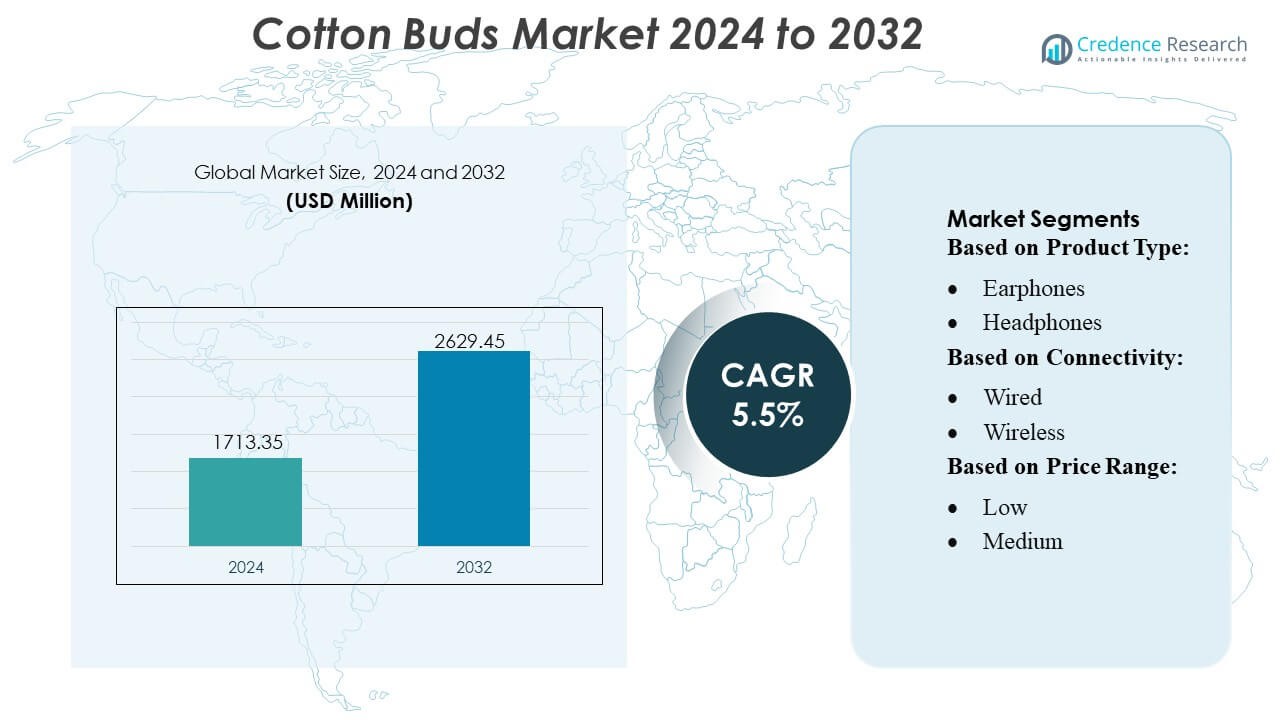
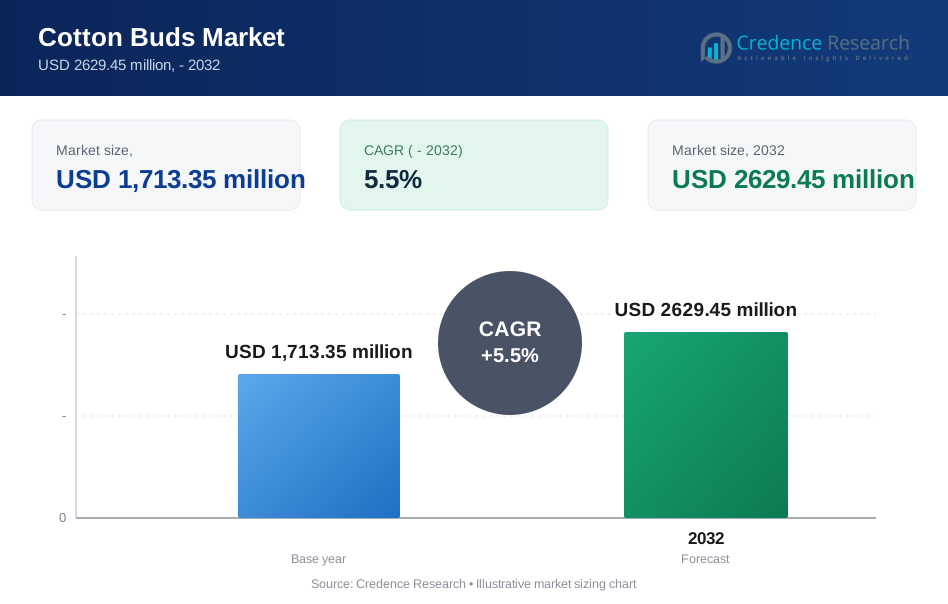
Cotton Buds Market size was valued USD 1713.35 million in 2024 and is anticipated to reach USD 2629.45 million by 2032, at a CAGR of 5.5% during the forecast period.
| REPORT ATTRIBUTE | DETAILS |
|---|---|
| Historical Period | 2020-2023 |
| Base Year | 2024 |
| Forecast Period | 2025-2032 |
| Cotton Buds Market Size 2024 | USD 1713.35 Million |
| Cotton Buds Market, CAGR | 5.5% |
| Cotton Buds Market Size 2032 | USD 2629.45 Million |
The cotton buds market features a mix of global consumer goods manufacturers and strong private-label brands that compete through large-scale production, cost efficiency, and accelerated adoption of biodegradable materials. Leading companies emphasize sustainable stems, dermatology-tested tips, and diversified applications across personal care, cosmetics, and medical use. Competitive positioning increasingly depends on eco-friendly product lines, packaging innovation, and expanded retail and e-commerce penetration. Asia-Pacific remains the leading region with an exact 36% market share, driven by its large population base, rapid consumption growth, and strong presence of both mass-market and premium hygiene-product suppliers.
Market Insights
- Cotton Buds Market size was valued at USD 1713.35 million in 2024 and is projected to reach USD 2629.45 million by 2032 at a CAGR of 5.5%.
- Strong market drivers include rising personal hygiene adoption, expanding cosmetic applications, and increasing demand for biodegradable stems supporting sustained segment growth across low-, medium-, and premium-price categories.
- Key trends highlight rapid premiumization, growing e-commerce distribution, and private-label expansion, while eco-friendly product development strengthens competitive differentiation among global and regional manufacturers.
- Market restraints stem from regulatory pressure on single-use plastics and competition from low-cost unorganized producers affecting pricing structure and quality consistency.
- Asia-Pacific leads with an exact 36% regional share, while the low-price segment captures around 65% share, driven by high consumption frequency and broad retail penetration across emerging markets.
Market Segmentation Analysis:
By Product Type
Earphones hold the dominant position in the cotton buds market with an estimated 58% share, supported by their compact form, low cost, and widespread use in hygiene and personal-care routines. Their disposable nature and convenience drive higher consumption volumes across households, travel kits, and medical settings. Headphones account for a smaller share due to lower usage frequency within personal grooming applications. Rising consumer preference for precision cleaning, increased adoption of multi-purpose buds, and strong retail availability reinforce the continued lead of earphones in this segment.
- For instance, Grado Signature S950 part of Grado’s “Signature” line uses a 52 mm dynamic driver, with a frequency response from 3.5 Hz to 51.5 kHz, and a sensitivity (SPL 1 mW) of 117 dB, nominal impedance 38 ohms, and total harmonic distortion below 0.1% at 100 dB.
By Connectivity
Wired variants dominate the market with an approximate 62% share, driven by their affordability, ease of availability, and suitability for everyday hygiene tasks, particularly in low- and middle-income regions. Their simple design and compatibility with traditional cotton-bud applications ensure steady demand across retail and healthcare channels. Wireless options represent a faster-growing niche but remain secondary due to higher prices and limited use cases. The wired segment benefits from strong penetration in convenience stores, bulk packaging formats, and user preference for straightforward, single-use hygiene tools.
- For instance, Pioneer DJ HDJ-X10 uses a 50 mm driver and delivers a frequency response from 5 Hz to 40 kHz, a spec that supports “high-resolution sound” suitable for professional monitoring and DJ usage.
By Price Range
The low-price segment leads with an estimated 65% share, attributed to strong demand for economical, disposable cotton buds used in personal care, cosmetics, and basic medical applications. Mass-market affordability, large-pack availability, and high consumption frequency reinforce this segment’s dominance. Medium-range products gain traction through improved build quality and environmentally friendly materials, while the high-price category remains limited to premium, biodegradable, or specialized buds. Growth drivers in the low-price category include expansion of private-label offerings, increased retail penetration, and strong uptake in emerging markets.
Key Growth Drivers
1. Rising Personal Hygiene and Grooming Adoption
Growing emphasis on personal hygiene and routine grooming significantly boosts cotton bud consumption across households, beauty salons, and medical facilities. Consumers increasingly prefer multi-purpose buds for cleaning ears, applying cosmetics, and addressing minor skin-care needs. High-frequency usage, expanding retail penetration, and increased demand in travel-friendly packaging formats reinforce market expansion. The shift toward disposable hygiene products, particularly in emerging economies, strengthens volume sales. This trend aligns with broader lifestyle upgrades and evolving consumer awareness of cleanliness and daily self-care practices.
- For instance, Alclair Versa Dual-Driver IEM uses two balanced-armature drivers in a 2-way crossover, has an impedance of 23 Ω at 1 kHz, delivers sensitivity of 101 dB (at 1 kHz, 100 mV) and peaks at 108 dB, and offers -26 dB noise reduction metrics provided directly on their product specification sheet.
2. Rapid Expansion of Cosmetic and Personal Care Applications
The expanding cosmetics industry strongly influences market growth as cotton buds become essential tools for makeup correction, precise product application, and skincare routines. Beauty brands actively promote single-use applicators for hygiene and accuracy, accelerating demand across premium and mass-market categories. Increasing female workforce participation and rising interest in at-home beauty treatments further stimulate consumption. The integration of cotton buds into specialized beauty kits and dermatology procedures enhances product relevance, while e-commerce channels strengthen accessibility and drive higher adoption among digitally engaged consumers.
- For instance, Panasonic’s wireless earphone model RZ-B110W is listed with features including “Ergonomic fit, clear sound with extra deep bass,” and battery life of up to 26 hours (with charging case).
3. Growing Demand for Eco-Friendly and Biodegradable Products
Environmental concerns drive the shift from plastic-stem cotton buds to biodegradable alternatives made from paper, bamboo, or organic cotton. Regulatory bans on single-use plastics across major regions accelerate adoption of sustainable designs. Manufacturers respond with certified compostable materials, improved packaging formats, and cleaner production processes that appeal to eco-conscious consumers. As sustainability becomes a core purchasing criterion, brands gain competitive advantage by offering environmentally compliant cotton buds. This transition enhances premium product opportunities while strengthening long-term market resilience.
Key Trends & Opportunities
1. Premiumization Through Value-Added Features
The market is witnessing strong momentum toward premium cotton buds featuring double-tipped designs, antibacterial coatings, and dermatologically tested materials. Consumers increasingly seek products with enhanced softness, precision tips, and cosmetic-grade quality, creating opportunities for differentiated offerings. Specialty buds for infant care, medical treatments, and beauty applications contribute to diversified revenue streams. Premiumization also supports higher margins for manufacturers and retailers, driven by strong demand from urban and professional segments. This shift opens pathways for brand-led innovation and targeted marketing strategies.
- For instance, Sonicare electric toothbrush brand, Philips claims that its sonic brush heads deliver up to 62,000 brush movements per minute, enabling thorough plaque removal while remaining gentle on gums.
2. Growth of Private Labels and Online Retail Distribution
Online platforms and private-label brands significantly accelerate market accessibility and affordability. E-commerce retailers offer competitive pricing, bundled packs, and subscription models that boost household consumption frequency. Private labels gain traction through cost-effective production and rapid scalability, appealing to price-sensitive consumers while maintaining acceptable quality standards. Digital marketplaces enable brands to experiment with sustainable materials and customizable packaging, creating new value propositions. The rise of direct-to-consumer sales further enhances visibility and drives category expansion across diverse regional markets.
- For instance, Schott uses its proprietary micro-float process to produce specialty glass with exceptional flatness and mirror-like surfaces. The process involves precise temperature control, with the glass floating on a tin bath at temperatures around 600°C.
3. Increasing Medical and Clinical Use Cases
Cotton buds are increasingly adopted in healthcare for wound cleaning, specimen collection, topical medication application, and minor dermatological procedures. Hospitals, clinics, and diagnostic centers rely on sterile, medical-grade variants that meet safety and hygiene protocols. Rising healthcare expenditure and increased frequency of outpatient procedures support higher demand for precision applicators. Manufacturers benefit from expanding clinical applications-particularly in pediatrics, ENT care, and point-of-care testing-creating avenues for specialized product lines with strict quality and sterilization standards.
Key Challenges
1. Regulatory Pressure on Single-Use Plastics
Stringent global regulations targeting single-use plastics challenge manufacturers reliant on traditional plastic-stem buds. Compliance with regional bans, extended producer responsibility policies, and environmental standards increases operational complexity and cost burdens. Companies must invest in alternative materials, redesign production lines, and obtain sustainability certifications, raising product development expenses. These shifts also affect pricing strategies and supply chain planning. Failure to transition toward eco-friendly solutions risks market exclusion, reduced brand credibility, and declining consumer acceptance in environmentally sensitive regions.
2. Competition from Low-Cost and Informal Manufacturers
The market faces intense price competition due to the presence of numerous small and unorganized manufacturers offering low-cost cotton buds with minimal quality control. These products often bypass regulatory compliance, undermining the value proposition of premium and branded variants. The fragmented competitive landscape pressures established players to optimize pricing while maintaining product quality and safety standards. Informal sector dominance in developing regions restricts margins, complicates market forecasting, and increases risks associated with counterfeit or substandard products entering retail channels.
Regional Analysis
North America
North America holds around 31% of the cotton buds market, driven by strong hygiene awareness, high consumption of personal care products, and well-established retail and healthcare channels. Demand remains strong across households, beauty salons, pediatric care, and clinical applications, supported by consistent product innovation and premiumization. The region’s regulatory restrictions on plastic stems accelerate adoption of biodegradable designs, encouraging brands to introduce sustainable variants. E-commerce penetration further boosts accessibility, while private-label offerings expand consumer reach. Growth remains steady, supported by rising cosmetic usage and continued expansion of environmentally compliant products.
Europe
Europe accounts for approximately 28% of the global market, supported by strict environmental regulations, high demand for biodegradable cotton buds, and strong consumer preference for eco-friendly personal care products. The EU’s ban on single-use plastic stems significantly shaped the market, promoting paper, bamboo, and organic-cotton alternatives. Premium cosmetic applications and dermatological use also contribute to stable demand across Germany, France, the UK, and Nordic countries. Retail chains and pharmacy networks dominate distribution, while sustainability certifications create differentiation for leading brands. Growth is reinforced by rising adoption of multi-purpose buds in beauty, hygiene, and healthcare routines.
Asia-Pacific
Asia-Pacific leads the market with around 36% share, driven by a large population base, high hygiene-product consumption, and rapid expansion of personal care and cosmetic industries. Countries such as China, India, Japan, and South Korea show strong demand due to rising disposable income, urbanization, and increased beauty-care adoption. Mass-market affordability and large-scale retail availability strengthen volume sales, while manufacturers benefit from cost-efficient production. Growing awareness of eco-friendly and biodegradable cotton buds enhances premium opportunities. Online retail channels significantly accelerate category penetration across urban and semi-urban areas, making APAC the fastest-growing regional market.
Latin America
Latin America holds an estimated 9% share, supported by increasing awareness of hygiene practices, expanding cosmetic usage, and wider availability of low- to mid-priced cotton buds across supermarkets and convenience stores. Brazil and Mexico dominate demand, driven by large consumer bases and rising grooming trends among younger populations. Adoption of eco-friendly buds is gradually increasing, although price sensitivity continues to influence purchasing patterns. Growth is further supported by the expansion of private-label offerings and improved distribution networks, particularly in urban centers. E-commerce growth adds an additional boost to product accessibility across the region.
Middle East & Africa
The Middle East & Africa region accounts for roughly 6% of the market, driven by rising hygiene awareness, growing retail penetration, and increased adoption of affordable personal care essentials. Demand is concentrated in GCC countries, South Africa, and North African markets where organized retail continues expanding. Cotton buds see steady usage in household grooming and healthcare applications, although market growth is moderated by economic disparities and price-sensitive consumer behavior. Sustainability-focused variants are slowly gaining traction, particularly in premium retail outlets. Strengthening distribution networks and rising urbanization support long-term growth potential across MEA.
Market Segmentations:
By Product Type:
- Earphones
- Headphones
By Connectivity:
- Wired
- Wireless
By Price Range:
- Low
- Medium
By Geography
- North America
- U.S.
- Canada
- Mexico
- Europe
- Germany
- France
- U.K.
- Italy
- Spain
- Rest of Europe
- Asia Pacific
- China
- Japan
- India
- South Korea
- South-east Asia
- Rest of Asia Pacific
- Latin America
- Brazil
- Argentina
- Rest of Latin America
- Middle East & Africa
- GCC Countries
- South Africa
- Rest of the Middle East and Africa
Competitive Landscape
The competitive landscape of the cotton buds market players such as Plantronics, Inc. (Acquired by HP Inc.), JVC Kenwood Corporation, Grado Labs, Pioneer Corporation, Bose Corporation, Alclair Audio, Inc., Logitech, Inc. (Including Ultimate Ears, LLC.), Panasonic Corporation, Apple, Inc., and Koninklijke Philips N.V. (Philips). the cotton buds market remains highly fragmented, with a mix of global consumer-goods manufacturers, regional hygiene-product suppliers, and private-label brands competing on pricing, product quality, and sustainability. Companies focus on expanding production capacity, optimizing supply chains, and introducing biodegradable stems made from paper, bamboo, and organic cotton to meet rising environmental regulations. Innovation centers on premium soft-tipped buds, cosmetic-grade applicators, and sterile medical variants that cater to diverse end-use segments. E-commerce growth enables wider reach and intensifies competition, while private-label retailers strengthen their market presence through cost-effective offerings and high-volume distribution. Continuous regulatory compliance and sustainability commitments increasingly determine competitive advantage.
Key Player Analysis
- Plantronics, Inc. (Acquired by HP Inc.)
- JVC Kenwood Corporation
- Grado Labs
- Pioneer Corporation
- Bose Corporation
- Alclair Audio, Inc.
- Logitech, Inc. (Including Ultimate Ears, LLC.)
- Panasonic Corporation
- Apple, Inc.
- Koninklijke Philips N.V. (Philips)
Recent Developments
- In June 2025, The Cotton Corporation of India (CCI) procured bales of cotton at the Minimum Support Price (MSP) during the season, spending to support farmers amid weak market demand. Over 500 procurement centers were set up, and with global cotton being cheaper, Indian mills increased imports despite an 11% duty.
- In October 2024, Sony’s PlayStation launched the Pulse Explore wireless earbuds and Pulse Elite wireless headset in India. These devices feature planar magnetic drivers and PlayStation Link wireless connectivity which offers advanced audio experiences.
- In July 2024, Samsung launched the Galaxy Buds 3 and Buds 3 Pro and they indeed feature Galaxy AI for enhanced audio, optimizing sound, providing real-time interpretation, and offering features like Adaptive ANC and Voice Detect, alongside new designs with blade lights and upgraded 2-way speakers, especially on the Pro model.
Report Coverage
The research report offers an in-depth analysis based on Product Type, Connectivity, Price Range and Geography. It details leading market players, providing an overview of their business, product offerings, investments, revenue streams, and key applications. Additionally, the report includes insights into the competitive environment, SWOT analysis, current market trends, as well as the primary drivers and constraints. Furthermore, it discusses various factors that have driven market expansion in recent years. The report also explores market dynamics, regulatory scenarios, and technological advancements that are shaping the industry. It assesses the impact of external factors and global economic changes on market growth. Lastly, it provides strategic recommendations for new entrants and established companies to navigate the complexities of the market.
Future Outlook
- The market will shift rapidly toward biodegradable and plastic-free cotton buds as regulations tighten and consumer preference for eco-friendly materials strengthens.
- Manufacturers will expand production of paper and bamboo stems to meet sustainability expectations across global markets.
- Premium cosmetic and dermatology-focused cotton buds will gain traction as beauty routines and professional skincare adoption increase.
- E-commerce will play a larger role in distribution, supported by subscription models and private-label expansion.
- Automated manufacturing and packaging processes will enhance efficiency and reduce production costs.
- Medical-grade sterile buds will see higher demand with increased outpatient procedures and point-of-care testing.
- Brands will adopt minimalist, recyclable packaging to align with circular economy requirements.
- Emerging markets will drive volume growth due to rising hygiene awareness and affordable product availability.
- Product diversification will accelerate, with multi-tip and specialty buds gaining wider acceptance.
- Competitive differentiation will increasingly rely on sustainability certifications and traceable raw-material sourcing.
Request a Free Sample
Fill in your details and we'll send you a free sample report.
- Sample data tables & charts
- Research methodology
Market Dynamics
Rising Personal Hygiene and Grooming Adoption
Increasing consumer focus on daily hygiene and grooming routines is driving higher consumption of cotton buds for ear cleaning, makeup application, and minor skincare needs, especially in households and beauty salons.
Expansion of Cosmetic and Personal Care Applications
The growing cosmetics industry and the trend toward at-home beauty treatments are boosting demand for cotton buds as essential tools for precise makeup correction, skincare, and beauty routines.
Shift Toward Eco-Friendly and Biodegradable Products
Regulatory bans on single-use plastics and heightened environmental awareness are accelerating the adoption of cotton buds with biodegradable stems made from paper, bamboo, or organic cotton, creating new premium and mass-market opportunities.
Growth of Private Labels and Online Retail
The rise of private-label brands and e-commerce platforms is making cotton buds more accessible and affordable, increasing household consumption frequency and enabling rapid market penetration, especially in emerging markets.
Increasing Medical and Clinical Use Cases
Cotton buds are seeing greater adoption in healthcare settings for wound cleaning, specimen collection, and topical medication application, driving demand for sterile, medical-grade variants that meet strict safety and hygiene standards.
Need a Custom Version of This Report?
Tailor the scope, geography, or segments to your exact requirements.
- Custom geography or segment scope
- Direct access to our analyst team
Frequently Asked Questions
What is the current market size for the Cotton Buds Market, and what is its projected size in 2032?
At what Compound Annual Growth Rate is the Cotton Buds Market projected to grow between 2024 and 2032?
Which Cotton Buds Market segment held the largest share in 2024?
What are the primary factors fueling the growth of the Cotton Buds Market?
Who are the leading companies in the Cotton Buds Market?
Which region commanded the largest share of the Cotton Buds Market in 2024?
Table of Content
Chapter 1 Market Segmentation
- 1.1 Segmentation Framework
- 1.1.1 Product and Service Classification
- 1.1.2 Application and End-Use Classification
- 1.1.3 Technology and Solution Classification
- 1.1.4 Customer and Distribution Channel Classification
- 1.1.5 Geographic Segmentation
- 1.1.6 Market Segment Definitions and Boundaries
- 1.2 By Price Range
- 1.2.1 Low
- 1.2.2 Medium
- 1.2.3 High
- 1.3 By Product Type
- 1.3.1 Standard Cotton Buds
- 1.3.2 Cosmetic Cotton Buds
- 1.3.3 Medical-Grade Cotton Buds
- 1.4 By Stem Material
- 1.4.1 Plastic
- 1.4.2 Paper
- 1.4.3 Bamboo
- 1.4.4 Wood
Chapter 2 Introduction
- 2.1 Report Objectives and Scope
- 2.2 Product Definition and Industry Terminology
- 2.3 Market Inclusions and Exclusions
- 2.4 Research Process
- 2.4.1 Primary Research and Expert Interviews
- 2.4.2 Secondary Research and Source Review
- 2.4.3 Top-Down and Bottom-Up Estimation
- 2.4.4 Data Triangulation and Verification
- 2.5 Market Size Measurement Basis
- 2.5.1 2024: USD 1,713.35 million → 2032: USD 2629.45 million
- 2.6 Historical and Forecast Reference Periods
- 2.6.1 Base Year: 2024
- 2.6.2 Forecast Period: 2024-2032
- 2.7 Research Assumptions and Limitations
Chapter 3 Executive Summary
- 3.1 Market Snapshot and Key Findings
- 3.2 Base-Year Market Size, 2024
- 3.3 Forecast Market Size, 2032
- 3.4 Revenue and Volume Growth Outlook
- 3.5 Key Demand and Supply Indicators
- 3.6 Leading Market Segments
- 3.7 Fastest-Growing Market Opportunities
- 3.8 Regional Performance Highlights
- 3.9 Technology and Industry Transformation
- 3.10 Competitive Landscape Summary
- 3.11 Analyst View and Strategic Implications
Chapter 4 Global Cotton Buds Market Trends and Developments
- 4.1 Historical Industry Development
- 4.2 Recent Market Trends and Developments
- 4.3 Demand and Customer Behavior Trends
- 4.4 Technology and Product Innovation
- 4.5 Artificial Intelligence, Automation and Digitalization
- 4.6 Local Manufacturing and Supply Chain Realignment
- 4.7 Industry Partnerships, Mergers and Acquisitions
- 4.8 Sustainability and Circular Economy Developments
- 4.9 Government and Private Sector Investment Trends
- 4.10 Emerging Business Models and Commercialization
- 4.11 Industry Developments and Announcements
Chapter 5 Global Cotton Buds Market Production, Supply and Demand Analysis
- 5.1 Demand Trend and Consumption Analysis
- 5.2 Demand Forecast, 2024-2032
- 5.3 Production and Output Trend
- 5.4 Production and Output Forecast, 2024-2032
- 5.5 Installed Capacity and Capacity Utilization
- 5.6 Company-Wise Production Plants and Statistics
- 5.6.1 Installed Production Capacity
- 5.6.2 Actual Production
- 5.6.3 Planned Capacity and Expansion Targets
- 5.7 Supply Chain Structure and Procurement Trends
- 5.8 Supply-Demand Gap and Bottlenecks
- 5.9 Import Dependence and Sourcing Structure
- 5.10 Contract Manufacturing and Outsourcing
- 5.11 Regional Supply and Demand Concentration
Chapter 6 Global Cotton Buds Market Pricing Analysis
- 6.1 Pricing Structure and Measurement
- 6.2 Historical Pricing Trends
- 6.3 Pricing Outlook, 2024-2032
- 6.4 Average Selling Price and Unit Economics
- 6.5 Pricing by Product and Market Segment
- 6.6 Geographic Pricing Differences
- 6.7 Key Input, Energy, Labor and Logistics Costs
- 6.8 Contract Pricing and Purchasing Models
- 6.9 Pricing Sensitivity and Competitive Positioning
- 6.10 Price, Margin and Profitability Implications
Chapter 7 Global Cotton Buds Market Dynamics
- 7.1 Market Growth Drivers
- 7.1.1 Demand-Side Drivers
- 7.1.2 Technology and Innovation Drivers
- 7.1.3 Infrastructure and Investment Drivers
- 7.1.4 Regulatory and Policy Drivers
- 7.2 Market Restraints
- 7.2.1 Cost and Affordability Constraints
- 7.2.2 Technology and Adoption Barriers
- 7.2.3 Supply Chain and Operational Constraints
- 7.3 Market Challenges
- 7.3.1 Competitive Pressure and Margin Erosion
- 7.3.2 Skills, Infrastructure and Implementation Gaps
- 7.4 Emerging Market Opportunities
- 7.5 Market Dynamics Impact and Time-Horizon Assessment
Chapter 8 Global Cotton Buds Value Chain Analysis
- 8.1 Industry Value Chain Overview
- 8.2 Upstream Suppliers and Critical Inputs
- 8.3 Technology and Component Providers
- 8.4 Manufacturing or Service Delivery
- 8.5 Distribution, Channel Partners and Integrators
- 8.6 Downstream Applications and End Users
- 8.7 Value Addition and Profit Pools
- 8.8 Vertical Integration and Outsourcing
- 8.9 Supplier Concentration and Risk
- 8.10 Supply Chain Localization and Resilience
Chapter 9 Global Cotton Buds Market Regulations and Policies
- 9.1 Relevant Laws, Standards and Compliance Frameworks
- 9.2 Product, Service, Safety and Quality Requirements
- 9.3 Government Policies, Incentives and Subsidies
- 9.4 Imports, Exports and Trade Barriers
- 9.5 Public Procurement and Local Content Requirements
- 9.6 Environmental and Sustainability Compliance
- 9.7 Upcoming Policy Changes and Market Implications
Chapter 10 Global Cotton Buds Market Hotspots and Opportunities
- 10.1 Market Opportunity Mapping and Growth Hotspots
- 10.2 High-Growth Applications and Customer Groups
- 10.3 Underserved Markets and White-Space Opportunities
- 10.4 Emerging Technology and Product Opportunities
- 10.5 New Capacity and Investment Hotspots
- 10.6 Market Entry and Expansion Opportunities
- 10.7 Distribution and Partnership Opportunities
- 10.8 Near-Term and Long-Term Commercial Potential
- 10.9 Opportunity Attractiveness and Execution Risks
Chapter 11 Global Cotton Buds Market Outlook, 2024-2032
- 11.1 Market Size and Analysis
- 11.1.1 Revenue (Market Measurement: 2024: USD 1,713.35 million → 2032: USD 2629.45 million)
- 11.1.2 Market Volume and Quantity Sold
- 11.1.3 Historical Market Size
- 11.1.4 Base-Year Market Size, 2024
- 11.2 Market Forecast, 2024-2032
- 11.2.1 Revenue Forecast to 2032
- 11.2.2 Volume Forecast to 2032
- 11.2.3 CAGR and Year-on-Year Growth
- 11.2.4 Incremental Revenue Opportunity
- 11.3 Forecast Assumptions and Scenario Analysis
- 11.3.1 Base-Case Forecast
- 11.3.2 Optimistic and Conservative Scenarios
- 11.3.3 Technology, Pricing and Policy Sensitivities
- 11.4 Market Attractiveness and Growth Outlook
Chapter 12 Global Cotton Buds Market Segmentation and Outlook
- 12.1 Segmentation Summary and Market Shares, 2024
- 12.2 Largest and Fastest-Growing Segments
- 12.3 By Price Range - Market Size and Forecast, 2024-2032
- 12.3.1 Segment Definition and Scope
- 12.3.2 Historical Market Size
- 12.3.3 Revenue Forecast, 2024-2032
- 12.3.4 Volume Forecast, 2024-2032
- 12.3.5 Base-Year Market Share, 2024
- 12.3.6 Segment CAGR and Growth Drivers
- 12.3.7 Subsegment Market Size and Forecast
- 12.3.7.1 Low
- 12.3.7.2 Medium
- 12.3.7.3 High
- 12.3.8 Subsegment Pricing and Adoption Trends
- 12.3.9 Leading Suppliers and Competition
- 12.3.10 Regional Demand and Opportunities
- 12.4 By Product Type - Market Size and Forecast, 2024-2032
- 12.4.1 Segment Definition and Scope
- 12.4.2 Historical Market Size
- 12.4.3 Revenue Forecast, 2024-2032
- 12.4.4 Volume Forecast, 2024-2032
- 12.4.5 Base-Year Market Share, 2024
- 12.4.6 Segment CAGR and Growth Drivers
- 12.4.7 Subsegment Market Size and Forecast
- 12.4.7.1 Standard Cotton Buds
- 12.4.7.2 Cosmetic Cotton Buds
- 12.4.7.3 Medical-Grade Cotton Buds
- 12.4.8 Subsegment Pricing and Adoption Trends
- 12.4.9 Leading Suppliers and Competition
- 12.4.10 Regional Demand and Opportunities
- 12.5 By Stem Material - Market Size and Forecast, 2024-2032
- 12.5.1 Segment Definition and Scope
- 12.5.2 Historical Market Size
- 12.5.3 Revenue Forecast, 2024-2032
- 12.5.4 Volume Forecast, 2024-2032
- 12.5.5 Base-Year Market Share, 2024
- 12.5.6 Segment CAGR and Growth Drivers
- 12.5.7 Subsegment Market Size and Forecast
- 12.5.7.1 Plastic
- 12.5.7.2 Paper
- 12.5.7.3 Bamboo
- 12.5.7.4 Wood
- 12.5.8 Subsegment Pricing and Adoption Trends
- 12.5.9 Leading Suppliers and Competition
- 12.5.10 Regional Demand and Opportunities
- 12.6 Segment Growth Comparison
- 12.7 Segment Attractiveness and Priority Matrix
Chapter 13 Global Cotton Buds Geographic Market Outlook, 2024-2032
- 13.1 Regional Market Size and Share, 2024
- 13.2 Regional Market Forecast, 2024-2032
- 13.3 Regional Pricing, Production and Demand Differences
- 13.4 North America
- 13.4.1 United States
- 13.4.2 Canada
- 13.4.3 Mexico
- 13.5 Europe
- 13.5.1 Germany
- 13.5.2 France
- 13.5.3 Italy
- 13.5.4 United Kingdom
- 13.5.5 Spain
- 13.5.6 Poland
- 13.5.7 Russia
- 13.5.8 Netherlands
- 13.5.9 Belgium
- 13.5.10 Sweden
- 13.5.11 Denmark
- 13.5.12 Norway
- 13.5.13 Rest of Europe
- 13.6 Asia Pacific
- 13.6.1 China
- 13.6.2 India
- 13.6.3 Japan
- 13.6.4 South Korea
- 13.6.5 Thailand
- 13.6.6 Indonesia
- 13.6.7 Vietnam
- 13.6.8 Malaysia
- 13.6.9 Australia
- 13.6.10 Rest of Asia Pacific
- 13.7 Latin America
- 13.7.1 Brazil
- 13.7.2 Argentina
- 13.7.3 Colombia
- 13.7.4 Chile
- 13.7.5 Rest of Latin America
- 13.8 Middle East
- 13.8.1 Saudi Arabia
- 13.8.2 United Arab Emirates
- 13.8.3 Turkey
- 13.8.4 Israel
- 13.8.5 Iran
- 13.8.6 Rest of the Middle East
- 13.9 Africa
- 13.9.1 South Africa
- 13.9.2 Egypt
- 13.9.3 Nigeria
- 13.9.4 Morocco
- 13.9.5 Rest of Africa
- 13.10 Regional Investment, Policy and Supply Chain Differences
- 13.11 Regional Competitive Landscape
- 13.12 Geographic Growth Hotspots
Chapter 14 Global Cotton Buds Technology, Innovation and Sustainability Outlook
- 14.1 Technology Landscape and Maturity
- 14.2 Product, Process and Service Innovation
- 14.3 AI, Automation and Digital Tools in the Industry
- 14.4 Technology Adoption and Performance Benchmarking
- 14.5 Innovation Pipeline and R&D Investment
- 14.6 Patent and Intellectual Property Trends
- 14.7 Energy Efficiency and Resource Management
- 14.8 Sustainability, Recycling and Circularity
- 14.9 Technology Roadmap, 2024-2032
- 14.10 Risks of Obsolescence and Technology Substitution
Chapter 15 Global Cotton Buds Market Key Strategic Imperatives
- 15.1 Growth and Market Entry Priorities
- 15.2 High-Return Products and Segments
- 15.3 Pricing, Profitability and Cost Optimization
- 15.4 Technology Investment and Product Differentiation
- 15.5 Supply Chain Localization and Resilience
- 15.6 Distribution and Customer Acquisition
- 15.7 Partnership, Acquisition and Capacity Strategy
- 15.8 Regional Expansion Priorities
- 15.9 Short-, Medium- and Long-Term Actions
Chapter 16 Competition Outlook
- 16.1 Industry Competition Characteristics
- 16.2 Market Structure and Concentration
- 16.3 Market Share and Competitive Positioning, 2024
- 16.4 Company-Wise Revenue and Product Benchmarking
- 16.5 Production and Service Capacity Benchmarking
- 16.6 Technology, Pricing and Differentiation
- 16.7 Regional Footprint and Distribution Strength
- 16.8 Mergers, Acquisitions and Strategic Alliances
- 16.9 New Entrants and Competitive Threats
- 16.10 Porter's Five Forces and Industry Attractiveness
- 16.11 Competitive Outlook, 2024-2032
Chapter 17 Company Profiles
- 17.1 Company Coverage and Selection Criteria
- 17.2 Unilever (Q-tips)
- 17.2.1 Business Description
- 17.2.2 Company Ownership and Geographic Presence
- 17.2.3 Product and Service Portfolio
- 17.2.4 Manufacturing and Operating Footprint
- 17.2.5 Production Capacity and Expansion Plans
- 17.2.6 Financial Performance and Investment
- 17.2.7 Market Share and Competitive Position
- 17.2.8 Technology and Innovation Capabilities
- 17.2.9 Strategic Alliances or Partnerships
- 17.2.10 Recent Developments
- 17.2.11 Growth Strategy and Outlook
- 17.3 Johnson & Johnson
- 17.4 Pigeon Corporation
- 17.5 The Procter & Gamble Company
- 17.6 Sanyo Chemical Industries
- 17.7 Cotton Swabs Co., Ltd.
- 17.8 Watsons
- 17.9 Swan (owned by Cardinal Health)
- 17.10 Bamboo Switch
- 17.11 Muji
- 17.12 Other Relevant Market Participants
Note: Every listed company is profiled on the structure shown under the first company. The company list is preliminary and may change based on research findings, market developments, data availability and client requirements.
Chapter 18 Disclaimer
- 18.1 Research and Forecast Disclaimer
- 18.2 Data Source and Estimation Limitations
Note: The depth of individual sections depends on data availability for this market. Volume, capacity, trade and other unit-based metrics are included where applicable.