
Market Overview
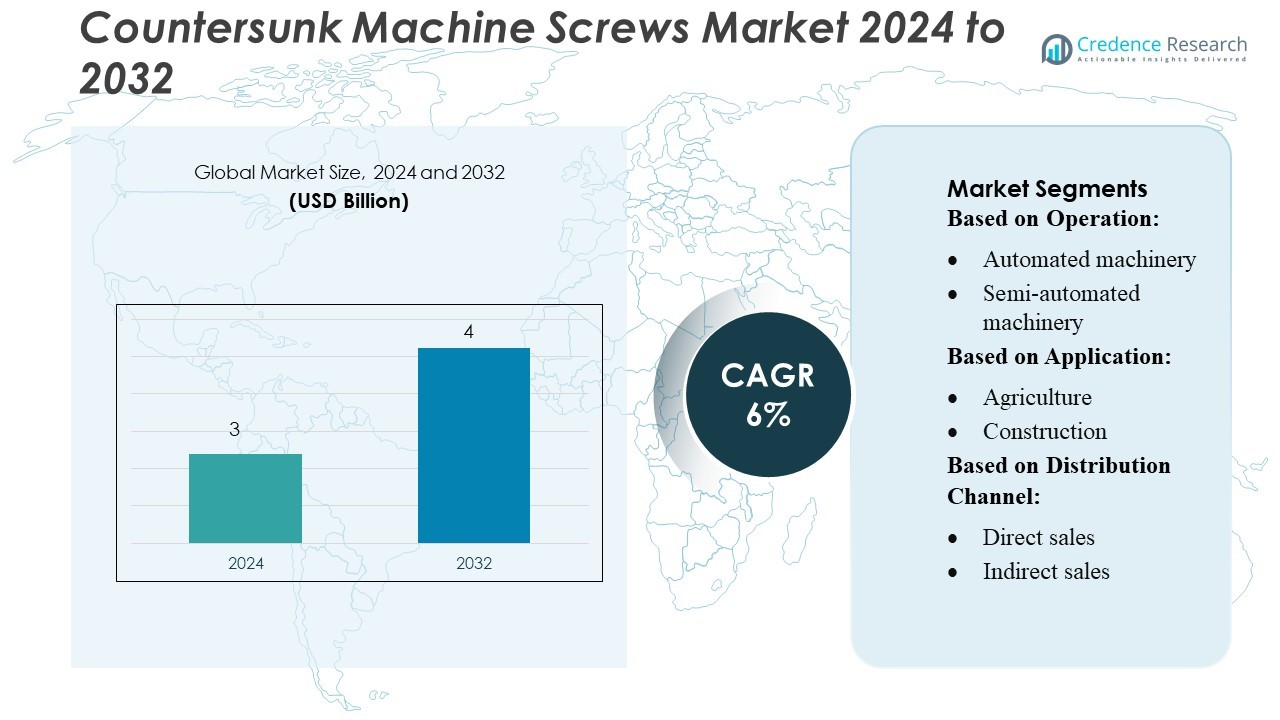
Countersunk Machine Screws Market size was valued USD 3 billion in 2024 and is anticipated to reach USD 4 billion by 2032, at a CAGR of 6% during the forecast period.
| REPORT ATTRIBUTE | DETAILS |
|---|---|
| Historical Period | 2020-2023 |
| Base Year | 2024 |
| Forecast Period | 2025-2032 |
| Countersunk Machine Screws Market Size 2024 | USD 3 Billion |
| Countersunk Machine Screws Market, CAGR | 6% |
| Countersunk Machine Screws Market Size 2032 | USD 4 Billion |
The Countersunk Machine Screws Market is shaped by a competitive group of manufacturers that focus on precision engineering, advanced coatings, and high-strength materials to meet industrial performance demands. Key players include Eurotec, GRK Fasteners, SPAX International GmbH & Co. KG, Fischer, Fastenmaster, SFS Group, Rothoblaas, Grip-Rite, Kyocera Senco, and Simpson Strong-Tie, each strengthening their position through product innovation and expanded distribution networks. Asia-Pacific remains the leading regional market, accounting for approximately 40% of global demand, supported by large-scale manufacturing, strong construction activity, and extensive production capacity across China, India, Japan, and South Korea.
Market Insights
- The Countersunk Machine Screws Market was valued at USD 3 billion in 2024 and is projected to reach USD 4 billion by 2032, growing at a 6% CAGR, supported by rising demand in construction, automotive, and industrial machinery applications.
- Increasing adoption of precision-engineered fasteners and corrosion-resistant coatings drives market expansion, supported by automation in assembly processes and the need for high-strength fastening solutions across sectors.
- The market experiences steady trends toward lightweight designs, advanced alloy development, and enhanced coating technologies, with top players investing in R&D to strengthen product performance.
- Competitive intensity remains high as manufacturers expand distribution networks, optimize production efficiency, and address restraints such as fluctuating raw material prices and supply-chain disruptions.
- Asia-Pacific leads the global market with 40% share, followed by North America and Europe, while the construction segment dominates overall consumption with the largest share due to extensive infrastructure development and industrial manufacturing activity.
Market Segmentation Analysis:
By Operation
The automated machinery segment dominates the countersunk machine screws market with an estimated 42–45% share, driven by rapid adoption of CNC machining systems and fully integrated production lines that require high-precision fastening components. Automated systems demand screws with tighter dimensional tolerances, consistent head geometry, and improved fatigue resistance to support continuous, high-speed operations. Semi-automated machinery remains a stable secondary contributor as mid-scale manufacturers upgrade legacy lines. Meanwhile, manual and robotic machinery segments grow steadily, with robotics benefiting from increasing deployment of articulated arms in electronics and metalworking assembly.
- For instance, GRK Fasteners’ products evaluated under ICC-ES ESR-2442 demonstrate engineered performance suitable for automated assembly, with allowable shear capacities reaching 2,320 lbf and torsional strength verified through standardized ICC testing.
By Application
Construction represents the leading application segment, accounting for approximately 30–32% of total demand, supported by rising global infrastructure activity and the need for durable, flush-mount fasteners in metal frameworks, fittings, and heavy equipment. Packaging and food processing industries also show strong adoption due to regulatory emphasis on hygienic, vibration-resistant fastening. Agriculture and mining rely on countersunk screws for machinery exposed to harsh operating environments, while semiconductor manufacturing drives demand for micro-precision screws with superior corrosion resistance and ultra-fine threading. The “Others” category captures growing usage in DIY tools and specialized industrial assemblies.
- For instance, SPAX International GmbH & Co. KG’s countersunk stainless-steel screws (e.g., the A2 Ø 10 mm T-STAR plus full-thread type) deliver a characteristic tensile strength of 17,000 N (as per their ETA-12/0114 technical approval).
By Distribution Channel
Direct sales lead the market with an estimated 55–58% share, driven by manufacturers’ preference for long-term supply contracts, bulk procurement, and customization capabilities aligned with OEM specifications. Industrial buyers prioritize direct sourcing to ensure traceability, quality assurance, and consistent delivery schedules. Indirect sales continue to expand through distributors and online platforms as small and mid-size enterprises seek flexible order quantities, faster lead times, and broad product availability. Growth in e-commerce marketplaces further accelerates indirect channel penetration, particularly in aftermarket and maintenance applications across construction, machinery repair, and equipment refurbishment.
Key Growth Drivers
- Expanding Use in Precision Assembly Across Manufacturing
Demand for countersunk machine screws continues to rise as manufacturers prioritize precise, flush-mounted fastening solutions to enhance product aesthetics, ergonomics, and structural integrity. Industries such as electronics, automotive, and industrial equipment increasingly adopt these screws to reduce vibration, improve load distribution, and streamline assembly. Their compatibility with automated fastening systems also supports higher production efficiency. Additionally, rapid growth in lightweight metal components and miniaturized assemblies strengthens the need for high-tolerance screws designed for secure fit and improved surface smoothness.
- For instance, Fischer’s UltraCut FBS II 10 × 120 SK concrete screw features a saw-tooth geometry that enables fast cutting into concrete, and its special design supports three embedment depths (65 / 55 / 35 mm) as per its technical datasheet.
- Growth in Construction and Infrastructure Projects
The surge in global construction and infrastructure development drives wide use of countersunk machine screws in metal framing, architectural hardware, HVAC systems, and structural fixtures. Their ability to sit flush with surfaces ensures a cleaner finish and reduces snagging risks in high-traffic environments. Infrastructure modernization, especially in emerging economies, emphasizes durable, corrosion-resistant fasteners that meet strict safety and performance standards. Increased adoption of stainless steel, alloy steel, and coated variants further supports market growth by extending service life in demanding outdoor and industrial conditions.
- For instance, FastenMaster’s FlatLOK structural wood screw (part of its LOK Line) is evaluated per ICC-ES AC233 and its TER-1503-01 report shows it can achieve withdrawal loads exceeding 5,000 lbf in LVL-to-LVL connections.
- Advancements in Materials and Manufacturing Technologies
Innovations in material engineering and precision machining significantly boost the performance and adoption of countersunk machine screws. Manufacturers are producing hardness-enhanced, lightweight, and anti-corrosive variants using advanced alloys and surface treatments, enabling reliable performance in high-load and harsh-environment applications. CNC machining, cold forging, and automated quality inspection systems improve dimensional accuracy and reduce defects, making these screws suitable for aerospace, medical devices, and semiconductor equipment. Improved supply chain integration and customization capabilities also allow faster development of application-specific screw designs.
Key Trends & Opportunities
1. Rising Preference for High-Performance and Specialty Screws
A major trend involves the shift toward specialty countersunk machine screws designed for extreme temperatures, chemical exposure, or high-vibration environments. As equipment complexity grows, industries increasingly demand screws with enhanced mechanical strength, unique head geometries, and tamper-resistant features. This trend creates opportunities for manufacturers to expand premium product lines and integrate advanced testing processes. Demand for micro-sized screws in electronics and precision instruments is also rising, offering a lucrative segment for specialized fastener producers.
- For instance, HECO-TOPIX®-plus A2 countersunk timber screw (HTP-S-CS-VFT) integrates GripFit, MagicClose, and PerfectPitch drive systems and has a variable thread pitch to deliver controlled pull-out forces in facades, with head diameters ranging from 5.9 mm to 11.7 mm per their product specs.
2. Growth of Automated Assembly and Robotics Integration
The expanding adoption of industrial automation and robotics in machining, packaging, and metal fabrication facilities is creating strong opportunities for countersunk machine screws designed for consistent automated feeding and fastening. Manufacturers are focusing on uniform thread profiles, standardized dimensions, and high-speed compatibility to ensure smooth robotic operation. This trend encourages development of high-quality, low-tolerance screws that reduce jamming and improve cycle times. As smart factories accelerate globally, demand for automation-compatible fasteners is expected to grow significantly.
- For instance, Rothoblaas’ VGS EVO structural countersunk screw features a 20 µm multilayer C4 EVO coating and a high-strength steel core (fₙ,k = 1000 N/mm²), and it demonstrated zero corrosion after 1,440 hours in ISO 9227 salt-spray testing, enabling reliable use in automated outdoor assembly.
3. Increasing Use of Sustainable and Recyclable Materials
Sustainability-driven purchasing patterns are creating opportunities for countersunk screw manufacturers to introduce eco-friendly materials and processes. The market is seeing increased interest in recyclable stainless steel, low-energy manufacturing methods, and coatings free of harmful chemicals. Companies adopting circular-economy practices-such as reprocessing scrap metals into fasteners-are gaining competitive advantage. This trend aligns with stricter environmental regulations and growing corporate commitments to reduce carbon footprints across supply chains.
Key Challenges
1. Price Volatility of Metals and Raw Materials
Fluctuating prices of steel, aluminum, and alloying materials pose a significant challenge for countersunk machine screw manufacturers. Sudden increases in raw material costs directly affect production expenses and shrink profit margins, especially for companies operating on high-volume, low-margin models. Supply disruptions caused by geopolitical tensions or trade restrictions further aggravate cost instability. Manufacturers must adopt strategies such as long-term supplier contracts, diversified sourcing, and improved production efficiency to mitigate this challenge.
2. Intense Competition and Market Fragmentation
The market is highly fragmented, with numerous global and regional players competing primarily on price rather than differentiation. This environment puts pressure on manufacturers to continuously innovate while keeping costs competitive. Low-cost producers from emerging economies intensify pricing competition, making product quality, certification compliance, and consistent supply critical differentiators. Small and mid-tier manufacturers may struggle to invest in advanced machinery, automation, and quality systems required to remain competitive in international markets.
Regional Analysis
North America
North America holds an estimated 28–30% share of the global countersunk machine screws market, driven by strong demand from aerospace, defense, automotive, and precision manufacturing sectors. The region benefits from advanced production capabilities, high adoption of CNC machining, and stringent quality standards that favor premium fasteners. The United States dominates regional consumption due to ongoing aircraft modernization and steady growth in industrial automation. Rising investments in EV manufacturing and defense component refurbishment continue to expand screw demand. Robust supply chains and strong OEM–supplier relationships reinforce North America's position as a key high-value market.
Europe
Europe accounts for roughly 25–27% of the global market, supported by its mature industrial base and strong emphasis on engineering-quality fasteners. Germany, France, and the U.K. lead consumption, primarily due to high production activity in automotive, machinery, rail, and aerospace systems. Strict regulatory frameworks and sustainability initiatives are pushing manufacturers toward corrosion-resistant alloys and high-performance coated screws. The region’s expanding renewable energy, industrial robotics, and precision equipment sectors continue to generate steady demand. Robust export activity and technologically advanced manufacturing standards keep Europe a critical market for premium countersunk screw solutions.
Asia-Pacific
Asia-Pacific leads the global market with an estimated 38–40% share, driven by rapid industrialization, large-scale manufacturing, and expanding construction activities. China, India, Japan, and South Korea remain major contributors, supported by strong electronics, automotive, consumer goods, and heavy machinery production. The availability of cost-effective manufacturing and extensive raw material supply further strengthens regional competitiveness. Growing semiconductor fabrication and increasing automation in packaging and assembly lines continue to accelerate fastener demand. APAC’s strong export base, coupled with increasing adoption of high-precision components, solidifies its dominance in the countersunk machine screws market.
Latin America
Latin America holds an estimated 6–7% share of the global countersunk machine screws market, influenced by expanding construction, agricultural machinery, mining equipment, and general manufacturing activity. Brazil and Mexico stand out as primary demand centers due to their sizeable industrial bases and growing investments in automotive and heavy engineering. The region is witnessing steady uptake of standardized and corrosion-resistant fasteners driven by harsh operating environments. Although reliance on imports remains high, the gradual growth of local machining capabilities and infrastructure modernization projects supports moderate but consistent market expansion across Latin America.
Middle East & Africa
The Middle East & Africa region represents approximately 4–5% of global demand, largely driven by construction, oil & gas equipment manufacturing, and industrial repair activities. Gulf countries contribute significantly due to ongoing infrastructure development and increased investment in industrial diversification initiatives. Demand for durable, corrosion-resistant countersunk screws remains particularly strong in high-temperature and offshore environments. Africa’s market is gradually expanding with rising manufacturing activities in South Africa, Egypt, and Nigeria. Although the region relies heavily on imported fasteners, increasing industrial clusters and construction megaprojects are expected to support steady long-term growth.
Market Segmentations:
By Operation:
- Automated machinery
- Semi-automated machinery
By Application:
- Agriculture
- Construction
By Distribution Channel:
- Direct sales
- Indirect sales
By Geography
- North America
- U.S.
- Canada
- Mexico
- Europe
- Germany
- France
- U.K.
- Italy
- Spain
- Rest of Europe
- Asia Pacific
- China
- Japan
- India
- South Korea
- South-east Asia
- Rest of Asia Pacific
- Latin America
- Brazil
- Argentina
- Rest of Latin America
- Middle East & Africa
- GCC Countries
- South Africa
- Rest of the Middle East and Africa
Competitive Landscape
The competitive landscape of the Countersunk Machine Screws Market features a diverse mix of global and specialized manufacturers, including Eurotec, GRK Fasteners, SPAX International GmbH & Co. KG, Fischer, Fastenmaster, SFS Group, Rothoblaas, Grip-Rite, Kyocera Senco, and Simpson Strong-Tie. The Countersunk Machine Screws Market is defined by continuous innovation, strong quality standards, and expanding global manufacturing capabilities. Companies increasingly focus on developing high-performance screws with improved torque resistance, precise threading, and advanced corrosion-resistant coatings to meet rising demand from construction, automotive, electronics, and aerospace sectors. Competition is further shaped by the growing adoption of automated assembly lines, pushing manufacturers to produce screws with consistent dimensional accuracy and enhanced drive designs. Market participants also strengthen their position through wider distribution networks, improved supply-chain resilience, and increased investment in R&D aimed at optimizing materials, surface treatments, and sustainability-focused production processes.
Key Player Analysis
- Eurotec
- GRK Fasteners
- SPAX International GmbH & Co. KG
- Fischer
- Fastenmaster
- SFS Group
- Rothoblaas
- Grip-Rite
- Kyocera Senco
- Simpson Strong-Tie
Recent Developments
- In January 2025, Bossard Group acquired the Ferdinand Gross Group, a German fastening technology distributor with a presence in Germany, Hungary, and Poland. The acquisition expands Bossard's market presence in Germany and Eastern Europe and allows the combined entity to offer a more comprehensive range of solutions to its customers in these regions.
- In December 2024, Bulten and ZJK Vietnam Precision Components Co., Ltd,The new joint venture plans to rent production facilities, which means limited investment costs and risk-taking for Bulten. Bulten's ownership signed a letter of intent to establish operations in Vietnam through a joint venture.
- In November 2024, Sandvik Mining and Rock Solutions launched the MD/MDX Peg Bolt, a new ground support solution for underground mining that improves safety by providing a visual indicator of correct installation. A plastic disc protrudes through the bolt's ID tab once the correct torque is applied, making it easy to see the bolt is installed properly, even after subsequent blasting cycles. This feature offers enhanced safety and peace of mind for miners.
- In April 2024, Norelem announced the launch of a leading global provider of standard parts and components for the manufacturing industry, norelem, has announced the launch of a new flexible. Made from aluminium, the clamping bolts offer a flexible clamping system to provide secure and powerful clamping for workpieces with regular and irregular outer contours.
Report Coverage
The research report offers an in-depth analysis based on Operation, Application, Distribution Channel and Geography. It details leading market players, providing an overview of their business, product offerings, investments, revenue streams, and key applications. Additionally, the report includes insights into the competitive environment, SWOT analysis, current market trends, as well as the primary drivers and constraints. Furthermore, it discusses various factors that have driven market expansion in recent years. The report also explores market dynamics, regulatory scenarios, and technological advancements that are shaping the industry. It assesses the impact of external factors and global economic changes on market growth. Lastly, it provides strategic recommendations for new entrants and established companies to navigate the complexities of the market.
Future Outlook
- The market will experience steady demand growth driven by expanding construction, automotive, and industrial manufacturing activities.
- Manufacturers will increasingly adopt advanced alloys and coatings to enhance corrosion resistance and long-term durability.
- Automation in assembly processes will accelerate the need for high-precision screws with consistent dimensional accuracy.
- The shift toward lightweight components will boost the development of optimized screw designs for improved strength-to-weight performance.
- Rising adoption of electric vehicles will support higher consumption of specialized fastening solutions.
- Global supply chains will become more localized to improve resilience and reduce lead times.
- Sustainability initiatives will encourage the use of eco-friendly materials and energy-efficient production methods.
- Demand for custom and application-specific screw geometries will increase as industries seek performance optimization.
- Digital quality control and smart manufacturing technologies will enhance productivity and reduce defect rates.
- Growing investments in infrastructure and urban development projects will reinforce long-term market expansion.

Request a Free Sample
Fill in your details and we'll send you a free sample report.
- Sample data tables & charts
- Research methodology
Market Dynamics
Expansion of Construction and Infrastructure Projects
Global growth in infrastructure and construction activity, especially in emerging economies, is driving demand for durable, flush-mount fasteners like countersunk machine screws, which are essential for metal frameworks, architectural hardware, and heavy equipment.
Rising Adoption of Automated and Precision Assembly
Manufacturers are increasingly integrating automated and robotic assembly lines, which require high-precision, consistent-dimension screws. This trend boosts demand for countersunk machine screws engineered for automated feeding and fastening.
Advancements in Materials and Coating Technologies
Ongoing innovation in high-strength alloys and corrosion-resistant coatings enhances the performance and longevity of countersunk machine screws, making them suitable for harsh environments and supporting their adoption in sectors such as automotive, aerospace, and industrial machinery.
Growth in Lightweight and Miniaturized Components
The shift toward lightweight metal components and miniaturized assemblies in electronics, automotive, and industrial equipment increases the need for high-tolerance, precision-engineered countersunk screws that provide secure fit and improved aesthetics.
Sustainability and Regulatory Compliance
Increasing focus on eco-friendly materials, recyclable metals, and compliance with stringent environmental regulations is encouraging manufacturers to develop sustainable countersunk screw solutions, further expanding market opportunities.
Need a Custom Version of This Report?
Tailor the scope, geography, or segments to your exact requirements.
- Custom geography or segment scope
- Direct access to our analyst team
Frequently Asked Questions
What is the current market size for the Countersunk Machine Screws Market, and what is its projected size in 2032?
At what Compound Annual Growth Rate is the Countersunk Machine Screws Market projected to grow between 2025 and 2032?
Which Countersunk Machine Screws Market segment held the largest share in 2024?
What are the primary factors fueling the growth of the Countersunk Machine Screws Market?
Who are the leading companies in the Countersunk Machine Screws Market?
Which region commanded the largest share of the Countersunk Machine Screws Market in 2024?
Table of Content
Chapter 1 Market Segmentation
- 1.1 Segmentation Framework
- 1.1.1 Product and Service Classification
- 1.1.2 Application and End-Use Classification
- 1.1.3 Technology and Solution Classification
- 1.1.4 Customer and Distribution Channel Classification
- 1.1.5 Geographic Segmentation
- 1.1.6 Market Segment Definitions and Boundaries
- 1.2 By Operation
- 1.2.1 Automated machinery
- 1.2.2 Semi-automated machinery
- 1.2.3 Manual machinery
- 1.2.4 Robotic machinery
- 1.3 By Application
- 1.3.1 Construction
- 1.3.2 Automotive
- 1.3.3 Industrial Machinery
- 1.3.4 Packaging & Food Processing
- 1.3.5 Agriculture & Mining
- 1.3.6 Others (DIY, Specialized Assemblies)
Chapter 2 Introduction
- 2.1 Report Objectives and Scope
- 2.2 Product Definition and Industry Terminology
- 2.3 Market Inclusions and Exclusions
- 2.4 Research Process
- 2.4.1 Primary Research and Expert Interviews
- 2.4.2 Secondary Research and Source Review
- 2.4.3 Top-Down and Bottom-Up Estimation
- 2.4.4 Data Triangulation and Verification
- 2.5 Market Size Measurement Basis
- 2.5.1 2024: USD 3 billion → 2032: USD 4 billion
- 2.6 Historical and Forecast Reference Periods
- 2.6.1 Base Year: 2024
- 2.6.2 Forecast Period: 2024-2032
- 2.7 Research Assumptions and Limitations
Chapter 3 Executive Summary
- 3.1 Market Snapshot and Key Findings
- 3.2 Base-Year Market Size, 2024
- 3.3 Forecast Market Size, 2032
- 3.4 Revenue and Volume Growth Outlook
- 3.5 Key Demand and Supply Indicators
- 3.6 Leading Market Segments
- 3.7 Fastest-Growing Market Opportunities
- 3.8 Regional Performance Highlights
- 3.9 Technology and Industry Transformation
- 3.10 Competitive Landscape Summary
- 3.11 Analyst View and Strategic Implications
Chapter 4 Global Countersunk Machine Screws Market Trends and Developments
- 4.1 Historical Industry Development
- 4.2 Recent Market Trends and Developments
- 4.3 Demand and Customer Behavior Trends
- 4.4 Technology and Product Innovation
- 4.5 Artificial Intelligence, Automation and Digitalization
- 4.6 Local Manufacturing and Supply Chain Realignment
- 4.7 Industry Partnerships, Mergers and Acquisitions
- 4.8 Sustainability and Circular Economy Developments
- 4.9 Government and Private Sector Investment Trends
- 4.10 Emerging Business Models and Commercialization
- 4.11 Industry Developments and Announcements
Chapter 5 Global Countersunk Machine Screws Market Production, Supply and Demand Analysis
- 5.1 Demand Trend and Consumption Analysis
- 5.2 Demand Forecast, 2024-2032
- 5.3 Production and Output Trend
- 5.4 Production and Output Forecast, 2024-2032
- 5.5 Installed Capacity and Capacity Utilization
- 5.6 Company-Wise Production Plants and Statistics
- 5.6.1 Installed Production Capacity
- 5.6.2 Actual Production
- 5.6.3 Planned Capacity and Expansion Targets
- 5.7 Supply Chain Structure and Procurement Trends
- 5.8 Supply-Demand Gap and Bottlenecks
- 5.9 Import Dependence and Sourcing Structure
- 5.10 Contract Manufacturing and Outsourcing
- 5.11 Regional Supply and Demand Concentration
Chapter 6 Global Countersunk Machine Screws Market Pricing Analysis
- 6.1 Pricing Structure and Measurement
- 6.2 Historical Pricing Trends
- 6.3 Pricing Outlook, 2024-2032
- 6.4 Average Selling Price and Unit Economics
- 6.5 Pricing by Product and Market Segment
- 6.6 Geographic Pricing Differences
- 6.7 Key Input, Energy, Labor and Logistics Costs
- 6.8 Contract Pricing and Purchasing Models
- 6.9 Pricing Sensitivity and Competitive Positioning
- 6.10 Price, Margin and Profitability Implications
Chapter 7 Global Countersunk Machine Screws Market Dynamics
- 7.1 Market Growth Drivers
- 7.1.1 Demand-Side Drivers
- 7.1.2 Technology and Innovation Drivers
- 7.1.3 Infrastructure and Investment Drivers
- 7.1.4 Regulatory and Policy Drivers
- 7.2 Market Restraints
- 7.2.1 Cost and Affordability Constraints
- 7.2.2 Technology and Adoption Barriers
- 7.2.3 Supply Chain and Operational Constraints
- 7.3 Market Challenges
- 7.3.1 Competitive Pressure and Margin Erosion
- 7.3.2 Skills, Infrastructure and Implementation Gaps
- 7.4 Emerging Market Opportunities
- 7.5 Market Dynamics Impact and Time-Horizon Assessment
Chapter 8 Global Countersunk Machine Screws Value Chain Analysis
- 8.1 Industry Value Chain Overview
- 8.2 Upstream Suppliers and Critical Inputs
- 8.3 Technology and Component Providers
- 8.4 Manufacturing or Service Delivery
- 8.5 Distribution, Channel Partners and Integrators
- 8.6 Downstream Applications and End Users
- 8.7 Value Addition and Profit Pools
- 8.8 Vertical Integration and Outsourcing
- 8.9 Supplier Concentration and Risk
- 8.10 Supply Chain Localization and Resilience
Chapter 9 Global Countersunk Machine Screws Market Regulations and Policies
- 9.1 Relevant Laws, Standards and Compliance Frameworks
- 9.2 Product, Service, Safety and Quality Requirements
- 9.3 Government Policies, Incentives and Subsidies
- 9.4 Imports, Exports and Trade Barriers
- 9.5 Public Procurement and Local Content Requirements
- 9.6 Environmental and Sustainability Compliance
- 9.7 Upcoming Policy Changes and Market Implications
Chapter 10 Global Countersunk Machine Screws Market Hotspots and Opportunities
- 10.1 Market Opportunity Mapping and Growth Hotspots
- 10.2 High-Growth Applications and Customer Groups
- 10.3 Underserved Markets and White-Space Opportunities
- 10.4 Emerging Technology and Product Opportunities
- 10.5 New Capacity and Investment Hotspots
- 10.6 Market Entry and Expansion Opportunities
- 10.7 Distribution and Partnership Opportunities
- 10.8 Near-Term and Long-Term Commercial Potential
- 10.9 Opportunity Attractiveness and Execution Risks
Chapter 11 Global Countersunk Machine Screws Market Outlook, 2024-2032
- 11.1 Market Size and Analysis
- 11.1.1 Revenue (Market Measurement: 2024: USD 3 billion → 2032: USD 4 billion)
- 11.1.2 Market Volume and Quantity Sold
- 11.1.3 Historical Market Size
- 11.1.4 Base-Year Market Size, 2024
- 11.2 Market Forecast, 2024-2032
- 11.2.1 Revenue Forecast to 2032
- 11.2.2 Volume Forecast to 2032
- 11.2.3 CAGR and Year-on-Year Growth
- 11.2.4 Incremental Revenue Opportunity
- 11.3 Forecast Assumptions and Scenario Analysis
- 11.3.1 Base-Case Forecast
- 11.3.2 Optimistic and Conservative Scenarios
- 11.3.3 Technology, Pricing and Policy Sensitivities
- 11.4 Market Attractiveness and Growth Outlook
Chapter 12 Global Countersunk Machine Screws Market Segmentation and Outlook
- 12.1 Segmentation Summary and Market Shares, 2024
- 12.2 Largest and Fastest-Growing Segments
- 12.3 By Operation - Market Size and Forecast, 2024-2032
- 12.3.1 Segment Definition and Scope
- 12.3.2 Historical Market Size
- 12.3.3 Revenue Forecast, 2024-2032
- 12.3.4 Volume Forecast, 2024-2032
- 12.3.5 Base-Year Market Share, 2024
- 12.3.6 Segment CAGR and Growth Drivers
- 12.3.7 Subsegment Market Size and Forecast
- 12.3.7.1 Automated machinery
- 12.3.7.2 Semi-automated machinery
- 12.3.7.3 Manual machinery
- 12.3.7.4 Robotic machinery
- 12.3.8 Subsegment Pricing and Adoption Trends
- 12.3.9 Leading Suppliers and Competition
- 12.3.10 Regional Demand and Opportunities
- 12.4 By Application - Market Size and Forecast, 2024-2032
- 12.4.1 Segment Definition and Scope
- 12.4.2 Historical Market Size
- 12.4.3 Revenue Forecast, 2024-2032
- 12.4.4 Volume Forecast, 2024-2032
- 12.4.5 Base-Year Market Share, 2024
- 12.4.6 Segment CAGR and Growth Drivers
- 12.4.7 Subsegment Market Size and Forecast
- 12.4.7.1 Construction
- 12.4.7.2 Automotive
- 12.4.7.3 Industrial Machinery
- 12.4.7.4 Packaging & Food Processing
- 12.4.7.5 Agriculture & Mining
- 12.4.7.6 Others (DIY, Specialized Assemblies)
- 12.4.8 Subsegment Pricing and Adoption Trends
- 12.4.9 Leading Suppliers and Competition
- 12.4.10 Regional Demand and Opportunities
- 12.5 Segment Growth Comparison
- 12.6 Segment Attractiveness and Priority Matrix
Chapter 13 Global Countersunk Machine Screws End-Use and Application Market Outlook
- 13.1 End-Use Industry and Customer Demand Structure
- 13.2 Leading Applications and Customer Groups
- 13.3 End-Use Market Size, Share and Forecast
- 13.4 Major End-Use Industry Deep Dives
- 13.4.1 Customer Requirements and Use Cases
- 13.4.2 Demand and Replacement Cycles
- 13.4.3 Technical and Regulatory Considerations
- 13.4.4 Purchasing and Procurement Models
- 13.4.5 Leading Vendors and Distribution Channels
- 13.4.6 Forecast and Commercial Opportunities
- 13.5 Emerging Applications and Cross-Segment Demand
- 13.6 End-Use Industry Investment Priorities
Chapter 14 Global Countersunk Machine Screws Geographic Market Outlook, 2024-2032
- 14.1 Regional Market Size and Share, 2024
- 14.2 Regional Market Forecast, 2024-2032
- 14.3 Regional Pricing, Production and Demand Differences
- 14.4 North America
- 14.4.1 United States
- 14.4.2 Canada
- 14.4.3 Mexico
- 14.5 Europe
- 14.5.1 Germany
- 14.5.2 France
- 14.5.3 Italy
- 14.5.4 United Kingdom
- 14.5.5 Spain
- 14.5.6 Poland
- 14.5.7 Russia
- 14.5.8 Netherlands
- 14.5.9 Belgium
- 14.5.10 Sweden
- 14.5.11 Denmark
- 14.5.12 Norway
- 14.5.13 Rest of Europe
- 14.6 Asia Pacific
- 14.6.1 China
- 14.6.2 India
- 14.6.3 Japan
- 14.6.4 South Korea
- 14.6.5 Thailand
- 14.6.6 Indonesia
- 14.6.7 Vietnam
- 14.6.8 Malaysia
- 14.6.9 Australia
- 14.6.10 Rest of Asia Pacific
- 14.7 Latin America
- 14.7.1 Brazil
- 14.7.2 Argentina
- 14.7.3 Colombia
- 14.7.4 Chile
- 14.7.5 Rest of Latin America
- 14.8 Middle East
- 14.8.1 Saudi Arabia
- 14.8.2 United Arab Emirates
- 14.8.3 Turkey
- 14.8.4 Israel
- 14.8.5 Iran
- 14.8.6 Rest of the Middle East
- 14.9 Africa
- 14.9.1 South Africa
- 14.9.2 Egypt
- 14.9.3 Nigeria
- 14.9.4 Morocco
- 14.9.5 Rest of Africa
- 14.10 Regional Investment, Policy and Supply Chain Differences
- 14.11 Regional Competitive Landscape
- 14.12 Geographic Growth Hotspots
Chapter 15 Global Countersunk Machine Screws Technology, Innovation and Sustainability Outlook
- 15.1 Technology Landscape and Maturity
- 15.2 Product, Process and Service Innovation
- 15.3 AI, Automation and Digital Tools in the Industry
- 15.4 Technology Adoption and Performance Benchmarking
- 15.5 Innovation Pipeline and R&D Investment
- 15.6 Patent and Intellectual Property Trends
- 15.7 Energy Efficiency and Resource Management
- 15.8 Sustainability, Recycling and Circularity
- 15.9 Technology Roadmap, 2024-2032
- 15.10 Risks of Obsolescence and Technology Substitution
Chapter 16 Global Countersunk Machine Screws Market Key Strategic Imperatives
- 16.1 Growth and Market Entry Priorities
- 16.2 High-Return Products and Segments
- 16.3 Pricing, Profitability and Cost Optimization
- 16.4 Technology Investment and Product Differentiation
- 16.5 Supply Chain Localization and Resilience
- 16.6 Distribution and Customer Acquisition
- 16.7 Partnership, Acquisition and Capacity Strategy
- 16.8 Regional Expansion Priorities
- 16.9 Short-, Medium- and Long-Term Actions
Chapter 17 Competition Outlook
- 17.1 Industry Competition Characteristics
- 17.2 Market Structure and Concentration
- 17.3 Market Share and Competitive Positioning, 2024
- 17.4 Company-Wise Revenue and Product Benchmarking
- 17.5 Production and Service Capacity Benchmarking
- 17.6 Technology, Pricing and Differentiation
- 17.7 Regional Footprint and Distribution Strength
- 17.8 Mergers, Acquisitions and Strategic Alliances
- 17.9 New Entrants and Competitive Threats
- 17.10 Porter's Five Forces and Industry Attractiveness
- 17.11 Competitive Outlook, 2024-2032
Chapter 18 Company Profiles
- 18.1 Company Coverage and Selection Criteria
- 18.2 Eurotec
- 18.2.1 Business Description
- 18.2.2 Company Ownership and Geographic Presence
- 18.2.3 Product and Service Portfolio
- 18.2.4 Manufacturing and Operating Footprint
- 18.2.5 Production Capacity and Expansion Plans
- 18.2.6 Financial Performance and Investment
- 18.2.7 Market Share and Competitive Position
- 18.2.8 Technology and Innovation Capabilities
- 18.2.9 Strategic Alliances or Partnerships
- 18.2.10 Recent Developments
- 18.2.11 Growth Strategy and Outlook
- 18.3 GRK Fasteners
- 18.4 SPAX International GmbH & Co. KG
- 18.5 Fischer
- 18.6 Fastenmaster
- 18.7 SFS Group
- 18.8 Rothoblaas
- 18.9 Grip-Rite
- 18.10 Kyocera Senco
- 18.11 Simpson Strong-Tie
- 18.12 Other Relevant Market Participants
Note: Every listed company is profiled on the structure shown under the first company. The company list is preliminary and may change based on research findings, market developments, data availability and client requirements.
Chapter 19 Disclaimer
- 19.1 Research and Forecast Disclaimer
- 19.2 Data Source and Estimation Limitations
Note: The depth of individual sections depends on data availability for this market. Volume, capacity, trade and other unit-based metrics are included where applicable.

