
Market Overview
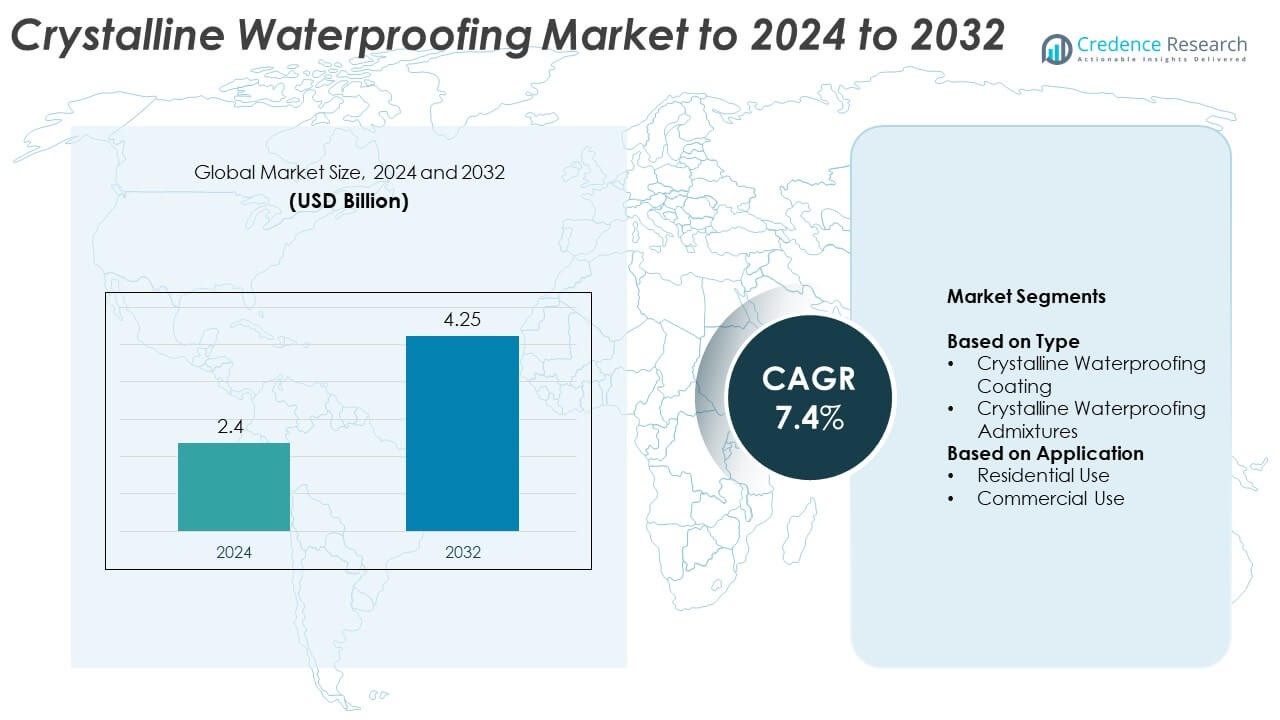
Crystalline Waterproofing Market size was valued USD 2.4 Billion in 2024 and is anticipated to reach USD 4.25 Billion by 2032, at a CAGR of 7.4% during the forecast period.
| REPORT ATTRIBUTE | DETAILS |
|---|---|
| Historical Period | 2020-2023 |
| Base Year | 2024 |
| Forecast Period | 2025-2032 |
| Crystalline Waterproofing Market Size 2024 | USD 2.4 Billion |
| Crystalline Waterproofing Market, CAGR | 7.4% |
| Crystalline Waterproofing Market Size 2032 | USD 4.25 Billion |
The crystalline waterproofing market is characterized by strong competition among leading companies such as Sika AG, BASF SE, Kryton International Inc, Saint Gobain, Tremco CPG Inc, and Fosroc International Limited. These players focus on expanding their product portfolios, improving material performance, and strengthening distribution networks across key markets. Asia Pacific dominated the global market with over 35% share in 2024, supported by large-scale construction, infrastructure modernization, and rapid urban development. North America and Europe followed, driven by stringent building standards and demand for durable, eco-friendly waterproofing solutions. Continuous innovation and sustainable product development remain central to maintaining a competitive edge.
Market Insights
- The crystalline waterproofing market was valued at USD 2.4 Billion in 2024 and is expected to reach USD 4.25 Billion by 2032, growing at a CAGR of 7.4%.
- Growing infrastructure investments, urban housing expansion, and focus on long-term concrete protection are driving market growth.
- Key trends include rising adoption of eco-friendly admixtures and integration of nanotechnology to enhance waterproofing performance and durability.
- The market is competitive, with global players emphasizing R&D, sustainable product lines, and partnerships to strengthen their global presence.
- Asia Pacific led with over 35% market share in 2024, followed by North America at 28% and Europe at 24%, while crystalline waterproofing admixtures dominated by type with a 60% share across applications, mainly in residential construction projects.
Market Segmentation Analysis:
By Type
Crystalline waterproofing admixtures held the dominant share of over 60% in 2024. These admixtures are widely preferred due to their self-sealing properties, long-term durability, and ability to integrate directly into concrete structures. Their usage minimizes maintenance needs and enhances resistance against water ingress and chemical exposure. Increasing adoption in large-scale infrastructure and commercial construction projects supports market growth. Moreover, the demand for admixtures continues to rise as builders focus on sustainable and cost-effective waterproofing solutions that ensure structural longevity in high-moisture environments.
- For instance, Xypex dosed the concrete at the Amos Rex art museum with Admix C-1000 NF, using varied amounts based on the structure's depth. The gallery walls, which are part of a subterranean structure that reaches approximately 14 m below grade and is subject to constant hydrostatic pressure, were dosed at 3 kg/m³.
By Application
The residential use segment accounted for the largest share of around 55% in 2024. This dominance is driven by growing urbanization and the rise in housing construction across developing economies. Crystalline waterproofing materials are increasingly applied in basements, roofs, and foundations to prevent leaks and improve building lifespan. Homeowners and developers favor these systems for their low maintenance and eco-friendly nature. The trend toward green and durable housing, supported by stricter building standards, further fuels the demand for crystalline waterproofing solutions in residential construction projects.
- For instance, Kryton's Krystol Internal Membrane (KIM) is an integral crystalline waterproofing admixture that reliably self-seals hairline cracks up to 0.5 mm in concrete.
Key Growth Drivers
Rising Infrastructure and Construction Activities
The rapid expansion of infrastructure and commercial construction projects globally is a major growth driver for the crystalline waterproofing market. Governments are investing heavily in transport networks, tunnels, and bridges that require durable, long-lasting waterproofing systems. Crystalline technology enhances structural integrity by forming insoluble crystals within concrete pores, providing permanent protection. The growing focus on cost-efficient and low-maintenance construction solutions further strengthens the demand across both developed and emerging economies.
- For instance, Construction joints were sealed with PENEBAR SW-45 swellable waterstop strips. For surface hardening and sealing, PENESEAL FH was applied to over 20,000 m² of the parking decks.
Shift Toward Sustainable and Eco-Friendly Solutions
Increasing environmental awareness is pushing the construction industry toward sustainable materials. Crystalline waterproofing aligns with green building practices by reducing the need for external membranes and maintenance chemicals. These materials improve concrete durability and minimize lifecycle costs. Builders are increasingly adopting eco-certified crystalline products to meet LEED and BREEAM standards. This shift toward environmentally responsible construction materials continues to support steady market expansion across residential and industrial sectors.
- For instance, Sika specifies WT-200 P with ≥350 kg/m³ binder. The mix targets a 0.45 maximum water–binder ratio. These limits support dense, durable concrete.
Growth in Urban Housing Development
Urbanization has driven a strong demand for new residential projects, particularly in Asia-Pacific and the Middle East. Crystalline waterproofing products are gaining traction for basements, roofs, and water-retaining structures in housing projects. Their self-healing characteristics and durability make them ideal for long-term residential use. Governments’ initiatives promoting affordable housing further boost adoption, as developers prefer cost-effective waterproofing that ensures long-lasting structural protection in high-density urban environments.
Key Trends and Opportunities
Integration of Nanotechnology in Waterproofing
Nanotechnology is emerging as a significant trend in crystalline waterproofing development. Advanced nano-additives enhance permeability reduction and crack-sealing efficiency, improving overall material performance. Manufacturers are investing in nanostructured crystals that react faster within concrete matrices. This innovation not only improves durability but also enables smart monitoring and predictive maintenance capabilities, opening new opportunities in smart infrastructure projects and sustainable construction.
- For instance, MasterLife 300D testing used 2 % by cement mass. Independent labs evaluated DIN 1048 and CRD-C 48 methods. The product meets ASTM C494 Type S.
Rising Adoption in Water Infrastructure Projects
Global demand for water conservation and wastewater treatment plants is creating opportunities for crystalline waterproofing systems. These materials are widely used in dams, reservoirs, and treatment tanks due to their superior resistance to hydrostatic pressure. The market is seeing greater adoption in public infrastructure initiatives as governments aim to reduce water leakage and improve sustainability in critical facilities. This trend supports steady growth in the utilities and industrial construction sectors.
- For instance, the recommended dosage for GCP ADPRUFE 100 is typically 2.5 litres/m³ of concrete.
Key Challenges
High Initial Costs and Limited Awareness
One of the primary challenges for the crystalline waterproofing market is the higher upfront cost compared to traditional waterproofing methods. Many contractors and end users remain unaware of the long-term benefits, leading to slower adoption. The lack of skilled professionals familiar with crystalline application techniques also hampers market penetration. Educating contractors and developers on lifecycle cost savings and performance benefits is crucial for expanding the market reach.
Performance Variability Due to Site Conditions
The efficiency of crystalline waterproofing largely depends on factors such as concrete quality, moisture content, and application methods. Inconsistent site conditions can lead to uneven crystal formation and reduced waterproofing effectiveness. Projects in regions with extreme temperature or humidity variations face additional challenges in maintaining product performance. Manufacturers are focusing on developing improved formulations and training programs to address these limitations and ensure consistent field results.
Regional Analysis
North America
North America held a market share of around 28% in 2024, driven by robust infrastructure renovation and residential development activities. The United States leads regional demand due to the growing adoption of durable waterproofing solutions in commercial and industrial projects. Strict building codes emphasizing structural durability and energy efficiency have increased the use of crystalline admixtures. Rising investments in sustainable construction and underground utility projects further enhance product adoption. Canada also shows steady growth, supported by expanding urban housing and government initiatives aimed at upgrading aging concrete infrastructure.
Europe
Europe accounted for approximately 24% of the global market in 2024, supported by advanced construction technologies and strong regulatory frameworks promoting eco-friendly materials. Countries like Germany, France, and the United Kingdom are key contributors, emphasizing waterproofing solutions in transport and residential projects. The European Union’s focus on green building certifications has encouraged the use of crystalline admixtures for sustainable infrastructure. Rising restoration activities of heritage buildings and increased awareness of long-term concrete protection drive further market penetration across Western and Northern Europe.
Asia Pacific
Asia Pacific dominated the global crystalline waterproofing market with over 35% share in 2024. The region’s growth is led by rapid urbanization, industrial expansion, and government-backed infrastructure development in China, India, and Southeast Asia. The construction of large-scale housing, metro networks, and water infrastructure projects significantly boosts demand for crystalline admixtures. Increasing foreign investments and a focus on cost-effective, long-lasting waterproofing materials support the regional outlook. Additionally, rising awareness about sustainable construction practices strengthens product adoption across both public and private sectors.
Latin America
Latin America captured nearly 8% of the global market share in 2024, with Brazil and Mexico being key contributors. The region’s growth is supported by rising residential construction and government initiatives for water management infrastructure. Builders are increasingly adopting crystalline waterproofing materials to enhance concrete durability in humid climates. The trend toward affordable and sustainable housing further drives demand. However, the market faces challenges due to limited awareness and slower adoption among small-scale contractors, although gradual modernization of construction standards is improving product penetration.
Middle East and Africa
The Middle East and Africa region accounted for around 5% of the global crystalline waterproofing market in 2024. Growth is fueled by increasing investments in large-scale infrastructure and commercial real estate projects across the UAE, Saudi Arabia, and South Africa. The region’s dry climate and high temperatures create a strong need for durable waterproofing systems. Governments’ focus on smart city development and water conservation projects further supports demand. Rising adoption of crystalline admixtures in underground structures and water-retaining facilities enhances market potential across emerging economies in this region.
Market Segmentations:
By Type
- Crystalline Waterproofing Coating
- Crystalline Waterproofing Admixtures
By Application
- Residential Use
- Commercial Use
By Geography
- North America
- U.S.
- Canada
- Mexico
- Europe
- Germany
- France
- U.K.
- Italy
- Spain
- Rest of Europe
- Asia Pacific
- China
- Japan
- India
- South Korea
- South-east Asia
- Rest of Asia Pacific
- Latin America
- Brazil
- Argentina
- Rest of Latin America
- Middle East & Africa
- GCC Countries
- South Africa
- Rest of the Middle East and Africa
Competitive Landscape
The crystalline waterproofing market features strong competition among major players such as Sika AG, BASF SE, Kryton International Inc, and Saint Gobain, which focus on technological innovation and geographic expansion. Companies are emphasizing advanced formulations that enhance self-healing capabilities and long-term durability of concrete structures. Strategic collaborations with construction firms and infrastructure developers are helping manufacturers strengthen their market presence. Growing emphasis on sustainable construction practices is driving firms to introduce eco-friendly and energy-efficient solutions. Continuous investments in research and development are aimed at improving application efficiency and reducing costs. Additionally, regional manufacturers are entering the market with cost-competitive products to capture emerging opportunities in developing economies. Increasing construction activity and stricter waterproofing regulations worldwide are fostering steady competition. Players are also enhancing their distribution networks and providing technical training to contractors to expand adoption across residential, commercial, and industrial applications.
Key Player Analysis
- Sika AG
- Kryton International Inc
- Tremco CPG Inc
- Xypex Chemical Corporation
- BASF SE
- Fosroc International Limited
- Master Builders Solutions
- Holderchem Building Chemicals
- Cemix Products Ltd
- R. Grace & Co
- Cormix International Limited
- Hycrete Inc
- Saint Gobain
Recent Developments
- In 2025, Fosroc launched Conplast Crystalline, an embedded crystalline admixture to create non-dissolvable crystals throughout concrete to stop the entry of water.
- In 2025, Sika expands its worldwide manufacturing presence by opening three new plants in China, Brazil, and Morocco, cement and admixtures plant. This will assist in producing local crystalline waterproofing admixtures like the WT-200 p range to increase availability and response within regions.
- In 2023, Sika completed the acquisition of the MBCC Group. This strategic move significantly expanded its footprint in the specialty building materials market and broadened its portfolio of waterproofing chemicals globally.
Report Coverage
The research report offers an in-depth analysis based on Type, Application and Geography. It details leading market players, providing an overview of their business, product offerings, investments, revenue streams, and key applications. Additionally, the report includes insights into the competitive environment, SWOT analysis, current market trends, as well as the primary drivers and constraints. Furthermore, it discusses various factors that have driven market expansion in recent years. The report also explores market dynamics, regulatory scenarios, and technological advancements that are shaping the industry. It assesses the impact of external factors and global economic changes on market growth. Lastly, it provides strategic recommendations for new entrants and established companies to navigate the complexities of the market.
Future Outlook
- The market will expand with growing infrastructure investments and urban development projects worldwide.
- Rising adoption of sustainable and green construction materials will boost product demand.
- Increasing government focus on waterproofing standards will enhance market penetration.
- Technological innovations such as nanotechnology will improve performance and durability.
- Demand for low-maintenance and long-lasting waterproofing solutions will rise in residential projects.
- Growth in smart cities and modern infrastructure will create new opportunities for crystalline admixtures.
- Manufacturers will focus on cost optimization and improved product formulations.
- Awareness programs and training initiatives will help address application challenges.
- Asia Pacific will continue dominating due to rapid urbanization and industrial growth.
- Collaboration between manufacturers and construction firms will drive large-scale adoption across sectors.

Request a Free Sample
Fill in your details and we'll send you a free sample report.
- Sample data tables & charts
- Research methodology
Need a Custom Version of This Report?
Tailor the scope, geography, or segments to your exact requirements.
- Custom geography or segment scope
- Direct access to our analyst team
Frequently Asked Questions
What is the current market size for Crystalline Waterproofing Market, and what is its projected size in 2032?
At what Compound Annual Growth Rate is the Crystalline Waterproofing Market projected to grow between 2025 and 2032?
Which Crystalline Waterproofing Market segment held the largest share in 2024?
What are the primary factors fueling the growth of the Crystalline Waterproofing Market?
Who are the leading companies in the Crystalline Waterproofing Market?
Which region commanded the largest share of the Crystalline Waterproofing Market in 2024?
Table of Content
Chapter 1 Market Segmentation
- 1.1 Segmentation Framework
- 1.1.1 Product and Service Classification
- 1.1.2 Application and End-Use Classification
- 1.1.3 Technology and Solution Classification
- 1.1.4 Customer and Distribution Channel Classification
- 1.1.5 Geographic Segmentation
- 1.1.6 Market Segment Definitions and Boundaries
Chapter 2 Introduction
- 2.1 Report Objectives and Scope
- 2.2 Product Definition and Industry Terminology
- 2.3 Market Inclusions and Exclusions
- 2.4 Research Process
- 2.4.1 Primary Research and Expert Interviews
- 2.4.2 Secondary Research and Source Review
- 2.4.3 Top-Down and Bottom-Up Estimation
- 2.4.4 Data Triangulation and Verification
- 2.5 Market Size Measurement Basis
- 2.5.1 2024: USD 2.4 Billion → 2032: USD 4.25 Billion
- 2.6 Historical and Forecast Reference Periods
- 2.6.1 Base Year: 2024
- 2.6.2 Forecast Period: 2024-2032
- 2.7 Research Assumptions and Limitations
Chapter 3 Executive Summary
- 3.1 Market Snapshot and Key Findings
- 3.2 Base-Year Market Size, 2024
- 3.3 Forecast Market Size, 2032
- 3.4 Revenue and Volume Growth Outlook
- 3.5 Key Demand and Supply Indicators
- 3.6 Leading Market Segments
- 3.7 Fastest-Growing Market Opportunities
- 3.8 Regional Performance Highlights
- 3.9 Technology and Industry Transformation
- 3.10 Competitive Landscape Summary
- 3.11 Analyst View and Strategic Implications
Chapter 4 Global Crystalline Waterproofing Market Trends and Developments
- 4.1 Historical Industry Development
- 4.2 Recent Market Trends and Developments
- 4.3 Demand and Customer Behavior Trends
- 4.4 Technology and Product Innovation
- 4.5 Artificial Intelligence, Automation and Digitalization
- 4.6 Local Manufacturing and Supply Chain Realignment
- 4.7 Industry Partnerships, Mergers and Acquisitions
- 4.8 Sustainability and Circular Economy Developments
- 4.9 Government and Private Sector Investment Trends
- 4.10 Emerging Business Models and Commercialization
- 4.11 Industry Developments and Announcements
Chapter 5 Global Crystalline Waterproofing Market Production, Supply and Demand Analysis
- 5.1 Demand Trend and Consumption Analysis
- 5.2 Demand Forecast, 2024-2032
- 5.3 Production and Output Trend
- 5.4 Production and Output Forecast, 2024-2032
- 5.5 Installed Capacity and Capacity Utilization
- 5.6 Company-Wise Production Plants and Statistics
- 5.6.1 Installed Production Capacity
- 5.6.2 Actual Production
- 5.6.3 Planned Capacity and Expansion Targets
- 5.7 Supply Chain Structure and Procurement Trends
- 5.8 Supply-Demand Gap and Bottlenecks
- 5.9 Import Dependence and Sourcing Structure
- 5.10 Contract Manufacturing and Outsourcing
- 5.11 Regional Supply and Demand Concentration
Chapter 6 Global Crystalline Waterproofing Market Pricing Analysis
- 6.1 Pricing Structure and Measurement
- 6.2 Historical Pricing Trends
- 6.3 Pricing Outlook, 2024-2032
- 6.4 Average Selling Price and Unit Economics
- 6.5 Pricing by Product and Market Segment
- 6.6 Geographic Pricing Differences
- 6.7 Key Input, Energy, Labor and Logistics Costs
- 6.8 Contract Pricing and Purchasing Models
- 6.9 Pricing Sensitivity and Competitive Positioning
- 6.10 Price, Margin and Profitability Implications
Chapter 7 Global Crystalline Waterproofing Market Dynamics
- 7.1 Market Growth Drivers
- 7.1.1 Demand-Side Drivers
- 7.1.2 Technology and Innovation Drivers
- 7.1.3 Infrastructure and Investment Drivers
- 7.1.4 Regulatory and Policy Drivers
- 7.2 Market Restraints
- 7.2.1 Cost and Affordability Constraints
- 7.2.2 Technology and Adoption Barriers
- 7.2.3 Supply Chain and Operational Constraints
- 7.3 Market Challenges
- 7.3.1 Competitive Pressure and Margin Erosion
- 7.3.2 Skills, Infrastructure and Implementation Gaps
- 7.4 Emerging Market Opportunities
- 7.5 Market Dynamics Impact and Time-Horizon Assessment
Chapter 8 Global Crystalline Waterproofing Value Chain Analysis
- 8.1 Industry Value Chain Overview
- 8.2 Upstream Suppliers and Critical Inputs
- 8.3 Technology and Component Providers
- 8.4 Manufacturing or Service Delivery
- 8.5 Distribution, Channel Partners and Integrators
- 8.6 Downstream Applications and End Users
- 8.7 Value Addition and Profit Pools
- 8.8 Vertical Integration and Outsourcing
- 8.9 Supplier Concentration and Risk
- 8.10 Supply Chain Localization and Resilience
Chapter 9 Global Crystalline Waterproofing Market Regulations and Policies
- 9.1 Relevant Laws, Standards and Compliance Frameworks
- 9.2 Product, Service, Safety and Quality Requirements
- 9.3 Government Policies, Incentives and Subsidies
- 9.4 Imports, Exports and Trade Barriers
- 9.5 Public Procurement and Local Content Requirements
- 9.6 Environmental and Sustainability Compliance
- 9.7 Upcoming Policy Changes and Market Implications
Chapter 10 Global Crystalline Waterproofing Market Hotspots and Opportunities
- 10.1 Market Opportunity Mapping and Growth Hotspots
- 10.2 High-Growth Applications and Customer Groups
- 10.3 Underserved Markets and White-Space Opportunities
- 10.4 Emerging Technology and Product Opportunities
- 10.5 New Capacity and Investment Hotspots
- 10.6 Market Entry and Expansion Opportunities
- 10.7 Distribution and Partnership Opportunities
- 10.8 Near-Term and Long-Term Commercial Potential
- 10.9 Opportunity Attractiveness and Execution Risks
Chapter 11 Global Crystalline Waterproofing Market Outlook, 2024-2032
- 11.1 Market Size and Analysis
- 11.1.1 Revenue (Market Measurement: 2024: USD 2.4 Billion → 2032: USD 4.25 Billion)
- 11.1.2 Market Volume and Quantity Sold
- 11.1.3 Historical Market Size
- 11.1.4 Base-Year Market Size, 2024
- 11.2 Market Forecast, 2024-2032
- 11.2.1 Revenue Forecast to 2032
- 11.2.2 Volume Forecast to 2032
- 11.2.3 CAGR and Year-on-Year Growth
- 11.2.4 Incremental Revenue Opportunity
- 11.3 Forecast Assumptions and Scenario Analysis
- 11.3.1 Base-Case Forecast
- 11.3.2 Optimistic and Conservative Scenarios
- 11.3.3 Technology, Pricing and Policy Sensitivities
- 11.4 Market Attractiveness and Growth Outlook
Chapter 12 Global Crystalline Waterproofing Market Segmentation and Outlook
- 12.1 Segmentation Summary and Market Shares, 2024
- 12.2 Largest and Fastest-Growing Segments
- 12.3 Segment Growth Comparison
- 12.4 Segment Attractiveness and Priority Matrix
Chapter 13 Global Crystalline Waterproofing Geographic Market Outlook, 2024-2032
- 13.1 Regional Market Size and Share, 2024
- 13.2 Regional Market Forecast, 2024-2032
- 13.3 Regional Pricing, Production and Demand Differences
- 13.4 North America
- 13.4.1 United States
- 13.4.2 Canada
- 13.4.3 Mexico
- 13.5 Europe
- 13.5.1 Germany
- 13.5.2 France
- 13.5.3 Italy
- 13.5.4 United Kingdom
- 13.5.5 Spain
- 13.5.6 Poland
- 13.5.7 Russia
- 13.5.8 Netherlands
- 13.5.9 Belgium
- 13.5.10 Sweden
- 13.5.11 Denmark
- 13.5.12 Norway
- 13.5.13 Rest of Europe
- 13.6 Asia Pacific
- 13.6.1 China
- 13.6.2 India
- 13.6.3 Japan
- 13.6.4 South Korea
- 13.6.5 Thailand
- 13.6.6 Indonesia
- 13.6.7 Vietnam
- 13.6.8 Malaysia
- 13.6.9 Australia
- 13.6.10 Rest of Asia Pacific
- 13.7 Latin America
- 13.7.1 Brazil
- 13.7.2 Argentina
- 13.7.3 Colombia
- 13.7.4 Chile
- 13.7.5 Rest of Latin America
- 13.8 Middle East
- 13.8.1 Saudi Arabia
- 13.8.2 United Arab Emirates
- 13.8.3 Turkey
- 13.8.4 Israel
- 13.8.5 Iran
- 13.8.6 Rest of the Middle East
- 13.9 Africa
- 13.9.1 South Africa
- 13.9.2 Egypt
- 13.9.3 Nigeria
- 13.9.4 Morocco
- 13.9.5 Rest of Africa
- 13.10 Regional Investment, Policy and Supply Chain Differences
- 13.11 Regional Competitive Landscape
- 13.12 Geographic Growth Hotspots
Chapter 14 Global Crystalline Waterproofing Technology, Innovation and Sustainability Outlook
- 14.1 Technology Landscape and Maturity
- 14.2 Product, Process and Service Innovation
- 14.3 AI, Automation and Digital Tools in the Industry
- 14.4 Technology Adoption and Performance Benchmarking
- 14.5 Innovation Pipeline and R&D Investment
- 14.6 Patent and Intellectual Property Trends
- 14.7 Energy Efficiency and Resource Management
- 14.8 Sustainability, Recycling and Circularity
- 14.9 Technology Roadmap, 2024-2032
- 14.10 Risks of Obsolescence and Technology Substitution
Chapter 15 Global Crystalline Waterproofing Market Key Strategic Imperatives
- 15.1 Growth and Market Entry Priorities
- 15.2 High-Return Products and Segments
- 15.3 Pricing, Profitability and Cost Optimization
- 15.4 Technology Investment and Product Differentiation
- 15.5 Supply Chain Localization and Resilience
- 15.6 Distribution and Customer Acquisition
- 15.7 Partnership, Acquisition and Capacity Strategy
- 15.8 Regional Expansion Priorities
- 15.9 Short-, Medium- and Long-Term Actions
Chapter 16 Competition Outlook
- 16.1 Industry Competition Characteristics
- 16.2 Market Structure and Concentration
- 16.3 Market Share and Competitive Positioning, 2024
- 16.4 Company-Wise Revenue and Product Benchmarking
- 16.5 Production and Service Capacity Benchmarking
- 16.6 Technology, Pricing and Differentiation
- 16.7 Regional Footprint and Distribution Strength
- 16.8 Mergers, Acquisitions and Strategic Alliances
- 16.9 New Entrants and Competitive Threats
- 16.10 Porter's Five Forces and Industry Attractiveness
- 16.11 Competitive Outlook, 2024-2032
Chapter 17 Company Profiles
- 17.1 Company Coverage and Selection Criteria
- 17.2 Leading Market Participants – Standard Profile Structure
- 17.2.1 Business Description
- 17.2.2 Company Ownership and Geographic Presence
- 17.2.3 Product and Service Portfolio
- 17.2.4 Manufacturing and Operating Footprint
- 17.2.5 Production Capacity and Expansion Plans
- 17.2.6 Financial Performance and Investment
- 17.2.7 Market Share and Competitive Position
- 17.2.8 Technology and Innovation Capabilities
- 17.2.9 Strategic Alliances or Partnerships
- 17.2.10 Recent Developments
- 17.2.11 Growth Strategy and Outlook
- 17.3 Other Relevant Market Participants
Note: Every listed company is profiled on the structure shown under the first company. The company list is preliminary and may change based on research findings, market developments, data availability and client requirements.
Chapter 18 Disclaimer
- 18.1 Research and Forecast Disclaimer
- 18.2 Data Source and Estimation Limitations
Note: The depth of individual sections depends on data availability for this market. Volume, capacity, trade and other unit-based metrics are included where applicable.

