
Market Overview
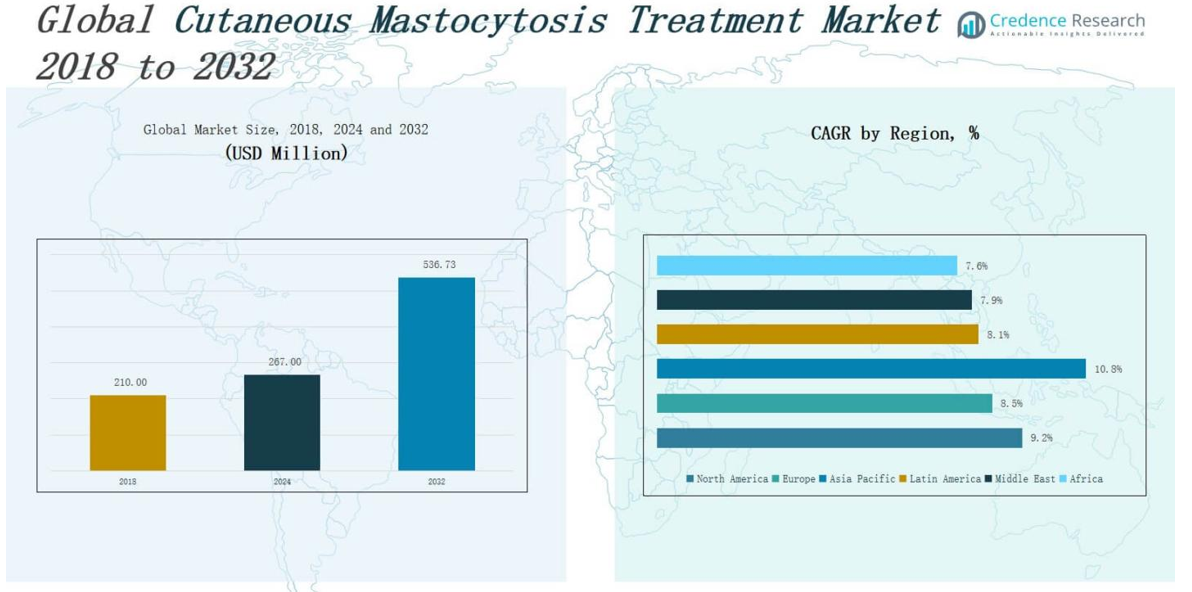
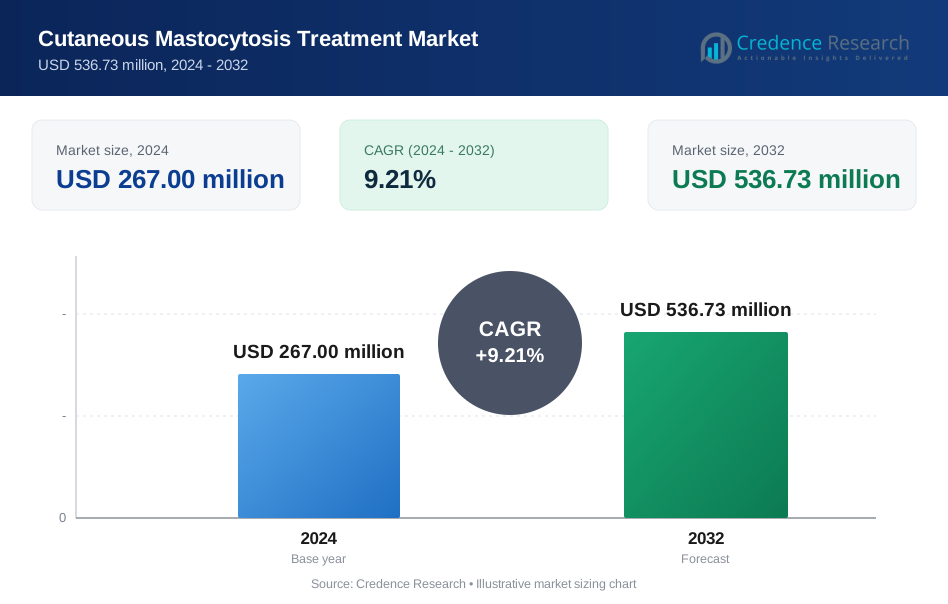
The Cutaneous Mastocytosis Treatment Market size was valued at USD 210.00 million in 2018 to USD 267.00 million in 2024 and is anticipated to reach USD 536.73 million by 2032, at a CAGR of 9.21% during the forecast period.
| REPORT ATTRIBUTE | DETAILS |
|---|---|
| Historical Period | 2020-2023 |
| Base Year | 2024 |
| Forecast Period | 2025-2032 |
| Cutaneous Mastocytosis Treatment Market Size 2024 | USD 267.00 million |
| Cutaneous Mastocytosis Treatment Market, CAGR | 9.21% |
| Cutaneous Mastocytosis Treatment Market Size 2032 | USD 536.73 million |
The Cutaneous Mastocytosis Treatment Market is driven by rising awareness among healthcare providers and patients about early diagnosis and effective management of mast cell disorders. Increasing incidence of pediatric cutaneous mastocytosis and the growing availability of targeted therapies, such as antihistamines, corticosteroids, and tyrosine kinase inhibitors, are accelerating treatment demand. Advances in molecular diagnostics and genetic profiling are enabling more precise classification of mastocytosis subtypes, facilitating personalized treatment approaches. The market also benefits from expanding clinical research focused on mast cell stabilization and symptom control, along with orphan drug designations that support drug development for rare dermatological conditions. Trends indicate a shift toward non-invasive therapies and topical formulations that improve patient compliance and quality of life. Collaborations between pharmaceutical companies and research institutions are fostering innovation, while regulatory incentives for rare disease therapies continue to encourage investment. The rising global focus on dermatological health and specialty care is reinforcing the market’s long-term growth potential.
The Cutaneous Mastocytosis Treatment Market spans key regions including North America, Europe, Asia Pacific, Latin America, the Middle East, and Africa. North America leads in market share due to strong healthcare infrastructure and early diagnosis rates, while Asia Pacific shows the fastest growth supported by expanding access to dermatological care and rising healthcare investment. Europe holds a significant share with established treatment protocols and patient registries. Latin America and the Middle East exhibit steady growth through public-private partnerships and improving specialist access. Africa, though still emerging, is seeing increased efforts in awareness and healthcare capacity. Key players shaping the global landscape include Novartis AG, Pfizer Inc., Sanofi S.A., Johnson & Johnson, Teva Pharmaceutical Industries Ltd., Bausch Health Companies Inc., Bayer AG, Mylan NV, and Mallinckrodt Pharmaceuticals. These companies focus on innovation, pediatric formulations, and expanding global footprints through regulatory approvals and strategic collaborations.
Market Insights
- The Cutaneous Mastocytosis Treatment Market was valued at USD 210.00 million in 2018, reached USD 267.00 million in 2024, and is projected to hit USD 536.73 million by 2032, growing at a CAGR of 9.21%.
- Rising pediatric prevalence and early diagnosis, especially in North America and Europe, are boosting demand for effective cutaneous mastocytosis treatments.
- Growing adoption of targeted therapies like tyrosine kinase inhibitors, corticosteroids, and mast cell stabilizers is improving patient outcomes and expanding treatment options.
- Asia Pacific is the fastest-growing region, driven by healthcare investment, dermatology access, and increased awareness across China, India, and Japan.
- Limited availability of curative treatments and low disease awareness in low-resource settings continue to challenge timely diagnosis and care.
- Regulatory support, orphan drug incentives, and active patient advocacy are attracting R&D investment and fostering drug development in rare dermatological disorders.
- Key players include Novartis AG, Pfizer Inc., Sanofi S.A., Johnson & Johnson, Teva Pharmaceutical, Bayer AG, Bausch Health, Mylan NV, and Mallinckrodt Pharmaceuticals.
Market Drivers
Rising Prevalence and Early Diagnosis of Pediatric Cases
The Cutaneous Mastocytosis Treatment Market is witnessing strong growth due to increasing awareness and early diagnosis, especially among pediatric populations. Healthcare providers are now more equipped to detect symptoms like skin lesions, itching, and flushing associated with mast cell proliferation. Improved screening programs and dermatological consultations in early childhood are contributing to timely intervention. The growing number of reported cases is driving demand for appropriate treatment and follow-up care. Pediatric patients are often the first to exhibit symptoms, making early-stage treatment critical. This demographic trend supports expanding therapeutic protocols and surveillance measures.
Expanding Availability of Targeted and Supportive Therapies
Therapeutic advancements are a key driver for the Cutaneous Mastocytosis Treatment Market. It benefits from the expanded availability of antihistamines, mast cell stabilizers, corticosteroids, and tyrosine kinase inhibitors that alleviate both acute and chronic symptoms. These therapies help manage inflammation, histamine release, and skin discomfort, significantly improving quality of life. Topical formulations and non-invasive options enhance patient compliance. Pharmaceutical companies are investing in drug reformulations to meet unmet dermatological needs. These innovations are positioning the market for robust clinical adoption.
- For instance, Novartis’s imatinib mesylate, a tyrosine kinase inhibitor, has demonstrated symptom improvement in patients with systemic and cutaneous mastocytosis, as documented in a 2023 clinical review.
Increasing Research in Rare Dermatological Disorders
Intensified research efforts in rare skin diseases are accelerating development in the Cutaneous Mastocytosis Treatment Market. Researchers and biotech firms are exploring molecular pathways that control mast cell activation and proliferation. It is benefiting from grants and funding directed toward orphan dermatology drug development. Enhanced understanding of KIT mutations is helping design targeted molecules with higher efficacy. The rare disease classification also allows for regulatory support, including fast-track approvals and extended exclusivity. These dynamics are fostering a favorable innovation environment.
Supportive Regulatory Framework and Patient Advocacy
Supportive regulatory policies and growing patient advocacy efforts are shaping the Cutaneous Mastocytosis Treatment Market. Rare disease incentives, such as orphan drug designation and tax credits, are attracting biopharmaceutical investment. Patient advocacy groups are increasing awareness, facilitating clinical trial participation, and pushing for treatment access. These organizations play a crucial role in influencing healthcare policies and treatment reimbursement. Public-private partnerships are also emerging to advance research. It is aligning industry efforts with patient-centered outcomes and regulatory milestones.
- For instance, the European Competence Network on Mastocytosis (ECNM), a patient advocacy and research consortium, actively facilitates clinical trial participation and has played a key role in establishing diagnostic and treatment guidelines, thereby improving patient access to care and influencing healthcare policy.
Market Trends
Shift Toward Precision Medicine and Targeted Therapy
The Cutaneous Mastocytosis Treatment Market is experiencing a clear shift toward precision medicine, driven by advances in genetic profiling and molecular diagnostics. Identification of KIT gene mutations has enabled the development of targeted therapies that disrupt mast cell proliferation at its source. Tyrosine kinase inhibitors and other targeted agents are gaining clinical traction for their ability to offer symptom relief with minimal off-target effects. This trend enhances treatment personalization and improves long-term outcomes. Clinicians are adopting mutation-based treatment decisions more frequently. It reflects a growing preference for evidence-based, individualized care.
- For instance, Blueprint Medicines’ avapritinib (AYVAKIT®) received FDA approval in 2021 for advanced systemic mastocytosis based on its ability to selectively inhibit mutated KIT D816V, demonstrating high response rates and durable symptom control in pivotal trials.
Development of Topical and Non-Invasive Treatment Options
Innovations in drug formulation are creating new opportunities in the Cutaneous Mastocytosis Treatment Market. Topical corticosteroids, antihistamines, and emerging topical kinase inhibitors are being developed to address localized symptoms without systemic side effects. These formulations improve patient adherence, particularly among pediatric and elderly populations. Transdermal delivery systems and microencapsulation technologies are under study to enhance absorption and efficacy. It is expanding the range of user-friendly treatment options. Non-invasive solutions support outpatient management and help reduce healthcare costs.
- For instance, Novartis AG has invested in topical corticosteroid formulations, such as clobetasol, which are used to reduce inflammation and skin lesions in cutaneous mastocytosis patients, improving symptom control with minimal systemic absorption.
Rising Clinical Trial Activity and Pipeline Expansion
The growing volume of clinical trials reflects the expanding pipeline in the Cutaneous Mastocytosis Treatment Market. Pharmaceutical and biotech companies are accelerating trials for next-generation mast cell stabilizers, immunomodulators, and biologics. Multiple investigational drugs are in Phase II and III stages, focusing on both efficacy and safety across different age groups. Global trial networks and patient registries are streamlining recruitment and data collection. It signals strong industry commitment to therapeutic innovation. Regulatory agencies are also showing greater responsiveness to rare disease programs.
Increased Role of Digital Health and Patient Monitoring Tools
Digital tools are gaining ground in the Cutaneous Mastocytosis Treatment Market through mobile apps, teledermatology, and wearable sensors. These technologies assist patients in tracking flare-ups, medication use, and side effects in real time. Telemedicine platforms allow specialists to monitor progress remotely, improving access in underserved regions. AI-driven tools are being tested to analyze skin images and symptom patterns. It is fostering proactive disease management. These innovations contribute to early intervention, better adherence, and long-term disease control.
Market Challenges Analysis
Limited Treatment Options and Lack of Curative Therapies
The Cutaneous Mastocytosis Treatment Market faces a significant challenge due to the limited availability of curative treatment options. Current therapies primarily focus on symptom management, offering temporary relief rather than addressing the underlying cause. Many patients require lifelong treatment, which may lead to side effects or diminished effectiveness over time. The absence of FDA-approved drugs specifically indicated for cutaneous mastocytosis limits standardized care protocols. It restricts clinical decision-making and increases reliance on off-label prescriptions. This therapeutic gap hinders optimal patient outcomes and innovation in drug development.
Low Disease Awareness and Diagnostic Delays
Low awareness among general practitioners and dermatologists often leads to misdiagnosis or delayed diagnosis in the Cutaneous Mastocytosis Treatment Market. The rarity of the condition contributes to underreporting and inconsistent documentation, making it difficult to assess true prevalence and guide health policy. Patients may endure extended periods of untreated symptoms, which can significantly affect quality of life. Limited access to specialized care and genetic testing exacerbates the diagnostic challenge, particularly in low-resource settings. It reduces the likelihood of early intervention and coordinated care. This gap in awareness and diagnostics continues to impede effective market penetration.
Market Opportunities
Emerging Biologics and Novel Therapeutic Pathways
The development of biologics and targeted therapies presents a strong growth opportunity in the Cutaneous Mastocytosis Treatment Market. Researchers are exploring monoclonal antibodies and immune-modulating agents that offer more precise mast cell control. Biotech firms are investing in therapies that inhibit KIT mutations, aiming to address disease progression at a molecular level. It creates room for first-in-class treatments that could secure regulatory incentives and market exclusivity. These advancements support a shift from symptom relief to disease-modifying strategies. The pipeline holds potential to redefine treatment standards and attract long-term clinical adoption.
Growing Focus on Pediatric Dermatology and Unmet Needs
Increased focus on pediatric dermatological care offers a strategic entry point for innovation in the Cutaneous Mastocytosis Treatment Market. Children represent a significant portion of patients, yet tailored therapies remain limited. Companies that develop age-appropriate formulations, such as low-dose topicals or oral suspensions, can tap into an underserved segment. It also opens the door for specialized clinical trials and regulatory fast-tracking. Expanding early intervention programs and caregiver education can strengthen market engagement. These efforts align with broader trends in rare disease care and pediatric treatment development.
Market Segmentation Analysis:
By Drug Class
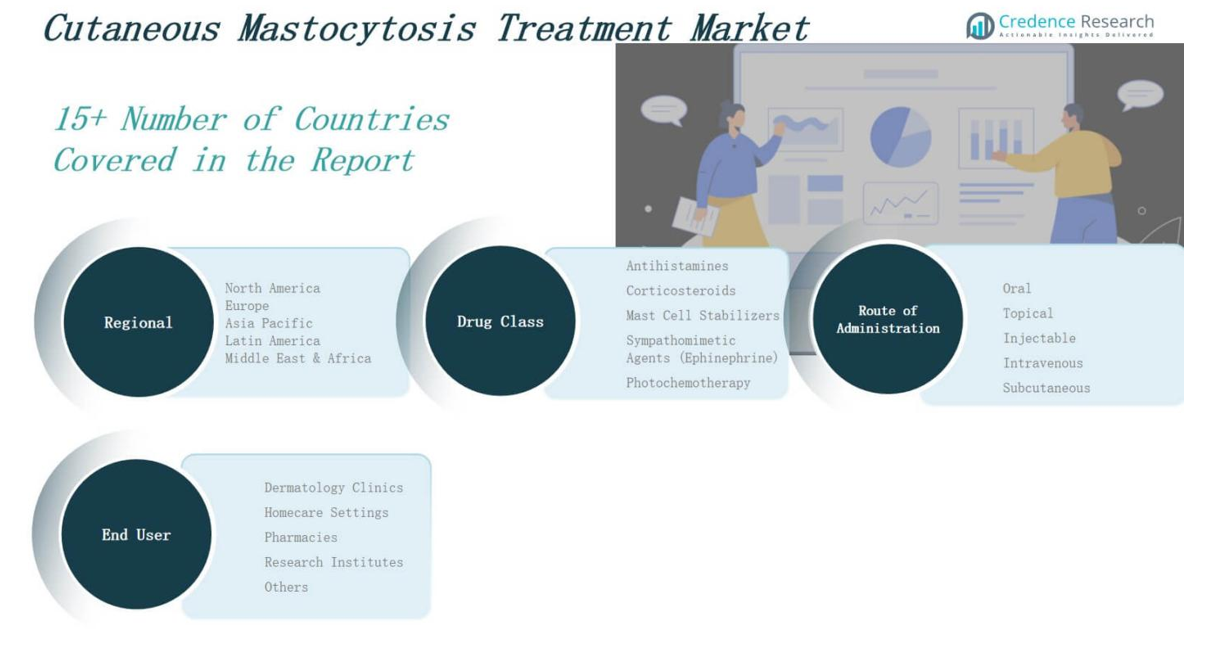
The Cutaneous Mastocytosis Treatment Market is segmented into antihistamines, corticosteroids, mast cell stabilizers, sympathomimetic agents (epinephrine), and photochemotherapy. Antihistamines remain the most widely used drug class due to their effectiveness in controlling pruritus and flushing. Corticosteroids are prescribed for more severe inflammation, particularly in topical forms. Mast cell stabilizers offer long-term management benefits by reducing degranulation activity. Epinephrine is used in emergency situations to treat anaphylaxis associated with systemic reactions. Photochemotherapy is applied in refractory or extensive cases, though its usage is limited due to side effects and accessibility.
- For example, topical corticosteroids such as clobetasol are prescribed for mild to moderate cutaneous mastocytosis, with NHS guidelines advising their use for a limited period to reduce mast cell numbers and inflammation in affected skin areas.
By Route of Administration
The Cutaneous Mastocytosis Treatment Market covers oral, topical, injectable, intravenous, and subcutaneous routes. Oral administration dominates due to ease of use and widespread patient preference, particularly for antihistamines. Topical treatments are favored in dermatological care for direct symptom relief with fewer systemic effects. Injectable and intravenous routes are used for acute management or hospital settings where rapid relief is required. Subcutaneous options are being explored for self-administration of long-acting agents, improving patient compliance.
- For instance, Regeneron Pharmaceuticals is actively developing subcutaneous long-acting biologics, such as Dupixent (dupilumab), which allows self-administration and improves compliance in chronic skin conditions, a model being explored for mastocytosis therapies.
By End-user
The Cutaneous Mastocytosis Treatment Market serves dermatology clinics, homecare settings, pharmacies, research institutes, and others. Dermatology clinics hold the largest share due to their specialized care capabilities and access to advanced treatments. Homecare settings are expanding with the availability of topical and oral treatments that support self-management. Pharmacies contribute through dispensing essential medications and offering consultation. Research institutes are driving innovation and clinical trials to expand therapeutic options. Others include hospitals and specialty centers offering multidisciplinary care.
Segments:
Based on Drug Class
- Antihistamines
- Corticosteroids
- Mast Cell Stabilizers
- Sympathomimetic Agents (Epinephrine)
- Photochemotherapy
Based on Route of Administration
- Oral
- Topical
- Injectable
- Intravenous
- Subcutaneous
Based on End-user
- Dermatology Clinics
- Homecare Settings
- Pharmacies
- Research Institutes
- Others
Based on Region
- North America
- U.S.
- Canada
- Mexico
- Europe
- Germany
- France
- U.K.
- Italy
- Spain
- Rest of Europe
- Asia Pacific
- China
- Japan
- India
- South Korea
- South-east Asia
- Rest of Asia Pacific
- Latin America
- Brazil
- Argentina
- Rest of Latin America
- Middle East & Africa
- GCC Countries
- South Africa
- Rest of the Middle East and Africa
Regional Analysis
North America
The North America Cutaneous Mastocytosis Treatment Market size was valued at USD 84.67 million in 2018 to USD 106.48 million in 2024 and is anticipated to reach USD 213.78 million by 2032, at a CAGR of 9.2% during the forecast period. North America holds the highest market share, driven by strong healthcare infrastructure, early diagnosis rates, and high awareness among clinicians. The U.S. leads with extensive access to advanced treatment options, including biologics and off-label therapies. Robust R&D investment from pharmaceutical companies supports innovation and regulatory approvals. The presence of key industry players and specialized dermatology centers enhances regional dominance. The Cutaneous Mastocytosis Treatment Market in North America continues to benefit from favorable reimbursement frameworks and growing clinical trial participation.
Europe
The Europe Cutaneous Mastocytosis Treatment Market size was valued at USD 55.65 million in 2018 to USD 68.02 million in 2024 and is anticipated to reach USD 129.22 million by 2032, at a CAGR of 8.5% during the forecast period. Europe maintains a substantial share, supported by national health systems, clinical guidelines, and rare disease frameworks. Countries like Germany, France, and the UK have established patient registries and diagnostic standards that support early intervention. Access to dermatological expertise and ongoing collaboration among academic institutions contribute to steady growth. It is driven by increased clinical adoption of topical and systemic therapies. Growing public health campaigns and patient advocacy networks are further elevating disease awareness across the region.
Asia Pacific
The Asia Pacific Cutaneous Mastocytosis Treatment Market size was valued at USD 41.58 million in 2018 to USD 55.76 million in 2024 and is anticipated to reach USD 126.29 million by 2032, at a CAGR of 10.8% during the forecast period. Asia Pacific is witnessing the fastest growth, fueled by rising healthcare expenditure, improved access to dermatological services, and growing awareness in countries such as China, India, and Japan. Urbanization and the expansion of specialty clinics in tier 1 and tier 2 cities are enhancing patient outreach. The market benefits from government investments in rare disease management and diagnostics. It is gaining momentum due to increased pharmaceutical partnerships and local production of generic drugs. Growth in telemedicine is further extending access to underserved areas.
Latin America
The Latin America Cutaneous Mastocytosis Treatment Market size was valued at USD 12.14 million in 2018 to USD 15.27 million in 2024 and is anticipated to reach USD 28.27 million by 2032, at a CAGR of 8.1% during the forecast period. The region shows steady progress, led by Brazil, Mexico, and Argentina, where public health systems are gradually integrating rare disease care. Rising demand for dermatological consultation and access to over-the-counter antihistamines supports baseline treatment coverage. It remains constrained by limited specialist availability and uneven healthcare access in rural areas. However, international collaborations and nonprofit involvement are promoting awareness and early diagnosis. Market players are entering through public-private partnerships and local distribution networks to improve outreach.
Middle East
The Middle East Cutaneous Mastocytosis Treatment Market size was valued at USD 8.61 million in 2018 to USD 10.30 million in 2024 and is anticipated to reach USD 18.84 million by 2032, at a CAGR of 7.9% during the forecast period. The market is expanding gradually with growing focus on rare disease programs in countries like the UAE, Saudi Arabia, and Israel. Access to high-quality private healthcare and adoption of international treatment protocols are improving diagnostic and therapeutic outcomes. Pharmaceutical imports and awareness initiatives are helping address knowledge gaps. It is experiencing rising demand for topical and oral therapies suited for outpatient care. Specialized centers are emerging in metropolitan areas, though rural access remains limited.
Africa
The Africa Cutaneous Mastocytosis Treatment Market size was valued at USD 7.35 million in 2018 to USD 11.16 million in 2024 and is anticipated to reach USD 20.33 million by 2032, at a CAGR of 7.6% during the forecast period. Africa represents an emerging market, with slow but improving access to dermatological diagnosis and essential medicines. South Africa and Egypt are leading in terms of market size due to better infrastructure and urban healthcare systems. Public health efforts and non-governmental organizations are driving early awareness. It is challenged by fragmented distribution channels and limited availability of specialist care. However, rising investment in healthcare capacity and growing pharmaceutical interest are creating long-term potential across the continent.
Key Player Analysis
- Novartis AG
- Mylan N.V.
- Teva Pharmaceutical Industries Ltd.
- Bausch Health Companies Inc.
- Pfizer Inc.
- Sanofi S.A.
- Johnson & Johnson
- Bayer AG
- Mallinckrodt Pharmaceuticals
Competitive Analysis
The Cutaneous Mastocytosis Treatment Market features a moderately competitive landscape with several established pharmaceutical companies and specialty drug developers. Key players such as Novartis AG, Pfizer Inc., Sanofi S.A., Johnson & Johnson, and Teva Pharmaceutical Industries Ltd. focus on antihistamines, corticosteroids, and emerging targeted therapies. It is shaped by ongoing research in mast cell biology and KIT gene inhibition, which influences product pipelines and treatment protocols. Companies are investing in pediatric formulations and non-invasive delivery systems to improve patient outcomes. Strategic collaborations, orphan drug designations, and clinical trial expansions are common approaches to gain market advantage. Firms also emphasize geographic expansion and regulatory approvals to broaden their global footprint. The Cutaneous Mastocytosis Treatment Market is evolving with a focus on innovation, patient-centric solutions, and rare disease positioning, creating opportunities for niche players and biosimilar manufacturers. Competitive intensity is expected to rise as more targeted and precision-based therapies enter clinical and commercial phases.
Recent Developments
- In June 2025, Sanofi announced the acquisition of Blueprint Medicines for approximately $9.1 billion, gaining access to AYVAKIT® (avapritinib), the only approved treatment for advanced systemic mastocytosis, with potential implications for cutaneous mastocytosis therapies.
- In May 2023, the European Medicines Agency (EMA) expanded its label for AYVAKIT® to include the treatment of indolent systemic mastocytosis, a form often overlapping with cutaneous symptoms, improving treatment access across the region.
- In June 2025, Blueprint Medicines presented long-term data on AYVAKIT® (avapritinib) at the European Hematology Association congress, reinforcing its sustained clinical efficacy and well-tolerated safety profile in systemic mastocytosis.
Market Concentration & Characteristics
The Cutaneous Mastocytosis Treatment Market exhibits moderate concentration, with a few multinational pharmaceutical companies dominating the landscape through established drug portfolios and strong research pipelines. It is characterized by a high level of specialization due to the rarity of the condition, leading to limited but targeted competition. Most therapies focus on symptom relief using antihistamines, corticosteroids, and mast cell stabilizers, while advanced treatments such as tyrosine kinase inhibitors are primarily in the investigational or off-label phase. The market shows a strong reliance on orphan drug designations and regulatory incentives, which encourage innovation despite a relatively small patient base. Demand is driven by pediatric diagnosis, clinical awareness, and institutional support for rare disease management. Geographic expansion remains a strategic priority, with players aiming to increase penetration in emerging regions. The Cutaneous Mastocytosis Treatment Market continues to evolve through advancements in precision medicine, supportive care, and non-invasive drug delivery technologies tailored for long-term symptom control.
Report Coverage
The research report offers an in-depth analysis based on Drug Class, Route of Administration, End-User and Geography. It details leading market players, providing an overview of their business, product offerings, investments, revenue streams, and key applications. Additionally, the report includes insights into the competitive environment, SWOT analysis, current market trends, as well as the primary drivers and constraints. Furthermore, it discusses various factors that have driven market expansion in recent years. The report also explores market dynamics, regulatory scenarios, and technological advancements that are shaping the industry. It assesses the impact of external factors and global economic changes on market growth. Lastly, it provides strategic recommendations for new entrants and established companies to navigate the complexities of the market.
Future Outlook
- Demand for personalized therapies will increase as genetic profiling and precision diagnostics become standard in mastocytosis care.
- Pharmaceutical companies will invest more in developing non-invasive and pediatric-friendly formulations.
- Awareness campaigns and education among primary care providers will reduce diagnostic delays.
- Orphan drug approvals will expand as regulatory bodies prioritize rare disease treatments.
- Market access in Asia Pacific and Latin America will grow due to healthcare infrastructure improvements.
- Telemedicine and digital health tools will support better disease monitoring and patient adherence.
- Strategic collaborations between biotech firms and research institutions will drive innovation.
- New biologics and targeted therapies will enter clinical trials focused on long-term mast cell regulation.
- Health systems will implement rare disease policies to improve reimbursement and treatment availability.
- The market will continue shifting toward outpatient and home-based care for symptom management.
Request a Free Sample
Fill in your details and we'll send you a free sample report.
- Sample data tables & charts
- Research methodology
Need a Custom Version of This Report?
Tailor the scope, geography, or segments to your exact requirements.
- Custom geography or segment scope
- Direct access to our analyst team
Frequently Asked Questions
What is the current size of the Cutaneous Mastocytosis Treatment Market?
What are the key segments within the Cutaneous Mastocytosis Treatment Market?
What are some challenges faced by the Cutaneous Mastocytosis Treatment Market?
Who are the major players in the Cutaneous Mastocytosis Treatment Market?
Table of Content
Chapter 1. Report Introduction
- 1.1 Report Description & Purpose
- 1.1.1 Report Title & Market Definition
- 1.1.2 Unique Selling Propositions (USP) & Key Differentiators
- 1.1.3 Value Proposition for Stakeholders
- 1.2 Research Objectives
- 1.2.1 Market Sizing Objectives (Volume & Revenue) (Volume Where Applicable)
- 1.2.2 Segmentation Objectives
- 1.2.3 Competitive Intelligence Objectives
- 1.2.4 Forecast & Scenario Objectives
- 1.3 Report Scope
- 1.3.1 Cutaneous Mastocytosis Treatment Scope – Segments & Subsegments Covered
- 1.3.2 Geographic Scope – Regions & Countries Covered
- 1.3.3 Historical Period, Base Year & Forecast Period (2024; forecast to 2032)
- 1.3.4 Inclusions & Exclusions
- 1.4 Industry Classification & Applicable Codes
- 1.5 Currency, Measurement Units & Valuation Basis
- 1.6 Target Stakeholders
- 1.7 Limitations & Assumptions
Chapter 2. Executive Summary
- 2.1 Global Cutaneous Mastocytosis Treatment Market Snapshot
- 2.1.1 Market Size – Historical (2024) & Forecast (2024-2032) (2024: USD 267.00 million → 2032: USD 536.73 million)
- 2.1.2 Volume & Revenue – Global Totals (Volume Where Applicable)
- 2.1.3 Key Market Highlights – Top Five Facts
- 2.2 Cutaneous Mastocytosis Treatment Market Segmentation Snapshot
- 2.2.1 Market Split by Region – 2024 vs. 2032
- 2.3 Competitive Snapshot
- 2.3.1 Top 10 Players by Revenue Share – 2024
- 2.3.2 Top 10 Players by Volume Share – 2024 (Volume Where Applicable)
- 2.3.3 Recent Strategic Developments (18-Month Summary)
- 2.4 Key Investment Highlights & Strategic Conclusions
Chapter 3. Cutaneous Mastocytosis Treatment Market Dynamics & Industry Analysis
- 3.1 Market Overview & Context
- 3.1.1 Cutaneous Mastocytosis Treatment Market Position in the Broader Industry Value Chain
- 3.1.2 Demand Structure & Purchasing Dynamics
- 3.1.3 Market Maturity & Development Stage by Region
- 3.2 Cutaneous Mastocytosis Treatment Market Drivers
- 3.3 Cutaneous Mastocytosis Treatment Market Restraints & Challenges
- 3.4 Cutaneous Mastocytosis Treatment Market Opportunities
- 3.5 Porter's Five Forces Analysis
- 3.5.1 Threat of New Entrants
- 3.5.2 Bargaining Power of Suppliers
- 3.5.3 Bargaining Power of Buyers
- 3.5.4 Threat of Substitutes
- 3.5.5 Competitive Rivalry – Intensity Assessment
- 3.6 Cutaneous Mastocytosis Treatment Value Chain Analysis
- 3.6.1 Upstream – Key Inputs, Resources & Suppliers
- 3.6.1.1 Key Input/Resource 1
- 3.6.1.2 Key Input/Resource 2
- 3.6.1.3 Key Input/Resource 3
- 3.6.2 Midstream – Core Operations & Value Creation
- 3.6.2.1 Operating Model & Process Overview
- 3.6.2.2 Key Operating Locations & Capabilities by Company
- 3.6.3 Downstream – Market Channels & End Users
- 3.6.3.1 Direct Sales & Customer Engagement Channels
- 3.6.3.2 Indirect Sales, Intermediaries & Partner Channels
- 3.6.4 Value Chain Profitability Analysis
- 3.6.1 Upstream – Key Inputs, Resources & Suppliers
- 3.7 PESTEL Analysis
- 3.7.1 Political Factors
- 3.7.2 Economic Factors
- 3.7.3 Social Factors
- 3.7.4 Technological Factors
- 3.7.5 Environmental Factors
- 3.7.6 Legal Factors
- 3.8 Cutaneous Mastocytosis Treatment Supply Chain Analysis
- 3.8.1 Critical Input & Resource Availability Risk Assessment
- 3.8.2 Supplier & Operational Concentration Risk (Geographic Exposure)
- 3.8.3 Supply & Service Disruption Impact Analysis
- 3.9 Regulatory & Policy Landscape
Note: The regulatory and policy landscape section covers regulations based on their applicability to the market, Cutaneous Mastocytosis Treatment category, geography, and scope of the study. Only regulatory frameworks with a material impact on operations, compliance, trade, sustainability, or market access are analyzed in detail.
Chapter 4. Key Investment Pockets & Opportunity Analysis
- 4.1 Cutaneous Mastocytosis Treatment Market Attractiveness Analysis
- 4.1.1 By Region – Investment Attractiveness Matrix (Market Size × CAGR)
- 4.2 Absolute Revenue Growth Opportunity
- 4.2.1 By Region – Absolute Revenue Growth Through 2032
- 4.3 Incremental Demand Opportunity
- 4.3.1 By Region – Incremental Demand Through 2032
- 4.3.2 Segment – Incremental Demand
- 4.4 Emerging Submarket Opportunity Deep Dive (Subject to Applicability)
- 4.5 Priority Market Opportunity Scorecards
- 4.5.1 United States
- 4.5.2 Europe
- 4.5.3 Asia
- 4.5.4 Middle East & Africa
Note: Priority market opportunity scorecards reflect the geographic scope and strategic relevance of the study. Listed markets are indicative and may be adapted to the industry.
Chapter 5. Cutaneous Mastocytosis Treatment Cross-Border Trade & Market Access Analysis
- 5.1 International Trade & Cross-Border Activity Overview
- 5.1.1 Global Export Value by Country (2024)
- 5.1.2 Global Export Volume by Country (2024) (Volume Where Applicable)
- 5.1.3 Global Import Value by Country (2024)
- 5.1.4 Global Import Volume by Country (2024) (Volume Where Applicable)
- 5.1.5 Net Trade Balance by Country (2024)
- 5.2 Export Analysis – Segment
- 5.2.1 Category 1 (Applicable Classification Code)
- 5.2.2 Category 2 (Applicable Classification Code)
- 5.2.3 Category 3 (Applicable Classification Code)
- 5.2.4 Category 4 (Applicable Classification Code)
- 5.2.5 Category 5 (Applicable Classification Code)
- 5.3 Import Analysis – Segment
- 5.3.1 Category 1 (Applicable Classification Code)
- 5.3.2 Category 2 (Applicable Classification Code)
- 5.3.3 Category 3 (Applicable Classification Code)
- 5.3.4 Category 4 (Applicable Classification Code)
- 5.3.5 Category 5 (Applicable Classification Code)
- 5.4 Cross-Border Pricing & Transaction Benchmarks
- 5.4.1 Export Pricing – Segment & Country
- 5.4.2 Import Pricing – Segment & Source Country
- 5.4.3 Price Trends (2024)
- 5.5 Key Cross-Border Trade & Delivery Routes
- 5.5.1 Cross-Border Trade/Delivery Route 1
- 5.5.2 Cross-Border Trade/Delivery Route 2
- 5.5.3 Cross-Border Trade/Delivery Route 3
- 5.5.4 Cross-Border Trade/Delivery Route 4
- 5.5.5 Cross-Border Trade/Delivery Route 5
- 5.6 Trade Policy & Market Access Impact Assessment
- 5.6.1 Tariff & Non-Tariff Barriers
- 5.6.2 Regional Trade & Economic Integration Frameworks
- 5.6.3 Bilateral & Multilateral Trade Agreements
- 5.6.4 Cross-Border Operating, Licensing & Localization Requirements
Note: This chapter applies where cross-border trade or delivery is relevant to Cutaneous Mastocytosis Treatment. Goods, services, and digital offerings are assessed using applicable classifications and transaction measures. Import-export volumes, trade balances, and route analyses are included only where meaningful to the market.
Chapter 6. Competitive Landscape & Company Benchmarking
- 6.1 Cutaneous Mastocytosis Treatment Market Concentration & Structure
- 6.1.1 Herfindahl-Hirschman Index (HHI) – vs. 2024
- 6.1.2 Leading, Mid-Sized & Emerging Player Structure
- 6.1.3 Global, Regional & Local Player Dynamics
- 6.2 Cutaneous Mastocytosis Treatment Market Share Analysis – 2024
- 6.2.1 Global Revenue Share by Company
- 6.2.2 Global Volume Share by Company (Volume Where Applicable)
- 6.2.3 Regional Revenue Share
- 6.2.4 Market Share Evolution ( vs. 2024)
- 6.2.5 Company Market Share by Key Segment
- 6.2.6 Company Market Share by Customer Group
- 6.3 Operating Scale, Capacity & Infrastructure Analysis
- 6.3.1 Global Operating Scale & Supply Capacity
- 6.3.2 Resource Utilization & Operating Efficiency
- 6.3.3 Output, Service Delivery & Activity Metrics
- 6.3.4 Operating Footprint & Infrastructure Map
- 6.3.5 Planned Operational & Capacity Expansion
- 6.4 Cutaneous Mastocytosis Treatment Competitive Benchmarking Matrix
- 6.4.1 Revenue, Growth, Profitability & Operating Metric Comparison
- 6.4.2 Channel Revenue Mix
- 6.4.3 Geographic Revenue Exposure
- 6.4.4 R&D Intensity
- 6.4.5 Sustainability Maturity
- 6.5 Strategic Developments in Cutaneous Mastocytosis Treatment (Last 24 Months)
- 6.5.1 Mergers, Acquisitions & Divestments
- 6.5.2 New Products, Services & Solutions in Cutaneous Mastocytosis Treatment
- 6.5.3 Operational & Infrastructure Expansions
- 6.5.4 Strategic Alliances, Joint Ventures & Partnerships
- 6.5.5 Distribution Expansion & Market Entry
- 6.5.6 Sustainability & ESG Initiatives
- 6.6 Competitive Strategy Mapping
- 6.6.1 Leader, Challenger, Follower & Niche Classification
- 6.6.2 Pricing Strategy Comparison
- 6.6.3 Channel Strategy Matrix
Note: Strategic developments are included based on their materiality and the availability of reliable information.
Chapter 7. Global Cutaneous Mastocytosis Treatment Market – By Sales & Delivery Channel
- 7.1 Segment Overview
- 7.1.1 Volume & Revenue Split by Channel (2024 & 2032) (Volume Where Applicable)
- 7.1.2 Channel Mix Evolution (2024-2032)
Chapter 8. Regional Market Analysis – Global Overview
- 8.1 Global Regional Overview
- 8.1.1 Regional Volume Share (Volume Where Applicable)
- 8.1.2 Regional Revenue Share
- 8.1.3 Regional Volume by Region (Volume Where Applicable)
- 8.1.4 Regional Revenue by Region
- 8.1.5 Regional Forecast Through 2032
- 8.2 Cross-Regional Segment Analysis
- 8.2.1 By Sales & Delivery Channel
- 8.2.2 By Competitive Positioning & Price Tier
Chapter 9. North America Cutaneous Mastocytosis Treatment Market
- 9.1 United States
- 9.2 Canada
- 9.3 Mexico
Chapter 10. Europe Cutaneous Mastocytosis Treatment Market
- 10.1 Germany
- 10.2 France
- 10.3 Italy
- 10.4 United Kingdom
- 10.5 Spain
- 10.6 Poland
- 10.7 Russia
- 10.8 Netherlands
- 10.9 Belgium
- 10.10 Sweden
- 10.11 Denmark
- 10.12 Norway
- 10.13 Rest of Europe
Chapter 11. Asia Pacific Cutaneous Mastocytosis Treatment Market
- 11.1 China
- 11.2 India
- 11.3 Japan
- 11.4 South Korea
- 11.5 Thailand
- 11.6 Indonesia
- 11.7 Vietnam
- 11.8 Malaysia
- 11.9 Australia
- 11.10 Rest of Asia Pacific
Chapter 12. Latin America Cutaneous Mastocytosis Treatment Market
- 12.1 Brazil
- 12.2 Argentina
- 12.3 Colombia
- 12.4 Chile
- 12.5 Rest of Latin America
Chapter 13. Middle East Cutaneous Mastocytosis Treatment Market
- 13.1 Saudi Arabia
- 13.2 United Arab Emirates
- 13.3 Turkey
- 13.4 Israel
- 13.5 Iran
- 13.6 Rest of the Middle East
Chapter 14. Africa Cutaneous Mastocytosis Treatment Market
- 14.1 South Africa
- 14.2 Egypt
- 14.3 Nigeria
- 14.4 Morocco
- 14.5 Rest of Africa
Chapter 15. Cutaneous Mastocytosis Treatment Company Profiles
- 15.1 [Company 01]
- 15.1.1 Company Overview
- 15.1.2 Key Management Personnel
- 15.1.3 Products & Services Portfolio
- 15.1.4 Financial Performance
- 15.1.5 Key Market Focus & Geographic Presence
- 15.1.6 Recent Developments & Strategic Initiatives
Note: The company profile list is preliminary and may change based on research findings, market developments, data availability, and client requirements.
Chapter 16. Appendices
- Appendix A – List of Abbreviations & Acronyms
- Appendix B – Industry Classification Code Reference – Full Series
- Appendix C – Supply, Output & Operating Capacity Data Tables
- Appendix D – End-Use & Demand Base Tables
- Appendix E – Demand, Adoption & Usage Assumptions
- Appendix F – Pricing & Revenue Metric Reference Tables
- Appendix G – Company Operations & Infrastructure Database
- Appendix H – Cross-Border Trade & Activity Data Tables (Where Applicable)
- Appendix I – Regulatory Summary Tables
- Appendix J – Primary Research Participant List (Anonymized)
- Appendix K – Primary Research Questionnaire Framework
- Appendix L – Data Sources & Bibliography
- Appendix M – Market Size Divergence & Source Comparison
Chapter 17. Research Methodology
- 17.1 Research Framework & Philosophy
- 17.2 Secondary Research – Sources, Hierarchy & Data Extraction
- 17.3 Data Modeling – Bottom-Up & Top-Down Market Sizing
- 17.4 Primary Research – Stakeholder Framework, LOI & Sample Sizes
- 17.5 Forecast Methodology – Regression, Scenario & Sensitivity Analysis
- 17.6 Quality Control – Four-Layer Validation Framework
- 17.7 Limitations & Standard Assumptions
- 17.8 Disclaimer
