
| REPORT ATTRIBUTE | DETAILS |
|---|---|
| Historical Period | 2019-2022 |
| Base Year | 2023 |
| Forecast Period | 2024-2032 |
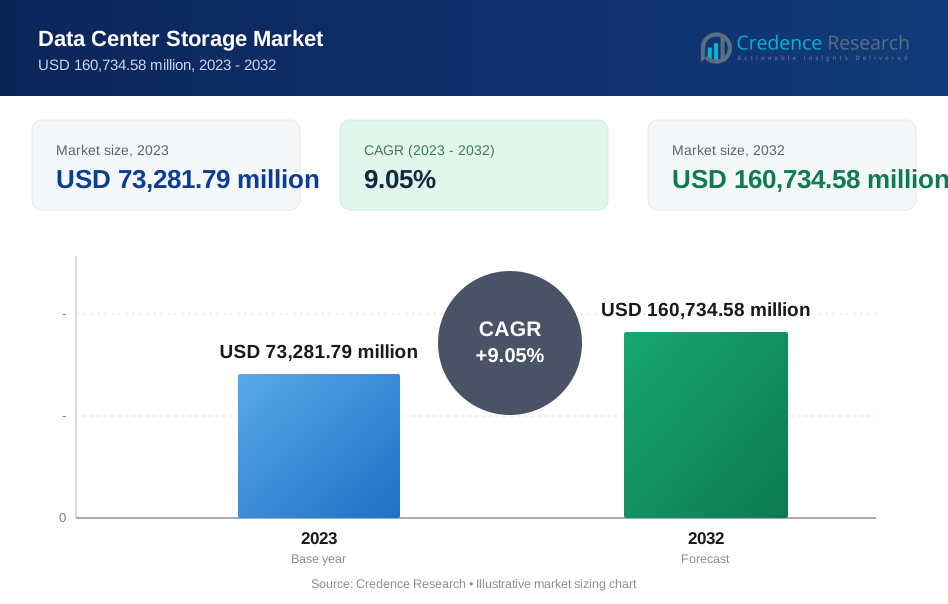
| Data Center Storage Market Size 2023 | USD 73,281.79 Million |
| Data Center Storage Market, CAGR | 9.05% |
| Data Center Storage Market Size 2032 | USD 160,734.58 Million |
Market Overview
The Data Center Storage Market is anticipated to expand from USD 73,281.79 million in 2023 to USD 160,734.58 million by 2032, at a compound annual growth rate (CAGR) of 9.05%.
The Global Data Center Storage Market is driven by escalating data volumes and the increasing need for scalable storage solutions. The rapid growth in cloud computing, big data analytics, and digital transformation initiatives fuels demand for advanced storage technologies. Key trends include the adoption of hyper-converged infrastructure for efficiency, the rise of AI and machine learning for data management, and a shift towards multi-cloud strategies. Additionally, growing emphasis on data security and compliance drives innovation in storage solutions to ensure reliable, scalable, and secure data management across global data centers.
The Global Data Center Storage Market shows significant regional variations with North America and Asia-Pacific leading in market share. North America, driven by high data consumption and technological advancements, holds a substantial portion of the market, with major players like Dell Technologies, IBM Corporation, and Hewlett Packard Enterprise driving innovations. In the Asia-Pacific region, rapid digital transformation and increasing data center investments contribute to robust growth, with key players such as Huawei Technologies and Toshiba Corporation leading the charge. These regions are shaping market trends with their focus on advanced storage solutions and infrastructure development.
Market Drivers
Exponential Growth of Data
The exponential growth of data is a primary driver of the Global Data Center Storage Market. The proliferation of Internet of Things (IoT) devices generates vast amounts of data that necessitate robust storage solutions to handle the influx. For instance, the number of IoT devices worldwide is forecast to almost double from 15.9 billion in 2023 to more than 32.1 billion by 2030. Social media platforms, including Facebook, Instagram, and TikTok, contribute terabytes of user-generated content daily, further stressing storage capacities. For example, Facebook has over 3.15 billion monthly active users, and YouTube has over 2.5 billion active users. Additionally, video streaming services such as Netflix and YouTube require substantial storage to manage and deliver high-definition content efficiently. On average, approximately 3 GB of data per hour is used for standard definition (SD) streaming, 7 GB per hour for high definition (HD) streaming, and up to 25 GB per hour for ultra-high definition (UHD) streaming. This surge in data generation across various platforms underscores the critical need for scalable and reliable storage solutions.
Cloud Computing Adoption
Cloud computing has significantly transformed the storage landscape by offering scalable and flexible solutions that adjust based on demand. This adaptability is particularly advantageous for businesses, providing cost-efficient storage options compared to traditional on-premises systems. Small and medium-sized enterprises, in particular, benefit from the lower capital expenditure associated with cloud storage. For instance, in the United States, 56% of small business owners spent as much as $600,000 annually on public cloud expenses. The ability to scale resources up or down according to business needs allows organizations to manage their storage requirements more effectively, driving widespread adoption and growth in the data center storage market.
Digital Transformation
The ongoing digital transformation, marked by Industry 4.0 and the rise of remote work and e-commerce, amplifies the demand for data storage. Industry 4.0 technologies, which include advanced manufacturing and automation, require substantial data storage to support real-time operations and analytics. The shift towards remote work and the expansion of online shopping further increase the reliance on digital infrastructure, thereby driving the need for enhanced storage solutions. These developments highlight the crucial role of data centers in supporting modern digital ecosystems.
Artificial Intelligence and Machine Learning
Artificial Intelligence (AI) and Machine Learning (ML) technologies significantly impact the data storage market by creating a demand for data-intensive applications. AI and ML algorithms require extensive datasets for training and inference, driving the need for high-capacity storage solutions. Moreover, the requirement for real-time data processing and analytics further fuels the demand for high-performance storage systems. The growing adoption of AI and ML across industries necessitates advanced storage solutions capable of handling complex and large-scale data operations efficiently.
Market Trends
Shift Towards Software-Defined Storage and Hyper-Converged Infrastructure
The shift towards Software-Defined Storage (SDS) and Hyper-Converged Infrastructure (HCI) represents significant trends in the data center storage market. SDS enhances flexibility and scalability compared to traditional hardware-based storage solutions, allowing organizations to adapt more readily to changing storage needs. For instance, DataCore SANsymphony offers a software-defined storage area network platform that is hardware agnostic and integrates with backup vendor Veeam for data protection. This adaptability makes SDS a cost-effective solution in the long run, as it reduces the need for frequent hardware upgrades. Simultaneously, Hyper-Converged Infrastructure integrates compute, storage, and networking resources into a single platform, streamlining IT management and reducing operational costs. HCI’s ability to consolidate resources simplifies infrastructure management, further driving its adoption. Both SDS and HCI offer substantial benefits in terms of operational efficiency and cost savings, reflecting the industry's move towards more integrated and versatile storage solutions.
Hybrid Cloud Storage, All-Flash Arrays, and Edge Computing
Hybrid cloud storage, all-flash arrays (AFAs), and edge computing are shaping the future of data center storage with their distinct advantages. Hybrid cloud storage optimizes performance and cost by combining on-premises storage with cloud-based storage, enhancing data migration and disaster recovery capabilities. This approach provides a balanced solution that leverages both local and cloud resources. All-Flash Arrays offer a significant performance boost over traditional hard disk drive-based storage, with lower latency that enables real-time data processing and analysis. Edge computing further revolutionizes storage by requiring localized data processing to reduce latency and manage the vast amounts of data generated by IoT devices. The integration of edge storage with on-premises and cloud solutions supports the growing need for immediate data access and processing efficiency. These trends highlight the evolving landscape of data storage, driven by the demand for speed, scalability, and seamless integration across diverse IT environments.
Market Challenges Analysis
Data Growth and Management Challenges
The rapid and relentless growth of data presents significant challenges in the data center storage sector. As data volumes continue to expand exponentially, managing storage capacity, accessibility, and overall efficiency becomes increasingly complex. For instance, the total amount of data created, captured, copied, and consumed globally is forecast to increase rapidly, reaching 64.2 zettabytes in 2020 and projected to grow to more than 180 zettabytes by 2025. This challenge is compounded by the variety of data types that organizations must handle, including structured, unstructured, and semi-structured data. Each data type requires different management strategies and solutions, further complicating the storage landscape. Organizations must invest in advanced storage technologies and management practices to address these issues effectively. The complexity of managing diverse data types alongside the need for scalable storage solutions highlights the ongoing challenge of ensuring efficient data growth management.
Data Security and Privacy Concerns
Data security and privacy are paramount concerns for data centers, with cyber threats and regulatory compliance being central issues. Data centers face persistent risks from cyberattacks, including data breaches, ransomware, and unauthorized access, which can compromise sensitive information and disrupt operations. To counteract these threats, data centers must implement robust security measures and continuously update their defenses. Additionally, adhering to stringent data privacy regulations such as GDPR and CCPA poses significant challenges. Compliance with these regulations can be burdensome and costly, requiring dedicated resources and expertise. Balancing the need for comprehensive security and regulatory compliance with operational efficiency remains a critical challenge for the data center industry.
Market Segmentation Analysis:
By Storage Type:
The global data center storage market is segmented into traditional storage, all-flash storage, and hybrid storage. Traditional storage, which includes hard disk drives (HDDs), remains prevalent due to its cost-effectiveness for large volumes of data. However, all-flash storage is gaining traction for its superior performance and reduced latency, making it ideal for high-speed data processing and real-time analytics. This type of storage delivers significantly faster read and write speeds compared to traditional HDD-based systems. Hybrid storage combines the benefits of both traditional and all-flash storage, offering a balanced solution that optimizes performance while managing costs. This approach enables organizations to leverage the high speed of flash storage for critical applications, while still benefiting from the lower cost per terabyte of traditional storage for less frequently accessed data.
By Application:
In terms of application, the data center storage market serves various sectors including IT and telecommunications, BFSI (banking, financial services, and insurance), government, healthcare, and others. The IT and telecommunications sector drives demand for scalable and high-performance storage solutions due to the rapid growth of data and the need for robust infrastructure. BFSI organizations require secure and reliable storage systems to handle sensitive financial data and transactions. Government agencies and healthcare providers also demand high-capacity and secure storage solutions to manage vast amounts of data while ensuring compliance with regulations. The "others" category includes diverse applications such as education and retail, each requiring tailored storage solutions to meet specific needs.
Segments:
Based on Storage Type:
- Traditional Storage
- All-Flash Storage
- Hybrid Storage
Based on Application:
- IT and Telecommunications
- BFSI
- Government
- Healthcare
- Others
Based on Deployment:
- Storage Area Network (SAN) System
- Network-attached storage (NAS) System
- Direct-Attached Storage (DAS) System
- Others
Based on the Geography:
- North America
- U.S.
- Canada
- Mexico
- Europe
- Germany
- France
- U.K.
- Italy
- Spain
- Rest of Europe
- Asia Pacific
- China
- Japan
- India
- South Korea
- South-east Asia
- Rest of Asia Pacific
- Latin America
- Brazil
- Argentina
- Rest of Latin America
- Middle East & Africa
- GCC Countries
- South Africa
- Rest of the Middle East and Africa
Regional Analysis
North America
North America dominates the global data center storage market with a significant market share of approximately 45%. The region’s leadership is driven by its advanced technological infrastructure and high adoption rate of cutting-edge storage solutions. The U.S. is particularly influential, with its extensive network of data centers and substantial investments in storage technologies, including all-flash and hybrid storage solutions. The rapid expansion of cloud computing services and the increasing need for data management in sectors like IT, telecommunications, and BFSI further bolster North America's dominance. The region’s focus on innovation and efficiency, coupled with favorable regulatory environments and significant technological advancements, continues to drive robust growth in the data center storage market.
Asia-Pacific
Asia-Pacific holds a considerable share of around 30% of the global data center storage market, reflecting its rapid economic development and burgeoning data demands. Countries like China, India, and Japan are key contributors to this growth, driven by their expanding IT infrastructure and increasing investments in data center facilities. The rise in digital transformation initiatives and the growing adoption of cloud services across various industries, including IT, healthcare, and government, fuel the demand for advanced storage solutions in the region. Additionally, the proliferation of IoT devices and increasing data generation from sectors like e-commerce and telecommunications drive the need for scalable and high-performance storage solutions. The region’s market dynamics are characterized by a surge in data center expansions and a growing emphasis on integrating next-generation storage technologies to support the escalating data needs.
Key Player Analysis
- Dell Technologies
- Hewlett Packard Enterprise
- NetApp
- IBM Corporation
- Pure Storage
- Western Digital Corporation
- Seagate Technology
- Cisco Systems, Inc.
- Nutanix, Inc.
- Micron Technology, Inc.
- Quantum Corporation
- Cohesity, Inc.
- Super Micro Computer, Inc.
- Commvault Systems, Inc.
- Snowflake Inc.
- DataDirect Networks
- Lenovo Group
- Huawei Technologies Co., Ltd.
- Hitachi Vantara
- Fujitsu Limited
- NEC Corporation
- Toshiba Corporation
- Kioxia Holdings Corporation
- Infinidat
- Veeam Software
Competitive Analysis
In the Global Data Center Storage Market, leading players like Dell Technologies, Hewlett Packard Enterprise, Quantum Corporation, Lenovo Group, Fujitsu Limited, Veeam Software and IBM Corporation are pivotal in driving innovation and competition. These companies are continually enhancing their storage solutions with cutting-edge technologies such as all-flash arrays, hybrid storage systems, and cloud integration. They emphasize improving performance, scalability, and cost-efficiency to meet the growing demands of data centers. Strategic investments in research and development, partnerships, and acquisitions are common as firms strive to stay ahead in a rapidly evolving market. Additionally, advancements in data management, security, and performance optimization are central to their competitive strategies, shaping the market landscape significantly.
Recent Developments
- In May 2024, Dell Technologies expanded its Dell AI Factory with NVIDIA to include new server, edge, workstation, solutions, and services advancements that speed AI adoption and innovation.
- In March 2024, HPE debuted an end-to-end AI-native portfolio for Generative AI, including two solutions that encompass all the compute, storage, software, networking, and consulting services needed to accelerate AI projects.
- In May 2024, NetApp unveiled new AFF A-Series systems that can power the most demanding IT workloads, including GenAI, VMware, and enterprise databases.
- In May 2024, IBM announced several new updates to its watsonx platform during its annual THINK conference, focusing on making AI more open, cost-effective, and flexible for businesses.
- In June 2024, Cisco announced new AI-powered innovations and investments at Cisco Live 2024, including a $1 billion global AI investment fund.
Market Concentration & Characteristics
The Global Data Center Storage Market exhibits a moderate to high level of market concentration, with a few leading players commanding significant shares. These key companies leverage their extensive expertise and comprehensive product portfolios to maintain competitive advantages. Market characteristics include a strong emphasis on technological innovation, with a focus on enhancing storage performance, scalability, and cost-efficiency. The market is marked by rapid technological advancements and continuous product development to meet the evolving demands of data management. Additionally, strategic collaborations, mergers, and acquisitions are prevalent, driving market dynamics and expanding technological capabilities. This concentration fosters a competitive environment where advancements in storage solutions, such as all-flash arrays and hybrid systems, are crucial for maintaining market leadership and addressing the growing needs of data centers globally.
Report Coverage
The research report offers an in-depth analysis based on Storage Type, Application, Deployment and Geography. It details leading market players, providing an overview of their business, product offerings, investments, revenue streams, and key applications. Additionally, the report includes insights into the competitive environment, SWOT analysis, current market trends, as well as the primary drivers and constraints. Furthermore, it discusses various factors that have driven market expansion in recent years. The report also explores market dynamics, regulatory scenarios, and technological advancements that are shaping the industry. It assesses the impact of external factors and global economic changes on market growth. Lastly, it provides strategic recommendations for new entrants and established companies to navigate the complexities of the market.
Future Outlook
- The market is expected to experience robust growth driven by increasing data generation and consumption across various industries.
- Demand for scalable and flexible storage solutions will rise as organizations seek to handle expanding data volumes.
- Adoption of all-flash storage systems will increase due to their superior performance and lower latency compared to traditional storage.
- Hybrid storage solutions will become more prevalent, combining on-premises and cloud-based storage to optimize cost and performance.
- The integration of advanced technologies, such as artificial intelligence and machine learning, will enhance data storage and management capabilities.
- Edge computing will drive demand for localized storage solutions to improve data processing efficiency and reduce latency.
- The rise of 5G networks will significantly impact data center storage needs, generating vast amounts of data requiring efficient storage solutions.
- Increased focus on data security and privacy will lead to advancements in encryption and access control measures.
- Regulatory pressures and compliance requirements will shape storage solutions, driving investments in secure and compliant storage infrastructure.
- Companies will continue to pursue strategic partnerships and acquisitions to expand their technological capabilities and market reach.
Request a Free Sample
Fill in your details and we'll send you a free sample report.
- Sample data tables & charts
- Research methodology
Need a Custom Version of This Report?
Tailor the scope, geography, or segments to your exact requirements.
- Custom geography or segment scope
- Direct access to our analyst team
Frequently Asked Questions
What is the current size of the Global Data Center Storage Market?
What factors are driving the growth of the Global Data Center Storage Market?
What are the key segments within the Global Data Center Storage Market?
What are some challenges faced by the Global Data Center Storage Market?
Who are the major players in the Global Data Center Storage Market?
Table of Content
Chapter 1. Report Introduction
- 1.1 Report Description & Purpose
- 1.1.1 Report Title & Market Definition
- 1.1.2 Unique Selling Propositions (USP) & Key Differentiators
- 1.1.3 Value Proposition for Stakeholders
- 1.2 Research Objectives
- 1.2.1 Market Sizing Objectives (Volume & Revenue)
- 1.2.2 Segmentation Objectives
- 1.2.3 Competitive Intelligence Objectives
- 1.2.4 Forecast & Scenario Objectives
- 1.3 Report Scope
- 1.3.1 Data Center Storage Scope – Types & Subtypes Covered
- 1.3.2 Geographic Scope – Regions & Countries Covered
- 1.3.3 Historical Period, Base Year & Forecast Period (2023; forecast to 2032)
- 1.3.4 Inclusions & Exclusions
- 1.4 HS Code & Classification Framework
- 1.5 Currency, Units & Pricing Basis
- 1.6 Target Stakeholders
- 1.7 Limitations & Assumptions
Chapter 2. Executive Summary
- 2.1 Global Data Center Storage Market Snapshot
- 2.1.1 Market Size – Historical (2023) & Forecast (2023-2032) (2023: USD 73,281.79 million → 2032: USD 160,734.58 million)
- 2.1.2 Volume & Revenue – Global Totals
- 2.1.3 Key Market Highlights – Top Five Facts
- 2.2 Data Center Storage Market Segmentation Snapshot
- 2.2.1 Market Split by Region – 2023 vs. 2032
- 2.3 Competitive Snapshot
- 2.3.1 Top 10 Players by Revenue Share – 2023
- 2.3.2 Top 10 Players by Volume Share – 2023
- 2.3.3 Recent Strategic Developments (18-Month Summary)
- 2.4 Key Investment Highlights & Strategic Conclusions
Chapter 3. Data Center Storage Market Dynamics & Industry Analysis
- 3.1 Market Overview & Context
- 3.1.1 Data Center Storage Market Position in the Broader Automotive Value Chain
- 3.1.2 OEM vs. Replacement Market Dynamics
- 3.1.3 Market Maturity & Development Stage by Region
- 3.2 Data Center Storage Market Drivers
- 3.3 Data Center Storage Market Restraints & Challenges
- 3.4 Data Center Storage Market Opportunities
- 3.5 Porter's Five Forces Analysis
- 3.5.1 Threat of New Entrants
- 3.5.2 Bargaining Power of Suppliers
- 3.5.3 Bargaining Power of Buyers
- 3.5.4 Threat of Substitutes
- 3.5.5 Competitive Rivalry – Intensity Assessment
- 3.6 Data Center Storage Value Chain Analysis
- 3.6.1 Upstream – Raw Material/Input Suppliers
- 3.6.1.1 Raw Material/Input 1
- 3.6.1.2 Raw Material/Input 2
- 3.6.1.3 Raw Material/Input 3
- 3.6.2 Midstream – Production/Manufacturing/Service Delivery
- 3.6.2.1 Production/Process Overview
- 3.6.2.2 Key Facility Locations & Capacity by Manufacturer
- 3.6.3 Downstream – Distribution & End Consumer
- 3.6.3.1 Primary Channel – B2B/OEM
- 3.6.3.2 Secondary Channels – Dealer, Retail, Online, Direct
- 3.6.4 Value Chain Profitability Analysis
- 3.6.1 Upstream – Raw Material/Input Suppliers
- 3.7 PESTEL Analysis
- 3.7.1 Political Factors
- 3.7.2 Economic Factors
- 3.7.3 Social Factors
- 3.7.4 Technological Factors
- 3.7.5 Environmental Factors
- 3.7.6 Legal Factors
- 3.8 Data Center Storage Supply Chain Analysis
- 3.8.1 Raw Material/Input Supply Risk Assessment
- 3.8.2 Manufacturing Concentration Risk (Geographic Exposure)
- 3.8.3 Trade Disruption Impact Analysis
- 3.9 Regulatory & Policy Landscape
Note: The regulatory and policy landscape section covers regulations based on their applicability to the market, Data Center Storage category, geography, and scope of the study. Only regulatory frameworks with a material impact on operations, compliance, trade, sustainability, or market access are analyzed in detail.
Chapter 4. Key Investment Pockets & Opportunity Analysis
- 4.1 Data Center Storage Market Attractiveness Analysis
- 4.1.1 By Region – Investment Attractiveness Matrix (Volume × CAGR)
- 4.2 Absolute Revenue Growth Opportunity
- 4.2.1 By Region – Absolute USD Growth Through 2032
- 4.3 Incremental Volume Opportunity
- 4.3.1 By Region – Incremental Volume Through 2032
- 4.3.2 Segment – Incremental Volume
- 4.4 Emerging Submarket Opportunity Deep Dive (Subject to Applicability)
- 4.5 Emerging Market Opportunity Scorecards
- 4.5.1 United States
- 4.5.2 Europe
- 4.5.3 Asia
- 4.5.4 Middle East & Africa
Note: Emerging Market Opportunity Scorecards will be included based on relevance and strategic importance. Regions listed are indicative and may vary depending on data availability and market dynamics.
Chapter 5. Data Center Storage Import-Export Analysis & Trade Flows
- 5.1 Global Trade Overview
- 5.1.1 Global Export Value by Country (2023)
- 5.1.2 Global Export Volume by Country (2023)
- 5.1.3 Global Import Value by Country (2023)
- 5.1.4 Global Import Volume by Country (2023)
- 5.1.5 Net Trade Balance by Country (2023)
- 5.2 Export Analysis – Segment
- 5.2.1 Type 1 (HS Code)
- 5.2.2 Type 2 (HS Code)
- 5.2.3 Type 3 (HS Code)
- 5.2.4 Type 4 (HS Code)
- 5.2.5 Type 5 (HS Code)
- 5.3 Import Analysis – Segment
- 5.3.1 Type 1 (HS Code)
- 5.3.2 Type 2 (HS Code)
- 5.3.3 Type 3 (HS Code)
- 5.3.4 Type 4 (HS Code)
- 5.3.5 Type 5 (HS Code)
- 5.4 Average Unit Trade Prices
- 5.4.1 Average Export Price – Segment & Country
- 5.4.2 Average Import Price – Segment & Source Country
- 5.4.3 Price Trends (2023)
- 5.5 Key Trade Route Analysis
- 5.5.1 Trade Route 1
- 5.5.2 Trade Route 2
- 5.5.3 Trade Route 3
- 5.5.4 Trade Route 4
- 5.5.5 Trade Route 5
- 5.6 Trade Policy Impact Assessment
- 5.6.1 US Anti-Dumping & Section 301 Tariffs
- 5.6.2 EU Customs Union Impact
- 5.6.3 Major Free Trade Agreements
- 5.6.4 USMCA Rules of Origin
Note: Trade policy analysis will be included only where relevant to the Data Center Storage market.
Chapter 6. Competitive Landscape & Company Benchmarking
- 6.1 Data Center Storage Market Concentration & Structure
- 6.1.1 Herfindahl-Hirschman Index (HHI) – vs. 2023
- 6.1.2 Tier 1, Tier 2 & Tier 3 Market Structure
- 6.1.3 Global, Regional & Local Player Dynamics
- 6.2 Data Center Storage Market Share Analysis – 2023
- 6.2.1 Global Revenue Share by Company
- 6.2.2 Global Volume Share by Company
- 6.2.3 Regional Revenue Share
- 6.2.4 Market Share Evolution ( vs. 2023)
- 6.2.5 OEM Segment Share by Company
- 6.2.6 Replacement Segment Share by Company
- 6.3 Production/Delivery Capacity & Facility Analysis
- 6.3.1 Global Installed Capacity
- 6.3.2 Capacity Utilization Rates
- 6.3.3 Production/Output Volume
- 6.3.4 Facility Locations & Capacity Map
- 6.3.5 Planned Capacity Additions
- 6.4 Data Center Storage Competitive Benchmarking Matrix
- 6.4.1 Revenue, Volume, CAGR & Profitability Comparison
- 6.4.2 Channel Revenue Mix
- 6.4.3 Geographic Revenue Exposure
- 6.4.4 R&D Intensity
- 6.4.5 Sustainability Maturity
- 6.5 Strategic Developments in Data Center Storage (Last 24 Months)
- 6.5.1 Mergers, Acquisitions & Divestments
- 6.5.2 New Data Center Storage Launches
- 6.5.3 Facility Expansions
- 6.5.4 Strategic Alliances, Joint Ventures & Partnerships
- 6.5.5 Distribution Expansion & Market Entry
- 6.5.6 Sustainability & ESG Initiatives
- 6.6 Competitive Strategy Mapping
- 6.6.1 Leader, Challenger, Follower & Niche Classification
- 6.6.2 Pricing Strategy Comparison
- 6.6.3 Channel Strategy Matrix
Note: Strategic developments are included based on their materiality and the availability of reliable information.
Chapter 7. Global Data Center Storage Market – By Distribution Channel
- 7.1 Segment Overview
- 7.1.1 Volume & Revenue Split by Channel (2023 & 2032)
- 7.1.2 Channel Mix Evolution (2023-2032)
Chapter 8. Regional Market Analysis – Global Overview
- 8.1 Global Regional Overview
- 8.1.1 Regional Volume Share
- 8.1.2 Regional Revenue Share
- 8.1.3 Regional Volume by Region
- 8.1.4 Regional Revenue by Region
- 8.1.5 Regional Forecast Through 2032
- 8.2 Cross-Regional Segment Analysis
- 8.2.1 By Distribution Channel
- 8.2.2 By Brand/Price Tier
Chapter 9. North America Data Center Storage Market
- 9.1 United States
- 9.2 Canada
- 9.3 Mexico
Chapter 10. Europe Data Center Storage Market
- 10.1 Germany
- 10.2 France
- 10.3 Italy
- 10.4 United Kingdom
- 10.5 Spain
- 10.6 Poland
- 10.7 Russia
- 10.8 Netherlands
- 10.9 Belgium
- 10.10 Sweden
- 10.11 Denmark
- 10.12 Norway
- 10.13 Rest of Europe
Chapter 11. Asia Pacific Data Center Storage Market
- 11.1 China
- 11.2 India
- 11.3 Japan
- 11.4 South Korea
- 11.5 Thailand
- 11.6 Indonesia
- 11.7 Vietnam
- 11.8 Malaysia
- 11.9 Australia
- 11.10 Rest of Asia Pacific
Chapter 12. Latin America Data Center Storage Market
- 12.1 Brazil
- 12.2 Argentina
- 12.3 Colombia
- 12.4 Chile
- 12.5 Rest of Latin America
Chapter 13. Middle East Data Center Storage Market
- 13.1 Saudi Arabia
- 13.2 United Arab Emirates
- 13.3 Turkey
- 13.4 Israel
- 13.5 Iran
- 13.6 Rest of the Middle East
Chapter 14. Africa Data Center Storage Market
- 14.1 South Africa
- 14.2 Egypt
- 14.3 Nigeria
- 14.4 Morocco
- 14.5 Rest of Africa
Chapter 15. Data Center Storage Company Profiles
- 15.1 [Company 01]
- 15.1.1 Company Overview
- 15.1.2 Key Management Personnel
- 15.1.3 Products & Services Portfolio
- 15.1.4 Financial Performance
- 15.1.5 Key Market Focus & Geographic Presence
- 15.1.6 Recent Developments & Strategic Initiatives
Note: The company profile list is preliminary and may change based on research findings, market developments, data availability, and client requirements.
Chapter 16. Appendices
- Appendix A – List of Abbreviations & Acronyms
- Appendix B – Industry Classification Code Reference – Full Series
- Appendix C – Production & Capacity Data Tables
- Appendix D – End-Use & Demand Base Tables
- Appendix E – Consumption & Replacement Rate Assumptions
- Appendix F – ASP Reference Tables
- Appendix G – Manufacturing & Facility Database
- Appendix H – Import-Export Data Tables
- Appendix I – Regulatory Summary Tables
- Appendix J – Primary Research Participant List (Anonymized)
- Appendix K – Primary Research Questionnaire Framework
- Appendix L – Data Sources & Bibliography
- Appendix M – Market Size Divergence & Source Comparison
Chapter 17. Research Methodology
- 17.1 Research Framework & Philosophy
- 17.2 Secondary Research – Sources, Hierarchy & Data Extraction
- 17.3 Data Modeling – Bottom-Up & Top-Down Market Sizing
- 17.4 Primary Research – Stakeholder Framework, LOI & Sample Sizes
- 17.5 Forecast Methodology – Regression, Scenario & Sensitivity Analysis
- 17.6 Quality Control – Four-Layer Validation Framework
- 17.7 Limitations & Standard Assumptions
- 17.8 Disclaimer
