
Market Overview
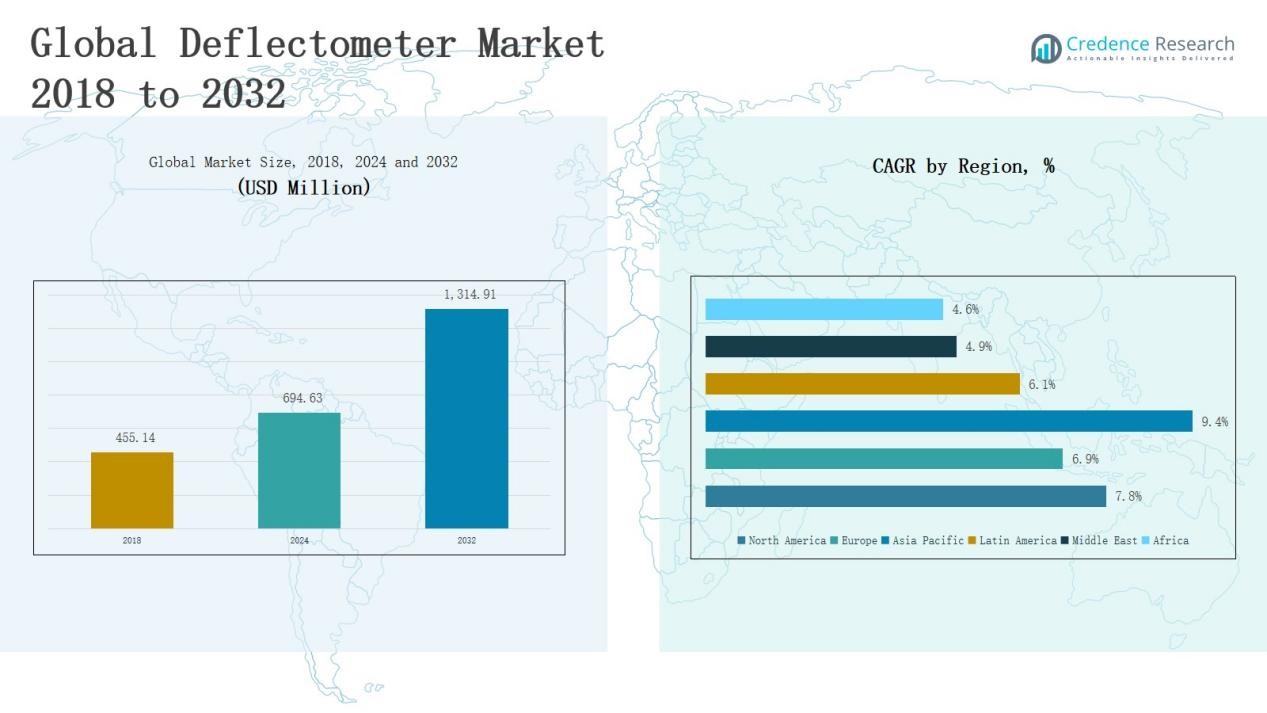
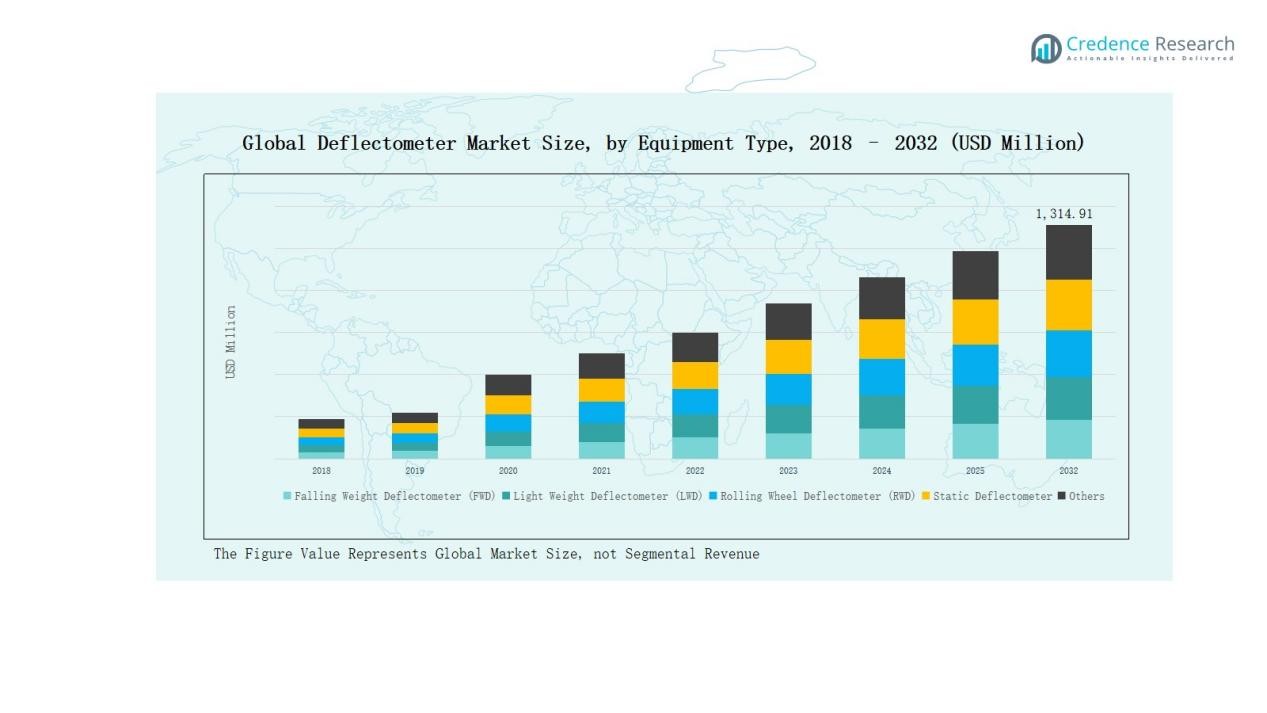
Deflectometer Market size was valued at USD 455.14 million in 2018 to USD 694.63 million in 2024 and is anticipated to reach USD 1,314.91 million by 2032, at a CAGR of 7.73% during the forecast period.
| REPORT ATTRIBUTE | DETAILS |
|---|---|
| Historical Period | 2020-2024 |
| Base Year | 2024 |
| Forecast Period | 2025-2032 |
| Deflectometer Market Size 2024 | USD 694.63 Million |
| Deflectometer Market, CAGR | 7.73% |
| Deflectometer Market Size 2032 | USD 1,314.91 Million |
The Deflectometer Market is shaped by leading players such as Illinois Tool Works Inc., Dynatest, PaveTesting Limited, Humboldt Mfg. Co., Controls Group, Aimil Ltd., Olson Instruments, EPSILON Technology Corp, Abatech, and ARA (Applied Research Associates), along with specialized firms like Greenwood Engineering, ZORN Instruments, HMP GmbH & Co. KG, KUAB, and Cooper Research Technology. These companies compete through advanced product portfolios, digital integration, and strategic collaborations to strengthen their market positions. North America emerged as the leading region with a 37% market share in 2024, supported by strict pavement testing standards, high infrastructure spending, and strong adoption of Falling Weight and Rolling Wheel Deflectometers.
Market Insights
- The Deflectometer Market grew from USD 455.14 million in 2018 to USD 694.63 million in 2024, and is projected to reach USD 1,314.91 million by 2032.
- Falling Weight Deflectometer (FWD) led with 41% share in 2024, followed by Light Weight Deflectometer (27%), Rolling Wheel Deflectometer (15%), Static Deflectometer (10%), and others (7%).
- By application, road construction dominated with 46% share in 2024, while railway construction held 18%, airport runways 12%, pavement rehabilitation 11%, bridges 9%, and others 4%.
- North America led with 37% share in 2024, followed by Europe (24%) and Asia Pacific (22%), while Latin America (4%), Middle East (2%), and Africa (1%) showed smaller shares.
- Key players include Illinois Tool Works Inc., Dynatest, PaveTesting Limited, Humboldt Mfg. Co., Controls Group, Aimil Ltd., Olson Instruments, EPSILON Technology Corp, Abatech, ARA, Greenwood Engineering, ZORN Instruments, HMP GmbH & Co. KG, KUAB, and Cooper Research Technology.
Market Segment Insights
By Equipment Type
Falling Weight Deflectometer (FWD) led the market with a 41% share in 2024, driven by its accuracy and standardization in highway evaluations. Light Weight Deflectometer (LWD) followed with 27%, supported by its portability and cost-effectiveness in urban and small-scale projects. Rolling Wheel Deflectometer (RWD) accounted for 15%, offering continuous pavement monitoring for large road networks, while Static Deflectometer held 10%, mainly in geotechnical and bridge studies. Other advanced models, including hybrid and IoT-enabled systems, captured the remaining 7%, reflecting niche adoption in research and smart infrastructure.
- For instance, Dynatest’s LWD has been utilized in municipal road projects in Germany for quick on-site compaction control, reducing testing time significantly compared to traditional plate load methods.
By Application
Road construction dominated applications with a 46% share in 2024, supported by global investments in highway expansion and rehabilitation. Railway construction contributed 18%, with demand rising from high-speed rail and metro projects in Asia Pacific. Airport runways represented 12%, driven by safety requirements and rising air traffic, while bridges held 9%, supported by static deflectometer use in structural analysis. Pavement rehabilitation and overlay projects accounted for 11%, reflecting maintenance-led infrastructure spending, and other applications such as mining and industrial pavements made up the remaining 4%.
- For instance, Delhi International Airport (DIAL) completed its fourth runway in 2023, which along with other expansion work, helped enhance the airport's overall airside capacity.
 Key Growth Drivers
Expanding Road and Highway Infrastructure
The surge in road and highway construction is a major growth driver for the deflectometer market. Governments in emerging economies are prioritizing transportation networks, leading to significant investments in new highways and upgrades. Falling Weight Deflectometers (FWD) and Rolling Wheel Deflectometers (RWD) are widely adopted for pavement strength analysis in these projects. The rising emphasis on preventive maintenance also fuels recurring demand, as road agencies increasingly rely on deflectometers to ensure safety and extend pavement service life.
- For instance, the National Highways Authority of India (NHAI) commissioned multiple Falling Weight Deflectometer surveys in 2022 to evaluate more than 1,200 km of national highways under its performance-based maintenance program.
Rising Demand for Pavement Rehabilitation
Aging road networks in developed regions, especially North America and Europe, create consistent demand for pavement rehabilitation. Deflectometers play a crucial role in evaluating pavement condition before overlay and repair work. The shift toward cost-effective maintenance over full reconstruction amplifies the use of FWD and LWD devices. Additionally, large-scale government-funded rehabilitation programs drive stable adoption. This demand extends to urban infrastructure where increasing vehicle traffic necessitates precise pavement monitoring, further strengthening market growth across both developed and developing countries.
- For instance, Highways England employs FWD testing across its 4,300-mile strategic road network to extend pavement life without resorting to full reconstruction.
Growth in Aviation and Rail Infrastructure
Expanding investments in airport runways and rail networks also boost deflectometer demand. Aviation authorities deploy deflectometers to ensure runways withstand increasing aircraft loads. Similarly, railway construction projects in Asia Pacific and Europe integrate LWD and static deflectometers for subgrade evaluation and compaction control. The global push for high-speed rail projects in countries like China and India further accelerates adoption. The integration of advanced testing equipment ensures structural reliability and safety standards, making aviation and rail infrastructure expansion a vital growth contributor.
Key Trends & Opportunities
Integration of Smart and Digital Technologies
The market is witnessing a strong trend toward smart deflectometers equipped with IoT sensors, cloud connectivity, and automated data analysis. These technologies enable real-time pavement monitoring, predictive maintenance, and integration with digital infrastructure platforms. Governments and contractors are increasingly adopting smart systems to improve testing efficiency and reduce manual errors. This trend creates opportunities for manufacturers to differentiate products with advanced analytics and software-enabled solutions. Long-term, digital transformation positions deflectometers as integral tools in smart city and intelligent transport systems.
- For instance, Advantech offers smart IoT sensing solutions with industrial-grade sensors that support versatile monitoring and data collection for infrastructure projects, including road and pavement assessments.
Rising Adoption in Emerging Economies
Developing nations present significant opportunities for deflectometer manufacturers. Rapid urbanization, industrial growth, and government-led infrastructure programs in Asia Pacific, Latin America, and Africa are expanding the market base. Countries like India and Brazil are investing heavily in highways, airports, and bridges, driving demand for both portable and advanced testing equipment. Lower-cost Light Weight Deflectometers (LWD) are particularly gaining traction in these regions due to their affordability and ease of use. Expanding distribution networks and localized manufacturing further unlock untapped market potential.
- For instance, Brazil's Ministry of Infrastructure was dissolved in 2023, and public investments in federal highway upgrades that year were far below $5 billion, with significant private and public spending being channeled through other programs like the New Growth Acceleration Programme (PAC).
Key Challenges
High Equipment and Maintenance Costs
The high upfront cost of advanced deflectometers, particularly Rolling Wheel Deflectometers (RWD), limits adoption among smaller contractors and developing markets. Beyond acquisition, ongoing calibration, servicing, and maintenance add to operational expenses. Many local contractors prefer cheaper alternatives or traditional testing methods. This cost barrier restricts wider penetration, especially in price-sensitive regions. To overcome this challenge, manufacturers must explore modular pricing, leasing models, or localized production to reduce costs while expanding reach to emerging infrastructure markets.
Limited Skilled Workforce
The operation of deflectometers requires skilled technicians capable of handling advanced software, calibration, and interpretation of test results. Many regions, particularly in developing economies, face a shortage of trained professionals. This knowledge gap leads to underutilization of equipment and inaccurate data interpretation, reducing the effectiveness of deflectometer testing. Manufacturers and agencies must invest in training programs, workshops, and digital tutorials to bridge this skills shortage. Without adequate workforce training, the reliability of deflectometer-based evaluations risks being compromised.
Competition from Alternative Testing Methods
Deflectometers face competition from other pavement testing techniques such as ground-penetrating radar (GPR), laser scanning, and automated imaging systems. These alternatives often provide faster results with less traffic disruption, appealing to agencies prioritizing efficiency. While deflectometers remain the standard for load-response testing, advancements in competing technologies threaten market share. Agencies are increasingly exploring hybrid testing strategies that combine GPR or imaging with deflection data. Sustained innovation and integration with complementary technologies are crucial for deflectometer manufacturers to remain competitive.
Regional Analysis
North America
North America led the deflectometer market with a 37% share in 2024, reaching a value of USD 301.41 million. The region is projected to expand at a CAGR of 7.8%, driven by heavy investments in road rehabilitation and advanced highway infrastructure. The U.S. dominates demand due to strict pavement testing standards and large-scale transportation funding programs. Adoption of Falling Weight Deflectometers (FWD) and Rolling Wheel Deflectometers (RWD) is particularly strong. By 2032, North America is expected to reach USD 572.15 million, reinforcing its position as the global leader in deflectometer adoption.
Europe
Europe accounted for a 24% share in 2024, valued at USD 193.26 million, with steady growth projected at a CAGR of 6.9%. Countries such as Germany, France, and the UK are major contributors, supported by advanced research and strict road quality regulations. Europe’s focus on pavement maintenance and sustainability initiatives is driving the demand for Light Weight Deflectometers (LWD) in both urban and rural projects. By 2032, the market is expected to reach USD 344.81 million, supported by ongoing infrastructure modernization programs across Western and Eastern Europe.
Asia Pacific
Asia Pacific represented a 22% market share in 2024, with revenues of USD 141.34 million, and is the fastest-growing region with a CAGR of 9.4%. Rapid urbanization, large-scale highway construction, and expansion of rail and airport projects in China, India, and Southeast Asia are fueling demand. LWDs are widely adopted due to affordability and mobility, while increasing use of FWD supports major infrastructure upgrades. By 2032, the region is projected to achieve USD 303.90 million, driven by government-backed infrastructure investment and smart city development programs.
Latin America
Latin America held a 4% share in 2024, valued at USD 32.48 million, and is expected to grow at a CAGR of 6.1%. Brazil and Argentina lead adoption due to rising investments in highway and airport infrastructure. Pavement rehabilitation programs and urban development initiatives contribute to the growing use of deflectometers. While the market is smaller compared to other regions, steady economic recovery and public-private partnerships are creating opportunities. By 2032, Latin America’s market size will reach USD 54.43 million, reflecting gradual but consistent infrastructure demand.
Middle East
The Middle East accounted for a 2% share in 2024, reaching USD 14.47 million, and is projected to expand at a CAGR of 4.9%. Growth is supported by investments in airport expansion, road networks, and mega construction projects in GCC countries. Adoption is still limited compared to developed regions due to reliance on imported testing technologies. However, government focus on long-term transport infrastructure is fostering steady demand. By 2032, the market is expected to grow to USD 22.13 million, supported by high-profile infrastructure modernization initiatives.
Africa
Africa contributed a 1% share in 2024, with a market value of USD 11.66 million, and is expected to grow at a CAGR of 4.6%. South Africa, Nigeria, and Egypt are the primary markets, driven by selective road and bridge projects. Limited budget allocations and lack of skilled workforce hinder wider adoption of deflectometers. However, international funding and aid-based infrastructure projects are creating opportunities for gradual growth. By 2032, the African market is anticipated to reach USD 17.49 million, reflecting its emerging but relatively small role in the global market.
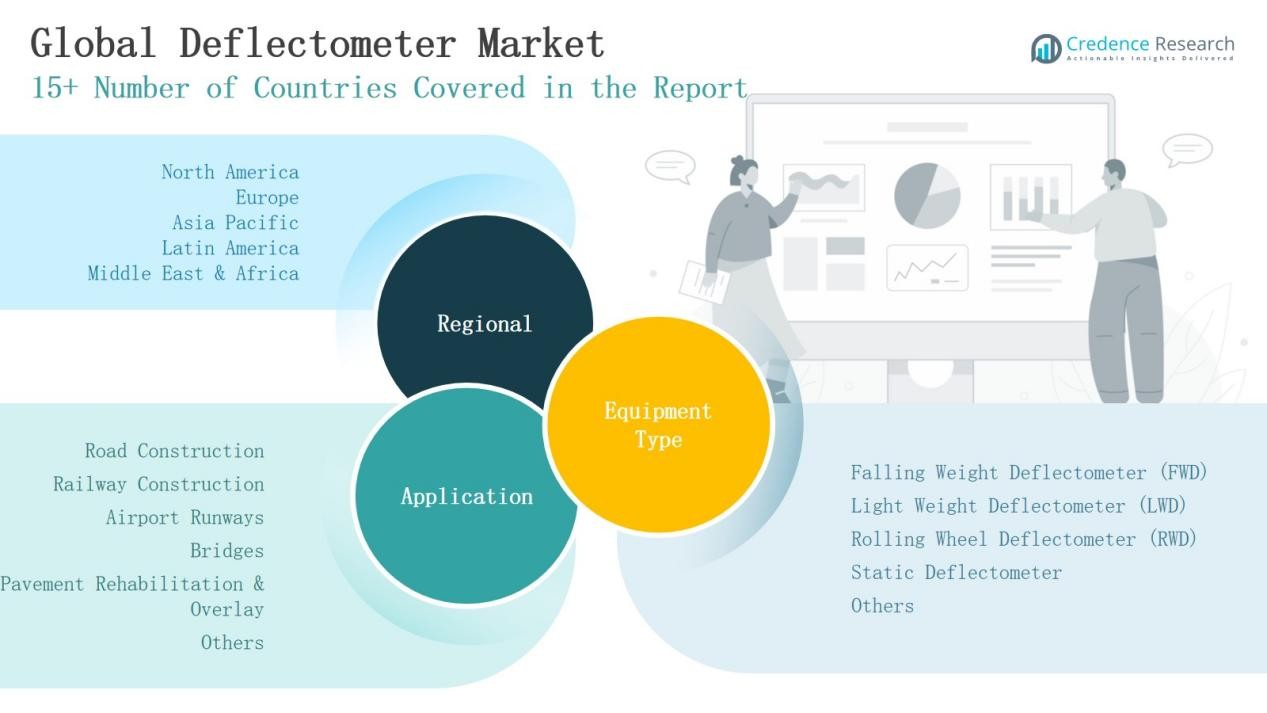
Market Segmentations:
By Equipment Type
- Falling Weight Deflectometer (FWD)
- Light Weight Deflectometer (LWD)
- Rolling Wheel Deflectometer (RWD)
- Static Deflectometer
- Others
By Application
- Road Construction
- Railway Construction
- Airport Runways
- Bridges
- Pavement Rehabilitation & Overlay
- Others
By Region
- North America: U.S., Canada, Mexico
- Europe: UK, France, Germany, Italy, Spain, Russia, Rest of Europe
- Asia Pacific: China, Japan, South Korea, India, Australia, Southeast Asia, Rest of Asia Pacific
- Latin America: Brazil, Argentina, Rest of Latin America
- Middle East: GCC Countries, Israel, Turkey, Rest of Middle East
- Africa: South Africa, Egypt, Rest of Africa
Competitive Landscape
The deflectometer market is moderately consolidated, with global players and regional manufacturers competing through product innovation, technology integration, and strategic partnerships. Leading companies such as Illinois Tool Works Inc., Dynatest, PaveTesting Limited, Humboldt Mfg. Co., and Controls Group hold significant market share due to their wide product portfolios and established global presence. These firms emphasize advanced technologies, including automated data collection, IoT-enabled sensors, and software-driven analytics, to strengthen market positioning. Regional players like Aimil Ltd., Abatech, and Olson Instruments focus on cost-effective solutions and cater primarily to developing markets, offering portable devices such as Light Weight Deflectometers (LWDs). Collaborations with government agencies and research institutes play a vital role in expanding market reach. Competition is further shaped by new entrants introducing hybrid and digital-enabled deflectometers for smart infrastructure projects. Overall, the landscape reflects a mix of established leaders and emerging players targeting niche applications, ensuring steady innovation and competitive intensity.
Key Players
- Illinois Tool Works Inc. (ITW)
- PaveTesting Limited
- Olson Instruments
- Dynatest
- Aimil Ltd.
- Humboldt Mfg. Co.
- Controls Group
- EPSILON TECHNOLOGY CORP
- Abatech
- ARA (Applied Research Associates)
- Greenwood Engineering (Traffic Speed Deflectometer)
- ZORN Instruments
- HMP GmbH & Co. KG
- KUAB
- Cooper Research Technology (Cooper Technology)
Recent Developments
- In May 2025, infraTest Prüftechnik GmbH acquired the WEBER Prüftechnik brand, known for its Light Weight Deflectometer (LWD WEBERconnect). Following the acquisition, infraTest continues to use the WEBER brand while providing LWD devices, calibration, servicing, and repair solutions.
- In February 2025, Greenwood Engineering held a webinar focused on the latest Traffic Speed Deflectometer (TSD) applications for road and runway management.
- In April 2025, ICC-IMS launched the Fast-Falling Weight Deflectometer (FastFWD), offering advanced pavement testing services with rapid, repeatable, and objective evaluations.
Report Coverage
The research report offers an in-depth analysis based on Equipment Type, Application and Region. It details leading market players, providing an overview of their business, product offerings, investments, revenue streams, and key applications. Additionally, the report includes insights into the competitive environment, SWOT analysis, current market trends, as well as the primary drivers and constraints. Furthermore, it discusses various factors that have driven market expansion in recent years. The report also explores market dynamics, regulatory scenarios, and technological advancements that are shaping the industry. It assesses the impact of external factors and global economic changes on market growth. Lastly, it provides strategic recommendations for new entrants and established companies to navigate the complexities of the market.
Future Outlook
- Demand for deflectometers will increase with rising investments in global road infrastructure.
- Adoption of smart and IoT-enabled deflectometers will enhance real-time pavement monitoring.
- Light Weight Deflectometers will gain traction in developing regions due to cost-effectiveness.
- Rolling Wheel Deflectometers will see wider use for large highway network assessments.
- Growth in airport and rail projects will strengthen the role of advanced testing equipment.
- Preventive maintenance strategies will drive recurring demand for pavement evaluation tools.
- Manufacturers will expand product offerings with digital integration and automated analytics.
- Partnerships with governments and research bodies will shape future adoption trends.
- Emerging economies will provide untapped opportunities through urbanization and smart city programs.
- Competition from alternative pavement testing technologies will push firms toward continuous innovation.

Request a Free Sample
Fill in your details and we'll send you a free sample report.
- Sample data tables & charts
- Research methodology
Market Dynamics
Expanding Road and Highway Infrastructure
Governments worldwide are investing heavily in new road and highway construction, particularly in emerging economies, which drives demand for deflectometers to ensure pavement quality and longevity. The adoption of FWD and RWD devices is especially strong in large-scale projects requiring accurate pavement strength analysis.
Rising Demand for Pavement Rehabilitation
Aging infrastructure in developed regions necessitates frequent pavement evaluation and rehabilitation, where deflectometers are essential for assessing existing conditions before overlays or repairs. This trend is reinforced by a shift toward preventive maintenance strategies to extend pavement life cost-effectively.
Growth in Aviation and Rail Infrastructure
Increasing investments in airport runways and railway networks, especially in Asia Pacific and Europe, are boosting the use of deflectometers for subgrade evaluation and compaction control. These sectors require high standards of safety and reliability, making advanced testing equipment indispensable.
Integration of Smart and Digital Technologies
The adoption of IoT-enabled, cloud-connected, and automated deflectometers is transforming pavement testing by enabling real-time data collection and predictive maintenance. This digital shift enhances efficiency, reduces manual errors, and supports integration with smart city and intelligent transport systems.
Rising Adoption in Emerging Economies
Rapid urbanization and government-led infrastructure programs in developing regions are expanding the market for cost-effective and portable deflectometers, such as LWDs. Localized manufacturing and distribution networks further facilitate market penetration in Asia Pacific, Latin America, and Africa.
Need a Custom Version of This Report?
Tailor the scope, geography, or segments to your exact requirements.
- Custom geography or segment scope
- Direct access to our analyst team
Frequently Asked Questions
What is the current market size for the Deflectometer Market, and what is its projected size in 2032?
At what Compound Annual Growth Rate is the Deflectometer Market projected to grow between 2025 and 2032?
Which Deflectometer Market segment held the largest share in 2024?
What are the primary factors fueling the growth of the Deflectometer Market?
Who are the leading companies in the Deflectometer Market?
Which region commanded the largest share of the Deflectometer Market in 2024?
Table of Content
Chapter 1 Market Segmentation
- 1.1 Segmentation Framework
- 1.1.1 Product and Service Classification
- 1.1.2 Application and End-Use Classification
- 1.1.3 Technology and Solution Classification
- 1.1.4 Customer and Distribution Channel Classification
- 1.1.5 Geographic Segmentation
- 1.1.6 Market Segment Definitions and Boundaries
- 1.2 By Application
- 1.2.1 Road Construction
- 1.2.2 Railway Construction
- 1.2.3 Airport Runways
- 1.2.4 Bridges
- 1.2.5 Pavement Rehabilitation & Overlay
- 1.2.6 Others
- 1.3 By Equipment Type
- 1.3.1 Falling Weight Deflectometer (FWD)
- 1.3.2 Light Weight Deflectometer (LWD)
- 1.3.3 Rolling Wheel Deflectometer (RWD)
- 1.3.4 Static Deflectometer
- 1.3.5 Others
Chapter 2 Introduction
- 2.1 Report Objectives and Scope
- 2.2 Product Definition and Industry Terminology
- 2.3 Market Inclusions and Exclusions
- 2.4 Research Process
- 2.4.1 Primary Research and Expert Interviews
- 2.4.2 Secondary Research and Source Review
- 2.4.3 Top-Down and Bottom-Up Estimation
- 2.4.4 Data Triangulation and Verification
- 2.5 Market Size Measurement Basis
- 2.5.1 2024: USD 694.63 million → 2032: USD 1,314.91 million
- 2.6 Historical and Forecast Reference Periods
- 2.6.1 Base Year: 2024
- 2.6.2 Forecast Period: 2024-2032
- 2.7 Research Assumptions and Limitations
Chapter 3 Executive Summary
- 3.1 Market Snapshot and Key Findings
- 3.2 Base-Year Market Size, 2024
- 3.3 Forecast Market Size, 2032
- 3.4 Revenue and Volume Growth Outlook
- 3.5 Key Demand and Supply Indicators
- 3.6 Leading Market Segments
- 3.7 Fastest-Growing Market Opportunities
- 3.8 Regional Performance Highlights
- 3.9 Technology and Industry Transformation
- 3.10 Competitive Landscape Summary
- 3.11 Analyst View and Strategic Implications
Chapter 4 Global Deflectometer Market Trends and Developments
- 4.1 Historical Industry Development
- 4.2 Recent Market Trends and Developments
- 4.3 Demand and Customer Behavior Trends
- 4.4 Technology and Product Innovation
- 4.5 Artificial Intelligence, Automation and Digitalization
- 4.6 Local Manufacturing and Supply Chain Realignment
- 4.7 Industry Partnerships, Mergers and Acquisitions
- 4.8 Sustainability and Circular Economy Developments
- 4.9 Government and Private Sector Investment Trends
- 4.10 Emerging Business Models and Commercialization
- 4.11 Industry Developments and Announcements
Chapter 5 Global Deflectometer Market Production, Supply and Demand Analysis
- 5.1 Demand Trend and Consumption Analysis
- 5.2 Demand Forecast, 2024-2032
- 5.3 Production and Output Trend
- 5.4 Production and Output Forecast, 2024-2032
- 5.5 Installed Capacity and Capacity Utilization
- 5.6 Company-Wise Production Plants and Statistics
- 5.6.1 Installed Production Capacity
- 5.6.2 Actual Production
- 5.6.3 Planned Capacity and Expansion Targets
- 5.7 Supply Chain Structure and Procurement Trends
- 5.8 Supply-Demand Gap and Bottlenecks
- 5.9 Import Dependence and Sourcing Structure
- 5.10 Contract Manufacturing and Outsourcing
- 5.11 Regional Supply and Demand Concentration
Chapter 6 Global Deflectometer Market Pricing Analysis
- 6.1 Pricing Structure and Measurement
- 6.2 Historical Pricing Trends
- 6.3 Pricing Outlook, 2024-2032
- 6.4 Average Selling Price and Unit Economics
- 6.5 Pricing by Product and Market Segment
- 6.6 Geographic Pricing Differences
- 6.7 Key Input, Energy, Labor and Logistics Costs
- 6.8 Contract Pricing and Purchasing Models
- 6.9 Pricing Sensitivity and Competitive Positioning
- 6.10 Price, Margin and Profitability Implications
Chapter 7 Global Deflectometer Market Dynamics
- 7.1 Market Growth Drivers
- 7.1.1 Demand-Side Drivers
- 7.1.2 Technology and Innovation Drivers
- 7.1.3 Infrastructure and Investment Drivers
- 7.1.4 Regulatory and Policy Drivers
- 7.2 Market Restraints
- 7.2.1 Cost and Affordability Constraints
- 7.2.2 Technology and Adoption Barriers
- 7.2.3 Supply Chain and Operational Constraints
- 7.3 Market Challenges
- 7.3.1 Competitive Pressure and Margin Erosion
- 7.3.2 Skills, Infrastructure and Implementation Gaps
- 7.4 Emerging Market Opportunities
- 7.5 Market Dynamics Impact and Time-Horizon Assessment
Chapter 8 Global Deflectometer Value Chain Analysis
- 8.1 Industry Value Chain Overview
- 8.2 Upstream Suppliers and Critical Inputs
- 8.3 Technology and Component Providers
- 8.4 Manufacturing or Service Delivery
- 8.5 Distribution, Channel Partners and Integrators
- 8.6 Downstream Applications and End Users
- 8.7 Value Addition and Profit Pools
- 8.8 Vertical Integration and Outsourcing
- 8.9 Supplier Concentration and Risk
- 8.10 Supply Chain Localization and Resilience
Chapter 9 Global Deflectometer Market Regulations and Policies
- 9.1 Relevant Laws, Standards and Compliance Frameworks
- 9.2 Product, Service, Safety and Quality Requirements
- 9.3 Government Policies, Incentives and Subsidies
- 9.4 Imports, Exports and Trade Barriers
- 9.5 Public Procurement and Local Content Requirements
- 9.6 Environmental and Sustainability Compliance
- 9.7 Upcoming Policy Changes and Market Implications
Chapter 10 Global Deflectometer Market Hotspots and Opportunities
- 10.1 Market Opportunity Mapping and Growth Hotspots
- 10.2 High-Growth Applications and Customer Groups
- 10.3 Underserved Markets and White-Space Opportunities
- 10.4 Emerging Technology and Product Opportunities
- 10.5 New Capacity and Investment Hotspots
- 10.6 Market Entry and Expansion Opportunities
- 10.7 Distribution and Partnership Opportunities
- 10.8 Near-Term and Long-Term Commercial Potential
- 10.9 Opportunity Attractiveness and Execution Risks
Chapter 11 Global Deflectometer Market Outlook, 2024-2032
- 11.1 Market Size and Analysis
- 11.1.1 Revenue (Market Measurement: 2024: USD 694.63 million → 2032: USD 1,314.91 million)
- 11.1.2 Market Volume and Quantity Sold
- 11.1.3 Historical Market Size
- 11.1.4 Base-Year Market Size, 2024
- 11.2 Market Forecast, 2024-2032
- 11.2.1 Revenue Forecast to 2032
- 11.2.2 Volume Forecast to 2032
- 11.2.3 CAGR and Year-on-Year Growth
- 11.2.4 Incremental Revenue Opportunity
- 11.3 Forecast Assumptions and Scenario Analysis
- 11.3.1 Base-Case Forecast
- 11.3.2 Optimistic and Conservative Scenarios
- 11.3.3 Technology, Pricing and Policy Sensitivities
- 11.4 Market Attractiveness and Growth Outlook
Chapter 12 Global Deflectometer Market Segmentation and Outlook
- 12.1 Segmentation Summary and Market Shares, 2024
- 12.2 Largest and Fastest-Growing Segments
- 12.3 By Application - Market Size and Forecast, 2024-2032
- 12.3.1 Segment Definition and Scope
- 12.3.2 Historical Market Size
- 12.3.3 Revenue Forecast, 2024-2032
- 12.3.4 Volume Forecast, 2024-2032
- 12.3.5 Base-Year Market Share, 2024
- 12.3.6 Segment CAGR and Growth Drivers
- 12.3.7 Subsegment Market Size and Forecast
- 12.3.7.1 Road Construction
- 12.3.7.2 Railway Construction
- 12.3.7.3 Airport Runways
- 12.3.7.4 Bridges
- 12.3.7.5 Pavement Rehabilitation & Overlay
- 12.3.7.6 Others
- 12.3.8 Subsegment Pricing and Adoption Trends
- 12.3.9 Leading Suppliers and Competition
- 12.3.10 Regional Demand and Opportunities
- 12.4 By Equipment Type - Market Size and Forecast, 2024-2032
- 12.4.1 Segment Definition and Scope
- 12.4.2 Historical Market Size
- 12.4.3 Revenue Forecast, 2024-2032
- 12.4.4 Volume Forecast, 2024-2032
- 12.4.5 Base-Year Market Share, 2024
- 12.4.6 Segment CAGR and Growth Drivers
- 12.4.7 Subsegment Market Size and Forecast
- 12.4.7.1 Falling Weight Deflectometer (FWD)
- 12.4.7.2 Light Weight Deflectometer (LWD)
- 12.4.7.3 Rolling Wheel Deflectometer (RWD)
- 12.4.7.4 Static Deflectometer
- 12.4.7.5 Others
- 12.4.8 Subsegment Pricing and Adoption Trends
- 12.4.9 Leading Suppliers and Competition
- 12.4.10 Regional Demand and Opportunities
- 12.5 Segment Growth Comparison
- 12.6 Segment Attractiveness and Priority Matrix
Chapter 13 Global Deflectometer End-Use and Application Market Outlook
- 13.1 End-Use Industry and Customer Demand Structure
- 13.2 Leading Applications and Customer Groups
- 13.3 End-Use Market Size, Share and Forecast
- 13.4 Major End-Use Industry Deep Dives
- 13.4.1 Customer Requirements and Use Cases
- 13.4.2 Demand and Replacement Cycles
- 13.4.3 Technical and Regulatory Considerations
- 13.4.4 Purchasing and Procurement Models
- 13.4.5 Leading Vendors and Distribution Channels
- 13.4.6 Forecast and Commercial Opportunities
- 13.5 Emerging Applications and Cross-Segment Demand
- 13.6 End-Use Industry Investment Priorities
Chapter 14 Global Deflectometer Geographic Market Outlook, 2024-2032
- 14.1 Regional Market Size and Share, 2024
- 14.2 Regional Market Forecast, 2024-2032
- 14.3 Regional Pricing, Production and Demand Differences
- 14.4 North America
- 14.4.1 United States
- 14.4.2 Canada
- 14.4.3 Mexico
- 14.5 Europe
- 14.5.1 Germany
- 14.5.2 France
- 14.5.3 Italy
- 14.5.4 United Kingdom
- 14.5.5 Spain
- 14.5.6 Poland
- 14.5.7 Russia
- 14.5.8 Netherlands
- 14.5.9 Belgium
- 14.5.10 Sweden
- 14.5.11 Denmark
- 14.5.12 Norway
- 14.5.13 Rest of Europe
- 14.6 Asia Pacific
- 14.6.1 China
- 14.6.2 India
- 14.6.3 Japan
- 14.6.4 South Korea
- 14.6.5 Thailand
- 14.6.6 Indonesia
- 14.6.7 Vietnam
- 14.6.8 Malaysia
- 14.6.9 Australia
- 14.6.10 Rest of Asia Pacific
- 14.7 Latin America
- 14.7.1 Brazil
- 14.7.2 Argentina
- 14.7.3 Colombia
- 14.7.4 Chile
- 14.7.5 Rest of Latin America
- 14.8 Middle East
- 14.8.1 Saudi Arabia
- 14.8.2 United Arab Emirates
- 14.8.3 Turkey
- 14.8.4 Israel
- 14.8.5 Iran
- 14.8.6 Rest of the Middle East
- 14.9 Africa
- 14.9.1 South Africa
- 14.9.2 Egypt
- 14.9.3 Nigeria
- 14.9.4 Morocco
- 14.9.5 Rest of Africa
- 14.10 Regional Investment, Policy and Supply Chain Differences
- 14.11 Regional Competitive Landscape
- 14.12 Geographic Growth Hotspots
Chapter 15 Global Deflectometer Technology, Innovation and Sustainability Outlook
- 15.1 Technology Landscape and Maturity
- 15.2 Product, Process and Service Innovation
- 15.3 AI, Automation and Digital Tools in the Industry
- 15.4 Technology Adoption and Performance Benchmarking
- 15.5 Innovation Pipeline and R&D Investment
- 15.6 Patent and Intellectual Property Trends
- 15.7 Energy Efficiency and Resource Management
- 15.8 Sustainability, Recycling and Circularity
- 15.9 Technology Roadmap, 2024-2032
- 15.10 Risks of Obsolescence and Technology Substitution
Chapter 16 Global Deflectometer Market Key Strategic Imperatives
- 16.1 Growth and Market Entry Priorities
- 16.2 High-Return Products and Segments
- 16.3 Pricing, Profitability and Cost Optimization
- 16.4 Technology Investment and Product Differentiation
- 16.5 Supply Chain Localization and Resilience
- 16.6 Distribution and Customer Acquisition
- 16.7 Partnership, Acquisition and Capacity Strategy
- 16.8 Regional Expansion Priorities
- 16.9 Short-, Medium- and Long-Term Actions
Chapter 17 Competition Outlook
- 17.1 Industry Competition Characteristics
- 17.2 Market Structure and Concentration
- 17.3 Market Share and Competitive Positioning, 2024
- 17.4 Company-Wise Revenue and Product Benchmarking
- 17.5 Production and Service Capacity Benchmarking
- 17.6 Technology, Pricing and Differentiation
- 17.7 Regional Footprint and Distribution Strength
- 17.8 Mergers, Acquisitions and Strategic Alliances
- 17.9 New Entrants and Competitive Threats
- 17.10 Porter's Five Forces and Industry Attractiveness
- 17.11 Competitive Outlook, 2024-2032
Chapter 18 Company Profiles
- 18.1 Company Coverage and Selection Criteria
- 18.2 Illinois Tool Works Inc.
- 18.2.1 Business Description
- 18.2.2 Company Ownership and Geographic Presence
- 18.2.3 Product and Service Portfolio
- 18.2.4 Manufacturing and Operating Footprint
- 18.2.5 Production Capacity and Expansion Plans
- 18.2.6 Financial Performance and Investment
- 18.2.7 Market Share and Competitive Position
- 18.2.8 Technology and Innovation Capabilities
- 18.2.9 Strategic Alliances or Partnerships
- 18.2.10 Recent Developments
- 18.2.11 Growth Strategy and Outlook
- 18.3 Dynatest
- 18.4 PaveTesting Limited
- 18.5 Humboldt Mfg. Co.
- 18.6 Controls Group
- 18.7 Aimil Ltd.
- 18.8 Olson Instruments
- 18.9 Greenwood Engineering
- 18.10 ZORN Instruments
- 18.11 Cooper Research Technology
- 18.12 Other Relevant Market Participants
Note: Every listed company is profiled on the structure shown under the first company. The company list is preliminary and may change based on research findings, market developments, data availability and client requirements.
Chapter 19 Disclaimer
- 19.1 Research and Forecast Disclaimer
- 19.2 Data Source and Estimation Limitations
Note: The depth of individual sections depends on data availability for this market. Volume, capacity, trade and other unit-based metrics are included where applicable.

