
| REPORT ATTRIBUTE | DETAILS |
|---|---|
| Historical Period | 2019-2022 |
| Base Year | 2023 |
| Forecast Period | 2024-2032 |
| Earthmoving Equipment Market Size 2024 | USD 47,595 Million |
| Earthmoving Equipment Market, CAGR | 6.3% |
| Earthmoving Equipment Market Size 2032 | USD 77,593.87 Million |
Market Overview
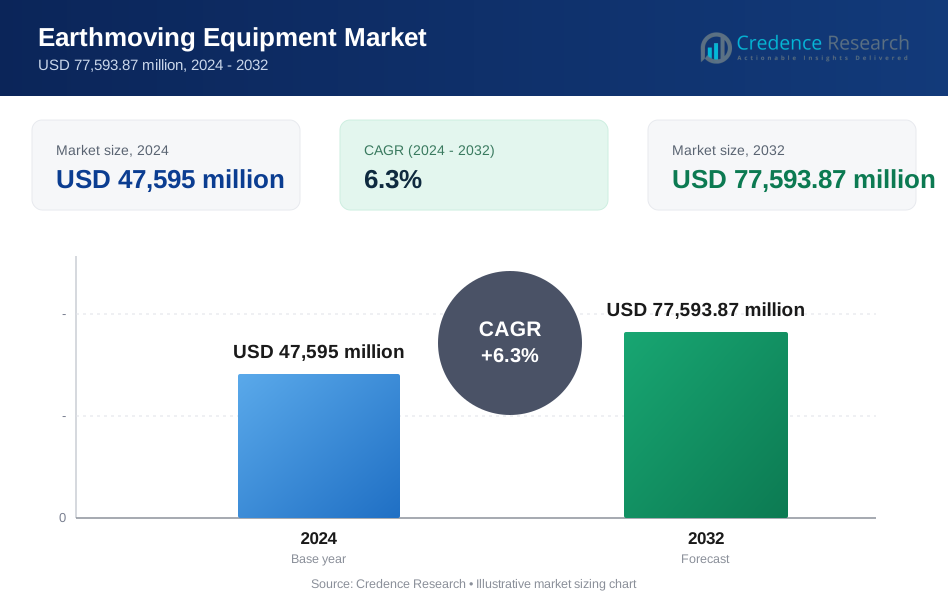
The Earthmoving Equipment Market is projected to grow from USD 47,595 million in 2024 to USD 77,593.87 million by 2032, reflecting a compound annual growth rate (CAGR) of 6.3%.
The Earthmoving Equipment market is driven by increasing infrastructure development, urbanization, and government initiatives promoting construction activities worldwide. The rising demand for efficient and advanced machinery to enhance productivity and reduce operational costs further propels market growth. Additionally, the trend toward automation and the integration of technology, such as telematics and IoT, is revolutionizing equipment management and maintenance. This shift allows for real-time data analytics, improving decision-making and operational efficiency. Moreover, the growing emphasis on sustainability is leading manufacturers to develop eco-friendly and energy-efficient earthmoving solutions, aligning with global environmental goals.
The geographical analysis of the earthmoving equipment market reveals significant growth opportunities across various regions, particularly in North America and Asia-Pacific. North America holds a substantial market share due to ongoing infrastructure projects and a robust construction industry. Meanwhile, the Asia-Pacific region is witnessing rapid urbanization and industrialization, driving demand for earthmoving equipment. Key players in the market include Caterpillar Inc., Komatsu Ltd., and AB Volvo, which are known for their advanced technology and diverse product offerings. These companies are focusing on innovation and sustainability to maintain their competitive edge in this dynamic market.
Market Drivers
Infrastructure Development
The rapid urbanization and industrialization of cities and towns significantly drive the demand for earthmoving equipment. As populations grow, the need for new infrastructure, such as roads, bridges, and buildings, intensifies. For instance, government initiatives like the Pradhan Mantri Grameen Sadak Yojana (PMGSY) in India have led to significant investments in rural road construction. Furthermore, expanding industries necessitate the construction of factories, warehouses, and transportation networks to support economic activities. Government initiatives, including investments in infrastructure projects like transportation systems and energy infrastructure, play a crucial role in fostering demand for earthmoving machinery, ensuring that these essential developments can proceed efficiently.
Mining and Quarrying
The mining and quarrying sectors are pivotal in driving the earthmoving equipment market due to their reliance on heavy machinery for resource extraction. As global demand for minerals, metals, and stones increases, mining and quarrying operations are expanding rapidly, necessitating more advanced and efficient equipment. For instance, India’s mining industry, which includes the extraction of 95 different minerals, has seen significant growth, particularly in states like Odisha, which contributes over 40% of the country’s mineral production. The continual pursuit of natural resources ensures a consistent demand for earthmoving machinery, underscoring its critical role in these industries.
Construction Projects
Earthmoving equipment is indispensable in various construction projects, including residential and commercial building initiatives. The construction of new homes, apartments, and commercial facilities requires significant earthmoving activities for site preparation and excavation. Additionally, renovations and expansions of existing structures often necessitate the use of heavy machinery, further driving demand within the construction sector.
Technological Advancements
Innovations in earthmoving equipment are transforming the industry, enhancing efficiency and productivity through advanced hydraulic systems and automation. Such technological advancements make modern machinery more attractive to customers. Furthermore, the growing emphasis on sustainability is prompting the development of environmentally friendly equipment, including electric and hybrid models. This shift not only addresses rising sustainability concerns but also aligns with the global push toward greener construction practices.
Market Trends
Technological Advancements and Data-Driven Operations
The earthmoving equipment market is witnessing significant technological advancements that are transforming operations and enhancing efficiency. The increasing adoption of automation in machinery, such as excavators and bulldozers, is not only improving productivity but also enhancing safety on job sites. For instance, a survey by the Cambridge University Press highlighted that the use of robotic autonomous systems in earthmoving equipment has drastically increased safety and operational efficiency. This shift towards autonomous or semi-autonomous equipment is reducing the need for human intervention in hazardous conditions, thereby minimizing the risk of accidents. Moreover, the transition to electric and hybrid power sources is gaining momentum, driven by concerns about emissions and fuel costs. Manufacturers are responding to these environmental challenges by developing equipment that utilizes cleaner energy, aligning with global sustainability goals. Advanced telematics systems are also becoming prevalent, providing real-time data on equipment performance, location, and maintenance needs. This capability enables fleet managers to optimize their operations, leading to improved resource allocation and reduced downtime. Coupled with predictive maintenance driven by data analytics, these innovations are allowing companies to preemptively address equipment issues, thereby reducing overall operational costs and enhancing productivity.
Sustainability Focus and Rental Services
Alongside technological advancements, there is a growing emphasis on sustainability within the earthmoving equipment market. Manufacturers are prioritizing emissions reduction by developing equipment with lower emission levels to comply with environmental regulations and meet customer demands for greener alternatives. Fuel efficiency is another critical focus, as enhanced fuel economy reduces operating costs and minimizes environmental impact, appealing to eco-conscious consumers. In addition to these trends, the popularity of rental and leasing services is surging, providing businesses with the flexibility to acquire equipment for short-term projects without incurring large upfront costs. This trend is particularly advantageous for small and medium-sized enterprises that may not have the financial capacity for significant capital investments. Furthermore, the market is becoming increasingly competitive, with more players entering the global scene, driving innovation and product differentiation. Manufacturers are not only focusing on advanced features but are also enhancing safety protocols by incorporating advanced safety features, such as collision avoidance systems and operator fatigue monitoring, ensuring that safety remains a top priority in equipment design. This holistic approach to technology, sustainability, and safety is shaping the future of the earthmoving equipment market, positioning it for continued growth and innovation.
Market Challenges Analysis
Economic Fluctuations and Competition
The earthmoving equipment market faces significant challenges stemming from economic fluctuations and heightened competition. Construction cycles are closely linked to the overall economic climate, making the industry sensitive to downturns that can result in reduced construction activity and infrastructure development. For instance, during the economic slowdown in 2020, the Indian construction equipment industry saw a significant decline in sales due to reduced infrastructure spending. Economic slowdowns often lead to budget constraints for public and private projects, ultimately diminishing demand for earthmoving equipment. Additionally, fluctuations in commodity prices, particularly steel and fuel, can affect manufacturing costs and operational expenses, forcing manufacturers to adjust pricing strategies to maintain profitability. Compounding these challenges is the intense global competition in the market. The influx of new players has intensified competition, resulting in price pressure that can squeeze margins and make it difficult for established manufacturers to sustain profitability. As companies vie for market share, they may resort to aggressive pricing tactics that further complicate financial stability within the industry. This competitive landscape demands constant innovation and differentiation to remain relevant and profitable in a market characterized by economic uncertainty.
Environmental Regulations and Technological Complexity
The earthmoving equipment market is also grappling with the increasing burden of environmental regulations and the complexities introduced by advanced technologies. Stricter emissions standards, aimed at reducing environmental impact, can elevate the costs associated with manufacturing and operating earthmoving equipment, particularly for older models that may require costly upgrades or retrofitting to comply with new regulations. Furthermore, regulations addressing noise pollution can restrict the usage of certain equipment types in specific areas, posing additional operational challenges. On the technological front, while advancements such as automation and electrification promise improved efficiency and productivity, they also introduce complexities related to maintenance and repairs. As equipment becomes more sophisticated, the need for skilled workers who can operate and maintain these modern machines has intensified, leading to a notable skill shortage in the labor market. This shortage not only drives up labor costs but also limits the availability of qualified personnel, further exacerbating operational challenges for businesses relying on earthmoving equipment. These multifaceted challenges underscore the need for companies to adapt to evolving market conditions while prioritizing innovation, compliance, and workforce development to thrive in a competitive landscape.
Market Segmentation Analysis:
By Equipment Type:
The earthmoving equipment market is primarily segmented by equipment type, which includes excavators, loaders, and dump trucks. Excavators hold a significant share due to their versatility and efficiency in various applications. Within this category, mini excavators are gaining traction in urban and residential projects where space is limited, while crawler excavators are favored for their stability and power in larger construction sites. Wheeled excavators are popular for their mobility and speed, making them ideal for projects requiring quick relocation. Other specialized excavators, such as draglines and long-reach models, cater to specific tasks in mining and heavy construction. Loaders are another critical segment, featuring skid steers, backhoes, wheeled, crawler, and mini loaders. Their ability to perform multiple tasks, from lifting to digging, makes them essential on job sites. Dump trucks, encompassing articulated and rigid models, are vital for transporting materials efficiently. The demand for specialized dumpers and motor graders is also rising, as they play crucial roles in earthmoving and grading operations. Together, these equipment types drive innovation and growth in the earthmoving sector.
By Industry:
The earthmoving equipment market is also segmented by industry, with key sectors including mining, construction, agriculture, and forestry. The construction industry is a major driver of market growth, characterized by a rising demand for infrastructure development, urbanization, and residential projects. Earthmoving equipment is crucial for site preparation, excavation, and material handling, contributing significantly to project efficiency and timelines. As government initiatives continue to focus on infrastructure upgrades, the construction sector will likely see sustained demand for earthmoving machinery. Mining is another prominent segment, where the need for robust and efficient earthmoving equipment is critical for resource extraction. The expansion of mining operations, driven by increasing demand for minerals and metals, fuels the need for specialized machinery. Additionally, the agriculture and forestry industries are adopting advanced earthmoving equipment for land preparation, planting, and maintenance tasks, highlighting the versatility of these machines across diverse applications. Overall, the varied industrial applications of earthmoving equipment underscore its essential role in supporting economic development and operational efficiency.
Segments:
Based on Equipment Type
- Excavators
- Mini Excavator
- Crawler Excavator
- Wheeled Excavator
- Others (Dragline, Long Reach, etc.)
- Loaders
- Skid Steer
- Backhoe
- Wheeled
- Crawler/Track
- Mini Loaders
- Dump Trucks
- Articulated Trucks
- Rigid Trucks
- Others (Dumpers, Motor Graders, etc.)
Based on Industry
- Mining
- Construction
- Agriculture & Forestry
- Others (Oil & Gas, etc.)
Based on the Geography:
- North America
- U.S.
- Canada
- Mexico
- Europe
- Germany
- France
- U.K.
- Italy
- Spain
- Rest of Europe
- Asia Pacific
- China
- Japan
- India
- South Korea
- South-east Asia
- Rest of Asia Pacific
- Latin America
- Brazil
- Argentina
- Rest of Latin America
- Middle East & Africa
- GCC Countries
- South Africa
- Rest of the Middle East and Africa
Regional Analysis
North America
North America holds a significant market share in the earthmoving equipment sector, accounting for approximately 30% of the global market. This dominance is driven by robust construction activities, particularly in the United States, where infrastructure development and urbanization continue to spur demand for advanced machinery. The region's commitment to modernizing its infrastructure, coupled with government initiatives aimed at enhancing transportation and public facilities, fuels the growth of earthmoving equipment sales. Additionally, the booming mining sector, particularly in Canada, contributes to the increasing need for powerful and efficient earthmoving machines. Innovations in technology, such as telematics and automation, are further enhancing operational efficiency, making North America a crucial player in the global earthmoving equipment market.
Asia-Pacific
In the Asia-Pacific region, the earthmoving equipment market is rapidly expanding, with a market share of approximately 35%, making it the largest in the world. This growth is primarily driven by significant investments in infrastructure projects across countries like China and India. The region's booming population and increasing urbanization necessitate the development of transportation networks, residential complexes, and commercial buildings, creating substantial demand for earthmoving machinery. Moreover, the ongoing industrialization efforts in countries like India are contributing to the rising need for earthmoving equipment in construction and mining operations. As technological advancements continue to reshape the industry, the Asia-Pacific region is expected to remain a key contributor to the global earthmoving equipment market, driven by a combination of infrastructure growth, industrial expansion, and the adoption of innovative technologies.
Key Player Analysis
- Caterpillar Inc.
- Doosan Infracore Co. Ltd
- C. Bamford Excavators Limited
- Hyundai Heavy Industries Co. Ltd
- Komatsu Ltd
- SANY America
- Liebherr Group
- Terex Corporation
- Hitachi Construction Machinery Co. Ltd
- CNH Industrial N.V
- AB Volvo
Competitive Analysis
The competitive landscape of the earthmoving equipment market is characterized by the presence of several leading players striving for market share through innovation and strategic initiatives. Major companies, including Caterpillar Inc., Komatsu Ltd., AB Volvo, Hitachi Construction Machinery Co. Ltd, Doosan Infracore Co. Ltd, J.C. Bamford Excavators Limited, Liebherr Group, CNH Industrial N.V, Hyundai Heavy Industries Co. Ltd, Terex Corporation, and SANY America, are investing in research and development to enhance their product offerings. These companies are focusing on technological advancements, such as automation and electric-powered machinery, to meet evolving customer demands. Furthermore, strategic partnerships and acquisitions are common among these players to expand their market reach and strengthen their competitive positioning. By leveraging their extensive distribution networks and brand reputation, these leading firms aim to capitalize on emerging opportunities within the growing earthmoving equipment market.
Recent Developments
- In April 2023, Caterpillar launched its new 320 GC excavator, designed for lower operating costs and improved fuel efficiency. They’ve also been focusing on expanding their service offerings with remote diagnostics and preventative maintenance solutions.
- In May 2024, Volvo CE introduced the new range of one hundred twenty tons excavators: EC210, EC230, EC370, EC400 and EC500, together with a few ECR145 short swing crawler excavators which have been improved on performance safety as well as operator features.
- In February 2022, John Deere focused on expanding its intelligent solutions portfolio. The company introduced their JDLink telematics platform with new features like real-time machine health monitoring and optimized routing for increased fleet management efficiency.
- In February 2022, Komatsu unveiled its intelligent Machine Control (iMC) 2.0 upgrade for excavators. This upgrade offers enhanced automation features for improved grading accuracy and faster cycle times.
Market Concentration & Characteristics
The earthmoving equipment market exhibits a moderate level of concentration, characterized by the presence of a few dominant players alongside numerous smaller manufacturers. Major companies, including Caterpillar Inc., Komatsu Ltd., and AB Volvo, significantly influence market trends through their extensive product portfolios and technological advancements. These leading firms invest heavily in research and development, enabling them to introduce innovative solutions that enhance efficiency and sustainability in operations. Additionally, the market features a diverse range of equipment types, including excavators, loaders, and dump trucks, catering to various industries such as construction, mining, and agriculture. The competitive landscape is further shaped by the growing demand for rental and leasing services, which provide flexibility to end-users and drive market growth. As sustainability becomes increasingly important, manufacturers are also focusing on producing environmentally friendly equipment, contributing to the evolving characteristics of the market and addressing customer needs for efficiency and reduced environmental impact.
Report Coverage
The research report offers an in-depth analysis based on Equipment Type, Industry and Geography. It details leading market players, providing an overview of their business, product offerings, investments, revenue streams, and key applications. Additionally, the report includes insights into the competitive environment, SWOT analysis, current market trends, as well as the primary drivers and constraints. Furthermore, it discusses various factors that have driven market expansion in recent years. The report also explores market dynamics, regulatory scenarios, and technological advancements that are shaping the industry. It assesses the impact of external factors and global economic changes on market growth. Lastly, it provides strategic recommendations for new entrants and established companies to navigate the complexities of the market.
Future Outlook
- The earthmoving equipment market is expected to experience steady growth driven by increasing infrastructure development worldwide.
- Adoption of advanced technologies, including automation and telematics, will enhance operational efficiency and safety.
- The demand for electric and hybrid earthmoving equipment will rise as manufacturers prioritize sustainability and emissions reduction.
- Growing urbanization will fuel the need for construction equipment in developing regions, expanding market opportunities.
- The trend towards rental and leasing services will continue, providing flexibility for businesses to manage costs effectively.
- Increased investments in renewable energy projects will boost demand for earthmoving equipment in the energy sector.
- Enhanced safety features and compliance with stringent regulations will become standard in equipment design and manufacturing.
- Manufacturers will focus on product differentiation to gain competitive advantages in a crowded market.
- The use of data analytics for predictive maintenance will reduce downtime and improve fleet management.
- Global supply chain resilience will be prioritized to mitigate disruptions and ensure steady equipment availability.
Request a Free Sample
Fill in your details and we'll send you a free sample report.
- Sample data tables & charts
- Research methodology
Need a Custom Version of This Report?
Tailor the scope, geography, or segments to your exact requirements.
- Custom geography or segment scope
- Direct access to our analyst team
Frequently Asked Questions
What is the current size of the Earthmoving Equipment market?
What factors are driving the growth of the Earthmoving Equipment market?
What are the key segments within the Earthmoving Equipment market?
What are some challenges faced by the Earthmoving Equipment market?
Who are the major players in the Earthmoving Equipment market?
Table of Content
Chapter 1. Report Introduction
- 1.1 Report Description & Purpose
- 1.1.1 Report Title & Market Definition
- 1.1.2 Unique Selling Propositions (USP) & Key Differentiators
- 1.1.3 Value Proposition for Stakeholders
- 1.2 Research Objectives
- 1.2.1 Market Sizing Objectives (Volume & Revenue)
- 1.2.2 Segmentation Objectives
- 1.2.3 Competitive Intelligence Objectives
- 1.2.4 Forecast & Scenario Objectives
- 1.3 Report Scope
- 1.3.1 Earthmoving Equipment Scope – Types & Subtypes Covered
- 1.3.2 Geographic Scope – Regions & Countries Covered
- 1.3.3 Historical Period, Base Year & Forecast Period (2024; forecast to 2032)
- 1.3.4 Inclusions & Exclusions
- 1.4 HS Code & Classification Framework
- 1.5 Currency, Units & Pricing Basis
- 1.6 Target Stakeholders
- 1.7 Limitations & Assumptions
Chapter 2. Executive Summary
- 2.1 Global Earthmoving Equipment Market Snapshot
- 2.1.1 Market Size – Historical (2024) & Forecast (2024-2032) (2024: USD 47,595 million → 2032: USD 77,593.87 million)
- 2.1.2 Volume & Revenue – Global Totals
- 2.1.3 Key Market Highlights – Top Five Facts
- 2.2 Earthmoving Equipment Market Segmentation Snapshot
- 2.2.1 Market Split by Region – 2024 vs. 2032
- 2.3 Competitive Snapshot
- 2.3.1 Top 10 Players by Revenue Share – 2024
- 2.3.2 Top 10 Players by Volume Share – 2024
- 2.3.3 Recent Strategic Developments (18-Month Summary)
- 2.4 Key Investment Highlights & Strategic Conclusions
Chapter 3. Earthmoving Equipment Market Dynamics & Industry Analysis
- 3.1 Market Overview & Context
- 3.1.1 Earthmoving Equipment Market Position in the Broader Automotive Value Chain
- 3.1.2 OEM vs. Replacement Market Dynamics
- 3.1.3 Market Maturity & Development Stage by Region
- 3.2 Earthmoving Equipment Market Drivers
- 3.3 Earthmoving Equipment Market Restraints & Challenges
- 3.4 Earthmoving Equipment Market Opportunities
- 3.5 Porter's Five Forces Analysis
- 3.5.1 Threat of New Entrants
- 3.5.2 Bargaining Power of Suppliers
- 3.5.3 Bargaining Power of Buyers
- 3.5.4 Threat of Substitutes
- 3.5.5 Competitive Rivalry – Intensity Assessment
- 3.6 Earthmoving Equipment Value Chain Analysis
- 3.6.1 Upstream – Raw Material/Input Suppliers
- 3.6.1.1 Raw Material/Input 1
- 3.6.1.2 Raw Material/Input 2
- 3.6.1.3 Raw Material/Input 3
- 3.6.2 Midstream – Production/Manufacturing/Service Delivery
- 3.6.2.1 Production/Process Overview
- 3.6.2.2 Key Facility Locations & Capacity by Manufacturer
- 3.6.3 Downstream – Distribution & End Consumer
- 3.6.3.1 Primary Channel – B2B/OEM
- 3.6.3.2 Secondary Channels – Dealer, Retail, Online, Direct
- 3.6.4 Value Chain Profitability Analysis
- 3.6.1 Upstream – Raw Material/Input Suppliers
- 3.7 PESTEL Analysis
- 3.7.1 Political Factors
- 3.7.2 Economic Factors
- 3.7.3 Social Factors
- 3.7.4 Technological Factors
- 3.7.5 Environmental Factors
- 3.7.6 Legal Factors
- 3.8 Earthmoving Equipment Supply Chain Analysis
- 3.8.1 Raw Material/Input Supply Risk Assessment
- 3.8.2 Manufacturing Concentration Risk (Geographic Exposure)
- 3.8.3 Trade Disruption Impact Analysis
- 3.9 Regulatory & Policy Landscape
Note: The regulatory and policy landscape section covers regulations based on their applicability to the market, Earthmoving Equipment category, geography, and scope of the study. Only regulatory frameworks with a material impact on operations, compliance, trade, sustainability, or market access are analyzed in detail.
Chapter 4. Key Investment Pockets & Opportunity Analysis
- 4.1 Earthmoving Equipment Market Attractiveness Analysis
- 4.1.1 By Region – Investment Attractiveness Matrix (Volume × CAGR)
- 4.2 Absolute Revenue Growth Opportunity
- 4.2.1 By Region – Absolute USD Growth Through 2032
- 4.3 Incremental Volume Opportunity
- 4.3.1 By Region – Incremental Volume Through 2032
- 4.3.2 Segment – Incremental Volume
- 4.4 Emerging Submarket Opportunity Deep Dive (Subject to Applicability)
- 4.5 Emerging Market Opportunity Scorecards
- 4.5.1 United States
- 4.5.2 Europe
- 4.5.3 Asia
- 4.5.4 Middle East & Africa
Note: Emerging Market Opportunity Scorecards will be included based on relevance and strategic importance. Regions listed are indicative and may vary depending on data availability and market dynamics.
Chapter 5. Earthmoving Equipment Import-Export Analysis & Trade Flows
- 5.1 Global Trade Overview
- 5.1.1 Global Export Value by Country (2024)
- 5.1.2 Global Export Volume by Country (2024)
- 5.1.3 Global Import Value by Country (2024)
- 5.1.4 Global Import Volume by Country (2024)
- 5.1.5 Net Trade Balance by Country (2024)
- 5.2 Export Analysis – Segment
- 5.2.1 Type 1 (HS Code)
- 5.2.2 Type 2 (HS Code)
- 5.2.3 Type 3 (HS Code)
- 5.2.4 Type 4 (HS Code)
- 5.2.5 Type 5 (HS Code)
- 5.3 Import Analysis – Segment
- 5.3.1 Type 1 (HS Code)
- 5.3.2 Type 2 (HS Code)
- 5.3.3 Type 3 (HS Code)
- 5.3.4 Type 4 (HS Code)
- 5.3.5 Type 5 (HS Code)
- 5.4 Average Unit Trade Prices
- 5.4.1 Average Export Price – Segment & Country
- 5.4.2 Average Import Price – Segment & Source Country
- 5.4.3 Price Trends (2024)
- 5.5 Key Trade Route Analysis
- 5.5.1 Trade Route 1
- 5.5.2 Trade Route 2
- 5.5.3 Trade Route 3
- 5.5.4 Trade Route 4
- 5.5.5 Trade Route 5
- 5.6 Trade Policy Impact Assessment
- 5.6.1 US Anti-Dumping & Section 301 Tariffs
- 5.6.2 EU Customs Union Impact
- 5.6.3 Major Free Trade Agreements
- 5.6.4 USMCA Rules of Origin
Note: Trade policy analysis will be included only where relevant to the Earthmoving Equipment market.
Chapter 6. Competitive Landscape & Company Benchmarking
- 6.1 Earthmoving Equipment Market Concentration & Structure
- 6.1.1 Herfindahl-Hirschman Index (HHI) – vs. 2024
- 6.1.2 Tier 1, Tier 2 & Tier 3 Market Structure
- 6.1.3 Global, Regional & Local Player Dynamics
- 6.2 Earthmoving Equipment Market Share Analysis – 2024
- 6.2.1 Global Revenue Share by Company
- 6.2.2 Global Volume Share by Company
- 6.2.3 Regional Revenue Share
- 6.2.4 Market Share Evolution ( vs. 2024)
- 6.2.5 OEM Segment Share by Company
- 6.2.6 Replacement Segment Share by Company
- 6.3 Production/Delivery Capacity & Facility Analysis
- 6.3.1 Global Installed Capacity
- 6.3.2 Capacity Utilization Rates
- 6.3.3 Production/Output Volume
- 6.3.4 Facility Locations & Capacity Map
- 6.3.5 Planned Capacity Additions
- 6.4 Earthmoving Equipment Competitive Benchmarking Matrix
- 6.4.1 Revenue, Volume, CAGR & Profitability Comparison
- 6.4.2 Channel Revenue Mix
- 6.4.3 Geographic Revenue Exposure
- 6.4.4 R&D Intensity
- 6.4.5 Sustainability Maturity
- 6.5 Strategic Developments in Earthmoving Equipment (Last 24 Months)
- 6.5.1 Mergers, Acquisitions & Divestments
- 6.5.2 New Earthmoving Equipment Launches
- 6.5.3 Facility Expansions
- 6.5.4 Strategic Alliances, Joint Ventures & Partnerships
- 6.5.5 Distribution Expansion & Market Entry
- 6.5.6 Sustainability & ESG Initiatives
- 6.6 Competitive Strategy Mapping
- 6.6.1 Leader, Challenger, Follower & Niche Classification
- 6.6.2 Pricing Strategy Comparison
- 6.6.3 Channel Strategy Matrix
Note: Strategic developments are included based on their materiality and the availability of reliable information.
Chapter 7. Global Earthmoving Equipment Market – By Distribution Channel
- 7.1 Segment Overview
- 7.1.1 Volume & Revenue Split by Channel (2024 & 2032)
- 7.1.2 Channel Mix Evolution (2024-2032)
Chapter 8. Regional Market Analysis – Global Overview
- 8.1 Global Regional Overview
- 8.1.1 Regional Volume Share
- 8.1.2 Regional Revenue Share
- 8.1.3 Regional Volume by Region
- 8.1.4 Regional Revenue by Region
- 8.1.5 Regional Forecast Through 2032
- 8.2 Cross-Regional Segment Analysis
- 8.2.1 By Distribution Channel
- 8.2.2 By Brand/Price Tier
Chapter 9. North America Earthmoving Equipment Market
- 9.1 United States
- 9.2 Canada
- 9.3 Mexico
Chapter 10. Europe Earthmoving Equipment Market
- 10.1 Germany
- 10.2 France
- 10.3 Italy
- 10.4 United Kingdom
- 10.5 Spain
- 10.6 Poland
- 10.7 Russia
- 10.8 Netherlands
- 10.9 Belgium
- 10.10 Sweden
- 10.11 Denmark
- 10.12 Norway
- 10.13 Rest of Europe
Chapter 11. Asia Pacific Earthmoving Equipment Market
- 11.1 China
- 11.2 India
- 11.3 Japan
- 11.4 South Korea
- 11.5 Thailand
- 11.6 Indonesia
- 11.7 Vietnam
- 11.8 Malaysia
- 11.9 Australia
- 11.10 Rest of Asia Pacific
Chapter 12. Latin America Earthmoving Equipment Market
- 12.1 Brazil
- 12.2 Argentina
- 12.3 Colombia
- 12.4 Chile
- 12.5 Rest of Latin America
Chapter 13. Middle East Earthmoving Equipment Market
- 13.1 Saudi Arabia
- 13.2 United Arab Emirates
- 13.3 Turkey
- 13.4 Israel
- 13.5 Iran
- 13.6 Rest of the Middle East
Chapter 14. Africa Earthmoving Equipment Market
- 14.1 South Africa
- 14.2 Egypt
- 14.3 Nigeria
- 14.4 Morocco
- 14.5 Rest of Africa
Chapter 15. Earthmoving Equipment Company Profiles
- 15.1 [Company 01]
- 15.1.1 Company Overview
- 15.1.2 Key Management Personnel
- 15.1.3 Products & Services Portfolio
- 15.1.4 Financial Performance
- 15.1.5 Key Market Focus & Geographic Presence
- 15.1.6 Recent Developments & Strategic Initiatives
Note: The company profile list is preliminary and may change based on research findings, market developments, data availability, and client requirements.
Chapter 16. Appendices
- Appendix A – List of Abbreviations & Acronyms
- Appendix B – Industry Classification Code Reference – Full Series
- Appendix C – Production & Capacity Data Tables
- Appendix D – End-Use & Demand Base Tables
- Appendix E – Consumption & Replacement Rate Assumptions
- Appendix F – ASP Reference Tables
- Appendix G – Manufacturing & Facility Database
- Appendix H – Import-Export Data Tables
- Appendix I – Regulatory Summary Tables
- Appendix J – Primary Research Participant List (Anonymized)
- Appendix K – Primary Research Questionnaire Framework
- Appendix L – Data Sources & Bibliography
- Appendix M – Market Size Divergence & Source Comparison
Chapter 17. Research Methodology
- 17.1 Research Framework & Philosophy
- 17.2 Secondary Research – Sources, Hierarchy & Data Extraction
- 17.3 Data Modeling – Bottom-Up & Top-Down Market Sizing
- 17.4 Primary Research – Stakeholder Framework, LOI & Sample Sizes
- 17.5 Forecast Methodology – Regression, Scenario & Sensitivity Analysis
- 17.6 Quality Control – Four-Layer Validation Framework
- 17.7 Limitations & Standard Assumptions
- 17.8 Disclaimer
