
Market Overview:
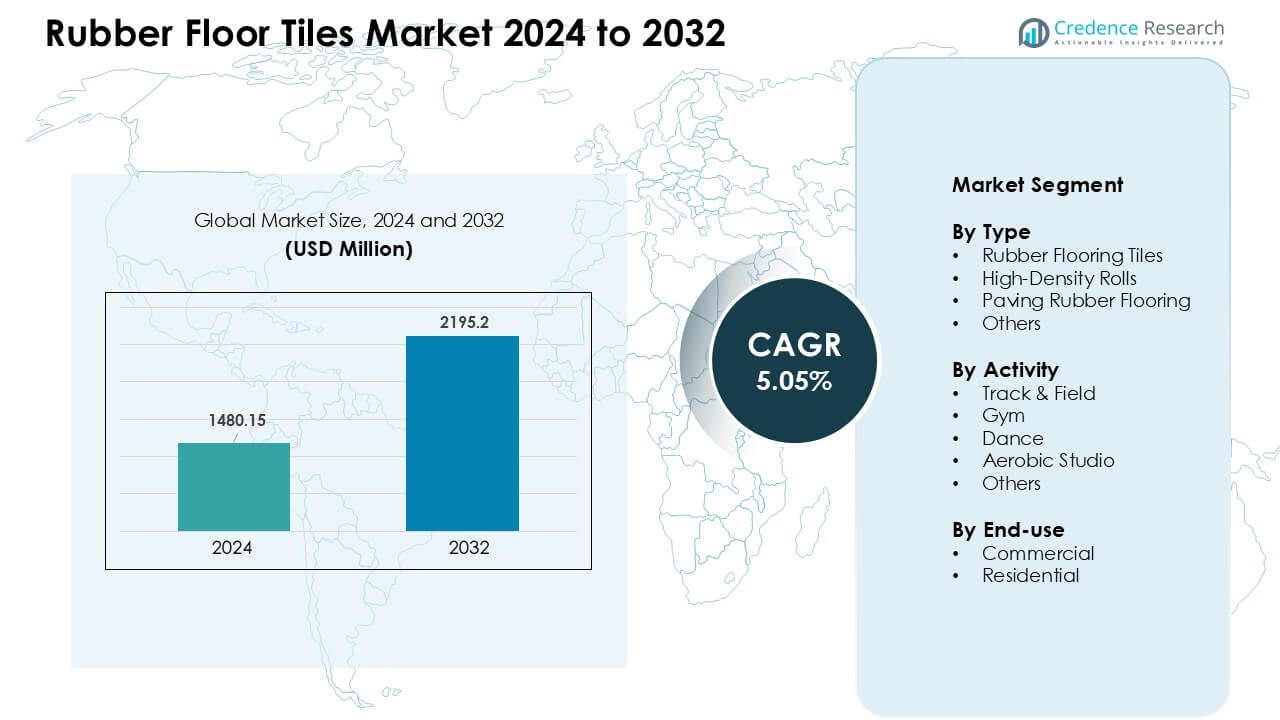
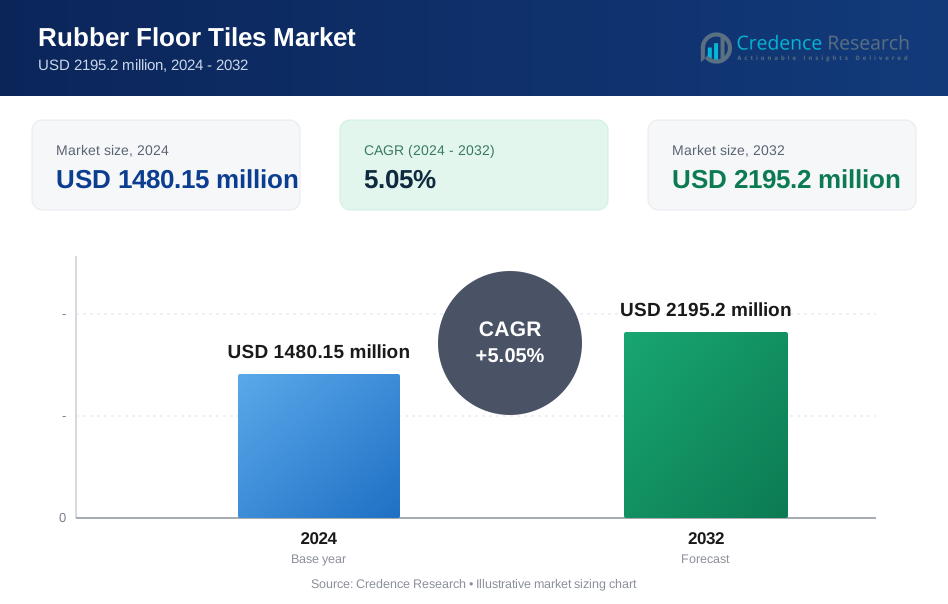
Rubber Floor Tiles Market was valued at USD 1480.15 million in 2024 and is anticipated to reach USD 2195.2 million by 2032, growing at a CAGR of 5.05 % during the forecast period.
| REPORT ATTRIBUTE | DETAILS |
|---|---|
| Historical Period | 2020-2023 |
| Base Year | 2024 |
| Forecast Period | 2025-2032 |
| Rubber Floor Tiles Market Size 2024 | USD 1480.15 Million |
| Rubber Floor Tiles Market, CAGR | 5.05 % |
| Rubber Floor Tiles Market Size 2032 | USD 2195.2 Million |
The Rubber Floor Tiles Market is shaped by major players including Mohawk Industries Inc., Forbo Flooring Systems, MONDO S.p.A, Tarkett S.A, Shaw Industries Group, Inc., IVC Group, Beaulieu International Group, Interface, Inc., Gerflor, and Fatra a.s. These companies strengthen their positions through advanced recycled-rubber technologies, modular tile systems, and strong distribution networks across commercial and sports flooring segments. Product innovation focuses on shock absorption, slip resistance, and low-VOC performance, supporting wider use in gyms, schools, and high-traffic buildings. North America led the global market in 2024 with a 38% share, driven by heavy investment in fitness facilities and steady renovation activity.
Market Insights:
- The Rubber Floor Tiles Market was valued at USD 15 million in 2024 and is projected to reach USD 2195.2 million by 2032, advancing at a CAGR of 5.05 % during the forecast period.
- Demand grows as gyms, sports centers, and commercial buildings prefer shock-absorbing and slip-resistant flooring, with gym applications holding about 48% share in 2024.
- Modular and recycled-rubber flooring trends rise as buyers seek sustainable, low-VOC, and customizable surface solutions for indoor and outdoor activity areas.
- Competition intensifies among leading companies through advancements in recycled materials, interlocking tile systems, and strong distribution reach, supporting large renovation and sports infrastructure projects.
- North America led the market with a 38% share in 2024 due to strong fitness infrastructure, while commercial end-use dominated with around 58% share, supported by high-traffic building upgrades.
Market Segmentation Analysis:
By Type
Rubber flooring tiles held the leading share in 2024 with about 46% of the Rubber Floor Tiles Market. Buyers preferred these tiles due to strong shock absorption, slip resistance, and long service life in busy areas. Demand grew in gyms, playgrounds, and commercial buildings that needed durable and low-maintenance floors. High-density rolls also gained use because large sports zones required seamless coverage. Paving rubber flooring expanded in outdoor tracks as cities invested in safer public spaces, while other niche formats supported customized project needs.
- For instance, Mondo S.p.A. have installed more than 1,100 athletic tracks and 800 artificial turf / rubber‑surface fields worldwide, showing the versatility of rubber-based flooring across both indoor and outdoor applications.
By Activity
Gym use dominated the market in 2024 with nearly 48% share, supported by rising global fitness participation and stronger investments in workout facilities. Gym floors required high-impact resistance and strong stability, which pushed buyers toward sturdy rubber tiles. Track and field projects saw steady adoption as schools and sports bodies upgraded training surfaces for better force reduction. Dance and aerobic studios used rubber options for vibration control and joint support, while other activity areas adopted these floors for versatile performance.
- For instance, many commercial gyms in India now use 20 mm–25 mm thick rubber tiles from Sundek Sports, engineered to absorb heavy impacts from gym equipment while remaining slip-resistant under high foot traffic.
By End-use
Commercial spaces held the dominant share in 2024 with about 58% of the Rubber Floor Tiles Market. Offices, retail outlets, and public buildings preferred rubber tiles for long-term durability, noise reduction, and easy upkeep. Growth rose as facility managers replaced traditional vinyl with safer and more resilient materials. Residential use increased as homeowners installed rubber floors in home gyms, play zones, and basements for improved comfort. Wider awareness of safety and sustainability supported adoption across both sectors.
Key Growth Drivers:
Growing Demand from Sports and Fitness Infrastructure
Sports and fitness construction is expanding worldwide, and this growth drives stronger demand for rubber floor tiles. Gyms, training centers, and athletic facilities need safe, shock-absorbing floors that protect users from injury and support heavy equipment. Rubber tiles offer strong durability, slip resistance, and noise control, which align with the requirements of modern fitness spaces. Many countries are upgrading school sports zones and community tracks, which increases the use of rubber surfaces. The rise of home gyms also adds steady demand. These trends strengthen market growth as buyers prefer long-lasting and low-maintenance flooring solutions.
- For Instance, Sundek Sports Private Limited a major supplier of gym rubber flooring in India produces high‑density rubber gym tiles designed specifically to “handle heavy machinery and continuous foot activity,” offering excellent shock absorption and slip resistance for fitness centers.
Shift Toward Safe, Resilient, and Low-Maintenance Flooring
Commercial buildings, public facilities, and residential projects increasingly adopt rubber floor tiles because they reduce long-term operating costs. Rubber surfaces handle heavy foot traffic and provide strong impact resistance, which reduces repair needs. Facility managers choose these tiles to enhance user safety through better grip and improved noise control. Hospitals, retail zones, and transport hubs use them to limit slips and vibration. Rubber tiles also support long service life, quick cleaning, and better comfort underfoot. These combined benefits position rubber flooring as a reliable choice for high-traffic buildings and strengthen its role in modernization projects.
- For instance, many rubber floor products on the market (including those by Sundek) are made from recycled or high‑density rubber that resists stains and moisture infiltration, allowing for simple maintenance often only sweeping and occasional damp‑mopping is needed for cleanliness in hospitals or public areas.
Rising Focus on Sustainable and Recycled Materials
A global shift toward eco-friendly construction boosts demand for rubber floor tiles made from recycled rubber, including reclaimed tires. Builders prefer materials that reduce waste and support green-building certifications. Many governments also promote sustainable flooring through updated regulations and incentives, which increases adoption. Recycled rubber tiles offer strong strength and long service life, creating both environmental and performance value. Growing awareness of indoor air quality encourages the use of low-VOC rubber flooring. These factors combine to accelerate market acceptance of sustainable rubber tiles across commercial, residential, and recreational spaces.
Key Trends & Opportunities:
Expansion of Modular and Customizable Flooring Systems
Modular rubber tiles are gaining traction because they allow easy installation, fast replacement, and flexible layout changes. Buyers in gyms, recreation centers, and retail spaces prefer tile-based systems that support zoning, branding, and color patterns. This demand encourages manufacturers to offer textured surfaces, interlocking edges, and custom designs. The trend toward personalized workout areas and themed interiors further boosts the use of modular formats. Growth in renovation activities also supports this shift, as modular tiles reduce downtime and enable partial upgrades instead of full replacements.
- For instance, Sundek Sports Private Limited a major rubber‑tile manufacturer in India offers interlocking rubber tiles designed for gyms, playgrounds and sports facilities that allow easy installation without adhesives, offering clients the flexibility to quickly install, remove, or reconfigure flooring layouts.
Growth in Outdoor Applications and Urban Sports Spaces
Cities are investing more in safe outdoor recreation zones, including playgrounds, running tracks, and community workout stations. Rubber flooring meets safety standards for impact reduction and weather resistance, which drives its use in these projects. Climate-resilient outdoor tiles also support heat resistance and drainage needs. As urban populations rise, demand grows for multipurpose outdoor fitness areas and pedestrian-friendly surfaces. This creates opportunities for suppliers to offer UV-stable, porous, and long-lasting rubber tiles targeted at municipal buyers and landscaping firms.
- For instance, flooring providers like Amazing Floors supply rubber playground tiles with textured, slip-resistant surfaces that maintain strong traction even under wet conditions making them suitable for outdoor playgrounds, parks, and public recreation areas subject to seasonal rainfall.
Key Challenges:
High Upfront Installation and Material Costs
Rubber floor tiles offer long-term value, but initial purchase and installation costs can be higher than vinyl or basic synthetic flooring. Budget-sensitive buyers in small gyms or residential spaces sometimes choose cheaper alternatives. Transport costs for heavy rubber tiles also raise the overall project expense. These cost concerns slow adoption in developing regions where labor and material budgets remain tight. Manufacturers must balance product quality with pricing and offer flexible formats to expand market reach.
Competition from Alternative Flooring Materials
Rubber tiles compete with vinyl, foam, laminate, and hybrid sports flooring systems that offer lower prices or wider design choices. Some buyers choose alternatives due to smoother aesthetics or lighter weight. Innovations in PVC-free materials and cushioned vinyl also challenge rubber in commercial and athletic settings. This competition forces suppliers to differentiate through performance, sustainability, and specialized designs. Maintaining market share requires continuous innovation and stronger awareness of rubber’s long-term durability advantages.
Regional Analysis:
North America
North America held the largest share of the Rubber Floor Tiles Market in 2024 with about 38%. Growth remained strong as gyms, wellness centers, and school sports facilities expanded across the U.S. and Canada. Commercial buildings also increased adoption due to stronger safety standards and the shift toward durable, low-maintenance floors. Home gyms gained traction, which supported residential demand. Government-backed recycling programs encouraged the use of tiles made from reclaimed rubber. Steady renovation activity across retail, transport hubs, and community recreation areas further strengthened regional consumption.
Europe
Europe accounted for nearly 32% of the market in 2024, supported by strict building safety norms and strong sustainability commitments. Countries such as Germany, the U.K., and France increased the use of recycled rubber flooring in public buildings and sports facilities. Demand rose in fitness centers, training academies, and indoor recreation spaces due to the need for shock absorption and enhanced slip resistance. The region’s aging infrastructure stimulated renovation projects, which boosted adoption of modular tiles. Growing preference for low-VOC floors aligned with EU environmental goals and strengthened market expansion.
Asia Pacific
Asia Pacific captured around 24% of the global share in 2024 and showed the fastest growth. Rapid urbanization, rising disposable incomes, and strong expansion of gyms and sports complexes drove demand. China, India, and Southeast Asia invested heavily in fitness infrastructure and community playgrounds, increasing the use of rubber surfaces. Commercial buildings chose rubber flooring for long-term durability and reduced upkeep. Expanding residential adoption, especially in home gyms and children’s play areas, supported growth. Manufacturers also widened local production capacity, improving product availability and lowering installation costs.
Latin America
Latin America held close to 4% of the Rubber Floor Tiles Market in 2024, driven by steady upgrades in fitness clubs, schools, and public sports programs. Brazil and Mexico led adoption as urban centers invested in community recreation spaces. Commercial facilities used rubber floors for noise control and safety benefits. Residential installations increased gradually, supported by rising interest in home fitness. However, cost sensitivity limited faster growth across smaller markets. Expanding regional distribution networks and awareness of recycled rubber flooring created new opportunities for long-term market penetration.
Middle East & Africa
The Middle East & Africa region accounted for about 2% of the market in 2024, supported by growing construction activity in the Gulf countries. Gyms, sports academies, and hospitality projects increasingly adopted rubber tiles for durability and comfort. Government-backed fitness campaigns in the UAE and Saudi Arabia encouraged upgrades to indoor and outdoor training zones. Africa saw gradual adoption, mainly in educational and recreational sites. Higher costs and limited local manufacturing slowed wider use, but expanding urban development and premium commercial projects continued to support regional demand.
Market Segmentations:
By Type
- Rubber Flooring Tiles
- High-Density Rolls
- Paving Rubber Flooring
- Others
By Activity
- Track & Field
- Gym
- Dance
- Aerobic Studio
- Others
By End-use
- Commercial
- Residential
By Geography
- North America
- U.S.
- Canada
- Mexico
- Europe
- Germany
- France
- U.K.
- Italy
- Spain
- Rest of Europe
- Asia Pacific
- China
- Japan
- India
- South Korea
- South-east Asia
- Rest of Asia Pacific
- Latin America
- Brazil
- Argentina
- Rest of Latin America
- Middle East & Africa
- GCC Countries
- South Africa
- Rest of the Middle East and Africa
Competitive Landscape:
The Rubber Floor Tiles Market features strong competition among global flooring manufacturers that focus on durable, safe, and high-performance surface solutions. Leading companies such as Mohawk Industries Inc., Forbo Flooring Systems, MONDO S.p.A, Tarkett S.A, Shaw Industries Group, Inc., IVC Group, Beaulieu International Group, Interface, Inc., Gerflor, and Fatra a.s. strengthened their positions through wider product portfolios and advanced recycled-rubber technologies. Many firms invested in modular tile formats, color-stable designs, and improved shock-absorption properties to meet rising demand from gyms, schools, commercial buildings, and public recreation spaces. Partnerships with builders and distributors expanded regional reach, while sustainability programs supported low-VOC and eco-friendly flooring. Continuous innovation in surface textures, interlocking systems, and heavy-duty tiles helped these companies compete in high-traffic environments and large-scale renovation projects.
Key Player Analysis:
- Mohawk Industries Inc.
- FORBO Flooring Systems
- MONDO S.p.A
- Tarkett S.A
- Shaw Industries Group, Inc.
- IVC Group
- Beaulieu International Group
- Interface, Inc.
- Gerflor
- Fatra a.s.
Recent Developments:
- In July 2025, Mohawk Industries, Inc. published its 16th annual Impact Report highlighting progress on sustainability, circularity, and low-carbon product initiatives that affect its resilient and tile portfolios (greater emphasis on recycled content and product circularity that shape the rubber/resilient tiles market). Mohawk was also recognized in 2025 for sustainability leadership in flooring.
- In March 2025, FORBO Flooring Systems summarising the 2024 business year confirmed ongoing investment in product innovation, sustainability, and growth of its modular tile portfolio (Marmoleum Modular and entrance/tiles ranges), and launched its Sustainability Program 2025 which includes ambitions on reuse, recycling, and take-back pilots developments that influence the wider tiles market (including specification of resilient/entry tile systems).
- In 2024, Gerflor launched a new eco-designed sports-flooring line under its “Taraflex” brand. This version uses more bio-based and recycled materials and reduces carbon footprint by ~43% compared to earlier versions.
Report Coverage:
The research report offers an in-depth analysis based on Type, Activity, End-Use and Geography. It details leading market players, providing an overview of their business, product offerings, investments, revenue streams, and key applications. Additionally, the report includes insights into the competitive environment, SWOT analysis, current market trends, as well as the primary drivers and constraints. Furthermore, it discusses various factors that have driven market expansion in recent years. The report also explores market dynamics, regulatory scenarios, and technological advancements that are shaping the industry. It assesses the impact of external factors and global economic changes on market growth. Lastly, it provides strategic recommendations for new entrants and established companies to navigate the complexities of the market.
Future Outlook:
- Demand will rise as gyms and fitness chains expand across major cities.
- Commercial buildings will adopt more durable and low-maintenance flooring solutions.
- Recycled-rubber tiles will gain wider use due to stronger sustainability goals.
- Modular interlocking tiles will see higher adoption in renovation projects.
- Outdoor sports zones and playground upgrades will drive new installation needs.
- Residential home-gym setups will support steady long-term demand.
- Manufacturers will invest in low-VOC and odor-controlled flooring materials.
- Product designs will shift toward customizable colors and textures.
- Smart flooring options with better impact monitoring may emerge.
- Regional players will expand capacity to reduce costs and improve availability.
Request a Free Sample
Fill in your details and we'll send you a free sample report.
- Sample data tables & charts
- Research methodology
Need a Custom Version of This Report?
Tailor the scope, geography, or segments to your exact requirements.
- Custom geography or segment scope
- Direct access to our analyst team
Frequently Asked Questions
What is the current market size for Rubber Floor Tiles Market, and what is its projected size in 2032?
At what Compound Annual Growth Rate is Rubber Floor Tiles Market projected to grow between 2024 and 2032?
Which Rubber Floor Tiles Market segment held the largest share in 2024?
What are the primary factors fueling the growth of Rubber Floor Tiles Market?
Who are the leading companies in Rubber Floor Tiles Market?
Which region commanded the largest share of Rubber Floor Tiles Market?
Table of Content
Chapter 1. Report Introduction
- 1.1 Report Description & Purpose
- 1.1.1 Report Title & Market Definition
- 1.1.2 Unique Selling Propositions (USP) & Key Differentiators
- 1.1.3 Value Proposition for Stakeholders
- 1.2 Research Objectives
- 1.2.1 Market Sizing Objectives (Volume & Revenue)
- 1.2.2 Segmentation Objectives
- 1.2.3 Competitive Intelligence Objectives
- 1.2.4 Forecast & Scenario Objectives
- 1.3 Report Scope
- 1.3.1 Rubber Floor Tiles Scope – Types & Subtypes Covered
- 1.3.2 Geographic Scope – Regions & Countries Covered
- 1.3.3 Historical Period, Base Year & Forecast Period (2024; forecast to 2032)
- 1.3.4 Inclusions & Exclusions
- 1.4 HS Code & Classification Framework
- 1.5 Currency, Units & Pricing Basis
- 1.6 Target Stakeholders
- 1.7 Limitations & Assumptions
Chapter 2. Executive Summary
- 2.1 Global Rubber Floor Tiles Market Snapshot
- 2.1.1 Market Size – Historical (2024) & Forecast (2024-2032) (2024: USD 1480.15 million → 2032: USD 2195.2 million)
- 2.1.2 Volume & Revenue – Global Totals
- 2.1.3 Key Market Highlights – Top Five Facts
- 2.2 Rubber Floor Tiles Market Segmentation Snapshot
- 2.2.1 Market Split by Region – 2024 vs. 2032
- 2.3 Competitive Snapshot
- 2.3.1 Top 10 Players by Revenue Share – 2024
- 2.3.2 Top 10 Players by Volume Share – 2024
- 2.3.3 Recent Strategic Developments (18-Month Summary)
- 2.4 Key Investment Highlights & Strategic Conclusions
Chapter 3. Rubber Floor Tiles Market Dynamics & Industry Analysis
- 3.1 Market Overview & Context
- 3.1.1 Rubber Floor Tiles Market Position in the Broader Automotive Value Chain
- 3.1.2 OEM vs. Replacement Market Dynamics
- 3.1.3 Market Maturity & Development Stage by Region
- 3.2 Rubber Floor Tiles Market Drivers
- 3.3 Rubber Floor Tiles Market Restraints & Challenges
- 3.4 Rubber Floor Tiles Market Opportunities
- 3.5 Porter's Five Forces Analysis
- 3.5.1 Threat of New Entrants
- 3.5.2 Bargaining Power of Suppliers
- 3.5.3 Bargaining Power of Buyers
- 3.5.4 Threat of Substitutes
- 3.5.5 Competitive Rivalry – Intensity Assessment
- 3.6 Rubber Floor Tiles Value Chain Analysis
- 3.6.1 Upstream – Raw Material/Input Suppliers
- 3.6.1.1 Raw Material/Input 1
- 3.6.1.2 Raw Material/Input 2
- 3.6.1.3 Raw Material/Input 3
- 3.6.2 Midstream – Production/Manufacturing/Service Delivery
- 3.6.2.1 Production/Process Overview
- 3.6.2.2 Key Facility Locations & Capacity by Manufacturer
- 3.6.3 Downstream – Distribution & End Consumer
- 3.6.3.1 Primary Channel – B2B/OEM
- 3.6.3.2 Secondary Channels – Dealer, Retail, Online, Direct
- 3.6.4 Value Chain Profitability Analysis
- 3.6.1 Upstream – Raw Material/Input Suppliers
- 3.7 PESTEL Analysis
- 3.7.1 Political Factors
- 3.7.2 Economic Factors
- 3.7.3 Social Factors
- 3.7.4 Technological Factors
- 3.7.5 Environmental Factors
- 3.7.6 Legal Factors
- 3.8 Rubber Floor Tiles Supply Chain Analysis
- 3.8.1 Raw Material/Input Supply Risk Assessment
- 3.8.2 Manufacturing Concentration Risk (Geographic Exposure)
- 3.8.3 Trade Disruption Impact Analysis
- 3.9 Regulatory & Policy Landscape
Note: The regulatory and policy landscape section covers regulations based on their applicability to the market, Rubber Floor Tiles category, geography, and scope of the study. Only regulatory frameworks with a material impact on operations, compliance, trade, sustainability, or market access are analyzed in detail.
Chapter 4. Key Investment Pockets & Opportunity Analysis
- 4.1 Rubber Floor Tiles Market Attractiveness Analysis
- 4.1.1 By Region – Investment Attractiveness Matrix (Volume × CAGR)
- 4.2 Absolute Revenue Growth Opportunity
- 4.2.1 By Region – Absolute USD Growth Through 2032
- 4.3 Incremental Volume Opportunity
- 4.3.1 By Region – Incremental Volume Through 2032
- 4.3.2 Segment – Incremental Volume
- 4.4 Emerging Submarket Opportunity Deep Dive (Subject to Applicability)
- 4.5 Emerging Market Opportunity Scorecards
- 4.5.1 United States
- 4.5.2 Europe
- 4.5.3 Asia
- 4.5.4 Middle East & Africa
Note: Emerging Market Opportunity Scorecards will be included based on relevance and strategic importance. Regions listed are indicative and may vary depending on data availability and market dynamics.
Chapter 5. Rubber Floor Tiles Import-Export Analysis & Trade Flows
- 5.1 Global Trade Overview
- 5.1.1 Global Export Value by Country (2024)
- 5.1.2 Global Export Volume by Country (2024)
- 5.1.3 Global Import Value by Country (2024)
- 5.1.4 Global Import Volume by Country (2024)
- 5.1.5 Net Trade Balance by Country (2024)
- 5.2 Export Analysis – Segment
- 5.2.1 Type 1 (HS Code)
- 5.2.2 Type 2 (HS Code)
- 5.2.3 Type 3 (HS Code)
- 5.2.4 Type 4 (HS Code)
- 5.2.5 Type 5 (HS Code)
- 5.3 Import Analysis – Segment
- 5.3.1 Type 1 (HS Code)
- 5.3.2 Type 2 (HS Code)
- 5.3.3 Type 3 (HS Code)
- 5.3.4 Type 4 (HS Code)
- 5.3.5 Type 5 (HS Code)
- 5.4 Average Unit Trade Prices
- 5.4.1 Average Export Price – Segment & Country
- 5.4.2 Average Import Price – Segment & Source Country
- 5.4.3 Price Trends (2024)
- 5.5 Key Trade Route Analysis
- 5.5.1 Trade Route 1
- 5.5.2 Trade Route 2
- 5.5.3 Trade Route 3
- 5.5.4 Trade Route 4
- 5.5.5 Trade Route 5
- 5.6 Trade Policy Impact Assessment
- 5.6.1 US Anti-Dumping & Section 301 Tariffs
- 5.6.2 EU Customs Union Impact
- 5.6.3 Major Free Trade Agreements
- 5.6.4 USMCA Rules of Origin
Note: Trade policy analysis will be included only where relevant to the Rubber Floor Tiles market.
Chapter 6. Competitive Landscape & Company Benchmarking
- 6.1 Rubber Floor Tiles Market Concentration & Structure
- 6.1.1 Herfindahl-Hirschman Index (HHI) – vs. 2024
- 6.1.2 Tier 1, Tier 2 & Tier 3 Market Structure
- 6.1.3 Global, Regional & Local Player Dynamics
- 6.2 Rubber Floor Tiles Market Share Analysis – 2024
- 6.2.1 Global Revenue Share by Company
- 6.2.2 Global Volume Share by Company
- 6.2.3 Regional Revenue Share
- 6.2.4 Market Share Evolution ( vs. 2024)
- 6.2.5 OEM Segment Share by Company
- 6.2.6 Replacement Segment Share by Company
- 6.3 Production/Delivery Capacity & Facility Analysis
- 6.3.1 Global Installed Capacity
- 6.3.2 Capacity Utilization Rates
- 6.3.3 Production/Output Volume
- 6.3.4 Facility Locations & Capacity Map
- 6.3.5 Planned Capacity Additions
- 6.4 Rubber Floor Tiles Competitive Benchmarking Matrix
- 6.4.1 Revenue, Volume, CAGR & Profitability Comparison
- 6.4.2 Channel Revenue Mix
- 6.4.3 Geographic Revenue Exposure
- 6.4.4 R&D Intensity
- 6.4.5 Sustainability Maturity
- 6.5 Strategic Developments in Rubber Floor Tiles (Last 24 Months)
- 6.5.1 Mergers, Acquisitions & Divestments
- 6.5.2 New Rubber Floor Tiles Launches
- 6.5.3 Facility Expansions
- 6.5.4 Strategic Alliances, Joint Ventures & Partnerships
- 6.5.5 Distribution Expansion & Market Entry
- 6.5.6 Sustainability & ESG Initiatives
- 6.6 Competitive Strategy Mapping
- 6.6.1 Leader, Challenger, Follower & Niche Classification
- 6.6.2 Pricing Strategy Comparison
- 6.6.3 Channel Strategy Matrix
Note: Strategic developments are included based on their materiality and the availability of reliable information.
Chapter 7. Global Rubber Floor Tiles Market – By Distribution Channel
- 7.1 Segment Overview
- 7.1.1 Volume & Revenue Split by Channel (2024 & 2032)
- 7.1.2 Channel Mix Evolution (2024-2032)
Chapter 8. Regional Market Analysis – Global Overview
- 8.1 Global Regional Overview
- 8.1.1 Regional Volume Share
- 8.1.2 Regional Revenue Share
- 8.1.3 Regional Volume by Region
- 8.1.4 Regional Revenue by Region
- 8.1.5 Regional Forecast Through 2032
- 8.2 Cross-Regional Segment Analysis
- 8.2.1 By Distribution Channel
- 8.2.2 By Brand/Price Tier
Chapter 9. North America Rubber Floor Tiles Market
- 9.1 United States
- 9.2 Canada
- 9.3 Mexico
Chapter 10. Europe Rubber Floor Tiles Market
- 10.1 Germany
- 10.2 France
- 10.3 Italy
- 10.4 United Kingdom
- 10.5 Spain
- 10.6 Poland
- 10.7 Russia
- 10.8 Netherlands
- 10.9 Belgium
- 10.10 Sweden
- 10.11 Denmark
- 10.12 Norway
- 10.13 Rest of Europe
Chapter 11. Asia Pacific Rubber Floor Tiles Market
- 11.1 China
- 11.2 India
- 11.3 Japan
- 11.4 South Korea
- 11.5 Thailand
- 11.6 Indonesia
- 11.7 Vietnam
- 11.8 Malaysia
- 11.9 Australia
- 11.10 Rest of Asia Pacific
Chapter 12. Latin America Rubber Floor Tiles Market
- 12.1 Brazil
- 12.2 Argentina
- 12.3 Colombia
- 12.4 Chile
- 12.5 Rest of Latin America
Chapter 13. Middle East Rubber Floor Tiles Market
- 13.1 Saudi Arabia
- 13.2 United Arab Emirates
- 13.3 Turkey
- 13.4 Israel
- 13.5 Iran
- 13.6 Rest of the Middle East
Chapter 14. Africa Rubber Floor Tiles Market
- 14.1 South Africa
- 14.2 Egypt
- 14.3 Nigeria
- 14.4 Morocco
- 14.5 Rest of Africa
Chapter 15. Rubber Floor Tiles Company Profiles
- 15.1 [Company 01]
- 15.1.1 Company Overview
- 15.1.2 Key Management Personnel
- 15.1.3 Products & Services Portfolio
- 15.1.4 Financial Performance
- 15.1.5 Key Market Focus & Geographic Presence
- 15.1.6 Recent Developments & Strategic Initiatives
Note: The company profile list is preliminary and may change based on research findings, market developments, data availability, and client requirements.
Chapter 16. Appendices
- Appendix A – List of Abbreviations & Acronyms
- Appendix B – Industry Classification Code Reference – Full Series
- Appendix C – Production & Capacity Data Tables
- Appendix D – End-Use & Demand Base Tables
- Appendix E – Consumption & Replacement Rate Assumptions
- Appendix F – ASP Reference Tables
- Appendix G – Manufacturing & Facility Database
- Appendix H – Import-Export Data Tables
- Appendix I – Regulatory Summary Tables
- Appendix J – Primary Research Participant List (Anonymized)
- Appendix K – Primary Research Questionnaire Framework
- Appendix L – Data Sources & Bibliography
- Appendix M – Market Size Divergence & Source Comparison
Chapter 17. Research Methodology
- 17.1 Research Framework & Philosophy
- 17.2 Secondary Research – Sources, Hierarchy & Data Extraction
- 17.3 Data Modeling – Bottom-Up & Top-Down Market Sizing
- 17.4 Primary Research – Stakeholder Framework, LOI & Sample Sizes
- 17.5 Forecast Methodology – Regression, Scenario & Sensitivity Analysis
- 17.6 Quality Control – Four-Layer Validation Framework
- 17.7 Limitations & Standard Assumptions
- 17.8 Disclaimer
