
Market Overview
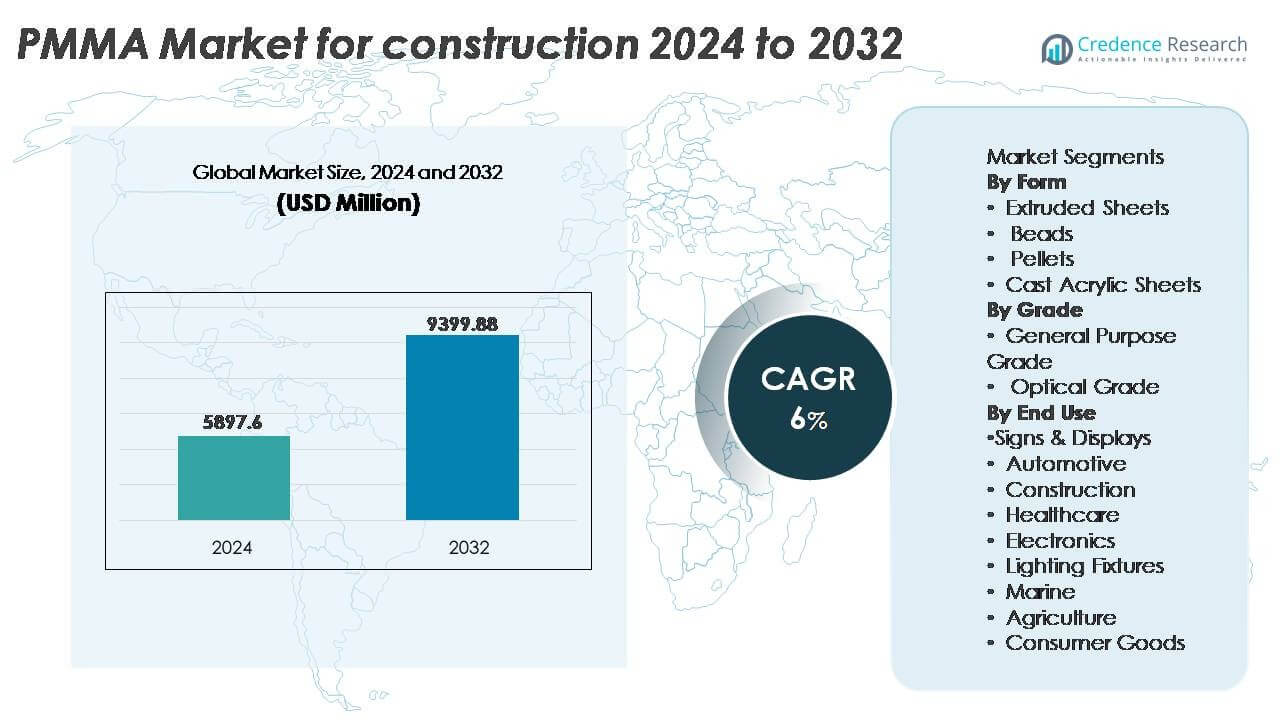
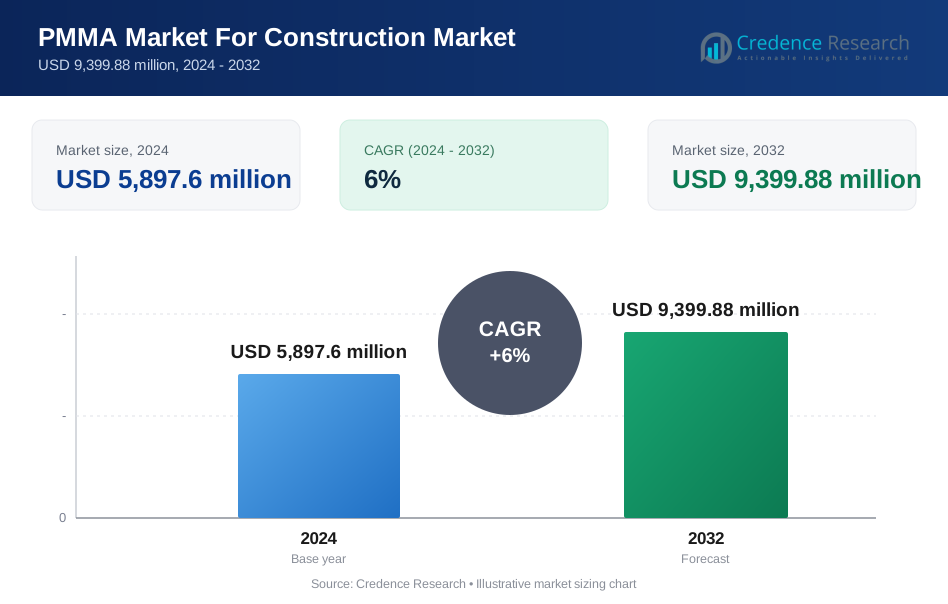
The PMMA (Polymethyl Methacrylate) market for construction applications was valued at USD 5,897.6 million in 2024 and is projected to reach USD 9,399.88 million by 2032, reflecting a compound annual growth rate (CAGR) of 6% over the forecast period.
| REPORT ATTRIBUTE | DETAILS |
|---|---|
| Historical Period | 2020-2023 |
| Base Year | 2024 |
| Forecast Period | 2025-2032 |
| PMMA Market For Construction Market Size 2024 | USD 5,897.6 Million |
| PMMA Market For Construction Market, CAGR | 6% |
| PMMA Market For Construction Market Size 2032 | USD 9,399.88 Million |
The PMMA market for construction is shaped by major chemical and material manufacturers such as Röhm GmbH, CHIMEI, Mitsubishi Chemical Group, LG Chem, Asahi Kasei Corporation, SK Geo Centric Co. Ltd., Trinseo, LOTTE Chemical Corporation, SABIC, and Dymatic Chemicals, Inc. These companies compete through innovations in optical-grade clarity, lightweight glazing solutions, and sustainability-driven recycled or bio-based PMMA formulations. Asia-Pacific leads the global market with 38% market share, driven by large-scale commercial construction, industrial capacity, and rapid urbanization. North America and Europe follow, supported by infrastructure upgrades and stringent green building standards that accelerate demand for energy-efficient PMMA applications in architectural glazing and signage solutions.
Market Insights
- The PMMA market for construction was valued at USD 5,897.6 million in 2024 and is expected to reach USD 9,399.88 million by 2032, registering a 6% CAGR during the forecast period.
- Rising demand for lightweight, energy-efficient glazing materials is driving adoption of PMMA as a substitute for glass in façades, skylights, signage, and roof installations across commercial and residential buildings.
- Key market trends include the growing use of PMMA in modular construction, LED lighting diffusers, and retail signage upgrades, supported by innovations in recycled and UV-resistant formulations.
- The market is moderately consolidated with leading players focusing on sustainability strategies, capacity expansions, and specialty grades to strengthen portfolio differentiation against competitive engineered plastics such as polycarbonate.
- Asia-Pacific leads with 38% market share, followed by North America at 28% and Europe at 26%; extruded sheets remain the dominant PMMA form segment due to their application in façades and architectural glazing across infrastructure development.
Market Segmentation Analysis:
By Form
Extruded sheets represent the dominant form-based sub-segment in the PMMA market for construction, accounting for the largest market share due to their superior impact resistance, design flexibility, and suitability for large-surface architectural installations. Their extensive use in skylights, façades, transparent roofing, and noise-reducing highway barriers supports widespread adoption. Cast acrylic sheets follow as a strong sub-segment in premium-grade architectural glazing, while pellets and beads primarily serve as feedstock for molding applications, including sanitary ware and decorative elements. Customized color, UV resistance, and lightweight characteristics continue to drive usage of extruded sheets across commercial building projects.
- For instance,Röhm’s PLEXIGLAS® Soundstop panels used in highway barriers are engineered to achieve noise reduction index values (DLR) of up to 33 dB (depending on thickness and test standard).
By Grade
General-purpose grade PMMA holds the dominant share in the construction sector, driven by its cost-effectiveness and versatile performance in non-critical architectural components such as partition panels, acrylic furniture elements, and interior décor installations. Optical grade PMMA, although holding a smaller share, is gaining prominence in specialized applications requiring superior light transmission and clarity, including high-transparency sound barriers, premium glazing, and modern daylighting systems. Increasing architectural preference for visually appealing structures and demand for alternative materials to glass further support general-purpose grade PMMA growth in mainstream construction workflows.
- For instance, Mitsubishi Chemical Group’s optical-grade PMMA exhibits light transmission rates of approximately 92%, making it suitable for daylighting panels and illumination-driven architectural glazing.
By End Use
Signs and displays represent the leading end-use sub-segment in the PMMA construction market, capturing the largest share due to expanding commercial infrastructure, retail branding renovation, and demand for UV-stable, weather-resistant advertising structures. Construction applications follow closely, driven by the growing replacement of traditional glass with PMMA in façades, skylights, and canopies. Lighting fixtures also gain momentum as modern illumination designs increasingly incorporate PMMA diffusers. Meanwhile, the automotive, marine, electronics, healthcare, agriculture, and consumer goods segments utilize PMMA for durability and formability across specialized construction-integrated components and environments.
Key Growth Drivers
Rising Adoption of PMMA as a Lightweight and Energy-Efficient Substitute to Glass
The expanding preference for modern architectural designs and stringent energy-efficiency goals strongly accelerate the adoption of PMMA in construction. Compared to traditional glass, PMMA offers nearly half the weight, higher impact resistance, and superior thermal insulation, enabling easier installation and reduced structural load on buildings. Its enhanced UV stability and optical clarity provide a long-lasting solution for skylights, façades, canopies, and greenhouses, supporting high daylight penetration without excessive heat transfer. Additionally, PMMA’s flexibility in shaping, coloring, and surface finishing aligns with evolving aesthetic demands in commercial and residential infrastructure. The combination of sustainability targets and the rise of advanced construction materials positions PMMA as a preferred substitute to conventional glazing, especially in high-traffic urban developments where durability and safety are critical performance criteria.
· For instance, Röhm GmbH’s PLEXIGLAS® Optical Grade achieves light transmission up to 92% and offers a service life exceeding 30 years under outdoor exposure, supported by its UV resistance technology that limits UV transmittance to below 1% in wavelengths under 380 nanometers.
Expansion of Smart Construction, Modular Infrastructure, and Prefabricated Building Systems
The growth of modular construction, prefabricated structures, and smart building ecosystems fuels increased PMMA consumption as manufacturers seek lightweight, pre-engineered, and adaptable materials. PMMA sheets, panels, and molded components integrate efficiently into modular facades, wall separations, and acoustic barriers, enabling fast assembly and customization. Its compatibility with CNC machining, 3D fabrication, and advanced polymer processing supports precision-based construction workflows that shorten project timelines and reduce waste. The integration of smart lighting, embedded sensors, and digital signage within infrastructure also boosts the need for PMMA, given its optical properties, electrical insulation, and clarity for housing sensor-driven interfaces. Increasing urban densification and demand for off-site construction fabrication reinforce PMMA’s relevance as a ready-to-install material supporting future-focused building models.
- For instance, Trinseo’s ALTUGLAS™ PMMA grades support CNC fabrication tolerances below 0.1 mm, enabling precision-fit modular components for façades and signage structures.
Growth in Commercial Branding, Retail Infrastructure, and Decorative Architectural Solutions
PMMA’s versatility in signage, display systems, and aesthetic architecture positions it as a critical material supporting the global expansion of retail spaces, transportation terminals, hospitality units, and public-facing commercial facilities. Its ability to retain color vibrancy, resist weathering, and disperse lighting uniformly drives adoption in backlit signboards, mall directories, branding installations, and illuminated façades. The rising influence of experiential commercial design and corporate identity expression increases demand for customizable polymer-based architectural features. PMMA’s smooth finish and molding flexibility enable designers to create unique, visually immersive environments that differentiate physical spaces from digital-first retail competition. This driver is reinforced by growing investments in commercial renovation, infrastructure upgrades, and urban beautification programs led by governmental redevelopment initiatives.
Key Trends & Opportunities
Development of Bio-Based and Recyclable PMMA for Sustainable Construction
Advancements in circular-economy-driven material science create significant opportunities for PMMA manufacturers serving the construction sector. The emergence of bio-based PMMA formulations and closed-loop recycling techniques aligns with global directives aimed at reducing carbon footprints and plastic waste. Construction developers increasingly seek low VOC, recyclable, and environmentally responsible materials for green certification compliance. The ability to chemically recycle PMMA back into its monomer state opens pathways for sustainable lifecycle management in architectural glazing, signage, and interior décor applications. Sustainability-driven procurement frameworks and ESG reporting obligations further expand opportunities for eco-friendly PMMA variants, particularly in large-scale commercial and public infrastructure.
- "For instance, Röhm's PLEXIGLAS® proTerra molding compounds use certified recycled feedstock or mass-balanced sustainable raw materials and deliver a documented reduction in product carbon footprint, enabling measurable sustainability performance in construction components".
Integration of PMMA in Advanced Lighting Design and Smart Illumination Infrastructure
Evolving lighting designs in buildings create opportunities for PMMA as an optical-grade material for LED diffusers, decorative luminaries, and architectural light panels. The transition toward smart lighting systems and energy-optimized illumination supports PMMA adoption due to its capacity to diffuse light evenly, enhance brightness, and minimize glare. Urban landscape lighting, theme-based hospitality design, and ambient interior installations incorporate PMMA for functional and aesthetic performance. Growing investments in façade illumination, under-cabinet lighting, and outdoor pathway lighting provide a fertile pipeline for PMMA-driven product innovation. As designers pursue dynamic lighting layouts integrated with building automation, PMMA-based components serve as a core material for next-generation visual architecture.
- For instance, SABIC’s LEXAN™ Light Diffusion portfolio demonstrates tested optical diffusion with light transmission levels above 85% while achieving haze values exceeding 90, enabling uniform LED output with reduced hotspot visibility in architectural lighting modules.
Key Challenges
Volatility in Raw Material Prices and Supply Chain Disruptions
PMMA production relies heavily on petrochemical derivatives, making the supply chain vulnerable to fluctuations in crude oil prices and disruptions in global chemical sourcing. Changes in feedstock availability, refinery outages, trade tariffs, and geopolitical uncertainties increase cost pressures for manufacturers and construction procurement teams. Additionally, transportation bottlenecks, extended lead times, and shortages in specialty chemical intermediates create planning challenges for large architectural projects with strict timelines. These factors impact pricing stability, supplier predictability, and budget allocation posing challenges for PMMA’s market competitiveness against alternative materials such as glass, polycarbonate, and emerging bio-composites.
Increasing Competitive Pressure from Alternative Engineering Plastics
While PMMA offers numerous strengths, it faces increasing competition from polycarbonate and advanced polymer composites that deliver higher impact resistance and heat tolerance for demanding construction environments. In applications involving fire safety compliance, structural stress, or extreme temperature exposure, alternative materials may exhibit superior regulatory performance or cost benefits. Continuous advancements in multilayer polymer films, hybrid façade solutions, and reinforced composites further challenge PMMA’s dominance in specific architectural roles. As material innovation accelerates, PMMA manufacturers are required to enhance formulation performance, improve fire ratings, and develop differentiated solutions to retain market relevance amid shifting construction standards and customer expectations.
Regional Analysis
North America
North America holds approximately 28% market share in the PMMA market for construction, supported by significant infrastructure refurbishment, commercial signage upgrades, and the adoption of energy-efficient architectural materials. The U.S. leads regional demand, driven by growth in commercial real estate, airport modernization, and LED-based signage installations. Strong compliance with green building standards, combined with an accelerated shift toward lightweight glazing alternatives, further enhances PMMA utilization. The presence of advanced manufacturing capabilities and design-oriented urban development strategies continues to position North America as a consistent consumer of PMMA in façades, skylights, and branded construction features.
Europe
Europe accounts for nearly 26% market share, driven by strict sustainability regulations, expanding modular housing construction, and rising investment in daylight-optimized façades. Germany, France, and the U.K. lead consumption, supported by energy-efficiency mandates and strong emphasis on façade sound barriers and noise-attenuating materials. PMMA adoption is reinforced by renovation projects across aging urban infrastructure and commercial centers. Growth in retail and hospitality design upgrades further fuels demand for aesthetically refined PMMA-based architectural elements. The region’s push toward circular construction materials is likely to accelerate interest in recycled and low-emission PMMA formulations.
Asia-Pacific
Asia-Pacific dominates the PMMA market with 38% market share, primarily driven by rapid urbanization, commercial infrastructure expansion, and government-led smart city programs. China, India, and Southeast Asian nations generate large-scale demand for PMMA in signage, transparent roofing, rail station upgrades, and mall infrastructures. The region’s cost-effective manufacturing ecosystem, access to raw materials, and high-volume construction output encourage PMMA adoption. Growing middle-class consumer expectations for visually appealing structures and retail environments further stimulate market expansion. Asia-Pacific remains the fastest-growing region, driven by infrastructure capitalization and industrial-scale capacity additions.
Latin America
Latin America holds around 5% market share, with growth influenced by expanding commercial construction, tourism-sector investments, and rising adoption of acrylic-based architectural décor. Mexico and Brazil lead regional demand as urban retail formats and transportation terminals integrate modern signage and translucent roofing systems. However, market development remains sensitive to economic cycles and construction funding volatility. Increasing presence of global retail chains and mall refurbishments offers incremental opportunities for PMMA sheets and molded components. Gradual modernization of city infrastructure and lighting projects across public spaces continues to support demand in select urban clusters.
Middle East & Africa
The Middle East & Africa region represents approximately 3% market share, driven by premium commercial and hospitality projects across the Gulf region. PMMA integration is visible in architectural glazing, illuminated signage, luxury interiors, and large-scale façade installations in tourism-driven economies such as the UAE, Qatar, and Saudi Arabia. Harsh climatic conditions reinforce demand for UV-stable, weather-resistant PMMA structures. In Africa, adoption remains nascent but increasing through urban redevelopment initiatives in key economies. Limited manufacturing infrastructure and reliance on imports influence pricing and supply, making the region a specialized yet opportunity-driven market.
Market Segmentations:
By Form
- Extruded Sheets
- Beads
- Pellets
- Cast Acrylic Sheets
By Grade
- General Purpose Grade
- Optical Grade
By End Use
- Signs & Displays
- Automotive
- Construction
- Healthcare
- Electronics
- Lighting Fixtures
- Marine
- Agriculture
- Consumer Goods
By Geography
- North America
- U.S.
- Canada
- Mexico
- Europe
- Germany
- France
- U.K.
- Italy
- Spain
- Rest of Europe
- Asia Pacific
- China
- Japan
- India
- South Korea
- South-east Asia
- Rest of Asia Pacific
- Latin America
- Brazil
- Argentina
- Rest of Latin America
- Middle East & Africa
- GCC Countries
- South Africa
- Rest of the Middle East and Africa
Competitive Landscape
The competitive landscape of the PMMA market for construction is characterized by the presence of multinational chemical manufacturers, regional acrylic sheet producers, and vertically integrated suppliers that focus on downstream fabrication and value-added architectural components. Leading companies compete through product quality, enhanced optical properties, UV resistance, customized thickness formats, and recycled PMMA formulations aligned with sustainability mandates. Strategic investments in R&D, chemical recycling technologies, and bio-based polymer development are shaping competitive differentiation as the construction industry shifts toward environmentally compliant materials. Partnerships with construction firms, signage system integrators, and manufacturers of glazing and lighting products support market penetration. Furthermore, players are expanding production capacity in Asia-Pacific and Europe to address demand from modular building, commercial infrastructure, and façade engineering segments. Mergers, acquisitions, and material innovation remain central strategies, allowing companies to broaden application portfolios and maintain pricing competitiveness amid increased demand for lightweight, durable, and design-flexible PMMA solutions in the construction sector.
Key Player Analysis
- Röhm GmbH
- SABIC
- CHIMEI
- LOTTE Chemical Corporation
- Mitsubishi Chemical Group
- SK Geo Centric Co. Ltd.
- Trinseo
- Asahi Kasei Corporation
- LG Chem
- Dymatic Chemicals, Inc.
Recent Developments
- In February 2025, Mitsubishi’s recycling initiative the company is working on chemical recycling technology that uses microwaves to depolymerize used acrylic resin back into MMA monomer, enabling circular reuse of PMMA material.
- In 15 October 2024, Röhm further reaffirmed its global growth strategy announcing expanded capacity across Europe, North America, and Asia, and highlighting PLEXIGLAS® molding compounds (including proTerra bio-footprint-reduced variants) as key materials for construction, lighting and signage markets.
- In February 2024, Röhm commissioned a new production line and colored-PMMA compounding facility in Worms, Germany to expand its capacity for PMMA molding compounds under the PLEXIGLAS® brand.
Report Coverage
The research report offers an in-depth analysis based on Form, Grade, End-Use and Geography. It details leading market players, providing an overview of their business, product offerings, investments, revenue streams, and key applications. Additionally, the report includes insights into the competitive environment, SWOT analysis, current market trends, as well as the primary drivers and constraints. Furthermore, it discusses various factors that have driven market expansion in recent years. The report also explores market dynamics, regulatory scenarios, and technological advancements that are shaping the industry. It assesses the impact of external factors and global economic changes on market growth. Lastly, it provides strategic recommendations for new entrants and established companies to navigate the complexities of the market.
Future Outlook
- PMMA will increasingly replace conventional glass in architectural glazing due to its lightweight structure and improved safety profile.
- Adoption of UV-resistant and impact-modified PMMA grades will expand for outdoor façades, canopies, and commercial signage.
- Bio-based and recycled PMMA will gain traction as sustainability regulations influence construction materials procurement.
- Technological collaboration between material suppliers and façade engineering firms will accelerate customized PMMA solutions.
- Modular and prefabricated construction projects will drive demand for pre-cut PMMA panels and molded components.
- Smart building applications will enhance usage of PMMA in lighting diffusers and embedded digital displays.
- Growth in retail modernization and branding upgrades will boost PMMA consumption in signage and visual display systems.
- Chemical recycling infrastructure will support circular PMMA usage across large construction corporations.
- PMMA demand will rise in markets influenced by tourism-driven infrastructure projects.
- Emerging economies will contribute significantly to new construction-driven PMMA consumption.
Request a Free Sample
Fill in your details and we'll send you a free sample report.
- Sample data tables & charts
- Research methodology
Need a Custom Version of This Report?
Tailor the scope, geography, or segments to your exact requirements.
- Custom geography or segment scope
- Direct access to our analyst team
Frequently Asked Questions
What is the current market size for the PMMA market for construction, and what is its projected size in 2032?
At what Compound Annual Growth Rate is the PMMA market for construction projected to grow between 2024 and 2032?
Which PMMA market for construction segment held the largest share in 2024?
What are the primary factors fueling the growth of the PMMA market for construction?
Who are the leading companies in the PMMA market for construction?
Which region commanded the largest share of the PMMA market for construction in 2024?
Table of Content
Chapter 1. Report Introduction
- 1.1 Report Description & Purpose
- 1.1.1 Report Title & Market Definition
- 1.1.2 Unique Selling Propositions (USP) & Key Differentiators
- 1.1.3 Value Proposition for Stakeholders
- 1.2 Research Objectives
- 1.2.1 Market Sizing Objectives (Volume & Revenue) (Volume Where Applicable)
- 1.2.2 Segmentation Objectives
- 1.2.3 Competitive Intelligence Objectives
- 1.2.4 Forecast & Scenario Objectives
- 1.3 Report Scope
- 1.3.1 PMMA Market For Construction Scope – Segments & Subsegments Covered
- 1.3.2 Geographic Scope – Regions & Countries Covered
- 1.3.3 Historical Period, Base Year & Forecast Period (2024; forecast to 2032)
- 1.3.4 Inclusions & Exclusions
- 1.4 Industry Classification & Applicable Codes
- 1.5 Currency, Measurement Units & Valuation Basis
- 1.6 Target Stakeholders
- 1.7 Limitations & Assumptions
Chapter 2. Executive Summary
- 2.1 Global PMMA Market For Construction Market Snapshot
- 2.1.1 Market Size – Historical (2024) & Forecast (2024-2032) (2024: USD 5,897.6 million → 2032: USD 9,399.88 million)
- 2.1.2 Volume & Revenue – Global Totals (Volume Where Applicable)
- 2.1.3 Key Market Highlights – Top Five Facts
- 2.2 PMMA Market For Construction Market Segmentation Snapshot
- 2.2.1 Market Split by Region – 2024 vs. 2032
- 2.3 Competitive Snapshot
- 2.3.1 Top 10 Players by Revenue Share – 2024
- 2.3.2 Top 10 Players by Volume Share – 2024 (Volume Where Applicable)
- 2.3.3 Recent Strategic Developments (18-Month Summary)
- 2.4 Key Investment Highlights & Strategic Conclusions
Chapter 3. PMMA Market For Construction Market Dynamics & Industry Analysis
- 3.1 Market Overview & Context
- 3.1.1 PMMA Market For Construction Market Position in the Broader Industry Value Chain
- 3.1.2 Demand Structure & Purchasing Dynamics
- 3.1.3 Market Maturity & Development Stage by Region
- 3.2 PMMA Market For Construction Market Drivers
- 3.3 PMMA Market For Construction Market Restraints & Challenges
- 3.4 PMMA Market For Construction Market Opportunities
- 3.5 Porter's Five Forces Analysis
- 3.5.1 Threat of New Entrants
- 3.5.2 Bargaining Power of Suppliers
- 3.5.3 Bargaining Power of Buyers
- 3.5.4 Threat of Substitutes
- 3.5.5 Competitive Rivalry – Intensity Assessment
- 3.6 PMMA Market For Construction Value Chain Analysis
- 3.6.1 Upstream – Key Inputs, Resources & Suppliers
- 3.6.1.1 Key Input/Resource 1
- 3.6.1.2 Key Input/Resource 2
- 3.6.1.3 Key Input/Resource 3
- 3.6.2 Midstream – Core Operations & Value Creation
- 3.6.2.1 Operating Model & Process Overview
- 3.6.2.2 Key Operating Locations & Capabilities by Company
- 3.6.3 Downstream – Market Channels & End Users
- 3.6.3.1 Direct Sales & Customer Engagement Channels
- 3.6.3.2 Indirect Sales, Intermediaries & Partner Channels
- 3.6.4 Value Chain Profitability Analysis
- 3.6.1 Upstream – Key Inputs, Resources & Suppliers
- 3.7 PESTEL Analysis
- 3.7.1 Political Factors
- 3.7.2 Economic Factors
- 3.7.3 Social Factors
- 3.7.4 Technological Factors
- 3.7.5 Environmental Factors
- 3.7.6 Legal Factors
- 3.8 PMMA Market For Construction Supply Chain Analysis
- 3.8.1 Critical Input & Resource Availability Risk Assessment
- 3.8.2 Supplier & Operational Concentration Risk (Geographic Exposure)
- 3.8.3 Supply & Service Disruption Impact Analysis
- 3.9 Regulatory & Policy Landscape
Note: The regulatory and policy landscape section covers regulations based on their applicability to the market, PMMA Market For Construction category, geography, and scope of the study. Only regulatory frameworks with a material impact on operations, compliance, trade, sustainability, or market access are analyzed in detail.
Chapter 4. Key Investment Pockets & Opportunity Analysis
- 4.1 PMMA Market For Construction Market Attractiveness Analysis
- 4.1.1 By Region – Investment Attractiveness Matrix (Market Size × CAGR)
- 4.2 Absolute Revenue Growth Opportunity
- 4.2.1 By Region – Absolute Revenue Growth Through 2032
- 4.3 Incremental Demand Opportunity
- 4.3.1 By Region – Incremental Demand Through 2032
- 4.3.2 Segment – Incremental Demand
- 4.4 Emerging Submarket Opportunity Deep Dive (Subject to Applicability)
- 4.5 Priority Market Opportunity Scorecards
- 4.5.1 United States
- 4.5.2 Europe
- 4.5.3 Asia
- 4.5.4 Middle East & Africa
Note: Priority market opportunity scorecards reflect the geographic scope and strategic relevance of the study. Listed markets are indicative and may be adapted to the industry.
Chapter 5. PMMA Market For Construction Cross-Border Trade & Market Access Analysis
- 5.1 International Trade & Cross-Border Activity Overview
- 5.1.1 Global Export Value by Country (2024)
- 5.1.2 Global Export Volume by Country (2024) (Volume Where Applicable)
- 5.1.3 Global Import Value by Country (2024)
- 5.1.4 Global Import Volume by Country (2024) (Volume Where Applicable)
- 5.1.5 Net Trade Balance by Country (2024)
- 5.2 Export Analysis – Segment
- 5.2.1 Category 1 (Applicable Classification Code)
- 5.2.2 Category 2 (Applicable Classification Code)
- 5.2.3 Category 3 (Applicable Classification Code)
- 5.2.4 Category 4 (Applicable Classification Code)
- 5.2.5 Category 5 (Applicable Classification Code)
- 5.3 Import Analysis – Segment
- 5.3.1 Category 1 (Applicable Classification Code)
- 5.3.2 Category 2 (Applicable Classification Code)
- 5.3.3 Category 3 (Applicable Classification Code)
- 5.3.4 Category 4 (Applicable Classification Code)
- 5.3.5 Category 5 (Applicable Classification Code)
- 5.4 Cross-Border Pricing & Transaction Benchmarks
- 5.4.1 Export Pricing – Segment & Country
- 5.4.2 Import Pricing – Segment & Source Country
- 5.4.3 Price Trends (2024)
- 5.5 Key Cross-Border Trade & Delivery Routes
- 5.5.1 Cross-Border Trade/Delivery Route 1
- 5.5.2 Cross-Border Trade/Delivery Route 2
- 5.5.3 Cross-Border Trade/Delivery Route 3
- 5.5.4 Cross-Border Trade/Delivery Route 4
- 5.5.5 Cross-Border Trade/Delivery Route 5
- 5.6 Trade Policy & Market Access Impact Assessment
- 5.6.1 Tariff & Non-Tariff Barriers
- 5.6.2 Regional Trade & Economic Integration Frameworks
- 5.6.3 Bilateral & Multilateral Trade Agreements
- 5.6.4 Cross-Border Operating, Licensing & Localization Requirements
Note: This chapter applies where cross-border trade or delivery is relevant to PMMA Market For Construction. Goods, services, and digital offerings are assessed using applicable classifications and transaction measures. Import-export volumes, trade balances, and route analyses are included only where meaningful to the market.
Chapter 6. Competitive Landscape & Company Benchmarking
- 6.1 PMMA Market For Construction Market Concentration & Structure
- 6.1.1 Herfindahl-Hirschman Index (HHI) – vs. 2024
- 6.1.2 Leading, Mid-Sized & Emerging Player Structure
- 6.1.3 Global, Regional & Local Player Dynamics
- 6.2 PMMA Market For Construction Market Share Analysis – 2024
- 6.2.1 Global Revenue Share by Company
- 6.2.2 Global Volume Share by Company (Volume Where Applicable)
- 6.2.3 Regional Revenue Share
- 6.2.4 Market Share Evolution ( vs. 2024)
- 6.2.5 Company Market Share by Key Segment
- 6.2.6 Company Market Share by Customer Group
- 6.3 Operating Scale, Capacity & Infrastructure Analysis
- 6.3.1 Global Operating Scale & Supply Capacity
- 6.3.2 Resource Utilization & Operating Efficiency
- 6.3.3 Output, Service Delivery & Activity Metrics
- 6.3.4 Operating Footprint & Infrastructure Map
- 6.3.5 Planned Operational & Capacity Expansion
- 6.4 PMMA Market For Construction Competitive Benchmarking Matrix
- 6.4.1 Revenue, Growth, Profitability & Operating Metric Comparison
- 6.4.2 Channel Revenue Mix
- 6.4.3 Geographic Revenue Exposure
- 6.4.4 R&D Intensity
- 6.4.5 Sustainability Maturity
- 6.5 Strategic Developments in PMMA Market For Construction (Last 24 Months)
- 6.5.1 Mergers, Acquisitions & Divestments
- 6.5.2 New Products, Services & Solutions in PMMA Market For Construction
- 6.5.3 Operational & Infrastructure Expansions
- 6.5.4 Strategic Alliances, Joint Ventures & Partnerships
- 6.5.5 Distribution Expansion & Market Entry
- 6.5.6 Sustainability & ESG Initiatives
- 6.6 Competitive Strategy Mapping
- 6.6.1 Leader, Challenger, Follower & Niche Classification
- 6.6.2 Pricing Strategy Comparison
- 6.6.3 Channel Strategy Matrix
Note: Strategic developments are included based on their materiality and the availability of reliable information.
Chapter 7. Global PMMA Market For Construction Market – By Sales & Delivery Channel
- 7.1 Segment Overview
- 7.1.1 Volume & Revenue Split by Channel (2024 & 2032) (Volume Where Applicable)
- 7.1.2 Channel Mix Evolution (2024-2032)
Chapter 8. Regional Market Analysis – Global Overview
- 8.1 Global Regional Overview
- 8.1.1 Regional Volume Share (Volume Where Applicable)
- 8.1.2 Regional Revenue Share
- 8.1.3 Regional Volume by Region (Volume Where Applicable)
- 8.1.4 Regional Revenue by Region
- 8.1.5 Regional Forecast Through 2032
- 8.2 Cross-Regional Segment Analysis
- 8.2.1 By Sales & Delivery Channel
- 8.2.2 By Competitive Positioning & Price Tier
Chapter 9. North America PMMA Market For Construction Market
- 9.1 United States
- 9.2 Canada
- 9.3 Mexico
Chapter 10. Europe PMMA Market For Construction Market
- 10.1 Germany
- 10.2 France
- 10.3 Italy
- 10.4 United Kingdom
- 10.5 Spain
- 10.6 Poland
- 10.7 Russia
- 10.8 Netherlands
- 10.9 Belgium
- 10.10 Sweden
- 10.11 Denmark
- 10.12 Norway
- 10.13 Rest of Europe
Chapter 11. Asia Pacific PMMA Market For Construction Market
- 11.1 China
- 11.2 India
- 11.3 Japan
- 11.4 South Korea
- 11.5 Thailand
- 11.6 Indonesia
- 11.7 Vietnam
- 11.8 Malaysia
- 11.9 Australia
- 11.10 Rest of Asia Pacific
Chapter 12. Latin America PMMA Market For Construction Market
- 12.1 Brazil
- 12.2 Argentina
- 12.3 Colombia
- 12.4 Chile
- 12.5 Rest of Latin America
Chapter 13. Middle East PMMA Market For Construction Market
- 13.1 Saudi Arabia
- 13.2 United Arab Emirates
- 13.3 Turkey
- 13.4 Israel
- 13.5 Iran
- 13.6 Rest of the Middle East
Chapter 14. Africa PMMA Market For Construction Market
- 14.1 South Africa
- 14.2 Egypt
- 14.3 Nigeria
- 14.4 Morocco
- 14.5 Rest of Africa
Chapter 15. PMMA Market For Construction Company Profiles
- 15.1 [Company 01]
- 15.1.1 Company Overview
- 15.1.2 Key Management Personnel
- 15.1.3 Products & Services Portfolio
- 15.1.4 Financial Performance
- 15.1.5 Key Market Focus & Geographic Presence
- 15.1.6 Recent Developments & Strategic Initiatives
Note: The company profile list is preliminary and may change based on research findings, market developments, data availability, and client requirements.
Chapter 16. Appendices
- Appendix A – List of Abbreviations & Acronyms
- Appendix B – Industry Classification Code Reference – Full Series
- Appendix C – Supply, Output & Operating Capacity Data Tables
- Appendix D – End-Use & Demand Base Tables
- Appendix E – Demand, Adoption & Usage Assumptions
- Appendix F – Pricing & Revenue Metric Reference Tables
- Appendix G – Company Operations & Infrastructure Database
- Appendix H – Cross-Border Trade & Activity Data Tables (Where Applicable)
- Appendix I – Regulatory Summary Tables
- Appendix J – Primary Research Participant List (Anonymized)
- Appendix K – Primary Research Questionnaire Framework
- Appendix L – Data Sources & Bibliography
- Appendix M – Market Size Divergence & Source Comparison
Chapter 17. Research Methodology
- 17.1 Research Framework & Philosophy
- 17.2 Secondary Research – Sources, Hierarchy & Data Extraction
- 17.3 Data Modeling – Bottom-Up & Top-Down Market Sizing
- 17.4 Primary Research – Stakeholder Framework, LOI & Sample Sizes
- 17.5 Forecast Methodology – Regression, Scenario & Sensitivity Analysis
- 17.6 Quality Control – Four-Layer Validation Framework
- 17.7 Limitations & Standard Assumptions
- 17.8 Disclaimer
