
| REPORT ATTRIBUTE | DETAILS |
|---|---|
| Historical Period | 2019-2022 |
| Base Year | 2023 |
| Forecast Period | 2024-2032 |
| eClinical Solutions Market Size 2023 | USD 9815.2 Million |
| eClinical Solutions Market, CAGR | 14.50% |
| eClinical Solutions Market Size 2032 | USD 33200.7 Million |
Market Insights
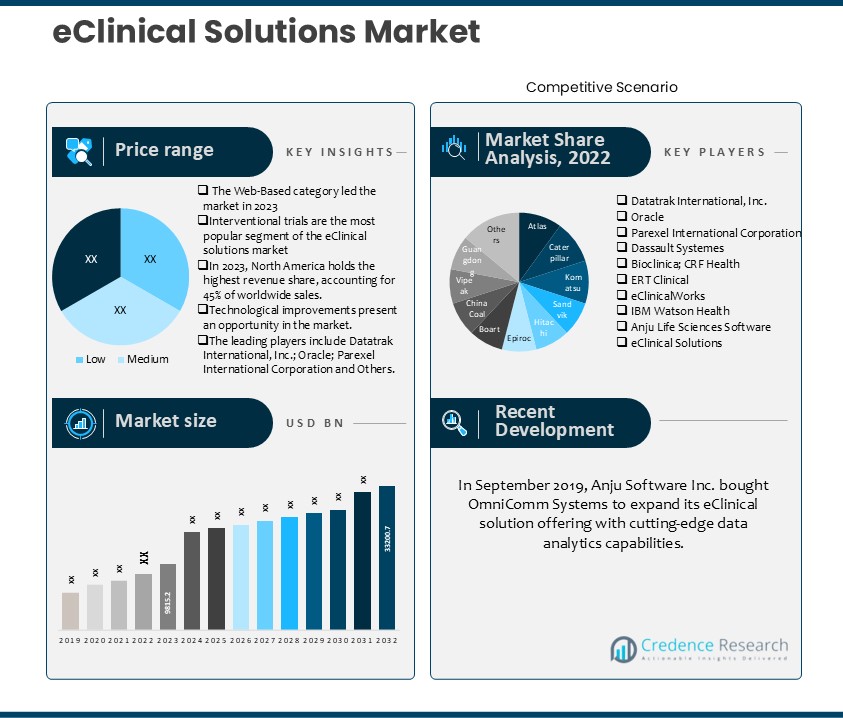
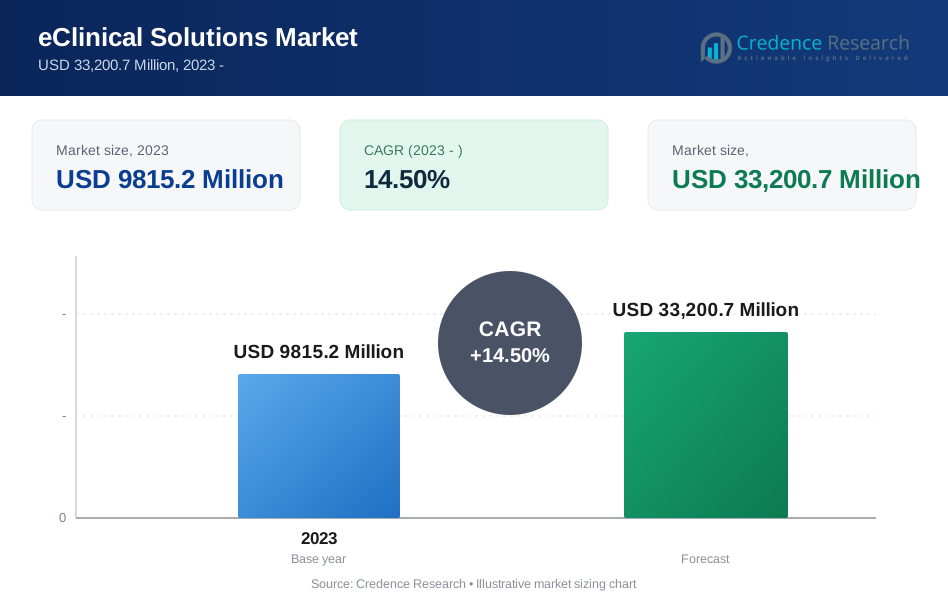
- The global demand for EClinical Solutions was valued at USD 9815.2 Million in 2023 and is expected to reach USD 33200.7 Million in 2032, growing at a CAGR of 14.50% between 2024 and 2032.
- The Electronic Data Capture (EDC) category owns the most shares in the eClinical Solutions Market. Clinical Trial Management Systems are the market's second largest sector. The Clinical Data Management System (CDMS) is the third most popular category.
- The Web-Based category topped the market in 2023 and is predicted to be the fastest-growing sector between 2023 and 2032. The cloud-based segment is predicted to experience an exponential CAGR of 15.1% throughout the projection period.
- The Phase III category dominated the market in 2023 and is predicted to be the fastest-growing segment over the forecast period (2023-2032).
- In 2023, CROs dominated the global eClinical solutions market and are likely to expand significantly in the next years. Pharmaceutical and biotechnology sectors are predicted to increase greatly.
- The software segment leads the e-clinical solutions market.
- In 2023, the Electronic Clinical Outcome Assessment (eCOA) category contributed for the majority of the eClinical Solution market's revenue, with Clinical Trial Management being an essential component.
- Interventional trial design is considered a major player in the eClinical solutions market.
- The interventional sector is the most popular in the eClinical solutions market.
- In 2023, North America has the biggest revenue share, accounting for 45% of global sales, while Europe has the second-largest eClinical Solution market share. The Asia-Pacific eClinical Solution Market is expected to grow at the fastest CAGR between 2023 and 2032.
- The high need for real-time data access propels market expansion.
- Lack of uniformity impedes market expansion.
Executive Summary
Market Definition
The eClinical Solutions Market refers to the industry that provides technological solutions and services for managing and conducting clinical trials in the healthcare and pharmaceutical industries. These solutions include a variety of software Delivery Modes and platforms that improve clinical trial operations, such as electronic data capture (EDC), clinical data management (CDM), electronic patient-reported outcomes (ePRO), clinical trial management systems (CTMS), and others. eClinical solutions strive to increase efficiency, data quality, and compliance across the clinical trial process, resulting in faster medication discovery and better patient outcomes.
Market Overview
The global EClinical Solutions Market has witnessed steady growth in recent years and is expected to grow at a CAGR of 14.50% between 2024 and 2032. The market was valued at USD 9815.2 million in 2023 and is expected to reach USD 33200.7 million in 2032.
The eClinical Solutions Market is rapidly increasing and is projected to remain so in the coming years. With the expanding complexity and volume of clinical trials, there is a greater need for advanced technological solutions to expedite operations and improve efficiency. Factors driving the market include the requirement for real-time data access, regulatory compliance, cost reduction, and increased usage of electronic data capture (EDC) systems. Furthermore, the transition to cloud-based solutions, as well as the incorporation of artificial intelligence (AI) and machine learning (ML) technologies, are driving market expansion. The clinical products Market is highly competitive, with leading competitors providing a diverse variety of innovative products and services to meet the unique requirements of the healthcare and pharmaceutical industries.
Segmentation by Product Type
- The Electronic Data Capture (EDC) category owns the most shares in the eClinical Solutions Market. EDC systems are commonly utilized to capture, manage, and store clinical trial data electronically, supplanting old paper-based approaches. EDC systems provide benefits such as real-time data access, enhanced data accuracy, and streamlined data collection processes, making them in high demand in the industry.
- Clinical Trial Management Systems are the market's second largest segment. CTMS platforms offer a full suite of tools for clinical trial planning, execution, and monitoring.
- The Clinical Data Management System (CDMS) is the third most popular category of the eClinical Solutions Market. CDMS platforms are intended to protect the quality, integrity, and security of clinical trial data.
Segmentation by Delivery Mode
- The Web-Based category led the market in 2023 and is expected to be the fastest-growing sector from 2023 to 2032. Market dominance can be linked to factors such as simplicity of use, usability, and minimal initial investment. Web-hosted goods are easily configurable, allowing suppliers to change how information is displayed to different user groups.
- The cloud-based segment is expected to enjoy an exponential CAGR of 15.1% throughout the forecast period, favorably boosting market growth.
Segmentation by Clinical Trial Phase
- The Phase III category dominated the market in 2023 and is expected to be the fastest-growing segment during the forecast period (2023-2032). The growing need for integrating clinical data management software to lower overall costs and improve process efficiency is driving the segment's growth.
Segmentation by End-User
- In 2023, CROs dominated the worldwide eClinical solutions market and are expected to rise significantly in the next years. This is due to pharmaceutical corporations' growing concern about reducing their overall spending.
- On the other hand, the Pharmaceutical and biotechnology industries are predicted to increase significantly during the forecast period. The eClinical solutions not only improve trial efficiency but also save time and money throughout medication development.
Segmentation by Component
- The software segment dominates the eClinical Solutions Market. eClinical solutions rely heavily on software to enable various features and processes. It includes a diverse set of software tools, including electronic data capture (EDC) systems, clinical trial management systems (CTMS), randomization and trial supply management (RTSM) systems, and electronic patient-reported outcome (ePRO) solutions.
Segmentation by Function
- In 2023, the Electronic Clinical Outcome Assessment (eCOA) category accounted for the majority of the eClinical Solution market's revenue. Because of the increasing relevance of high-quality clinical data, eCOA is expected to increase at the quickest rate, with a CAGR of 15.2%.
- Clinical Trial Management is an important component of the eClinical Solutions Market. This section focuses on the preparation, execution, and monitoring of clinical trials. It includes tasks including study design, patient recruiting, site management, and data analysis. Effective clinical trial management is critical to the efficient running of trials and the timely transmission of data.
Segmentation by Study Design
- Interventional trials are regarded as a prominent player in the eClinical solutions market. Interventional trials assess new treatments or interventions in a controlled environment to determine their safety and efficacy. These studies frequently necessitate strong data management, randomization, and supply management solutions to ensure accurate data collection, proper treatment allocation, and fast trial execution.
Segmentation by Trial Type
- Interventional trials are the most popular segment of the eClinical solutions market. Interventional trials investigate new treatments or interventions in a controlled environment. These studies frequently necessitate sophisticated data management, randomization, and supply management technologies to ensure accurate data gathering and effective trial execution.
Segmentation by Region
- In 2023, North America holds the highest revenue share, accounting for 45% of worldwide sales.
- Europe has the second-largest eClinical Solution market share. Government investment in research and drug development
- The Asia-Pacific eClinical Solution Market is predicted to develop at the quickest CAGR between 2023 and 2032
- The rest of the world, including Latin America, the Middle East, and Africa, supplies the remaining demand for EClinical Solutions.
North America's eClinical Solution market was worth USD 2.977 billion in 2023 and is predicted to rise at a substantial CAGR over the study period. The market is predicted to rise as the target population grows and lifestyle-related ailments such as diabetes and heart disorders become more prevalent. Introducing new goods is also propelling the regional market, as are eClinical solution suppliers and a rise in government incentives. Residences of significant companies and the availability of modern infrastructure are also expected to support regional market growth.
Europe has the second-largest eClinical Solution market share. Government investment in research and drug development, a key driver of Europe's market growth as a developing economy, is expected to rise during the projection period. Furthermore, the German eClinical Solution market had the highest market share, while the UK eClinical Solution market was the fastest-growing in Europe.
Additionally, the Asia-Pacific eClinical Solution Market is predicted to develop at the quickest CAGR between 2023 and 2032. The region has a significant unmet medical need and an increasing prevalence of target chronic diseases such as cancer, cardiovascular disease, and infectious diseases. Countries with huge patient populations and low expenses, such as China, India, Korea, and Japan, are receiving more studies. Outsourcing has boosted the adoption of eClinical solutions in these domains.
Key Highlights of the Report
Type, Delivery Mode, Clinical Trial Phase, End-User, Type, Function, Study Design, Trial Type, and Region segment of the global EClinical Solutions Market. The Web-Based category led the market in 2023, while the software segment dominated the eClinical Solutions Market. Also, interventional trials are the most popular segment, while the cloud-based segment has the largest CAGR. In addition, the Phase III category dominated the market in 2023 and is predicted to be the fastest-growing segment, with North America leading the market growth.
The market is driven by the increasing need for effective and streamlined clinical trial processes, growing usage of electronic data capture (EDC) systems for data management, and technological advancements such as cloud computing and AI, which drive innovation in eClinical solutions. Furthermore, important market barriers include data security and privacy issues when dealing with sensitive patient information, high implementation and maintenance costs of clinical solutions, resistance to change, and integration of new technologies in traditional clinical trial processes.
Nonetheless, North America North America holds the highest revenue share, and it is expected to grow at a significant CAGR throughout the study period. Additionally, Europe has the second-largest eClinical Solution market share. Furthermore, the Asia-Pacific eClinical Solution Market is expected to grow at the fastest CAGR between 2023 and 2032.
What Are The Main Drivers Of The Global EClinical Solutions Market?
The eClinical Solutions Market is being driven by several factors. One key driver is the increasing demand for efficient and streamlined clinical trial processes. With the complexity and scale of clinical trials growing, there is a need for advanced technology solutions that can automate and optimize various aspects of the process. Another driver is the growing adoption of electronic data capture (EDC) systems for data management. EDC systems allow for real-time data collection, improved data quality, and faster analysis, which are crucial in today's fast-paced research environment.
What Are The Major Challenges Faced By The Global EClinical Solutions Market?
While the eClinical Solutions Market has promising growth prospects, there are also some restraints to consider. One major restraint is the concern over data security and privacy. With the handling of sensitive patient information, there is a need for robust security measures to protect data from breaches or unauthorized access. Another restraint is the high implementation and maintenance costs associated with eClinical solutions. Organizations need to invest in infrastructure, software licenses, and ongoing support, which can be a barrier for some.
What Are The Growth Opportunities In The Global EClinical Solutions Market?
The eClinical Solutions Market presents several opportunities for organizations. One opportunity is the expansion into emerging markets that are witnessing a rise in the number of clinical trials. As these markets develop, there is a growing demand for advanced eClinical solutions to support research activities. Another opportunity lies in the integration of mobile and wearable technology for remote patient monitoring. By leveraging these technologies, researchers can collect real-time data from patients in their natural environments, improving data accuracy and patient engagement.
Market Drivers
Several factors drive the global EClinical Solutions Market. The following are the key drivers of the global EClinical Solutions Market:
High Need For Real-Time Data Access
Global improvements in the healthcare sector have led providers to adopt remote monitoring; real-time data access enables remote monitoring of patients participating in clinical trials. Patients can use eClinical solutions to report data remotely, using electronic patient-reported outcome tools or wearables. Real-time data access enables healthcare practitioners, researchers, and sponsors to make educated decisions faster. With eClinical solutions, data produced during a clinical trial is immediately available, allowing stakeholders to monitor patient safety, evaluate study progress, and make key choices in real time. This allows for speedier intervention, trial protocol adjustments, and immediate responses to safety issues or bad occurrences. Considering the components that provide real-time data with eClinical solutions, the element appears to work as a market driver.
Market Restraints
The global EClinical Solutions Market faces some challenges that may hinder its growth. These include the following:
Lack Of Standardization
In clinical trials, data is generated from numerous sources, including diverse sites, investigators, equipment, and systems. Without established data models and formats, integrating and harmonizing data becomes difficult and time-consuming. This lack of uniformity can lead to data inconsistencies, inaccuracies, and difficulty in doing cross-study analysis, meta-analysis, or comparative effectiveness research. Without standardized data gathering methods and formats, there is a greater risk of data quality concerns such as errors, inconsistencies, and missing data. This lack of uniformity might jeopardize the reliability and integrity of clinical trial data, perhaps leading to erroneous analysis, skewed results, or incorrect conclusions. As a result, a lack of uniformity limits market growth.
Opportunities
The global EClinical Solutions Market offers significant growth opportunities. These include the following:
Technological Advancements
The combination of big data analytics and eClinical technologies enables detailed analysis of large amounts of clinical and non-clinical data. It facilitates the discovery of novel biomarkers, the classification of patient subgroups, trial design optimization, and predictive modeling. These findings have the potential to lead to more tailored and focused interventions, better trial outcomes, and improved patient care. Advanced communication and collaboration capabilities allow study teams, investigators, and sponsors to engage more seamlessly. Virtual trial platforms enable decentralized or hybrid trial methods, removing the requirement for physical site visits and easing logistical issues. These technologies allow for greater participant recruitment, faster trial execution, and cost savings, all of which are seen as market technology breakthroughs.
Competitive Landscape
Key Players
The global EClinical Solutions Market is highly competitive, with several key players. Some of the major players in the market and their market share are as follows:
- Datatrak International, Inc.
- Oracle
- Parexel International Corporation
- Dassault Systemes
- Bioclinica; CRF Health
- ERT Clinical
- eClinicalWorks
- IBM Watson Health
- Anju Life Sciences Software
- eClinical Solutions
These organizations prioritize product innovation, Clinical Trial Phase expansion, and mergers and acquisitions to stay competitive.
The global EClinical Solutions Market's key players continually seek to stay ahead by offering new products and developments.
In January 2023, Veeva Systems was chosen by Adare Pharma Solutions, a contract development and manufacturing organization (CDMO) specializing in oral dosage forms. The company used Veeva Vault Quality Suite to integrate quality systems throughout the enterprise.
In May 2022, Emmes unveiled the third generation of Advantage eClinical at the Society for Clinical Trials (SCT) in San Diego. Advantage eClinical's cloud platform will be released as a separate software product after more than two years of development. The system was created exclusively for clinical trial sponsors of all sizes, providing them with faster study builds, increased flexibility, and insights.
Summary of Key Findings
- Technological improvements present an opportunity in the market.
- Product Type, Delivery Mode, Clinical Trial Phase, End-User, type, Function, Study Design, Trial Type, and region segment the market.
- The software category dominated the eClinical Solutions Market.
- In 2023, the Web-Based category topped the market and is predicted to be the fastest-growing sector between 2023 and 2032
- North America is leading market growth.; the market is highly competitive with key players including Datatrak International, Inc.; Oracle; Parexel International Corporation and Others.
Future Outlook
- Continued growth and expansion
- Increasing adoption of cloud-based solutions
- Integration of AI and ML technologies
- Emphasis on real-time data access and analysis
- Rising demand for regulatory compliance
How CXOs Can Benefit from the Credence Research EClinical Solutions Market Report
The Credence Research EClinical Solutions Market Report provides CXOs with a comprehensive overview of the market, including:
- Market size and growth forecast:The report provides detailed estimates of the global EClinical Solutions Market size, segmented by Product Type, Delivery Mode, Clinical Trial Phase, End-User type, Function, Study Design, Trial Type, and region. It also includes forecasts for the market through 2032 based on key trends and drivers.
- Market segmentation:The report segments the EClinical Solutions Market by Product Type, Delivery Mode, Clinical Trial Phase, End-User, type, Function, Study Design, Trial Type, and region. This segmentation provides CXOs with a granular understanding of the market and the opportunities in each segment.
- Competitive Landscape:The report profiles the key players in the EClinical Solutions Market and provides insights into their strategies, product offerings, and financial performance. This information can help CXOs to identify and assess their competition.
- Key trends and drivers:The report identifies and analyzes the key trends and drivers that are shaping the EClinical Solutions Market. This information can help CXOs to make informed decisions about their investments and strategies.
CXOs can use the insights from the Credence Research EClinical Solutions Market Report to:
- Identify growth opportunities:The report can help CXOs to identify new growth opportunities in the EClinical Solutions Market. For example, it can provide insights on emerging trends, market dynamics, and competitive landscapes.
- Make informed investment decisions:The report can help CXOs to make informed investment decisions about EClinical Solutionss. For example, it provides market analysis and insights on key players, market trends, and growth opportunities.
- Develop competitive strategies:The report can help CXOs to develop competitive strategies for their EClinical Solutions businesses. For example, it provides insights on market trends, customer preferences, and competitor analysis.
- Track market developments:The report can help CXOs to track market developments and stay ahead of the curve. For example, the report provides insights into the latest trends and innovations in the EClinical Solutions Market.
Overall, the Credence Research EClinical Solutions Market Report is a valuable resource for CXOs who are looking to gain a deeper understanding of the market and identify opportunities for growth.
Segmentation
By Product Type:- Electronic Data Capture (EDC)
- Clinical Data Management System (CDMS)
- Clinical Trial Management System (CTMS)
- Randomization and Trial Supply Management (RTSM)
- eCOA (Electronic Clinical Outcome Assessment)
- Clinical Analytics Platform
- Safety Solutions
- eTMF (Electronic Trial Master File)
- IVRS (Interactive Voice Response System)
- ePRO (Electronic Patient-Reported Outcomes)
- Others
- Web-Hosted (On-Demand)
- Licensed Enterprise (On-Premises)
- Cloud-Based (SaaS)
- Phase I
- Phase II
- Phase III
- Phase IV/Post-Market Surveillance
- Pharmaceutical and Biopharmaceutical Companies
- Contract Research Organizations (CROs)
- Consulting Service Companies
- Medical Device Companies
- Academic Research Institutes
- Hospitals
- Others
- Services
- Consulting
- Implementation
- Training
- Support and Maintenance
- Software
- Clinical Data Management
- Randomization and Trial Supply Management
- Clinical Trial Management
- Clinical Analytics
- Safety and Pharmacovigilance
- Electronic Clinical Outcome Assessment (eCOA)
- Others
- Interventional Trials
- Observational Trials
- Expanded Access Trials
- Interventional
- Observational
- North America
- U.S
- Canada
- Mexico
- Europe
- Germany
- France
- U.K.
- Italy
- Spain
- Rest of Europe
- Asia Pacific
- China
- Japan
- India
- South Korea
- South-east Asia
- Rest of Asia Pacific
- Latin America
- Brazil
- Argentina
- Rest of Latin America
- Middle East & Africa
- GCC Countries
- South Africa
- Rest of Middle East and Africa
Adjacent Markets |
||
| Electronic Health Records (EHR) Market | Healthcare Analytics Market | Patient Engagement Solutions Market |
| Clinical Data Management System (CDMS) Market | Telemedicine Market | Healthcare IT Market |
| Clinical Trial Management System (CTMS) Market | Medical Imaging Software Market | Healthcare Compliance Solutions Market |
Request a Free Sample
Fill in your details and we'll send you a free sample report.
- Sample data tables & charts
- Research methodology
Market Dynamics
High Need for Real-Time Data Access
The demand for immediate access to clinical trial data enables faster decision-making, improved patient safety monitoring, and more agile trial management, which is critical as trials become more complex and geographically dispersed.
Growing Adoption of Electronic Data Capture (EDC) Systems
EDC systems streamline data collection, improve data accuracy, and reduce manual errors, making them essential for modern clinical trials and driving widespread adoption across the industry.
Technological Advancements in Cloud and AI
The integration of cloud-based platforms and artificial intelligence enhances scalability, data analytics, and remote access, allowing for more efficient trial execution and supporting decentralized and hybrid trial models.
Expansion of Clinical Trials in Emerging Markets
Increasing clinical research activity in Asia Pacific and other emerging regions, driven by large patient populations and cost advantages, is boosting demand for advanced eClinical solutions to support local and global studies.
Regulatory Compliance and Data Integrity Requirements
Stricter regulatory standards for data quality, security, and transparency in clinical trials are pushing organizations to adopt robust eClinical solutions that ensure compliance and safeguard sensitive patient information.
Need a Custom Version of This Report?
Tailor the scope, geography, or segments to your exact requirements.
- Custom geography or segment scope
- Direct access to our analyst team
Frequently Asked Questions
What is the current size of the global EClinical Solutions Market?
What is the expected growth rate of the EClinical Solutions Market between 2024 and 2032?
Which segment is leading the market share in terms of Function?
Which Delivery Mode segment governs the demand for EClinical Solutions in the world?
Which Clinical Trial Phase segment is expected to post the fastest growth during the forecast period?
Which region is fueling the growth of the EClinical Solutions industry?
Who are the major players in the global EClinical Solutions Market?
What are the major market drivers of the EClinical Solutions industry?
What are the major market restraints of the EClinical Solutions industry?
What are the major market opportunities of the EClinical Solutions industry?
Table of Content
Chapter 1 Market Segmentation
- 1.1 Segmentation Framework
- 1.1.1 Product and Service Classification
- 1.1.2 Application and End-Use Classification
- 1.1.3 Technology and Solution Classification
- 1.1.4 Customer and Distribution Channel Classification
- 1.1.5 Geographic Segmentation
- 1.1.6 Market Segment Definitions and Boundaries
- 1.2 By End-User
- 1.2.1 Pharmaceutical and Biopharmaceutical Companies
- 1.2.2 Contract Research Organizations (CROs)
- 1.2.3 Academic Research Institutes
- 1.2.4 Medical Device Companies
- 1.3 By Product Type
- 1.3.1 Electronic Data Capture (EDC)
- 1.3.2 Clinical Data Management System (CDMS)
- 1.3.3 Clinical Trial Management System (CTMS)
- 1.3.4 Randomization and Trial Supply Management (RTSM)
- 1.3.5 Electronic Clinical Outcome Assessment (eCOA)
- 1.4 By Delivery Mode
- 1.4.1 Web-Hosted (On-Demand)
- 1.4.2 Licensed Enterprise (On-Premises)
- 1.4.3 Cloud-Based (SaaS)
Chapter 2 Introduction
- 2.1 Report Objectives and Scope
- 2.2 Product Definition and Industry Terminology
- 2.3 Market Inclusions and Exclusions
- 2.4 Research Process
- 2.4.1 Primary Research and Expert Interviews
- 2.4.2 Secondary Research and Source Review
- 2.4.3 Top-Down and Bottom-Up Estimation
- 2.4.4 Data Triangulation and Verification
- 2.5 Market Size Measurement Basis
- 2.5.1 2023: USD 9815.2 Million → 2032: USD 33,200.7 Million
- 2.6 Historical and Forecast Reference Periods
- 2.6.1 Base Year: 2023
- 2.6.2 Forecast Period: 2023-2032
- 2.7 Research Assumptions and Limitations
Chapter 3 Executive Summary
- 3.1 Market Snapshot and Key Findings
- 3.2 Base-Year Market Size, 2023
- 3.3 Forecast Market Size, 2032
- 3.4 Revenue and Volume Growth Outlook
- 3.5 Key Demand and Supply Indicators
- 3.6 Leading Market Segments
- 3.7 Fastest-Growing Market Opportunities
- 3.8 Regional Performance Highlights
- 3.9 Technology and Industry Transformation
- 3.10 Competitive Landscape Summary
- 3.11 Analyst View and Strategic Implications
Chapter 4 Global eClinical Solutions Market Trends and Developments
- 4.1 Historical Industry Development
- 4.2 Recent Market Trends and Developments
- 4.3 Demand and Customer Behavior Trends
- 4.4 Technology and Product Innovation
- 4.5 Artificial Intelligence, Automation and Digitalization
- 4.6 Local Manufacturing and Supply Chain Realignment
- 4.7 Industry Partnerships, Mergers and Acquisitions
- 4.8 Sustainability and Circular Economy Developments
- 4.9 Government and Private Sector Investment Trends
- 4.10 Emerging Business Models and Commercialization
- 4.11 Industry Developments and Announcements
Chapter 5 Global eClinical Solutions Market Production, Supply and Demand Analysis
- 5.1 Demand Trend and Consumption Analysis
- 5.2 Demand Forecast, 2023-2032
- 5.3 Production and Output Trend
- 5.4 Production and Output Forecast, 2023-2032
- 5.5 Installed Capacity and Capacity Utilization
- 5.6 Company-Wise Production Plants and Statistics
- 5.6.1 Installed Production Capacity
- 5.6.2 Actual Production
- 5.6.3 Planned Capacity and Expansion Targets
- 5.7 Supply Chain Structure and Procurement Trends
- 5.8 Supply-Demand Gap and Bottlenecks
- 5.9 Import Dependence and Sourcing Structure
- 5.10 Contract Manufacturing and Outsourcing
- 5.11 Regional Supply and Demand Concentration
Chapter 6 Global eClinical Solutions Market Pricing Analysis
- 6.1 Pricing Structure and Measurement
- 6.2 Historical Pricing Trends
- 6.3 Pricing Outlook, 2023-2032
- 6.4 Average Selling Price and Unit Economics
- 6.5 Pricing by Product and Market Segment
- 6.6 Geographic Pricing Differences
- 6.7 Key Input, Energy, Labor and Logistics Costs
- 6.8 Contract Pricing and Purchasing Models
- 6.9 Pricing Sensitivity and Competitive Positioning
- 6.10 Price, Margin and Profitability Implications
Chapter 7 Global eClinical Solutions Market Dynamics
- 7.1 Market Growth Drivers
- 7.1.1 Demand-Side Drivers
- 7.1.2 Technology and Innovation Drivers
- 7.1.3 Infrastructure and Investment Drivers
- 7.1.4 Regulatory and Policy Drivers
- 7.2 Market Restraints
- 7.2.1 Cost and Affordability Constraints
- 7.2.2 Technology and Adoption Barriers
- 7.2.3 Supply Chain and Operational Constraints
- 7.3 Market Challenges
- 7.3.1 Competitive Pressure and Margin Erosion
- 7.3.2 Skills, Infrastructure and Implementation Gaps
- 7.4 Emerging Market Opportunities
- 7.5 Market Dynamics Impact and Time-Horizon Assessment
Chapter 8 Global eClinical Solutions Value Chain Analysis
- 8.1 Industry Value Chain Overview
- 8.2 Upstream Suppliers and Critical Inputs
- 8.3 Technology and Component Providers
- 8.4 Manufacturing or Service Delivery
- 8.5 Distribution, Channel Partners and Integrators
- 8.6 Downstream Applications and End Users
- 8.7 Value Addition and Profit Pools
- 8.8 Vertical Integration and Outsourcing
- 8.9 Supplier Concentration and Risk
- 8.10 Supply Chain Localization and Resilience
Chapter 9 Global eClinical Solutions Market Regulations and Policies
- 9.1 Relevant Laws, Standards and Compliance Frameworks
- 9.2 Product, Service, Safety and Quality Requirements
- 9.3 Government Policies, Incentives and Subsidies
- 9.4 Imports, Exports and Trade Barriers
- 9.5 Public Procurement and Local Content Requirements
- 9.6 Environmental and Sustainability Compliance
- 9.7 Upcoming Policy Changes and Market Implications
Chapter 10 Global eClinical Solutions Market Hotspots and Opportunities
- 10.1 Market Opportunity Mapping and Growth Hotspots
- 10.2 High-Growth Applications and Customer Groups
- 10.3 Underserved Markets and White-Space Opportunities
- 10.4 Emerging Technology and Product Opportunities
- 10.5 New Capacity and Investment Hotspots
- 10.6 Market Entry and Expansion Opportunities
- 10.7 Distribution and Partnership Opportunities
- 10.8 Near-Term and Long-Term Commercial Potential
- 10.9 Opportunity Attractiveness and Execution Risks
Chapter 11 Global eClinical Solutions Market Outlook, 2023-2032
- 11.1 Market Size and Analysis
- 11.1.1 Revenue (Market Measurement: 2023: USD 9815.2 Million → 2032: USD 33,200.7 Million)
- 11.1.2 Market Volume and Quantity Sold
- 11.1.3 Historical Market Size
- 11.1.4 Base-Year Market Size, 2023
- 11.2 Market Forecast, 2023-2032
- 11.2.1 Revenue Forecast to 2032
- 11.2.2 Volume Forecast to 2032
- 11.2.3 CAGR and Year-on-Year Growth
- 11.2.4 Incremental Revenue Opportunity
- 11.3 Forecast Assumptions and Scenario Analysis
- 11.3.1 Base-Case Forecast
- 11.3.2 Optimistic and Conservative Scenarios
- 11.3.3 Technology, Pricing and Policy Sensitivities
- 11.4 Market Attractiveness and Growth Outlook
Chapter 12 Global eClinical Solutions Market Segmentation and Outlook
- 12.1 Segmentation Summary and Market Shares, 2023
- 12.2 Largest and Fastest-Growing Segments
- 12.3 By End-User - Market Size and Forecast, 2023-2032
- 12.3.1 Segment Definition and Scope
- 12.3.2 Historical Market Size
- 12.3.3 Revenue Forecast, 2023-2032
- 12.3.4 Volume Forecast, 2023-2032
- 12.3.5 Base-Year Market Share, 2023
- 12.3.6 Segment CAGR and Growth Drivers
- 12.3.7 Subsegment Market Size and Forecast
- 12.3.7.1 Pharmaceutical and Biopharmaceutical Companies
- 12.3.7.2 Contract Research Organizations (CROs)
- 12.3.7.3 Academic Research Institutes
- 12.3.7.4 Medical Device Companies
- 12.3.8 Subsegment Pricing and Adoption Trends
- 12.3.9 Leading Suppliers and Competition
- 12.3.10 Regional Demand and Opportunities
- 12.4 By Product Type - Market Size and Forecast, 2023-2032
- 12.4.1 Segment Definition and Scope
- 12.4.2 Historical Market Size
- 12.4.3 Revenue Forecast, 2023-2032
- 12.4.4 Volume Forecast, 2023-2032
- 12.4.5 Base-Year Market Share, 2023
- 12.4.6 Segment CAGR and Growth Drivers
- 12.4.7 Subsegment Market Size and Forecast
- 12.4.7.1 Electronic Data Capture (EDC)
- 12.4.7.2 Clinical Data Management System (CDMS)
- 12.4.7.3 Clinical Trial Management System (CTMS)
- 12.4.7.4 Randomization and Trial Supply Management (RTSM)
- 12.4.7.5 Electronic Clinical Outcome Assessment (eCOA)
- 12.4.8 Subsegment Pricing and Adoption Trends
- 12.4.9 Leading Suppliers and Competition
- 12.4.10 Regional Demand and Opportunities
- 12.5 By Delivery Mode - Market Size and Forecast, 2023-2032
- 12.5.1 Segment Definition and Scope
- 12.5.2 Historical Market Size
- 12.5.3 Revenue Forecast, 2023-2032
- 12.5.4 Volume Forecast, 2023-2032
- 12.5.5 Base-Year Market Share, 2023
- 12.5.6 Segment CAGR and Growth Drivers
- 12.5.7 Subsegment Market Size and Forecast
- 12.5.7.1 Web-Hosted (On-Demand)
- 12.5.7.2 Licensed Enterprise (On-Premises)
- 12.5.7.3 Cloud-Based (SaaS)
- 12.5.8 Subsegment Pricing and Adoption Trends
- 12.5.9 Leading Suppliers and Competition
- 12.5.10 Regional Demand and Opportunities
- 12.6 Segment Growth Comparison
- 12.7 Segment Attractiveness and Priority Matrix
Chapter 13 Global eClinical Solutions End-Use and Application Market Outlook
- 13.1 End-Use Industry and Customer Demand Structure
- 13.2 Leading Applications and Customer Groups
- 13.3 End-Use Market Size, Share and Forecast
- 13.4 Major End-Use Industry Deep Dives
- 13.4.1 Customer Requirements and Use Cases
- 13.4.2 Demand and Replacement Cycles
- 13.4.3 Technical and Regulatory Considerations
- 13.4.4 Purchasing and Procurement Models
- 13.4.5 Leading Vendors and Distribution Channels
- 13.4.6 Forecast and Commercial Opportunities
- 13.5 Emerging Applications and Cross-Segment Demand
- 13.6 End-Use Industry Investment Priorities
Chapter 14 Global eClinical Solutions Geographic Market Outlook, 2023-2032
- 14.1 Regional Market Size and Share, 2023
- 14.2 Regional Market Forecast, 2023-2032
- 14.3 Regional Pricing, Production and Demand Differences
- 14.4 North America
- 14.4.1 United States
- 14.4.2 Canada
- 14.4.3 Mexico
- 14.5 Europe
- 14.5.1 Germany
- 14.5.2 France
- 14.5.3 Italy
- 14.5.4 United Kingdom
- 14.5.5 Spain
- 14.5.6 Poland
- 14.5.7 Russia
- 14.5.8 Netherlands
- 14.5.9 Belgium
- 14.5.10 Sweden
- 14.5.11 Denmark
- 14.5.12 Norway
- 14.5.13 Rest of Europe
- 14.6 Asia Pacific
- 14.6.1 China
- 14.6.2 India
- 14.6.3 Japan
- 14.6.4 South Korea
- 14.6.5 Thailand
- 14.6.6 Indonesia
- 14.6.7 Vietnam
- 14.6.8 Malaysia
- 14.6.9 Australia
- 14.6.10 Rest of Asia Pacific
- 14.7 Latin America
- 14.7.1 Brazil
- 14.7.2 Argentina
- 14.7.3 Colombia
- 14.7.4 Chile
- 14.7.5 Rest of Latin America
- 14.8 Middle East
- 14.8.1 Saudi Arabia
- 14.8.2 United Arab Emirates
- 14.8.3 Turkey
- 14.8.4 Israel
- 14.8.5 Iran
- 14.8.6 Rest of the Middle East
- 14.9 Africa
- 14.9.1 South Africa
- 14.9.2 Egypt
- 14.9.3 Nigeria
- 14.9.4 Morocco
- 14.9.5 Rest of Africa
- 14.10 Regional Investment, Policy and Supply Chain Differences
- 14.11 Regional Competitive Landscape
- 14.12 Geographic Growth Hotspots
Chapter 15 Global eClinical Solutions Technology, Innovation and Sustainability Outlook
- 15.1 Technology Landscape and Maturity
- 15.2 Product, Process and Service Innovation
- 15.3 AI, Automation and Digital Tools in the Industry
- 15.4 Technology Adoption and Performance Benchmarking
- 15.5 Innovation Pipeline and R&D Investment
- 15.6 Patent and Intellectual Property Trends
- 15.7 Energy Efficiency and Resource Management
- 15.8 Sustainability, Recycling and Circularity
- 15.9 Technology Roadmap, 2023-2032
- 15.10 Risks of Obsolescence and Technology Substitution
Chapter 16 Global eClinical Solutions Market Key Strategic Imperatives
- 16.1 Growth and Market Entry Priorities
- 16.2 High-Return Products and Segments
- 16.3 Pricing, Profitability and Cost Optimization
- 16.4 Technology Investment and Product Differentiation
- 16.5 Supply Chain Localization and Resilience
- 16.6 Distribution and Customer Acquisition
- 16.7 Partnership, Acquisition and Capacity Strategy
- 16.8 Regional Expansion Priorities
- 16.9 Short-, Medium- and Long-Term Actions
Chapter 17 Competition Outlook
- 17.1 Industry Competition Characteristics
- 17.2 Market Structure and Concentration
- 17.3 Market Share and Competitive Positioning, 2023
- 17.4 Company-Wise Revenue and Product Benchmarking
- 17.5 Production and Service Capacity Benchmarking
- 17.6 Technology, Pricing and Differentiation
- 17.7 Regional Footprint and Distribution Strength
- 17.8 Mergers, Acquisitions and Strategic Alliances
- 17.9 New Entrants and Competitive Threats
- 17.10 Porter's Five Forces and Industry Attractiveness
- 17.11 Competitive Outlook, 2023-2032
Chapter 18 Company Profiles
- 18.1 Company Coverage and Selection Criteria
- 18.2 Oracle
- 18.2.1 Business Description
- 18.2.2 Company Ownership and Geographic Presence
- 18.2.3 Product and Service Portfolio
- 18.2.4 Manufacturing and Operating Footprint
- 18.2.5 Production Capacity and Expansion Plans
- 18.2.6 Financial Performance and Investment
- 18.2.7 Market Share and Competitive Position
- 18.2.8 Technology and Innovation Capabilities
- 18.2.9 Strategic Alliances or Partnerships
- 18.2.10 Recent Developments
- 18.2.11 Growth Strategy and Outlook
- 18.3 Parexel International Corporation
- 18.4 Dassault Systèmes
- 18.5 Datatrak International, Inc.
- 18.6 Bioclinica
- 18.7 ERT Clinical
- 18.8 eClinicalWorks
- 18.9 IBM Watson Health
- 18.10 Anju Life Sciences Software
- 18.11 Veeva Systems
- 18.12 Other Relevant Market Participants
Note: Every listed company is profiled on the structure shown under the first company. The company list is preliminary and may change based on research findings, market developments, data availability and client requirements.
Chapter 19 Disclaimer
- 19.1 Research and Forecast Disclaimer
- 19.2 Data Source and Estimation Limitations
Note: The depth of individual sections depends on data availability for this market. Volume, capacity, trade and other unit-based metrics are included where applicable.

