Electric and Fuel Cell Truck Market Overview:
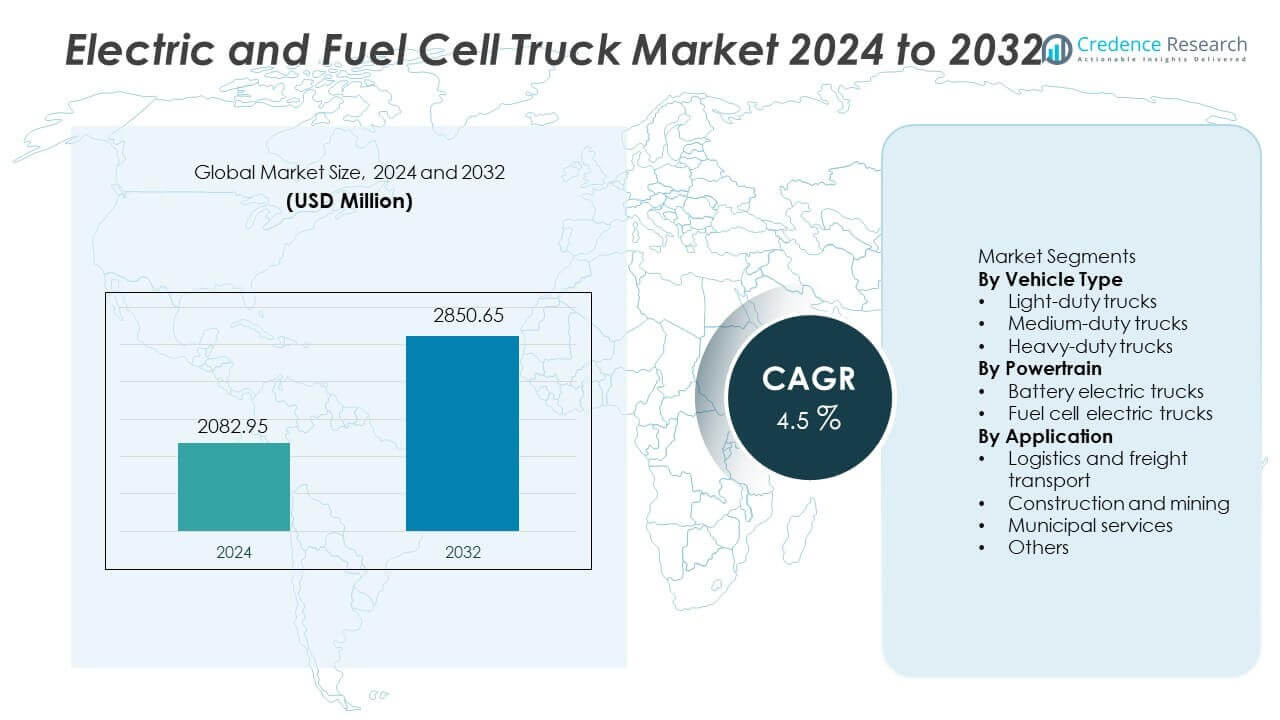
The Electric and Fuel Cell Truck market was valued at USD 2,082.95 million in 2024 and is anticipated to reach USD 2,850.65 million by 2032, growing at a CAGR of 4.5% during the forecast period.
| REPORT ATTRIBUTE | DETAILS |
|---|---|
| Historical Period | 2020-2024 |
| Base Year | 2025 |
| Forecast Period | 2026-2032 |
| Electric and Fuel Cell Truck Market Size 2024 | USD 2,082.95 million |
| Electric and Fuel Cell Truck Market, CAGR | 4.5% |
| Electric and Fuel Cell Truck Market Size 2032 | USD 2,850.65 million |
Electric and Fuel Cell Truck Market Insights
- Market growth is driven by strict emission regulations, government incentives, and fleet electrification programs, with heavy-duty trucks leading the vehicle type segment at a 46% share due to rising adoption in freight and long-haul operations.
- Market trends highlight strong adoption of battery electric trucks, which dominate the powertrain segment with a 62% share, driven by expanding charging infrastructure, lower operating costs, and faster near-term deployment compared to hydrogen solutions.
- Competitive analysis shows manufacturers focusing on technology innovation, cost reduction, and partnerships, with logistics and freight transport holding a 48% application share due to high vehicle utilization and emission compliance needs.
- Regional analysis indicates Asia Pacific leads with a 34% share, followed by North America at 32% and Europe at 28%, while the Rest of the World holds 6%, reflecting infrastructure readiness and policy maturity differences.
Electric and Fuel Cell Truck Market Segmentation Analysis:
By Vehicle Type
By vehicle type, heavy-duty trucks dominate the electric and fuel cell truck market with a 46% share. This dominance reflects rising adoption in long-haul freight and industrial logistics. Heavy-duty fleets benefit from higher payload capacity and longer duty cycles. Government mandates for emission reduction accelerate electrification in this segment. Fleet operators prioritize total cost of ownership benefits. Medium-duty trucks hold a 34% share, supported by urban logistics and regional distribution. Light-duty trucks account for 20%, driven by last-mile delivery growth. Infrastructure investments and fleet electrification programs strengthen heavy-duty segment leadership.
- For instance, Volvo Group deployed FH Electric trucks capable of hauling heavy freight with high-capacity battery packs and substantial gross combination weight ratings.
By Powertrain By powertrain, battery electric trucks lead the market with a 62% share. Strong charging infrastructure development supports adoption across urban and regional routes. Battery electric trucks offer lower operating costs and simpler maintenance. Fleet electrification incentives further accelerate deployment. Fuel cell electric trucks hold a 38% share, supported by long-range capabilities and fast refueling. Hydrogen-based solutions attract interest for heavy-duty and long-haul operations. Public-private hydrogen corridor projects support future adoption. Battery electric dominance reflects infrastructure readiness and near-term cost advantages across commercial fleet applications.
- For instance, Tesla, Inc. delivered Semi trucks with 1 MWh battery packs and charging at 750 kW Megachargers.
By Application
By application, logistics and freight transport holds the largest share at 48%. E-commerce growth and supply chain decarbonization drive fleet replacement. Operators focus on emission compliance and fuel savings. Municipal services account for 27%, supported by public fleet electrification programs. Construction and mining represent 17%, driven by pilot projects in controlled environments. Other applications hold an 8% share, including utility and specialty services. Logistics leadership reflects high vehicle utilization rates and regulatory pressure. Urban delivery electrification remains a key growth driver across application segments.
Key Growth Drivers
Government Emission Regulations and Policy Support
Government emission regulations strongly drive the electric and fuel cell truck market. Many countries enforce strict limits on commercial vehicle emissions. Zero-emission mandates accelerate fleet electrification decisions. Financial incentives reduce upfront vehicle costs for operators. Subsidies support charging and hydrogen refueling infrastructure development. Public procurement policies favor electric and fuel cell trucks. Urban low-emission zones restrict diesel truck access. Compliance requirements push fleet replacement cycles. Long-term climate targets sustain regulatory momentum. Policy certainty improves investment confidence for manufacturers and fleet operators.
- For instance, Daimler Truck AG developed the eActros 300 with a 336 kWh battery to meet EU CO₂ fleet targets.
Rising Fleet Electrification by Logistics Operators
Logistics operators increasingly electrify fleets to reduce operating costs. Fuel savings improve total cost of ownership over time. Electric trucks offer lower maintenance requirements. Predictable urban routes support electrification feasibility. Large fleets benefit from centralized charging infrastructure. Corporate sustainability goals influence procurement strategies. E-commerce growth increases demand for clean delivery vehicles. Customer pressure encourages low-emission transport solutions. Fleet trials validate performance reliability. Logistics sector adoption remains a major demand driver across regions.
- For instance, Amazon operates Rivian electric delivery trucks with a 135 kWh battery and a 240 km daily route design.
Advancements in Battery and Hydrogen Technologies
Technology improvements support wider electric and fuel cell truck adoption. Battery energy density continues to improve driving range. Charging times decline with fast-charging solutions. Hydrogen fuel cell efficiency improves for heavy-duty use. Vehicle reliability increases under commercial duty cycles. Cost reductions enhance affordability for fleet buyers. Modular platforms improve manufacturing scalability. Technology maturity supports broader application coverage. Continuous innovation strengthens market competitiveness. Performance improvements sustain long-term market growth potential.
Key Trends & Opportunities
Expansion of Charging and Hydrogen Refueling Infrastructure
Infrastructure expansion creates strong growth opportunities for the market. Governments invest in public charging corridors. Private operators deploy depot-based charging systems. Hydrogen refueling networks expand along freight routes. Infrastructure availability reduces range anxiety concerns. Public-private partnerships accelerate rollout speed. Integrated energy management improves fleet efficiency. Urban and highway coverage improves operational flexibility. Infrastructure readiness supports heavy-duty adoption. This trend enhances long-term market scalability.
- For instance, ABB Ltd. installed 350 kW DC fast chargers supporting heavy truck charging within 90 minutes for large battery packs.
Growing Adoption in Municipal and Public Fleets
Municipal fleets increasingly adopt electric and fuel cell trucks. Public waste collection and transit fleets lead adoption. Governments prioritize visible emission reductions. Predictable routes suit electric vehicle deployment. Public funding supports vehicle procurement programs. Fleet electrification improves urban air quality. Noise reduction benefits residential areas. Municipal demand provides stable order volumes. Pilot programs expand into full-scale deployment. Public fleets create reference use cases for private operators.
- For instance, Hyundai Motor Company deployed fuel cell trucks in public fleet trials achieving 400 km daily municipal operations without mid-day refueling.
Key Challenges
High Initial Vehicle and Infrastructure Costs
High upfront costs remain a major market challenge. Electric and fuel cell trucks cost more than diesel models. Charging and hydrogen infrastructure require significant capital. Smaller fleet operators face budget constraints. Return on investment depends on utilization levels. Incentive availability varies by region. Infrastructure delays slow deployment timelines. Financing complexity affects adoption decisions. Cost sensitivity remains high in competitive logistics markets. Reducing upfront costs is critical for broader adoption.
Limited Hydrogen Availability and Supply Chain Readiness
Hydrogen supply limitations constrain fuel cell truck adoption. Refueling infrastructure remains limited in many regions. Hydrogen production costs remain high. Green hydrogen availability is still developing. Supply chain coordination challenges affect reliability. Fleet operators hesitate without refueling certainty. Infrastructure investment requires long-term demand assurance. Regulatory frameworks vary across markets. Technology readiness differs by region. Supply chain maturity remains a key adoption barrier.
Regional Analysis
North America
North America holds a 32% share of the electric and fuel cell truck market, driven by strong policy support and fleet electrification initiatives. The United States leads regional adoption due to zero-emission mandates and incentive programs. Logistics operators invest in battery electric trucks for regional and last-mile delivery. Public funding supports charging and hydrogen refueling corridors. Corporate sustainability targets accelerate fleet replacement decisions. Municipal fleets adopt electric trucks for waste and utility services. Technology partnerships support vehicle deployment at scale. Mature infrastructure and strong OEM presence sustain steady regional growth.
Europe
Europe accounts for a 28% share of the electric and fuel cell truck market, supported by strict emission regulations. Countries such as Germany, France, and the Netherlands lead adoption across logistics and municipal fleets. Zero-emission zones drive demand for clean commercial vehicles. Government subsidies reduce acquisition costs for fleet operators. Hydrogen fuel cell trucks gain traction in long-haul pilots. Public-private infrastructure projects expand refueling networks. Strong sustainability commitments influence procurement strategies. Advanced manufacturing capabilities support innovation. Europe remains a key region for technology-driven adoption.
Asia Pacific
Asia Pacific dominates the electric and fuel cell truck market with a 34% share, driven by large-scale deployment. China leads adoption through aggressive electrification policies and domestic manufacturing strength. Government mandates accelerate fleet electrification across logistics and municipal services. Cost-competitive production supports rapid market penetration. Japan and South Korea advance fuel cell truck development. Urban air quality initiatives boost adoption. Infrastructure expansion supports operational viability. Export-oriented manufacturing enhances scale. Asia Pacific remains the fastest-growing and most influential regional market.
Rest of the World
The Rest of the World holds a 6% share of the electric and fuel cell truck market, reflecting early-stage adoption. Latin America shows pilot deployments in urban logistics. The Middle East explores hydrogen trucks aligned with clean energy strategies. Australia invests in electric trucks for mining and freight corridors. Infrastructure gaps limit rapid expansion. Policy frameworks remain under development. Import dependence affects cost structures. Fleet trials build operational awareness. Gradual investment growth supports long-term adoption potential across emerging regions.
Electric and Fuel Cell Truck Market Segmentations:
By Vehicle Type
- Light-duty trucks
- Medium-duty trucks
- Heavy-duty trucks
By Powertrain
- Battery electric trucks
- Fuel cell electric trucks
By Application
- Logistics and freight transport
- Construction and mining
- Municipal services
- Others
By Geography
- North America
- U.S.
- Canada
- Mexico
- Europe
- Germany
- France
- U.K.
- Italy
- Spain
- Rest of Europe
- Asia Pacific
- China
- Japan
- India
- South Korea
- South-east Asia
- Rest of Asia Pacific
- Latin America
- Brazil
- Argentina
- Rest of Latin America
- Middle East & Africa
- GCC Countries
- South Africa
- Rest of the Middle East and Africa
Competitive Landscape
Competitive Landscape Analysis in the electric and fuel cell truck market highlights Tesla, Inc., BYD Company Ltd., Volvo Group, Daimler Truck AG, and Hyundai Motor Company as leading participants. The market shows strong competition focused on technology leadership and production scale. Major players invest heavily in battery efficiency and hydrogen fuel cell development. Strategic partnerships support infrastructure deployment and vehicle trials. Manufacturers expand electric truck portfolios across duty segments. Cost reduction and total ownership optimization remain key priorities. Regional manufacturing expansion improves supply responsiveness. Fleet-focused solutions strengthen long-term contracts. Compliance with emission regulations shapes product strategies. Innovation pace differentiates market leaders. Overall competition centers on performance reliability, infrastructure readiness, and global expansion capability.
Key Player Analysis
- Tesla, Inc.
- BYD Company Ltd.
- Volvo Group
- Daimler Truck AG
- PACCAR Inc.
- Hyundai Motor Company
- Nikola Corporation
- Scania AB
- IVECO Group
- Hino Motors Ltd.
Recent Developments
- In April 2025, Volvo Group reported 5,000 battery-electric trucks delivered across 50 countries.
- In April 2025, PACCAR Inc. expanded BEVs with Peterbilt 579EV updates and new 567EV.
- In November 2024, BYD Company Ltd. launched the 2025 T5 EV with 82–132 kWh packs.
Report Coverage
The research report offers an in-depth analysis based on Vehicle Type, Powertrain, Application and Geography. It details leading market players, providing an overview of their business, product offerings, investments, revenue streams, and key applications. Additionally, the report includes insights into the competitive environment, SWOT analysis, current market trends, as well as the primary drivers and constraints. Furthermore, it discusses various factors that have driven market expansion in recent years. The report also explores market dynamics, regulatory scenarios, and technological advancements that are shaping the industry. It assesses the impact of external factors and global economic changes on market growth. Lastly, it provides strategic recommendations for new entrants and established companies to navigate the complexities of the market.
Future Outlook
- Fleet electrification will accelerate across logistics and freight operations worldwide.
- Heavy-duty electric trucks will gain wider adoption in long-haul applications.
- Battery technology improvements will extend driving range and reduce charging time.
- Hydrogen fuel cell trucks will expand as refueling networks mature.
- Government emission mandates will continue shaping fleet replacement decisions.
- Charging and hydrogen infrastructure investments will support market scalability.
- Manufacturers will focus on reducing total cost of ownership for operators.
- Municipal and public fleets will increase zero-emission truck procurement.
- Strategic partnerships will strengthen technology development and deployment.
- Asia Pacific will remain the leading region for electric and fuel cell truck growth.

Request a Free Sample
Fill in your details and we'll send you a free sample report.
- Sample data tables & charts
- Research methodology
Need a Custom Version of This Report?
Tailor the scope, geography, or segments to your exact requirements.
- Custom geography or segment scope
- Direct access to our analyst team
Frequently Asked Questions
What is the current market size for the Electric and Fuel Cell Truck market, and what is its projected size in 2032?
At what Compound Annual Growth Rate is the Electric and Fuel Cell Truck market projected to grow between 2024 and 2032?
Which Electric and Fuel Cell Truck market segment held the largest share in 2024?
What are the primary factors fueling the growth of the Electric and Fuel Cell Truck market?
Who are the leading companies in the Electric and Fuel Cell Truck market?
Which region commanded the largest share of the Electric and Fuel Cell Truck market in 2024?
Table of Content
Chapter 1 Market Segmentation
- 1.1 Segmentation Framework
- 1.1.1 Product and Service Classification
- 1.1.2 Application and End-Use Classification
- 1.1.3 Technology and Solution Classification
- 1.1.4 Customer and Distribution Channel Classification
- 1.1.5 Geographic Segmentation
- 1.1.6 Market Segment Definitions and Boundaries
Chapter 2 Introduction
- 2.1 Report Objectives and Scope
- 2.2 Product Definition and Industry Terminology
- 2.3 Market Inclusions and Exclusions
- 2.4 Research Process
- 2.4.1 Primary Research and Expert Interviews
- 2.4.2 Secondary Research and Source Review
- 2.4.3 Top-Down and Bottom-Up Estimation
- 2.4.4 Data Triangulation and Verification
- 2.5 Market Size Measurement Basis
- 2.5.1 2024: USD 2,082.95 million → 2032: USD 2,850.65 million
- 2.6 Historical and Forecast Reference Periods
- 2.6.1 Base Year: 2024
- 2.6.2 Forecast Period: 2024-2032
- 2.7 Research Assumptions and Limitations
Chapter 3 Executive Summary
- 3.1 Market Snapshot and Key Findings
- 3.2 Base-Year Market Size, 2024
- 3.3 Forecast Market Size, 2032
- 3.4 Revenue and Volume Growth Outlook
- 3.5 Key Demand and Supply Indicators
- 3.6 Leading Market Segments
- 3.7 Fastest-Growing Market Opportunities
- 3.8 Regional Performance Highlights
- 3.9 Technology and Industry Transformation
- 3.10 Competitive Landscape Summary
- 3.11 Analyst View and Strategic Implications
Chapter 4 Global Electric and Fuel Cell Truck Market Trends and Developments
- 4.1 Historical Industry Development
- 4.2 Recent Market Trends and Developments
- 4.3 Demand and Customer Behavior Trends
- 4.4 Technology and Product Innovation
- 4.5 Artificial Intelligence, Automation and Digitalization
- 4.6 Local Manufacturing and Supply Chain Realignment
- 4.7 Industry Partnerships, Mergers and Acquisitions
- 4.8 Sustainability and Circular Economy Developments
- 4.9 Government and Private Sector Investment Trends
- 4.10 Emerging Business Models and Commercialization
- 4.11 Industry Developments and Announcements
Chapter 5 Global Electric and Fuel Cell Truck Market Production, Supply and Demand Analysis
- 5.1 Demand Trend and Consumption Analysis
- 5.2 Demand Forecast, 2024-2032
- 5.3 Production and Output Trend
- 5.4 Production and Output Forecast, 2024-2032
- 5.5 Installed Capacity and Capacity Utilization
- 5.6 Company-Wise Production Plants and Statistics
- 5.6.1 Installed Production Capacity
- 5.6.2 Actual Production
- 5.6.3 Planned Capacity and Expansion Targets
- 5.7 Supply Chain Structure and Procurement Trends
- 5.8 Supply-Demand Gap and Bottlenecks
- 5.9 Import Dependence and Sourcing Structure
- 5.10 Contract Manufacturing and Outsourcing
- 5.11 Regional Supply and Demand Concentration
Chapter 6 Global Electric and Fuel Cell Truck Market Pricing Analysis
- 6.1 Pricing Structure and Measurement
- 6.2 Historical Pricing Trends
- 6.3 Pricing Outlook, 2024-2032
- 6.4 Average Selling Price and Unit Economics
- 6.5 Pricing by Product and Market Segment
- 6.6 Geographic Pricing Differences
- 6.7 Key Input, Energy, Labor and Logistics Costs
- 6.8 Contract Pricing and Purchasing Models
- 6.9 Pricing Sensitivity and Competitive Positioning
- 6.10 Price, Margin and Profitability Implications
Chapter 7 Global Electric and Fuel Cell Truck Market Dynamics
- 7.1 Market Growth Drivers
- 7.1.1 Demand-Side Drivers
- 7.1.2 Technology and Innovation Drivers
- 7.1.3 Infrastructure and Investment Drivers
- 7.1.4 Regulatory and Policy Drivers
- 7.2 Market Restraints
- 7.2.1 Cost and Affordability Constraints
- 7.2.2 Technology and Adoption Barriers
- 7.2.3 Supply Chain and Operational Constraints
- 7.3 Market Challenges
- 7.3.1 Competitive Pressure and Margin Erosion
- 7.3.2 Skills, Infrastructure and Implementation Gaps
- 7.4 Emerging Market Opportunities
- 7.5 Market Dynamics Impact and Time-Horizon Assessment
Chapter 8 Global Electric and Fuel Cell Truck Value Chain Analysis
- 8.1 Industry Value Chain Overview
- 8.2 Upstream Suppliers and Critical Inputs
- 8.3 Technology and Component Providers
- 8.4 Manufacturing or Service Delivery
- 8.5 Distribution, Channel Partners and Integrators
- 8.6 Downstream Applications and End Users
- 8.7 Value Addition and Profit Pools
- 8.8 Vertical Integration and Outsourcing
- 8.9 Supplier Concentration and Risk
- 8.10 Supply Chain Localization and Resilience
Chapter 9 Global Electric and Fuel Cell Truck Market Regulations and Policies
- 9.1 Relevant Laws, Standards and Compliance Frameworks
- 9.2 Product, Service, Safety and Quality Requirements
- 9.3 Government Policies, Incentives and Subsidies
- 9.4 Imports, Exports and Trade Barriers
- 9.5 Public Procurement and Local Content Requirements
- 9.6 Environmental and Sustainability Compliance
- 9.7 Upcoming Policy Changes and Market Implications
Chapter 10 Global Electric and Fuel Cell Truck Market Hotspots and Opportunities
- 10.1 Market Opportunity Mapping and Growth Hotspots
- 10.2 High-Growth Applications and Customer Groups
- 10.3 Underserved Markets and White-Space Opportunities
- 10.4 Emerging Technology and Product Opportunities
- 10.5 New Capacity and Investment Hotspots
- 10.6 Market Entry and Expansion Opportunities
- 10.7 Distribution and Partnership Opportunities
- 10.8 Near-Term and Long-Term Commercial Potential
- 10.9 Opportunity Attractiveness and Execution Risks
Chapter 11 Global Electric and Fuel Cell Truck Market Outlook, 2024-2032
- 11.1 Market Size and Analysis
- 11.1.1 Revenue (Market Measurement: 2024: USD 2,082.95 million → 2032: USD 2,850.65 million)
- 11.1.2 Market Volume and Quantity Sold
- 11.1.3 Historical Market Size
- 11.1.4 Base-Year Market Size, 2024
- 11.2 Market Forecast, 2024-2032
- 11.2.1 Revenue Forecast to 2032
- 11.2.2 Volume Forecast to 2032
- 11.2.3 CAGR and Year-on-Year Growth
- 11.2.4 Incremental Revenue Opportunity
- 11.3 Forecast Assumptions and Scenario Analysis
- 11.3.1 Base-Case Forecast
- 11.3.2 Optimistic and Conservative Scenarios
- 11.3.3 Technology, Pricing and Policy Sensitivities
- 11.4 Market Attractiveness and Growth Outlook
Chapter 12 Global Electric and Fuel Cell Truck Market Segmentation and Outlook
- 12.1 Segmentation Summary and Market Shares, 2024
- 12.2 Largest and Fastest-Growing Segments
- 12.3 Segment Growth Comparison
- 12.4 Segment Attractiveness and Priority Matrix
Chapter 13 Global Electric and Fuel Cell Truck Geographic Market Outlook, 2024-2032
- 13.1 Regional Market Size and Share, 2024
- 13.2 Regional Market Forecast, 2024-2032
- 13.3 Regional Pricing, Production and Demand Differences
- 13.4 North America
- 13.4.1 United States
- 13.4.2 Canada
- 13.4.3 Mexico
- 13.5 Europe
- 13.5.1 Germany
- 13.5.2 France
- 13.5.3 Italy
- 13.5.4 United Kingdom
- 13.5.5 Spain
- 13.5.6 Poland
- 13.5.7 Russia
- 13.5.8 Netherlands
- 13.5.9 Belgium
- 13.5.10 Sweden
- 13.5.11 Denmark
- 13.5.12 Norway
- 13.5.13 Rest of Europe
- 13.6 Asia Pacific
- 13.6.1 China
- 13.6.2 India
- 13.6.3 Japan
- 13.6.4 South Korea
- 13.6.5 Thailand
- 13.6.6 Indonesia
- 13.6.7 Vietnam
- 13.6.8 Malaysia
- 13.6.9 Australia
- 13.6.10 Rest of Asia Pacific
- 13.7 Latin America
- 13.7.1 Brazil
- 13.7.2 Argentina
- 13.7.3 Colombia
- 13.7.4 Chile
- 13.7.5 Rest of Latin America
- 13.8 Middle East
- 13.8.1 Saudi Arabia
- 13.8.2 United Arab Emirates
- 13.8.3 Turkey
- 13.8.4 Israel
- 13.8.5 Iran
- 13.8.6 Rest of the Middle East
- 13.9 Africa
- 13.9.1 South Africa
- 13.9.2 Egypt
- 13.9.3 Nigeria
- 13.9.4 Morocco
- 13.9.5 Rest of Africa
- 13.10 Regional Investment, Policy and Supply Chain Differences
- 13.11 Regional Competitive Landscape
- 13.12 Geographic Growth Hotspots
Chapter 14 Global Electric and Fuel Cell Truck Technology, Innovation and Sustainability Outlook
- 14.1 Technology Landscape and Maturity
- 14.2 Product, Process and Service Innovation
- 14.3 AI, Automation and Digital Tools in the Industry
- 14.4 Technology Adoption and Performance Benchmarking
- 14.5 Innovation Pipeline and R&D Investment
- 14.6 Patent and Intellectual Property Trends
- 14.7 Energy Efficiency and Resource Management
- 14.8 Sustainability, Recycling and Circularity
- 14.9 Technology Roadmap, 2024-2032
- 14.10 Risks of Obsolescence and Technology Substitution
Chapter 15 Global Electric and Fuel Cell Truck Market Key Strategic Imperatives
- 15.1 Growth and Market Entry Priorities
- 15.2 High-Return Products and Segments
- 15.3 Pricing, Profitability and Cost Optimization
- 15.4 Technology Investment and Product Differentiation
- 15.5 Supply Chain Localization and Resilience
- 15.6 Distribution and Customer Acquisition
- 15.7 Partnership, Acquisition and Capacity Strategy
- 15.8 Regional Expansion Priorities
- 15.9 Short-, Medium- and Long-Term Actions
Chapter 16 Competition Outlook
- 16.1 Industry Competition Characteristics
- 16.2 Market Structure and Concentration
- 16.3 Market Share and Competitive Positioning, 2024
- 16.4 Company-Wise Revenue and Product Benchmarking
- 16.5 Production and Service Capacity Benchmarking
- 16.6 Technology, Pricing and Differentiation
- 16.7 Regional Footprint and Distribution Strength
- 16.8 Mergers, Acquisitions and Strategic Alliances
- 16.9 New Entrants and Competitive Threats
- 16.10 Porter's Five Forces and Industry Attractiveness
- 16.11 Competitive Outlook, 2024-2032
Chapter 17 Company Profiles
- 17.1 Company Coverage and Selection Criteria
- 17.2 Leading Market Participants – Standard Profile Structure
- 17.2.1 Business Description
- 17.2.2 Company Ownership and Geographic Presence
- 17.2.3 Product and Service Portfolio
- 17.2.4 Manufacturing and Operating Footprint
- 17.2.5 Production Capacity and Expansion Plans
- 17.2.6 Financial Performance and Investment
- 17.2.7 Market Share and Competitive Position
- 17.2.8 Technology and Innovation Capabilities
- 17.2.9 Strategic Alliances or Partnerships
- 17.2.10 Recent Developments
- 17.2.11 Growth Strategy and Outlook
- 17.3 Other Relevant Market Participants
Note: Every listed company is profiled on the structure shown under the first company. The company list is preliminary and may change based on research findings, market developments, data availability and client requirements.
Chapter 18 Disclaimer
- 18.1 Research and Forecast Disclaimer
- 18.2 Data Source and Estimation Limitations
Note: The depth of individual sections depends on data availability for this market. Volume, capacity, trade and other unit-based metrics are included where applicable.