Monorail System Market Overview:
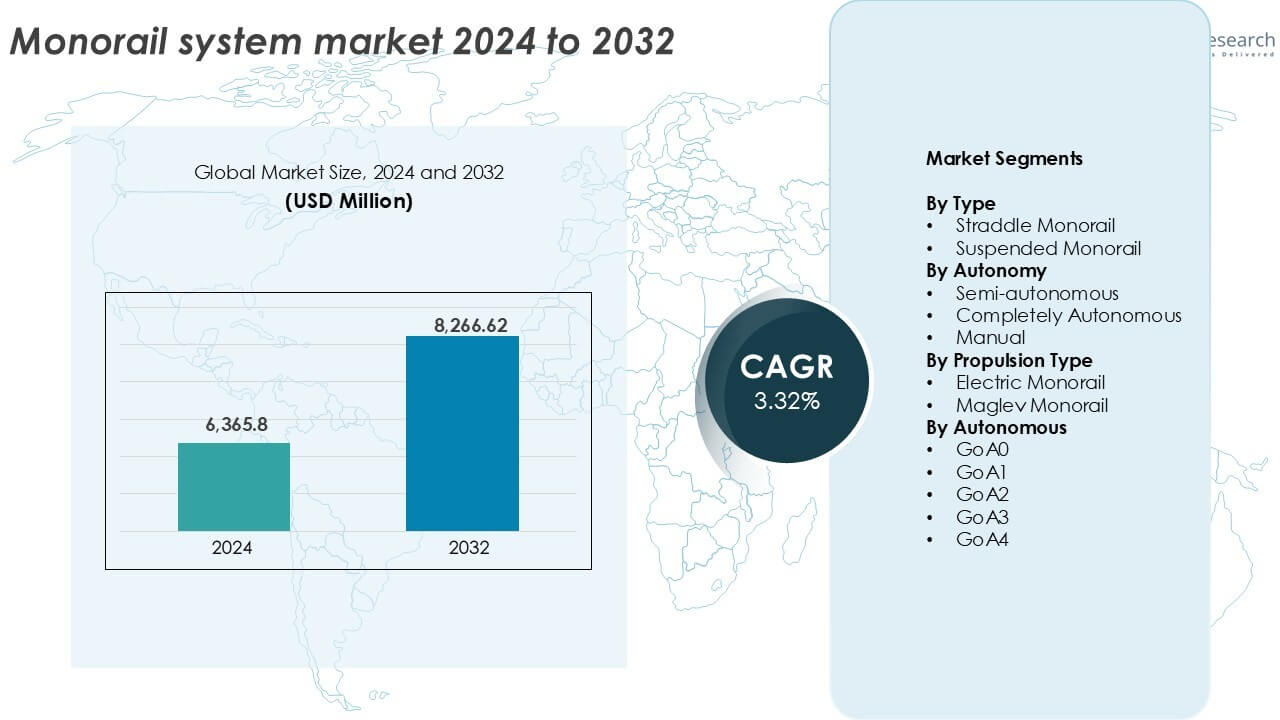
The Monorail System market size was valued at USD 6,365.8 million in 2024 and is anticipated to reach USD 8,266.62 million by 2032, at a CAGR of 3.32% during the forecast period.
| REPORT ATTRIBUTE | DETAILS |
|---|---|
| Historical Period | 2020-2023 |
| Base Year | 2024 |
| Forecast Period | 2025-2032 |
| Monorail System Market Size 2024 | USD 6,365.8 million |
| Monorail System Market, CAGR | 3.32% |
| Monorail System Market Size 2032 | USD 8,266.62 million |
Monorail system market: Global analysis and forecast
The monorail system market is led by key players including Hitachi Rail, CRRC Corporation Limited, Bombardier Corporation, Alstom S.A. and BYD Company Ltd. These companies dominate due to their strong portfolios in monorail vehicle manufacturing, signaling technologies and integrated transit solutions. Hitachi Rail and CRRC have established extensive networks across Asia-Pacific, the leading region with a 45% market share in 2024. Alstom and Bombardier maintain a strong presence in Europe and Latin America, while BYD continues expanding in China and Southeast Asia. Siemens AG, Mitsubishi Electric and Thales Group contribute to control, electrification and automation technologies supporting system reliability and efficiency. Collaborations and technology transfers remain key strategies among global players to strengthen their competitive position in emerging markets and smart city transport infrastructure development.
Monorail System Market Insights
- The monorail system market reached $6.37 billion in 2024 and is forecast to reach $8.27 billion by 2032, growing at a CAGR of 3.32%.
- Market growth is driven by rapid urbanization, traffic congestion and government focus on sustainable public transport. Cities prefer monorails for mid-capacity corridors where metro systems are costly or impractical. Elevated design reduces land use and supports faster project execution.
- Automation, electric propulsion and smart signaling shape current market trends. Straddle monorail systems dominate by type, holding over 65% share due to higher stability and passenger capacity. Electric monorails lead propulsion types with more than 70% share, supported by low emissions and energy efficiency.
- The competitive landscape includes global players focusing on integrated solutions, automation and long-term service contracts. Strong financial capability and project experience remain key advantages in winning large public infrastructure bids.
- Asia-Pacific leads regional demand with about 45% market share, followed by North America at 22% and Europe at 18%. The Middle East and Africa and Latin America together account for the remaining share, driven by mega urban transit projects.
Monorail System Market Segmentation Analysis
By type
The straddle monorail segment holds the dominant share of the global monorail system market, accounting for over 65% of total revenue in 2024. This segment benefits from high passenger capacity, cost-efficient construction and better structural stability in dense urban zones. Straddle systems operate with elevated tracks, reducing land usage and improving integration with existing infrastructure. Major city deployments across Asia-Pacific and the Middle East have accelerated adoption. Their ability to manage higher axle loads and ensure safer navigation on curves further supports their preference over suspended systems in metropolitan transit networks.
- Hitachi Rail delivered the Chongqing straddle monorail system in China, operating over 90 kilometers of track. The network runs six-car trains carrying more than 30,000 passengers per hour per direction.
By autonomy
The semi-autonomous segment leads the monorail system market with a share exceeding 45% in 2024. Transit authorities favor this configuration for its balance of automation efficiency and human oversight. Semi-autonomous systems lower operational costs while enhancing safety through AI-assisted functions, including obstacle detection and real-time diagnostics. Cities adopting smart mobility solutions find this mode attractive for modernizing public transport with reduced driver dependency. These systems also allow smoother transitions for operators and regulators cautious about fully autonomous transport modes, making them ideal for staged automation deployment in high-density corridors.
- Alstom supplies semi-automated monorail signaling with driver-assist functions. Alstom's Urbalis-based systems support automatic train protection and real-time condition monitoring.
By propulsion type
The electric monorail segment dominates the propulsion type category, capturing more than 70% of market share in 2024. Governments and urban planners prefer electric propulsion for its lower emissions, noise reduction and alignment with sustainability goals. These systems offer simplified maintenance and energy efficiency, lowering total lifecycle costs. Electrically powered monorails also integrate well with renewable energy grids and regenerative braking technologies. Growing emphasis on eco-friendly transit in China, Japan and European countries supports further adoption, especially in congested urban centers seeking clean, reliable public transportation.
Key Growth Drivers
Urban population growth and congestion management
Rapid urbanization has intensified traffic congestion in major cities, driving demand for efficient public transit systems. Monorails offer an elevated, space-efficient alternative to traditional rail and bus systems, requiring minimal ground footprint. They reduce travel time in densely populated urban corridors and integrate smoothly with intermodal transit hubs. Governments in countries like India, China and Brazil are investing in monorail infrastructure to ease vehicular congestion and support sustainable mobility. Urban transport authorities prefer monorails for mid-capacity routes where subways are financially or spatially unviable. As urban populations grow, monorails offer a scalable, low-emission solution to improve urban mobility.
- Chongqing Rail Transit operates the world's largest monorail network. Lines 2 and 3 together exceed 90 kilometers in route length. Line 3 alone carries more than 1.3 million passengers per day.
Emphasis on eco-friendly and energy-efficient transport
Environmental concerns and carbon reduction goals have made monorails a preferred option in sustainable transport planning. Electric-powered monorails emit significantly less pollution than diesel-based modes, contributing to clean air initiatives. Their quiet operation and minimal land use reduce ecological disruption during installation and operation. Policymakers are incentivizing green transit infrastructure through subsidies, low-interest financing and public-private partnerships. Countries adopting green transport targets, including Japan and Germany, are investing in monorail systems for urban and intercity use. Monorails also complement renewable energy grids and can integrate with electric vehicle charging networks.
- Hitachi Rail supplies electric straddle monorail systems with regenerative braking technology. The Chongqing monorail recovers braking energy back into the traction power system.
Rising investment in transit infrastructure modernization
Governments worldwide are allocating higher budgets to upgrade and expand public transport systems, with monorails gaining traction as a cost-effective alternative to subways. Emerging economies in Asia-Pacific, Latin America and Africa are initiating monorail projects as part of broader infrastructure reforms and economic stimulus packages. Modular construction, faster deployment and lower tunneling requirements reduce installation timelines and capital expenditure. Countries like Thailand and Egypt have launched large-scale monorail corridors under national transportation strategies. Global infrastructure financing institutions and private investors are also participating in these developments, making monorail deployment more feasible and widespread.
Key Trends and Opportunities
Integration of autonomous and AI-driven control systems
Adoption of semi-autonomous and fully autonomous monorail systems is increasing, driven by advances in artificial intelligence, sensors and machine learning. These systems enhance safety, reduce human error and improve scheduling precision. Automation also lowers labor costs, enabling operators to scale services with fewer personnel. Countries like South Korea and the UAE are piloting driverless monorail systems for urban routes. AI tools support predictive maintenance, real-time passenger information and adaptive traffic control. Integration with centralized transport management platforms allows seamless multimodal connectivity and analytics-driven route optimization.
- Hitachi Rail deploys AI-based train control and monitoring systems in urban monorail projects. Hitachi's systems use continuous condition monitoring to predict component wear before failure.
Public-private partnerships and global collaborations
Public-private partnerships are becoming a key model for monorail development, allowing governments to share project risk and financing with private investors. This trend accelerates infrastructure rollout in budget-constrained regions while ensuring operational efficiency. International firms bring advanced rolling stock, signaling systems and project execution expertise. Hitachi, Alstom and Bombardier are involved in several monorail partnerships across Asia and the Middle East. PPPs also enable lifecycle management approaches, including design-build-operate-transfer and revenue-sharing models. These partnerships unlock new markets and offer long-term revenue streams for both public authorities and private companies.
Key Challenges
High initial capital expenditure and long payback period
Despite being cheaper than subways, monorail systems still involve high upfront costs related to elevated tracks, station infrastructure and specialized rolling stock. In developing countries, financial constraints delay or halt projects. Return on investment depends heavily on passenger volumes, which may fluctuate due to urban migration, competing transit systems or policy changes. The long payback period discourages private investors unless strong guarantees are provided. Maintenance of elevated infrastructure and proprietary components adds to recurring costs. These financial and operational risks limit adoption in regions without robust funding mechanisms or regulatory frameworks.
Limited flexibility and network scalability
Monorail systems lack the route flexibility of bus networks and often require dedicated corridors with minimal curvature. Their elevated design imposes constraints in highly built-up urban areas with space or zoning issues. Integration with other modes - such as metros or trams - requires customized infrastructure that may not be cost-effective. Extensions or changes in route alignment are complex and costly. In some cities, monorails serve only a small fraction of the commuting population due to limited coverage. These scalability issues can make monorails less attractive compared to modular or on-demand transport systems, especially in rapidly changing urban layouts.
Regional Analysis
Asia-Pacific
Asia-Pacific holds the largest share of the global monorail system market, accounting for over 45% in 2024. High urban population density, traffic congestion and strong government investment drive demand across China, India, Japan and Thailand. India continues to expand its Mumbai Monorail, while China is deploying straddle monorail systems in medium-tier cities. Japan remains a leader in operational safety and automation. Public-private partnerships and smart city initiatives also support regional growth.
North America
North America holds approximately 22% market share. The U.S. and Canada are gradually adopting monorail solutions for specific urban corridors, airport transit and entertainment hubs. Projects like the Las Vegas Monorail and Disney's monorail network illustrate use in niche segments. Local governments are evaluating monorail systems as supplements to light rail, particularly in cities facing space constraints. Ongoing infrastructure modernization plans and private investments offer future growth opportunities.
Europe
Europe represents nearly 18% of the global monorail system market, supported by sustainability goals and smart transport investments. Germany, France and the United Kingdom are exploring monorail systems as part of low-emission transit solutions in urban zones. European Union transport policies encourage electric mobility and infrastructure innovation, favoring monorail adoption. While metros dominate public rail networks, monorails are being considered for feeder routes and tourist corridors.
Middle East and Africa
The Middle East and Africa region contributes around 9% to the global monorail system market. The UAE, Saudi Arabia and Egypt are driving regional growth with high-profile projects. Cairo's monorail development is one of the largest globally, aiming to connect the New Administrative Capital. Gulf nations view monorails as part of their diversification and sustainability plans. Africa's adoption remains limited but is expected to rise through international aid and development funding.
Latin America
Latin America holds a 6% share of the global monorail system market, with Brazil and Mexico leading deployments. São Paulo's monorail network is among the largest in the region, offering scalable, elevated solutions in crowded urban areas. Economic constraints and political instability have slowed adoption in some countries, but growing urban populations and interest in low-emission transit are renewing momentum. As urban sprawl intensifies in megacities, monorails offer efficient public transport with lower ground disruption and competitive installation timelines compared to subways.
Monorail System Market Segmentations:
By Type
- Straddle Monorail
- Suspended Monorail
By Autonomy
- Semi-autonomous
- Completely Autonomous
- Manual
By Propulsion Type
- Electric Monorail
- Maglev Monorail
By Autonomous
- GoA0
- GoA1
- GoA2
- GoA3
- GoA4
By Geography
- North America
- U.S.
- Canada
- Mexico
- Europe
- Germany
- France
- U.K.
- Italy
- Spain
- Rest of Europe
- Asia Pacific
- China
- Japan
- India
- South Korea
- South-east Asia
- Rest of Asia Pacific
- Latin America
- Brazil
- Argentina
- Rest of Latin America
- Middle East & Africa
- GCC Countries
- South Africa
- Rest of the Middle East and Africa
Competitive Landscape
The monorail system market features a moderately consolidated competitive landscape, with a mix of global corporations and regional players driving innovation and deployment. Key participants include Hitachi Rail, CRRC Corporation Limited, Bombardier Corporation, Alstom S.A. and BYD Company Ltd, each offering specialized rolling stock, automation and propulsion technologies. These companies compete on system efficiency, safety integration and lifecycle cost advantages. Strategic partnerships, public-private contracts and cross-border technology transfers are common to gain market access. Siemens AG and Mitsubishi Electric contribute advanced control systems, while ABB and Thales Group focus on electrification and signaling solutions. Local firms and joint ventures in Asia-Pacific and the Middle East are gaining traction through government-backed infrastructure rollouts.
Key player analysis
- Thales Group
- Mitsubishi Electric
- General Electric
- Hitachi Rail
- CRRC Corporation Limited
- BYD Company Ltd
- Bombardier Corporation
- Alstom S.A.
- Siemens AG
- ABB
- Ansaldo STS
Recent developments
In Sept. 2024, trains manufactured by Alstom were successfully tested before the launch of a new Egyptian monorail system. The trains were constructed under a £2.3 billion contract and are part of a 61-mile monorail network in the Egyptian capital.
In June 2024, the first monorail train from China arrived in São Paulo, Brazil. A total of 14 monorail trains have been ordered for Line 17, known as the Gold line. BYD will deliver all trains through 2025.
In Feb. 2023, CRRC Changchun introduced its first medium-capacity monorail train in Chongqing, China. The multi-adaptive straddle-type monorail offers excellent climbing ability, a small turning radius and high environmental adaptability. With a maximum speed of 80 kilometers per hour, each car accommodates 136 passengers. Its lightweight construction and low running noise minimize environmental impact.
Report coverage
The research report offers an in-depth analysis based on type, autonomy, propulsion type and geography. It details leading market players, providing an overview of their business, product offerings, investments, revenue streams and key applications. The report also includes insights into the competitive environment, SWOT analysis, current market trends, and primary drivers and constraints. It examines market dynamics, regulatory scenarios and technological advancements shaping the industry, and provides strategic recommendations for new entrants and established companies.
Future outlook
- Demand for monorail systems will grow steadily due to urban population expansion and congestion concerns.
- Governments will prioritize monorails in sustainable transport strategies for mid-capacity urban routes.
- Electric monorails will dominate propulsion choices with increased focus on clean, energy-efficient transit.
- Straddle monorail systems will continue to lead due to structural advantages and higher passenger capacity.
- Integration of AI-driven automation and predictive maintenance will improve operational efficiency.
- Public-private partnerships will expand, enabling faster project execution and shared investment risks.
- Asia-Pacific will remain the largest regional market, driven by infrastructure investments and urban mobility needs.
- Semi-autonomous monorail systems will gain wider acceptance for balancing safety and automation.
- High initial capital costs and limited network scalability will continue to challenge adoption in some regions.
- Cross-border collaborations and technology transfers will support standardization and global market expansion.

Request a Free Sample
Fill in your details and we'll send you a free sample report.
- Sample data tables & charts
- Research methodology
Need a Custom Version of This Report?
Tailor the scope, geography, or segments to your exact requirements.
- Custom geography or segment scope
- Direct access to our analyst team
Frequently Asked Questions
What is the current market size for the Monorail system market, and what is its projected size in 2032?
At what Compound Annual Growth Rate is the Monorail system market projected to grow between 2024 and 2032?
Which Monorail system market segment held the largest share in 2024?
What are the primary factors fueling the growth of the Monorail system market?
Who are the leading companies in the Monorail system market?
Which region commanded the largest share of the Monorail system market in 2024?
Table of Content
Chapter 1 Market Segmentation
- 1.1 Segmentation Framework
- 1.1.1 Product and Service Classification
- 1.1.2 Application and End-Use Classification
- 1.1.3 Technology and Solution Classification
- 1.1.4 Customer and Distribution Channel Classification
- 1.1.5 Geographic Segmentation
- 1.1.6 Market Segment Definitions and Boundaries
Chapter 2 Introduction
- 2.1 Report Objectives and Scope
- 2.2 Product Definition and Industry Terminology
- 2.3 Market Inclusions and Exclusions
- 2.4 Research Process
- 2.4.1 Primary Research and Expert Interviews
- 2.4.2 Secondary Research and Source Review
- 2.4.3 Top-Down and Bottom-Up Estimation
- 2.4.4 Data Triangulation and Verification
- 2.5 Market Size Measurement Basis
- 2.5.1 2024: USD 6,365.8 million → 2032: USD 8,266.62 million
- 2.6 Historical and Forecast Reference Periods
- 2.6.1 Base Year: 2024
- 2.6.2 Forecast Period: 2024-2032
- 2.7 Research Assumptions and Limitations
Chapter 3 Executive Summary
- 3.1 Market Snapshot and Key Findings
- 3.2 Base-Year Market Size, 2024
- 3.3 Forecast Market Size, 2032
- 3.4 Revenue and Volume Growth Outlook
- 3.5 Key Demand and Supply Indicators
- 3.6 Leading Market Segments
- 3.7 Fastest-Growing Market Opportunities
- 3.8 Regional Performance Highlights
- 3.9 Technology and Industry Transformation
- 3.10 Competitive Landscape Summary
- 3.11 Analyst View and Strategic Implications
Chapter 4 Global Monorail Systems Market Trends and Developments
- 4.1 Historical Industry Development
- 4.2 Recent Market Trends and Developments
- 4.3 Demand and Customer Behavior Trends
- 4.4 Technology and Product Innovation
- 4.5 Artificial Intelligence, Automation and Digitalization
- 4.6 Local Manufacturing and Supply Chain Realignment
- 4.7 Industry Partnerships, Mergers and Acquisitions
- 4.8 Sustainability and Circular Economy Developments
- 4.9 Government and Private Sector Investment Trends
- 4.10 Emerging Business Models and Commercialization
- 4.11 Industry Developments and Announcements
Chapter 5 Global Monorail Systems Market Production, Supply and Demand Analysis
- 5.1 Demand Trend and Consumption Analysis
- 5.2 Demand Forecast, 2024-2032
- 5.3 Production and Output Trend
- 5.4 Production and Output Forecast, 2024-2032
- 5.5 Installed Capacity and Capacity Utilization
- 5.6 Company-Wise Production Plants and Statistics
- 5.6.1 Installed Production Capacity
- 5.6.2 Actual Production
- 5.6.3 Planned Capacity and Expansion Targets
- 5.7 Supply Chain Structure and Procurement Trends
- 5.8 Supply-Demand Gap and Bottlenecks
- 5.9 Import Dependence and Sourcing Structure
- 5.10 Contract Manufacturing and Outsourcing
- 5.11 Regional Supply and Demand Concentration
Chapter 6 Global Monorail Systems Market Pricing Analysis
- 6.1 Pricing Structure and Measurement
- 6.2 Historical Pricing Trends
- 6.3 Pricing Outlook, 2024-2032
- 6.4 Average Selling Price and Unit Economics
- 6.5 Pricing by Product and Market Segment
- 6.6 Geographic Pricing Differences
- 6.7 Key Input, Energy, Labor and Logistics Costs
- 6.8 Contract Pricing and Purchasing Models
- 6.9 Pricing Sensitivity and Competitive Positioning
- 6.10 Price, Margin and Profitability Implications
Chapter 7 Global Monorail Systems Market Dynamics
- 7.1 Market Growth Drivers
- 7.1.1 Demand-Side Drivers
- 7.1.2 Technology and Innovation Drivers
- 7.1.3 Infrastructure and Investment Drivers
- 7.1.4 Regulatory and Policy Drivers
- 7.2 Market Restraints
- 7.2.1 Cost and Affordability Constraints
- 7.2.2 Technology and Adoption Barriers
- 7.2.3 Supply Chain and Operational Constraints
- 7.3 Market Challenges
- 7.3.1 Competitive Pressure and Margin Erosion
- 7.3.2 Skills, Infrastructure and Implementation Gaps
- 7.4 Emerging Market Opportunities
- 7.5 Market Dynamics Impact and Time-Horizon Assessment
Chapter 8 Global Monorail Systems Value Chain Analysis
- 8.1 Industry Value Chain Overview
- 8.2 Upstream Suppliers and Critical Inputs
- 8.3 Technology and Component Providers
- 8.4 Manufacturing or Service Delivery
- 8.5 Distribution, Channel Partners and Integrators
- 8.6 Downstream Applications and End Users
- 8.7 Value Addition and Profit Pools
- 8.8 Vertical Integration and Outsourcing
- 8.9 Supplier Concentration and Risk
- 8.10 Supply Chain Localization and Resilience
Chapter 9 Global Monorail Systems Market Regulations and Policies
- 9.1 Relevant Laws, Standards and Compliance Frameworks
- 9.2 Product, Service, Safety and Quality Requirements
- 9.3 Government Policies, Incentives and Subsidies
- 9.4 Imports, Exports and Trade Barriers
- 9.5 Public Procurement and Local Content Requirements
- 9.6 Environmental and Sustainability Compliance
- 9.7 Upcoming Policy Changes and Market Implications
Chapter 10 Global Monorail Systems Market Hotspots and Opportunities
- 10.1 Market Opportunity Mapping and Growth Hotspots
- 10.2 High-Growth Applications and Customer Groups
- 10.3 Underserved Markets and White-Space Opportunities
- 10.4 Emerging Technology and Product Opportunities
- 10.5 New Capacity and Investment Hotspots
- 10.6 Market Entry and Expansion Opportunities
- 10.7 Distribution and Partnership Opportunities
- 10.8 Near-Term and Long-Term Commercial Potential
- 10.9 Opportunity Attractiveness and Execution Risks
Chapter 11 Global Monorail Systems Market Outlook, 2024-2032
- 11.1 Market Size and Analysis
- 11.1.1 Revenue (Market Measurement: 2024: USD 6,365.8 million → 2032: USD 8,266.62 million)
- 11.1.2 Market Volume and Quantity Sold
- 11.1.3 Historical Market Size
- 11.1.4 Base-Year Market Size, 2024
- 11.2 Market Forecast, 2024-2032
- 11.2.1 Revenue Forecast to 2032
- 11.2.2 Volume Forecast to 2032
- 11.2.3 CAGR and Year-on-Year Growth
- 11.2.4 Incremental Revenue Opportunity
- 11.3 Forecast Assumptions and Scenario Analysis
- 11.3.1 Base-Case Forecast
- 11.3.2 Optimistic and Conservative Scenarios
- 11.3.3 Technology, Pricing and Policy Sensitivities
- 11.4 Market Attractiveness and Growth Outlook
Chapter 12 Global Monorail Systems Market Segmentation and Outlook
- 12.1 Segmentation Summary and Market Shares, 2024
- 12.2 Largest and Fastest-Growing Segments
- 12.3 Segment Growth Comparison
- 12.4 Segment Attractiveness and Priority Matrix
Chapter 13 Global Monorail Systems Geographic Market Outlook, 2024-2032
- 13.1 Regional Market Size and Share, 2024
- 13.2 Regional Market Forecast, 2024-2032
- 13.3 Regional Pricing, Production and Demand Differences
- 13.4 North America
- 13.4.1 United States
- 13.4.2 Canada
- 13.4.3 Mexico
- 13.5 Europe
- 13.5.1 Germany
- 13.5.2 France
- 13.5.3 Italy
- 13.5.4 United Kingdom
- 13.5.5 Spain
- 13.5.6 Poland
- 13.5.7 Russia
- 13.5.8 Netherlands
- 13.5.9 Belgium
- 13.5.10 Sweden
- 13.5.11 Denmark
- 13.5.12 Norway
- 13.5.13 Rest of Europe
- 13.6 Asia Pacific
- 13.6.1 China
- 13.6.2 India
- 13.6.3 Japan
- 13.6.4 South Korea
- 13.6.5 Thailand
- 13.6.6 Indonesia
- 13.6.7 Vietnam
- 13.6.8 Malaysia
- 13.6.9 Australia
- 13.6.10 Rest of Asia Pacific
- 13.7 Latin America
- 13.7.1 Brazil
- 13.7.2 Argentina
- 13.7.3 Colombia
- 13.7.4 Chile
- 13.7.5 Rest of Latin America
- 13.8 Middle East
- 13.8.1 Saudi Arabia
- 13.8.2 United Arab Emirates
- 13.8.3 Turkey
- 13.8.4 Israel
- 13.8.5 Iran
- 13.8.6 Rest of the Middle East
- 13.9 Africa
- 13.9.1 South Africa
- 13.9.2 Egypt
- 13.9.3 Nigeria
- 13.9.4 Morocco
- 13.9.5 Rest of Africa
- 13.10 Regional Investment, Policy and Supply Chain Differences
- 13.11 Regional Competitive Landscape
- 13.12 Geographic Growth Hotspots
Chapter 14 Global Monorail Systems Technology, Innovation and Sustainability Outlook
- 14.1 Technology Landscape and Maturity
- 14.2 Product, Process and Service Innovation
- 14.3 AI, Automation and Digital Tools in the Industry
- 14.4 Technology Adoption and Performance Benchmarking
- 14.5 Innovation Pipeline and R&D Investment
- 14.6 Patent and Intellectual Property Trends
- 14.7 Energy Efficiency and Resource Management
- 14.8 Sustainability, Recycling and Circularity
- 14.9 Technology Roadmap, 2024-2032
- 14.10 Risks of Obsolescence and Technology Substitution
Chapter 15 Global Monorail Systems Market Key Strategic Imperatives
- 15.1 Growth and Market Entry Priorities
- 15.2 High-Return Products and Segments
- 15.3 Pricing, Profitability and Cost Optimization
- 15.4 Technology Investment and Product Differentiation
- 15.5 Supply Chain Localization and Resilience
- 15.6 Distribution and Customer Acquisition
- 15.7 Partnership, Acquisition and Capacity Strategy
- 15.8 Regional Expansion Priorities
- 15.9 Short-, Medium- and Long-Term Actions
Chapter 16 Competition Outlook
- 16.1 Industry Competition Characteristics
- 16.2 Market Structure and Concentration
- 16.3 Market Share and Competitive Positioning, 2024
- 16.4 Company-Wise Revenue and Product Benchmarking
- 16.5 Production and Service Capacity Benchmarking
- 16.6 Technology, Pricing and Differentiation
- 16.7 Regional Footprint and Distribution Strength
- 16.8 Mergers, Acquisitions and Strategic Alliances
- 16.9 New Entrants and Competitive Threats
- 16.10 Porter's Five Forces and Industry Attractiveness
- 16.11 Competitive Outlook, 2024-2032
Chapter 17 Company Profiles
- 17.1 Company Coverage and Selection Criteria
- 17.2 Leading Market Participants – Standard Profile Structure
- 17.2.1 Business Description
- 17.2.2 Company Ownership and Geographic Presence
- 17.2.3 Product and Service Portfolio
- 17.2.4 Manufacturing and Operating Footprint
- 17.2.5 Production Capacity and Expansion Plans
- 17.2.6 Financial Performance and Investment
- 17.2.7 Market Share and Competitive Position
- 17.2.8 Technology and Innovation Capabilities
- 17.2.9 Strategic Alliances or Partnerships
- 17.2.10 Recent Developments
- 17.2.11 Growth Strategy and Outlook
- 17.3 Other Relevant Market Participants
Note: Every listed company is profiled on the structure shown under the first company. The company list is preliminary and may change based on research findings, market developments, data availability and client requirements.
Chapter 18 Disclaimer
- 18.1 Research and Forecast Disclaimer
- 18.2 Data Source and Estimation Limitations
Note: The depth of individual sections depends on data availability for this market. Volume, capacity, trade and other unit-based metrics are included where applicable.