
Market Overview
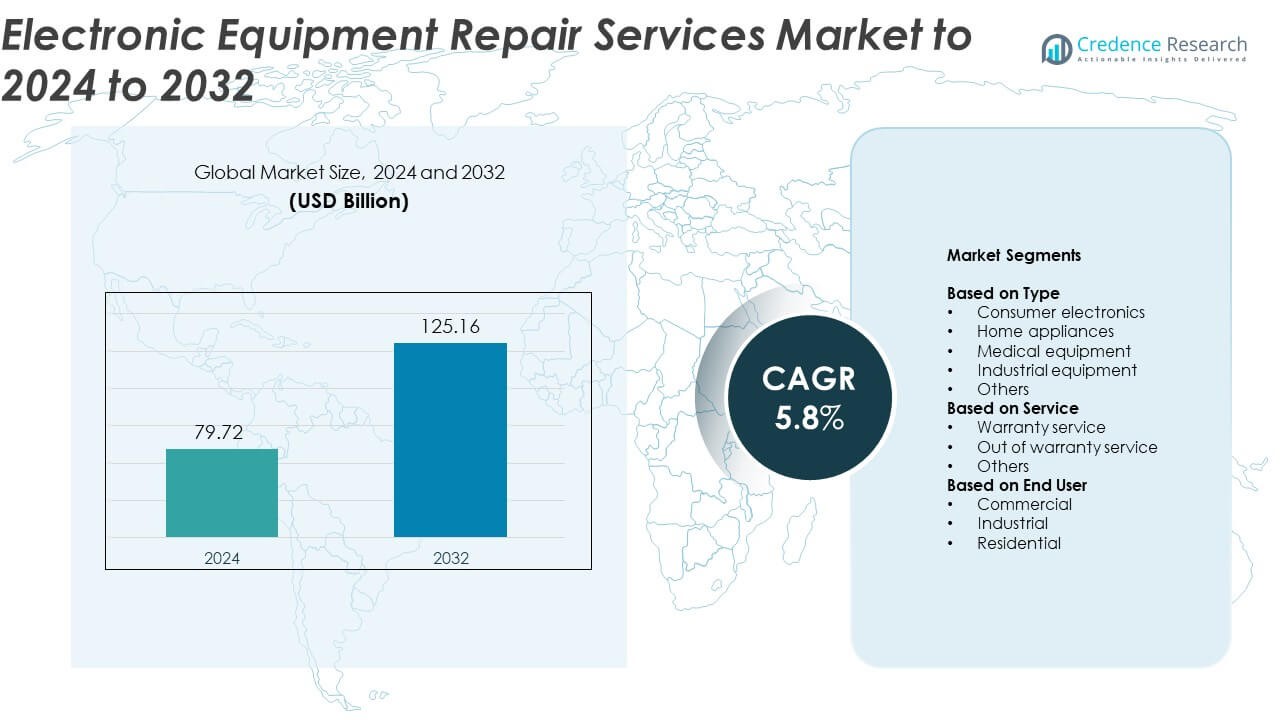
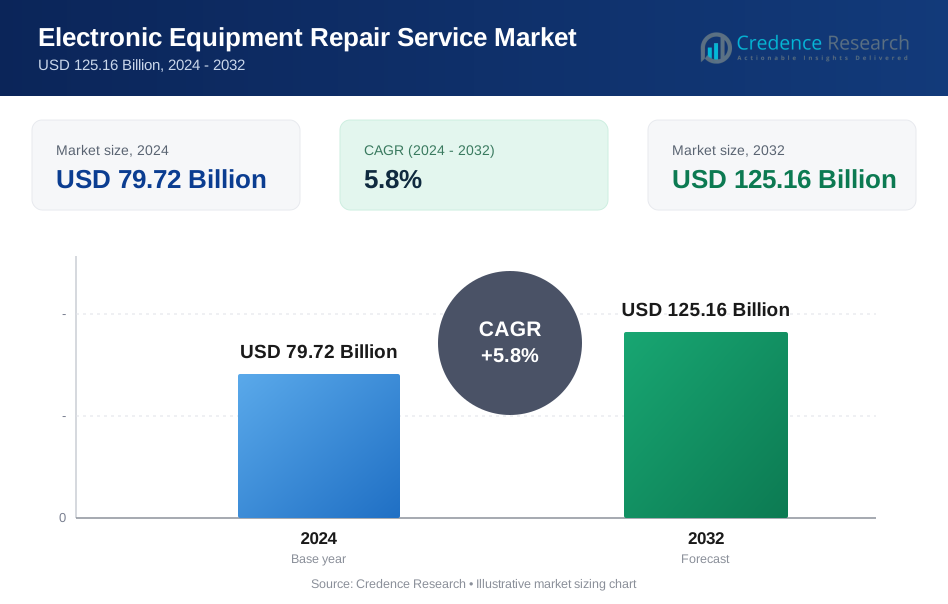
The Electronic Equipment Repair Services Market size was valued at USD 79.72 Billion in 2024 and is anticipated to reach USD 125.16 Billion by 2032, at a CAGR of 5.8% during the forecast period.
| REPORT ATTRIBUTE | DETAILS |
|---|---|
| Historical Period | 2020-2023 |
| Base Year | 2024 |
| Forecast Period | 2025-2032 |
| Electronic Equipment Repair Service Market Size 2024 | USD 79.72 Billion |
| Electronic Equipment Repair Service Market, CAGR | 5.8% |
| Electronic Equipment Repair Service Market Size 2032 | USD 125.16 Billion |
The electronic equipment repair services market is shaped by key players such as Mendtronix Inc., Redington Services, Encompass Supply Chain Solutions, Inc., B2X Care Solutions GmbH, The Cableshoppe Inc. (CSI), uBreakiFix (Asurion LLC), Quest International, Inc., Moduslink Global Solutions, Electronix Services Ltd., Parts Town, and iCracked, Inc. (Square Trade). These companies dominate through wide service portfolios, advanced repair capabilities, and strong regional networks. North America leads the market with a 37% share in 2024, driven by high electronic device adoption and structured service systems. Europe follows with 29% share, supported by sustainability-focused repair initiatives, while Asia Pacific captures 24% share, reflecting growing demand from cost-conscious consumers.
Market Insights
- The electronic equipment repair services market was valued at USD 79.72 Billion in 2024 and is projected to reach USD 125.16 Billion by 2032, growing at a CAGR of 5.8%.
- Rising ownership of smartphones, laptops, and appliances is fueling demand for repair and maintenance services, with consumer electronics accounting for 46% of total market share.
- Growing focus on sustainability and the circular economy is driving adoption of repair-friendly policies and eco-efficient service models.
- The market is moderately fragmented, with companies expanding after-sales networks and integrating AI-based diagnostic tools to enhance service efficiency.
- North America leads with 37% share, followed by Europe at 29% and Asia Pacific at 24%, driven by robust digital infrastructure, environmental regulations, and increasing demand for affordable repair options.
Market Segmentation Analysis:
By Type
Consumer electronics dominate the electronic equipment repair services market, accounting for nearly 46% share in 2024. The dominance stems from the rising ownership of smartphones, laptops, and televisions that require frequent maintenance and part replacement. Rapid product innovation and shorter device lifecycles have increased demand for repair services. Growing e-waste concerns and the push for circular economy models are encouraging users to repair rather than replace devices. Expanding after-sales networks by manufacturers and independent service providers further strengthen the segment’s position in the global market.
- For instance, Apple operates 5,000+ Authorized Service Providers worldwide, supporting device repairs.
By Service
Out of warranty service leads the market with around 57% share in 2024. The growth is driven by the increasing number of electronic devices that exceed their warranty period but remain functional. Consumers prefer independent or third-party repair centers due to affordable pricing and accessibility. The rising cost of new electronics and greater awareness about repair rights also support this segment. Expanding availability of skilled technicians and certified spare parts enhances the reliability of out-of-warranty repair solutions globally.
- For instance, uBreakiFix by Asurion designated 50 flagship Samsung repair locations across the US.
By End User
The commercial segment holds the largest market share of approximately 48% in 2024. Businesses in retail, healthcare, and IT heavily rely on electronic systems that require regular servicing to avoid downtime. The growth is driven by increasing adoption of high-end devices in offices, clinics, and data centers. Outsourcing repair and maintenance helps enterprises reduce operational costs and extend asset lifespans. Rising focus on preventive maintenance programs and managed service contracts further supports sustained demand in the commercial end-use category.
Key Growth Drivers
Rising Electronic Device Penetration
The rapid adoption of smartphones, laptops, and smart home devices is a major growth driver. Increased consumer dependence on technology has expanded the need for maintenance and repair services. As digital lifestyles evolve, devices are being used more intensively, leading to frequent wear and technical failures. The constant product innovation cycle also raises demand for specialized repair expertise, encouraging service providers to expand their offerings.
- For instance, IDC reported approximately 17 billionsmartphones were shipped globally in 2023, which represented a 3.2% decline compared to 2022.
Shift Toward Sustainable Consumption
Growing environmental awareness is driving consumers to repair rather than replace electronics. Governments and manufacturers are supporting repair-friendly policies to reduce e-waste. This sustainability shift benefits independent and authorized repair centers alike, as users look for cost-effective, eco-conscious solutions. The trend is fostering a circular economy that extends product life cycles and supports market expansion globally.
- For instance, Best Buy’s Geek Squad fields 20,000+ Agents across the US.
Expanding After-Sales Service Networks
Manufacturers and third-party service providers are rapidly broadening their repair and maintenance infrastructure. Enhanced accessibility to service centers, online booking systems, and doorstep repairs have improved customer convenience. Strategic partnerships with retailers and insurers are strengthening after-sales ecosystems. This expansion helps build customer trust and supports long-term brand loyalty while ensuring continuous revenue for service providers.
Key Trends & Opportunities
Integration of AI and IoT in Diagnostics
Artificial intelligence and IoT-based tools are transforming repair diagnostics. These technologies enable predictive maintenance by identifying faults before they cause device failure. Automated analysis reduces repair time and enhances accuracy. Companies are integrating smart diagnostic software and remote monitoring systems to improve efficiency and customer satisfaction.
- For instance, Dell SupportAssist connects to 89 million+ devices for AI-driven diagnostics.
Growing Adoption of Subscription-Based Models Subscription-based maintenance services are gaining popularity across commercial and residential sectors. Customers prefer predictable costs and proactive repairs over one-time expenses. Service providers are offering customized packages covering preventive maintenance, parts replacement, and remote support. This recurring revenue model is enhancing profitability and customer retention.
- For instance, HP Instant Ink counts about 13 million subscribers for subscription maintenance.
Key Challenges
Shortage of Skilled Technicians
A major challenge for the industry is the shortage of qualified repair professionals. The fast pace of technological change demands continuous training and certification. Many regions lack structured programs to develop technical expertise, leading to inconsistent service quality. This skill gap can limit market expansion and delay service delivery.
Rapid Product Obsolescence
Frequent updates and model changes in electronics make repair processes complex and costly. Manufacturers often restrict access to spare parts or repair manuals, limiting third-party service capabilities. As devices become more compact and integrated, repairability decreases. This trend pressures independent service providers to adapt quickly or risk losing competitiveness.
Regional Analysis
North America North America leads the electronic equipment repair services market, accounting for around 37% share in 2024. The region benefits from high electronic device ownership and advanced after-sales service infrastructure. Growing demand for smartphone, laptop, and home appliance repairs supports strong growth. The presence of organized repair networks and extended product life initiatives also contribute to market expansion. The U.S. dominates regional revenue due to well-established electronics ecosystems, while Canada shows steady adoption driven by sustainability-focused consumer behavior.
Europe
Europe holds about 29% share of the market in 2024, driven by strong regulatory support for repair and sustainability. The EU’s “Right to Repair” policies have increased repair accessibility and affordability. Countries such as Germany, France, and the UK are leading due to high consumer awareness and mature service networks. The growing shift toward refurbished electronics further boosts the market. Increasing adoption of green practices and product lifecycle extension programs continues to strengthen Europe’s competitive position.
Asia Pacific
Asia Pacific accounts for nearly 24% share of the electronic equipment repair services market in 2024. Rapid urbanization, increasing electronic device penetration, and cost-sensitive consumers drive strong regional demand. China, Japan, and India are major contributors, supported by large consumer bases and expanding service networks. Local manufacturers and third-party service providers are increasing their presence, making repair services more affordable. Rising awareness about e-waste management and repair-friendly regulations are expected to further accelerate regional growth.
Latin America
Latin America represents around 6% share of the global market in 2024. The region’s growth is fueled by rising consumer electronics ownership and an increasing focus on cost-effective repair options. Brazil and Mexico dominate due to strong retail electronics sectors and growing networks of independent repair providers. Limited product replacement affordability encourages longer device usage, boosting repair demand. Government initiatives promoting e-waste reduction and recycling are also supporting regional expansion.
Middle East and Africa
The Middle East and Africa hold approximately 4% share of the electronic equipment repair services market in 2024. Growth is supported by increasing adoption of consumer electronics and expanding retail infrastructure. The UAE and Saudi Arabia lead regional development with growing demand for smartphone and appliance repair services. Africa’s market is gradually expanding due to affordability-driven repair culture and local entrepreneurship. Efforts to build organized service centers and improve spare parts availability are expected to enhance future market growth.
Market Segmentations:
By Type
- Consumer electronics
- Home appliances
- Medical equipment
- Industrial equipment
- Others
By Service
- Warranty service
- Out of warranty service
- Others
By End User
- Commercial
- Industrial
- Residential
By Geography
- North America
- U.S.
- Canada
- Mexico
- Europe
- Germany
- France
- U.K.
- Italy
- Spain
- Rest of Europe
- Asia Pacific
- China
- Japan
- India
- South Korea
- South-east Asia
- Rest of Asia Pacific
- Latin America
- Brazil
- Argentina
- Rest of Latin America
- Middle East & Africa
- GCC Countries
- South Africa
- Rest of the Middle East and Africa
Competitive Landscape
The electronic equipment repair services market features a competitive landscape with key participants such as Mendtronix Inc., Redington Services, Encompass Supply Chain Solutions, Inc., B2X Care Solutions GmbH, The Cableshoppe Inc. (CSI), uBreakiFix (Asurion LLC), Quest International, Inc., Moduslink Global Solutions, Electronix Services Ltd., Parts Town, and iCracked, Inc. (Square Trade). The market is highly fragmented, with companies focusing on expanding service networks, improving turnaround times, and integrating advanced diagnostic technologies. Players are adopting digital platforms for booking, tracking, and customer support to enhance efficiency and transparency. Strategic alliances with OEMs and component suppliers strengthen access to genuine parts and service reliability. Many firms are investing in sustainability through repair-friendly initiatives and eco-efficient operations. Continuous staff training, certification programs, and global logistics capabilities further enhance competitiveness, positioning leading players to meet the growing demand for reliable, fast, and cost-effective electronic repair solutions.
Key Player Analysis
- Mendtronix Inc.
- Redington Services
- Encompass Supply Chain Solutions, Inc.
- B2X Care Solutions GmbH
- The Cableshoppe Inc. (CSI)
- uBreakiFix (Asurion LLC)
- Quest International, Inc.
- Moduslink Global Solutions
- Electronix Services Ltd.
- Parts Town
- iCracked, Inc. (Square Trade)
Recent Developments
- In 2025, Encompass partnered strategically with ServicePower, a leading field service management platform.
- In 2025, uBreakiFix (Asurion LLC) Opened new repair locations, expanding U.S. footprint.
- In 2024, Parts Town launched two new AI-powered tools: PartPredictor and the HVAC Data Plate Scanner, aimed at improving efficiency in identifying correct parts for repairs across various equipment types.
Report Coverage
The research report offers an in-depth analysis based on Type, Service, End-User and Geography. It details leading market players, providing an overview of their business, product offerings, investments, revenue streams, and key applications. Additionally, the report includes insights into the competitive environment, SWOT analysis, current market trends, as well as the primary drivers and constraints. Furthermore, it discusses various factors that have driven market expansion in recent years. The report also explores market dynamics, regulatory scenarios, and technological advancements that are shaping the industry. It assesses the impact of external factors and global economic changes on market growth. Lastly, it provides strategic recommendations for new entrants and established companies to navigate the complexities of the market.
Future Outlook
- The market will continue growing as consumers favor repair over replacement to reduce waste.
- Expanding digitalization will drive demand for skilled technicians and advanced diagnostic tools.
- Manufacturers will strengthen authorized service networks to enhance customer trust.
- AI-driven predictive maintenance will become standard for both industrial and consumer applications.
- Governments will introduce more repair-friendly regulations supporting circular economy practices.
- Subscription-based repair and maintenance plans will see increased adoption among commercial users.
- Growth in refurbished electronics will create new revenue streams for service providers.
- Emerging economies will witness strong expansion due to cost-sensitive consumers.
- Online booking platforms and on-site repair models will improve customer convenience.
- Strategic partnerships between OEMs and independent service providers will enhance global service accessibility.
Request a Free Sample
Fill in your details and we'll send you a free sample report.
- Sample data tables & charts
- Research methodology
Need a Custom Version of This Report?
Tailor the scope, geography, or segments to your exact requirements.
- Custom geography or segment scope
- Direct access to our analyst team
Frequently Asked Questions
What is the current market size for Electronic Equipment Repair Services Market, and what is its projected size in 2032?
At what Compound Annual Growth Rate is the Electronic Equipment Repair Services Market projected to grow between 2025 and 2032?
Which Electronic Equipment Repair Services Market segment held the largest share in 2024?
What are the primary factors fueling the growth of the Electronic Equipment Repair Services Market?
Who are the leading companies in the Electronic Equipment Repair Services Market?
Which region commanded the largest share of the Electronic Equipment Repair Services Market in 2024?
Table of Content
Chapter 1. Report Introduction
- 1.1 Report Description & Purpose
- 1.1.1 Report Title & Market Definition
- 1.1.2 Unique Selling Propositions (USP) & Key Differentiators
- 1.1.3 Value Proposition for Stakeholders
- 1.2 Research Objectives
- 1.2.1 Market Sizing Objectives (Volume & Revenue)
- 1.2.2 Segmentation Objectives
- 1.2.3 Competitive Intelligence Objectives
- 1.2.4 Forecast & Scenario Objectives
- 1.3 Report Scope
- 1.3.1 Electronic Equipment Repair Service Scope – Types & Subtypes Covered
- 1.3.2 Geographic Scope – Regions & Countries Covered
- 1.3.3 Historical Period, Base Year & Forecast Period (2024; forecast to 2032)
- 1.3.4 Inclusions & Exclusions
- 1.4 HS Code & Classification Framework
- 1.5 Currency, Units & Pricing Basis
- 1.6 Target Stakeholders
- 1.7 Limitations & Assumptions
Chapter 2. Executive Summary
- 2.1 Global Electronic Equipment Repair Service Market Snapshot
- 2.1.1 Market Size – Historical (2024) & Forecast (2024-2032) (2024: USD 79.72 Billion → 2032: USD 125.16 Billion)
- 2.1.2 Volume & Revenue – Global Totals
- 2.1.3 Key Market Highlights – Top Five Facts
- 2.2 Electronic Equipment Repair Service Market Segmentation Snapshot
- 2.2.1 Market Split by Region – 2024 vs. 2032
- 2.3 Competitive Snapshot
- 2.3.1 Top 10 Players by Revenue Share – 2024
- 2.3.2 Top 10 Players by Volume Share – 2024
- 2.3.3 Recent Strategic Developments (18-Month Summary)
- 2.4 Key Investment Highlights & Strategic Conclusions
Chapter 3. Electronic Equipment Repair Service Market Dynamics & Industry Analysis
- 3.1 Market Overview & Context
- 3.1.1 Electronic Equipment Repair Service Market Position in the Broader Automotive Value Chain
- 3.1.2 OEM vs. Replacement Market Dynamics
- 3.1.3 Market Maturity & Development Stage by Region
- 3.2 Electronic Equipment Repair Service Market Drivers
- 3.3 Electronic Equipment Repair Service Market Restraints & Challenges
- 3.4 Electronic Equipment Repair Service Market Opportunities
- 3.5 Porter's Five Forces Analysis
- 3.5.1 Threat of New Entrants
- 3.5.2 Bargaining Power of Suppliers
- 3.5.3 Bargaining Power of Buyers
- 3.5.4 Threat of Substitutes
- 3.5.5 Competitive Rivalry – Intensity Assessment
- 3.6 Electronic Equipment Repair Service Value Chain Analysis
- 3.6.1 Upstream – Raw Material/Input Suppliers
- 3.6.1.1 Raw Material/Input 1
- 3.6.1.2 Raw Material/Input 2
- 3.6.1.3 Raw Material/Input 3
- 3.6.2 Midstream – Production/Manufacturing/Service Delivery
- 3.6.2.1 Production/Process Overview
- 3.6.2.2 Key Facility Locations & Capacity by Manufacturer
- 3.6.3 Downstream – Distribution & End Consumer
- 3.6.3.1 Primary Channel – B2B/OEM
- 3.6.3.2 Secondary Channels – Dealer, Retail, Online, Direct
- 3.6.4 Value Chain Profitability Analysis
- 3.6.1 Upstream – Raw Material/Input Suppliers
- 3.7 PESTEL Analysis
- 3.7.1 Political Factors
- 3.7.2 Economic Factors
- 3.7.3 Social Factors
- 3.7.4 Technological Factors
- 3.7.5 Environmental Factors
- 3.7.6 Legal Factors
- 3.8 Electronic Equipment Repair Service Supply Chain Analysis
- 3.8.1 Raw Material/Input Supply Risk Assessment
- 3.8.2 Manufacturing Concentration Risk (Geographic Exposure)
- 3.8.3 Trade Disruption Impact Analysis
- 3.9 Regulatory & Policy Landscape
Note: The regulatory and policy landscape section covers regulations based on their applicability to the market, Electronic Equipment Repair Service category, geography, and scope of the study. Only regulatory frameworks with a material impact on operations, compliance, trade, sustainability, or market access are analyzed in detail.
Chapter 4. Key Investment Pockets & Opportunity Analysis
- 4.1 Electronic Equipment Repair Service Market Attractiveness Analysis
- 4.1.1 By Region – Investment Attractiveness Matrix (Volume × CAGR)
- 4.2 Absolute Revenue Growth Opportunity
- 4.2.1 By Region – Absolute USD Growth Through 2032
- 4.3 Incremental Volume Opportunity
- 4.3.1 By Region – Incremental Volume Through 2032
- 4.3.2 Segment – Incremental Volume
- 4.4 Emerging Submarket Opportunity Deep Dive (Subject to Applicability)
- 4.5 Emerging Market Opportunity Scorecards
- 4.5.1 United States
- 4.5.2 Europe
- 4.5.3 Asia
- 4.5.4 Middle East & Africa
Note: Emerging Market Opportunity Scorecards will be included based on relevance and strategic importance. Regions listed are indicative and may vary depending on data availability and market dynamics.
Chapter 5. Electronic Equipment Repair Service Import-Export Analysis & Trade Flows
- 5.1 Global Trade Overview
- 5.1.1 Global Export Value by Country (2024)
- 5.1.2 Global Export Volume by Country (2024)
- 5.1.3 Global Import Value by Country (2024)
- 5.1.4 Global Import Volume by Country (2024)
- 5.1.5 Net Trade Balance by Country (2024)
- 5.2 Export Analysis – Segment
- 5.2.1 Type 1 (HS Code)
- 5.2.2 Type 2 (HS Code)
- 5.2.3 Type 3 (HS Code)
- 5.2.4 Type 4 (HS Code)
- 5.2.5 Type 5 (HS Code)
- 5.3 Import Analysis – Segment
- 5.3.1 Type 1 (HS Code)
- 5.3.2 Type 2 (HS Code)
- 5.3.3 Type 3 (HS Code)
- 5.3.4 Type 4 (HS Code)
- 5.3.5 Type 5 (HS Code)
- 5.4 Average Unit Trade Prices
- 5.4.1 Average Export Price – Segment & Country
- 5.4.2 Average Import Price – Segment & Source Country
- 5.4.3 Price Trends (2024)
- 5.5 Key Trade Route Analysis
- 5.5.1 Trade Route 1
- 5.5.2 Trade Route 2
- 5.5.3 Trade Route 3
- 5.5.4 Trade Route 4
- 5.5.5 Trade Route 5
- 5.6 Trade Policy Impact Assessment
- 5.6.1 US Anti-Dumping & Section 301 Tariffs
- 5.6.2 EU Customs Union Impact
- 5.6.3 Major Free Trade Agreements
- 5.6.4 USMCA Rules of Origin
Note: Trade policy analysis will be included only where relevant to the Electronic Equipment Repair Service market.
Chapter 6. Competitive Landscape & Company Benchmarking
- 6.1 Electronic Equipment Repair Service Market Concentration & Structure
- 6.1.1 Herfindahl-Hirschman Index (HHI) – vs. 2024
- 6.1.2 Tier 1, Tier 2 & Tier 3 Market Structure
- 6.1.3 Global, Regional & Local Player Dynamics
- 6.2 Electronic Equipment Repair Service Market Share Analysis – 2024
- 6.2.1 Global Revenue Share by Company
- 6.2.2 Global Volume Share by Company
- 6.2.3 Regional Revenue Share
- 6.2.4 Market Share Evolution ( vs. 2024)
- 6.2.5 OEM Segment Share by Company
- 6.2.6 Replacement Segment Share by Company
- 6.3 Production/Delivery Capacity & Facility Analysis
- 6.3.1 Global Installed Capacity
- 6.3.2 Capacity Utilization Rates
- 6.3.3 Production/Output Volume
- 6.3.4 Facility Locations & Capacity Map
- 6.3.5 Planned Capacity Additions
- 6.4 Electronic Equipment Repair Service Competitive Benchmarking Matrix
- 6.4.1 Revenue, Volume, CAGR & Profitability Comparison
- 6.4.2 Channel Revenue Mix
- 6.4.3 Geographic Revenue Exposure
- 6.4.4 R&D Intensity
- 6.4.5 Sustainability Maturity
- 6.5 Strategic Developments in Electronic Equipment Repair Service (Last 24 Months)
- 6.5.1 Mergers, Acquisitions & Divestments
- 6.5.2 New Electronic Equipment Repair Service Launches
- 6.5.3 Facility Expansions
- 6.5.4 Strategic Alliances, Joint Ventures & Partnerships
- 6.5.5 Distribution Expansion & Market Entry
- 6.5.6 Sustainability & ESG Initiatives
- 6.6 Competitive Strategy Mapping
- 6.6.1 Leader, Challenger, Follower & Niche Classification
- 6.6.2 Pricing Strategy Comparison
- 6.6.3 Channel Strategy Matrix
Note: Strategic developments are included based on their materiality and the availability of reliable information.
Chapter 7. Global Electronic Equipment Repair Service Market – By Distribution Channel
- 7.1 Segment Overview
- 7.1.1 Volume & Revenue Split by Channel (2024 & 2032)
- 7.1.2 Channel Mix Evolution (2024-2032)
Chapter 8. Regional Market Analysis – Global Overview
- 8.1 Global Regional Overview
- 8.1.1 Regional Volume Share
- 8.1.2 Regional Revenue Share
- 8.1.3 Regional Volume by Region
- 8.1.4 Regional Revenue by Region
- 8.1.5 Regional Forecast Through 2032
- 8.2 Cross-Regional Segment Analysis
- 8.2.1 By Distribution Channel
- 8.2.2 By Brand/Price Tier
Chapter 9. North America Electronic Equipment Repair Service Market
- 9.1 United States
- 9.2 Canada
- 9.3 Mexico
Chapter 10. Europe Electronic Equipment Repair Service Market
- 10.1 Germany
- 10.2 France
- 10.3 Italy
- 10.4 United Kingdom
- 10.5 Spain
- 10.6 Poland
- 10.7 Russia
- 10.8 Netherlands
- 10.9 Belgium
- 10.10 Sweden
- 10.11 Denmark
- 10.12 Norway
- 10.13 Rest of Europe
Chapter 11. Asia Pacific Electronic Equipment Repair Service Market
- 11.1 China
- 11.2 India
- 11.3 Japan
- 11.4 South Korea
- 11.5 Thailand
- 11.6 Indonesia
- 11.7 Vietnam
- 11.8 Malaysia
- 11.9 Australia
- 11.10 Rest of Asia Pacific
Chapter 12. Latin America Electronic Equipment Repair Service Market
- 12.1 Brazil
- 12.2 Argentina
- 12.3 Colombia
- 12.4 Chile
- 12.5 Rest of Latin America
Chapter 13. Middle East Electronic Equipment Repair Service Market
- 13.1 Saudi Arabia
- 13.2 United Arab Emirates
- 13.3 Turkey
- 13.4 Israel
- 13.5 Iran
- 13.6 Rest of the Middle East
Chapter 14. Africa Electronic Equipment Repair Service Market
- 14.1 South Africa
- 14.2 Egypt
- 14.3 Nigeria
- 14.4 Morocco
- 14.5 Rest of Africa
Chapter 15. Electronic Equipment Repair Service Company Profiles
- 15.1 [Company 01]
- 15.1.1 Company Overview
- 15.1.2 Key Management Personnel
- 15.1.3 Products & Services Portfolio
- 15.1.4 Financial Performance
- 15.1.5 Key Market Focus & Geographic Presence
- 15.1.6 Recent Developments & Strategic Initiatives
Note: The company profile list is preliminary and may change based on research findings, market developments, data availability, and client requirements.
Chapter 16. Appendices
- Appendix A – List of Abbreviations & Acronyms
- Appendix B – Industry Classification Code Reference – Full Series
- Appendix C – Production & Capacity Data Tables
- Appendix D – End-Use & Demand Base Tables
- Appendix E – Consumption & Replacement Rate Assumptions
- Appendix F – ASP Reference Tables
- Appendix G – Manufacturing & Facility Database
- Appendix H – Import-Export Data Tables
- Appendix I – Regulatory Summary Tables
- Appendix J – Primary Research Participant List (Anonymized)
- Appendix K – Primary Research Questionnaire Framework
- Appendix L – Data Sources & Bibliography
- Appendix M – Market Size Divergence & Source Comparison
Chapter 17. Research Methodology
- 17.1 Research Framework & Philosophy
- 17.2 Secondary Research – Sources, Hierarchy & Data Extraction
- 17.3 Data Modeling – Bottom-Up & Top-Down Market Sizing
- 17.4 Primary Research – Stakeholder Framework, LOI & Sample Sizes
- 17.5 Forecast Methodology – Regression, Scenario & Sensitivity Analysis
- 17.6 Quality Control – Four-Layer Validation Framework
- 17.7 Limitations & Standard Assumptions
- 17.8 Disclaimer
