
Market Overview:
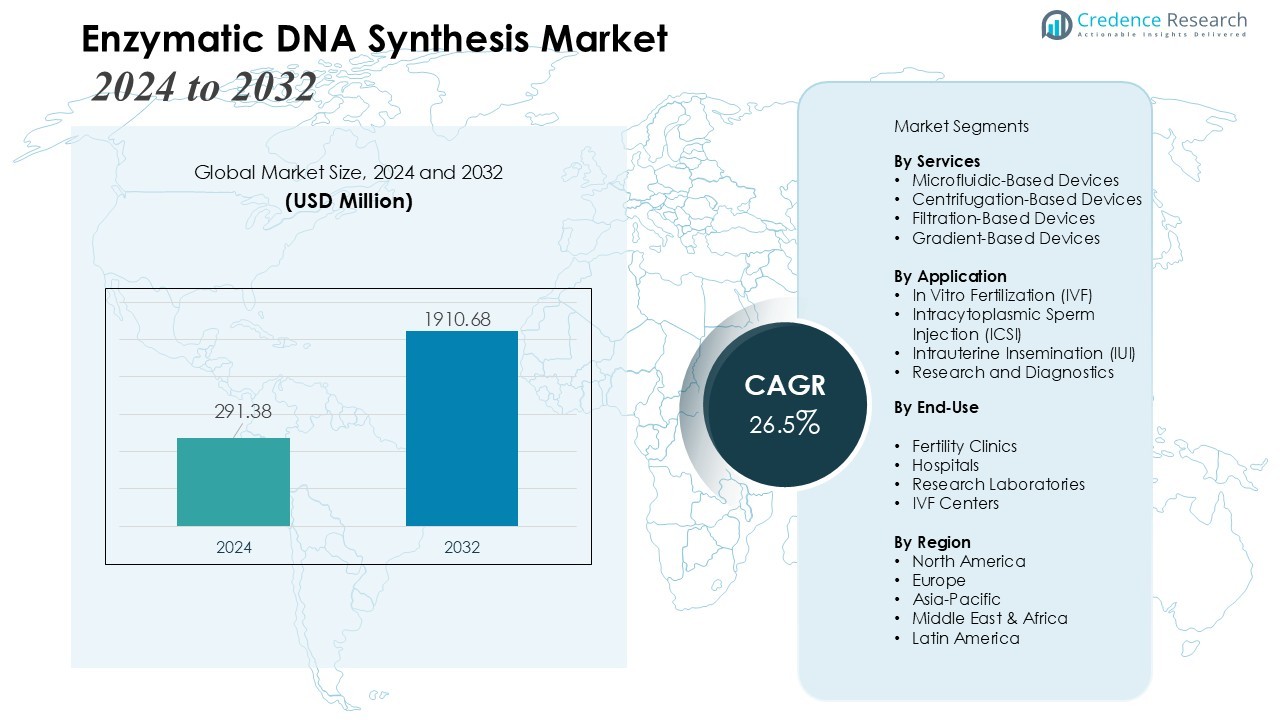
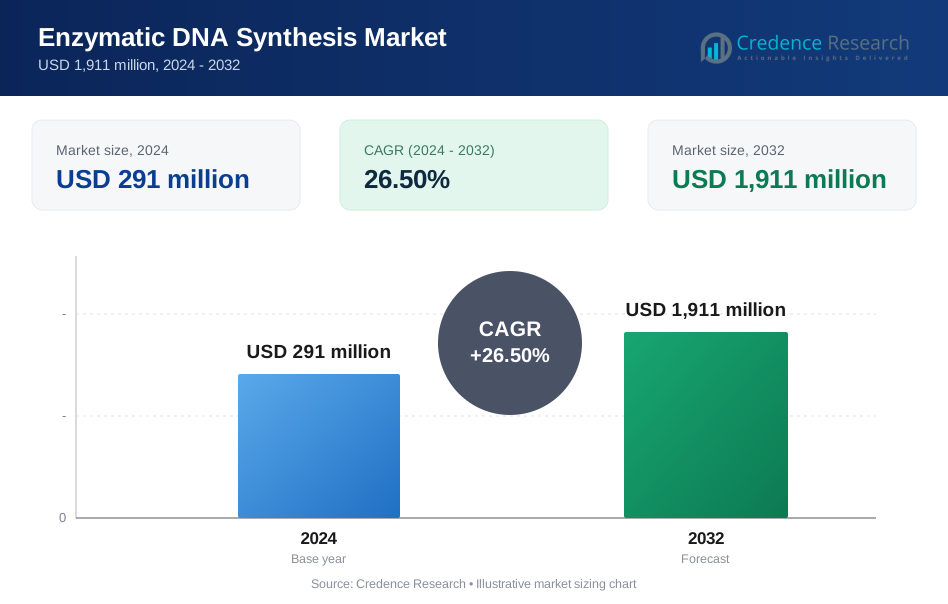
The Enzymatic DNA Synthesis Market size was valued at USD 291.38 million in 2024 and is anticipated to reach USD 1910.68 million by 2032, at a CAGR of 26.5% during the forecast period (2024-2032).
| REPORT ATTRIBUTE | DETAILS |
|---|---|
| Historical Period | 2020-2023 |
| Base Year | 2024 |
| Forecast Period | 2025-2032 |
| Enzymatic DNA Synthesis Market Size 2024 | USD 291.38 Million |
| Enzymatic DNA Synthesis Market, CAGR | 26.5% |
| Enzymatic DNA Synthesis Market Size 2032 | USD 1910.68 Million |
Key market drivers include rising investments in biopharmaceutical R&D, growing adoption of precision medicine, and the need for high-fidelity DNA synthesis in vaccine development and personalized therapeutics. Technological advancements in enzymatic synthesis, including improved polymerases and automated platforms, further accelerate market expansion. The shift toward sustainable and scalable DNA production methods is also contributing to broader adoption across research and clinical applications.
Regionally, North America dominates the market due to advanced research infrastructure, well-established biotech and pharmaceutical industries, and substantial government and private funding. Asia-Pacific is expected to witness the fastest growth, supported by increasing investments in biotechnology, expanding genomic research, and rising demand for synthetic biology applications. Europe and other regions show steady growth, driven by regulatory support for innovation and expansion of academic and commercial research initiatives.
Market Insights:
- The global Enzymatic DNA Synthesis Market was valued at USD 291 million in 2024 and is expected to reach USD 1,911 million by 2032, growing at a CAGR of 26.5% during the forecast period.
- Rising investments in biopharmaceutical research and development drive demand for high-quality synthetic DNA across drug discovery, gene therapy, and vaccine development pipelines.
- The growing adoption of precision medicine and personalized therapeutics boosts the market, as it supports patient-specific treatments and tailored vaccine production.
- Technological advancements, including improved polymerases and automated synthesis platforms, enhance production efficiency, reduce errors, and enable high-throughput applications.
- Increasing focus on sustainable and scalable DNA production encourages broader adoption in academic, clinical, and commercial research sectors worldwide.
- North America dominates the market with 50% share due to advanced research infrastructure, strong biotech industries, and substantial government and private funding.
- Asia-Pacific shows the fastest growth potential with 18% market share, driven by expanding biotechnology investments, growing genomic research, and rising demand for synthetic biology applications, while Europe holds 24% share with steady growth supported by regulatory initiatives and collaborative research.
 Market Drivers:
Expansion of Synthetic Biology and Genomic Research Applications
The growth of synthetic biology and genomic research significantly drives the Enzymatic DNA Synthesis Market. Researchers require accurate, high-fidelity DNA sequences to develop synthetic genes, study complex biological pathways, and advance functional genomics. It enables rapid design and construction of customized DNA, reducing errors and increasing experimental efficiency. Rising demand for engineered biological systems in pharmaceuticals and industrial biotechnology contributes to its adoption. The market benefits from continuous investment in laboratory infrastructure and advanced genomic tools.
- For instance, Twist Bioscience achieved synthesis of DNA sequences up to 1,200 bases long (and longer) using an initial chemical (phosphoramidite) method on a silicon chip to create oligonucleotides, which were then assembled and error-corrected using enzymatic reactions to produce the final gene fragments.
Rising Demand for Precision Medicine and Personalized Therapeutics
Precision medicine and personalized therapeutics create substantial opportunities for enzymatic DNA synthesis technologies. It supports the development of patient-specific treatments, gene therapies, and tailored vaccines, which require precise and reliable DNA sequences. Pharmaceutical companies increasingly rely on enzymatic synthesis to accelerate drug discovery and reduce production timelines. Growing awareness of individualized healthcare solutions fuels adoption across hospitals, research centers, and biotech firms. This trend emphasizes innovation in DNA synthesis to meet clinical and commercial requirements.
Technological Advancements Enhancing Efficiency and Accuracy
Advancements in enzymatic synthesis platforms, including improved polymerases and automated systems, enhance efficiency and accuracy. It enables faster production of oligonucleotides and synthetic genes while reducing environmental waste compared to traditional chemical methods. These innovations allow researchers to scale DNA production for high-throughput applications and complex experiments. Companies continue to invest in developing novel enzymatic approaches that increase yield and reduce synthesis errors. Such technological progress strengthens market growth by offering cost-effective and reliable solutions.
- For instance, DNA Script's enzymatic platform synthesizes DNA oligonucleotides much faster than 18 bases per hour (e.g., producing 20-mers in about 6 hours or 60-mers in around 13 hours).
Increasing Biopharmaceutical R&D Investments Across Key Regions
Rising biopharmaceutical research and development investments propel the Enzymatic DNA Synthesis Market. It supports drug discovery, gene therapy, and vaccine development pipelines that require high-quality synthetic DNA. North America maintains leadership due to strong funding and well-established biotech industries, while Asia-Pacific shows rapid adoption fueled by expanding research facilities and government support. The market benefits from collaboration between academic institutions and commercial biotech companies to accelerate innovation. These investments provide a stable foundation for sustained market growth.
Market Trends:
Adoption of High-Throughput and Automated Enzymatic DNA Synthesis Platforms
The Enzymatic DNA Synthesis Market is witnessing a strong trend toward high-throughput and automated synthesis platforms. It enables researchers to produce large volumes of oligonucleotides and synthetic genes with consistent quality and minimal manual intervention. Laboratories increasingly integrate automated systems to reduce operational costs and accelerate research timelines. Companies focus on developing platforms that offer enhanced precision, scalability, and compatibility with downstream applications. The trend reflects growing demand for reliable, rapid, and scalable DNA synthesis solutions across pharmaceutical, biotechnology, and academic sectors. Integration with digital tools and bioinformatics further improves design accuracy and process efficiency.
- For instance Ansa Biotechnologies demonstrated direct synthesis of DNA molecules exceeding 1,000 bases long using TdT-dNTP conjugates.
Expansion of Synthetic Biology, Gene Therapy, and Personalized Medicine Applications
Enzymatic DNA synthesis is becoming a critical tool for synthetic biology, gene therapy, and personalized medicine initiatives. It supports the creation of custom DNA sequences for novel therapeutic development, vaccines, and complex genetic research. The trend includes partnerships between biotech firms and academic institutions to leverage expertise and accelerate innovation. It enables cost-effective production of long DNA fragments and complex gene constructs that were challenging with chemical synthesis. Growing adoption in emerging markets reflects increased funding for genomic research and biotechnology infrastructure. The market trends indicate that demand will continue to rise due to the need for rapid, accurate, and flexible DNA synthesis technologies to support evolving scientific and clinical applications.
- For instance, DNA Script synthesized a 150-base DNA strand of defined sequence using enzymatic methods.
Market Challenges Analysis:
High Cost and Technical Complexity of Enzymatic DNA Synthesis Technologies
The Enzymatic DNA Synthesis Market faces challenges due to the high cost and technical complexity of its platforms. It requires specialized enzymes, precision instruments, and skilled personnel, which increase operational expenses. Small and medium-sized laboratories may struggle to adopt these technologies due to limited budgets and resource constraints. The complexity of maintaining high fidelity and consistent quality in long DNA sequences further limits widespread implementation. Companies continue to invest in reducing costs, but initial capital and operational requirements remain significant barriers.
Regulatory Uncertainty and Limitations in Long-Fragment Synthesis
Regulatory uncertainty and technical limitations in synthesizing long DNA fragments restrict market growth. It faces scrutiny due to potential biosecurity risks and ethical concerns related to synthetic biology and gene manipulation. Strict regulations in different regions can delay approvals and complicate commercial adoption. Technical challenges in producing extremely long or complex sequences without errors reduce efficiency and restrict applications. These factors require continuous innovation and compliance strategies to overcome market barriers and enable broader adoption.
Market Opportunities:
Expansion of Gene Therapy and Personalized Medicine Applications
The Enzymatic DNA Synthesis Market presents significant opportunities through the growth of gene therapy and personalized medicine. It enables precise production of custom DNA sequences required for patient-specific treatments, vaccines, and therapeutic development. Pharmaceutical and biotechnology companies increasingly adopt enzymatic synthesis to accelerate research pipelines and reduce time-to-market. Rising investments in genomic research and targeted therapies further support demand. Emerging applications in regenerative medicine and rare genetic disorder treatments create additional avenues for adoption. Collaboration between academic institutions and commercial entities strengthens innovation and product development.
Emerging Markets and Increasing Biotech Infrastructure Investments
Emerging markets provide substantial growth potential for enzymatic DNA synthesis technologies. It benefits from rising investments in biotechnology infrastructure, research facilities, and life sciences education in regions such as Asia-Pacific and Latin America. Governments promote innovation through grants, incentives, and partnerships that encourage adoption of advanced DNA synthesis methods. Expanding academic and commercial research programs in synthetic biology, vaccine development, and industrial biotechnology offer new revenue streams. Market players focusing on cost-effective, scalable solutions can capture opportunities in these fast-growing regions. Increasing global demand for sustainable and efficient DNA synthesis methods reinforces long-term growth potential.
Market Segmentation Analysis:
By Services
The Enzymatic DNA Synthesis Market offers diverse services, including custom DNA synthesis, oligonucleotide production, and gene assembly solutions. It enables researchers and pharmaceutical companies to obtain precise and high-fidelity DNA sequences tailored to experimental or therapeutic needs. Custom DNA synthesis dominates the market due to demand for patient-specific treatments, vaccine development, and synthetic biology applications. Oligonucleotide production supports high-throughput screening and functional genomics studies. Companies continue to expand service portfolios to enhance efficiency, accuracy, and turnaround times, meeting the growing requirements of research and clinical laboratories.
- For instance, Camena Bioscience achieved enzymatic synthesis of a 2.7-kb (kilobase pair) plasmid in 2020 using its proprietary gSynth™ platform.
By Application
Applications in synthetic biology, gene therapy, vaccine development, and functional genomics drive the Enzymatic DNA Synthesis Market. It allows researchers to construct complex gene sequences and study biological pathways with improved accuracy and scalability. Synthetic biology and industrial biotechnology contribute significantly to market growth due to engineered biological system development. Gene therapy and personalized medicine applications increasingly rely on enzymatic synthesis to produce precise DNA constructs efficiently. The market benefits from continuous innovation in enzymatic platforms that reduce errors and accelerate experimental timelines.
- For instance, DNA Script's enzymatic platform (the benchtop Syntax system) achieves synthesis of DNA sequences up to 120 nucleotides (nt) long for in-lab use
By End-Use
The market serves pharmaceutical and biotechnology companies, academic and research institutions, and clinical laboratories. It supports drug discovery, genomic research, and therapeutic development across these sectors. Pharmaceutical and biotech companies lead adoption due to investments in R&D and the need for high-quality DNA for vaccines, therapeutics, and diagnostics. Academic institutions leverage enzymatic synthesis for fundamental research and synthetic biology projects. Clinical laboratories increasingly utilize these solutions to support diagnostic tests and personalized treatment strategies. Continuous expansion of end-use applications reinforces market growth globally.
Segmentations:
By Services
- Custom DNA Synthesis
- Oligonucleotide Production
- Gene Assembly Solutions
By Application
- Synthetic Biology
- Gene Therapy
- Vaccine Development
- Functional Genomics
- Industrial Biotechnology
By End-Use
- Pharmaceutical Companies
- Biotechnology Companies
- Academic and Research Institutions
- Clinical Laboratories
By Region
- North America
- U.S.
- Canada
- Mexico
- Europe
- Germany
- France
- U.K.
- Italy
- Spain
- Rest of Europe
- Asia Pacific
- China
- Japan
- India
- South Korea
- South-east Asia
- Rest of Asia Pacific
- Latin America
- Brazil
- Argentina
- Rest of Latin America
- Middle East & Africa
- GCC Countries
- South Africa
- Rest of the Middle East and Africa
Regional Analysis:
North America Maintains Leadership Driven by Advanced Research Infrastructure
North America holds 50% of the global enzymatic DNA synthesis market in 2024, maintaining its position as the largest regional contributor. The region’s dominance is supported by strong biotechnology and pharmaceutical industries with substantial government and private funding. It benefits from leading universities and research institutions driving adoption of high-throughput enzymatic synthesis platforms. Companies focus on technological innovation, expanding product portfolios, and strategic collaborations. Demand for precision medicine and personalized therapeutics further reinforces market growth. The presence of major market players ensures sustained leadership in the global market.
Europe Shows Steady Growth Fueled by Regulatory Support and Research Collaborations
Europe accounts for 24% of the global enzymatic DNA synthesis market in 2024, demonstrating consistent growth. The region benefits from regulatory frameworks that encourage biotechnology innovation and commercialization of enzymatic DNA synthesis applications in pharmaceuticals, academic research, and industrial biotechnology. It leverages collaborative initiatives between research institutions and biotech firms to accelerate product development and enhance technological capabilities. Investment in laboratory infrastructure and genomic research programs supports steady adoption. The region’s focus on gene therapy and synthetic biology strengthens its market position. Cross-border partnerships and funding programs also foster innovation across key European markets.
Asia-Pacific Emerges as a High-Growth Region with Expanding Biotech Investments
Asia-Pacific contributes 18% to the global enzymatic DNA synthesis market in 2024, reflecting rapid growth potential. The region benefits from increasing investments in biotechnology infrastructure, life sciences research, and educational programs. It leverages government grants, incentives, and strategic partnerships to encourage adoption of advanced DNA synthesis technologies. Rising demand for gene therapy, vaccine development, and synthetic biology applications accelerates market penetration. Collaborations between local biotech companies and global players strengthen technological capabilities. Expanding research activities and infrastructure position Asia-Pacific as a key growth opportunity for global market participants.
Key Player Analysis:
- Telesis Bio Inc.
- Twist Bioscience Corporation
- GenScript Biotech Corp.
- Evonetix
- Ansa Biotechnologies, Inc.
- Camena Bio
- Molecular Assemblies
- DNA Script
- Touchlight
- Kern Systems
Competitive Analysis:
The Enzymatic DNA Synthesis Market is highly competitive, with leading players focusing on innovation, strategic partnerships, and expansion of service portfolios. It includes companies offering custom DNA synthesis, oligonucleotide production, and gene assembly solutions with high accuracy and scalability. Key market participants emphasize research and development to improve enzymatic platforms, enhance synthesis efficiency, and reduce operational costs. Companies also engage in collaborations with academic institutions and biotechnology firms to strengthen technological capabilities and accelerate product development. North American and European players dominate the market due to established infrastructure and funding, while emerging companies in Asia-Pacific focus on expanding regional presence and capturing high-growth opportunities. Competitive strategies include mergers, acquisitions, and licensing agreements to secure intellectual property and expand market reach. Continuous technological innovation and focus on high-fidelity DNA production maintain strong differentiation among market participants.
Recent Developments:
- In May 2025, Telesis Bio Inc. announced a licensing agreement with Regeneron Pharmaceuticals to deploy its Gibson SOLA platform for rapid on-site DNA and gene synthesis at Regeneron's R&D facilities.
- In August 2025, GenScript Biotech Corp. announced a strategic collaboration with Bioelectronica to accelerate antibody discovery using single B-cell screening and gene synthesis services.
Report Coverage:
The research report offers an in-depth analysis based on Services, Application, End-Use and Region. It details leading market players, providing an overview of their business, product offerings, investments, revenue streams, and key applications. Additionally, the report includes insights into the competitive environment, SWOT analysis, current market trends, as well as the primary drivers and constraints. Furthermore, it discusses various factors that have driven market expansion in recent years. The report also explores market dynamics, regulatory scenarios, and technological advancements that are shaping the industry. It assesses the impact of external factors and ITALY economic changes on market growth. Lastly, it provides strategic recommendations for new entrants and established companies to navigate the complexities of the market.
Future Outlook:
- Expansion of gene therapy and personalized medicine applications will continue to drive adoption of enzymatic DNA synthesis technologies.
- Integration of automated and high-throughput synthesis platforms will enhance research efficiency and reduce turnaround times.
- Advancements in polymerase enzymes and enzymatic chemistry will improve synthesis accuracy and enable production of longer DNA sequences.
- Growing demand for synthetic biology and industrial biotechnology applications will create new opportunities across pharmaceuticals and research sectors.
- Collaboration between biotechnology companies and academic institutions will accelerate innovation and commercialization of novel DNA synthesis solutions.
- Emerging markets will experience significant growth due to increasing investments in biotechnology infrastructure and life sciences research.
- Development of cost-effective and scalable enzymatic DNA synthesis methods will make technology accessible to smaller laboratories and research centers.
- Regulatory frameworks supporting synthetic biology and genomic research will encourage broader adoption globally.
- Continuous focus on sustainable and environmentally friendly DNA synthesis methods will strengthen market appeal.
- Expansion of applications in vaccine development, diagnostics, and functional genomics will reinforce long-term market potential.
Request a Free Sample
Fill in your details and we'll send you a free sample report.
- Sample data tables & charts
- Research methodology
Need a Custom Version of This Report?
Tailor the scope, geography, or segments to your exact requirements.
- Custom geography or segment scope
- Direct access to our analyst team
Frequently Asked Questions
What is the current market size of the Enzymatic DNA Synthesis Market, and what is its expected growth trajectory?
What factors are driving the growth of the Enzymatic DNA Synthesis Market?
Which applications and services dominate the Enzymatic DNA Synthesis Market?
Which regions lead the Enzymatic DNA Synthesis Market, and which regions are showing high growth potential?
Who are the key players in the Enzymatic DNA Synthesis Market?
Table of Content
Chapter 1. Report Introduction
- 1.1 Report Description & Purpose
- 1.1.1 Report Title & Market Definition
- 1.1.2 Unique Selling Propositions (USP) & Key Differentiators
- 1.1.3 Value Proposition for Stakeholders
- 1.2 Research Objectives
- 1.2.1 Market Sizing Objectives (Volume & Revenue) (Volume Where Applicable)
- 1.2.2 Segmentation Objectives
- 1.2.3 Competitive Intelligence Objectives
- 1.2.4 Forecast & Scenario Objectives
- 1.3 Report Scope
- 1.3.1 Enzymatic DNA Synthesis Scope – Segments & Subsegments Covered
- 1.3.2 Geographic Scope – Regions & Countries Covered
- 1.3.3 Historical Period, Base Year & Forecast Period (2024; forecast to 2032)
- 1.3.4 Inclusions & Exclusions
- 1.4 Industry Classification & Applicable Codes
- 1.5 Currency, Measurement Units & Valuation Basis
- 1.6 Target Stakeholders
- 1.7 Limitations & Assumptions
Chapter 2. Executive Summary
- 2.1 Global Enzymatic DNA Synthesis Market Snapshot
- 2.1.1 Market Size – Historical (2024) & Forecast (2024-2032) (2024: USD 291 million → 2032: USD 1,911 million)
- 2.1.2 Volume & Revenue – Global Totals (Volume Where Applicable)
- 2.1.3 Key Market Highlights – Top Five Facts
- 2.2 Enzymatic DNA Synthesis Market Segmentation Snapshot
- 2.2.1 Market Split by Region – 2024 vs. 2032
- 2.3 Competitive Snapshot
- 2.3.1 Top 10 Players by Revenue Share – 2024
- 2.3.2 Top 10 Players by Volume Share – 2024 (Volume Where Applicable)
- 2.3.3 Recent Strategic Developments (18-Month Summary)
- 2.4 Key Investment Highlights & Strategic Conclusions
Chapter 3. Enzymatic DNA Synthesis Market Dynamics & Industry Analysis
- 3.1 Market Overview & Context
- 3.1.1 Enzymatic DNA Synthesis Market Position in the Broader Industry Value Chain
- 3.1.2 Demand Structure & Purchasing Dynamics
- 3.1.3 Market Maturity & Development Stage by Region
- 3.2 Enzymatic DNA Synthesis Market Drivers
- 3.3 Enzymatic DNA Synthesis Market Restraints & Challenges
- 3.4 Enzymatic DNA Synthesis Market Opportunities
- 3.5 Porter's Five Forces Analysis
- 3.5.1 Threat of New Entrants
- 3.5.2 Bargaining Power of Suppliers
- 3.5.3 Bargaining Power of Buyers
- 3.5.4 Threat of Substitutes
- 3.5.5 Competitive Rivalry – Intensity Assessment
- 3.6 Enzymatic DNA Synthesis Value Chain Analysis
- 3.6.1 Upstream – Key Inputs, Resources & Suppliers
- 3.6.1.1 Key Input/Resource 1
- 3.6.1.2 Key Input/Resource 2
- 3.6.1.3 Key Input/Resource 3
- 3.6.2 Midstream – Core Operations & Value Creation
- 3.6.2.1 Operating Model & Process Overview
- 3.6.2.2 Key Operating Locations & Capabilities by Company
- 3.6.3 Downstream – Market Channels & End Users
- 3.6.3.1 Direct Sales & Customer Engagement Channels
- 3.6.3.2 Indirect Sales, Intermediaries & Partner Channels
- 3.6.4 Value Chain Profitability Analysis
- 3.6.1 Upstream – Key Inputs, Resources & Suppliers
- 3.7 PESTEL Analysis
- 3.7.1 Political Factors
- 3.7.2 Economic Factors
- 3.7.3 Social Factors
- 3.7.4 Technological Factors
- 3.7.5 Environmental Factors
- 3.7.6 Legal Factors
- 3.8 Enzymatic DNA Synthesis Supply Chain Analysis
- 3.8.1 Critical Input & Resource Availability Risk Assessment
- 3.8.2 Supplier & Operational Concentration Risk (Geographic Exposure)
- 3.8.3 Supply & Service Disruption Impact Analysis
- 3.9 Regulatory & Policy Landscape
Note: The regulatory and policy landscape section covers regulations based on their applicability to the market, Enzymatic DNA Synthesis category, geography, and scope of the study. Only regulatory frameworks with a material impact on operations, compliance, trade, sustainability, or market access are analyzed in detail.
Chapter 4. Key Investment Pockets & Opportunity Analysis
- 4.1 Enzymatic DNA Synthesis Market Attractiveness Analysis
- 4.1.1 By Region – Investment Attractiveness Matrix (Market Size × CAGR)
- 4.2 Absolute Revenue Growth Opportunity
- 4.2.1 By Region – Absolute Revenue Growth Through 2032
- 4.3 Incremental Demand Opportunity
- 4.3.1 By Region – Incremental Demand Through 2032
- 4.3.2 Segment – Incremental Demand
- 4.4 Emerging Submarket Opportunity Deep Dive (Subject to Applicability)
- 4.5 Priority Market Opportunity Scorecards
- 4.5.1 United States
- 4.5.2 Europe
- 4.5.3 Asia
- 4.5.4 Middle East & Africa
Note: Priority market opportunity scorecards reflect the geographic scope and strategic relevance of the study. Listed markets are indicative and may be adapted to the industry.
Chapter 5. Enzymatic DNA Synthesis Cross-Border Trade & Market Access Analysis
- 5.1 International Trade & Cross-Border Activity Overview
- 5.1.1 Global Export Value by Country (2024)
- 5.1.2 Global Export Volume by Country (2024) (Volume Where Applicable)
- 5.1.3 Global Import Value by Country (2024)
- 5.1.4 Global Import Volume by Country (2024) (Volume Where Applicable)
- 5.1.5 Net Trade Balance by Country (2024)
- 5.2 Export Analysis – Segment
- 5.2.1 Category 1 (Applicable Classification Code)
- 5.2.2 Category 2 (Applicable Classification Code)
- 5.2.3 Category 3 (Applicable Classification Code)
- 5.2.4 Category 4 (Applicable Classification Code)
- 5.2.5 Category 5 (Applicable Classification Code)
- 5.3 Import Analysis – Segment
- 5.3.1 Category 1 (Applicable Classification Code)
- 5.3.2 Category 2 (Applicable Classification Code)
- 5.3.3 Category 3 (Applicable Classification Code)
- 5.3.4 Category 4 (Applicable Classification Code)
- 5.3.5 Category 5 (Applicable Classification Code)
- 5.4 Cross-Border Pricing & Transaction Benchmarks
- 5.4.1 Export Pricing – Segment & Country
- 5.4.2 Import Pricing – Segment & Source Country
- 5.4.3 Price Trends (2024)
- 5.5 Key Cross-Border Trade & Delivery Routes
- 5.5.1 Cross-Border Trade/Delivery Route 1
- 5.5.2 Cross-Border Trade/Delivery Route 2
- 5.5.3 Cross-Border Trade/Delivery Route 3
- 5.5.4 Cross-Border Trade/Delivery Route 4
- 5.5.5 Cross-Border Trade/Delivery Route 5
- 5.6 Trade Policy & Market Access Impact Assessment
- 5.6.1 Tariff & Non-Tariff Barriers
- 5.6.2 Regional Trade & Economic Integration Frameworks
- 5.6.3 Bilateral & Multilateral Trade Agreements
- 5.6.4 Cross-Border Operating, Licensing & Localization Requirements
Note: This chapter applies where cross-border trade or delivery is relevant to Enzymatic DNA Synthesis. Goods, services, and digital offerings are assessed using applicable classifications and transaction measures. Import-export volumes, trade balances, and route analyses are included only where meaningful to the market.
Chapter 6. Competitive Landscape & Company Benchmarking
- 6.1 Enzymatic DNA Synthesis Market Concentration & Structure
- 6.1.1 Herfindahl-Hirschman Index (HHI) – the historical period vs. 2024
- 6.1.2 Leading, Mid-Sized & Emerging Player Structure
- 6.1.3 Global, Regional & Local Player Dynamics
- 6.2 Enzymatic DNA Synthesis Market Share Analysis – 2024
- 6.2.1 Global Revenue Share by Company
- 6.2.2 Global Volume Share by Company (Volume Where Applicable)
- 6.2.3 Regional Revenue Share
- 6.2.4 Market Share Evolution (the historical period vs. 2024)
- 6.2.5 Company Market Share by Key Segment
- 6.2.6 Company Market Share by Customer Group
- 6.3 Operating Scale, Capacity & Infrastructure Analysis
- 6.3.1 Global Operating Scale & Supply Capacity
- 6.3.2 Resource Utilization & Operating Efficiency
- 6.3.3 Output, Service Delivery & Activity Metrics
- 6.3.4 Operating Footprint & Infrastructure Map
- 6.3.5 Planned Operational & Capacity Expansion
- 6.4 Enzymatic DNA Synthesis Competitive Benchmarking Matrix
- 6.4.1 Revenue, Growth, Profitability & Operating Metric Comparison
- 6.4.2 Channel Revenue Mix
- 6.4.3 Geographic Revenue Exposure
- 6.4.4 R&D Intensity
- 6.4.5 Sustainability Maturity
- 6.5 Strategic Developments in Enzymatic DNA Synthesis (Last 24 Months)
- 6.5.1 Mergers, Acquisitions & Divestments
- 6.5.2 New Products, Services & Solutions in Enzymatic DNA Synthesis
- 6.5.3 Operational & Infrastructure Expansions
- 6.5.4 Strategic Alliances, Joint Ventures & Partnerships
- 6.5.5 Distribution Expansion & Market Entry
- 6.5.6 Sustainability & ESG Initiatives
- 6.6 Competitive Strategy Mapping
- 6.6.1 Leader, Challenger, Follower & Niche Classification
- 6.6.2 Pricing Strategy Comparison
- 6.6.3 Channel Strategy Matrix
Note: Strategic developments are included based on their materiality and the availability of reliable information.
Chapter 7. Global Enzymatic DNA Synthesis Market – By Sales & Delivery Channel
- 7.1 Segment Overview
- 7.1.1 Volume & Revenue Split by Channel (2024 & 2032) (Volume Where Applicable)
- 7.1.2 Channel Mix Evolution (2024-2032)
Chapter 8. Regional Market Analysis – Global Overview
- 8.1 Global Regional Overview
- 8.1.1 Regional Volume Share (Volume Where Applicable)
- 8.1.2 Regional Revenue Share
- 8.1.3 Regional Volume by Region (Volume Where Applicable)
- 8.1.4 Regional Revenue by Region
- 8.1.5 Regional Forecast Through 2032
- 8.2 Cross-Regional Segment Analysis
- 8.2.1 By Sales & Delivery Channel
- 8.2.2 By Competitive Positioning & Price Tier
Chapter 9. North America Enzymatic DNA Synthesis Market
- 9.1 United States
- 9.2 Canada
- 9.3 Mexico
Chapter 10. Europe Enzymatic DNA Synthesis Market
- 10.1 Germany
- 10.2 France
- 10.3 Italy
- 10.4 United Kingdom
- 10.5 Spain
- 10.6 Poland
- 10.7 Russia
- 10.8 Netherlands
- 10.9 Belgium
- 10.10 Sweden
- 10.11 Denmark
- 10.12 Norway
- 10.13 Rest of Europe
Chapter 11. Asia Pacific Enzymatic DNA Synthesis Market
- 11.1 China
- 11.2 India
- 11.3 Japan
- 11.4 South Korea
- 11.5 Thailand
- 11.6 Indonesia
- 11.7 Vietnam
- 11.8 Malaysia
- 11.9 Australia
- 11.10 Rest of Asia Pacific
Chapter 12. Latin America Enzymatic DNA Synthesis Market
- 12.1 Brazil
- 12.2 Argentina
- 12.3 Colombia
- 12.4 Chile
- 12.5 Rest of Latin America
Chapter 13. Middle East Enzymatic DNA Synthesis Market
- 13.1 Saudi Arabia
- 13.2 United Arab Emirates
- 13.3 Turkey
- 13.4 Israel
- 13.5 Iran
- 13.6 Rest of the Middle East
Chapter 14. Africa Enzymatic DNA Synthesis Market
- 14.1 South Africa
- 14.2 Egypt
- 14.3 Nigeria
- 14.4 Morocco
- 14.5 Rest of Africa
Chapter 15. Enzymatic DNA Synthesis Company Profiles
- 15.1 [Company 01]
- 15.1.1 Company Overview
- 15.1.2 Key Management Personnel
- 15.1.3 Products & Services Portfolio
- 15.1.4 Financial Performance
- 15.1.5 Key Market Focus & Geographic Presence
- 15.1.6 Recent Developments & Strategic Initiatives
Note: The company profile list is preliminary and may change based on research findings, market developments, data availability, and client requirements.
Chapter 16. Appendices
- Appendix A – List of Abbreviations & Acronyms
- Appendix B – Industry Classification Code Reference – Full Series
- Appendix C – Supply, Output & Operating Capacity Data Tables
- Appendix D – End-Use & Demand Base Tables
- Appendix E – Demand, Adoption & Usage Assumptions
- Appendix F – Pricing & Revenue Metric Reference Tables
- Appendix G – Company Operations & Infrastructure Database
- Appendix H – Cross-Border Trade & Activity Data Tables (Where Applicable)
- Appendix I – Regulatory Summary Tables
- Appendix J – Primary Research Participant List (Anonymized)
- Appendix K – Primary Research Questionnaire Framework
- Appendix L – Data Sources & Bibliography
- Appendix M – Market Size Divergence & Source Comparison
Chapter 17. Research Methodology
- 17.1 Research Framework & Philosophy
- 17.2 Secondary Research – Sources, Hierarchy & Data Extraction
- 17.3 Data Modeling – Bottom-Up & Top-Down Market Sizing
- 17.4 Primary Research – Stakeholder Framework, LOI & Sample Sizes
- 17.5 Forecast Methodology – Regression, Scenario & Sensitivity Analysis
- 17.6 Quality Control – Four-Layer Validation Framework
- 17.7 Limitations & Standard Assumptions
- 17.8 Disclaimer
