Market Overview:
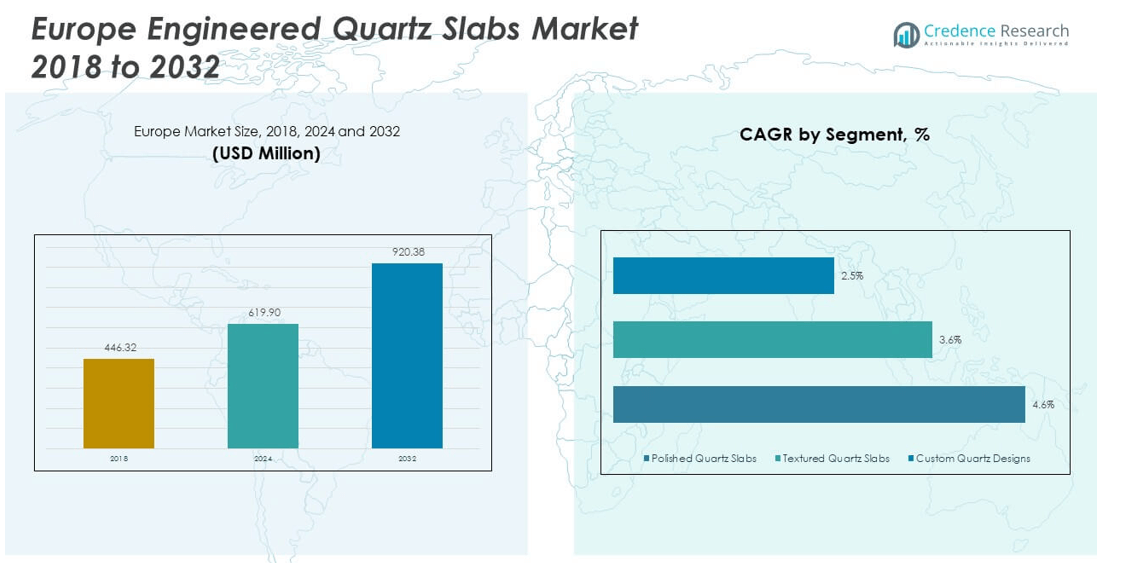
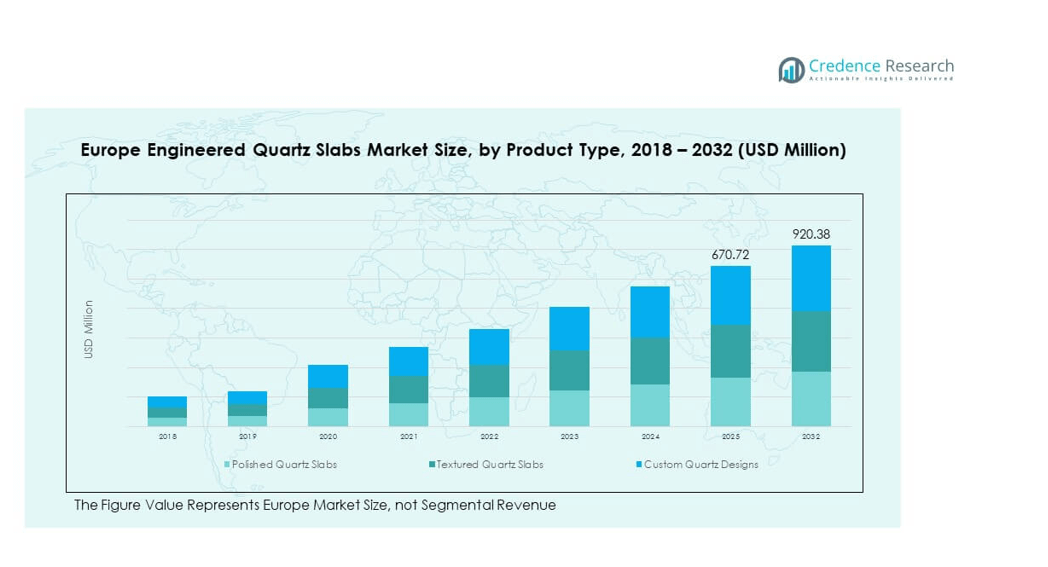
The Europe Quartz Engineered Quartz Slabs Market size was valued at USD 446.32 million in 2018 to USD 619.90 million in 2024 and is anticipated to reach USD 920.38 million by 2032, at a CAGR of 4.60% during the forecast period.
| REPORT ATTRIBUTE | DETAILS |
|---|---|
| Historical Period | 2020-2023 |
| Base Year | 2024 |
| Forecast Period | 2025-2032 |
| Europe Quartz Engineered Quartz Slabs Market Size 2024 | USD 619.90 million |
| Europe Quartz Engineered Quartz Slabs Market, CAGR | 4.60% |
| Europe Quartz Engineered Quartz Slabs MarketSize 2032 | USD 920.38 million |
The market is expanding due to rising demand for durable and stylish surface materials across residential and commercial projects. Growing consumer preference for non-porous, stain-resistant, and hygienic surfaces supports adoption. Increasing renovation activities, along with the rising popularity of modern kitchen and bathroom designs, continue to drive demand. Developers and homeowners also view engineered quartz as a sustainable and cost-efficient alternative compared to natural stone, enhancing its market growth.
Geographically, Western Europe leads the market with strong demand from countries like Germany, France, and the UK, where modern housing projects and high-end interiors are driving adoption. Southern Europe, including Italy and Spain, is also showing steady demand, supported by their well-established tile and surface industries. Meanwhile, Eastern Europe is emerging as a growth hub, driven by urbanization, rising disposable incomes, and increasing consumer awareness of premium and durable surface materials.
Market Insights:
- The Europe Quartz Engineered Quartz Slabs Market was valued at USD 446.32 million in 2018, reached USD 619.90 million in 2024, and is expected to hit USD 920.38 million by 2032, growing at a CAGR of 4.60%.
- Western Europe leads with 48% share, driven by strong construction, renovation, and luxury interior demand across Germany, France, and the UK.
- Southern Europe holds 28% share, supported by Italy and Spain’s established tile industries and cultural preference for stylish surfaces, while Eastern Europe, with 24% share, is the fastest-growing, driven by urbanization and rising disposable incomes.
- Polished quartz slabs account for nearly 55% of the market, dominating due to their versatility, durability, and adoption in kitchens and bathrooms.
- Textured quartz slabs hold about 28% share, while custom quartz designs represent nearly 17%, growing steadily among premium buyers seeking exclusive aesthetics.
Market Drivers:
Rising Demand for Durable and Aesthetic Surfaces
The Europe Quartz Engineered Quartz Slabs Market is driven by strong demand for durable and aesthetically appealing surfaces in residential and commercial applications. Consumers increasingly favor quartz over natural stones due to its non-porous structure and resistance to stains. This shift is fueled by rising awareness of hygienic and easy-to-maintain materials in households and businesses. Architects and designers promote quartz for modern interiors, which encourages higher adoption in kitchens and bathrooms. Rising home renovations across Europe further enhance sales volumes. The material’s versatility in color, texture, and finishing attracts diverse customer segments. Strong design flexibility and durability reinforce the market’s consistent growth momentum.
- For instance, Cosentino’s Silestone slabs manufactured with HybriQ+® technology feature less than 50% crystalline silica and incorporate a minimum of 20% recycled content, aligning with the growing preference for hygienic and sustainable surfaces in modern interiors.
Urbanization and Rising Housing Projects Across Europe
Rapid urbanization across European cities creates consistent demand for modern housing projects and commercial spaces. Real estate developers prefer engineered quartz slabs due to their long life cycle and competitive cost compared to alternatives. Demand is especially robust in countries experiencing growth in luxury apartments and modern offices. Governments supporting urban housing initiatives indirectly boost adoption of quartz slabs. Growing disposable incomes increase consumer willingness to invest in high-quality interiors. Retail and hospitality industries are also key adopters, using quartz for stylish yet practical finishes. The Europe Quartz Engineered Quartz Slabs Market benefits from these sustained construction activities.
- For instance, Caesarstone achieved a gross margin of 19.6% in Q2 2025 while targeting $10 million in annual cost reductions, underscoring its robust operational efficiency and production reliability for supplying high-volume residential and commercial developments.
Sustainability Awareness and Eco-Friendly Choices
Sustainability plays a central role in market expansion across Europe. Consumers are becoming increasingly eco-conscious, preferring materials that align with green building standards. Quartz slabs appeal to this preference, offering sustainable manufacturing processes and recyclable components. Builders adopt these products to comply with green certification requirements. The focus on reducing natural stone mining supports further transition toward engineered alternatives. Manufacturers invest in sustainable practices, boosting product acceptance across Europe. This trend enhances the long-term position of quartz as a responsible material choice. The Europe Quartz Engineered Quartz Slabs Market is aligning with the region’s environmental commitments.
Technological Advancements and Innovation in Product Design
Advances in manufacturing and finishing technologies improve the quality, durability, and design diversity of engineered quartz slabs. Producers now deliver slabs with enhanced textures that replicate marble and granite while retaining quartz advantages. Digital printing allows unique designs that cater to diverse consumer preferences. Smart manufacturing techniques reduce production costs, enhancing accessibility for mid-range consumers. Companies emphasize R&D to expand color ranges and surface effects, creating new customer appeal. Adoption of automation ensures consistent quality and supply reliability across markets. Technological upgrades also facilitate customization, attracting premium customers. The Europe Quartz Engineered Quartz Slabs Market benefits from this innovation-driven approach.
Market Trends:
Growing Popularity of Minimalist and Modern Interiors
The Europe Quartz Engineered Quartz Slabs Market is witnessing strong adoption driven by minimalist and modern interior design preferences. Homeowners and businesses increasingly choose sleek surfaces with clean finishes. Quartz’s ability to provide uniform color patterns suits these preferences well. The rise of open kitchen and living concepts has accelerated this demand. Neutral shades and subtle textures are among the most requested designs. Designers leverage quartz for flooring, wall cladding, and countertops to achieve contemporary aesthetics. It is becoming a top material for projects emphasizing elegance, simplicity, and functionality. This design-driven trend strengthens quartz’s long-term relevance.
- For instance, Caesarstone’s ICON™ collection, launched in 2025, consists of high-performance quartz surfaces made entirely without crystalline silica and includes up to 80% recycled post-industrial glass, catering to sustainability-focused renovation projects across Europe.
Expansion in the Hospitality and Retail Industries
The hospitality and retail sectors are adopting engineered quartz for stylish yet durable finishes. Hotels, restaurants, and shopping complexes require surfaces that combine visual appeal with high performance. Quartz slabs provide resistance to heavy usage and offer long-lasting elegance. Interior designers in hospitality prioritize quartz for countertops, bars, and reception areas. Retail spaces adopt it for display counters and flooring due to its premium appearance. This application diversity supports continued industry adoption. The Europe Quartz Engineered Quartz Slabs Market is capitalizing on these demands, strengthening its role beyond residential spaces. This trend enhances sales potential across non-residential segments.
- For instance, Breton’s Bioquartz® solution, deployed in European manufacturing since 2023, offers engineered quartz slabs with zero silica, meeting regulatory safety standards while maintaining the visual and mechanical characteristics required for commercial interiors.
Customization and Premium Product Offerings
Consumers increasingly demand customization in their home and office interiors. Engineered quartz offers unmatched design flexibility compared to natural stone alternatives. Manufacturers are expanding portfolios with unique textures, finishes, and custom color options. Premium product offerings target high-end customers seeking exclusivity in interiors. The growing luxury housing market in Europe supports this movement. Technology-driven innovations allow manufacturers to meet tailored customer requirements effectively. Personalized slabs align with evolving consumer tastes for uniqueness. The Europe Quartz Engineered Quartz Slabs Market continues to benefit from this trend, expanding its appeal across multiple consumer classes.
Integration with Sustainable Construction Practices
Green building certifications are shaping construction trends in Europe. Builders prioritize materials that contribute to energy efficiency and sustainability goals. Quartz slabs meet these requirements by offering long life cycles and recyclable properties. This integration enhances adoption across public infrastructure and residential projects. Eco-conscious consumers also drive demand for sustainable interiors. Manufacturers market their slabs with environmental certifications to appeal to this growing segment. The market aligns with Europe’s regulatory environment, which favors low-impact construction materials. The Europe Quartz Engineered Quartz Slabs Market is thus positioned to grow under the broader sustainability framework shaping the region.
Market Challenges Analysis:
High Competition from Alternative Surface Materials
The Europe Quartz Engineered Quartz Slabs Market faces strong competition from natural stones, ceramics, and laminates. Many consumers remain loyal to traditional marble and granite due to their established prestige. Ceramics and laminates offer lower-cost options, attracting price-sensitive customers. This competition puts pressure on quartz manufacturers to differentiate through quality and design. Companies must focus on marketing to highlight advantages such as hygiene and durability. Failure to emphasize these benefits risks losing ground to competitors. Smaller manufacturers struggle to compete with established material providers. This challenge requires innovation and branding investments to sustain growth.
Volatile Raw Material Costs and Supply Chain Constraints
Another challenge impacting the Europe Quartz Engineered Quartz Slabs Market is raw material cost volatility and supply chain disruptions. Quartz production depends on consistent access to raw quartz, resins, and pigments. Price fluctuations in these inputs affect manufacturers’ profit margins. Energy-intensive production also makes costs vulnerable to rising energy prices in Europe. Supply chain constraints, such as transportation delays, create delivery challenges for large projects. Smaller companies with limited resources face greater risks during disruptions. Manufacturers must adopt flexible sourcing strategies to mitigate risks. Balancing cost management with quality maintenance remains a key hurdle for market participants.
Market Opportunities:
Expansion in Renovation and Remodeling Activities
The Europe Quartz Engineered Quartz Slabs Market is positioned to benefit from growing renovation and remodeling projects across the region. Rising consumer focus on upgrading kitchens and bathrooms supports steady demand. Homeowners increasingly replace older surfaces with quartz due to its superior features. Real estate modernization and interior redesign projects further amplify adoption. Demand for hygienic and elegant materials strengthens quartz’s appeal in both luxury and mid-range housing. Manufacturers that cater to renovation-driven needs will secure strong growth. This opportunity highlights quartz as a preferred choice in Europe’s remodeling landscape.
Rising Demand in Emerging Eastern European Markets
Eastern Europe presents new growth opportunities for the Europe Quartz Engineered Quartz Slabs Market. Countries such as Poland, Hungary, and Romania are experiencing urbanization and rising disposable incomes. Growing awareness of premium and durable materials supports quartz adoption. Expanding housing projects and commercial infrastructure create consistent demand. Middle-class consumers in these markets are increasingly willing to invest in high-quality interiors. Manufacturers that expand distribution networks into these regions can capture significant potential. This emerging demand strengthens the market’s long-term growth outlook across Europe. It represents a key opportunity for expansion beyond traditional Western markets.
Market Segmentation Analysis:
By Product Type
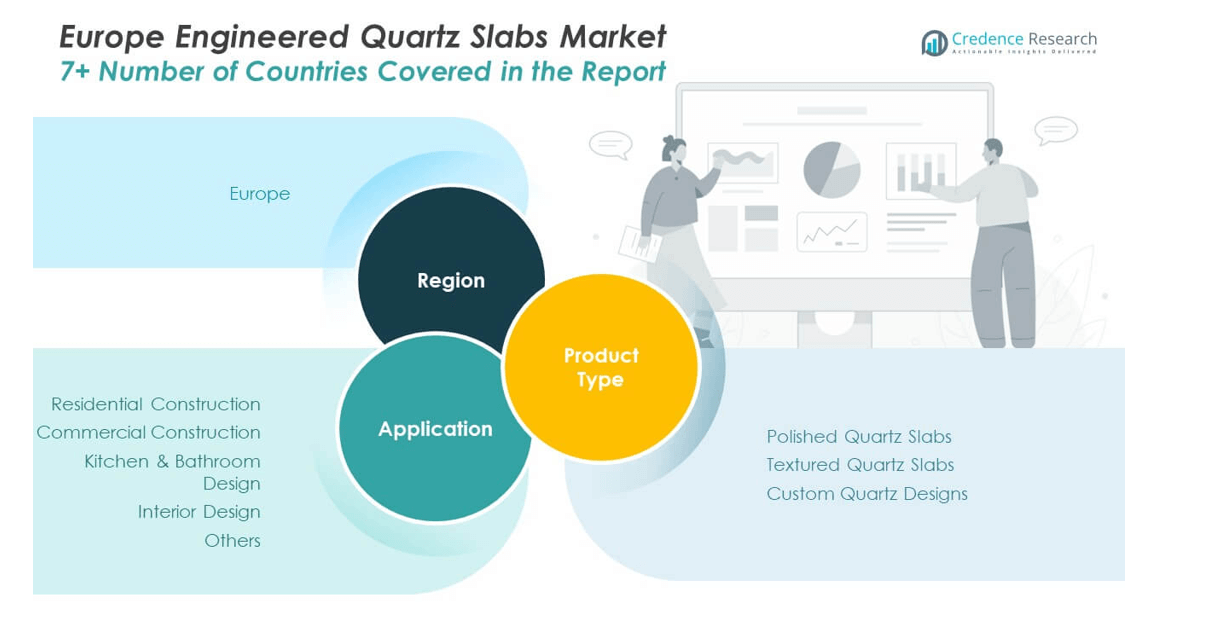
Polished quartz slabs dominate demand in the Europe Quartz Engineered Quartz Slabs Market due to their smooth finish, durability, and wide use in kitchens and bathrooms. They remain the preferred choice for residential projects that emphasize both aesthetics and functionality. Textured quartz slabs are gaining traction as architects and designers increasingly recommend surfaces with unique appearances and tactile finishes for luxury projects. Custom quartz designs represent a growing niche, catering to high-end customers who seek exclusive styles, personalized patterns, and innovative surface effects. This category continues to expand as consumers invest in premium interiors.
By Application
The Europe Quartz Engineered Quartz Slabs Market benefits strongly from residential construction, which drives steady demand through renovation and new housing projects. Rising consumer interest in durable and hygienic surfaces supports quartz adoption across households. Commercial construction is also significant, as hotels, retail outlets, and office spaces adopt quartz for its strength and modern appearance. Kitchen and bathroom design remains a core application, with quartz positioned as a premium alternative to natural stone. Interior design extends usage beyond countertops into flooring, wall cladding, and decorative applications. The “others” segment, covering specialized projects, adds to overall growth by diversifying use cases across the market.
- For instance, Breton’s advanced technology enables mass production of ultra-thin, full-body quartz slabs suitable for flooring, wall cladding, and custom furnishings, broadening their use in innovative architectural and interior design projects.
Segmentation:
By Product Type
- Polished Quartz Slabs
- Textured Quartz Slabs
- Custom Quartz Designs
By Application
- Residential Construction
- Commercial Construction
- Kitchen & Bathroom Design
- Interior Design
- Others
By Region
- Europe (overall)
By Country (Europe)
- UK
- France
- Germany
- Italy
- Spain
- Russia
- Rest of Europe
Regional Analysis:
Western Europe – Leading Market Share
Western Europe holds the dominant position in the Europe Quartz Engineered Quartz Slabs Market with a market share of around 48%. Countries such as Germany, France, and the UK drive growth through advanced construction activities, high consumer spending, and preference for premium interiors. Demand is further supported by strong renovation activities and the rise of luxury housing projects. The hospitality and retail sectors in these nations also integrate quartz slabs into modern designs for durability and aesthetics. Manufacturers prioritize this region due to its established infrastructure and consistent demand for high-value materials. It continues to serve as the core revenue contributor across Europe.
Southern Europe – Strong Growth Potential
Southern Europe accounts for nearly 28% of the Europe Quartz Engineered Quartz Slabs Market, driven by Italy, Spain, and other Mediterranean countries with a strong tradition in surface and tile industries. The region shows strong adoption in residential and commercial applications, supported by cultural emphasis on stylish interiors. Italy also serves as a hub for design innovation, influencing broader adoption across Europe. Spain and Portugal further drive demand through vibrant real estate and renovation activities. The climate-driven focus on durable and low-maintenance surfaces strengthens quartz’s position in this region. It remains a key growth area where modern design preferences align with quartz’s advantages.
Eastern Europe – Emerging Market Segment
Eastern Europe represents around 24% of the Europe Quartz Engineered Quartz Slabs Market and is positioned as an emerging growth hub. Countries such as Poland, Hungary, and Romania experience rising urbanization and rapid infrastructure development, which boost adoption of quartz slabs. Growing disposable incomes in these markets drive consumer willingness to invest in durable and premium interiors. Construction activity across residential and commercial projects provides new opportunities for suppliers and distributors. Manufacturers expanding into these countries gain early access to a developing customer base with strong growth potential. It continues to evolve as an important region complementing the established Western and Southern markets.
Key Player Analysis:
- Silestone (Cosentino)
- Caesarstone
- Compac Surfaces
- Technistone
- Quartzforms
- Santa Margherita
- Breton S.p.A.
- Stone Italiana
- Quarella
- Lapitec
Competitive Analysis:
The Europe Quartz Engineered Quartz Slabs Market is highly competitive, with leading companies focusing on design innovation, sustainability, and regional expansion. Key players such as Silestone (Cosentino), Caesarstone, Compac Surfaces, Technistone, and Quartzforms emphasize premium product portfolios and customer-centric strategies. It is characterized by continuous product differentiation and investment in eco-friendly manufacturing processes. Local and regional manufacturers compete through cost advantages, while established brands dominate through strong distribution networks and brand recognition. Strategic partnerships, acquisitions, and product launches remain core strategies to maintain market leadership. The competitive environment continues to evolve as players respond to growing demand from residential, commercial, and design-driven applications.
Recent Developments:
- In July 2025, Caesarstone introduced its new ICON collection to the European market, offering premium engineered quartz surfaces with updated colorways and enhanced durability for modern design needs.
- In September 2024, Cosentino expanded its Silestone portfolio across Europe with the launch of the new Le Chic collection, incorporating advanced HybriQ+ technology to reduce silica content and improve environmental sustainability of quartz slabs.
Report Coverage:
The research report offers an in-depth analysis based on product type, application, and regional segments. It details leading market players, providing an overview of their business, product offerings, investments, revenue streams, and key applications. Additionally, the report includes insights into the competitive environment, SWOT analysis, current market trends, as well as the primary drivers and constraints. Furthermore, it discusses various factors that have driven market expansion in recent years. The report also explores market dynamics, regulatory scenarios, and technological advancements that are shaping the industry. It assesses the impact of external factors and global economic changes on market growth. Lastly, it provides strategic recommendations for new entrants and established companies to navigate the complexities of the market.
Future Outlook:
- Rising adoption of quartz slabs in residential renovations will sustain steady market demand.
- Commercial construction projects will expand quartz applications in hospitality, retail, and office interiors.
- Premium product offerings with custom textures and colors will gain traction among luxury buyers.
- Sustainable and eco-friendly manufacturing processes will become central to competitive strategies.
- Eastern Europe will emerge as a high-growth region due to rising urbanization and disposable incomes.
- Western Europe will remain the dominant market, supported by advanced infrastructure and renovation activity.
- Technological innovation in digital printing and finishing will diversify surface aesthetics.
- Strategic partnerships and distribution expansion will enhance supply chain resilience across the region.
- The preference for hygienic, non-porous, and low-maintenance materials will reinforce market penetration.
- The market will witness stronger consolidation, with leading players expanding their influence across Europe.

Request a Free Sample
Fill in your details and we'll send you a free sample report.
- Sample data tables & charts
- Research methodology
Need a Custom Version of This Report?
Tailor the scope, geography, or segments to your exact requirements.
- Custom geography or segment scope
- Direct access to our analyst team
Frequently Asked Questions
What is the current market size for Europe Quartz Engineered Quartz Slabs Market, and what is its projected size in 2032?
At what Compound Annual Growth Rate is the Europe Quartz Engineered Quartz Slabs Market projected to grow between 2024 and 2032?
Which Europe Quartz Engineered Quartz Slabs Market segment held the largest share in 2024?
What are the primary factors fueling the growth of the Europe Quartz Engineered Quartz Slabs Market?
Who are the leading companies in the Europe Quartz Engineered Quartz Slabs Market?
Table of Content
Chapter 1. Report Introduction
- 1.1 Report Description & Purpose
- 1.1.1 Report Title & Market Definition
- 1.1.2 Unique Selling Propositions (USP) & Key Differentiators
- 1.1.3 Value Proposition for Stakeholders
- 1.2 Research Objectives
- 1.2.1 Market Sizing Objectives (Volume & Revenue) (Volume Where Applicable)
- 1.2.2 Segmentation Objectives
- 1.2.3 Competitive Intelligence Objectives
- 1.2.4 Forecast & Scenario Objectives
- 1.3 Report Scope
- 1.3.1 Europe Quartz Engineered Quartz Slabs Scope – Segments & Subsegments Covered
- 1.3.2 Geographic Scope – Selected Region & Countries Covered
- 1.3.3 Historical Period, Base Year & Forecast Period (2024; forecast to 2032)
- 1.3.4 Inclusions & Exclusions
- 1.4 Industry Classification & Applicable Codes
- 1.5 Currency, Measurement Units & Valuation Basis
- 1.6 Target Stakeholders
- 1.7 Limitations & Assumptions
Chapter 2. Executive Summary
- 2.1 Europe Quartz Engineered Quartz Slabs Snapshot
- 2.1.1 Market Size – Historical (2024) & Forecast (2024-2032) (2024: USD 619.90 million → 2032: USD 920.38 million)
- 2.1.2 Volume & Revenue – Regional Totals (Volume Where Applicable)
- 2.1.3 Key Market Highlights – Top Five Facts
- 2.2 Europe Quartz Engineered Quartz Slabs Segmentation Snapshot
- 2.2.1 Market Split by Country – 2024 vs. 2032
- 2.3 Competitive Snapshot
- 2.3.1 Top 10 Players by Revenue Share – 2024
- 2.3.2 Top 10 Players by Volume Share – 2024 (Volume Where Applicable)
- 2.3.3 Recent Strategic Developments (18-Month Summary)
- 2.4 Key Investment Highlights & Strategic Conclusions
Chapter 3. Europe Quartz Engineered Quartz Slabs Dynamics & Industry Analysis
- 3.1 Market Overview & Context
- 3.1.1 Europe Quartz Engineered Quartz Slabs Position in the Broader Industry Value Chain
- 3.1.2 Demand Structure & Purchasing Dynamics
- 3.1.3 Market Maturity & Development Stage by Country
- 3.2 Europe Quartz Engineered Quartz Slabs Drivers
- 3.3 Europe Quartz Engineered Quartz Slabs Restraints & Challenges
- 3.4 Europe Quartz Engineered Quartz Slabs Opportunities
- 3.5 Porter's Five Forces Analysis
- 3.5.1 Threat of New Entrants
- 3.5.2 Bargaining Power of Suppliers
- 3.5.3 Bargaining Power of Buyers
- 3.5.4 Threat of Substitutes
- 3.5.5 Competitive Rivalry – Intensity Assessment
- 3.6 Europe Quartz Engineered Quartz Slabs Value Chain Analysis
- 3.6.1 Upstream – Key Inputs, Resources & Suppliers
- 3.6.1.1 Key Input/Resource 1
- 3.6.1.2 Key Input/Resource 2
- 3.6.1.3 Key Input/Resource 3
- 3.6.2 Midstream – Core Operations & Value Creation
- 3.6.2.1 Operating Model & Process Overview
- 3.6.2.2 Key Operating Locations & Capabilities by Company
- 3.6.3 Downstream – Market Channels & End Users
- 3.6.3.1 Direct Sales & Customer Engagement Channels
- 3.6.3.2 Indirect Sales, Intermediaries & Partner Channels
- 3.6.4 Value Chain Profitability Analysis
- 3.6.1 Upstream – Key Inputs, Resources & Suppliers
- 3.7 PESTEL Analysis
- 3.7.1 Political Factors
- 3.7.2 Economic Factors
- 3.7.3 Social Factors
- 3.7.4 Technological Factors
- 3.7.5 Environmental Factors
- 3.7.6 Legal Factors
- 3.8 Europe Quartz Engineered Quartz Slabs Supply Chain Analysis
- 3.8.1 Critical Input & Resource Availability Risk Assessment
- 3.8.2 Supplier & Operational Concentration Risk (Geographic Exposure)
- 3.8.3 Supply & Service Disruption Impact Analysis
- 3.9 Regional & Country Regulatory Landscape
Note: The regulatory and policy landscape section covers regulations based on their applicability to the market, Europe Quartz Engineered Quartz Slabs category, geography, and scope of the study. Only regulatory frameworks with a material impact on operations, compliance, trade, sustainability, or market access are analyzed in detail.
Chapter 4. Key Investment Pockets & Opportunity Analysis
- 4.1 Europe Quartz Engineered Quartz Slabs Attractiveness Analysis
- 4.1.1 By Country – Investment Attractiveness Matrix (Market Size × CAGR)
- 4.2 Absolute Revenue Growth Opportunity
- 4.2.1 By Country – Absolute Revenue Growth Through 2032
- 4.3 Incremental Demand Opportunity
- 4.3.1 By Country – Incremental Demand Through 2032
- 4.3.2 Segment – Incremental Demand
- 4.4 Emerging Submarket Opportunity Deep Dive (Subject to Applicability)
- 4.5 Priority Country Opportunity Scorecards
- 4.5.1 Priority Country 1
- 4.5.2 Priority Country 2
- 4.5.3 Priority Country 3
- 4.5.4 Priority Country 4
Note: Priority countries are selected from within the region covered by the study. Numbered entries are indicative and are populated with relevant country names based on market size, growth potential, and strategic relevance.
Chapter 5. Europe Quartz Engineered Quartz Slabs Cross-Border Trade & Market Access Analysis
- 5.1 Intra-Regional & Extra-Regional Trade Overview
- 5.1.1 Regional Export Value by Country (2024)
- 5.1.2 Regional Export Volume by Country (2024) (Volume Where Applicable)
- 5.1.3 Regional Import Value by Country (2024)
- 5.1.4 Regional Import Volume by Country (2024) (Volume Where Applicable)
- 5.1.5 Net Trade Balance by Country (2024)
- 5.2 Export Analysis – Segment
- 5.2.1 Category 1 (Applicable Classification Code)
- 5.2.2 Category 2 (Applicable Classification Code)
- 5.2.3 Category 3 (Applicable Classification Code)
- 5.2.4 Category 4 (Applicable Classification Code)
- 5.2.5 Category 5 (Applicable Classification Code)
- 5.3 Import Analysis – Segment
- 5.3.1 Category 1 (Applicable Classification Code)
- 5.3.2 Category 2 (Applicable Classification Code)
- 5.3.3 Category 3 (Applicable Classification Code)
- 5.3.4 Category 4 (Applicable Classification Code)
- 5.3.5 Category 5 (Applicable Classification Code)
- 5.4 Cross-Border Pricing & Transaction Benchmarks
- 5.4.1 Export Pricing – Segment & Country
- 5.4.2 Import Pricing – Segment & Source Country
- 5.4.3 Price Trends (2024)
- 5.5 Key Cross-Border Trade & Delivery Routes
- 5.5.1 Cross-Border Trade/Delivery Route 1
- 5.5.2 Cross-Border Trade/Delivery Route 2
- 5.5.3 Cross-Border Trade/Delivery Route 3
- 5.5.4 Cross-Border Trade/Delivery Route 4
- 5.5.5 Cross-Border Trade/Delivery Route 5
- 5.6 Trade Policy & Market Access Impact Assessment
- 5.6.1 Tariff & Non-Tariff Barriers
- 5.6.2 Regional Trade & Economic Integration Frameworks
- 5.6.3 Bilateral & Multilateral Trade Agreements
- 5.6.4 Cross-Border Operating, Licensing & Localization Requirements
Note: Cross-border analysis applies where relevant to Europe Quartz Engineered Quartz Slabs. Country trade flows distinguish intra-regional activity from trade with markets outside the region. Regional external trade totals exclude intra-regional flows to avoid double counting. Classifications and transaction measures follow the market scope; volume and route analyses apply only where meaningful.
Chapter 6. Competitive Landscape & Company Benchmarking
- 6.1 Europe Quartz Engineered Quartz Slabs Concentration & Structure
- 6.1.1 Herfindahl-Hirschman Index (HHI) – vs. 2024
- 6.1.2 Leading, Mid-Sized & Emerging Player Structure
- 6.1.3 Global, Regional & Local Player Dynamics
- 6.2 Europe Quartz Engineered Quartz Slabs Share Analysis – 2024
- 6.2.1 Regional Revenue Share by Company
- 6.2.2 Regional Volume Share by Company (Volume Where Applicable)
- 6.2.3 Company Revenue Share by Country
- 6.2.4 Market Share Evolution ( vs. 2024)
- 6.2.5 Company Market Share by Key Segment
- 6.2.6 Company Market Share by Customer Group
- 6.3 Operating Scale, Capacity & Infrastructure Analysis
- 6.3.1 Regional Operating Scale & Supply Capacity
- 6.3.2 Resource Utilization & Operating Efficiency
- 6.3.3 Output, Service Delivery & Activity Metrics
- 6.3.4 Operating Footprint & Infrastructure Map
- 6.3.5 Planned Operational & Capacity Expansion
- 6.4 Europe Quartz Engineered Quartz Slabs Competitive Benchmarking Matrix
- 6.4.1 Revenue, Growth, Profitability & Operating Metric Comparison
- 6.4.2 Channel Revenue Mix
- 6.4.3 Revenue Exposure by Country Within the Region
- 6.4.4 R&D Intensity
- 6.4.5 Sustainability Maturity
- 6.5 Strategic Developments in Europe Quartz Engineered Quartz Slabs (Last 24 Months)
- 6.5.1 Mergers, Acquisitions & Divestments
- 6.5.2 New Products, Services & Solutions in Europe Quartz Engineered Quartz Slabs
- 6.5.3 Operational & Infrastructure Expansions
- 6.5.4 Strategic Alliances, Joint Ventures & Partnerships
- 6.5.5 Distribution Expansion & Market Entry
- 6.5.6 Sustainability & ESG Initiatives
- 6.6 Competitive Strategy Mapping
- 6.6.1 Leader, Challenger, Follower & Niche Classification
- 6.6.2 Pricing Strategy Comparison
- 6.6.3 Channel Strategy Matrix
Note: Strategic developments are included based on their materiality and the availability of reliable information.
Chapter 7. Europe Quartz Engineered Quartz Slabs – By Sales & Delivery Channel
- 7.1 Segment Overview
- 7.1.1 Volume & Revenue Split by Channel (2024 & 2032) (Volume Where Applicable)
- 7.1.2 Channel Mix Evolution (2024-2032)
Chapter 8. Country Market Analysis – Regional Overview
- 8.1 Country Market Overview Within the Region
- 8.1.1 Country Volume Share Within the Region (Where Applicable)
- 8.1.2 Country Revenue Share Within the Region
- 8.1.3 Market Volume by Country (Where Applicable)
- 8.1.4 Market Revenue by Country
- 8.1.5 Country Forecasts Through 2032
- 8.2 Cross-Country Segment Analysis
- 8.2.1 By Sales & Delivery Channel
- 8.2.2 By Competitive Positioning & Price Tier
Chapter 9. Europe Quartz Engineered Quartz Slabs – Priority Country 1
Chapter 10. Europe Quartz Engineered Quartz Slabs – Priority Country 2
Chapter 11. Europe Quartz Engineered Quartz Slabs – Priority Country 3
Chapter 12. Europe Quartz Engineered Quartz Slabs – Priority Country 4
Chapter 13. Europe Quartz Engineered Quartz Slabs Company Profiles
- 13.1 [Company 01]
- 13.1.1 Company Overview
- 13.1.2 Key Management Personnel
- 13.1.3 Products & Services Portfolio
- 13.1.4 Financial Performance
- 13.1.5 Regional Market Focus & Country Presence
- 13.1.6 Recent Developments & Strategic Initiatives
Note: The company profile list is preliminary and may change based on research findings, market developments, data availability, and client requirements.
Chapter 14. Appendices
- Appendix A – List of Abbreviations & Acronyms
- Appendix B – Industry Classification Code Reference – Full Series
- Appendix C – Supply, Output & Operating Capacity Data Tables
- Appendix D – End-Use & Demand Base Tables
- Appendix E – Demand, Adoption & Usage Assumptions
- Appendix F – Pricing & Revenue Metric Reference Tables
- Appendix G – Company Operations & Infrastructure Database
- Appendix H – Cross-Border Trade & Activity Data Tables (Where Applicable)
- Appendix I – Regulatory Summary Tables
- Appendix J – Primary Research Participant List (Anonymized)
- Appendix K – Primary Research Questionnaire Framework
- Appendix L – Data Sources & Bibliography
- Appendix M – Market Size Divergence & Source Comparison
Chapter 15. Research Methodology
- 15.1 Research Framework & Philosophy
- 15.2 Secondary Research – Sources, Hierarchy & Data Extraction
- 15.3 Data Modeling – Country-Level Estimates & Regional Aggregation
- 15.4 Primary Research – Stakeholder Framework, LOI & Sample Sizes
- 15.5 Forecast Methodology – Regression, Scenario & Sensitivity Analysis
- 15.6 Quality Control – Four-Layer Validation Framework
- 15.7 Limitations & Standard Assumptions
- 15.8 Disclaimer