
Market Overview:
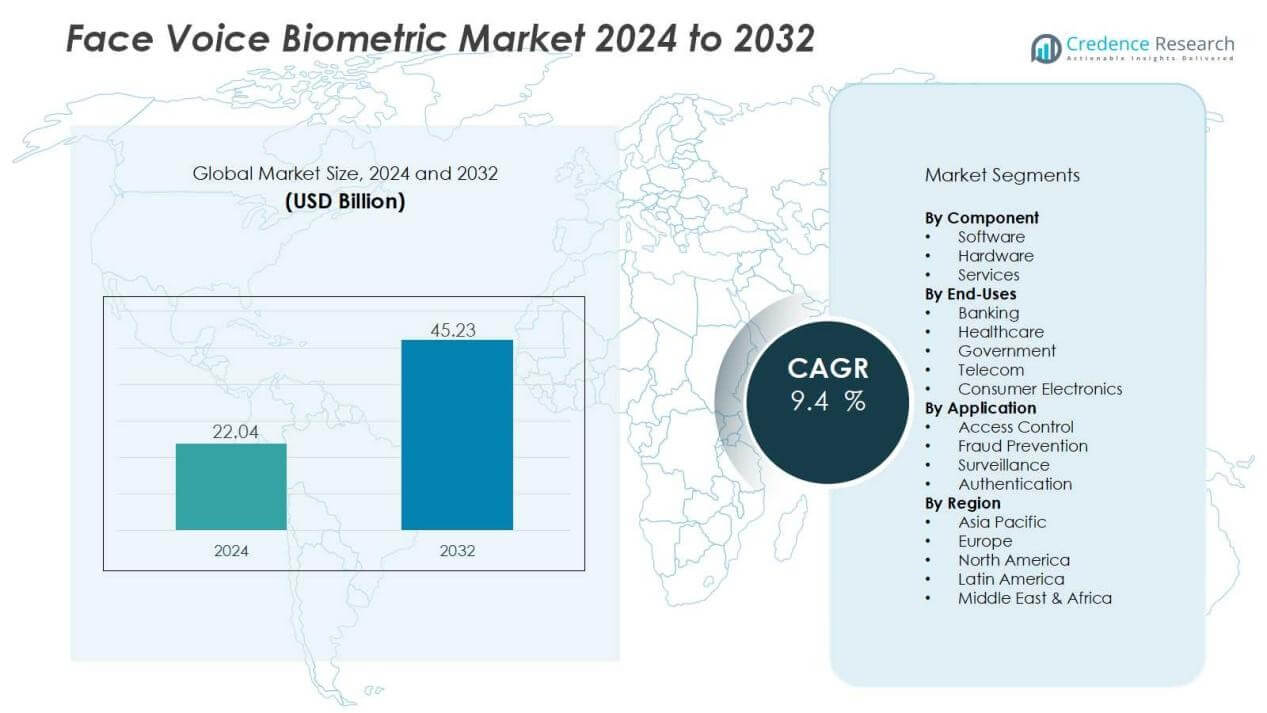
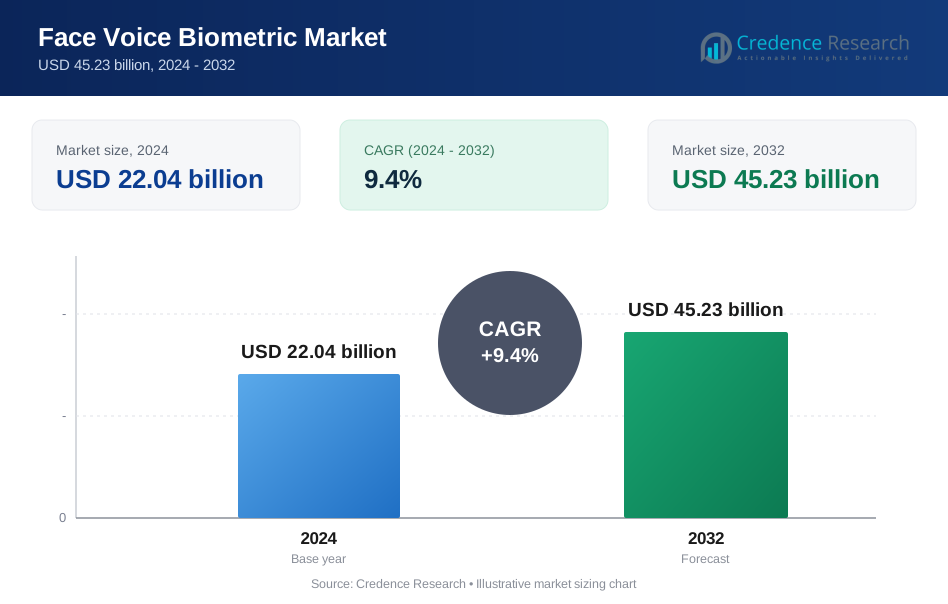
The Face Voice Biometric Market size was valued at USD 22.04 billion in 2024 and is anticipated to reach USD 45.23 billion by 2032, at a CAGR of 9.4 % during the forecast period (2024-2032).
| REPORT ATTRIBUTE | DETAILS |
|---|---|
| Historical Period | 2020-2023 |
| Base Year | 2024 |
| Forecast Period | 2025-2032 |
| Face Voice Biometric Market Size 2024 | USD 22.04 Billion |
| Face Voice Biometric Market, CAGR | 9.4 % |
| Face Voice Biometric Market Size 2032 | USD 45.23 Billion |
Key drivers shaping this market include the growing need for fraud prevention and stronger identity verification methods. The expansion of digital banking, e-commerce, and remote work models fuels adoption, as biometric solutions deliver convenience alongside security. Continuous advancements in AI, machine learning, and cloud-based deployment further strengthen performance and scalability. Increased consumer awareness and demand for contactless authentication also drive adoption across industries.
Regionally, North America dominates due to advanced technological infrastructure, early adoption, and strong regulatory frameworks supporting biometric integration. Europe follows closely, with demand supported by GDPR compliance and investment in security solutions. Asia-Pacific is the fastest-growing market, driven by expanding smartphone usage, government-led digital ID programs, and rapid financial inclusion in China, India, and Southeast Asia. Latin America and the Middle East & Africa are gradually adopting biometric solutions, supported by digital transformation initiatives and rising demand for secure online services.
 Market Insights:
- The face voice biometric market was valued at USD 22.04 billion in 2024 and is expected to reach USD 45.23 billion by 2032, growing at a CAGR of 9.4%.
- Rising demand for fraud prevention and identity verification across banking, healthcare, telecom, and government fuels adoption.
- Expansion of digital banking, e-commerce, and remote work models strengthens the need for secure biometric authentication.
- Advancements in AI, machine learning, and cloud deployment improve system accuracy, scalability, and adaptability.
- Consumer demand for contactless, convenient, and password-free solutions supports rapid adoption across industries.
- Privacy concerns, regulatory requirements, and high deployment costs remain major challenges to market growth.
- North America leads with 38.5% share, Europe follows with 29.7%, and Asia-Pacific grows fastest with 24.6% share.
Market Drivers:
Rising Need for Secure Authentication Across Industries:
The face voice biometric market is driven by the growing demand for secure authentication across financial services, healthcare, telecom, and government. Cyber threats and identity theft incidents have forced organizations to move beyond traditional password-based systems. Biometrics deliver a stronger, more reliable method of verifying identity. It ensures both convenience for users and higher protection for organizations handling sensitive data.
- For Instance, NatWest has implemented biometric security features, such as facial recognition, to enhance customer security, allowing customers to raise their daily payment limit for faster payments up to a maximum of £20,000 using their app and a card reader
Growing Adoption in Digital Banking and E-Commerce:
The rise of digital banking and online retail supports the expansion of the face voice biometric market. Financial institutions and e-commerce platforms require fast, frictionless, and secure ways to verify customers. Biometric systems reduce fraud risk while improving customer trust in digital channels. It provides a seamless verification experience that strengthens user engagement. Increasing use of mobile banking apps further accelerates adoption.
- For instance, as of September 2025, FaceTec’s 3D Liveness Detection AI performed over 3,400,000,000 liveness checks annually with zero reported fraud incidents, enabling banks and e-commerce platforms to authenticate users in under three seconds per check
Technological Advancements in AI and Machine Learning:
Continuous innovation in artificial intelligence and machine learning is another critical driver for the face voice biometric market. These technologies improve accuracy, speed, and adaptability of biometric systems. Advanced algorithms help distinguish subtle differences in faces and voices, even under challenging conditions. It enables higher system reliability across varied environments. Growing integration of cloud-based services expands scalability for enterprises of all sizes.
Rising Consumer Demand for Contactless and Convenient Solutions:
The shift toward contactless solutions has fueled the growth of the face voice biometric market. Consumers increasingly prefer quick and secure authentication methods for both physical and digital interactions. Biometric systems offer hands-free verification that aligns with modern lifestyle expectations. It reduces dependency on passwords or physical tokens, enhancing overall user experience. Expanding adoption in smartphones, wearables, and smart home devices reinforces this trend.
Market Trends:
Integration of Biometric Solutions with AI, Cloud, and IoT Ecosystems:
The face voice biometric market is witnessing a strong shift toward integration with AI, cloud, and IoT ecosystems. Enterprises are deploying biometric solutions across interconnected devices to create secure and seamless digital experiences. AI-powered models enhance accuracy and speed, while cloud platforms improve scalability for both small and large organizations. It supports continuous upgrades and remote deployment, reducing dependency on complex infrastructure. IoT connectivity allows biometric access in smart homes, vehicles, and workplaces, enhancing everyday convenience. The convergence of these technologies positions biometrics as a core element of digital transformation strategies.
- For instance, Keyless, a cloud-based biometric authentication provider, achieves 700 milliseconds authentication time with a false match rate of 1 in 1 billion, using AI-driven passive liveness detection and secure device binding technology to prevent spoofing and fraud across financial services.
Expansion of Multimodal Authentication and Consumer-Centric Applications:
The face voice biometric market is also shaped by the growing preference for multimodal authentication that combines facial recognition with voice verification. This approach reduces errors, minimizes spoofing attempts, and delivers stronger protection against cyber threats. It provides organizations with higher reliability in high-risk sectors such as finance, defense, and healthcare. Consumer-facing applications are expanding rapidly, from mobile banking and e-commerce to telehealth and ride-hailing platforms. Integration in smartphones, wearables, and kiosks highlights the push toward user-centric experiences. The trend reflects growing acceptance of biometrics in daily life, supported by rising trust in secure and convenient authentication methods.
- For instance, Daon’s IdentityX platform records over 250 million daily authentications, demonstrating seamless multimodal deployment at scale.
Market Challenges Analysis:
Privacy Concerns and Data Protection Regulations:
The face voice biometric market faces challenges linked to privacy concerns and strict regulatory frameworks. Consumers remain cautious about the storage and use of sensitive biometric data. Governments worldwide enforce regulations such as GDPR and CCPA, requiring companies to ensure transparency and compliance. It raises implementation costs and limits flexibility for global deployments. Security breaches or misuse of data can quickly erode user trust, creating resistance to adoption. Addressing these concerns requires strong encryption methods and clear data-handling policies.
High Implementation Costs and Technical Limitations:
The face voice biometric market also struggles with high deployment costs and technical hurdles. Small and medium enterprises often find system integration expensive, slowing broader adoption. Accuracy can decline in noisy environments, low-light conditions, or with aging populations. It restricts usability in certain applications where reliability must remain consistent. Hardware requirements and software upgrades further add to expenses. Vendors must focus on cost-effective, adaptable solutions to overcome these barriers and support sustainable growth.
Market Opportunities:
Expanding Role in Financial Services, Healthcare, and Government Programs:
The face voice biometric market presents strong opportunities within financial services, healthcare, and government-led digital ID initiatives. Banks and fintech firms seek advanced verification to reduce fraud and improve customer trust. Healthcare providers can adopt biometrics to secure patient records and support telemedicine platforms. Government programs, such as e-passports and digital identity projects, create large-scale adoption opportunities. It enables faster service delivery while ensuring compliance with security standards. Expanding investments in public sector digitalization strengthen the growth outlook across developed and emerging markets.
Rising Adoption in Consumer Devices and Smart Environments:
The face voice biometric market is also set to benefit from growing integration into smartphones, wearables, and connected devices. Consumer demand for seamless, secure, and contactless authentication continues to rise globally. Smart home ecosystems and automotive applications highlight the versatility of biometric solutions in everyday life. It offers hands-free, personalized access to devices and services, improving convenience. Enterprises are also deploying biometrics in workplace access control and remote workforce management. The widening use across both personal and enterprise applications creates a multi-channel growth path for vendors.
Market Segmentation Analysis:
By Component:
The face voice biometric market is segmented into software, hardware, and services. Software holds the dominant position due to rising demand for AI-powered algorithms that improve recognition accuracy and reduce false matches. It supports integration with cloud platforms, enabling scalability for enterprises of all sizes. Hardware, including cameras, microphones, and sensors, contributes steadily as consumer devices embed biometric functions. Services are expanding with maintenance, integration, and consulting to support deployment in complex environments. It ensures long-term reliability and adaptability across industries.
- For instance, Megvii’s Face++ software analyzes 106 data points on the face and is widely used in law enforcement for real-time criminal identification and city-wide CCTV analysis, showcasing its advanced AI capabilities.
By Application:
Key applications include access control, fraud prevention, surveillance, and authentication. Access control leads adoption, with enterprises and governments investing in secure entry solutions. Fraud prevention is critical in banking and fintech, where biometric systems reduce risks and strengthen customer trust. Surveillance applications gain traction in law enforcement and smart city projects. Authentication supports consumer-facing services, such as e-commerce and telehealth platforms. It enables seamless and secure verification in both physical and digital environments.
- For instance, HID Global’s OMNIKEY 5x21 series smart card readers deliver a mean time between failures of 500,000 hours — a testament to their reliability in high-security environments.
By End-Use:
The face voice biometric market serves banking, healthcare, government, telecom, and consumer electronics. Banking remains a major end-use sector, with institutions implementing biometric verification for account security. Healthcare adopts it to protect sensitive patient information and enable secure telemedicine. Government agencies leverage biometrics for national IDs, border control, and law enforcement. Telecom and consumer electronics sectors expand adoption through smartphones, wearables, and customer verification systems. It reflects the growing role of biometrics in critical and everyday applications.
Segmentations:
By Component:
- Software
- Hardware
- Services
By Application:
- Access Control
- Fraud Prevention
- Surveillance
- Authentication
By End-Use:
- Banking
- Healthcare
- Government
- Telecom
- Consumer Electronics
By Region:
- North America
- U.S.
- Canada
- Mexico
- Europe
- UK
- France
- Germany
- Italy
- Spain
- Russia
- Rest of Europe
- Asia Pacific
- China
- Japan
- South Korea
- India
- Australia
- Southeast Asia
- Rest of Asia Pacific
- Latin America
- Brazil
- Argentina
- Rest of Latin America
- Middle East
- GCC Countries
- Israel
- Turkey
- Rest of Middle East
- Africa
- South Africa
- Egypt
- Rest of Africa
Regional Analysis:
North America:
North America held 38.5% market share in the face voice biometric market in 2024, supported by early technology adoption and advanced infrastructure. The region benefits from robust cybersecurity policies, strong consumer awareness, and regulatory frameworks promoting secure authentication. It is widely deployed across banking, defense, and healthcare sectors to ensure protection of sensitive data. Rising investments in AI-driven biometrics strengthen accuracy and reduce fraud risks. The presence of leading solution providers further enhances innovation and scalability. Expansion in digital banking and e-governance projects continues to drive adoption across enterprises and government agencies.
Europe:
Europe accounted for 29.7% market share in the face voice biometric market in 2024, supported by strict data protection regulations and widespread adoption in financial services. The region demonstrates high demand for GDPR-compliant solutions that ensure consumer trust and transparency. It sees strong investment in multimodal biometric technologies for airports, border security, and enterprise applications. Healthcare and insurance providers are adopting solutions to meet security and privacy standards. Regional players collaborate with global vendors to enhance system interoperability and innovation. The market benefits from rising digital identity programs across Western and Northern Europe.
Asia-Pacific:
Asia-Pacific captured 24.6% market share in the face voice biometric market in 2024, driven by rising smartphone penetration and government-led digital ID programs. Rapid urbanization and financial inclusion initiatives across China, India, and Southeast Asia increase adoption. It is widely used in telecom, banking, and public services to verify large populations efficiently. Governments invest in biometric-based national identity systems and smart city projects. Local and international vendors expand aggressively to capture this fast-growing demand. The region’s strong focus on digital transformation and secure online services positions it as the key growth engine through 2032.
Key Player Analysis:
- Accu-Time Systems, Inc.
- BIO-key International, Inc.
- AFIX Technologies
- DERMALOG Identification Systems GmbH
- EyeVerify, Inc.
- Fujitsu Limited
- East Shore Technologies, Inc.
- HID Global Corporation
- IDEMIA
- Iris ID, Inc.
- Gemalto NV
- NEC Corporation
Competitive Analysis:
The face voice biometric market is highly competitive, shaped by global technology providers and specialized vendors. Key players include Accu-Time Systems, Inc., BIO-key International, Inc., AFIX Technologies, DERMALOG Identification Systems GmbH, EyeVerify, Inc., and Fujitsu Limited. Companies focus on innovation in AI algorithms, hardware integration, and cloud-based solutions to improve accuracy and scalability. It reflects strong investments in multimodal authentication that combines face and voice recognition for higher reliability. Strategic partnerships with financial institutions, governments, and telecom operators strengthen distribution networks and expand market reach. Vendors also prioritize compliance with data protection regulations to build user trust and sustain adoption. Growing demand in consumer electronics, banking, and healthcare creates opportunities for firms offering cost-effective and flexible solutions. Competitive intensity remains high, with continuous product launches and regional expansion strategies driving differentiation among leading and emerging players.
Recent Developments:
- In June 2025, BIO-key International, Inc.'s CEO Michael DePasquale acquired shares worth $3,900 on June 15, 2025, showing confidence in the company’s performance.
- In January 2024, AFIX Technologies formed a partnership with Caspian Group for cutting-edge scaffolding solutions announced on January 7, 2024, expanding their market presence in the scaffolding sector.
Report Coverage:
The research report offers an in-depth analysis based on Component, Application, End-Use and Region. It details leading Market players, providing an overview of their business, product offerings, investments, revenue streams, and key applications. Additionally, the report includes insights into the competitive environment, SWOT analysis, current Market trends, as well as the primary drivers and constraints. Furthermore, it discusses various factors that have driven Market expansion in recent years. The report also explores Market dynamics, regulatory scenarios, and technological advancements that are shaping the industry. It assesses the impact of external factors and global economic changes on Market growth. Lastly, it provides strategic recommendations for new entrants and established companies to navigate the complexities of the Market.
Future Outlook:
- Adoption of multimodal biometrics will expand, combining face and voice for higher security.
- Financial services will remain a leading sector, driving demand for fraud-resistant authentication solutions.
- Healthcare providers will integrate biometrics to secure patient data and support digital health services.
- Government initiatives for national IDs and border control will accelerate biometric deployments globally.
- AI and machine learning will enhance system accuracy and adaptability in varied conditions.
- Consumer devices such as smartphones, wearables, and smart home systems will embed biometric features.
- Cloud-based biometric solutions will grow, offering scalability and remote deployment for enterprises.
- Vendors will prioritize privacy-focused designs to address regulatory pressures and strengthen user trust.
- Emerging markets in Asia-Pacific, Latin America, and Africa will witness rapid adoption through digital inclusion.
- Strategic partnerships and mergers will shape competition, driving innovation and market consolidation.
Request a Free Sample
Fill in your details and we'll send you a free sample report.
- Sample data tables & charts
- Research methodology
Need a Custom Version of This Report?
Tailor the scope, geography, or segments to your exact requirements.
- Custom geography or segment scope
- Direct access to our analyst team
Frequently Asked Questions
What is the current market size for the Face Voice Biometric Market, and what is its projected size in 2032?
At what Compound Annual Growth Rate is the Face Voice Biometric Market projected to grow between 2024 and 2032?
Which Face Voice Biometric Market segment held the largest share in 2024?
What are the primary factors fueling the growth of the Face Voice Biometric Market?
Who are the leading companies in the Face Voice Biometric Market?
Which region commanded the largest share of the Face Voice Biometric Market in 2024?
Table of Content
Chapter 1. Report Introduction
- 1.1 Report Description & Purpose
- 1.1.1 Report Title & Market Definition
- 1.1.2 Unique Selling Propositions (USP) & Key Differentiators
- 1.1.3 Value Proposition for Stakeholders
- 1.2 Research Objectives
- 1.2.1 Market Sizing Objectives (Volume & Revenue)
- 1.2.2 Segmentation Objectives
- 1.2.3 Competitive Intelligence Objectives
- 1.2.4 Forecast & Scenario Objectives
- 1.3 Report Scope
- 1.3.1 Face Voice Biometric Scope – Types & Subtypes Covered
- 1.3.2 Geographic Scope – Regions & Countries Covered
- 1.3.3 Historical Period, Base Year & Forecast Period (2024; forecast to 2032)
- 1.3.4 Inclusions & Exclusions
- 1.4 HS Code & Classification Framework
- 1.5 Currency, Units & Pricing Basis
- 1.6 Target Stakeholders
- 1.7 Limitations & Assumptions
Chapter 2. Executive Summary
- 2.1 Global Face Voice Biometric Market Snapshot
- 2.1.1 Market Size – Historical (2024) & Forecast (2024-2032) (2024: USD 22.04 billion → 2032: USD 45.23 billion)
- 2.1.2 Volume & Revenue – Global Totals
- 2.1.3 Key Market Highlights – Top Five Facts
- 2.2 Face Voice Biometric Market Segmentation Snapshot
- 2.2.1 Market Split by Region – 2024 vs. 2032
- 2.3 Competitive Snapshot
- 2.3.1 Top 10 Players by Revenue Share – 2024
- 2.3.2 Top 10 Players by Volume Share – 2024
- 2.3.3 Recent Strategic Developments (18-Month Summary)
- 2.4 Key Investment Highlights & Strategic Conclusions
Chapter 3. Face Voice Biometric Market Dynamics & Industry Analysis
- 3.1 Market Overview & Context
- 3.1.1 Face Voice Biometric Market Position in the Broader Automotive Value Chain
- 3.1.2 OEM vs. Replacement Market Dynamics
- 3.1.3 Market Maturity & Development Stage by Region
- 3.2 Face Voice Biometric Market Drivers
- 3.3 Face Voice Biometric Market Restraints & Challenges
- 3.4 Face Voice Biometric Market Opportunities
- 3.5 Porter's Five Forces Analysis
- 3.5.1 Threat of New Entrants
- 3.5.2 Bargaining Power of Suppliers
- 3.5.3 Bargaining Power of Buyers
- 3.5.4 Threat of Substitutes
- 3.5.5 Competitive Rivalry – Intensity Assessment
- 3.6 Face Voice Biometric Value Chain Analysis
- 3.6.1 Upstream – Raw Material/Input Suppliers
- 3.6.1.1 Raw Material/Input 1
- 3.6.1.2 Raw Material/Input 2
- 3.6.1.3 Raw Material/Input 3
- 3.6.2 Midstream – Production/Manufacturing/Service Delivery
- 3.6.2.1 Production/Process Overview
- 3.6.2.2 Key Facility Locations & Capacity by Manufacturer
- 3.6.3 Downstream – Distribution & End Consumer
- 3.6.3.1 Primary Channel – B2B/OEM
- 3.6.3.2 Secondary Channels – Dealer, Retail, Online, Direct
- 3.6.4 Value Chain Profitability Analysis
- 3.6.1 Upstream – Raw Material/Input Suppliers
- 3.7 PESTEL Analysis
- 3.7.1 Political Factors
- 3.7.2 Economic Factors
- 3.7.3 Social Factors
- 3.7.4 Technological Factors
- 3.7.5 Environmental Factors
- 3.7.6 Legal Factors
- 3.8 Face Voice Biometric Supply Chain Analysis
- 3.8.1 Raw Material/Input Supply Risk Assessment
- 3.8.2 Manufacturing Concentration Risk (Geographic Exposure)
- 3.8.3 Trade Disruption Impact Analysis
- 3.9 Regulatory & Policy Landscape
Note: The regulatory and policy landscape section covers regulations based on their applicability to the market, Face Voice Biometric category, geography, and scope of the study. Only regulatory frameworks with a material impact on operations, compliance, trade, sustainability, or market access are analyzed in detail.
Chapter 4. Key Investment Pockets & Opportunity Analysis
- 4.1 Face Voice Biometric Market Attractiveness Analysis
- 4.1.1 By Region – Investment Attractiveness Matrix (Volume × CAGR)
- 4.2 Absolute Revenue Growth Opportunity
- 4.2.1 By Region – Absolute USD Growth Through 2032
- 4.3 Incremental Volume Opportunity
- 4.3.1 By Region – Incremental Volume Through 2032
- 4.3.2 Segment – Incremental Volume
- 4.4 Emerging Submarket Opportunity Deep Dive (Subject to Applicability)
- 4.5 Emerging Market Opportunity Scorecards
- 4.5.1 United States
- 4.5.2 Europe
- 4.5.3 Asia
- 4.5.4 Middle East & Africa
Note: Emerging Market Opportunity Scorecards will be included based on relevance and strategic importance. Regions listed are indicative and may vary depending on data availability and market dynamics.
Chapter 5. Face Voice Biometric Import-Export Analysis & Trade Flows
- 5.1 Global Trade Overview
- 5.1.1 Global Export Value by Country (2024)
- 5.1.2 Global Export Volume by Country (2024)
- 5.1.3 Global Import Value by Country (2024)
- 5.1.4 Global Import Volume by Country (2024)
- 5.1.5 Net Trade Balance by Country (2024)
- 5.2 Export Analysis – Segment
- 5.2.1 Type 1 (HS Code)
- 5.2.2 Type 2 (HS Code)
- 5.2.3 Type 3 (HS Code)
- 5.2.4 Type 4 (HS Code)
- 5.2.5 Type 5 (HS Code)
- 5.3 Import Analysis – Segment
- 5.3.1 Type 1 (HS Code)
- 5.3.2 Type 2 (HS Code)
- 5.3.3 Type 3 (HS Code)
- 5.3.4 Type 4 (HS Code)
- 5.3.5 Type 5 (HS Code)
- 5.4 Average Unit Trade Prices
- 5.4.1 Average Export Price – Segment & Country
- 5.4.2 Average Import Price – Segment & Source Country
- 5.4.3 Price Trends (2024)
- 5.5 Key Trade Route Analysis
- 5.5.1 Trade Route 1
- 5.5.2 Trade Route 2
- 5.5.3 Trade Route 3
- 5.5.4 Trade Route 4
- 5.5.5 Trade Route 5
- 5.6 Trade Policy Impact Assessment
- 5.6.1 US Anti-Dumping & Section 301 Tariffs
- 5.6.2 EU Customs Union Impact
- 5.6.3 Major Free Trade Agreements
- 5.6.4 USMCA Rules of Origin
Note: Trade policy analysis will be included only where relevant to the Face Voice Biometric market.
Chapter 6. Competitive Landscape & Company Benchmarking
- 6.1 Face Voice Biometric Market Concentration & Structure
- 6.1.1 Herfindahl-Hirschman Index (HHI) – vs. 2024
- 6.1.2 Tier 1, Tier 2 & Tier 3 Market Structure
- 6.1.3 Global, Regional & Local Player Dynamics
- 6.2 Face Voice Biometric Market Share Analysis – 2024
- 6.2.1 Global Revenue Share by Company
- 6.2.2 Global Volume Share by Company
- 6.2.3 Regional Revenue Share
- 6.2.4 Market Share Evolution ( vs. 2024)
- 6.2.5 OEM Segment Share by Company
- 6.2.6 Replacement Segment Share by Company
- 6.3 Production/Delivery Capacity & Facility Analysis
- 6.3.1 Global Installed Capacity
- 6.3.2 Capacity Utilization Rates
- 6.3.3 Production/Output Volume
- 6.3.4 Facility Locations & Capacity Map
- 6.3.5 Planned Capacity Additions
- 6.4 Face Voice Biometric Competitive Benchmarking Matrix
- 6.4.1 Revenue, Volume, CAGR & Profitability Comparison
- 6.4.2 Channel Revenue Mix
- 6.4.3 Geographic Revenue Exposure
- 6.4.4 R&D Intensity
- 6.4.5 Sustainability Maturity
- 6.5 Strategic Developments in Face Voice Biometric (Last 24 Months)
- 6.5.1 Mergers, Acquisitions & Divestments
- 6.5.2 New Face Voice Biometric Launches
- 6.5.3 Facility Expansions
- 6.5.4 Strategic Alliances, Joint Ventures & Partnerships
- 6.5.5 Distribution Expansion & Market Entry
- 6.5.6 Sustainability & ESG Initiatives
- 6.6 Competitive Strategy Mapping
- 6.6.1 Leader, Challenger, Follower & Niche Classification
- 6.6.2 Pricing Strategy Comparison
- 6.6.3 Channel Strategy Matrix
Note: Strategic developments are included based on their materiality and the availability of reliable information.
Chapter 7. Global Face Voice Biometric Market – By Distribution Channel
- 7.1 Segment Overview
- 7.1.1 Volume & Revenue Split by Channel (2024 & 2032)
- 7.1.2 Channel Mix Evolution (2024-2032)
Chapter 8. Regional Market Analysis – Global Overview
- 8.1 Global Regional Overview
- 8.1.1 Regional Volume Share
- 8.1.2 Regional Revenue Share
- 8.1.3 Regional Volume by Region
- 8.1.4 Regional Revenue by Region
- 8.1.5 Regional Forecast Through 2032
- 8.2 Cross-Regional Segment Analysis
- 8.2.1 By Distribution Channel
- 8.2.2 By Brand/Price Tier
Chapter 9. North America Face Voice Biometric Market
- 9.1 United States
- 9.2 Canada
- 9.3 Mexico
Chapter 10. Europe Face Voice Biometric Market
- 10.1 Germany
- 10.2 France
- 10.3 Italy
- 10.4 United Kingdom
- 10.5 Spain
- 10.6 Poland
- 10.7 Russia
- 10.8 Netherlands
- 10.9 Belgium
- 10.10 Sweden
- 10.11 Denmark
- 10.12 Norway
- 10.13 Rest of Europe
Chapter 11. Asia Pacific Face Voice Biometric Market
- 11.1 China
- 11.2 India
- 11.3 Japan
- 11.4 South Korea
- 11.5 Thailand
- 11.6 Indonesia
- 11.7 Vietnam
- 11.8 Malaysia
- 11.9 Australia
- 11.10 Rest of Asia Pacific
Chapter 12. Latin America Face Voice Biometric Market
- 12.1 Brazil
- 12.2 Argentina
- 12.3 Colombia
- 12.4 Chile
- 12.5 Rest of Latin America
Chapter 13. Middle East Face Voice Biometric Market
- 13.1 Saudi Arabia
- 13.2 United Arab Emirates
- 13.3 Turkey
- 13.4 Israel
- 13.5 Iran
- 13.6 Rest of the Middle East
Chapter 14. Africa Face Voice Biometric Market
- 14.1 South Africa
- 14.2 Egypt
- 14.3 Nigeria
- 14.4 Morocco
- 14.5 Rest of Africa
Chapter 15. Face Voice Biometric Company Profiles
- 15.1 [Company 01]
- 15.1.1 Company Overview
- 15.1.2 Key Management Personnel
- 15.1.3 Products & Services Portfolio
- 15.1.4 Financial Performance
- 15.1.5 Key Market Focus & Geographic Presence
- 15.1.6 Recent Developments & Strategic Initiatives
Note: The company profile list is preliminary and may change based on research findings, market developments, data availability, and client requirements.
Chapter 16. Appendices
- Appendix A – List of Abbreviations & Acronyms
- Appendix B – Industry Classification Code Reference – Full Series
- Appendix C – Production & Capacity Data Tables
- Appendix D – End-Use & Demand Base Tables
- Appendix E – Consumption & Replacement Rate Assumptions
- Appendix F – ASP Reference Tables
- Appendix G – Manufacturing & Facility Database
- Appendix H – Import-Export Data Tables
- Appendix I – Regulatory Summary Tables
- Appendix J – Primary Research Participant List (Anonymized)
- Appendix K – Primary Research Questionnaire Framework
- Appendix L – Data Sources & Bibliography
- Appendix M – Market Size Divergence & Source Comparison
Chapter 17. Research Methodology
- 17.1 Research Framework & Philosophy
- 17.2 Secondary Research – Sources, Hierarchy & Data Extraction
- 17.3 Data Modeling – Bottom-Up & Top-Down Market Sizing
- 17.4 Primary Research – Stakeholder Framework, LOI & Sample Sizes
- 17.5 Forecast Methodology – Regression, Scenario & Sensitivity Analysis
- 17.6 Quality Control – Four-Layer Validation Framework
- 17.7 Limitations & Standard Assumptions
- 17.8 Disclaimer
