Market Overview
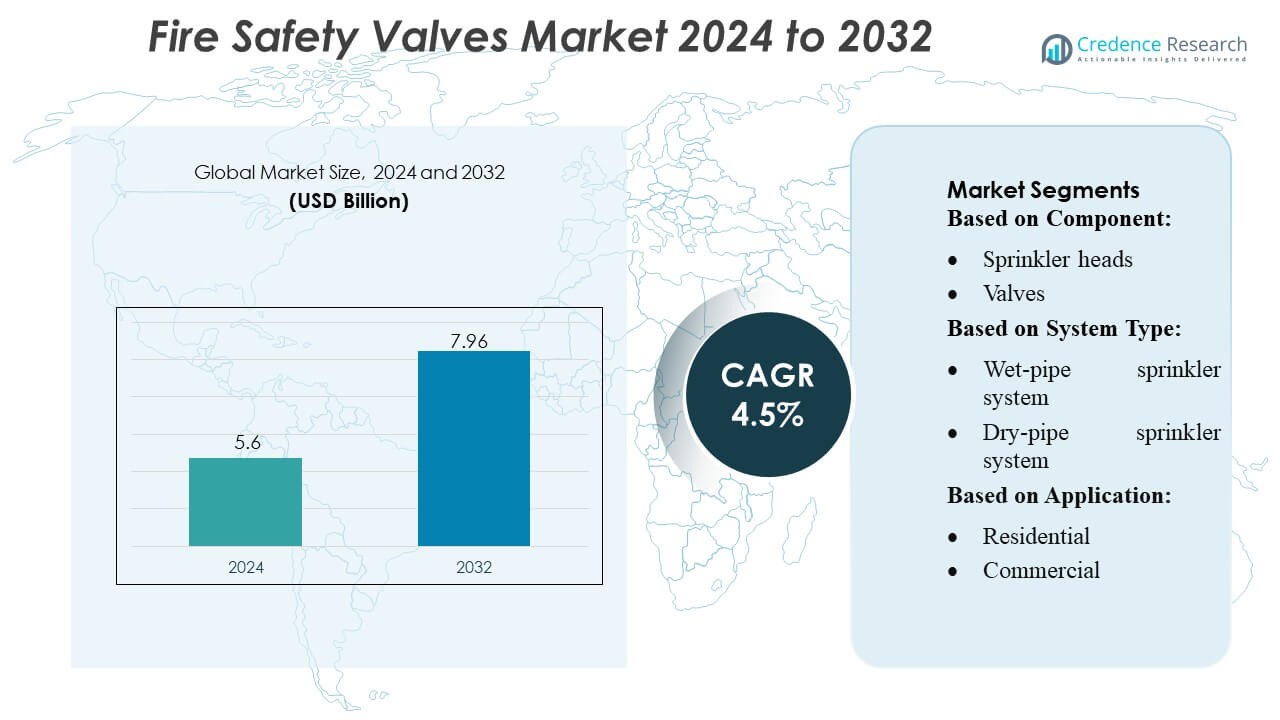
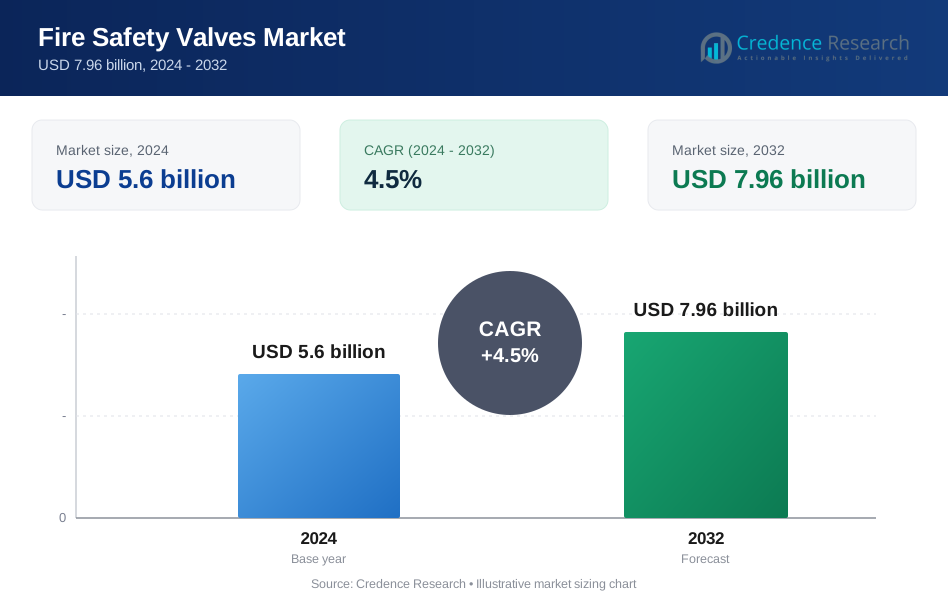
Fire Safety Valves Market size was valued USD 5.6 billion in 2024 and is anticipated to reach USD 7.96 billion by 2032, at a CAGR of 4.5% during the forecast period.
| REPORT ATTRIBUTE | DETAILS |
|---|---|
| Historical Period | 2020-2023 |
| Base Year | 2024 |
| Forecast Period | 2025-2032 |
| Fire Safety Valves Market Size 2024 | USD 5.6 Billion |
| Fire Safety Valves Market, CAGR | 4.5% |
| Fire Safety Valves Market Size 2032 | USD 7.96 Billion |
The Fire Safety Valves Market is shaped by a group of globally established manufacturers that focus on high-performance flow-control technologies, certified safety standards, and advanced system integration capabilities. These players compete through innovation in automated valve mechanisms, corrosion-resistant materials, and smart monitoring features that support modern fire suppression networks across commercial, industrial, and residential facilities. Their strategies emphasize product reliability, regulatory compliance, and expansion into fast-growing construction and industrial hubs. Asia-Pacific leads the global market with approximately 38–40% share, driven by rapid urbanization, large-scale infrastructure development, and tightening fire safety regulations across high-density regions.
Market Insights
- The Fire Safety Valves Market was valued at USD 5.6 billion in 2024 and is projected to reach USD 7.96 billion by 2032, registering a CAGR of 4.5%, supported by ongoing upgrades in global fire protection infrastructure.
- Market growth is driven by increasing construction activities, stricter safety regulations, and rising adoption of automated valve systems with corrosion-resistant designs and intelligent monitoring capabilities.
- Advancements in smart suppression technologies, integration with building automation systems, and demand for high-efficiency valves in industrial facilities shape emerging market trends.
- Competitive intensity remains high as global manufacturers focus on certified product lines, system compatibility, and expansion across fast-growing commercial and industrial sectors, while cost barriers and maintenance requirements act as notable restraints.
- Asia-Pacific leads with 38–40% share, followed by North America and Europe, while the sprinkler pipe and fittings segment dominates with over 30% share, driven by extensive installation across large-scale infrastructure and high-density urban developments.
Market Segmentation Analysis:
By Component
The component segment is led by sprinkler pipe and pipe fittings, accounting for around 30–32% of the market, supported by their essential role in establishing robust fire suppression networks across residential, commercial, and industrial infrastructures. Their dominance stems from increased construction activity, higher compliance with fire safety mandates, and rising adoption of automated sprinkler systems. Sprinkler heads and valves follow, driven by upgrades in detection precision and flow control. Compressors and pumps with controllers gain traction in high-risk environments requiring stable pressure systems, while the “others” category grows with sensor-enabled accessories and smart monitoring components.
- For instance, Honeywell’s fire‑life‑safety business includes waterflow detectors compatible with steel pipes sized 2″ through 8″ - e.g. their WFD20 detector supports 2″ steel pipe - highlighting their direct involvement in piping and fittings for sprinkler networks.
By System Type
The wet-pipe sprinkler system holds the dominant position with approximately 40–45% market share, driven by its reliability, low maintenance requirements, and widespread acceptance across commercial and residential buildings. Its ability to provide immediate response without complex activation mechanisms strengthens its adoption in regions with stable temperatures. Dry-pipe and pre-action systems witness growth in cold-storage facilities, data centers, and high-value asset environments where accidental discharge avoidance is crucial. Deluge systems expand in heavy industrial zones requiring rapid water flow for large-area suppression. The “others” category includes emerging hybrid systems integrating mist and smart-controlled suppression technologies.
- For instance, Siemens AG’s boiler control solution for industrial fire-tube applications incorporates a burner management system (BMS) built on a PLC platform, which supports features such as flame-scanner redundancy, applications up to SIL 3 safety rating, and real-time diagnostics via HMI with remote access.
By Application
The commercial segment leads with around 45–48% market share, driven by stringent safety regulations across offices, malls, hospitality buildings, hospitals, and educational institutions. Growing investments in infrastructure modernization and the integration of smart fire suppression solutions further support dominance in this category. The industrial segment follows, benefiting from heightened safety requirements in manufacturing plants, oil & gas facilities, and logistics warehouses where risk exposure is high. The residential segment shows increasing adoption due to rising awareness, government mandates for multi-unit dwellings, and improved affordability of integrated sprinkler and valve systems.
Key Growth Drivers
1. Expansion of Commercial and Industrial Infrastructure
The rapid expansion of commercial complexes, industrial facilities, and large public infrastructure projects significantly drives demand for fire safety valves. Governments worldwide continue strengthening fire safety codes, making sprinkler systems and high-performance valve assemblies mandatory in new construction. Industrial sectors such as oil & gas, chemicals, manufacturing, and warehousing require advanced suppression systems due to higher fire risk exposure. This broad-based infrastructure growth, combined with compliance pressure, accelerates installation rates and pushes manufacturers to supply durable, certified, and performance-tested fire safety valves across diverse building environments.
- For instance, MHI-INC's industrial electric steam generator line features standard units capable of producing superheated steam at 1,300 °C with flow rates up to 200 kg/h in specialized configurations.
2. Rising Emphasis on Workplace and Public Safety Compliance
Growing awareness of fire hazards and the rising frequency of industrial and residential accidents reinforce the need for stringent safety compliance. Regulatory authorities now enforce tighter inspection processes, certification standards, and periodic system upgrades, boosting replacement and modernization demand for fire safety valves. Organizations prioritize life-safety systems to mitigate liability and ensure operational continuity, leading to greater adoption of advanced flow-control valves and automated sprinkler networks. This regulatory shift encourages manufacturers to innovate high-reliability components tailored to evolving safety frameworks across developed and emerging markets.
- For instance, Thermax Ltd. supplied a packaged firetube boiler with a working pressure of 10.54 kg/cm² and steam temperature range of 184–215 °C, specifically for chemical‑industry use on natural gas, enabling improved combustion control and reduced emissions under stringent norms.
3. Technological Advancements in Fire Suppression Systems
Continuous advancements in sensor integration, automated activation mechanisms, corrosion-resistant materials, and intelligent water-flow control enhance the performance of modern fire safety valves. Smart valves capable of real-time monitoring, remote diagnostics, and predictive maintenance appeal to data centers, logistics hubs, and high-value industrial environments. These innovations improve response accuracy, reduce false activations, and extend system lifespan, driving strong replacement demand. The shift toward IoT-enabled safety infrastructure and the rising adoption of high-efficiency suppression systems contribute to stable, long-term market growth.
Key Trends & Opportunities
1. Growing Adoption of Smart and Connected Fire Safety Systems
The integration of IoT, AI-driven alerts, and real-time pressure monitoring creates significant opportunities for next-generation fire safety valves. Smart valves help detect anomalies early, optimize water usage, and reduce system downtime. Commercial buildings, data centers, and industrial plants increasingly adopt connected suppression networks for predictive maintenance and compliance reporting. This trend aligns with the broader shift toward digital building management systems, enabling manufacturers to offer value-added features such as automated diagnostics, remote testing, and seamless integration with smart fire panels.
- For instance, Cheema Boilers Limited offers a range of high-capacity Gas PAC and Oil PAC models have an operating capacity range from 1 TPH to 16 TPH (1,000 kg/hr to 16,000 kg/hr). Other sources indicate the range for both Oil PAC and Gas PAC can go up to 20 TPH in some configurations.
2. Increased Demand for High-Performance Valves in Harsh Environments
Industries operating in extreme conditions-such as petrochemical plants, offshore rigs, power facilities, and cold-storage warehouses-are driving demand for corrosion-resistant, high-strength, and quick-response valve systems. Manufacturers invest in advanced alloys, epoxy-coated interiors, and specialized sealing technologies to meet these application needs. The growing complexity of industrial operations and rising emphasis on operational resilience expand the opportunity for premium-grade valves. This trend supports higher margins and encourages innovation across pressure-sustaining, deluge, and pre-action system valves tailored for high-risk environments.
- For instance, BHEL’s distributed digital control, monitoring & information system (DDCMIS) enables boiler ramp‑up at a rate of 3% per minute for loads between 70‑100% TMCR, and 2% per minute for 55‑70% TMCR.
3. Expansion of Retrofitting and Upgradation Activities
Aging infrastructure across developed countries presents a major opportunity for retrofitting and system upgrades. Many commercial buildings, factories, and public facilities still operate outdated fire suppression systems that fail to meet modern safety standards. As insurance companies enforce stricter risk-assessment criteria, facility managers increasingly invest in replacing legacy valves with certified, efficient models. Government-sponsored building revitalization programs and sustainability-driven facility upgrades further boost this trend, creating long-term revenue streams for manufacturers and service providers.
Key Challenges
1. High Installation and Maintenance Costs
The cost-intensive nature of installing and maintaining advanced fire safety valves poses a challenge, particularly for small enterprises and residential buildings. Complex systems require skilled technicians, periodic inspection, and regulatory certification, raising overall lifecycle expenses. Many property owners postpone upgrades or choose lower-cost alternatives, slowing adoption of high-performance valves. Additionally, integrating new valves into older infrastructure may demand significant system overhauls, further increasing costs. This financial barrier limits market penetration in cost-sensitive regions.
2. Regulatory Variations and Certification Complexities
Fire safety regulations vary widely across countries and regions, creating a complex compliance landscape for manufacturers. Valves must meet different certification standards-such as UL, FM, CE, and local codes-before entering specific markets, resulting in higher testing costs and extended product development cycles. Frequent updates to safety norms and inconsistent enforcement across emerging markets add operational uncertainty. These regulatory discrepancies hinder streamlined global expansion and require companies to maintain multi-standard production lines, increasing operational and documentation burdens.
Regional Analysis
North America
North America holds a 28–30% share of the Fire Safety Valves Market, supported by stringent building codes, advanced fire safety standards, and high adoption of automated suppression systems. The U.S. leads due to extensive commercial infrastructure, strong emphasis on workplace safety, and continual modernization of industrial facilities. Robust insurance regulations and mandatory compliance certifications accelerate the installation of high-performance valves across residential towers, data centers, manufacturing plants, and logistics hubs. Growing investment in smart building technologies further drives replacement demand, while Canada contributes steadily through infrastructure expansion and strict enforcement of provincial fire protection regulations.
Europe
Europe accounts for 24–26% of the global market, driven by rigorous fire safety legislation, rapid urban redevelopment, and widespread integration of advanced sprinkler systems. Countries such as Germany, the U.K., and France lead adoption due to strict compliance frameworks, insurance mandates, and high awareness of fire risk mitigation. The region’s strong industrial base-including chemicals, automotive, and energy sectors-supports demand for high-performance, corrosion-resistant valves. Ongoing renovations in aging infrastructure and the push for intelligent fire monitoring systems enhance market growth. Additionally, EU directives promoting safety standardization encourage consistent product upgrades across commercial and industrial facilities.
Asia-Pacific
Asia-Pacific dominates the market with the largest share of 38–40%, driven by rapid urbanization, large-scale commercial construction, and expanding manufacturing activity. China and India remain key contributors as government-led safety regulations tighten across high-rise buildings, industrial clusters, and public infrastructure. The region’s booming logistics, electronics, and petrochemical industries demand advanced suppression systems with reliable valve performance. Increasing adoption of smart fire safety technologies and rising safety awareness in emerging economies further accelerate market penetration. Strong investments in industrial parks, airports, and smart cities reinforce APAC’s leadership, making it the fastest-growing region for fire safety valves.
Latin America
Latin America represents 8–10% of the market, supported by growing enforcement of fire protection standards in commercial buildings and industrial facilities. Brazil and Mexico lead adoption with infrastructure expansion, modernization of public spaces, and rising investment in oil & gas, mining, and manufacturing sectors that require robust fire suppression systems. Although budget constraints limit high-end system installations, increasing collaboration with global safety equipment manufacturers enhances market accessibility. The development of shopping malls, warehouses, and residential complexes accelerates demand, while government-driven safety campaigns gradually strengthen penetration of certified fire safety valves across the region.
Middle East & Africa
The Middle East & Africa region holds 6–8% market share, driven by large-scale infrastructure development, especially in the UAE, Saudi Arabia, and Qatar. High-value construction projects, including commercial towers, airports, and industrial zones, require advanced fire suppression systems equipped with durable valves capable of performing in extreme temperatures. The oil & gas sector further contributes to demand, given its strict safety requirements and reliance on deluge and high-pressure systems. In Africa, growth remains gradual but improves with rising urban development and adoption of modern building codes. Increasing reliance on international standards boosts demand for certified valve solutions.
Market Segmentations:
By Component:
- Sprinkler heads
- Valves
By System Type:
- Wet-pipe sprinkler system
- Dry-pipe sprinkler system
By Application:
- Residential
- Commercial
By Geography
- North America
- U.S.
- Canada
- Mexico
- Europe
- Germany
- France
- U.K.
- Italy
- Spain
- Rest of Europe
- Asia Pacific
- China
- Japan
- India
- South Korea
- South-east Asia
- Rest of Asia Pacific
- Latin America
- Brazil
- Argentina
- Rest of Latin America
- Middle East & Africa
- GCC Countries
- South Africa
- Rest of the Middle East and Africa
Competitive Landscape
The competitive landscape of the Fire Safety Valves Market features leading players such as Honeywell International, Inc., Iteris, Inc., Robert Bosch GmbH, Siemens AG, Halma plc, GENTEX CORPORATION, Raytheon Technologies Corporation, Eaton, Johnson Controls, and Hitachi Ltd. the Fire Safety Valves Market is characterized by continuous innovation, strong regulatory alignment, and expanding adoption of smart suppression technologies. Companies in this space prioritize developing high-reliability valves with advanced flow control, corrosion resistance, and automated monitoring features to meet stringent global safety standards. Market competition intensifies as manufacturers invest in R&D, upgrade production capabilities, and form partnerships with construction firms, system integrators, and industrial operators. The shift toward IoT-enabled fire protection systems, modernization of aging infrastructure, and rapid growth in industrial and commercial construction further drive differentiation, pushing vendors to deliver certified, performance-tested solutions across diverse end-use environments.
Key Player Analysis
- Honeywell International, Inc.
- Iteris, Inc.
- Robert Bosch GmbH
- Siemens AG
- Halma plc
- GENTEX CORPORATION
- Raytheon Technologies Corporation
- Eaton
- Johnson Controls
- Hitachi Ltd.
Recent Developments
- In October 2025, Honeywell announced the introduction of NOTIFIER INSPIRE which features the latest generation self-testing smoke detectors and fire alarms compliant with EN standards. This solution reduces configuration, automatic and manual testing workload alongside streamlining system maintenance, thus eliminating procedures for manual verification and active compliance with fire and life safety systems.
- In July 2025, Pye-Barker Fire & Safety announced they had acquired 12 companies since the beginning of 2025, specializing in fire alarm, sprinkler, and security services. This expansion strategy was reported by the company's news release and covered by outlets like Security Systems News.
- In December 2024, Siemens Smart Infrastructure proclaimed the acquisition of Denmark Danfoss Fire Safety, a company specializing in fire suppression technologies. It receives access to high-pressure water mist and low-pressure CO2 fire extinguishing solutions for their existing fire safety portfolio.
- In October 2024, Johnson Controls launched the Tyco ESFR-25 Dry-Type Pendent Sprinkler aimed at providing comprehensive fire protection for refrigerated and frozen storage facilities. It is specifically engineered for use in settings where water is sourced from a wet system in an adjacent temperature-controlled space.
Report Coverage
The research report offers an in-depth analysis based on Component, System Type, Application and Geography. It details leading market players, providing an overview of their business, product offerings, investments, revenue streams, and key applications. Additionally, the report includes insights into the competitive environment, SWOT analysis, current market trends, as well as the primary drivers and constraints. Furthermore, it discusses various factors that have driven market expansion in recent years. The report also explores market dynamics, regulatory scenarios, and technological advancements that are shaping the industry. It assesses the impact of external factors and global economic changes on market growth. Lastly, it provides strategic recommendations for new entrants and established companies to navigate the complexities of the market.
Future Outlook
- The market will advance toward wider adoption of smart, sensor-integrated fire safety valves.
- Manufacturers will increasingly invest in corrosion-resistant materials to improve durability.
- Emerging economies will accelerate installations as fire safety regulations strengthen.
- Automated and remotely monitored suppression systems will gain traction across commercial spaces.
- Industrial facilities will drive demand for high-pressure and rapid-response valve technologies.
- Aging buildings will create significant opportunities for retrofitting and system upgrades.
- Digital compliance tracking and predictive maintenance will influence procurement decisions.
- Sustainability initiatives will promote eco-efficient valve designs with lower energy use.
- Collaboration between insurers and regulatory bodies will push higher adoption of certified valves.
- Integration of fire safety valves with building management systems will expand rapidly.
Request a Free Sample
Fill in your details and we'll send you a free sample report.
- Sample data tables & charts
- Research methodology
Market Dynamics
Expansion of Commercial and Industrial Infrastructure
Rapid growth in commercial complexes, industrial facilities, and public infrastructure projects is driving the installation of advanced fire safety valves, as governments and regulatory bodies mandate robust fire suppression systems in new construction and high-risk environments.
Stricter Safety Regulations and Compliance
Increasingly stringent fire safety codes and inspection requirements across regions are compelling organizations to upgrade or replace outdated valves with certified, high-performance models, boosting market demand for compliant and reliable fire safety solutions.
Technological Advancements in Smart and Automated Valves
The integration of IoT, real-time monitoring, and automated diagnostics into fire safety valves enhances system reliability, enables predictive maintenance, and reduces false activations, making these advanced solutions attractive for commercial, industrial, and data center applications.
Retrofitting and Modernization of Aging Infrastructure
Aging buildings and legacy fire suppression systems in developed markets are being retrofitted with modern, efficient fire safety valves to meet current safety standards and insurance requirements, creating a steady replacement and upgrade market.
Growth in High-Risk and Harsh Environment Applications
Industries such as oil & gas, petrochemicals, and cold storage require corrosion-resistant, high-strength, and rapid-response valve systems, driving innovation and premium product adoption in environments with elevated fire risk and operational demands.
Need a Custom Version of This Report?
Tailor the scope, geography, or segments to your exact requirements.
- Custom geography or segment scope
- Direct access to our analyst team
Frequently Asked Questions
What is the current market size for the Fire Safety Valves Market, and what is its projected size in 2032?
At what Compound Annual Growth Rate is the Fire Safety Valves Market projected to grow between 2025 and 2032?
Which Fire Safety Valves Market segment held the largest share in 2024?
What are the primary factors fueling the growth of the Fire Safety Valves Market?
Who are the leading companies in the Fire Safety Valves Market?
Which region commanded the largest share of the Fire Safety Valves Market in 2024?
Table of Content
Chapter 1 Market Segmentation
- 1.1 Segmentation Framework
- 1.1.1 Product and Service Classification
- 1.1.2 Application and End-Use Classification
- 1.1.3 Technology and Solution Classification
- 1.1.4 Customer and Distribution Channel Classification
- 1.1.5 Geographic Segmentation
- 1.1.6 Market Segment Definitions and Boundaries
- 1.2 By Component
- 1.2.1 Sprinkler heads
- 1.2.2 Valves
- 1.2.3 Sprinkler pipe and pipe fittings
- 1.2.4 Compressors and pumps with controllers
- 1.2.5 Sensor-enabled accessories
- 1.3 By Application
- 1.3.1 Commercial
- 1.3.2 Industrial
- 1.3.3 Residential
- 1.4 By System Type
- 1.4.1 Wet-pipe sprinkler system
- 1.4.2 Dry-pipe sprinkler system
- 1.4.3 Pre-action system
- 1.4.4 Deluge system
- 1.4.5 Hybrid/mist systems
Chapter 2 Introduction
- 2.1 Report Objectives and Scope
- 2.2 Product Definition and Industry Terminology
- 2.3 Market Inclusions and Exclusions
- 2.4 Research Process
- 2.4.1 Primary Research and Expert Interviews
- 2.4.2 Secondary Research and Source Review
- 2.4.3 Top-Down and Bottom-Up Estimation
- 2.4.4 Data Triangulation and Verification
- 2.5 Market Size Measurement Basis
- 2.5.1 2024: USD 5.6 billion → 2032: USD 7.96 billion
- 2.6 Historical and Forecast Reference Periods
- 2.6.1 Base Year: 2024
- 2.6.2 Forecast Period: 2024-2032
- 2.7 Research Assumptions and Limitations
Chapter 3 Executive Summary
- 3.1 Market Snapshot and Key Findings
- 3.2 Base-Year Market Size, 2024
- 3.3 Forecast Market Size, 2032
- 3.4 Revenue and Volume Growth Outlook
- 3.5 Key Demand and Supply Indicators
- 3.6 Leading Market Segments
- 3.7 Fastest-Growing Market Opportunities
- 3.8 Regional Performance Highlights
- 3.9 Technology and Industry Transformation
- 3.10 Competitive Landscape Summary
- 3.11 Analyst View and Strategic Implications
Chapter 4 Global Fire Safety Valves Market Trends and Developments
- 4.1 Historical Industry Development
- 4.2 Recent Market Trends and Developments
- 4.3 Demand and Customer Behavior Trends
- 4.4 Technology and Product Innovation
- 4.5 Artificial Intelligence, Automation and Digitalization
- 4.6 Local Manufacturing and Supply Chain Realignment
- 4.7 Industry Partnerships, Mergers and Acquisitions
- 4.8 Sustainability and Circular Economy Developments
- 4.9 Government and Private Sector Investment Trends
- 4.10 Emerging Business Models and Commercialization
- 4.11 Industry Developments and Announcements
Chapter 5 Global Fire Safety Valves Market Production, Supply and Demand Analysis
- 5.1 Demand Trend and Consumption Analysis
- 5.2 Demand Forecast, 2024-2032
- 5.3 Production and Output Trend
- 5.4 Production and Output Forecast, 2024-2032
- 5.5 Installed Capacity and Capacity Utilization
- 5.6 Company-Wise Production Plants and Statistics
- 5.6.1 Installed Production Capacity
- 5.6.2 Actual Production
- 5.6.3 Planned Capacity and Expansion Targets
- 5.7 Supply Chain Structure and Procurement Trends
- 5.8 Supply-Demand Gap and Bottlenecks
- 5.9 Import Dependence and Sourcing Structure
- 5.10 Contract Manufacturing and Outsourcing
- 5.11 Regional Supply and Demand Concentration
Chapter 6 Global Fire Safety Valves Market Pricing Analysis
- 6.1 Pricing Structure and Measurement
- 6.2 Historical Pricing Trends
- 6.3 Pricing Outlook, 2024-2032
- 6.4 Average Selling Price and Unit Economics
- 6.5 Pricing by Product and Market Segment
- 6.6 Geographic Pricing Differences
- 6.7 Key Input, Energy, Labor and Logistics Costs
- 6.8 Contract Pricing and Purchasing Models
- 6.9 Pricing Sensitivity and Competitive Positioning
- 6.10 Price, Margin and Profitability Implications
Chapter 7 Global Fire Safety Valves Market Dynamics
- 7.1 Market Growth Drivers
- 7.1.1 Demand-Side Drivers
- 7.1.2 Technology and Innovation Drivers
- 7.1.3 Infrastructure and Investment Drivers
- 7.1.4 Regulatory and Policy Drivers
- 7.2 Market Restraints
- 7.2.1 Cost and Affordability Constraints
- 7.2.2 Technology and Adoption Barriers
- 7.2.3 Supply Chain and Operational Constraints
- 7.3 Market Challenges
- 7.3.1 Competitive Pressure and Margin Erosion
- 7.3.2 Skills, Infrastructure and Implementation Gaps
- 7.4 Emerging Market Opportunities
- 7.5 Market Dynamics Impact and Time-Horizon Assessment
Chapter 8 Global Fire Safety Valves Value Chain Analysis
- 8.1 Industry Value Chain Overview
- 8.2 Upstream Suppliers and Critical Inputs
- 8.3 Technology and Component Providers
- 8.4 Manufacturing or Service Delivery
- 8.5 Distribution, Channel Partners and Integrators
- 8.6 Downstream Applications and End Users
- 8.7 Value Addition and Profit Pools
- 8.8 Vertical Integration and Outsourcing
- 8.9 Supplier Concentration and Risk
- 8.10 Supply Chain Localization and Resilience
Chapter 9 Global Fire Safety Valves Market Regulations and Policies
- 9.1 Relevant Laws, Standards and Compliance Frameworks
- 9.2 Product, Service, Safety and Quality Requirements
- 9.3 Government Policies, Incentives and Subsidies
- 9.4 Imports, Exports and Trade Barriers
- 9.5 Public Procurement and Local Content Requirements
- 9.6 Environmental and Sustainability Compliance
- 9.7 Upcoming Policy Changes and Market Implications
Chapter 10 Global Fire Safety Valves Market Hotspots and Opportunities
- 10.1 Market Opportunity Mapping and Growth Hotspots
- 10.2 High-Growth Applications and Customer Groups
- 10.3 Underserved Markets and White-Space Opportunities
- 10.4 Emerging Technology and Product Opportunities
- 10.5 New Capacity and Investment Hotspots
- 10.6 Market Entry and Expansion Opportunities
- 10.7 Distribution and Partnership Opportunities
- 10.8 Near-Term and Long-Term Commercial Potential
- 10.9 Opportunity Attractiveness and Execution Risks
Chapter 11 Global Fire Safety Valves Market Outlook, 2024-2032
- 11.1 Market Size and Analysis
- 11.1.1 Revenue (Market Measurement: 2024: USD 5.6 billion → 2032: USD 7.96 billion)
- 11.1.2 Market Volume and Quantity Sold
- 11.1.3 Historical Market Size
- 11.1.4 Base-Year Market Size, 2024
- 11.2 Market Forecast, 2024-2032
- 11.2.1 Revenue Forecast to 2032
- 11.2.2 Volume Forecast to 2032
- 11.2.3 CAGR and Year-on-Year Growth
- 11.2.4 Incremental Revenue Opportunity
- 11.3 Forecast Assumptions and Scenario Analysis
- 11.3.1 Base-Case Forecast
- 11.3.2 Optimistic and Conservative Scenarios
- 11.3.3 Technology, Pricing and Policy Sensitivities
- 11.4 Market Attractiveness and Growth Outlook
Chapter 12 Global Fire Safety Valves Market Segmentation and Outlook
- 12.1 Segmentation Summary and Market Shares, 2024
- 12.2 Largest and Fastest-Growing Segments
- 12.3 By Component - Market Size and Forecast, 2024-2032
- 12.3.1 Segment Definition and Scope
- 12.3.2 Historical Market Size
- 12.3.3 Revenue Forecast, 2024-2032
- 12.3.4 Volume Forecast, 2024-2032
- 12.3.5 Base-Year Market Share, 2024
- 12.3.6 Segment CAGR and Growth Drivers
- 12.3.7 Subsegment Market Size and Forecast
- 12.3.7.1 Sprinkler heads
- 12.3.7.2 Valves
- 12.3.7.3 Sprinkler pipe and pipe fittings
- 12.3.7.4 Compressors and pumps with controllers
- 12.3.7.5 Sensor-enabled accessories
- 12.3.8 Subsegment Pricing and Adoption Trends
- 12.3.9 Leading Suppliers and Competition
- 12.3.10 Regional Demand and Opportunities
- 12.4 By Application - Market Size and Forecast, 2024-2032
- 12.4.1 Segment Definition and Scope
- 12.4.2 Historical Market Size
- 12.4.3 Revenue Forecast, 2024-2032
- 12.4.4 Volume Forecast, 2024-2032
- 12.4.5 Base-Year Market Share, 2024
- 12.4.6 Segment CAGR and Growth Drivers
- 12.4.7 Subsegment Market Size and Forecast
- 12.4.7.1 Commercial
- 12.4.7.2 Industrial
- 12.4.7.3 Residential
- 12.4.8 Subsegment Pricing and Adoption Trends
- 12.4.9 Leading Suppliers and Competition
- 12.4.10 Regional Demand and Opportunities
- 12.5 By System Type - Market Size and Forecast, 2024-2032
- 12.5.1 Segment Definition and Scope
- 12.5.2 Historical Market Size
- 12.5.3 Revenue Forecast, 2024-2032
- 12.5.4 Volume Forecast, 2024-2032
- 12.5.5 Base-Year Market Share, 2024
- 12.5.6 Segment CAGR and Growth Drivers
- 12.5.7 Subsegment Market Size and Forecast
- 12.5.7.1 Wet-pipe sprinkler system
- 12.5.7.2 Dry-pipe sprinkler system
- 12.5.7.3 Pre-action system
- 12.5.7.4 Deluge system
- 12.5.7.5 Hybrid/mist systems
- 12.5.8 Subsegment Pricing and Adoption Trends
- 12.5.9 Leading Suppliers and Competition
- 12.5.10 Regional Demand and Opportunities
- 12.6 Segment Growth Comparison
- 12.7 Segment Attractiveness and Priority Matrix
Chapter 13 Global Fire Safety Valves End-Use and Application Market Outlook
- 13.1 End-Use Industry and Customer Demand Structure
- 13.2 Leading Applications and Customer Groups
- 13.3 End-Use Market Size, Share and Forecast
- 13.4 Major End-Use Industry Deep Dives
- 13.4.1 Customer Requirements and Use Cases
- 13.4.2 Demand and Replacement Cycles
- 13.4.3 Technical and Regulatory Considerations
- 13.4.4 Purchasing and Procurement Models
- 13.4.5 Leading Vendors and Distribution Channels
- 13.4.6 Forecast and Commercial Opportunities
- 13.5 Emerging Applications and Cross-Segment Demand
- 13.6 End-Use Industry Investment Priorities
Chapter 14 Global Fire Safety Valves Geographic Market Outlook, 2024-2032
- 14.1 Regional Market Size and Share, 2024
- 14.2 Regional Market Forecast, 2024-2032
- 14.3 Regional Pricing, Production and Demand Differences
- 14.4 North America
- 14.4.1 United States
- 14.4.2 Canada
- 14.4.3 Mexico
- 14.5 Europe
- 14.5.1 Germany
- 14.5.2 France
- 14.5.3 Italy
- 14.5.4 United Kingdom
- 14.5.5 Spain
- 14.5.6 Poland
- 14.5.7 Russia
- 14.5.8 Netherlands
- 14.5.9 Belgium
- 14.5.10 Sweden
- 14.5.11 Denmark
- 14.5.12 Norway
- 14.5.13 Rest of Europe
- 14.6 Asia Pacific
- 14.6.1 China
- 14.6.2 India
- 14.6.3 Japan
- 14.6.4 South Korea
- 14.6.5 Thailand
- 14.6.6 Indonesia
- 14.6.7 Vietnam
- 14.6.8 Malaysia
- 14.6.9 Australia
- 14.6.10 Rest of Asia Pacific
- 14.7 Latin America
- 14.7.1 Brazil
- 14.7.2 Argentina
- 14.7.3 Colombia
- 14.7.4 Chile
- 14.7.5 Rest of Latin America
- 14.8 Middle East
- 14.8.1 Saudi Arabia
- 14.8.2 United Arab Emirates
- 14.8.3 Turkey
- 14.8.4 Israel
- 14.8.5 Iran
- 14.8.6 Rest of the Middle East
- 14.9 Africa
- 14.9.1 South Africa
- 14.9.2 Egypt
- 14.9.3 Nigeria
- 14.9.4 Morocco
- 14.9.5 Rest of Africa
- 14.10 Regional Investment, Policy and Supply Chain Differences
- 14.11 Regional Competitive Landscape
- 14.12 Geographic Growth Hotspots
Chapter 15 Global Fire Safety Valves Technology, Innovation and Sustainability Outlook
- 15.1 Technology Landscape and Maturity
- 15.2 Product, Process and Service Innovation
- 15.3 AI, Automation and Digital Tools in the Industry
- 15.4 Technology Adoption and Performance Benchmarking
- 15.5 Innovation Pipeline and R&D Investment
- 15.6 Patent and Intellectual Property Trends
- 15.7 Energy Efficiency and Resource Management
- 15.8 Sustainability, Recycling and Circularity
- 15.9 Technology Roadmap, 2024-2032
- 15.10 Risks of Obsolescence and Technology Substitution
Chapter 16 Global Fire Safety Valves Market Key Strategic Imperatives
- 16.1 Growth and Market Entry Priorities
- 16.2 High-Return Products and Segments
- 16.3 Pricing, Profitability and Cost Optimization
- 16.4 Technology Investment and Product Differentiation
- 16.5 Supply Chain Localization and Resilience
- 16.6 Distribution and Customer Acquisition
- 16.7 Partnership, Acquisition and Capacity Strategy
- 16.8 Regional Expansion Priorities
- 16.9 Short-, Medium- and Long-Term Actions
Chapter 17 Competition Outlook
- 17.1 Industry Competition Characteristics
- 17.2 Market Structure and Concentration
- 17.3 Market Share and Competitive Positioning, 2024
- 17.4 Company-Wise Revenue and Product Benchmarking
- 17.5 Production and Service Capacity Benchmarking
- 17.6 Technology, Pricing and Differentiation
- 17.7 Regional Footprint and Distribution Strength
- 17.8 Mergers, Acquisitions and Strategic Alliances
- 17.9 New Entrants and Competitive Threats
- 17.10 Porter's Five Forces and Industry Attractiveness
- 17.11 Competitive Outlook, 2024-2032
Chapter 18 Company Profiles
- 18.1 Company Coverage and Selection Criteria
- 18.2 Honeywell International, Inc.
- 18.2.1 Business Description
- 18.2.2 Company Ownership and Geographic Presence
- 18.2.3 Product and Service Portfolio
- 18.2.4 Manufacturing and Operating Footprint
- 18.2.5 Production Capacity and Expansion Plans
- 18.2.6 Financial Performance and Investment
- 18.2.7 Market Share and Competitive Position
- 18.2.8 Technology and Innovation Capabilities
- 18.2.9 Strategic Alliances or Partnerships
- 18.2.10 Recent Developments
- 18.2.11 Growth Strategy and Outlook
- 18.3 Siemens AG
- 18.4 Johnson Controls
- 18.5 Halma plc
- 18.6 Robert Bosch GmbH
- 18.7 Eaton
- 18.8 Raytheon Technologies Corporation
- 18.9 GENTEX CORPORATION
- 18.10 Hitachi Ltd.
- 18.11 Iteris, Inc.
- 18.12 Other Relevant Market Participants
Note: Every listed company is profiled on the structure shown under the first company. The company list is preliminary and may change based on research findings, market developments, data availability and client requirements.
Chapter 19 Disclaimer
- 19.1 Research and Forecast Disclaimer
- 19.2 Data Source and Estimation Limitations
Note: The depth of individual sections depends on data availability for this market. Volume, capacity, trade and other unit-based metrics are included where applicable.