Market overview
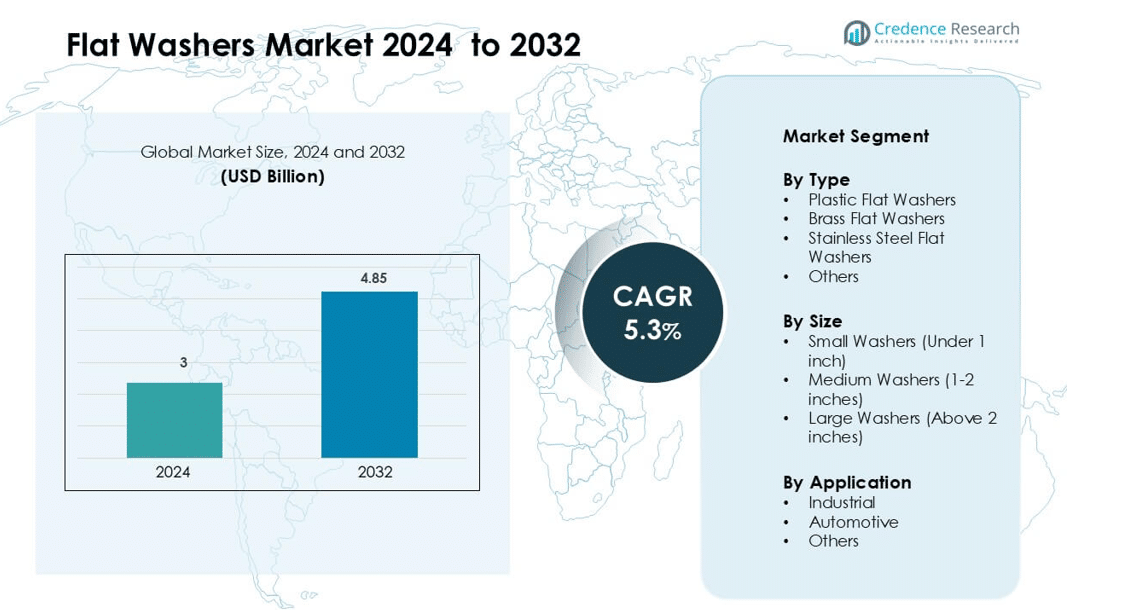
Flat Washers Market was valued at USD 3 billion in 2024 and is anticipated to reach USD 4.85 billion by 2032, growing at a CAGR of 5.3 % during the forecast period.
| REPORT ATTRIBUTE | DETAILS |
|---|---|
| Historical Period | 2020-2023 |
| Base Year | 2024 |
| Forecast Period | 2025-2032 |
| Flat Washers Market Size 2024 | USD 3 billion |
| Flat Washers Market, CAGR | 5.3% |
| Flat Washers Market Size 2032 | USD 4.85 billion |
North America leads the Flat Washers Market with a 34% share, supported by strong industrial activity, advanced manufacturing systems, and high demand for precision fastening components. The market features established players that focus on material quality, automated production, and performance-critical washer designs used in machinery, automotive systems, and construction projects. These companies strengthen competitiveness through expanded stainless steel portfolios, tighter dimensional tolerances, and improved coating technologies suited for heavy-duty conditions. Their wide distribution networks and long-standing OEM partnerships help maintain leadership across global applications. Strong regional infrastructure and consistent industrial upgrades keep North America the dominant hub for high-performance flat washers.
Market Insights
- The Flat Washers Market reached USD 3 billion in 2024 and is projected to grow at a CAGR of 5.3 % from 2024 to 2032, driven by rising industrial and automotive use.
- Strong demand from industrial machinery acts as a key driver, as the industrial segment holds a 58% share, supported by the need for reliable load distribution and improved fastening stability.
- Stainless steel washers remain a major trend, with this type leading the market at a 46% share, driven by corrosion resistance and suitability for heavy-duty applications.
- Competition intensifies as global manufacturers focus on precision-engineered washers, while low-cost regional suppliers pressure pricing and challenge high-quality vendors.
- Asia-Pacific dominates regional demand with a 38% share, followed by North America at 34%, driven by strong manufacturing, automotive production, and ongoing infrastructure expansion.
Market Segmentation Analysis:
By Type
Stainless steel flat washers hold the dominant position with a 46% share due to strong corrosion resistance and high load-bearing strength. These washers support heavy machinery, structural joints, and outdoor systems where durability matters most. Demand rises as manufacturers seek longer service life and reduced maintenance in industrial equipment. Plastic and brass washers grow in niche uses such as electronics and plumbing where weight reduction or conductivity is needed. The trend toward stronger fastening reliability keeps stainless steel at the center of large-scale production needs across factories and infrastructure projects.
- For instance, Boker’s Inc. manufactures over 32,000 non-standard washer sizes using stainless steel grades such as 304 and 316L, ensuring tensile strength up to 515 MPa and superior resistance in marine and chemical environments.
By Size
Small washers under 1 inch lead the market with a 52% share because they fit a wide range of screws and bolts used in electronics, appliances, and light machinery. Their compact form supports precision assembly and high-volume production. Growth is driven by rising demand for consumer devices and compact industrial components. Medium and large washers hold steady roles in heavy equipment and construction but see slower expansion. Widespread adoption in automated assembly lines keeps small washers as the most used size category worldwide.
- For instance, Penn Engineering, known for its PEM brand fasteners, does offer micro-sized fastening solutions under the microPEM® product line.
By Application
The industrial segment dominates with a 58% share, supported by strong use in machinery, fabrication, energy systems, and general equipment assembly. Factories require large volumes of flat washers to improve load distribution and protect joint surfaces. Demand grows as industries upgrade systems, expand automation, and move toward higher safety standards. Automotive and other segments expand but remain smaller due to specific fastening needs. Consistent replacement cycles and rising global manufacturing output reinforce the leadership of industrial applications in the market.
Key Growth Drivers
Rising Demand from Industrial and Machinery Applications
Growth accelerates as factories increase investments in automation, heavy machinery, and precision equipment. Flat washers support stable fastening in pumps, conveyors, turbines, compressors, and assembly lines, which boosts repeat demand. The shift toward compact, high-torque machines raises the need for washers that improve load distribution and prevent material distortion. Manufacturers also upgrade equipment to meet global safety norms, which increases usage of wear-resistant stainless-steel grades. Strong expansion in metal fabrication, electrical equipment, and energy systems further lifts consumption. As industries scale production to meet global orders, the demand for reliable washers grows across every phase of operations.
- For instance, the Nord-Lock Group supplies high-quality wedge-locking washers used in numerous critical industrial applications worldwide, providing secure fastening solutions for heavy machinery and equipment operating under severe vibration and dynamic loads.
Growth in Automotive Production and Aftermarket Repairs
The automotive sector drives notable expansion due to rising production of passenger cars, electric vehicles, and commercial fleets. Washers secure suspension parts, engine components, braking systems, and interior assemblies, making them essential for safety and performance. EV platforms use a higher number of lightweight and corrosion-resistant washers, which lifts demand for stainless steel and coated variants. Aftermarket repairs also create continuous need as garages replace washers during maintenance cycles. Rising global vehicle ownership, new manufacturing units, and strong exports strengthen long-term demand. This creates steady volume growth in both OEM and replacement markets.
- For instance, Böllhoff is a known supplier of fastening technology to the automotive industry, and it is highly probable they supply components to BMW.
Expansion of Construction and Infrastructure Projects
Construction activity fuels growth as washers support fastening in structural frames, HVAC systems, plumbing lines, and architectural fittings. Governments invest in smart cities, transportation corridors, renewable power plants, and commercial complexes, which raises consumption across large projects. Builders prefer high-strength washers to maintain joint stability under vibration, moisture, and heavy loads. The rise of modular construction and prefabricated units amplifies the need for standardized fastening components. Global infrastructure modernization, especially in developing regions, ensures sustained demand. These factors make construction a major long-term growth engine for the flat washers market.
Key Trend & Opportunity
Rising Adoption of Stainless Steel and Coated Washers
A major trend is the rising preference for corrosion-resistant washers driven by harsh operating environments and higher durability expectations. Stainless steel, zinc-coated, and polymer-coated washers gain traction in marine, energy, automotive, and outdoor installations. These materials extend service life and reduce long-term maintenance, which appeals to cost-focused industries. The shift toward electric vehicles and renewable systems expands the need for anti-corrosion fastening components. Manufacturers also introduce advanced coatings such as PTFE and epoxy to improve wear resistance. Growing demand for premium-grade washers creates opportunities for material innovation and new product lines.
- For instance, ITW Shakeproof Group produces zinc-nickel coated washers with over 720 hours of salt spray corrosion resistance, meeting ASTM B117 standards for automotive and marine use.
Increasing Use of Automated Fastening and Precision Assembly
Automation in factories drives higher demand for uniform, high-tolerance washers suited for robotic tools and precision machinery. Automated assembly lines require consistent washer dimensions to avoid misalignment and downtime. This encourages manufacturers to invest in high-accuracy stamping and CNC machining technologies. Electronics, aerospace, and medical device sectors expand the use of small, precision washers as products get smaller and more complex. Growth in robotics, IoT devices, and compact appliances opens new opportunities. Vendors that supply standardized washers compatible with automated systems gain a competitive edge as factories modernize.
- For instance, SPIROL utilize vision-inspection systems and manufacture parts feeding equipment, including systems compatible with automation and robotics. They produce engineered fasteners and installation machines, emphasizing quality and high performance.
Key Challenge
Price Volatility in Raw Materials
The market faces challenges due to fluctuating prices of steel, brass, copper, and polymers used in washer production. Sudden cost spikes disrupt supply chains and reduce profit margins for manufacturers. Many mid-scale producers lack the capacity to hedge against raw-material risks, leading to unstable pricing for end users. Global trade shifts, geopolitical tensions, and energy-related disruptions further raise uncertainty. Buyers may switch to lower-grade or imported alternatives during periods of high material prices, which affects premium washer segments. Sustaining consistent production while managing unpredictable input costs remains a major industry challenge.
Competition from Low-Cost Unstandardized Products
The market faces intense competition from low-cost local manufacturers that supply unstandardized washers. These products often fail to meet dimensional accuracy or strength requirements, creating safety concerns and performance issues. Price-sensitive buyers in construction and small-scale industries may choose cheaper options, reducing demand for high-quality washers. This also pressures established companies to lower prices, which affects profitability. The surge of low-cost imports in developing markets increases the challenge. Ensuring product compliance, maintaining quality, and differentiating through material and design innovation remain key difficulties for reputable manufacturers.
Regional Analysis
North America
North America leads the Flat Washers Market with a 34% share, driven by strong industrial output, advanced manufacturing, and robust automotive production. The region benefits from high adoption of stainless steel and precision-grade washers across machinery, aerospace, and construction. Upgrades in energy infrastructure and expansion of EV assembly plants lift long-term demand. U.S. factories also emphasize strict safety and performance standards, increasing the need for high-tolerance fastening components. Canada’s industrial equipment sector and ongoing commercial construction projects further support growth, keeping North America a stable and mature market for premium washers.
Europe
Europe holds a 28% share, supported by strong engineering, automotive, and machinery industries. Germany, Italy, and France anchor demand due to their extensive manufacturing bases and strict compliance norms for fastening components. Renewable energy installations and electric mobility programs push the use of corrosion-resistant stainless steel washers. The region also benefits from advanced metalworking capabilities and a preference for standardized, high-precision parts. Growth continues in industrial maintenance, rail projects, and heavy equipment upgrades. Despite competition from lower-cost imports, Europe maintains steady demand for high-quality washers across OEM and aftermarket channels.
Asia-Pacific
Asia-Pacific dominates with the largest 38% share, driven by massive manufacturing activity in China, India, Japan, and South Korea. The region’s rapid industrialization, expanding automotive production, and extensive construction projects stimulate high-volume washer consumption. Fast growth in electronics and machinery manufacturing increases demand for small, precision washers. Rising infrastructure investments and industrial expansion across Southeast Asia strengthen long-term prospects. Local producers supply large volumes at competitive prices, while global manufacturers target premium stainless steel and coated variants. Asia-Pacific remains the fastest-growing region in both OEM and replacement markets.
Latin America
Latin America accounts for an 8% share, supported by construction, mining, and automotive assembly operations in Brazil, Mexico, and Chile. Industrial facilities modernize equipment, which increases demand for washers designed for heavy loads and vibration control. Growth in regional manufacturing and expansion of commercial buildings also boost the market. However, economic fluctuations and reliance on imported fastening components limit overall scale. Despite challenges, steady industrial upgrades and infrastructure development maintain stable consumption across key economies, creating pockets of demand for both standard and corrosion-resistant washer types.
Middle East & Africa
The Middle East & Africa region holds a 6% share, driven by energy projects, industrial expansion, and construction of commercial and residential infrastructure. Gulf countries invest heavily in oil & gas facilities, power plants, and large-scale building projects, which boosts usage of high-strength washers. Africa’s rising urban development and growth in mining equipment further support demand. However, supply chain gaps and limited local manufacturing slow wider adoption. Imports remain a primary source for many industries. Despite constraints, long-term infrastructure pipelines keep the region a developing but steady market for flat washers.
Market Segmentations
By Type
- Plastic Flat Washers
- Brass Flat Washers
- Stainless Steel Flat Washers
- Others
By Size
- Small Washers (Under 1 inch)
- Medium Washers (1-2 inches)
- Large Washers (Above 2 inches)
By Application
- Industrial
- Automotive
- Others
By Geography
- North America
- U.S.
- Canada
- Mexico
- Europe
- Germany
- France
- U.K.
- Italy
- Spain
- Rest of Europe
- Asia Pacific
- China
- Japan
- India
- South Korea
- South-east Asia
- Rest of Asia Pacific
- Latin America
- Brazil
- Argentina
- Rest of Latin America
- Middle East & Africa
- GCC Countries
- South Africa
- Rest of the Middle East and Africa
Competitive Landscape
The competitive landscape of the Flat Washers Market features a mix of global manufacturers, regional suppliers, and specialized engineering firms that focus on precision fastening components. Leading companies compete through material innovation, advanced coating technologies, and expanded production capacity to meet rising demand from industrial, automotive, and construction sectors. Many firms strengthen their portfolios with stainless steel, brass, and specialty alloy washers designed for high-load and corrosion-prone environments. Automation in stamping, CNC machining, and quality inspection enhances consistency and supports large-volume orders. Partnerships with OEMs, distributors, and industrial service providers help expand market reach. Companies also invest in custom washer solutions for heavy machinery, high-temperature systems, and electronic assemblies. Competitive pressure increases as low-cost regional producers supply standard-grade washers, pushing established vendors to focus on quality, durability, and compliance certifications. The market continues to evolve toward high-performance materials and precise manufacturing standards to support diverse application requirements.
Key Player Analysis
- Rivit Srl
- MISUMI Group Inc.
- Solon Manufacturing Co.
- Bossard
- Jergens Inc.
- S & W Manufacturing
- Essentra PLC
- The Hillman Group
- Gris Group
- Willie Washer Manufacturing Corporation
Recent Developments
- In April 2025, MISUMI announced its acquisition of Fictiv Inc. to enhance its digital manufacturing capabilities and accelerate supplier-network scale.
- In September 2024, Bossard completed acquisition of Aero Negoce International Group, expanding its aerospace fastening portfolio (which includes washers).
Report Coverage
The research report offers an in-depth analysis based on Type, Size, Application and Geography. It details leading market players, providing an overview of their business, product offerings, investments, revenue streams, and key applications. Additionally, the report includes insights into the competitive environment, SWOT analysis, current market trends, as well as the primary drivers and constraints. Furthermore, it discusses various factors that have driven market expansion in recent years. The report also explores market dynamics, regulatory scenarios, and technological advancements that are shaping the industry. It assesses the impact of external factors and global economic changes on market growth. Lastly, it provides strategic recommendations for new entrants and established companies to navigate the complexities of the market.
Future Outlook
- Demand for high-strength stainless steel washers will rise due to wider industrial upgrades.
- Precision washers for automated assembly lines will gain stronger adoption across factories.
- Growth in electric vehicles will expand the need for lightweight and corrosion-resistant washer variants.
- Construction and infrastructure projects will continue to drive large-volume washer consumption.
- Manufacturers will invest more in advanced coatings to improve heat and wear resistance.
- Customized washers for heavy machinery and high-vibration systems will see increased use.
- Digital quality-control tools will enhance accuracy in large-scale washer production.
- Supply chains will shift toward regional manufacturing to reduce import dependency.
- Sustainability efforts will encourage higher use of recyclable and low-impact materials.
- Competition will intensify as low-cost suppliers expand capacity in emerging markets.

Request a Free Sample
Fill in your details and we'll send you a free sample report.
- Sample data tables & charts
- Research methodology
Market Dynamics
Rising Demand from Industrial and Machinery Applications
Factories are investing in automation and heavy machinery, increasing the need for flat washers to ensure stable fastening, load distribution, and compliance with safety standards. This drives repeat demand as industries upgrade equipment and expand production capacity.
Growth in Automotive Production and Aftermarket Repairs
The automotive sector uses flat washers extensively in suspension, engine, and braking systems, with rising vehicle production and EV adoption boosting demand for corrosion-resistant and lightweight washer variants. Aftermarket repairs also sustain steady replacement cycles.
Expansion of Construction and Infrastructure Projects
Large-scale construction and infrastructure development require high-strength washers for structural stability in frames, HVAC, and plumbing systems. Government investments in smart cities and transportation projects further increase washer consumption.
Rising Adoption of Stainless Steel and Coated Washers
Industries operating in harsh environments are shifting toward stainless steel and coated washers for their superior corrosion resistance and durability, reducing maintenance costs and extending service life in marine, energy, and outdoor applications.
Increasing Use of Automated Fastening and Precision Assembly
The trend toward factory automation and precision assembly lines is driving demand for high-tolerance, uniform washers that support robotic tools and minimize misalignment, especially in electronics, aerospace, and medical device manufacturing.
Need a Custom Version of This Report?
Tailor the scope, geography, or segments to your exact requirements.
- Custom geography or segment scope
- Direct access to our analyst team
Frequently Asked Questions
What is the current market size for the Flat Washers Market, and what is its projected size in 2032?
At what Compound Annual Growth Rate is the Flat Washers Market projected to grow between 2025 and 2032?
Which segment is expected to post the highest CAGR during the forecast period?
Who are the major players in the global flat washers market?
What are the major market drivers of the flat washers industry?
What are the major market restraints of the flat washers industry?
What are the major market opportunities of the flat washers industry?
Who are the leading companies in the Flat Washers Market?
Table of Content
Chapter 1 Market Segmentation
- 1.1 Segmentation Framework
- 1.1.1 Product and Service Classification
- 1.1.2 Application and End-Use Classification
- 1.1.3 Technology and Solution Classification
- 1.1.4 Customer and Distribution Channel Classification
- 1.1.5 Geographic Segmentation
- 1.1.6 Market Segment Definitions and Boundaries
- 1.2 By Size
- 1.2.1 Small Washers (Under 1 inch)
- 1.2.2 Medium Washers (1-2 inches)
- 1.2.3 Large Washers (Above 2 inches)
- 1.3 By Type
- 1.3.1 Stainless Steel Flat Washers
- 1.3.2 Plastic Flat Washers
- 1.3.3 Brass Flat Washers
- 1.3.4 Others
- 1.4 By Application
- 1.4.1 Industrial
- 1.4.2 Automotive
- 1.4.3 Others
Chapter 2 Introduction
- 2.1 Report Objectives and Scope
- 2.2 Product Definition and Industry Terminology
- 2.3 Market Inclusions and Exclusions
- 2.4 Research Process
- 2.4.1 Primary Research and Expert Interviews
- 2.4.2 Secondary Research and Source Review
- 2.4.3 Top-Down and Bottom-Up Estimation
- 2.4.4 Data Triangulation and Verification
- 2.5 Market Size Measurement Basis
- 2.5.1 2024: USD 3 billion → 2032: USD 4.85 billion
- 2.6 Historical and Forecast Reference Periods
- 2.6.1 Base Year: 2024
- 2.6.2 Forecast Period: 2024-2032
- 2.7 Research Assumptions and Limitations
Chapter 3 Executive Summary
- 3.1 Market Snapshot and Key Findings
- 3.2 Base-Year Market Size, 2024
- 3.3 Forecast Market Size, 2032
- 3.4 Revenue and Volume Growth Outlook
- 3.5 Key Demand and Supply Indicators
- 3.6 Leading Market Segments
- 3.7 Fastest-Growing Market Opportunities
- 3.8 Regional Performance Highlights
- 3.9 Technology and Industry Transformation
- 3.10 Competitive Landscape Summary
- 3.11 Analyst View and Strategic Implications
Chapter 4 Global Flat Washers Market Trends and Developments
- 4.1 Historical Industry Development
- 4.2 Recent Market Trends and Developments
- 4.3 Demand and Customer Behavior Trends
- 4.4 Technology and Product Innovation
- 4.5 Artificial Intelligence, Automation and Digitalization
- 4.6 Local Manufacturing and Supply Chain Realignment
- 4.7 Industry Partnerships, Mergers and Acquisitions
- 4.8 Sustainability and Circular Economy Developments
- 4.9 Government and Private Sector Investment Trends
- 4.10 Emerging Business Models and Commercialization
- 4.11 Industry Developments and Announcements
Chapter 5 Global Flat Washers Market Production, Supply and Demand Analysis
- 5.1 Demand Trend and Consumption Analysis
- 5.2 Demand Forecast, 2024-2032
- 5.3 Production and Output Trend
- 5.4 Production and Output Forecast, 2024-2032
- 5.5 Installed Capacity and Capacity Utilization
- 5.6 Company-Wise Production Plants and Statistics
- 5.6.1 Installed Production Capacity
- 5.6.2 Actual Production
- 5.6.3 Planned Capacity and Expansion Targets
- 5.7 Supply Chain Structure and Procurement Trends
- 5.8 Supply-Demand Gap and Bottlenecks
- 5.9 Import Dependence and Sourcing Structure
- 5.10 Contract Manufacturing and Outsourcing
- 5.11 Regional Supply and Demand Concentration
Chapter 6 Global Flat Washers Market Pricing Analysis
- 6.1 Pricing Structure and Measurement
- 6.2 Historical Pricing Trends
- 6.3 Pricing Outlook, 2024-2032
- 6.4 Average Selling Price and Unit Economics
- 6.5 Pricing by Product and Market Segment
- 6.6 Geographic Pricing Differences
- 6.7 Key Input, Energy, Labor and Logistics Costs
- 6.8 Contract Pricing and Purchasing Models
- 6.9 Pricing Sensitivity and Competitive Positioning
- 6.10 Price, Margin and Profitability Implications
Chapter 7 Global Flat Washers Market Dynamics
- 7.1 Market Growth Drivers
- 7.1.1 Demand-Side Drivers
- 7.1.2 Technology and Innovation Drivers
- 7.1.3 Infrastructure and Investment Drivers
- 7.1.4 Regulatory and Policy Drivers
- 7.2 Market Restraints
- 7.2.1 Cost and Affordability Constraints
- 7.2.2 Technology and Adoption Barriers
- 7.2.3 Supply Chain and Operational Constraints
- 7.3 Market Challenges
- 7.3.1 Competitive Pressure and Margin Erosion
- 7.3.2 Skills, Infrastructure and Implementation Gaps
- 7.4 Emerging Market Opportunities
- 7.5 Market Dynamics Impact and Time-Horizon Assessment
Chapter 8 Global Flat Washers Value Chain Analysis
- 8.1 Industry Value Chain Overview
- 8.2 Upstream Suppliers and Critical Inputs
- 8.3 Technology and Component Providers
- 8.4 Manufacturing or Service Delivery
- 8.5 Distribution, Channel Partners and Integrators
- 8.6 Downstream Applications and End Users
- 8.7 Value Addition and Profit Pools
- 8.8 Vertical Integration and Outsourcing
- 8.9 Supplier Concentration and Risk
- 8.10 Supply Chain Localization and Resilience
Chapter 9 Global Flat Washers Market Regulations and Policies
- 9.1 Relevant Laws, Standards and Compliance Frameworks
- 9.2 Product, Service, Safety and Quality Requirements
- 9.3 Government Policies, Incentives and Subsidies
- 9.4 Imports, Exports and Trade Barriers
- 9.5 Public Procurement and Local Content Requirements
- 9.6 Environmental and Sustainability Compliance
- 9.7 Upcoming Policy Changes and Market Implications
Chapter 10 Global Flat Washers Market Hotspots and Opportunities
- 10.1 Market Opportunity Mapping and Growth Hotspots
- 10.2 High-Growth Applications and Customer Groups
- 10.3 Underserved Markets and White-Space Opportunities
- 10.4 Emerging Technology and Product Opportunities
- 10.5 New Capacity and Investment Hotspots
- 10.6 Market Entry and Expansion Opportunities
- 10.7 Distribution and Partnership Opportunities
- 10.8 Near-Term and Long-Term Commercial Potential
- 10.9 Opportunity Attractiveness and Execution Risks
Chapter 11 Global Flat Washers Market Outlook, 2024-2032
- 11.1 Market Size and Analysis
- 11.1.1 Revenue (Market Measurement: 2024: USD 3 billion → 2032: USD 4.85 billion)
- 11.1.2 Market Volume and Quantity Sold
- 11.1.3 Historical Market Size
- 11.1.4 Base-Year Market Size, 2024
- 11.2 Market Forecast, 2024-2032
- 11.2.1 Revenue Forecast to 2032
- 11.2.2 Volume Forecast to 2032
- 11.2.3 CAGR and Year-on-Year Growth
- 11.2.4 Incremental Revenue Opportunity
- 11.3 Forecast Assumptions and Scenario Analysis
- 11.3.1 Base-Case Forecast
- 11.3.2 Optimistic and Conservative Scenarios
- 11.3.3 Technology, Pricing and Policy Sensitivities
- 11.4 Market Attractiveness and Growth Outlook
Chapter 12 Global Flat Washers Market Segmentation and Outlook
- 12.1 Segmentation Summary and Market Shares, 2024
- 12.2 Largest and Fastest-Growing Segments
- 12.3 By Size - Market Size and Forecast, 2024-2032
- 12.3.1 Segment Definition and Scope
- 12.3.2 Historical Market Size
- 12.3.3 Revenue Forecast, 2024-2032
- 12.3.4 Volume Forecast, 2024-2032
- 12.3.5 Base-Year Market Share, 2024
- 12.3.6 Segment CAGR and Growth Drivers
- 12.3.7 Subsegment Market Size and Forecast
- 12.3.7.1 Small Washers (Under 1 inch)
- 12.3.7.2 Medium Washers (1-2 inches)
- 12.3.7.3 Large Washers (Above 2 inches)
- 12.3.8 Subsegment Pricing and Adoption Trends
- 12.3.9 Leading Suppliers and Competition
- 12.3.10 Regional Demand and Opportunities
- 12.4 By Type - Market Size and Forecast, 2024-2032
- 12.4.1 Segment Definition and Scope
- 12.4.2 Historical Market Size
- 12.4.3 Revenue Forecast, 2024-2032
- 12.4.4 Volume Forecast, 2024-2032
- 12.4.5 Base-Year Market Share, 2024
- 12.4.6 Segment CAGR and Growth Drivers
- 12.4.7 Subsegment Market Size and Forecast
- 12.4.7.1 Stainless Steel Flat Washers
- 12.4.7.2 Plastic Flat Washers
- 12.4.7.3 Brass Flat Washers
- 12.4.7.4 Others
- 12.4.8 Subsegment Pricing and Adoption Trends
- 12.4.9 Leading Suppliers and Competition
- 12.4.10 Regional Demand and Opportunities
- 12.5 By Application - Market Size and Forecast, 2024-2032
- 12.5.1 Segment Definition and Scope
- 12.5.2 Historical Market Size
- 12.5.3 Revenue Forecast, 2024-2032
- 12.5.4 Volume Forecast, 2024-2032
- 12.5.5 Base-Year Market Share, 2024
- 12.5.6 Segment CAGR and Growth Drivers
- 12.5.7 Subsegment Market Size and Forecast
- 12.5.7.1 Industrial
- 12.5.7.2 Automotive
- 12.5.7.3 Others
- 12.5.8 Subsegment Pricing and Adoption Trends
- 12.5.9 Leading Suppliers and Competition
- 12.5.10 Regional Demand and Opportunities
- 12.6 Segment Growth Comparison
- 12.7 Segment Attractiveness and Priority Matrix
Chapter 13 Global Flat Washers End-Use and Application Market Outlook
- 13.1 End-Use Industry and Customer Demand Structure
- 13.2 Leading Applications and Customer Groups
- 13.3 End-Use Market Size, Share and Forecast
- 13.4 Major End-Use Industry Deep Dives
- 13.4.1 Customer Requirements and Use Cases
- 13.4.2 Demand and Replacement Cycles
- 13.4.3 Technical and Regulatory Considerations
- 13.4.4 Purchasing and Procurement Models
- 13.4.5 Leading Vendors and Distribution Channels
- 13.4.6 Forecast and Commercial Opportunities
- 13.5 Emerging Applications and Cross-Segment Demand
- 13.6 End-Use Industry Investment Priorities
Chapter 14 Global Flat Washers Geographic Market Outlook, 2024-2032
- 14.1 Regional Market Size and Share, 2024
- 14.2 Regional Market Forecast, 2024-2032
- 14.3 Regional Pricing, Production and Demand Differences
- 14.4 North America
- 14.4.1 United States
- 14.4.2 Canada
- 14.4.3 Mexico
- 14.5 Europe
- 14.5.1 Germany
- 14.5.2 France
- 14.5.3 Italy
- 14.5.4 United Kingdom
- 14.5.5 Spain
- 14.5.6 Poland
- 14.5.7 Russia
- 14.5.8 Netherlands
- 14.5.9 Belgium
- 14.5.10 Sweden
- 14.5.11 Denmark
- 14.5.12 Norway
- 14.5.13 Rest of Europe
- 14.6 Asia Pacific
- 14.6.1 China
- 14.6.2 India
- 14.6.3 Japan
- 14.6.4 South Korea
- 14.6.5 Thailand
- 14.6.6 Indonesia
- 14.6.7 Vietnam
- 14.6.8 Malaysia
- 14.6.9 Australia
- 14.6.10 Rest of Asia Pacific
- 14.7 Latin America
- 14.7.1 Brazil
- 14.7.2 Argentina
- 14.7.3 Colombia
- 14.7.4 Chile
- 14.7.5 Rest of Latin America
- 14.8 Middle East
- 14.8.1 Saudi Arabia
- 14.8.2 United Arab Emirates
- 14.8.3 Turkey
- 14.8.4 Israel
- 14.8.5 Iran
- 14.8.6 Rest of the Middle East
- 14.9 Africa
- 14.9.1 South Africa
- 14.9.2 Egypt
- 14.9.3 Nigeria
- 14.9.4 Morocco
- 14.9.5 Rest of Africa
- 14.10 Regional Investment, Policy and Supply Chain Differences
- 14.11 Regional Competitive Landscape
- 14.12 Geographic Growth Hotspots
Chapter 15 Global Flat Washers Technology, Innovation and Sustainability Outlook
- 15.1 Technology Landscape and Maturity
- 15.2 Product, Process and Service Innovation
- 15.3 AI, Automation and Digital Tools in the Industry
- 15.4 Technology Adoption and Performance Benchmarking
- 15.5 Innovation Pipeline and R&D Investment
- 15.6 Patent and Intellectual Property Trends
- 15.7 Energy Efficiency and Resource Management
- 15.8 Sustainability, Recycling and Circularity
- 15.9 Technology Roadmap, 2024-2032
- 15.10 Risks of Obsolescence and Technology Substitution
Chapter 16 Global Flat Washers Market Key Strategic Imperatives
- 16.1 Growth and Market Entry Priorities
- 16.2 High-Return Products and Segments
- 16.3 Pricing, Profitability and Cost Optimization
- 16.4 Technology Investment and Product Differentiation
- 16.5 Supply Chain Localization and Resilience
- 16.6 Distribution and Customer Acquisition
- 16.7 Partnership, Acquisition and Capacity Strategy
- 16.8 Regional Expansion Priorities
- 16.9 Short-, Medium- and Long-Term Actions
Chapter 17 Competition Outlook
- 17.1 Industry Competition Characteristics
- 17.2 Market Structure and Concentration
- 17.3 Market Share and Competitive Positioning, 2024
- 17.4 Company-Wise Revenue and Product Benchmarking
- 17.5 Production and Service Capacity Benchmarking
- 17.6 Technology, Pricing and Differentiation
- 17.7 Regional Footprint and Distribution Strength
- 17.8 Mergers, Acquisitions and Strategic Alliances
- 17.9 New Entrants and Competitive Threats
- 17.10 Porter's Five Forces and Industry Attractiveness
- 17.11 Competitive Outlook, 2024-2032
Chapter 18 Company Profiles
- 18.1 Company Coverage and Selection Criteria
- 18.2 Rivit Srl
- 18.2.1 Business Description
- 18.2.2 Company Ownership and Geographic Presence
- 18.2.3 Product and Service Portfolio
- 18.2.4 Manufacturing and Operating Footprint
- 18.2.5 Production Capacity and Expansion Plans
- 18.2.6 Financial Performance and Investment
- 18.2.7 Market Share and Competitive Position
- 18.2.8 Technology and Innovation Capabilities
- 18.2.9 Strategic Alliances or Partnerships
- 18.2.10 Recent Developments
- 18.2.11 Growth Strategy and Outlook
- 18.3 MISUMI Group Inc.
- 18.4 Solon Manufacturing Co.
- 18.5 Bossard
- 18.6 Jergens Inc.
- 18.7 S & W Manufacturing
- 18.8 Essentra PLC
- 18.9 The Hillman Group
- 18.10 Gris Group
- 18.11 Willie Washer Manufacturing Corporation
- 18.12 Other Relevant Market Participants
Note: Every listed company is profiled on the structure shown under the first company. The company list is preliminary and may change based on research findings, market developments, data availability and client requirements.
Chapter 19 Disclaimer
- 19.1 Research and Forecast Disclaimer
- 19.2 Data Source and Estimation Limitations
Note: The depth of individual sections depends on data availability for this market. Volume, capacity, trade and other unit-based metrics are included where applicable.