
Market Overview:
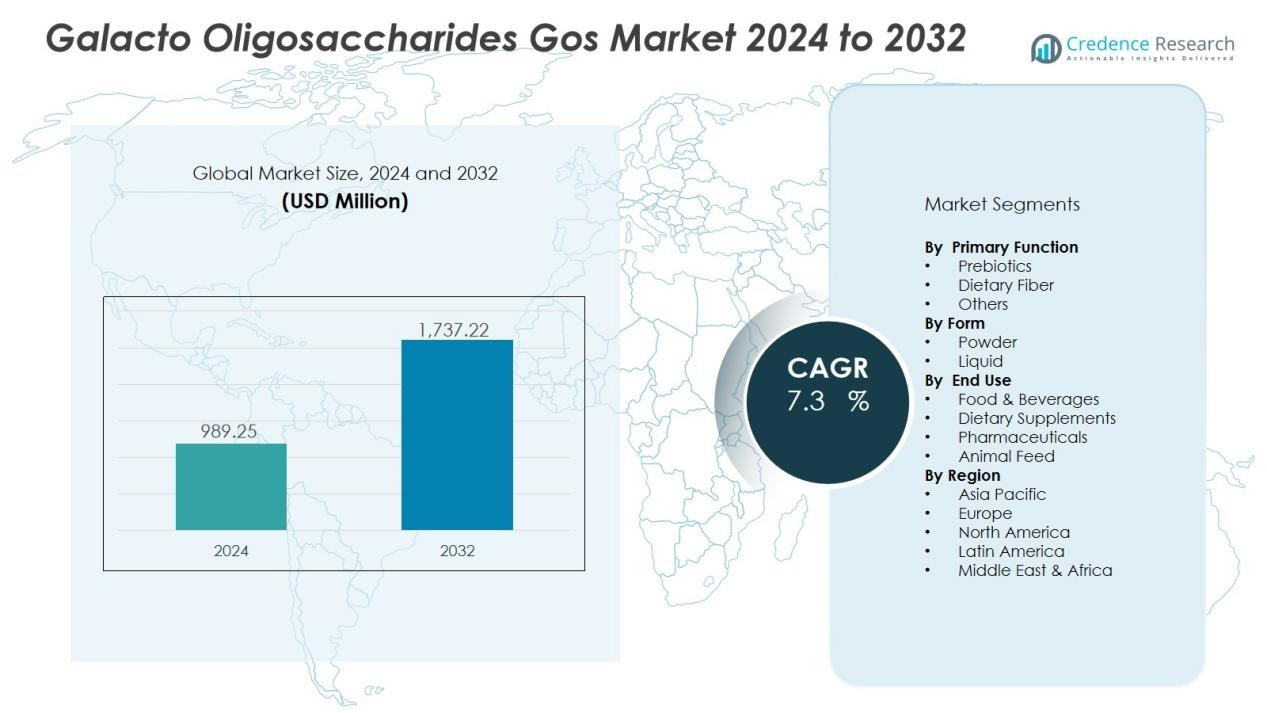
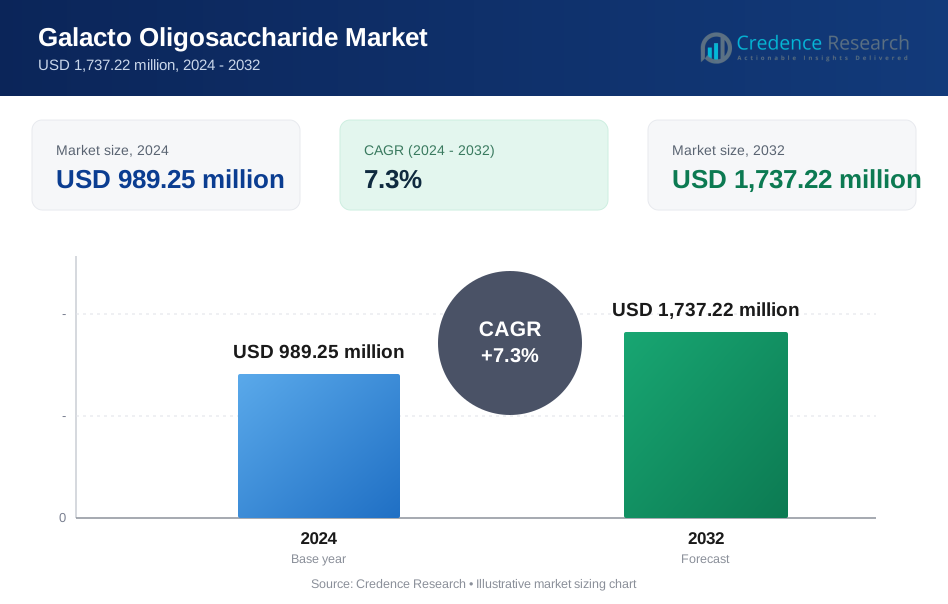
The Galacto Oligosaccharides (GOS) Market size was valued at USD 989.25 million in 2024 and is anticipated to reach USD 1,737.22 million by 2032, at a CAGR of 7.3 % during the forecast period (2024-2032).
| REPORT ATTRIBUTE | DETAILS |
|---|---|
| Historical Period | 2020-2023 |
| Base Year | 2024 |
| Forecast Period | 2025-2032 |
| Galacto Oligosaccharides Market Size 2024 | USD 989.25 Million |
| Galacto Oligosaccharides Market, CAGR | 7.3 % |
| Galacto Oligosaccharides Market Size 2032 | USD 1,737.22 Million |
Growth in the galacto oligosaccharides (GOS) market is fueled by multiple drivers. Rising consumer preference for prebiotic-rich foods, expanding applications in infant nutrition, and growing interest in gut health have been key factors. The inclusion of GOS in functional foods, beverages, and dietary supplements has widened adoption. In addition, scientific research highlighting GOS benefits in digestive health and immunity continues to strengthen demand across diverse consumer groups.
Regionally, Europe holds a significant share of the galacto oligosaccharides (GOS) market, driven by advanced food processing industries and high awareness of functional nutrition. North America follows with steady growth, supported by dietary supplement consumption and innovation in infant formula. Asia-Pacific is emerging as the fastest-growing region, propelled by rising birth rates, growing middle-class populations, and increasing focus on health and wellness. Latin America and the Middle East & Africa show gradual but consistent growth, with expanding food and beverage sectors contributing to market adoption.
Market Insights:
- The galacto oligosaccharides (GOS) market size was valued at USD 989.25 million in 2024 and is anticipated to reach USD 1,737.22 million by 2032, growing at a CAGR of 7.3% during 2024–2032.
- Rising consumer preference for prebiotic-rich foods is driving strong adoption across functional beverages, dairy, and fortified products.
- Infant nutrition remains a leading application, with GOS widely used in formula to replicate the benefits of human milk oligosaccharides.
- Growing awareness of gut health and preventive healthcare supports demand, as GOS strengthens digestive balance and immunity.
- Diversification into pharmaceuticals and animal feed enhances market resilience, expanding usage beyond human nutrition.
- High production costs and raw material fluctuations remain key challenges, restricting growth in price-sensitive markets.
- Europe held 38% market share in 2024, followed by North America with 27% and Asia-Pacific with 24%, highlighting strong global distribution and regional opportunities.
Market Drivers:
Rising Demand for Functional and Nutritional Food Products:
The galacto oligosaccharides (GOS) market benefits from the increasing consumer preference for functional foods. Health-conscious buyers seek products that support digestive wellness and immunity. GOS, recognized for its prebiotic properties, fits well into this demand. It finds strong adoption in functional beverages, dairy products, and fortified foods. This shift toward nutritional products continues to expand market opportunities.
- For instance, FrieslandCampina Ingredients launched Biotis GOS-OP High Purity in 2024, featuring a 94% concentration of GOS, allowing functional supplement brands to offer clinically effective dosages as low as 2 grams per serving.
Expanding Use in Infant Nutrition and Formula Applications:
Infant formula remains a major driver for the galacto oligosaccharides (GOS) market. Manufacturers include GOS to replicate the prebiotic effects of human milk oligosaccharides. It helps promote healthy gut microbiota in infants, supporting growth and immunity. With rising birth rates in developing regions and premiumization of baby food in developed markets, GOS adoption in infant nutrition is set to increase. This demand strengthens its role in the global food industry.
Growing Awareness of Gut Health and Prebiotic Benefits:
Consumers increasingly understand the role of prebiotics in maintaining digestive balance. The galacto oligosaccharides (GOS) market gains traction as GOS supports beneficial bacteria growth in the gut. It also reduces risks of gastrointestinal disorders, making it appealing across multiple demographics. Awareness campaigns and scientific research on gut health drive demand further. Rising interest in preventive healthcare adds momentum to its market expansion.
- For instance, Bimuno® GOS (made by Clasado Biosciences) demonstrated a proven prebiotic effect at an ultra-low dose of just 380 mg per day, significantly increasing bifidobacteria levels in adult subjects in a published 2025 study.
Rising Applications Beyond Food in Pharmaceuticals and Animal Feed:
The galacto oligosaccharides (GOS) market is diversifying into pharmaceuticals and animal nutrition. In healthcare, GOS is used in dietary supplements targeting immunity and digestion. In animal feed, it improves gut health and growth performance in livestock. This broader application base ensures steady demand beyond human nutrition. It strengthens the market’s resilience against fluctuations in food sector trends.
Market Trends:
Increasing Integration of GOS in Functional Food and Beverage Portfolios:
The galacto oligosaccharides (GOS) market is witnessing strong integration across functional food and beverage categories. Manufacturers are embedding GOS into dairy products, bakery items, cereals, and nutritional drinks to meet consumer demand for health-oriented products. It enhances product positioning by delivering scientifically backed digestive and immune benefits. Companies are investing in formulation technologies to maintain GOS stability across different product types. Rising consumer preference for natural and plant-based ingredients also supports innovation in clean-label formulations. This trend is accelerating collaborations between food companies and ingredient suppliers to develop differentiated offerings.
- For Instance, FrieslandCampina Ingredients has provided its Vivinal GOS ingredient for infant formula for over 2 decades. The prebiotic ingredient is now used by numerous commercial infant formula brands globally to support digestive health by promoting beneficial gut bacteria.
Expanding Focus on Research, Clinical Validation, and New Application Areas:
The galacto oligosaccharides (GOS) market is advancing with increased emphasis on clinical validation and scientific research. Companies are funding studies to demonstrate benefits in immunity, metabolic health, and allergy reduction, strengthening consumer trust. It is also entering new application areas such as pharmaceuticals, dietary supplements, and animal feed, where demand for prebiotics is increasing. Technological advances in production methods are helping manufacturers reduce costs and scale output efficiently. Growing partnerships between biotech firms and food producers reflect the sector’s commitment to innovation. These developments highlight a broader movement toward evidence-driven product expansion across diverse industries.
- For instance, in May 2021, FrieslandCampina Ingredients enrolled 64 women in a four-week Biotis® GOS trial and reported a 22% rise in fecal Bifidobacteria abundance from baseline in the treatment group.
Market Challenges Analysis:
High Production Costs and Supply Chain Complexities:
The galacto oligosaccharides (GOS) market faces challenges linked to high production costs and complex supply chains. Manufacturing requires advanced enzymatic processes, specialized equipment, and strict quality standards, which increase operational expenses. Limited availability of raw materials and fluctuating prices further affect cost efficiency. It often leads to higher retail prices, restricting adoption in price-sensitive markets. Scaling production while maintaining purity and functionality remains a persistent hurdle for suppliers. Supply chain disruptions also create risks, especially when sourcing dairy-based inputs for GOS production.
Regulatory Barriers and Intense Market Competition:
The galacto oligosaccharides (GOS) market is impacted by strict regulatory frameworks across different regions. Compliance with varying food safety, labeling, and health claim standards increases complexity for manufacturers. It slows down product approvals and market entry in certain countries. Strong competition from other prebiotics, such as inulin and fructooligosaccharides, also limits growth potential. Consumer skepticism regarding functional ingredient claims can further restrict acceptance. Companies must invest in education and clinical validation to overcome these barriers. Building consumer trust while differentiating products in a crowded market remains a critical challenge.
Market Opportunities:
Expansion into Emerging Economies and Rising Middle-Class Consumption :
The galacto oligosaccharides (GOS) market has strong opportunities in emerging economies with growing middle-class populations. Rising income levels and increasing awareness of gut health are fueling demand for functional foods and dietary supplements. Infant nutrition is a key driver in countries with high birth rates, where GOS can strengthen premium formula offerings. It also benefits from urbanization trends that push consumers toward convenient, fortified products. Expanding distribution through supermarkets, specialty stores, and online platforms further supports growth in these regions. Manufacturers targeting Asia-Pacific, Latin America, and parts of Africa can gain significant long-term advantage.
Innovation in Product Formulation and Expansion into Healthcare Applications :
The galacto oligosaccharides (GOS) market is poised for growth through innovation in product formulation and diversification into healthcare. Companies are investing in clean-label, vegan, and lactose-free options to appeal to broader consumer groups. It also presents opportunities in pharmaceuticals and nutraceuticals, where GOS is studied for immunity, allergy prevention, and metabolic health benefits. Growth in dietary supplements and medical nutrition segments expands market scope beyond food and beverages. Partnerships between biotech firms, food manufacturers, and healthcare providers encourage new product development. This innovation-led diversification strengthens resilience and creates opportunities across multiple industries.
Market Segmentation Analysis:
By Primary Function:
The galacto oligosaccharides (GOS) market is segmented by primary function into prebiotic, dietary fiber, and others. Prebiotic applications dominate the segment, driven by strong demand for gut health solutions. It supports beneficial bacteria growth and enhances immunity, making it highly suitable for infant and adult nutrition. Dietary fiber applications are also expanding due to consumer focus on digestion and weight management. Other functions include roles in metabolic health and allergy reduction, supported by growing clinical validation.
- For Instance, Based on the 2006 Nutricia Early Life Nutrition study, the GOS/FOS blend reduced the incidence of atopic dermatitis (eczema) by 57.6% after the first 6 months of use in infants at risk of allergic disease.
By Form:
The galacto oligosaccharides (GOS) market is categorized by form into powder and liquid. Powder form holds a larger share due to easy handling, longer shelf life, and wide use in infant formula and functional foods. It is also preferred in dietary supplements for its stable formulation properties. Liquid GOS is gaining traction in beverages, dairy products, and pharmaceutical applications. Its flexibility in blending with liquid-based products supports broader adoption. Both forms continue to evolve with advancements in formulation technologies.
By End-Use:
The galacto oligosaccharides (GOS) market by end-use includes food and beverages, dietary supplements, pharmaceuticals, and animal feed. Food and beverages lead the segment, fueled by rising consumer demand for fortified products. Infant formula remains a critical driver within this category. Dietary supplements are growing as consumers seek preventive health solutions. Pharmaceutical applications are expanding with research into metabolic and immune health. Animal feed adoption is increasing due to its role in enhancing livestock performance and gut health.
- For instance, Yakult Pharmaceutical conducted a clinical study where patients received capsules containing 2.7 grams of GOS daily, demonstrating enhancement of beneficial bifidobacteria levels in the subjects.
Segmentations:
By Primary Function:
- Prebiotics
- Dietary Fiber
- Others
By Form:
- Powder
- Liquid
By End-Use:
- Food & Beverages
- Dietary Supplements
- Pharmaceuticals
- Animal Feed
By Region:
- North America
- U.S.
- Canada
- Mexico
- Europe
- Germany
- France
- U.K.
- Italy
- Spain
- Rest of Europe
- Asia Pacific
- China
- Japan
- India
- South Korea
- South-east Asia
- Rest of Asia Pacific
- Latin America
- Brazil
- Argentina
- Rest of Latin America
- Middle East & Africa
- GCC Countries
- South Africa
- Rest of the Middle East and Africa
Regional Analysis:
Europe:
Europe accounted for 38% market share of the galacto oligosaccharides (GOS) market in 2024. The region leads due to high awareness of gut health and established demand for functional nutrition. It benefits from strong dairy industries, advanced food processing facilities, and regulatory frameworks that promote prebiotic integration in food. Consumers in countries such as Germany, France, and the Netherlands actively prefer fortified products. Leading manufacturers also maintain production hubs in Europe to meet rising demand. Continuous research in clinical nutrition strengthens GOS applications in both infant formula and adult health products.
North America:
North America accounted for 27% market share of the galacto oligosaccharides (GOS) market in 2024. The region demonstrates steady growth, fueled by increasing demand for infant formula and dietary supplements. It benefits from rising consumer focus on preventive health and a well-established nutraceutical sector. Manufacturers are expanding product portfolios by introducing clean-label and plant-based GOS ingredients. Regulatory approvals for prebiotics support innovation and market entry. The presence of global and regional players also strengthens competitive intensity. Partnerships with healthcare professionals and clinical institutions further drive adoption in the U.S. and Canada.
Asia-Pacific:
Asia-Pacific accounted for 24% market share of the galacto oligosaccharides (GOS) market in 2024. The region is the fastest-growing due to high birth rates, rising disposable income, and growing urban populations. It benefits from increasing demand for infant formula and fortified foods in China, India, and Southeast Asia. Government initiatives promoting child nutrition further strengthen consumption patterns. Local and global players are expanding production capacities to meet rising demand. Online retail and digital platforms also play a major role in boosting accessibility. It continues to be a key growth driver shaping the global industry outlook.
Key Player Analysis:
- Friesland Campina
- King-prebiotics
- Van Wankum Ingredients
- Vitalus Nutrition Inc.
- Novasep
- Saputo Dairy
- Novozymes
- Ingredion
- Little Étoile
- Biosynth
Competitive Analysis:
The galacto oligosaccharides (GOS) market is characterized by strong competition among established global and regional players. Key companies include Friesland Campina, King-prebiotics, Van Wankum Ingredients, Vitalus Nutrition Inc., Novasep, Saputo Dairy, and Novozymes, each focusing on expanding their product portfolios and strengthening global reach. It benefits from innovation-driven strategies where firms invest in advanced production technologies to improve efficiency and scalability. Leading companies are also forming strategic partnerships with food and pharmaceutical manufacturers to increase application diversity. Strong emphasis on clinical validation and regulatory compliance supports their market positioning. Regional players enhance competitiveness by offering cost-effective solutions in emerging economies. The presence of both multinational and specialized niche players ensures a balanced competitive environment where product quality, innovation, and partnerships drive growth and differentiation.
Recent Developments:
- In September 2025, FrieslandCampina Ingredients announced the upcoming showcase of new protein and prebiotic innovations, focusing on gut health and muscle support at Vitafoods Asia 2025.
- In May 2025, Ingredion and Amyris jointly decided to wind down their RealSweet venture, with Ingredion securing exclusive access to Amyris’ fermentation technology for Reb M.
Report Coverage:
The research report offers an in-depth analysis based on Primary Function, Form, End-Use and Region. It details leading Market players, providing an overview of their business, product offerings, investments, revenue streams, and key applications. Additionally, the report includes insights into the competitive environment, SWOT analysis, current Market trends, as well as the primary drivers and constraints. Furthermore, it discusses various factors that have driven Market expansion in recent years. The report also explores Market dynamics, regulatory scenarios, and technological advancements that are shaping the industry. It assesses the impact of external factors and global economic changes on Market growth. Lastly, it provides strategic recommendations for new entrants and established companies to navigate the complexities of the Market.
Future Outlook:
- The galacto oligosaccharides (GOS) market will see stronger adoption in infant formula as parents prioritize nutrition and immunity.
- Demand for dietary supplements containing GOS will rise, supported by consumer focus on digestive wellness.
- Food and beverage companies will expand product portfolios by integrating GOS into dairy, bakery, and beverage categories.
- Pharmaceutical and nutraceutical sectors will create opportunities as clinical research validates broader health benefits.
- The animal feed industry will adopt GOS to improve gut health and growth performance in livestock.
- Technological advancements in production processes will lower costs and enhance product scalability.
- Clean-label and plant-based formulations will gain traction to meet vegan and lactose-intolerant consumer needs.
- Regional players in Asia-Pacific will expand rapidly, supported by demographic growth and urbanization trends.
- Strategic partnerships between biotech firms, food manufacturers, and healthcare providers will accelerate product innovation.
- Rising global awareness of preventive healthcare will position GOS as a key prebiotic ingredient across industries.
Request a Free Sample
Fill in your details and we'll send you a free sample report.
- Sample data tables & charts
- Research methodology
Need a Custom Version of This Report?
Tailor the scope, geography, or segments to your exact requirements.
- Custom geography or segment scope
- Direct access to our analyst team
Frequently Asked Questions
What is the current market size for the Galacto Oligosaccharides (GOS) Market, and what is its projected size in 2032?
At what Compound Annual Growth Rate is the Galacto Oligosaccharides (GOS) Market projected to grow between 2024 and 2032?
Which Galacto Oligosaccharides (GOS) Market segment held the largest share in 2024?
What are the primary factors fueling the growth of the Galacto Oligosaccharides (GOS) Market?
Who are the leading companies in the Galacto Oligosaccharides (GOS) Market?
Table of Content
Chapter 1. Report Introduction
- 1.1 Report Description & Purpose
- 1.1.1 Report Title & Market Definition
- 1.1.2 Unique Selling Propositions (USP) & Key Differentiators
- 1.1.3 Value Proposition for Stakeholders
- 1.2 Research Objectives
- 1.2.1 Market Sizing Objectives (Volume & Revenue)
- 1.2.2 Segmentation Objectives
- 1.2.3 Competitive Intelligence Objectives
- 1.2.4 Forecast & Scenario Objectives
- 1.3 Report Scope
- 1.3.1 Galacto Oligosaccharide Scope – Types & Subtypes Covered
- 1.3.2 Geographic Scope – Regions & Countries Covered
- 1.3.3 Historical Period, Base Year & Forecast Period (2024; forecast to 2032)
- 1.3.4 Inclusions & Exclusions
- 1.4 HS Code & Classification Framework
- 1.5 Currency, Units & Pricing Basis
- 1.6 Target Stakeholders
- 1.7 Limitations & Assumptions
Chapter 2. Executive Summary
- 2.1 Global Galacto Oligosaccharide Market Snapshot
- 2.1.1 Market Size – Historical (2024) & Forecast (2024-2032) (2024: USD 989.25 million → 2032: USD 1,737.22 million)
- 2.1.2 Volume & Revenue – Global Totals
- 2.1.3 Key Market Highlights – Top Five Facts
- 2.2 Galacto Oligosaccharide Market Segmentation Snapshot
- 2.2.1 Market Split by Region – 2024 vs. 2032
- 2.3 Competitive Snapshot
- 2.3.1 Top 10 Players by Revenue Share – 2024
- 2.3.2 Top 10 Players by Volume Share – 2024
- 2.3.3 Recent Strategic Developments (18-Month Summary)
- 2.4 Key Investment Highlights & Strategic Conclusions
Chapter 3. Galacto Oligosaccharide Market Dynamics & Industry Analysis
- 3.1 Market Overview & Context
- 3.1.1 Galacto Oligosaccharide Market Position in the Broader Automotive Value Chain
- 3.1.2 OEM vs. Replacement Market Dynamics
- 3.1.3 Market Maturity & Development Stage by Region
- 3.2 Galacto Oligosaccharide Market Drivers
- 3.3 Galacto Oligosaccharide Market Restraints & Challenges
- 3.4 Galacto Oligosaccharide Market Opportunities
- 3.5 Porter's Five Forces Analysis
- 3.5.1 Threat of New Entrants
- 3.5.2 Bargaining Power of Suppliers
- 3.5.3 Bargaining Power of Buyers
- 3.5.4 Threat of Substitutes
- 3.5.5 Competitive Rivalry – Intensity Assessment
- 3.6 Galacto Oligosaccharide Value Chain Analysis
- 3.6.1 Upstream – Raw Material/Input Suppliers
- 3.6.1.1 Raw Material/Input 1
- 3.6.1.2 Raw Material/Input 2
- 3.6.1.3 Raw Material/Input 3
- 3.6.2 Midstream – Production/Manufacturing/Service Delivery
- 3.6.2.1 Production/Process Overview
- 3.6.2.2 Key Facility Locations & Capacity by Manufacturer
- 3.6.3 Downstream – Distribution & End Consumer
- 3.6.3.1 Primary Channel – B2B/OEM
- 3.6.3.2 Secondary Channels – Dealer, Retail, Online, Direct
- 3.6.4 Value Chain Profitability Analysis
- 3.6.1 Upstream – Raw Material/Input Suppliers
- 3.7 PESTEL Analysis
- 3.7.1 Political Factors
- 3.7.2 Economic Factors
- 3.7.3 Social Factors
- 3.7.4 Technological Factors
- 3.7.5 Environmental Factors
- 3.7.6 Legal Factors
- 3.8 Galacto Oligosaccharide Supply Chain Analysis
- 3.8.1 Raw Material/Input Supply Risk Assessment
- 3.8.2 Manufacturing Concentration Risk (Geographic Exposure)
- 3.8.3 Trade Disruption Impact Analysis
- 3.9 Regulatory & Policy Landscape
Note: The regulatory and policy landscape section covers regulations based on their applicability to the market, Galacto Oligosaccharide category, geography, and scope of the study. Only regulatory frameworks with a material impact on operations, compliance, trade, sustainability, or market access are analyzed in detail.
Chapter 4. Key Investment Pockets & Opportunity Analysis
- 4.1 Galacto Oligosaccharide Market Attractiveness Analysis
- 4.1.1 By Region – Investment Attractiveness Matrix (Volume × CAGR)
- 4.2 Absolute Revenue Growth Opportunity
- 4.2.1 By Region – Absolute USD Growth Through 2032
- 4.3 Incremental Volume Opportunity
- 4.3.1 By Region – Incremental Volume Through 2032
- 4.3.2 Segment – Incremental Volume
- 4.4 Emerging Submarket Opportunity Deep Dive (Subject to Applicability)
- 4.5 Emerging Market Opportunity Scorecards
- 4.5.1 United States
- 4.5.2 Europe
- 4.5.3 Asia
- 4.5.4 Middle East & Africa
Note: Emerging Market Opportunity Scorecards will be included based on relevance and strategic importance. Regions listed are indicative and may vary depending on data availability and market dynamics.
Chapter 5. Galacto Oligosaccharide Import-Export Analysis & Trade Flows
- 5.1 Global Trade Overview
- 5.1.1 Global Export Value by Country (2024)
- 5.1.2 Global Export Volume by Country (2024)
- 5.1.3 Global Import Value by Country (2024)
- 5.1.4 Global Import Volume by Country (2024)
- 5.1.5 Net Trade Balance by Country (2024)
- 5.2 Export Analysis – Segment
- 5.2.1 Type 1 (HS Code)
- 5.2.2 Type 2 (HS Code)
- 5.2.3 Type 3 (HS Code)
- 5.2.4 Type 4 (HS Code)
- 5.2.5 Type 5 (HS Code)
- 5.3 Import Analysis – Segment
- 5.3.1 Type 1 (HS Code)
- 5.3.2 Type 2 (HS Code)
- 5.3.3 Type 3 (HS Code)
- 5.3.4 Type 4 (HS Code)
- 5.3.5 Type 5 (HS Code)
- 5.4 Average Unit Trade Prices
- 5.4.1 Average Export Price – Segment & Country
- 5.4.2 Average Import Price – Segment & Source Country
- 5.4.3 Price Trends (2024)
- 5.5 Key Trade Route Analysis
- 5.5.1 Trade Route 1
- 5.5.2 Trade Route 2
- 5.5.3 Trade Route 3
- 5.5.4 Trade Route 4
- 5.5.5 Trade Route 5
- 5.6 Trade Policy Impact Assessment
- 5.6.1 US Anti-Dumping & Section 301 Tariffs
- 5.6.2 EU Customs Union Impact
- 5.6.3 Major Free Trade Agreements
- 5.6.4 USMCA Rules of Origin
Note: Trade policy analysis will be included only where relevant to the Galacto Oligosaccharide market.
Chapter 6. Competitive Landscape & Company Benchmarking
- 6.1 Galacto Oligosaccharide Market Concentration & Structure
- 6.1.1 Herfindahl-Hirschman Index (HHI) – vs. 2024
- 6.1.2 Tier 1, Tier 2 & Tier 3 Market Structure
- 6.1.3 Global, Regional & Local Player Dynamics
- 6.2 Galacto Oligosaccharide Market Share Analysis – 2024
- 6.2.1 Global Revenue Share by Company
- 6.2.2 Global Volume Share by Company
- 6.2.3 Regional Revenue Share
- 6.2.4 Market Share Evolution ( vs. 2024)
- 6.2.5 OEM Segment Share by Company
- 6.2.6 Replacement Segment Share by Company
- 6.3 Production/Delivery Capacity & Facility Analysis
- 6.3.1 Global Installed Capacity
- 6.3.2 Capacity Utilization Rates
- 6.3.3 Production/Output Volume
- 6.3.4 Facility Locations & Capacity Map
- 6.3.5 Planned Capacity Additions
- 6.4 Galacto Oligosaccharide Competitive Benchmarking Matrix
- 6.4.1 Revenue, Volume, CAGR & Profitability Comparison
- 6.4.2 Channel Revenue Mix
- 6.4.3 Geographic Revenue Exposure
- 6.4.4 R&D Intensity
- 6.4.5 Sustainability Maturity
- 6.5 Strategic Developments in Galacto Oligosaccharide (Last 24 Months)
- 6.5.1 Mergers, Acquisitions & Divestments
- 6.5.2 New Galacto Oligosaccharide Launches
- 6.5.3 Facility Expansions
- 6.5.4 Strategic Alliances, Joint Ventures & Partnerships
- 6.5.5 Distribution Expansion & Market Entry
- 6.5.6 Sustainability & ESG Initiatives
- 6.6 Competitive Strategy Mapping
- 6.6.1 Leader, Challenger, Follower & Niche Classification
- 6.6.2 Pricing Strategy Comparison
- 6.6.3 Channel Strategy Matrix
Note: Strategic developments are included based on their materiality and the availability of reliable information.
Chapter 7. Global Galacto Oligosaccharide Market – By Distribution Channel
- 7.1 Segment Overview
- 7.1.1 Volume & Revenue Split by Channel (2024 & 2032)
- 7.1.2 Channel Mix Evolution (2024-2032)
Chapter 8. Regional Market Analysis – Global Overview
- 8.1 Global Regional Overview
- 8.1.1 Regional Volume Share
- 8.1.2 Regional Revenue Share
- 8.1.3 Regional Volume by Region
- 8.1.4 Regional Revenue by Region
- 8.1.5 Regional Forecast Through 2032
- 8.2 Cross-Regional Segment Analysis
- 8.2.1 By Distribution Channel
- 8.2.2 By Brand/Price Tier
Chapter 9. North America Galacto Oligosaccharide Market
- 9.1 United States
- 9.2 Canada
- 9.3 Mexico
Chapter 10. Europe Galacto Oligosaccharide Market
- 10.1 Germany
- 10.2 France
- 10.3 Italy
- 10.4 United Kingdom
- 10.5 Spain
- 10.6 Poland
- 10.7 Russia
- 10.8 Netherlands
- 10.9 Belgium
- 10.10 Sweden
- 10.11 Denmark
- 10.12 Norway
- 10.13 Rest of Europe
Chapter 11. Asia Pacific Galacto Oligosaccharide Market
- 11.1 China
- 11.2 India
- 11.3 Japan
- 11.4 South Korea
- 11.5 Thailand
- 11.6 Indonesia
- 11.7 Vietnam
- 11.8 Malaysia
- 11.9 Australia
- 11.10 Rest of Asia Pacific
Chapter 12. Latin America Galacto Oligosaccharide Market
- 12.1 Brazil
- 12.2 Argentina
- 12.3 Colombia
- 12.4 Chile
- 12.5 Rest of Latin America
Chapter 13. Middle East Galacto Oligosaccharide Market
- 13.1 Saudi Arabia
- 13.2 United Arab Emirates
- 13.3 Turkey
- 13.4 Israel
- 13.5 Iran
- 13.6 Rest of the Middle East
Chapter 14. Africa Galacto Oligosaccharide Market
- 14.1 South Africa
- 14.2 Egypt
- 14.3 Nigeria
- 14.4 Morocco
- 14.5 Rest of Africa
Chapter 15. Galacto Oligosaccharide Company Profiles
- 15.1 [Company 01]
- 15.1.1 Company Overview
- 15.1.2 Key Management Personnel
- 15.1.3 Products & Services Portfolio
- 15.1.4 Financial Performance
- 15.1.5 Key Market Focus & Geographic Presence
- 15.1.6 Recent Developments & Strategic Initiatives
Note: The company profile list is preliminary and may change based on research findings, market developments, data availability, and client requirements.
Chapter 16. Appendices
- Appendix A – List of Abbreviations & Acronyms
- Appendix B – Industry Classification Code Reference – Full Series
- Appendix C – Production & Capacity Data Tables
- Appendix D – End-Use & Demand Base Tables
- Appendix E – Consumption & Replacement Rate Assumptions
- Appendix F – ASP Reference Tables
- Appendix G – Manufacturing & Facility Database
- Appendix H – Import-Export Data Tables
- Appendix I – Regulatory Summary Tables
- Appendix J – Primary Research Participant List (Anonymized)
- Appendix K – Primary Research Questionnaire Framework
- Appendix L – Data Sources & Bibliography
- Appendix M – Market Size Divergence & Source Comparison
Chapter 17. Research Methodology
- 17.1 Research Framework & Philosophy
- 17.2 Secondary Research – Sources, Hierarchy & Data Extraction
- 17.3 Data Modeling – Bottom-Up & Top-Down Market Sizing
- 17.4 Primary Research – Stakeholder Framework, LOI & Sample Sizes
- 17.5 Forecast Methodology – Regression, Scenario & Sensitivity Analysis
- 17.6 Quality Control – Four-Layer Validation Framework
- 17.7 Limitations & Standard Assumptions
- 17.8 Disclaimer
