Market Overview
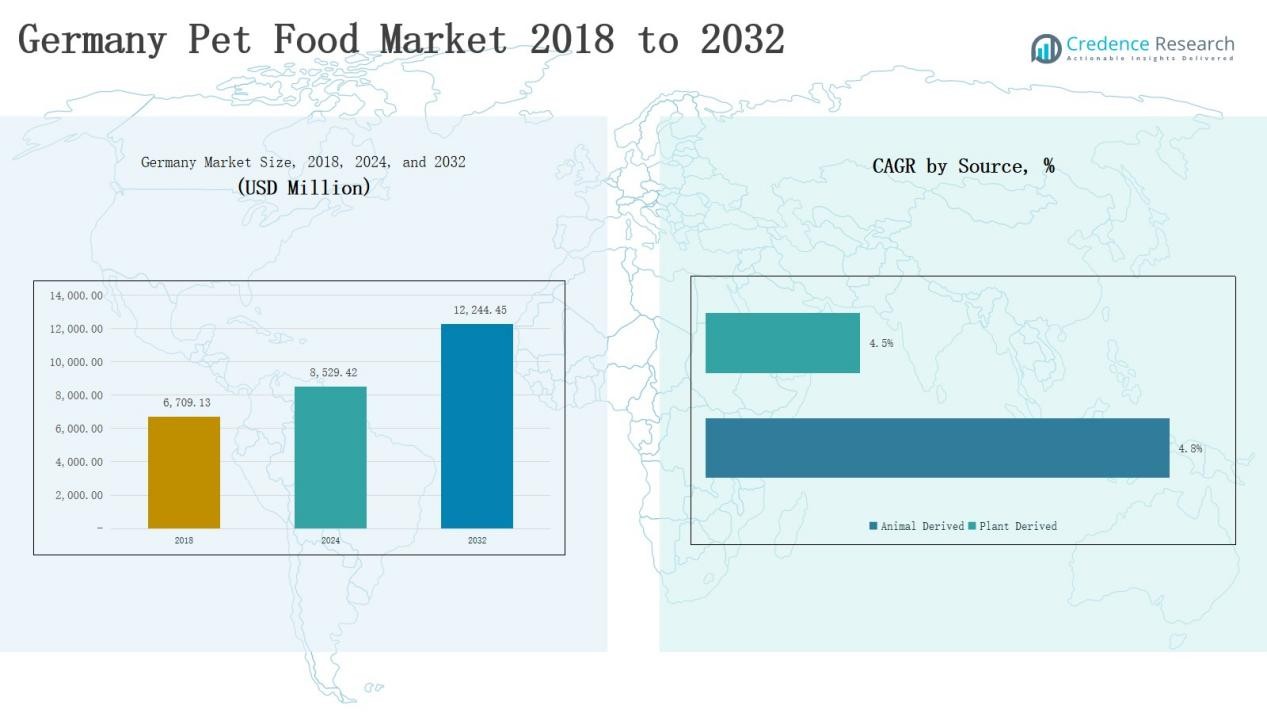
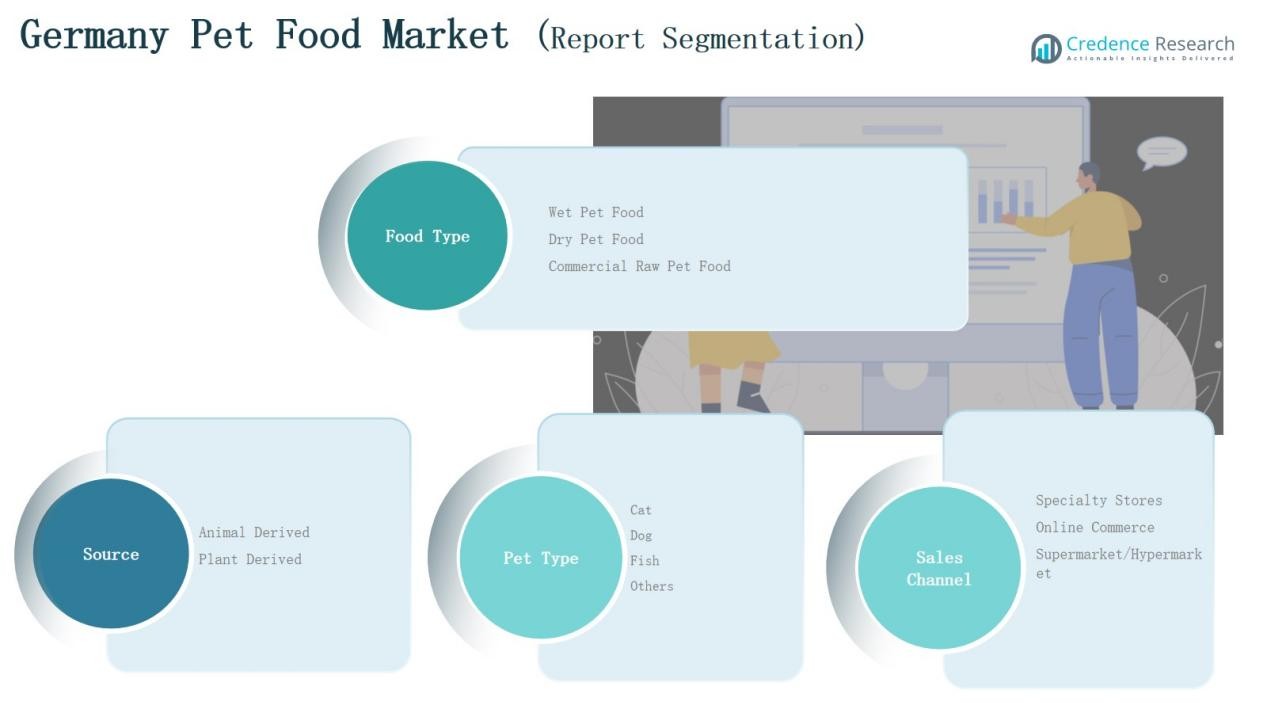
The Germany Pet Food Market size was valued at USD 6,709.13 million in 2018, increased to USD 8,529.42 million in 2024, and is anticipated to reach USD 12,244.45 million by 2032, growing at a CAGR of 4.66% during the forecast period.
| REPORT ATTRIBUTE | DETAILS |
|---|---|
| Historical Period | 2020-2023 |
| Base Year | 2024 |
| Forecast Period | 2025-2032 |
| Germany Pet Food Market Size 2024 | USD 8,529.42 Million |
| Germany Pet Food Market, CAGR | 4.66% |
| Germany Pet Food Market Size 2032 | USD 12,244.45 Million |
The Germany Pet Food Market is led by global players such as Mars, Incorporated, Nestlé Purina PetCare, Hill’s Pet Nutrition, and General Mills, Inc., alongside strong domestic brands including Heristo AG, Deuerer, United Petfood, and Bewital Petfood GmbH & Co. KG. These companies maintain dominance through extensive product portfolios, advanced nutrition research, and sustainable packaging initiatives. Regional manufacturers emphasize locally sourced ingredients and private-label production to compete effectively. Among all regions, South Germany emerged as the leading market in 2024, capturing a 29% share, driven by high pet ownership and strong purchasing power.
Market Insights
- The Germany Pet Food Market grew from USD 6,709.13 million in 2018 to USD 8,529.42 million in 2024, and is projected to reach USD 12,244.45 million by 2032, at a CAGR of 4.66%.
- Dry pet food led the market with a 61% share in 2024, driven by affordability, easy storage, and the growing demand for grain-free and fortified diets.
- The animal-derived segment dominated with a 74% share, supported by strong preference for meat-based nutrition and sustainable protein sourcing.
- By pet type, dogs accounted for 58% of the market in 2024, reflecting higher spending on specialized and functional diets for canine health.
- South Germany emerged as the leading region with a 29% share, fueled by high pet ownership, premium product demand, and strong consumer purchasing power.
Market Segment Insights
By Food Type
Dry pet food dominated the Germany Pet Food Market in 2024 with a 61% share, driven by convenience, longer shelf life, and cost efficiency. Consumers prefer dry food for its easy storage and suitability for bulk purchases. The growing availability of fortified, grain-free, and breed-specific dry formulations further supports segment leadership. Wet food follows due to its higher palatability and digestibility, appealing to aging pets, while commercial raw pet food gains attention from premium and health-focused consumers.
- For instance, Hill’s Pet Nutrition enhanced its Science Plan Sensitive Stomach & Skin range with a new grain-free dry variant tailored for dogs with allergies, reflecting rising demand for fortified and specialized formulas.
By Source
The animal-derived segment held 74% share of the Germany Pet Food Market in 2024, supported by strong demand for protein-rich and meat-based formulations. Pet owners emphasize high nutritional value and taste, driving the popularity of products using poultry, beef, and fish ingredients. Companies invest in sustainable meat sourcing and transparency in labeling to maintain consumer trust. The plant-derived segment is growing as eco-conscious consumers explore vegan or hypoallergenic pet diets emphasizing environmental benefits.
- For instance, in March 2024, Mars Petcare Germany expanded its Cesar Natural Goodness range using responsibly sourced chicken and beef to meet growing demand for traceable ingredients.
By Pet Type
The dog segment accounted for 58% share of the Germany Pet Food Market in 2024, fueled by the country’s large dog population and rising spending on canine nutrition. Dog owners prefer high-quality, functional diets tailored for breed, size, and age-specific needs. The cat food segment follows due to urban households favoring compact pets. Fish and other small pets represent smaller shares but continue to grow through niche offerings such as specialized flakes, pellets, and natural feed formulations.
Key Growth Drivers
Rising Pet Humanization and Premiumization
The growing trend of treating pets as family members drives strong demand for premium and health-focused pet food in Germany. Consumers increasingly seek products with natural ingredients, organic certification, and tailored nutrition for specific breeds or life stages. Brands are expanding their premium portfolios with functional benefits like joint health, digestion, and skin care. This shift toward higher-value, wellness-oriented products continues to elevate market revenues and reshape purchasing behavior across both urban and rural households.
- For instance, THE PACK, a UK-based plant-based pet food company, grew its footprint in Europe in 2024 by securing a listing with Planet Organic and launching an equity crowdfunding campaign, demonstrating rising consumer preference for sustainable and organic pet products in northern and western Europe.
Expansion of E-Commerce and Direct-to-Consumer Channels
Online sales platforms are rapidly transforming pet food distribution in Germany. Consumers favor e-commerce for its convenience, variety, and availability of subscription-based delivery models. Companies leverage digital platforms for personalized marketing and transparent ingredient sourcing. Leading players are enhancing their online presence through partnerships with pet care portals and retailers. This expansion increases accessibility for consumers, particularly in smaller cities, while offering brands valuable data insights to refine product offerings and marketing strategies.
- For instance, retailers like Fressnapf.de enhance accessibility through comprehensive online services, offering detailed product information and automated subscription options, thereby expanding pet food availability even in smaller cities.
Increasing Focus on Sustainable and Ethical Sourcing
Sustainability has become a core growth factor in the Germany Pet Food Market. Consumers actively prefer brands adopting eco-friendly packaging, responsibly sourced proteins, and carbon-neutral production. Manufacturers are introducing recyclable materials and renewable ingredients to meet regulatory and environmental expectations. Local sourcing initiatives and clean-label formulations further strengthen brand credibility. The rising alignment between ethical practices and consumer trust supports long-term growth and competitiveness among both multinational and regional market players.
Key Trends & Opportunities
Growth of Functional and Veterinary Diets
There is a notable surge in demand for pet food addressing specific health concerns such as allergies, obesity, and digestive disorders. Veterinary-recommended and functional diets enriched with probiotics, antioxidants, and omega fatty acids are gaining attention. This trend reflects growing awareness of preventive pet healthcare among German pet owners. Companies focusing on clinical nutrition and specialized formulations stand to capture premium segments and expand their brand presence in the fast-evolving pet wellness market.
- For instance, Dr.Clauder's produces functional pet food formulations tailored to sensitive stomachs and dieters, developed through in-house research to ensure high quality and scientific backing.
Rise of Plant-Based and Alternative Protein Formulations
The shift toward sustainable lifestyles is accelerating interest in plant-based and insect protein pet food. German consumers increasingly value ethical, climate-friendly nutrition choices for their pets. Startups and established brands are developing products using pea, lentil, and insect protein to reduce carbon footprints. These formulations attract environmentally conscious consumers and pet owners with allergen-sensitive pets. This emerging opportunity is expected to reshape product innovation and broaden the market’s protein portfolio over the coming years.
- For instance, Omni, a German vegan pet food brand, launched a nutritionally complete cat food in 2024 made with cultivated chicken meat in partnership with cultivated meat producer Meatly. This innovation provides cats with essential nutrients from cruelty-free sources optimized for vitamin and mineral content, aligning with sustainability goals.
Key Challenges
Fluctuating Raw Material and Ingredient Costs
Volatility in prices of meat, grains, and packaging materials poses a major challenge for manufacturers. Supply disruptions and inflation increase production costs, impacting profit margins. Companies are compelled to adjust pricing strategies or reformulate products with cost-efficient ingredients. Maintaining quality and affordability amid rising costs remains critical for competitiveness. This challenge particularly affects small and mid-sized producers facing limited access to long-term supplier contracts or economies of scale in procurement.
Stringent Regulatory and Labeling Requirements
The German Pet Food Market faces strict compliance norms under EU food safety and labeling regulations. Companies must ensure transparency in ingredient sourcing, nutritional claims, and traceability. Compliance involves high operational costs and complex certification processes, especially for organic and functional products. Small manufacturers often struggle to meet evolving standards while maintaining profitability. Adhering to these regulations is essential for maintaining consumer confidence and sustaining exports across the broader European market.
Rising Competition and Market Saturation
Germany’s mature pet food sector is witnessing intense competition among global giants and local brands. The proliferation of new entrants offering niche and premium products increases market fragmentation. High brand loyalty and price sensitivity among consumers challenge differentiation efforts. Companies must continuously innovate and invest in marketing to retain market share. This competitive intensity limits margin expansion and forces players to explore strategic collaborations, private labels, and value-added offerings for growth.
Regional Analysis
North Germany
North Germany accounted for 24% share of the Germany Pet Food Market in 2024, supported by strong urbanization and a growing population of pet owners in cities like Hamburg and Bremen. The region benefits from advanced logistics infrastructure, facilitating efficient distribution across retail and online channels. Consumers in this region prefer high-quality, natural, and sustainable pet food brands. Local manufacturers emphasize organic sourcing and transparency to meet demand. Premium dog and cat food products drive most sales, supported by rising disposable incomes and modern retail penetration.
South Germany
South Germany held the largest 29% share of the Germany Pet Food Market in 2024, driven by high pet ownership rates and robust spending capacity across Bavaria and Baden-Württemberg. The region’s focus on premium and functional pet nutrition supports product innovation and private-label development. Manufacturers benefit from strong industrial infrastructure and proximity to major suppliers. Consumers actively choose products with high meat content and eco-friendly packaging. The region’s export-oriented companies strengthen its contribution to the national pet food sector.
East Germany
East Germany captured a 21% share of the Germany Pet Food Market in 2024, supported by expanding urban centers and improving retail availability. Pet adoption programs and awareness campaigns have increased ownership, particularly among younger consumers. The market is witnessing growing preference for affordable and value-based pet food products. Manufacturers target this region through discount chains and regional distributors. Investment in modern production facilities supports local supply, while gradual shifts toward premium options create long-term opportunities.
West Germany
West Germany accounted for 26% share of the Germany Pet Food Market in 2024, led by established consumer bases in North Rhine-Westphalia and Hesse. It benefits from high retail density, well-developed e-commerce platforms, and the presence of leading multinational brands. Pet owners in this region prioritize balanced nutrition and convenience in packaging. Companies emphasize brand loyalty programs and innovation in sustainable sourcing to retain customers. Rising pet care awareness continues to support consistent growth across all major distribution channels.
Market Segmentations:
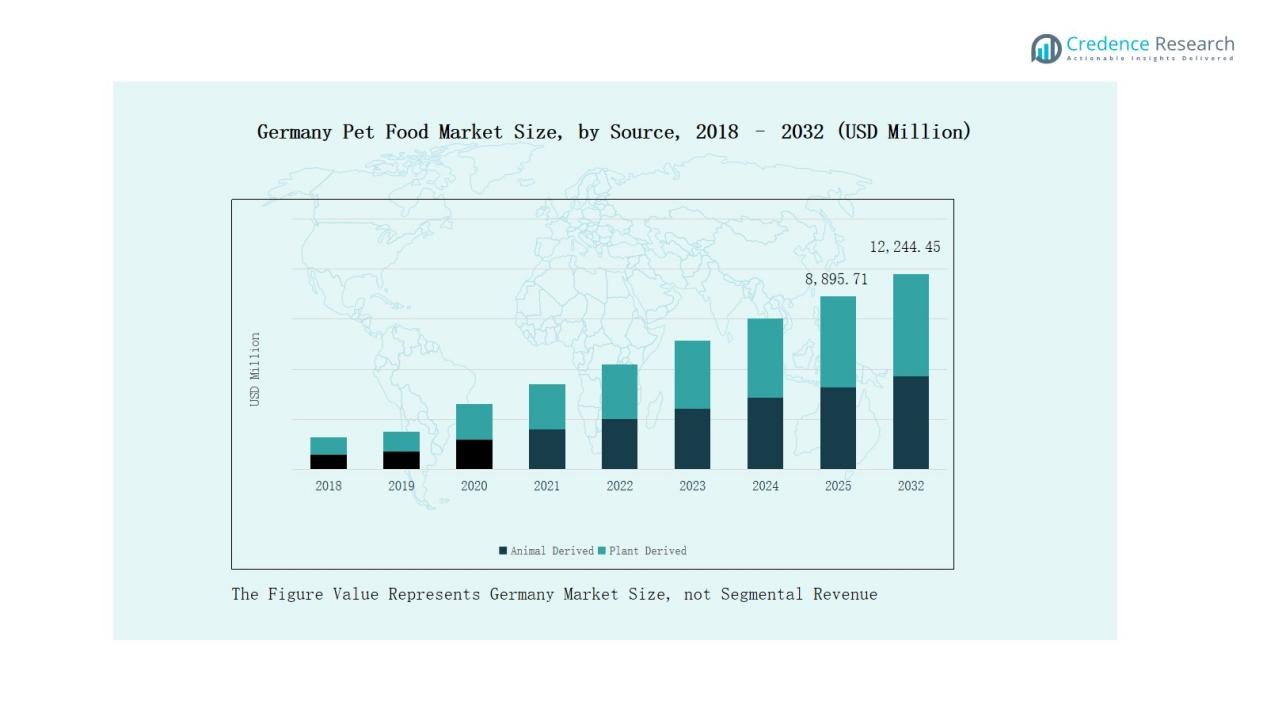
By Food Type
- Wet Pet Food
- Dry Pet Food
- Commercial Raw Pet Food
By Source
- Animal Derived
- Plant Derived
By Pet Type
- Cat
- Dog
- Fish
- Others
By Sales Channel
- Specialty Stores
- Online Commerce
- Supermarket/Hypermarket
By Region
- North Germany
- South Germany
- East Germany
- West Germany
Competitive Landscape
The competitive landscape of the Germany Pet Food Market is characterized by the presence of major multinational corporations and strong domestic brands competing across premium and mass-market segments. Leading players such as Mars, Incorporated, Nestlé Purina PetCare, Hill’s Pet Nutrition, and General Mills, Inc. dominate through wide product portfolios, extensive retail networks, and continuous innovation in specialized nutrition. Local companies like Heristo AG, Deuerer, and United Petfood enhance market diversity with regionally sourced, private-label, and affordable product offerings. Competition centers on product quality, sustainable packaging, and ingredient transparency to align with evolving consumer expectations. Companies focus on expanding e-commerce presence, veterinary partnerships, and clean-label innovations to strengthen brand trust. The market remains moderately consolidated, with premiumization trends, health-oriented formulations, and sustainability driving strategic collaborations and product diversification among key participants.
Key Players
- Heristo AG
- Mars, Incorporated
- Nestlé Purina PetCare
- Hill’s Pet Nutrition
- General Mills, Inc.
- Deuerer
- United Petfood
- Bewital Petfood GmbH & Co. KG
- Pets Deli
- Pets Choice
- MPM Products
- Other Key Players
Recent Developments
- In May 2024, VAFO Group became the sole owner of German manufacturer Allco Tiernahrung via acquisition, integrating its operations under VAFO.de.
- In March 2025, The Nutriment Company (TNC) acquired German raw pet food firm BAF Petfood from Fressnapf to expand its raw food presence in Germany.
- In June 2025, TNC acquired another German pet food business, Graf Barf, to further strengthen its footprint in raw and human-grade nutrition.
Report Coverage
The research report offers an in-depth analysis based on Food Type, Source, Pet Type, Sales Channel and Region. It details leading market players, providing an overview of their business, product offerings, investments, revenue streams, and key applications. Additionally, the report includes insights into the competitive environment, SWOT analysis, current market trends, as well as the primary drivers and constraints. Furthermore, it discusses various factors that have driven market expansion in recent years. The report also explores market dynamics, regulatory scenarios, and technological advancements that are shaping the industry. It assesses the impact of external factors and global economic changes on market growth. Lastly, it provides strategic recommendations for new entrants and established companies to navigate the complexities of the market.
Future Outlook
- Demand for premium and natural pet food products will continue to expand across Germany.
- Online retail and subscription-based delivery models will strengthen market accessibility.
- Sustainable packaging and eco-friendly sourcing will become central to brand positioning.
- Functional and veterinary diets will gain traction among health-conscious pet owners.
- Plant-based and alternative protein pet foods will attract environmentally aware consumers.
- Private-label brands from supermarkets will increase competition in the mid-price segment.
- Manufacturers will invest more in digital marketing and direct-to-consumer engagement.
- Product innovation will focus on breed-specific, age-specific, and allergen-free formulations.
- Partnerships with veterinarians and pet clinics will support trusted product recommendations.
- Expansion of regional production facilities will enhance supply efficiency and reduce import reliance.

Request a Free Sample
Fill in your details and we'll send you a free sample report.
- Sample data tables & charts
- Research methodology
Need a Custom Version of This Report?
Tailor the scope, geography, or segments to your exact requirements.
- Custom geography or segment scope
- Direct access to our analyst team
Frequently Asked Questions
What is the current market size for the Germany Pet Food Market, and what is its projected size in 2032?
At what Compound Annual Growth Rate is the Germany Pet Food Market projected to grow between 2025 and 2032?
Which Germany Pet Food Market segment held the largest share in 2024?
What are the primary factors fueling the growth of the Germany Pet Food Market?
Who are the leading companies in the Germany Pet Food Market?
Which region commanded the largest share of the Germany Pet Food Market in 2024?
Table of Content
Chapter 1 Market Segmentation
- 1.1 Segmentation Framework
- 1.1.1 Product and Service Classification
- 1.1.2 Application and End-Use Classification
- 1.1.3 Technology and Solution Classification
- 1.1.4 Customer and Distribution Channel Classification
- 1.1.5 Geographic Segmentation
- 1.1.6 Market Segment Definitions and Boundaries
Chapter 2 Introduction
- 2.1 Report Objectives and Scope
- 2.2 Product Definition and Industry Terminology
- 2.3 Market Inclusions and Exclusions
- 2.4 Research Process
- 2.4.1 Primary Research and Expert Interviews
- 2.4.2 Secondary Research and Source Review
- 2.4.3 Top-Down and Bottom-Up Estimation
- 2.4.4 Data Triangulation and Verification
- 2.5 Market Size Measurement Basis
- 2.5.1 2024: USD 8,529.42 million → 2032: USD 12,244.45 million
- 2.6 Historical and Forecast Reference Periods
- 2.6.1 Base Year: 2024
- 2.6.2 Forecast Period: 2024-2032
- 2.7 Research Assumptions and Limitations
Chapter 3 Executive Summary
- 3.1 Market Snapshot and Key Findings
- 3.2 Base-Year Market Size, 2024
- 3.3 Forecast Market Size, 2032
- 3.4 Revenue and Volume Growth Outlook
- 3.5 Key Demand and Supply Indicators
- 3.6 Leading Market Segments
- 3.7 Fastest-Growing Market Opportunities
- 3.8 Regional Performance Highlights
- 3.9 Technology and Industry Transformation
- 3.10 Competitive Landscape Summary
- 3.11 Analyst View and Strategic Implications
Chapter 4 Germany Pet Food Market Market Trends and Developments
- 4.1 Historical Industry Development
- 4.2 Recent Market Trends and Developments
- 4.3 Demand and Customer Behavior Trends
- 4.4 Technology and Product Innovation
- 4.5 Artificial Intelligence, Automation and Digitalization
- 4.6 Local Manufacturing and Supply Chain Realignment
- 4.7 Industry Partnerships, Mergers and Acquisitions
- 4.8 Sustainability and Circular Economy Developments
- 4.9 Government and Private Sector Investment Trends
- 4.10 Emerging Business Models and Commercialization
- 4.11 Industry Developments and Announcements
Chapter 5 Germany Pet Food Market Market Production, Supply and Demand Analysis
- 5.1 Demand Trend and Consumption Analysis
- 5.2 Demand Forecast, 2024-2032
- 5.3 Production and Output Trend
- 5.4 Production and Output Forecast, 2024-2032
- 5.5 Installed Capacity and Capacity Utilization
- 5.6 Company-Wise Production Plants and Statistics
- 5.6.1 Installed Production Capacity
- 5.6.2 Actual Production
- 5.6.3 Planned Capacity and Expansion Targets
- 5.7 Supply Chain Structure and Procurement Trends
- 5.8 Supply-Demand Gap and Bottlenecks
- 5.9 Import Dependence and Sourcing Structure
- 5.10 Contract Manufacturing and Outsourcing
- 5.11 Regional Supply and Demand Concentration
Chapter 6 Germany Pet Food Market Market Pricing Analysis
- 6.1 Pricing Structure and Measurement
- 6.2 Historical Pricing Trends
- 6.3 Pricing Outlook, 2024-2032
- 6.4 Average Selling Price and Unit Economics
- 6.5 Pricing by Product and Market Segment
- 6.6 Geographic Pricing Differences
- 6.7 Key Input, Energy, Labor and Logistics Costs
- 6.8 Contract Pricing and Purchasing Models
- 6.9 Pricing Sensitivity and Competitive Positioning
- 6.10 Price, Margin and Profitability Implications
Chapter 7 Germany Pet Food Market Market Dynamics
- 7.1 Market Growth Drivers
- 7.1.1 Demand-Side Drivers
- 7.1.2 Technology and Innovation Drivers
- 7.1.3 Infrastructure and Investment Drivers
- 7.1.4 Regulatory and Policy Drivers
- 7.2 Market Restraints
- 7.2.1 Cost and Affordability Constraints
- 7.2.2 Technology and Adoption Barriers
- 7.2.3 Supply Chain and Operational Constraints
- 7.3 Market Challenges
- 7.3.1 Competitive Pressure and Margin Erosion
- 7.3.2 Skills, Infrastructure and Implementation Gaps
- 7.4 Emerging Market Opportunities
- 7.5 Market Dynamics Impact and Time-Horizon Assessment
Chapter 8 Germany Pet Food Market Value Chain Analysis
- 8.1 Industry Value Chain Overview
- 8.2 Upstream Suppliers and Critical Inputs
- 8.3 Technology and Component Providers
- 8.4 Manufacturing or Service Delivery
- 8.5 Distribution, Channel Partners and Integrators
- 8.6 Downstream Applications and End Users
- 8.7 Value Addition and Profit Pools
- 8.8 Vertical Integration and Outsourcing
- 8.9 Supplier Concentration and Risk
- 8.10 Supply Chain Localization and Resilience
Chapter 9 Germany Pet Food Market Market Regulations and Policies
- 9.1 Relevant Laws, Standards and Compliance Frameworks
- 9.2 Product, Service, Safety and Quality Requirements
- 9.3 Government Policies, Incentives and Subsidies
- 9.4 Imports, Exports and Trade Barriers
- 9.5 Public Procurement and Local Content Requirements
- 9.6 Environmental and Sustainability Compliance
- 9.7 Upcoming Policy Changes and Market Implications
Chapter 10 Germany Pet Food Market Market Hotspots and Opportunities
- 10.1 Market Opportunity Mapping and Growth Hotspots
- 10.2 High-Growth Applications and Customer Groups
- 10.3 Underserved Markets and White-Space Opportunities
- 10.4 Emerging Technology and Product Opportunities
- 10.5 New Capacity and Investment Hotspots
- 10.6 Market Entry and Expansion Opportunities
- 10.7 Distribution and Partnership Opportunities
- 10.8 Near-Term and Long-Term Commercial Potential
- 10.9 Opportunity Attractiveness and Execution Risks
Chapter 11 Germany Pet Food Market Market Outlook, 2024-2032
- 11.1 Market Size and Analysis
- 11.1.1 Revenue (Market Measurement: 2024: USD 8,529.42 million → 2032: USD 12,244.45 million)
- 11.1.2 Market Volume and Quantity Sold
- 11.1.3 Historical Market Size
- 11.1.4 Base-Year Market Size, 2024
- 11.2 Market Forecast, 2024-2032
- 11.2.1 Revenue Forecast to 2032
- 11.2.2 Volume Forecast to 2032
- 11.2.3 CAGR and Year-on-Year Growth
- 11.2.4 Incremental Revenue Opportunity
- 11.3 Forecast Assumptions and Scenario Analysis
- 11.3.1 Base-Case Forecast
- 11.3.2 Optimistic and Conservative Scenarios
- 11.3.3 Technology, Pricing and Policy Sensitivities
- 11.4 Market Attractiveness and Growth Outlook
Chapter 12 Germany Pet Food Market Market Segmentation and Outlook
- 12.1 Segmentation Summary and Market Shares, 2024
- 12.2 Largest and Fastest-Growing Segments
- 12.3 Segment Growth Comparison
- 12.4 Segment Attractiveness and Priority Matrix
Chapter 13 Germany Pet Food Market Geographic Market Outlook, 2024-2032
- 13.1 Domestic Market Distribution and Demand Clusters
- 13.2 State- or Province-Wise Market Size and Forecast, 2024-2032
- 13.3 City and Metropolitan Market Outlook
- 13.4 Industrial, Manufacturing and Commercial Clusters
- 13.5 Geographic Concentration of Key End Users
- 13.6 Local Pricing and Purchasing Differences
- 13.7 Domestic Production Facilities and Capacity Map
- 13.8 Local Infrastructure and Project Pipeline
- 13.9 State-Level Policy and Incentive Differences
- 13.10 Subnational Investment Hotspots and Opportunities
- 13.11 Distribution and Logistics Networks
- 13.12 Domestic Competitive Footprint
Chapter 14 Germany Pet Food Market Technology, Innovation and Sustainability Outlook
- 14.1 Technology Landscape and Maturity
- 14.2 Product, Process and Service Innovation
- 14.3 AI, Automation and Digital Tools in the Industry
- 14.4 Technology Adoption and Performance Benchmarking
- 14.5 Innovation Pipeline and R&D Investment
- 14.6 Patent and Intellectual Property Trends
- 14.7 Energy Efficiency and Resource Management
- 14.8 Sustainability, Recycling and Circularity
- 14.9 Technology Roadmap, 2024-2032
- 14.10 Risks of Obsolescence and Technology Substitution
Chapter 15 Germany Pet Food Market Market Key Strategic Imperatives
- 15.1 Growth and Market Entry Priorities
- 15.2 High-Return Products and Segments
- 15.3 Pricing, Profitability and Cost Optimization
- 15.4 Technology Investment and Product Differentiation
- 15.5 Supply Chain Localization and Resilience
- 15.6 Distribution and Customer Acquisition
- 15.7 Partnership, Acquisition and Capacity Strategy
- 15.8 Regional Expansion Priorities
- 15.9 Short-, Medium- and Long-Term Actions
Chapter 16 Competition Outlook
- 16.1 Industry Competition Characteristics
- 16.2 Market Structure and Concentration
- 16.3 Market Share and Competitive Positioning, 2024
- 16.4 Company-Wise Revenue and Product Benchmarking
- 16.5 Production and Service Capacity Benchmarking
- 16.6 Technology, Pricing and Differentiation
- 16.7 Regional Footprint and Distribution Strength
- 16.8 Mergers, Acquisitions and Strategic Alliances
- 16.9 New Entrants and Competitive Threats
- 16.10 Porter's Five Forces and Industry Attractiveness
- 16.11 Competitive Outlook, 2024-2032
Chapter 17 Company Profiles
- 17.1 Company Coverage and Selection Criteria
- 17.2 Leading Market Participants – Standard Profile Structure
- 17.2.1 Business Description
- 17.2.2 Company Ownership and Geographic Presence
- 17.2.3 Product and Service Portfolio
- 17.2.4 Manufacturing and Operating Footprint
- 17.2.5 Production Capacity and Expansion Plans
- 17.2.6 Financial Performance and Investment
- 17.2.7 Market Share and Competitive Position
- 17.2.8 Technology and Innovation Capabilities
- 17.2.9 Strategic Alliances or Partnerships
- 17.2.10 Recent Developments
- 17.2.11 Growth Strategy and Outlook
- 17.3 Other Relevant Market Participants
Note: Every listed company is profiled on the structure shown under the first company. The company list is preliminary and may change based on research findings, market developments, data availability and client requirements.
Chapter 18 Disclaimer
- 18.1 Research and Forecast Disclaimer
- 18.2 Data Source and Estimation Limitations
Note: The depth of individual sections depends on data availability for this market. Volume, capacity, trade and other unit-based metrics are included where applicable.