
Market Overview
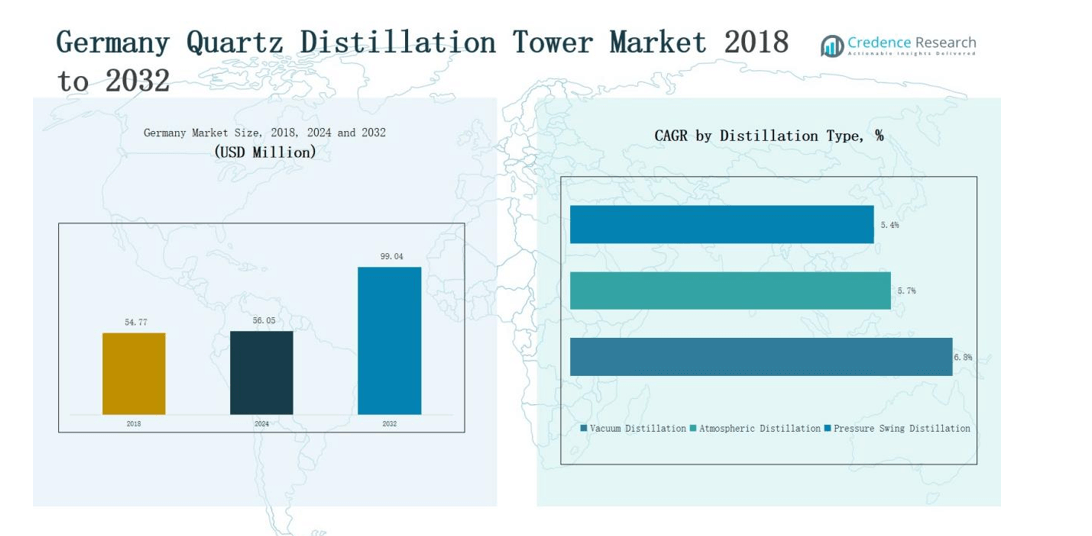
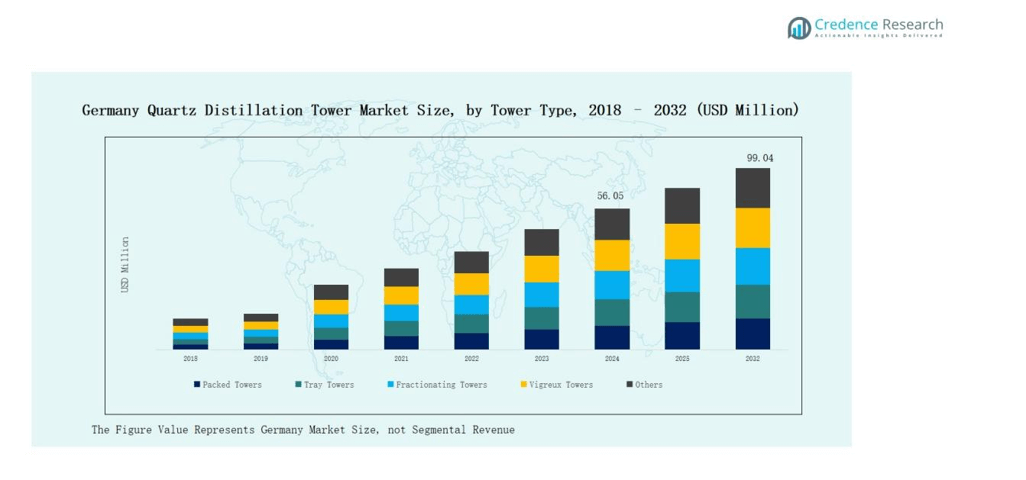
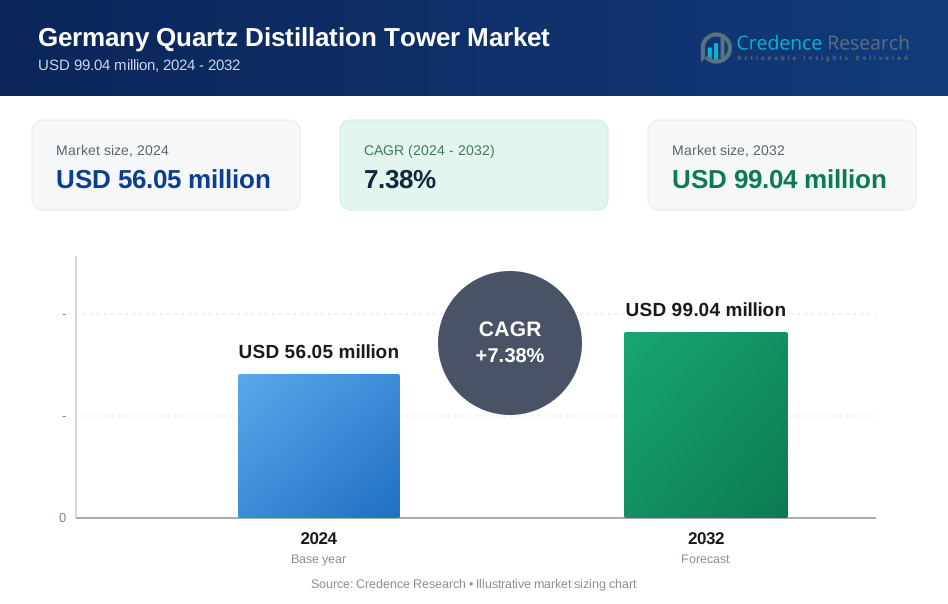
The Germany Quartz Distillation Tower Market was valued at USD 54.77 million in 2018, increasing to USD 56.05 million in 2024, and is projected to reach USD 99.04 million by 2032, growing at a CAGR of 7.38% during the forecast period.
| REPORT ATTRIBUTE | DETAILS |
|---|---|
| Historical Period | 2020-2023 |
| Base Year | 2024 |
| Forecast Period | 2025-2032 |
| Germany Quartz Distillation Tower Market Size 2024 | USD 56.05 million |
| Germany Quartz Distillation Tower Market, CAGR | 7.38% |
| Germany Quartz Distillation Tower Market Size 2032 | USD 99.04 million |
The Germany Quartz Distillation Tower Market is driven by established players such as Raesch Quarz (Germany) GmbH, Heraeus Quarzglas GmbH & Co. KG, WONIK Quartz Europe, Quarzglas Komponenten und Service (QCS), semiQuarz GmbH, EUROQUARZ GmbH, and Nano Quarz Wafer GmbH. These companies focus on precision manufacturing, material innovation, and advanced automation to deliver high-purity, corrosion-resistant distillation systems for semiconductor, pharmaceutical, and chemical industries. Strategic collaborations and continuous R&D investments enhance their technological capabilities and product efficiency. Southern Germany emerged as the leading region, commanding 29% of the total market share in 2024, supported by its robust industrial base, high R&D intensity, and strong presence of semiconductor and process technology manufacturers.
Market Insights
- The Germany Quartz Distillation Tower Market was valued at USD 54.77 million in 2018, reached USD 56.05 million in 2024, and is expected to attain USD 99.04 million by 2032, growing at a CAGR of 7.38%.
- Packed Towers led the market with a 2% share in 2024, favored for high surface area and efficiency in semiconductor and chemical distillation processes.
- Vacuum Distillation dominated by 6% share in 2024, driven by demand for low-temperature purification in semiconductor and pharmaceutical manufacturing.
- Stainless Steel material held a 8% share, supported by strong resistance to corrosion, thermal stress, and suitability for high-purity industrial applications.
- Southern Germany emerged as the leading region with 29% share, driven by its robust semiconductor base, industrial automation investments, and strong R&D ecosystem.
Market Segment Insights
By Tower Type:
The Packed Towers segment dominated the Germany Quartz Distillation Tower Market in 2024, accounting for 37.2% of total revenue. Their high surface area, efficient mass transfer, and low pressure drop make them ideal for high-purity applications in semiconductor and chemical industries. Growing demand for compact and corrosion-resistant tower designs drives their adoption. Structured packing variants further enhance performance by optimizing vapor–liquid contact efficiency, supporting energy savings and improved operational reliability in advanced process environments.
- For instance, Heraeus Quartzglass expanded its production of high-purity quartz components used in packed distillation systems for semiconductor-grade chemical distillation in Bitterfeld, Germany.
By Distillation Type:
The Vacuum Distillation segment held the largest share of 44.6% in 2024, driven by its ability to separate heat-sensitive compounds at lower temperatures. This method minimizes thermal degradation, making it essential for semiconductor-grade quartz purification and pharmaceutical synthesis. Increasing industrial focus on high-purity output and energy efficiency supports segment expansion. Adoption of automated control systems and integration with digital monitoring platforms enhance process accuracy and reduce operational downtime across manufacturing facilities.
- For instance, high-purity magnesium (99.999%) was refined using vacuum distillation techniques for applications like blue-light laser diodes in the semiconductor industry, with apparatus designed to condense purified metal onto specially placed baffle plates, significantly enhancing purity levels.
By Material:
The Stainless Steel segment led the market with a 51.8% share in 2024, favored for its superior corrosion resistance, strength, and thermal stability. It is widely used in distillation systems processing aggressive chemicals or high-purity compounds. The material’s durability and compatibility with quartz components improve system lifespan and reliability. Advancements in alloy formulations and surface treatment technologies continue to enhance mechanical integrity, driving preference across chemical, semiconductor, and optical manufacturing industries in Germany.
Key Growth Drivers
Rising Semiconductor Production Demand
Germany’s expanding semiconductor industry is a major growth driver for the Quartz Distillation Tower Market. High-purity quartz towers are essential for producing ultrapure chemicals used in wafer cleaning and etching. Increasing government and private investments in chip fabrication facilities boost the adoption of advanced distillation systems. The focus on energy-efficient and contamination-free operations encourages manufacturers to upgrade to automated quartz-based units, supporting steady market expansion across the semiconductor value chain.
- For instance, Heraeus Conamic introduced an energy-efficient quartz tower system for semiconductor-grade hydrofluoric acid production, reducing contamination risks during microchip fabrication.
Growth in Pharmaceutical and Chemical Sectors
Strong performance of Germany’s pharmaceutical and specialty chemical industries fuels demand for high-purity distillation systems. Quartz distillation towers ensure superior resistance to corrosion and thermal shock, vital for synthesizing sensitive compounds. With stricter regulatory standards and growing production of active pharmaceutical ingredients (APIs), companies prioritize precision distillation equipment. Continuous process upgrades and research-focused infrastructure in Germany strengthen the market for advanced quartz towers with enhanced purity, durability, and operational consistency.
- For instance, GESLabs uses thin-film distillation plants from VTA Verfahrenstechnische Anlagen GmbH to produce high-purity cannabinoid APIs, ensuring minimal thermal decomposition and high potency.
Technological Advancements and Automation
Advancements in tower design, including structured packing and automated temperature control, significantly enhance process efficiency. German manufacturers increasingly adopt smart monitoring systems for real-time operational control and predictive maintenance. Integration of digital sensors and AI-based process analytics minimizes energy use and product loss, ensuring consistent quality. These innovations align with Germany’s Industry 4.0 goals, driving the modernization of distillation infrastructure in semiconductor, chemical, and optical material production facilities.
Key Trends & Opportunities
Shift Toward Sustainable and Energy-Efficient Systems
Sustainability trends are transforming the Germany Quartz Distillation Tower Market. Manufacturers focus on developing energy-efficient designs that reduce emissions and thermal losses. Integration of eco-friendly materials and recyclable quartz components supports circular manufacturing goals. Government initiatives promoting carbon-neutral industrial operations encourage adoption of green distillation technologies. Companies investing in sustainable tower designs gain a competitive edge through operational cost reduction and compliance with evolving European environmental standards.
- For instance, in 2025, companies like SAES Getters developed advanced quartz towers utilizing recyclable materials aimed at reducing thermal losses and emissions.
Rising Adoption of High-Purity Quartz Materials
Increasing reliance on ultra-high-purity quartz in chemical and semiconductor processing presents major growth opportunities. High-purity quartz improves distillation precision, prevents contamination, and ensures long-term operational stability. German R&D initiatives in advanced materials technology foster the development of superior quartz compositions for complex applications. Collaborations between material suppliers and equipment manufacturers enhance innovation, paving the way for next-generation distillation towers that meet stricter performance and safety standards.
- For instance, Sibelco launched its IOTA series high-purity quartz products in September 2024, specifically engineered for semiconductor crucibles with 99.998% silica content.
Key Challenges
High Manufacturing and Installation Costs
Quartz distillation towers involve complex manufacturing processes and high material costs, limiting adoption among small and medium-sized enterprises. The need for specialized fabrication, machining, and thermal treatment increases production expenses. Installation and maintenance require skilled technicians, adding to total system costs. These financial barriers restrict market entry for new players and slow adoption rates across less capital-intensive industries, especially when competing with conventional metal-based alternatives.
Limited Availability of High-Purity Quartz Material
Access to high-purity quartz remains a critical challenge for manufacturers in Germany. Dependence on limited global suppliers and fluctuating raw material prices affect production stability. Supply chain disruptions can delay project timelines and inflate procurement costs. Manufacturers are exploring local sourcing and recycling initiatives to mitigate risks, but ensuring consistent purity and quality remains difficult. These material constraints pose long-term risks to scalability and cost competitiveness within the market.
Stringent Regulatory and Safety Standards
Germany’s rigorous environmental and industrial safety regulations increase compliance costs for manufacturers. Standards covering emissions, energy efficiency, and chemical handling require continuous process upgrades and certifications. Non-compliance can lead to operational delays or product recalls. Companies must invest in advanced monitoring systems and documentation to meet evolving European norms. Although necessary for quality assurance, these regulations add financial and operational pressure, especially for smaller market participants.
Regional Analysis
Southern Germany
Southern Germany accounted for 29% of the Germany Quartz Distillation Tower Market in 2024. Strong industrial infrastructure across Bavaria and Baden-Württemberg supports high adoption of advanced distillation systems. The region hosts leading semiconductor and chemical manufacturing facilities that rely on precision quartz towers for ultra-pure production. It benefits from significant investments in automation and cleanroom technologies. The presence of research institutions and equipment suppliers strengthens innovation and testing capabilities. Expanding renewable energy integration in process industries further supports long-term market growth.
Northern Germany
Northern Germany held 21% of the market share in 2024, driven by its well-developed chemical and pharmaceutical base. Hamburg and Bremen remain strategic hubs for quartz component manufacturing and export. It benefits from proximity to North Sea ports, enabling efficient material imports for tower production. Industrial clusters across Lower Saxony and Schleswig-Holstein are upgrading to sustainable distillation systems to meet environmental norms. Government support for green process technology adoption enhances the region’s competitiveness in high-purity chemical applications.
Western Germany
Western Germany captured 25% of total market share in 2024, supported by a dense concentration of chemical and optical manufacturing companies. North Rhine-Westphalia remains a major production zone with strong infrastructure and advanced processing facilities. It demonstrates consistent demand for corrosion-resistant and energy-efficient quartz towers across multiple industries. Industrial modernization programs continue to improve equipment performance and reduce emissions. Continuous R&D collaborations with engineering institutes enhance technological progress and material development in this region.
Eastern Germany
Eastern Germany represented 14% of the market share in 2024. It is witnessing increasing industrial investments in precision manufacturing and semiconductor fabrication. Saxony’s “Silicon Saxony” cluster drives demand for high-purity quartz distillation systems in electronic and optical applications. It benefits from improved manufacturing infrastructure and federal funding programs promoting advanced process technologies. Growing partnerships between public research bodies and equipment producers support product innovation. The region’s emerging industrial base strengthens its contribution to national production capacity.
Central Germany
Central Germany accounted for 11% of the market share in 2024. It is gaining momentum through growing investments in specialty chemical production and laboratory research. The region leverages its central location for efficient logistics and equipment distribution across Europe. Universities and technical centers support local innovation and skill development in high-purity quartz applications. Manufacturers are expanding regional facilities to serve niche industrial clients requiring customized distillation systems. It continues to play a supporting role in national production and R&D networks.
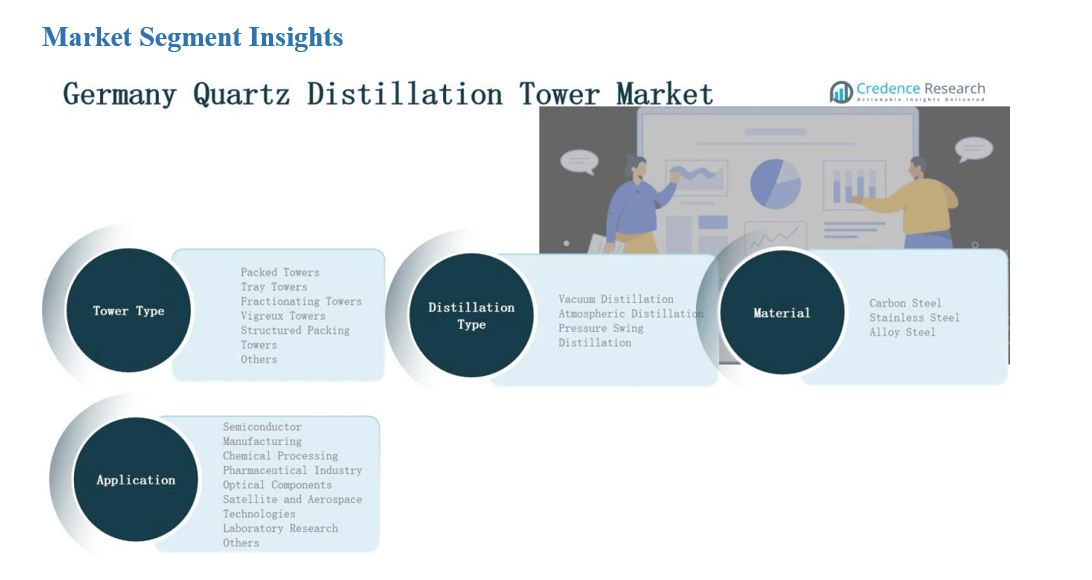
Market Segmentations:
By Tower Type
- Packed Towers
- Tray Towers
- Fractionating Towers
- Vigreux Towers
- Structured Packing Towers
- Others
By Distillation Type
- Vacuum Distillation
- Atmospheric Distillation
- Pressure Swing Distillation
By Material
- Carbon Steel
- Stainless Steel
- Alloy Steel
By Application
- Semiconductor Manufacturing
- Chemical Processing
- Pharmaceutical Industry
- Optical Components
- Satellite and Aerospace Technologies
- Laboratory Research
- Others
By Region
- Southern Germany
- Northern Germany
- Western Germany
- Eastern Germany
Competitive Landscape
The Germany Quartz Distillation Tower Market features a moderately consolidated structure, with leading players focusing on product innovation, material enhancement, and process automation. Key companies such as Raesch Quarz (Germany) GmbH, Heraeus Quarzglas GmbH & Co. KG, WONIK Quartz Europe, and Quarzglas Komponenten und Service (QCS) dominate through advanced manufacturing capabilities and extensive product portfolios. These firms emphasize the production of high-purity, thermally stable, and corrosion-resistant towers tailored for semiconductor, pharmaceutical, and chemical applications. Continuous R&D investments aim to improve tower efficiency and durability under extreme conditions. Strategic collaborations with research institutions and process equipment manufacturers strengthen technological leadership. Mid-sized companies such as semiQuarz GmbH, EUROQUARZ GmbH, and Nano Quarz Wafer GmbH compete through customized product solutions and regional client networks. The market remains innovation-driven, with growing emphasis on sustainable production, precision engineering, and automation to enhance competitiveness across domestic and international markets.
Key Players
- Raesch Quarz (Germany) GmbH
- Heraeus Quarzglas GmbH & Co. KG
- WONIK Quartz Europe
- Quarzglas Komponenten und Service (QCS)
- semiQuarz GmbH
- EUROQUARZ GmbH
- Nano Quarz Wafer GmbH
Recent Developments
- In April 2024, Raesch Quarz (Germany) GmbH emphasized their continuous quality improvements and innovative quartz glass refinement for process cylinders and distillation vessels, supporting future-oriented quartz glass applications.
- On January 1, 2025, Heraeus merged its Conamic and Comvance units into a new operating company, Heraeus Covantics.
- In January 2025, SCHOTT AG completed the acquisition of QSIL GmbH Quarzschmelze Ilmenau in Germany, strengthening its portfolio in high-performance quartz materials for semiconductor and optical applications.
Report Coverage
The research report offers an in-depth analysis based on Tower Type, Distillation Type, Application, Material and Region. It details leading market players, providing an overview of their business, product offerings, investments, revenue streams, and key applications. Additionally, the report includes insights into the competitive environment, SWOT analysis, current market trends, as well as the primary drivers and constraints. Furthermore, it discusses various factors that have driven market expansion in recent years. The report also explores market dynamics, regulatory scenarios, and technological advancements that are shaping the industry. It assesses the impact of external factors and global economic changes on market growth. Lastly, it provides strategic recommendations for new entrants and established companies to navigate the complexities of the market.
Future Outlook
- Demand for high-purity quartz towers will rise with semiconductor manufacturing expansion.
- Automation and digital monitoring will improve operational efficiency and process control.
- Adoption of energy-efficient and sustainable distillation designs will gain momentum.
- Integration of AI-based predictive maintenance systems will reduce downtime and maintenance cost.
- Local sourcing of high-purity quartz will strengthen supply chain stability.
- Pharmaceutical and specialty chemical industries will continue driving product demand.
- Collaborations between research institutions and manufacturers will accelerate product innovation.
- Customized tower configurations will grow to meet diverse industrial needs.
- Government initiatsives supporting advanced manufacturing will enhance domestic production capacity.
- Export opportunities for German-made quartz towers will expand across Europe and Asia.
Request a Free Sample
Fill in your details and we'll send you a free sample report.
- Sample data tables & charts
- Research methodology
Need a Custom Version of This Report?
Tailor the scope, geography, or segments to your exact requirements.
- Custom geography or segment scope
- Direct access to our analyst team
Frequently Asked Questions
What is the current market size for Germany Quartz Distillation Tower Market, and what is its projected size in 2032?
At what Compound Annual Growth Rate is the Germany Quartz Distillation Tower Market projected to grow between 2025 and 2032?
Which Germany Quartz Distillation Tower Market segment held the largest share in 2024?
What are the primary factors fueling the growth of the Germany Quartz Distillation Tower Market?
Who are the leading companies in the Germany Quartz Distillation Tower Market?
Table of Content
Chapter 1. Report Introduction
- 1.1 Report Description & Purpose
- 1.1.1 Report Title & Market Definition
- 1.1.2 Unique Selling Propositions (USP) & Key Differentiators
- 1.1.3 Value Proposition for Stakeholders
- 1.2 Research Objectives
- 1.2.1 Market Sizing Objectives (Volume & Revenue)
- 1.2.2 Segmentation Objectives
- 1.2.3 Competitive Intelligence Objectives
- 1.2.4 Forecast & Scenario Objectives
- 1.3 Report Scope
- 1.3.1 Germany Quartz Distillation Tower Scope – Types & Subtypes Covered
- 1.3.2 Geographic Scope – Regions & Countries Covered
- 1.3.3 Historical Period, Base Year & Forecast Period (2024; forecast to 2032)
- 1.3.4 Inclusions & Exclusions
- 1.4 HS Code & Classification Framework
- 1.5 Currency, Units & Pricing Basis
- 1.6 Target Stakeholders
- 1.7 Limitations & Assumptions
Chapter 2. Executive Summary
- 2.1 Global Germany Quartz Distillation Tower Market Snapshot
- 2.1.1 Market Size – Historical (2024) & Forecast (2024-2032) (2024: USD 56.05 million → 2032: USD 99.04 million)
- 2.1.2 Volume & Revenue – Global Totals
- 2.1.3 Key Market Highlights – Top Five Facts
- 2.2 Germany Quartz Distillation Tower Market Segmentation Snapshot
- 2.2.1 Market Split by Region – 2024 vs. 2032
- 2.3 Competitive Snapshot
- 2.3.1 Top 10 Players by Revenue Share – 2024
- 2.3.2 Top 10 Players by Volume Share – 2024
- 2.3.3 Recent Strategic Developments (18-Month Summary)
- 2.4 Key Investment Highlights & Strategic Conclusions
Chapter 3. Germany Quartz Distillation Tower Market Dynamics & Industry Analysis
- 3.1 Market Overview & Context
- 3.1.1 Germany Quartz Distillation Tower Market Position in the Broader Automotive Value Chain
- 3.1.2 OEM vs. Replacement Market Dynamics
- 3.1.3 Market Maturity & Development Stage by Region
- 3.2 Germany Quartz Distillation Tower Market Drivers
- 3.3 Germany Quartz Distillation Tower Market Restraints & Challenges
- 3.4 Germany Quartz Distillation Tower Market Opportunities
- 3.5 Porter's Five Forces Analysis
- 3.5.1 Threat of New Entrants
- 3.5.2 Bargaining Power of Suppliers
- 3.5.3 Bargaining Power of Buyers
- 3.5.4 Threat of Substitutes
- 3.5.5 Competitive Rivalry – Intensity Assessment
- 3.6 Germany Quartz Distillation Tower Value Chain Analysis
- 3.6.1 Upstream – Raw Material/Input Suppliers
- 3.6.1.1 Raw Material/Input 1
- 3.6.1.2 Raw Material/Input 2
- 3.6.1.3 Raw Material/Input 3
- 3.6.2 Midstream – Production/Manufacturing/Service Delivery
- 3.6.2.1 Production/Process Overview
- 3.6.2.2 Key Facility Locations & Capacity by Manufacturer
- 3.6.3 Downstream – Distribution & End Consumer
- 3.6.3.1 Primary Channel – B2B/OEM
- 3.6.3.2 Secondary Channels – Dealer, Retail, Online, Direct
- 3.6.4 Value Chain Profitability Analysis
- 3.6.1 Upstream – Raw Material/Input Suppliers
- 3.7 PESTEL Analysis
- 3.7.1 Political Factors
- 3.7.2 Economic Factors
- 3.7.3 Social Factors
- 3.7.4 Technological Factors
- 3.7.5 Environmental Factors
- 3.7.6 Legal Factors
- 3.8 Germany Quartz Distillation Tower Supply Chain Analysis
- 3.8.1 Raw Material/Input Supply Risk Assessment
- 3.8.2 Manufacturing Concentration Risk (Geographic Exposure)
- 3.8.3 Trade Disruption Impact Analysis
- 3.9 Regulatory & Policy Landscape
Note: The regulatory and policy landscape section covers regulations based on their applicability to the market, Germany Quartz Distillation Tower category, geography, and scope of the study. Only regulatory frameworks with a material impact on operations, compliance, trade, sustainability, or market access are analyzed in detail.
Chapter 4. Key Investment Pockets & Opportunity Analysis
- 4.1 Germany Quartz Distillation Tower Market Attractiveness Analysis
- 4.1.1 By Region – Investment Attractiveness Matrix (Volume × CAGR)
- 4.2 Absolute Revenue Growth Opportunity
- 4.2.1 By Region – Absolute USD Growth Through 2032
- 4.3 Incremental Volume Opportunity
- 4.3.1 By Region – Incremental Volume Through 2032
- 4.3.2 Segment – Incremental Volume
- 4.4 Emerging Submarket Opportunity Deep Dive (Subject to Applicability)
- 4.5 Emerging Market Opportunity Scorecards
- 4.5.1 United States
- 4.5.2 Europe
- 4.5.3 Asia
- 4.5.4 Middle East & Africa
Note: Emerging Market Opportunity Scorecards will be included based on relevance and strategic importance. Regions listed are indicative and may vary depending on data availability and market dynamics.
Chapter 5. Germany Quartz Distillation Tower Import-Export Analysis & Trade Flows
- 5.1 Global Trade Overview
- 5.1.1 Global Export Value by Country (2024)
- 5.1.2 Global Export Volume by Country (2024)
- 5.1.3 Global Import Value by Country (2024)
- 5.1.4 Global Import Volume by Country (2024)
- 5.1.5 Net Trade Balance by Country (2024)
- 5.2 Export Analysis – Segment
- 5.2.1 Type 1 (HS Code)
- 5.2.2 Type 2 (HS Code)
- 5.2.3 Type 3 (HS Code)
- 5.2.4 Type 4 (HS Code)
- 5.2.5 Type 5 (HS Code)
- 5.3 Import Analysis – Segment
- 5.3.1 Type 1 (HS Code)
- 5.3.2 Type 2 (HS Code)
- 5.3.3 Type 3 (HS Code)
- 5.3.4 Type 4 (HS Code)
- 5.3.5 Type 5 (HS Code)
- 5.4 Average Unit Trade Prices
- 5.4.1 Average Export Price – Segment & Country
- 5.4.2 Average Import Price – Segment & Source Country
- 5.4.3 Price Trends (2024)
- 5.5 Key Trade Route Analysis
- 5.5.1 Trade Route 1
- 5.5.2 Trade Route 2
- 5.5.3 Trade Route 3
- 5.5.4 Trade Route 4
- 5.5.5 Trade Route 5
- 5.6 Trade Policy Impact Assessment
- 5.6.1 US Anti-Dumping & Section 301 Tariffs
- 5.6.2 EU Customs Union Impact
- 5.6.3 Major Free Trade Agreements
- 5.6.4 USMCA Rules of Origin
Note: Trade policy analysis will be included only where relevant to the Germany Quartz Distillation Tower market.
Chapter 6. Competitive Landscape & Company Benchmarking
- 6.1 Germany Quartz Distillation Tower Market Concentration & Structure
- 6.1.1 Herfindahl-Hirschman Index (HHI) – vs. 2024
- 6.1.2 Tier 1, Tier 2 & Tier 3 Market Structure
- 6.1.3 Global, Regional & Local Player Dynamics
- 6.2 Germany Quartz Distillation Tower Market Share Analysis – 2024
- 6.2.1 Global Revenue Share by Company
- 6.2.2 Global Volume Share by Company
- 6.2.3 Regional Revenue Share
- 6.2.4 Market Share Evolution ( vs. 2024)
- 6.2.5 OEM Segment Share by Company
- 6.2.6 Replacement Segment Share by Company
- 6.3 Production/Delivery Capacity & Facility Analysis
- 6.3.1 Global Installed Capacity
- 6.3.2 Capacity Utilization Rates
- 6.3.3 Production/Output Volume
- 6.3.4 Facility Locations & Capacity Map
- 6.3.5 Planned Capacity Additions
- 6.4 Germany Quartz Distillation Tower Competitive Benchmarking Matrix
- 6.4.1 Revenue, Volume, CAGR & Profitability Comparison
- 6.4.2 Channel Revenue Mix
- 6.4.3 Geographic Revenue Exposure
- 6.4.4 R&D Intensity
- 6.4.5 Sustainability Maturity
- 6.5 Strategic Developments in Germany Quartz Distillation Tower (Last 24 Months)
- 6.5.1 Mergers, Acquisitions & Divestments
- 6.5.2 New Germany Quartz Distillation Tower Launches
- 6.5.3 Facility Expansions
- 6.5.4 Strategic Alliances, Joint Ventures & Partnerships
- 6.5.5 Distribution Expansion & Market Entry
- 6.5.6 Sustainability & ESG Initiatives
- 6.6 Competitive Strategy Mapping
- 6.6.1 Leader, Challenger, Follower & Niche Classification
- 6.6.2 Pricing Strategy Comparison
- 6.6.3 Channel Strategy Matrix
Note: Strategic developments are included based on their materiality and the availability of reliable information.
Chapter 7. Global Germany Quartz Distillation Tower Market – By Distribution Channel
- 7.1 Segment Overview
- 7.1.1 Volume & Revenue Split by Channel (2024 & 2032)
- 7.1.2 Channel Mix Evolution (2024-2032)
Chapter 8. Regional Market Analysis – Global Overview
- 8.1 Global Regional Overview
- 8.1.1 Regional Volume Share
- 8.1.2 Regional Revenue Share
- 8.1.3 Regional Volume by Region
- 8.1.4 Regional Revenue by Region
- 8.1.5 Regional Forecast Through 2032
- 8.2 Cross-Regional Segment Analysis
- 8.2.1 By Distribution Channel
- 8.2.2 By Brand/Price Tier
Chapter 9. North America Germany Quartz Distillation Tower Market
- 9.1 United States
- 9.2 Canada
- 9.3 Mexico
Chapter 10. Europe Germany Quartz Distillation Tower Market
- 10.1 Germany
- 10.2 France
- 10.3 Italy
- 10.4 United Kingdom
- 10.5 Spain
- 10.6 Poland
- 10.7 Russia
- 10.8 Netherlands
- 10.9 Belgium
- 10.10 Sweden
- 10.11 Denmark
- 10.12 Norway
- 10.13 Rest of Europe
Chapter 11. Asia Pacific Germany Quartz Distillation Tower Market
- 11.1 China
- 11.2 India
- 11.3 Japan
- 11.4 South Korea
- 11.5 Thailand
- 11.6 Indonesia
- 11.7 Vietnam
- 11.8 Malaysia
- 11.9 Australia
- 11.10 Rest of Asia Pacific
Chapter 12. Latin America Germany Quartz Distillation Tower Market
- 12.1 Brazil
- 12.2 Argentina
- 12.3 Colombia
- 12.4 Chile
- 12.5 Rest of Latin America
Chapter 13. Middle East Germany Quartz Distillation Tower Market
- 13.1 Saudi Arabia
- 13.2 United Arab Emirates
- 13.3 Turkey
- 13.4 Israel
- 13.5 Iran
- 13.6 Rest of the Middle East
Chapter 14. Africa Germany Quartz Distillation Tower Market
- 14.1 South Africa
- 14.2 Egypt
- 14.3 Nigeria
- 14.4 Morocco
- 14.5 Rest of Africa
Chapter 15. Germany Quartz Distillation Tower Company Profiles
- 15.1 [Company 01]
- 15.1.1 Company Overview
- 15.1.2 Key Management Personnel
- 15.1.3 Products & Services Portfolio
- 15.1.4 Financial Performance
- 15.1.5 Key Market Focus & Geographic Presence
- 15.1.6 Recent Developments & Strategic Initiatives
Note: The company profile list is preliminary and may change based on research findings, market developments, data availability, and client requirements.
Chapter 16. Appendices
- Appendix A – List of Abbreviations & Acronyms
- Appendix B – Industry Classification Code Reference – Full Series
- Appendix C – Production & Capacity Data Tables
- Appendix D – End-Use & Demand Base Tables
- Appendix E – Consumption & Replacement Rate Assumptions
- Appendix F – ASP Reference Tables
- Appendix G – Manufacturing & Facility Database
- Appendix H – Import-Export Data Tables
- Appendix I – Regulatory Summary Tables
- Appendix J – Primary Research Participant List (Anonymized)
- Appendix K – Primary Research Questionnaire Framework
- Appendix L – Data Sources & Bibliography
- Appendix M – Market Size Divergence & Source Comparison
Chapter 17. Research Methodology
- 17.1 Research Framework & Philosophy
- 17.2 Secondary Research – Sources, Hierarchy & Data Extraction
- 17.3 Data Modeling – Bottom-Up & Top-Down Market Sizing
- 17.4 Primary Research – Stakeholder Framework, LOI & Sample Sizes
- 17.5 Forecast Methodology – Regression, Scenario & Sensitivity Analysis
- 17.6 Quality Control – Four-Layer Validation Framework
- 17.7 Limitations & Standard Assumptions
- 17.8 Disclaimer
