
Glass Cosmetic Bottle Market Overview:
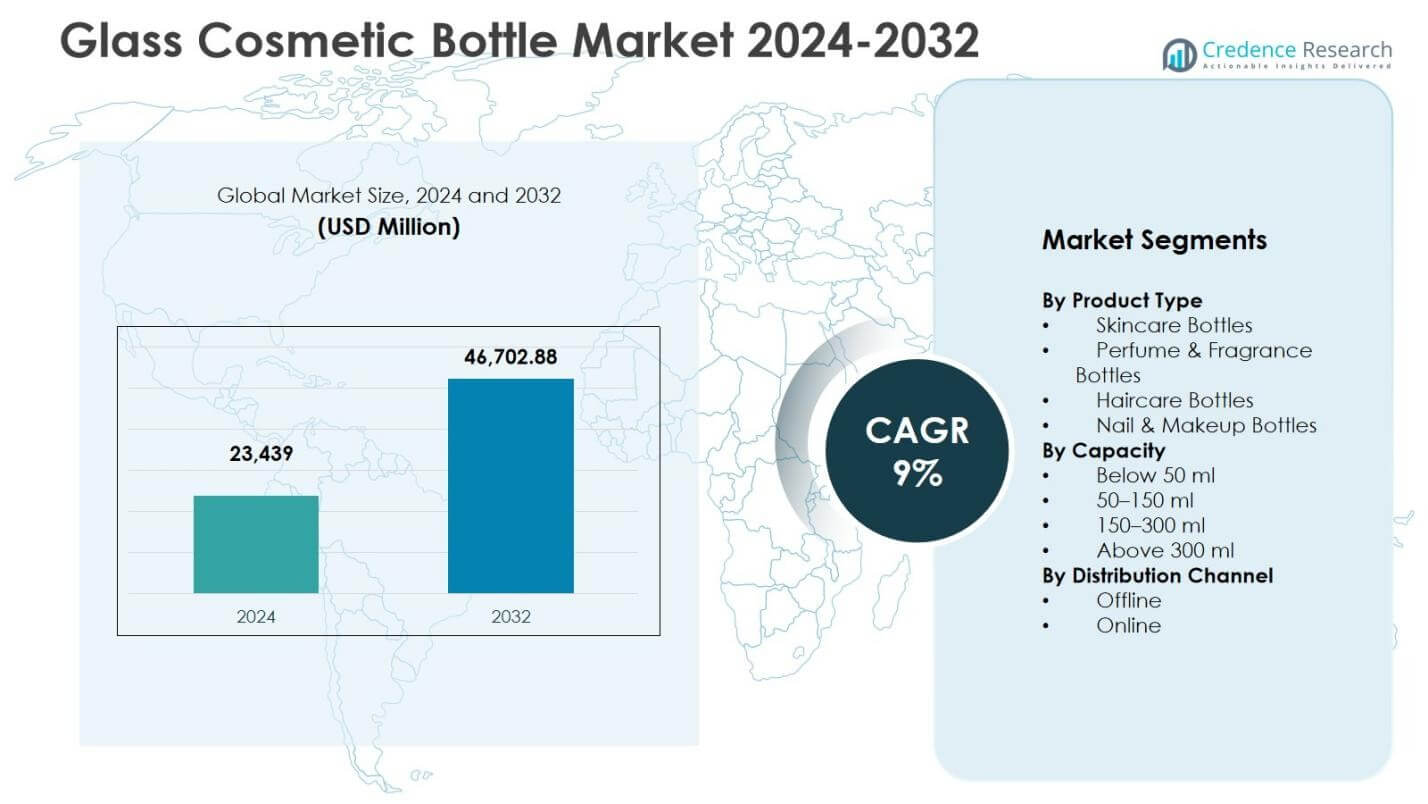
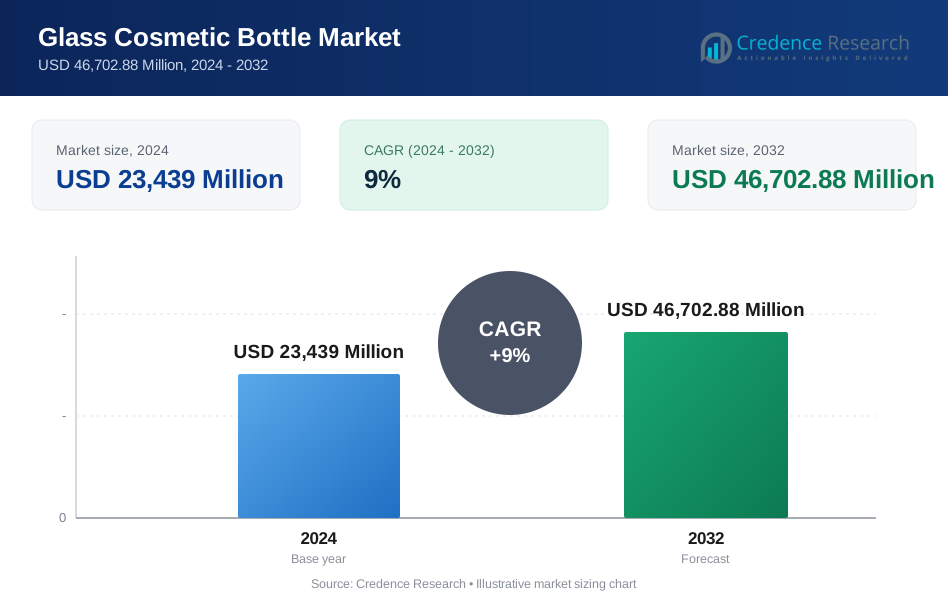
Glass Cosmetic Bottle Market size was valued USD 23,439 Million in 2024 and is anticipated to reach USD 46,702.88 Million by 2032, at a CAGR of 9% during the forecast period.
| REPORT ATTRIBUTE | DETAILS |
|---|---|
| Historical Period | 2020-2023 |
| Base Year | 2024 |
| Forecast Period | 2025-2032 |
| Glass Cosmetic Bottle Market Size 2024 | USD 23,439 million |
| Glass Cosmetic Bottle Market, CAGR | 9% |
| Glass Cosmetic Bottle Market Size 2032 | USD 46,702.88 million |
Glass Cosmetic Bottle Market Insights
- Market growth is driven by rising demand for premium skincare and fragrance packaging, with the Skincare Bottles segment accounting for 41.2% share in 2024 due to strong adoption in luxury and dermatology-grade product lines.
- Key trends include increasing use of recyclable and refillable glass formats, lightweight bottle innovation, and customization through decorative finishes to support brand differentiation in high-value cosmetic categories.
- Leading players focus on design innovation, capacity expansion, and partnerships with global beauty brands, strengthening their market presence through sustainable manufacturing practices and value-added packaging solutions.
- Europe led the market with 32.4% share in 2024, followed by North America with 28.6% and Asia-Pacific with 26.1%, supported by strong luxury cosmetic production bases and expanding premium beauty consumption across these regions.
Glass Cosmetic Bottle Market Segmentation Analysis:
By Product Type
The Glass Cosmetic Bottle Market by product type is led by Skincare Bottles, which accounted for 41.2% share in 2024 owing to rising demand for serums, facial oils, and premium skincare formulations that favor glass for product stability, aesthetics, and recyclability. Perfume & Fragrance Bottles, Haircare Bottles, and Nail & Makeup Bottles collectively support market expansion through luxury branding and strong adoption in premium cosmetic lines. The dominance of skincare packaging is driven by premiumization, sustainability preferences, and brand positioning toward eco-friendly, high-value glass formats.
- For instance, L’Oréal’s Lancôme brand uses glass dropper bottles for its Advanced Génifique Serum, emphasizing product preservation and a premium sensory experience.
By Capacity
In terms of capacity, the 50–150 ml segment dominated the market with a 46.5% share in 2024, supported by its suitability for skincare, perfumes, and cosmetic serums where controlled dosing, portability, and premium design alignment are essential. Below 50 ml bottles remain important for travel-size and mini-pack launches, while 150–300 ml formats serve haircare and personal care ranges. Above 300 ml bottles address niche product categories. Growth in the dominant 50–150 ml category is driven by product standardization across cosmetics, premium branding trends, and strong adoption in luxury skincare lines.
- For instance, Silcare offers a 50 ml white PET bottle with pump for serums and light emulsions, ideal for hyaluronic acid moisturizers or vitamin concentrates in professional skincare lines. Its hygienic pump ensures controlled dosing while protecting sensitive formulas.
By Distribution Channel
By distribution channel, the market is dominated by the Offline channel, which held a 62.4% share in 2024, driven by strong dependence on B2B procurement networks, packaging distributors, and direct relationships with cosmetic manufacturers for customization, bulk purchasing, and design collaboration. The Online channel is expanding as brands increasingly source through digital platforms for rapid sampling and cost-efficient procurement. However, offline channels maintain leadership due to supplier reliability, technical consultation needs, and design validation processes that favor in-person vendor engagement and long-term manufacturing partnerships.
Key Growth Drivers
Premiumization of Beauty and Skincare Products
The Glass Cosmetic Bottle Market experiences strong growth as global beauty brands increasingly shift toward premium and luxury product positioning. Glass bottles reinforce brand value through aesthetic appeal, product safety, and compatibility with high-end formulations such as serums, essential oils, and fragrances. Consumers associate glass with purity, durability, and elegance, which strengthens brand perception and supports premium pricing strategies. The rapid expansion of luxury skincare and fragrance portfolios, especially in Europe, North America, and Asia, further accelerates demand for customized, decorative, and design-enhanced glass bottles that align with modern branding and consumer lifestyle preferences.
- For instance, L’Oréal’s Lancôme partnered with Verescence to produce recyclable glass bottles for the La Vie Est Belle fragrance line, combining eco-design with a premium finish.
Rising Demand for Sustainable and Eco-Friendly Packaging
Sustainability emerges as a major driver as cosmetic manufacturers transition from plastic packaging to recyclable and reusable materials. Glass bottles offer environmental benefits, including full recyclability, chemical inertness, and lower contamination risk for active cosmetic ingredients. Growing consumer awareness of green packaging and increasing regulatory pressure on plastic waste strengthen adoption across skincare, haircare, and fragrance categories. Brands leverage glass packaging to support clean-beauty positioning, circular economy initiatives, and refillable product formats. This shift encourages investment in lightweight glass designs, recycled glass content, and sustainable production technologies that reinforce long-term market expansion.
- For instance, L'Oréal's Lancôme La Vie Est Belle Elixir offers a 100 ml refill bottle that saves 73% glass, 66% plastic, and 61% cardboard compared to two 50 ml bottles, promoting reusable glass packaging in fragrances.
Growth of Skincare, Wellness, and Personal Care Industries
Rapid expansion of skincare and personal care categories significantly drives the Glass Cosmetic Bottle Market, supported by rising self-care trends, urban lifestyles, and increasing consumer spending on grooming and beauty products. Skincare brands prefer glass bottles for formulations sensitive to heat, oxygen, and UV exposure, helping maintain product stability and shelf integrity. The surge in dermatology-grade products, anti-aging serums, organic beauty lines, and aromatherapy oils increases the use of precision-dose droppers and pump-based glass containers. Strong growth in e-commerce beauty distribution and premium private-label cosmetics further contributes to sustained market momentum.
Key Trends & Opportunities
Adoption of Refillable, Reusable, and Custom-Designed Packaging Solutions
A major trend shaping the market is the rising adoption of refillable and reusable cosmetic glass packaging formats, driven by sustainability commitments and circular packaging initiatives among leading beauty companies. Brands increasingly collaborate with packaging manufacturers to develop custom-designed, embossed, and decorative glass bottles that enhance brand differentiation and consumer experience. The trend also creates opportunities in luxury fragrance refills, skincare serum replacements, and modular bottle-cap systems. Growing investment in personalization, UV-coated finishes, and advanced printing technologies strengthens demand for premium glass aesthetics while supporting environmentally responsible brand positioning across global markets.
- For instance, Estée Lauder transitioned its Revitalizing Supreme+ Moisturizer to a recyclable glass jar with refillable pods in fiscal 2023, reducing packaging weight by 90% per refill and cutting associated emissions and water use by 40% over the lifecycle.
Technological Advancements in Lightweight and Recycled Glass Production
Innovation in lightweight glass manufacturing and higher recycled glass content presents significant opportunities for market growth. Producers are developing thinner yet durable glass structures that reduce material consumption and transportation impact without compromising strength or visual quality. Advanced molding techniques, automated forming systems, and improved annealing technologies enhance precision, design flexibility, and production efficiency. The integration of post-consumer recycled glass and low-carbon melting processes aligns with sustainability targets for cosmetic brands. These advancements enable manufacturers to balance cost, performance, and environmental standards, supporting wider adoption of glass packaging across mainstream and premium product segments.
- For instance, Verallia S.A. leads in lightweight, eco-friendly glass packaging with high recycled content integration. Their solutions maintain durability for brands using advanced forming for thinner walls.
Key Challenges
High Manufacturing and Transportation Costs Compared to Plastic Packaging
One of the key challenges in the Glass Cosmetic Bottle Market is the relatively high production and logistics cost compared to plastic alternatives. Glass requires energy-intensive melting processes, specialized machinery, and stringent quality control, which increase manufacturing expenses for producers and brand owners. Additionally, glass bottles are heavier and more fragile, leading to higher transportation, handling, and storage costs across global distribution channels. These cost differentials create pricing constraints for mass-market cosmetic products and may limit adoption among cost-sensitive manufacturers, particularly in emerging economies or highly competitive product categories.
Breakage Risk, Handling Limitations, and Design Constraints
Glass bottles pose operational challenges due to their brittleness and susceptibility to breakage during filling, packaging, and transportation processes. Manufacturers and distributors must invest in reinforced packaging, shock-resistant logistics solutions, and protective handling practices, which add complexity to supply chain operations. Certain product formats, such as travel-size and portable cosmetics, face limitations due to safety and convenience concerns. In addition, design and weight constraints restrict flexibility for squeeze-based or impact-resistant applications. These functional challenges encourage some brands to opt for alternative materials, thereby restraining the full penetration potential of glass packaging in the cosmetic industry.
Regional Analysis
North America
North America holds a strong position in the Glass Cosmetic Bottle Market and accounted for 28.6% share in 2024, supported by the dominance of premium beauty, luxury skincare, and fragrance brands across the United States and Canada. The region benefits from high consumer spending on cosmetic products, strong private-label growth, and rising adoption of sustainable and refillable packaging formats. Manufacturers increasingly collaborate with global beauty companies for design customization and value-added decoration. Expanding clean-beauty trends, growth in dermatology-grade skincare, and the presence of established packaging suppliers further reinforce market demand across luxury and mid-premium cosmetic segments.
Europe
Europe emerged as the leading regional market and recorded 32.4% share in 2024, driven by the strong presence of heritage perfume houses, luxury cosmetic brands, and advanced glass manufacturing clusters in France, Italy, and Germany. The region benefits from stringent sustainability regulations, accelerated plastic-reduction initiatives, and rapid adoption of recycled and lightweight glass solutions. European brands increasingly favor decorative finishes, embossed designs, and refill-enabled formats to enhance brand identity and premium aesthetics. Strong export-oriented production, innovation in specialty glass packaging, and rising demand for high-end skincare and fragrance collections continue to strengthen Europe’s leadership in the market.
Asia-Pacific
Asia-Pacific represents the fastest-growing regional market and contributed 26.1% share in 2024, supported by rapid urbanization, rising disposable incomes, and expanding beauty and personal-care consumption in China, Japan, South Korea, and India. Strong growth in K-beauty, J-beauty, and domestic premium cosmetic brands fuels demand for compact, design-centric glass bottles used in serums, essences, and fragrance lines. The region also benefits from increasing investments in local glass manufacturing and decorative finishing technologies. E-commerce beauty expansion, premium skincare adoption among young consumers, and brand repositioning toward sustainable packaging accelerate long-term demand for glass cosmetic containers.
Latin America
Latin America accounted for 7.9% share in 2024, driven by expanding cosmetic production hubs in Brazil and Mexico and increasing penetration of premium fragrance and skincare categories. Regional manufacturers focus on cost-efficient decorative glass solutions and partnerships with global and regional beauty brands. Rising consumer inclination toward premium grooming products and growing adoption of recyclable packaging support steady demand. The presence of strong fragrance culture in key urban markets strengthens the use of specialty glass bottles. However, economic fluctuations and price-sensitivity in mass-market segments influence procurement strategies and limit large-scale premium packaging adoption.
Middle East & Africa
The Middle East & Africa region recorded 5.0% share in 2024, supported by strong demand for luxury perfumes, attar oils, and high-end cosmetic products across the Gulf countries. Premium fragrance houses and niche perfume brands drive significant consumption of ornate and decorative glass bottles with specialty caps and embellishments. Increasing retail expansion, rising tourism-driven luxury product sales, and brand investments in premium beauty portfolios support market growth. Meanwhile, Africa shows gradual adoption driven by urban middle-class consumers and emerging cosmetic manufacturing activity, although infrastructure gaps and cost constraints continue to moderate large-scale packaging penetration.
Glass Cosmetic Bottle Market Segmentations:
By Product Type
- Skincare Bottles
- Perfume & Fragrance Bottles
- Haircare Bottles
- Nail & Makeup Bottles
By Capacity
- Below 50 ml
- 50–150 ml
- 150–300 ml
- Above 300 ml
By Distribution Channel
- Offline
- Online
By Geography
- North America
- U.S.
- Canada
- Mexico
- Europe
- Germany
- France
- U.K.
- Italy
- Spain
- Rest of Europe
- Asia Pacific
- China
- Japan
- India
- South Korea
- South-east Asia
- Rest of Asia Pacific
- Latin America
- Brazil
- Argentina
- Rest of Latin America
- Middle East & Africa
- GCC Countries
- South Africa
- Rest of the Middle East and Africa
Competitive Landscape
Competitive landscape in the Glass Cosmetic Bottle Market is shaped by the presence of major players such as Verescence Inc., Piramal Glass Limited, Bormioli Luigi S.p.A., Stölzle-Oberglas GmbH, Vitro S.A.B. de C.V., SGD Pharma, Zignago Vetro SpA, Baralan International SpA, Pragati Glass Pvt. Ltd., and Saver Glass Inc. The market reflects strong emphasis on premium design innovation, decorative finishing, and sustainability-driven packaging solutions to support luxury skincare, fragrance, and cosmetic brands. Companies focus on expanding production capabilities, lightweight glass development, and integration of recycled glass content to align with global sustainability mandates. Strategic initiatives such as capacity expansion, collaboration with beauty brands, and investment in advanced molding and coating technologies strengthen competitive positioning. Vendors also prioritize customization, aesthetic differentiation, and value-added services to cater to premium beauty portfolios and niche fragrance labels, reinforcing brand identity and consumer appeal across global markets.
Key Player Analysis
- Verescence Inc.
- Vitro S.A.B. de C.V.
- Zignago Vetro SpA
- Piramal Glass Limited
- Pragati Glass Pvt. Ltd.
- Stölzle-Oberglas GmbH
- Bormioli Luigi S.p.A.
- SGD Pharma
- Baralan International SpA
- Saver Glass Inc.
Recent Developments
- In October 2025, Bormioli Luigi introduced its EDGE glass bottle collection and new all-glass lipstick model designed for sustainability and premium appeal.
- In July 2025, Berlin Packaging acquired Cosmei, an Italian firm specializing in innovative cosmetic packaging solutions, to enhance its beauty sector portfolio and supply chain in Europe and Asia.
- In September 2024, Bormioli Luigi partnered with Penn State University to develop sustainable glass for cosmetic packaging, enhancing eco-friendly production techniques.
- In October 2024, SGD Pharma introduced glass bottles featuring 20% post-consumer recycled glass cullet, supporting environmental performance in cosmetic packaging.
Report Coverage
The research report offers an in-depth analysis based on Product Type, Capacity, Distribution Channel and Geography. It details leading market players, providing an overview of their business, product offerings, investments, revenue streams, and key applications. Additionally, the report includes insights into the competitive environment, SWOT analysis, current market trends, as well as the primary drivers and constraints. Furthermore, it discusses various factors that have driven market expansion in recent years. The report also explores market dynamics, regulatory scenarios, and technological advancements that are shaping the industry. It assesses the impact of external factors and global economic changes on market growth. Lastly, it provides strategic recommendations for new entrants and established companies to navigate the complexities of the market.
Future Outlook
- The market will witness stronger adoption of sustainable and recyclable glass packaging as brands intensify environmental commitments.
- Manufacturers will increasingly develop lightweight glass bottles to reduce material consumption and logistics costs.
- Premium skincare and fragrance segments will continue to drive demand for decorative and custom-designed glass bottles.
- Refillable and reusable packaging formats will gain wider acceptance across luxury and mainstream cosmetic brands.
- Advances in automated molding and finishing technologies will enhance production efficiency and design precision.
- E-commerce expansion in beauty and personal care will accelerate demand for premium, durable, and visually appealing glass containers.
- Regional manufacturing investments will increase to support localized supply chains and faster delivery cycles.
- Partnerships between packaging suppliers and cosmetic brands will intensify to co-create innovative design and branding solutions.
- The shift toward clean-beauty and natural formulations will reinforce the preference for glass containers over plastic alternatives.
- Growing consumer focus on product authenticity and premium aesthetics will strengthen long-term market opportunities.
Request a Free Sample
Fill in your details and we'll send you a free sample report.
- Sample data tables & charts
- Research methodology
Need a Custom Version of This Report?
Tailor the scope, geography, or segments to your exact requirements.
- Custom geography or segment scope
- Direct access to our analyst team
Frequently Asked Questions
What is the current market size for the Glass Cosmetic Bottle Market, and what is its projected size in 2032?
At what Compound Annual Growth Rate is the Glass Cosmetic Bottle Market projected to grow between 2024 and 2032?
Which Glass Cosmetic Bottle Market segment held the largest share in 2024?
What are the primary factors fueling the growth of the Glass Cosmetic Bottle Market?
Who are the leading companies in the Glass Cosmetic Bottle Market?
Which region commanded the largest share of the Glass Cosmetic Bottle Market in 2024?
Table of Content
Chapter 1. Report Introduction
- 1.1 Report Description & Purpose
- 1.1.1 Report Title & Market Definition
- 1.1.2 Unique Selling Propositions (USP) & Key Differentiators
- 1.1.3 Value Proposition for Stakeholders
- 1.2 Research Objectives
- 1.2.1 Market Sizing Objectives (Volume & Revenue)
- 1.2.2 Segmentation Objectives
- 1.2.3 Competitive Intelligence Objectives
- 1.2.4 Forecast & Scenario Objectives
- 1.3 Report Scope
- 1.3.1 Glass Cosmetic Bottle Scope – Types & Subtypes Covered
- 1.3.2 Geographic Scope – Regions & Countries Covered
- 1.3.3 Historical Period, Base Year & Forecast Period (2024; forecast to 2032)
- 1.3.4 Inclusions & Exclusions
- 1.4 HS Code & Classification Framework
- 1.5 Currency, Units & Pricing Basis
- 1.6 Target Stakeholders
- 1.7 Limitations & Assumptions
Chapter 2. Executive Summary
- 2.1 Global Glass Cosmetic Bottle Market Snapshot
- 2.1.1 Market Size – Historical (2024) & Forecast (2024-2032) (2024: USD 23,439 Million → 2032: USD 46,702.88 Million)
- 2.1.2 Volume & Revenue – Global Totals
- 2.1.3 Key Market Highlights – Top Five Facts
- 2.2 Glass Cosmetic Bottle Market Segmentation Snapshot
- 2.2.1 Market Split by Region – 2024 vs. 2032
- 2.3 Competitive Snapshot
- 2.3.1 Top 10 Players by Revenue Share – 2024
- 2.3.2 Top 10 Players by Volume Share – 2024
- 2.3.3 Recent Strategic Developments (18-Month Summary)
- 2.4 Key Investment Highlights & Strategic Conclusions
Chapter 3. Glass Cosmetic Bottle Market Dynamics & Industry Analysis
- 3.1 Market Overview & Context
- 3.1.1 Glass Cosmetic Bottle Market Position in the Broader Automotive Value Chain
- 3.1.2 OEM vs. Replacement Market Dynamics
- 3.1.3 Market Maturity & Development Stage by Region
- 3.2 Glass Cosmetic Bottle Market Drivers
- 3.3 Glass Cosmetic Bottle Market Restraints & Challenges
- 3.4 Glass Cosmetic Bottle Market Opportunities
- 3.5 Porter's Five Forces Analysis
- 3.5.1 Threat of New Entrants
- 3.5.2 Bargaining Power of Suppliers
- 3.5.3 Bargaining Power of Buyers
- 3.5.4 Threat of Substitutes
- 3.5.5 Competitive Rivalry – Intensity Assessment
- 3.6 Glass Cosmetic Bottle Value Chain Analysis
- 3.6.1 Upstream – Raw Material/Input Suppliers
- 3.6.1.1 Raw Material/Input 1
- 3.6.1.2 Raw Material/Input 2
- 3.6.1.3 Raw Material/Input 3
- 3.6.2 Midstream – Production/Manufacturing/Service Delivery
- 3.6.2.1 Production/Process Overview
- 3.6.2.2 Key Facility Locations & Capacity by Manufacturer
- 3.6.3 Downstream – Distribution & End Consumer
- 3.6.3.1 Primary Channel – B2B/OEM
- 3.6.3.2 Secondary Channels – Dealer, Retail, Online, Direct
- 3.6.4 Value Chain Profitability Analysis
- 3.6.1 Upstream – Raw Material/Input Suppliers
- 3.7 PESTEL Analysis
- 3.7.1 Political Factors
- 3.7.2 Economic Factors
- 3.7.3 Social Factors
- 3.7.4 Technological Factors
- 3.7.5 Environmental Factors
- 3.7.6 Legal Factors
- 3.8 Glass Cosmetic Bottle Supply Chain Analysis
- 3.8.1 Raw Material/Input Supply Risk Assessment
- 3.8.2 Manufacturing Concentration Risk (Geographic Exposure)
- 3.8.3 Trade Disruption Impact Analysis
- 3.9 Regulatory & Policy Landscape
Note: The regulatory and policy landscape section covers regulations based on their applicability to the market, Glass Cosmetic Bottle category, geography, and scope of the study. Only regulatory frameworks with a material impact on operations, compliance, trade, sustainability, or market access are analyzed in detail.
Chapter 4. Key Investment Pockets & Opportunity Analysis
- 4.1 Glass Cosmetic Bottle Market Attractiveness Analysis
- 4.1.1 By Region – Investment Attractiveness Matrix (Volume × CAGR)
- 4.2 Absolute Revenue Growth Opportunity
- 4.2.1 By Region – Absolute USD Growth Through 2032
- 4.3 Incremental Volume Opportunity
- 4.3.1 By Region – Incremental Volume Through 2032
- 4.3.2 Segment – Incremental Volume
- 4.4 Emerging Submarket Opportunity Deep Dive (Subject to Applicability)
- 4.5 Emerging Market Opportunity Scorecards
- 4.5.1 United States
- 4.5.2 Europe
- 4.5.3 Asia
- 4.5.4 Middle East & Africa
Note: Emerging Market Opportunity Scorecards will be included based on relevance and strategic importance. Regions listed are indicative and may vary depending on data availability and market dynamics.
Chapter 5. Glass Cosmetic Bottle Import-Export Analysis & Trade Flows
- 5.1 Global Trade Overview
- 5.1.1 Global Export Value by Country (2024)
- 5.1.2 Global Export Volume by Country (2024)
- 5.1.3 Global Import Value by Country (2024)
- 5.1.4 Global Import Volume by Country (2024)
- 5.1.5 Net Trade Balance by Country (2024)
- 5.2 Export Analysis – Segment
- 5.2.1 Type 1 (HS Code)
- 5.2.2 Type 2 (HS Code)
- 5.2.3 Type 3 (HS Code)
- 5.2.4 Type 4 (HS Code)
- 5.2.5 Type 5 (HS Code)
- 5.3 Import Analysis – Segment
- 5.3.1 Type 1 (HS Code)
- 5.3.2 Type 2 (HS Code)
- 5.3.3 Type 3 (HS Code)
- 5.3.4 Type 4 (HS Code)
- 5.3.5 Type 5 (HS Code)
- 5.4 Average Unit Trade Prices
- 5.4.1 Average Export Price – Segment & Country
- 5.4.2 Average Import Price – Segment & Source Country
- 5.4.3 Price Trends (2024)
- 5.5 Key Trade Route Analysis
- 5.5.1 Trade Route 1
- 5.5.2 Trade Route 2
- 5.5.3 Trade Route 3
- 5.5.4 Trade Route 4
- 5.5.5 Trade Route 5
- 5.6 Trade Policy Impact Assessment
- 5.6.1 US Anti-Dumping & Section 301 Tariffs
- 5.6.2 EU Customs Union Impact
- 5.6.3 Major Free Trade Agreements
- 5.6.4 USMCA Rules of Origin
Note: Trade policy analysis will be included only where relevant to the Glass Cosmetic Bottle market.
Chapter 6. Competitive Landscape & Company Benchmarking
- 6.1 Glass Cosmetic Bottle Market Concentration & Structure
- 6.1.1 Herfindahl-Hirschman Index (HHI) – vs. 2024
- 6.1.2 Tier 1, Tier 2 & Tier 3 Market Structure
- 6.1.3 Global, Regional & Local Player Dynamics
- 6.2 Glass Cosmetic Bottle Market Share Analysis – 2024
- 6.2.1 Global Revenue Share by Company
- 6.2.2 Global Volume Share by Company
- 6.2.3 Regional Revenue Share
- 6.2.4 Market Share Evolution ( vs. 2024)
- 6.2.5 OEM Segment Share by Company
- 6.2.6 Replacement Segment Share by Company
- 6.3 Production/Delivery Capacity & Facility Analysis
- 6.3.1 Global Installed Capacity
- 6.3.2 Capacity Utilization Rates
- 6.3.3 Production/Output Volume
- 6.3.4 Facility Locations & Capacity Map
- 6.3.5 Planned Capacity Additions
- 6.4 Glass Cosmetic Bottle Competitive Benchmarking Matrix
- 6.4.1 Revenue, Volume, CAGR & Profitability Comparison
- 6.4.2 Channel Revenue Mix
- 6.4.3 Geographic Revenue Exposure
- 6.4.4 R&D Intensity
- 6.4.5 Sustainability Maturity
- 6.5 Strategic Developments in Glass Cosmetic Bottle (Last 24 Months)
- 6.5.1 Mergers, Acquisitions & Divestments
- 6.5.2 New Glass Cosmetic Bottle Launches
- 6.5.3 Facility Expansions
- 6.5.4 Strategic Alliances, Joint Ventures & Partnerships
- 6.5.5 Distribution Expansion & Market Entry
- 6.5.6 Sustainability & ESG Initiatives
- 6.6 Competitive Strategy Mapping
- 6.6.1 Leader, Challenger, Follower & Niche Classification
- 6.6.2 Pricing Strategy Comparison
- 6.6.3 Channel Strategy Matrix
Note: Strategic developments are included based on their materiality and the availability of reliable information.
Chapter 7. Global Glass Cosmetic Bottle Market – By Distribution Channel
- 7.1 Segment Overview
- 7.1.1 Volume & Revenue Split by Channel (2024 & 2032)
- 7.1.2 Channel Mix Evolution (2024-2032)
Chapter 8. Regional Market Analysis – Global Overview
- 8.1 Global Regional Overview
- 8.1.1 Regional Volume Share
- 8.1.2 Regional Revenue Share
- 8.1.3 Regional Volume by Region
- 8.1.4 Regional Revenue by Region
- 8.1.5 Regional Forecast Through 2032
- 8.2 Cross-Regional Segment Analysis
- 8.2.1 By Distribution Channel
- 8.2.2 By Brand/Price Tier
Chapter 9. North America Glass Cosmetic Bottle Market
- 9.1 United States
- 9.2 Canada
- 9.3 Mexico
Chapter 10. Europe Glass Cosmetic Bottle Market
- 10.1 Germany
- 10.2 France
- 10.3 Italy
- 10.4 United Kingdom
- 10.5 Spain
- 10.6 Poland
- 10.7 Russia
- 10.8 Netherlands
- 10.9 Belgium
- 10.10 Sweden
- 10.11 Denmark
- 10.12 Norway
- 10.13 Rest of Europe
Chapter 11. Asia Pacific Glass Cosmetic Bottle Market
- 11.1 China
- 11.2 India
- 11.3 Japan
- 11.4 South Korea
- 11.5 Thailand
- 11.6 Indonesia
- 11.7 Vietnam
- 11.8 Malaysia
- 11.9 Australia
- 11.10 Rest of Asia Pacific
Chapter 12. Latin America Glass Cosmetic Bottle Market
- 12.1 Brazil
- 12.2 Argentina
- 12.3 Colombia
- 12.4 Chile
- 12.5 Rest of Latin America
Chapter 13. Middle East Glass Cosmetic Bottle Market
- 13.1 Saudi Arabia
- 13.2 United Arab Emirates
- 13.3 Turkey
- 13.4 Israel
- 13.5 Iran
- 13.6 Rest of the Middle East
Chapter 14. Africa Glass Cosmetic Bottle Market
- 14.1 South Africa
- 14.2 Egypt
- 14.3 Nigeria
- 14.4 Morocco
- 14.5 Rest of Africa
Chapter 15. Glass Cosmetic Bottle Company Profiles
- 15.1 [Company 01]
- 15.1.1 Company Overview
- 15.1.2 Key Management Personnel
- 15.1.3 Products & Services Portfolio
- 15.1.4 Financial Performance
- 15.1.5 Key Market Focus & Geographic Presence
- 15.1.6 Recent Developments & Strategic Initiatives
Note: The company profile list is preliminary and may change based on research findings, market developments, data availability, and client requirements.
Chapter 16. Appendices
- Appendix A – List of Abbreviations & Acronyms
- Appendix B – Industry Classification Code Reference – Full Series
- Appendix C – Production & Capacity Data Tables
- Appendix D – End-Use & Demand Base Tables
- Appendix E – Consumption & Replacement Rate Assumptions
- Appendix F – ASP Reference Tables
- Appendix G – Manufacturing & Facility Database
- Appendix H – Import-Export Data Tables
- Appendix I – Regulatory Summary Tables
- Appendix J – Primary Research Participant List (Anonymized)
- Appendix K – Primary Research Questionnaire Framework
- Appendix L – Data Sources & Bibliography
- Appendix M – Market Size Divergence & Source Comparison
Chapter 17. Research Methodology
- 17.1 Research Framework & Philosophy
- 17.2 Secondary Research – Sources, Hierarchy & Data Extraction
- 17.3 Data Modeling – Bottom-Up & Top-Down Market Sizing
- 17.4 Primary Research – Stakeholder Framework, LOI & Sample Sizes
- 17.5 Forecast Methodology – Regression, Scenario & Sensitivity Analysis
- 17.6 Quality Control – Four-Layer Validation Framework
- 17.7 Limitations & Standard Assumptions
- 17.8 Disclaimer
