
Market Overview:
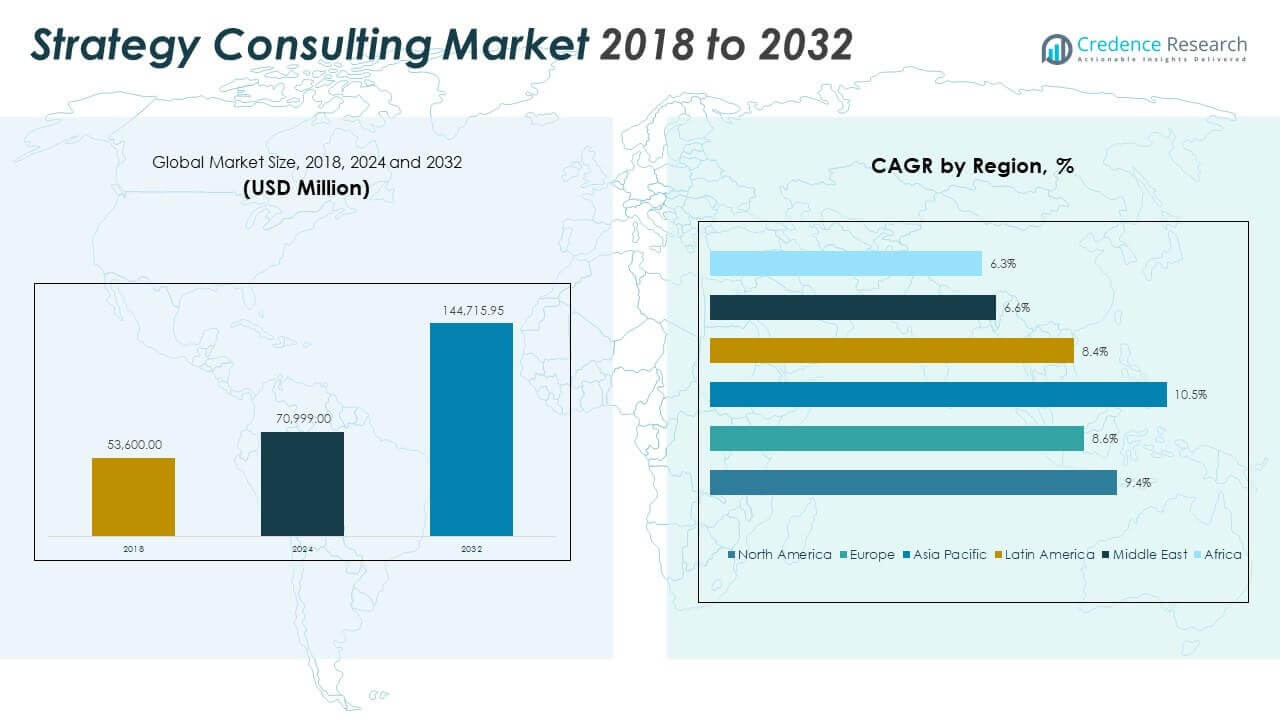
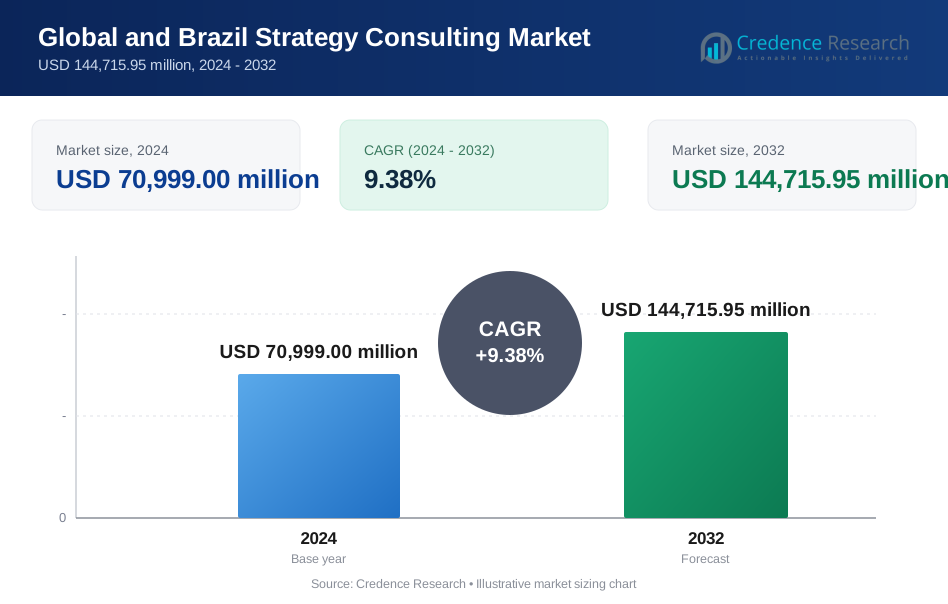
The Global and Brazil Strategy Consulting Market size was valued at USD 53,600.00 million in 2018 to USD 70,999.00 million in 2024 and is anticipated to reach USD 1,44,715.95 million by 2032, at a CAGR of 9.38% during the forecast period.
| REPORT ATTRIBUTE | DETAILS |
|---|---|
| Historical Period | 2020-2023 |
| Base Year | 2024 |
| Forecast Period | 2025-2032 |
| Global and Brazil Strategy Consulting Market Size 2024 | USD 70,999.00 million |
| Global and Brazil Strategy Consulting Market, CAGR | 9.38% |
| Global and Brazil Strategy Consulting Market Size 2032 | USD 1,44,715.95 million |
Market growth is driven by rising business complexity across industries. Companies face pressure from digital change and cost control needs. Leadership teams seek clear direction for growth and restructuring. Strategy consultants support mergers, market entry, and portfolio decisions. Data-led planning strengthens decision quality for executives. Demand also rises from private equity activity and transformation programs. Firms value external perspective for objective analysis. Regulatory shifts increase the need for structured planning. Long-term value creation remains a key focus.
Regional performance shows strong variation across markets. North America leads due to mature enterprises and high consulting spend. The United States drives demand through large-scale transformation projects. Europe follows with steady adoption among multinational firms. Asia Pacific emerges rapidly due to expansion of regional corporations. China and India show strong demand from digital strategy work. Latin America grows steadily, led by Brazil. The Middle East and Africa show gradual adoption through reforms.
Market Insights:
- The Global and Brazil Strategy Consulting Market was valued at USD 53,600.00 million in 2018, reached USD 70,999.00 million in 2024, and is projected to hit USD 144,715.95 million by 2032, expanding at a CAGR of 9.38%, reflecting sustained demand for high-value strategic advisory services.
- North America, Asia Pacific, and Europe together dominate the market with shares of about 34.4%, 32.6%, and 23.9%, driven by mature enterprises, large-scale transformation programs, and strong presence of global consulting firms.
- Asia Pacific is the fastest-growing region with a CAGR of 10.5% and a share of over 30%, supported by rapid enterprise expansion, digital adoption, and rising demand from China and India.
- Regional share distribution shows a clear concentration in developed and high-growth economies, with North America and Asia Pacific accounting for more than two-thirds of total demand due to scale and complexity of business operations.
- Emerging regions such as Latin America, the Middle East, and Africa together hold under 15% share, reflecting smaller but steadily expanding consulting adoption driven by reforms, modernization efforts, and growing private sector activity.
Market Drivers:
Rising Need For Enterprise-Wide Strategic Transformation And Performance Alignment
Organizations face constant pressure to adapt business models. Digital disruption reshapes competitive positioning across sectors. Leaders demand clear roadmaps for growth and efficiency. Consultants guide portfolio optimization and operating model redesign. Strategy firms support mergers, divestments, and turnaround planning. Boardrooms rely on external expertise for objective insights. Risk management needs drive structured strategic reviews. The Global and Brazil Strategy Consulting Market benefits from this demand.
Growing Complexity Of Corporate Decision-Making And Competitive Landscapes
Markets show higher volatility and shorter planning cycles. Executives manage diverse geographies and product lines. Data overload complicates strategic clarity for leadership teams. Consultants translate analysis into actionable priorities. Firms depend on scenario planning for uncertain outcomes. Competitive benchmarking supports informed investment choices. Strategy advisors help align vision with execution. This complexity sustains long-term consulting demand.
- For instance, Boston Consulting Group applies proprietary scenario planning and competitive benchmarking frameworks across global clients, supporting multi-market portfolio decisions and capital allocation priorities amid volatile business conditions.
Expansion Of Digital Transformation And Technology-Led Business Strategy
Technology reshapes value chains and customer engagement models. Firms seek guidance on digital investment priorities. Strategy consultants link technology adoption with business goals. Cloud, analytics, and automation shape corporate agendas. Leaders expect measurable returns from transformation programs. External advisors reduce execution risk. Strategic technology roadmaps gain board-level focus. Demand remains steady across industries.
- For instance, Accenture Strategy supports clients on cloud, data, and automation roadmaps through Accenture’s expanded data and AI workforce of about 77,000 professionals as of fiscal 2025, operating under its Reinvention Services model, which integrates strategy, technology, and operations to embed AI across enterprise transformation programs.
Increasing Private Equity Activity And Portfolio Optimization Needs
Private equity firms require rapid value creation strategies. Portfolio companies need clear growth and exit plans. Consultants support due diligence and integration strategy. Operational improvement drives margin expansion goals. Strategic reviews help identify scale opportunities. Advisors assist leadership transitions post-acquisition. Performance tracking supports investor confidence. This activity reinforces consulting relevance.
Market Trends:
Shift Toward Outcome-Oriented And Value-Based Consulting Engagement Models
Clients expect measurable business impact from advisory work. Fee structures align with performance milestones. Consultants focus on execution support, not advice alone. Strategy projects include implementation oversight. Clients prefer shorter, focused engagements. Internal capability building gains importance. Value realization frameworks shape project scope. The Global and Brazil Strategy Consulting Market reflects this shift.
- For instance, Bain & Company reports industry-leading client Net Promoter Scores, frequently cited as more than twice those of major competitors, highlighting strong alignment between advisory work and realized client value.
Rising Demand For Industry-Specific And Sector-Focused Strategy Expertise
Clients prefer consultants with deep sector knowledge. Generic frameworks show limited relevance today. Industry expertise improves strategic accuracy. Sector-led practices gain stronger client trust. Healthcare, energy, and financial services drive demand. Local market insight supports better outcomes. Firms invest in specialized advisory teams. This trend reshapes competitive positioning.
Integration Of Advanced Analytics Into Core Strategy Development
Data-driven strategy gains strong acceptance among executives. Predictive models support investment decisions. Consultants embed analytics into strategic planning. Real-time dashboards improve monitoring discipline. Evidence-based insights reduce strategic risk. Clients value transparency in assumptions. Analytical rigor strengthens consultant credibility. Adoption continues across regions.
- For instance, BCG integrates advanced analytics and AI capabilities through BCG X, a global tech-build division formed by combining GAMMA, Digital Ventures, and Platinion, bringing together more than 3,000 technology and data specialists supporting strategy and transformation engagements.
Growth Of Hybrid Consulting Models Combining Local And Global Teams
Firms blend global expertise with local market insight. Cross-border collaboration improves solution relevance. Clients expect culturally aligned recommendations. Hybrid delivery reduces project timelines. Knowledge transfer becomes more efficient. Regional hubs support consistent quality. Brazil sees strong adoption of this model. Operational flexibility defines modern consulting delivery.
Market Challenges Analysis:
High Client Expectations And Pressure To Demonstrate Tangible Strategic Impact
Clients demand faster and visible results from consultants. Strategy projects face intense performance scrutiny. Long-term outcomes prove hard to quantify. Budget approvals depend on prior success metrics. Consultants face pressure to justify premium fees. Misaligned expectations risk client dissatisfaction. Internal client resistance can limit execution success. The Global and Brazil Strategy Consulting Market navigates these pressures.
Talent Retention And Rising Competition From In-House Strategy Teams
Top consultants face high attrition rates globally. Corporations build internal strategy units. In-house teams reduce reliance on external advisors. Consulting firms compete for specialized talent. Knowledge continuity becomes a challenge. Training costs increase operational burden. Brand reputation influences hiring outcomes. These factors affect long-term scalability.
Market Opportunities:
Expansion Of Strategy Consulting Demand Among Mid-Sized And Emerging Enterprises
Mid-sized firms seek structured growth strategies. Expansion plans require professional strategic guidance. Consultants tailor cost-effective advisory models. Digital tools enable scalable service delivery. Emerging enterprises value external validation. Growth-stage firms lack internal strategy depth. This segment offers untapped potential. The Global and Brazil Strategy Consulting Market gains new clients.
Increasing Focus On Sustainability, ESG, And Long-Term Value Creation Strategies
Sustainability shapes corporate strategy priorities. Firms seek ESG-aligned growth frameworks. Consultants integrate sustainability into core strategy. Regulatory pressure increases demand for structured planning. Long-term value creation gains investor attention. Strategy advisors support transition planning. ESG strategy becomes board-level focus. This area offers strong growth potential.
Market Segmentation Analysis:
By service type reflects varied strategic needs across organizations. Strategy and operations lead due to strong demand for growth planning, cost optimization, and performance improvement. Financial consulting supports capital structure design, risk management, and restructuring initiatives. Human capital consulting focuses on workforce strategy, leadership alignment, and productivity improvement. Other specialized strategy services address digital transformation, sustainability strategy, and innovation planning. This segmentation highlights the breadth of advisory demand. Each service supports different stages of corporate decision-making. Demand varies by industry maturity and market conditions.
By consulting models, project-based consulting dominates due to its clear scope and defined outcomes. Organizations prefer this model for transformation programs and market entry plans. Retainer-based consulting supports long-term strategic alignment and continuous advisory needs. Large enterprises rely on this model for ongoing decision support. Agile consulting gains relevance where speed and flexibility matter. It suits fast-changing sectors and innovation-led strategies. This mix reflects evolving client expectations. Model choice affects engagement depth and duration.
- For instance, PwC has advised pharmaceutical companies on R&D operating model optimization and regulatory strategy, helping improve pipeline efficiency, clinical development governance, and readiness for regulatory review, as referenced in industry analyses and PwC healthcare insights.
By client type, corporate clients represent the largest share of demand. Private enterprises require frequent strategy reviews to stay competitive. Government consulting supports policy execution, public sector reform, and efficiency programs. Public institutions rely on structured strategic frameworks. Nonprofit and NGO consulting focuses on mission alignment and resource efficiency. These organizations seek impact-driven strategy support. Each client type follows distinct decision cycles. Advisory approaches vary accordingly.
- For instance, Oliver Wyman has supported public health authorities with healthcare procurement strategy, focusing on supply chain efficiency, cost control, and sourcing optimization across medical goods and services.
By end user industry, IT and telecom lead due to rapid technology shifts. Firms seek guidance on digital investment and competitive positioning. Retail and e-commerce depend on strategy for expansion and channel optimization. Healthcare drives demand through system reform and cost management needs. Other end user industries adopt consulting based on competition and regulation. Sector dynamics shape advisory scope. Industry expertise improves strategy outcomes.
Segmentation:
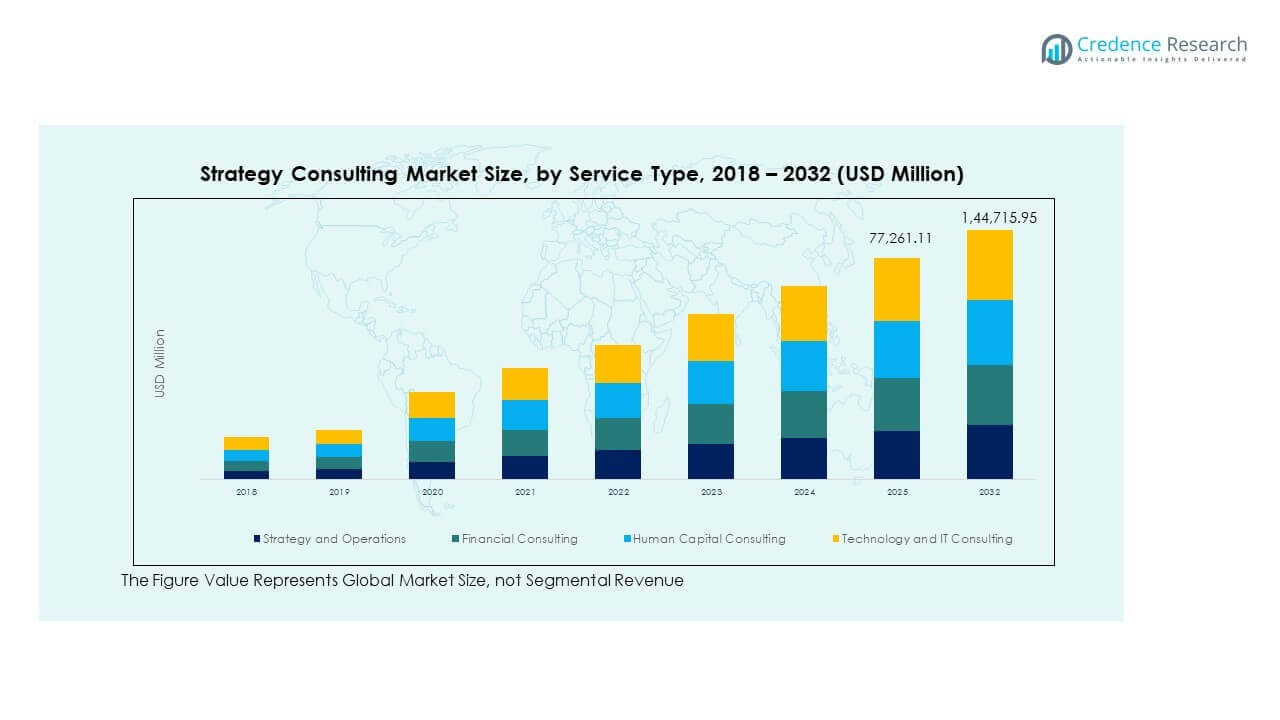
By Service Type
- Strategy and Operations
- Financial Consulting
- Human Capital Consulting
- Other Specialized Strategy Services
By Consulting Models
- Project-Based Consulting
- Retainer-Based Consulting
- Agile Consulting
By Client Type
- Corporate Clients
- Government Consulting
- Nonprofit and NGO Consulting
By End User Industry
- IT and Telecom
- Retail and E-commerce
- Healthcare
- Other End User Industries
By Region
- North America
- Europe
- Asia Pacific
- Latin America
- Middle East and Africa
- Brazil
Regional Analysis:
North America Regional Analysis
The North America Global and Brazil Strategy Consulting Market size was valued at USD 18,652.80 million in 2018 to USD 24,394.83 million in 2024 and is anticipated to reach USD 49,652.30 million by 2032, at a CAGR of 9.4% during the forecast period, holding about 34.4% market share. North America leads due to mature enterprises and high advisory spend. The United States drives strong demand from large corporations. Firms seek strategy support for digital scale and cost control. Board-level strategy reviews remain frequent. Private equity activity sustains consulting demand. Sector diversity supports stable revenue flow. Technology and healthcare dominate engagements. Canada adds steady public and private demand.
Europe Regional Analysis
The Europe Global and Brazil Strategy Consulting Market size was valued at USD 14,096.80 million in 2018 to USD 17,946.60 million in 2024 and is anticipated to reach USD 34,551.32 million by 2032, at a CAGR of 8.6% during the forecast period, accounting for nearly 25.3% share. Europe shows strong demand from multinational firms. Germany, the UK, and France lead adoption. Strategy focus centers on restructuring and growth balance. Regulatory change shapes advisory scope. Sustainability strategy gains traction across sectors. Public sector reforms support consulting use. Cross-border complexity raises demand. Local expertise improves execution quality.
Asia Pacific Regional Analysis
The Asia Pacific Global and Brazil Strategy Consulting Market size was valued at USD 15,490.40 million in 2018 to USD 21,288.75 million in 2024 and is anticipated to reach USD 47,220.93 million by 2032, at a CAGR of 10.5% during the forecast period, representing about 30.0% share. Asia Pacific records the fastest growth pace. China and India lead due to business expansion. Digital transformation drives strategy demand. Family-owned firms seek formal planning support. Market entry strategy remains a key focus. Regional competition raises advisory needs. Technology and retail fuel adoption. Local partnerships enhance delivery depth.
Latin America Regional Analysis
The Latin America Global and Brazil Strategy Consulting Market size was valued at USD 3,376.80 million in 2018 to USD 4,429.63 million in 2024 and is anticipated to reach USD 8,374.71 million by 2032, at a CAGR of 8.4% during the forecast period, holding around 6.2% share. Brazil leads regional demand. Firms seek efficiency and growth guidance. Economic reforms shape strategy needs. Public sector consulting supports modernization goals. Consumer and energy sectors drive projects. Local expertise improves relevance. Budget sensitivity affects engagement models. Long-term potential remains strong.
Middle East Regional Analysis
The Middle East Global and Brazil Strategy Consulting Market size was valued at USD 1,125.60 million in 2018 to USD 1,320.12 million in 2024 and is anticipated to reach USD 2,186.01 million by 2032, at a CAGR of 6.6% during the forecast period, accounting for nearly 1.9% share. Demand centers on diversification agendas. Government-led programs drive strategy work. Energy transition shapes advisory scope. Large public projects require planning support. Regional hubs attract global firms. Private sector adoption grows steadily. Local regulations influence engagement design. Long-term reforms sustain demand.
Africa Regional Analysis
The Africa Global and Brazil Strategy Consulting Market size was valued at USD 857.60 million in 2018 to USD 1,619.06 million in 2024 and is anticipated to reach USD 2,730.68 million by 2032, at a CAGR of 6.3% during the forecast period, representing about 2.3% share. Africa shows gradual market expansion. Demand comes from public sector reforms. Infrastructure and telecom drive advisory needs. Multinationals seek entry strategies. Skills development supports consulting use. Budget limits affect project scale. Regional disparities shape demand patterns. Long-term growth prospects remain positive.
Key Player Analysis:
- Bain and Company
- The Boston Consulting Group
- McKinsey & Company
- Deloitte Strategy
- PwC Strategy&
- Accenture Strategy
- KPMG Advisory
- EY-Parthenon
Competitive Analysis:
The Global and Brazil Strategy Consulting Market shows high competitive intensity with strong global and regional participation. Leading firms compete through deep industry expertise and board-level access. Global players such as McKinsey, BCG, and Bain dominate complex transformation mandates. These firms focus on data-led strategy and execution support. Consulting majors integrate technology and analytics to strengthen differentiation. Mid-tier firms compete on flexibility and sector focus. Regional consultancies leverage local knowledge and regulatory insight. Pricing discipline and delivery speed shape client selection. Talent quality remains a key competitive factor. Firms invest in capability building to retain clients. Partnerships enhance geographic reach and service depth. Competitive positioning depends on trust, outcomes, and long-term relationships.
Recent Developments:
- In May 2025, Bain & Company formed a global partnership with Palantir to enhance AI productivity through advanced platforms, announced combining Bain's industry expertise with Palantir's AI systems for client transformation across sectors. This collaboration targets strategic business outcomes in the global strategy consulting market by enabling faster AI adoption.
- In March 2025, EY-Parthenon integrated EY's Strategy & Transactions team expanding from core strategy and M&A services to include financial advisory, performance improvement, and business transformation, while investing $250 million in AI tools with partners like Microsoft and OpenAI.
Report Coverage:
The research report offers an in-depth analysis based on Service Type, Consulting Models, Client Type and End User Industry. It details leading market players, providing an overview of their business, product offerings, investments, revenue streams, and key applications. Additionally, the report includes insights into the competitive environment, SWOT analysis, current market trends, as well as the primary drivers and constraints. Furthermore, it discusses various factors that have driven market expansion in recent years. The report also explores market dynamics, regulatory scenarios, and technological advancements that are shaping the industry. It assesses the impact of external factors and global economic changes on market growth. Lastly, it provides strategic recommendations for new entrants and established companies to navigate the complexities of the market.
Future Outlook:
- Enterprises will increase reliance on external advisors to handle rapid business model shifts.
- Strategy consulting demand will rise with ongoing digital and operational transformation programs.
- Firms will seek advisors who combine strategy design with execution oversight capabilities.
- Analytics-driven decision support will shape future consulting engagement structures.
- Sustainability and ESG strategy will gain importance in long-term advisory mandates.
- Agile and hybrid consulting models will see broader client acceptance across sectors.
- Mid-sized enterprises will emerge as a stronger demand base for strategic advisory services.
- Public sector reforms will create sustained need for policy and execution consulting.
- Regional consulting firms will expand through partnerships with global players.
- Talent development and sector specialization will define competitive advantage going forward.
Request a Free Sample
Fill in your details and we'll send you a free sample report.
- Sample data tables & charts
- Research methodology
Need a Custom Version of This Report?
Tailor the scope, geography, or segments to your exact requirements.
- Custom geography or segment scope
- Direct access to our analyst team
Frequently Asked Questions
What is the current market size for Global and Brazil Strategy Consulting Market, and what is its projected size in 2032?
At what Compound Annual Growth Rate is the Global and Brazil Strategy Consulting Market projected to grow between 2024 and 2032?
Which Global and Brazil Strategy Consulting Market segment held the largest share in 2024?
What are the primary factors fueling the growth of the Global and Brazil Strategy Consulting Market?
Who are the leading companies in the Global and Brazil Strategy Consulting Market?
Which region commanded the largest share of the Global and Brazil Strategy Consulting Market in 2024?
Table of Content
Chapter 1. Report Introduction
- 1.1 Report Description & Purpose
- 1.1.1 Report Title & Market Definition
- 1.1.2 Unique Selling Propositions (USP) & Key Differentiators
- 1.1.3 Value Proposition for Stakeholders
- 1.2 Research Objectives
- 1.2.1 Market Sizing Objectives (Volume & Revenue)
- 1.2.2 Segmentation Objectives
- 1.2.3 Competitive Intelligence Objectives
- 1.2.4 Forecast & Scenario Objectives
- 1.3 Report Scope
- 1.3.1 Global and Brazil Strategy Consulting Scope – Types & Subtypes Covered
- 1.3.2 Geographic Scope – Regions & Countries Covered
- 1.3.3 Historical Period, Base Year & Forecast Period (2024; forecast to 2032)
- 1.3.4 Inclusions & Exclusions
- 1.4 HS Code & Classification Framework
- 1.5 Currency, Units & Pricing Basis
- 1.6 Target Stakeholders
- 1.7 Limitations & Assumptions
Chapter 2. Executive Summary
- 2.1 Global Global and Brazil Strategy Consulting Market Snapshot
- 2.1.1 Market Size – Historical (2024) & Forecast (2024-2032) (2024: USD 70,999.00 million → 2032: USD 144,715.95 million)
- 2.1.2 Volume & Revenue – Global Totals
- 2.1.3 Key Market Highlights – Top Five Facts
- 2.2 Global and Brazil Strategy Consulting Market Segmentation Snapshot
- 2.2.1 Market Split by Region – 2024 vs. 2032
- 2.3 Competitive Snapshot
- 2.3.1 Top 10 Players by Revenue Share – 2024
- 2.3.2 Top 10 Players by Volume Share – 2024
- 2.3.3 Recent Strategic Developments (18-Month Summary)
- 2.4 Key Investment Highlights & Strategic Conclusions
Chapter 3. Global and Brazil Strategy Consulting Market Dynamics & Industry Analysis
- 3.1 Market Overview & Context
- 3.1.1 Global and Brazil Strategy Consulting Market Position in the Broader Automotive Value Chain
- 3.1.2 OEM vs. Replacement Market Dynamics
- 3.1.3 Market Maturity & Development Stage by Region
- 3.2 Global and Brazil Strategy Consulting Market Drivers
- 3.3 Global and Brazil Strategy Consulting Market Restraints & Challenges
- 3.4 Global and Brazil Strategy Consulting Market Opportunities
- 3.5 Porter's Five Forces Analysis
- 3.5.1 Threat of New Entrants
- 3.5.2 Bargaining Power of Suppliers
- 3.5.3 Bargaining Power of Buyers
- 3.5.4 Threat of Substitutes
- 3.5.5 Competitive Rivalry – Intensity Assessment
- 3.6 Global and Brazil Strategy Consulting Value Chain Analysis
- 3.6.1 Upstream – Raw Material/Input Suppliers
- 3.6.1.1 Raw Material/Input 1
- 3.6.1.2 Raw Material/Input 2
- 3.6.1.3 Raw Material/Input 3
- 3.6.2 Midstream – Production/Manufacturing/Service Delivery
- 3.6.2.1 Production/Process Overview
- 3.6.2.2 Key Facility Locations & Capacity by Manufacturer
- 3.6.3 Downstream – Distribution & End Consumer
- 3.6.3.1 Primary Channel – B2B/OEM
- 3.6.3.2 Secondary Channels – Dealer, Retail, Online, Direct
- 3.6.4 Value Chain Profitability Analysis
- 3.6.1 Upstream – Raw Material/Input Suppliers
- 3.7 PESTEL Analysis
- 3.7.1 Political Factors
- 3.7.2 Economic Factors
- 3.7.3 Social Factors
- 3.7.4 Technological Factors
- 3.7.5 Environmental Factors
- 3.7.6 Legal Factors
- 3.8 Global and Brazil Strategy Consulting Supply Chain Analysis
- 3.8.1 Raw Material/Input Supply Risk Assessment
- 3.8.2 Manufacturing Concentration Risk (Geographic Exposure)
- 3.8.3 Trade Disruption Impact Analysis
- 3.9 Regulatory & Policy Landscape
Note: The regulatory and policy landscape section covers regulations based on their applicability to the market, Global and Brazil Strategy Consulting category, geography, and scope of the study. Only regulatory frameworks with a material impact on operations, compliance, trade, sustainability, or market access are analyzed in detail.
Chapter 4. Key Investment Pockets & Opportunity Analysis
- 4.1 Global and Brazil Strategy Consulting Market Attractiveness Analysis
- 4.1.1 By Region – Investment Attractiveness Matrix (Volume × CAGR)
- 4.2 Absolute Revenue Growth Opportunity
- 4.2.1 By Region – Absolute USD Growth Through 2032
- 4.3 Incremental Volume Opportunity
- 4.3.1 By Region – Incremental Volume Through 2032
- 4.3.2 Segment – Incremental Volume
- 4.4 Emerging Submarket Opportunity Deep Dive (Subject to Applicability)
- 4.5 Emerging Market Opportunity Scorecards
- 4.5.1 United States
- 4.5.2 Europe
- 4.5.3 Asia
- 4.5.4 Middle East & Africa
Note: Emerging Market Opportunity Scorecards will be included based on relevance and strategic importance. Regions listed are indicative and may vary depending on data availability and market dynamics.
Chapter 5. Global and Brazil Strategy Consulting Import-Export Analysis & Trade Flows
- 5.1 Global Trade Overview
- 5.1.1 Global Export Value by Country (2024)
- 5.1.2 Global Export Volume by Country (2024)
- 5.1.3 Global Import Value by Country (2024)
- 5.1.4 Global Import Volume by Country (2024)
- 5.1.5 Net Trade Balance by Country (2024)
- 5.2 Export Analysis – Segment
- 5.2.1 Type 1 (HS Code)
- 5.2.2 Type 2 (HS Code)
- 5.2.3 Type 3 (HS Code)
- 5.2.4 Type 4 (HS Code)
- 5.2.5 Type 5 (HS Code)
- 5.3 Import Analysis – Segment
- 5.3.1 Type 1 (HS Code)
- 5.3.2 Type 2 (HS Code)
- 5.3.3 Type 3 (HS Code)
- 5.3.4 Type 4 (HS Code)
- 5.3.5 Type 5 (HS Code)
- 5.4 Average Unit Trade Prices
- 5.4.1 Average Export Price – Segment & Country
- 5.4.2 Average Import Price – Segment & Source Country
- 5.4.3 Price Trends (2024)
- 5.5 Key Trade Route Analysis
- 5.5.1 Trade Route 1
- 5.5.2 Trade Route 2
- 5.5.3 Trade Route 3
- 5.5.4 Trade Route 4
- 5.5.5 Trade Route 5
- 5.6 Trade Policy Impact Assessment
- 5.6.1 US Anti-Dumping & Section 301 Tariffs
- 5.6.2 EU Customs Union Impact
- 5.6.3 Major Free Trade Agreements
- 5.6.4 USMCA Rules of Origin
Note: Trade policy analysis will be included only where relevant to the Global and Brazil Strategy Consulting market.
Chapter 6. Competitive Landscape & Company Benchmarking
- 6.1 Global and Brazil Strategy Consulting Market Concentration & Structure
- 6.1.1 Herfindahl-Hirschman Index (HHI) – vs. 2024
- 6.1.2 Tier 1, Tier 2 & Tier 3 Market Structure
- 6.1.3 Global, Regional & Local Player Dynamics
- 6.2 Global and Brazil Strategy Consulting Market Share Analysis – 2024
- 6.2.1 Global Revenue Share by Company
- 6.2.2 Global Volume Share by Company
- 6.2.3 Regional Revenue Share
- 6.2.4 Market Share Evolution ( vs. 2024)
- 6.2.5 OEM Segment Share by Company
- 6.2.6 Replacement Segment Share by Company
- 6.3 Production/Delivery Capacity & Facility Analysis
- 6.3.1 Global Installed Capacity
- 6.3.2 Capacity Utilization Rates
- 6.3.3 Production/Output Volume
- 6.3.4 Facility Locations & Capacity Map
- 6.3.5 Planned Capacity Additions
- 6.4 Global and Brazil Strategy Consulting Competitive Benchmarking Matrix
- 6.4.1 Revenue, Volume, CAGR & Profitability Comparison
- 6.4.2 Channel Revenue Mix
- 6.4.3 Geographic Revenue Exposure
- 6.4.4 R&D Intensity
- 6.4.5 Sustainability Maturity
- 6.5 Strategic Developments in Global and Brazil Strategy Consulting (Last 24 Months)
- 6.5.1 Mergers, Acquisitions & Divestments
- 6.5.2 New Global and Brazil Strategy Consulting Launches
- 6.5.3 Facility Expansions
- 6.5.4 Strategic Alliances, Joint Ventures & Partnerships
- 6.5.5 Distribution Expansion & Market Entry
- 6.5.6 Sustainability & ESG Initiatives
- 6.6 Competitive Strategy Mapping
- 6.6.1 Leader, Challenger, Follower & Niche Classification
- 6.6.2 Pricing Strategy Comparison
- 6.6.3 Channel Strategy Matrix
Note: Strategic developments are included based on their materiality and the availability of reliable information.
Chapter 7. Global Global and Brazil Strategy Consulting Market – By Distribution Channel
- 7.1 Segment Overview
- 7.1.1 Volume & Revenue Split by Channel (2024 & 2032)
- 7.1.2 Channel Mix Evolution (2024-2032)
Chapter 8. Regional Market Analysis – Global Overview
- 8.1 Global Regional Overview
- 8.1.1 Regional Volume Share
- 8.1.2 Regional Revenue Share
- 8.1.3 Regional Volume by Region
- 8.1.4 Regional Revenue by Region
- 8.1.5 Regional Forecast Through 2032
- 8.2 Cross-Regional Segment Analysis
- 8.2.1 By Distribution Channel
- 8.2.2 By Brand/Price Tier
Chapter 9. North America Global and Brazil Strategy Consulting Market
- 9.1 United States
- 9.2 Canada
- 9.3 Mexico
Chapter 10. Europe Global and Brazil Strategy Consulting Market
- 10.1 Germany
- 10.2 France
- 10.3 Italy
- 10.4 United Kingdom
- 10.5 Spain
- 10.6 Poland
- 10.7 Russia
- 10.8 Netherlands
- 10.9 Belgium
- 10.10 Sweden
- 10.11 Denmark
- 10.12 Norway
- 10.13 Rest of Europe
Chapter 11. Asia Pacific Global and Brazil Strategy Consulting Market
- 11.1 China
- 11.2 India
- 11.3 Japan
- 11.4 South Korea
- 11.5 Thailand
- 11.6 Indonesia
- 11.7 Vietnam
- 11.8 Malaysia
- 11.9 Australia
- 11.10 Rest of Asia Pacific
Chapter 12. Latin America Global and Brazil Strategy Consulting Market
- 12.1 Brazil
- 12.2 Argentina
- 12.3 Colombia
- 12.4 Chile
- 12.5 Rest of Latin America
Chapter 13. Middle East Global and Brazil Strategy Consulting Market
- 13.1 Saudi Arabia
- 13.2 United Arab Emirates
- 13.3 Turkey
- 13.4 Israel
- 13.5 Iran
- 13.6 Rest of the Middle East
Chapter 14. Africa Global and Brazil Strategy Consulting Market
- 14.1 South Africa
- 14.2 Egypt
- 14.3 Nigeria
- 14.4 Morocco
- 14.5 Rest of Africa
Chapter 15. Global and Brazil Strategy Consulting Company Profiles
- 15.1 [Company 01]
- 15.1.1 Company Overview
- 15.1.2 Key Management Personnel
- 15.1.3 Products & Services Portfolio
- 15.1.4 Financial Performance
- 15.1.5 Key Market Focus & Geographic Presence
- 15.1.6 Recent Developments & Strategic Initiatives
Note: The company profile list is preliminary and may change based on research findings, market developments, data availability, and client requirements.
Chapter 16. Appendices
- Appendix A – List of Abbreviations & Acronyms
- Appendix B – Industry Classification Code Reference – Full Series
- Appendix C – Production & Capacity Data Tables
- Appendix D – End-Use & Demand Base Tables
- Appendix E – Consumption & Replacement Rate Assumptions
- Appendix F – ASP Reference Tables
- Appendix G – Manufacturing & Facility Database
- Appendix H – Import-Export Data Tables
- Appendix I – Regulatory Summary Tables
- Appendix J – Primary Research Participant List (Anonymized)
- Appendix K – Primary Research Questionnaire Framework
- Appendix L – Data Sources & Bibliography
- Appendix M – Market Size Divergence & Source Comparison
Chapter 17. Research Methodology
- 17.1 Research Framework & Philosophy
- 17.2 Secondary Research – Sources, Hierarchy & Data Extraction
- 17.3 Data Modeling – Bottom-Up & Top-Down Market Sizing
- 17.4 Primary Research – Stakeholder Framework, LOI & Sample Sizes
- 17.5 Forecast Methodology – Regression, Scenario & Sensitivity Analysis
- 17.6 Quality Control – Four-Layer Validation Framework
- 17.7 Limitations & Standard Assumptions
- 17.8 Disclaimer
