
Market Overview:
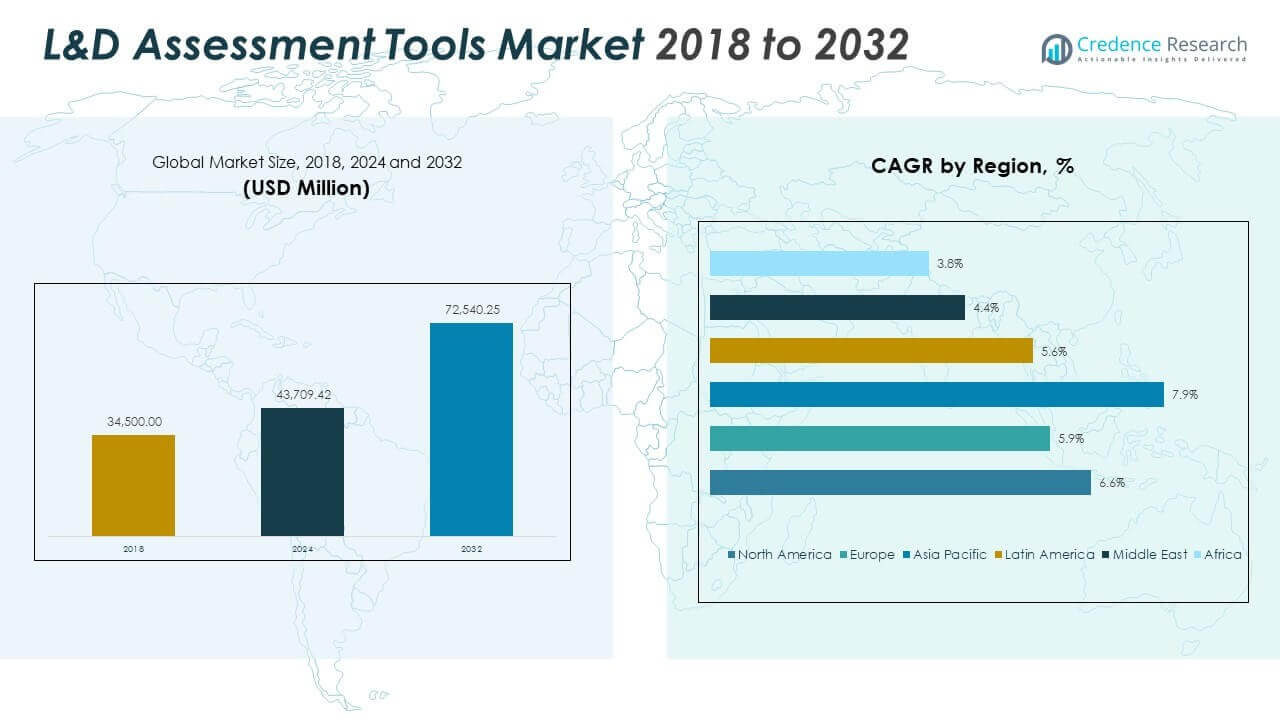
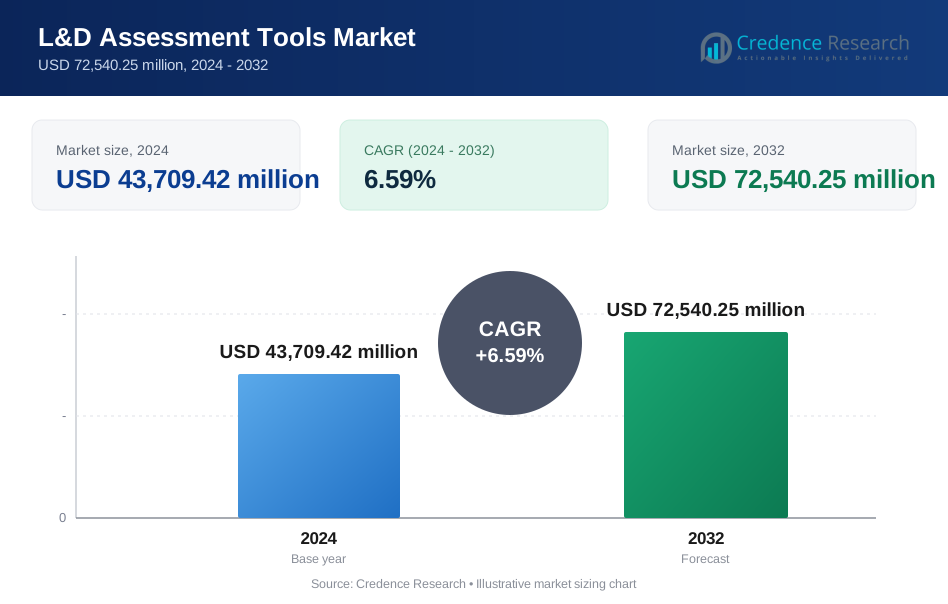
The L&D Assessment Tools Market size was valued at USD 34,500.00 million in 2018 to USD 43,709.42 million in 2024 and is anticipated to reach USD 72,540.25 million by 2032, at a CAGR of 6.59% during the forecast period.
| REPORT ATTRIBUTE | DETAILS |
|---|---|
| Historical Period | 2020-2023 |
| Base Year | 2024 |
| Forecast Period | 2025-2032 |
| L&D Assessment Tools Market Size 2024 | USD 43,709.42 million |
| L&D Assessment Tools Market, CAGR | 6.59% |
| L&D Assessment Tools Market Size 2032 | USD 72,540.25 million |
Demand rises as organizations focus on measurable workforce skills. Companies face constant change in technology and job roles. Learning leaders require clear visibility into skill gaps and readiness levels. Assessment tools support targeted reskilling and internal mobility programs. Enterprises adopt analytics to track training impact and employee progress. Remote and hybrid work models increase reliance on digital evaluations. Compliance needs in regulated sectors also drive adoption. Integration with learning platforms improves usability. These factors collectively strengthen long-term market demand.
North America leads due to early adoption of digital learning technologies. Large enterprises invest heavily in workforce analytics and AI tools. Europe follows, supported by strong compliance needs and public-sector training programs. Countries such as Germany and the UK show mature adoption. Asia Pacific emerges as the fastest-growing region. India, China, and Southeast Asia benefit from large talent pools and skilling initiatives. Latin America shows steady uptake among enterprises. The Middle East and Africa adopt tools gradually through government-led workforce programs.
Market Insights:
- The L&D Assessment Tools Market was valued at USD 34,500.00 million in 2018, reached USD 43,709.42 million in 2024, and is projected to hit USD 72,540.25 million by 2032, growing at a CAGR of 6.59% over the forecast period.
- North America leads with about 36.4% share in 2024 due to early digital adoption, strong enterprise L&D budgets, and high compliance needs, followed by Europe at ~26.4% driven by regulated industries and public-sector training, and Asia Pacific at ~26.4% supported by large-scale workforce digitization.
- Asia Pacific is the fastest-growing region with a 7.9% CAGR and roughly 26.4% share, fueled by rapid enterprise expansion, government-led skilling programs, and rising adoption across India, China, and Southeast Asia.
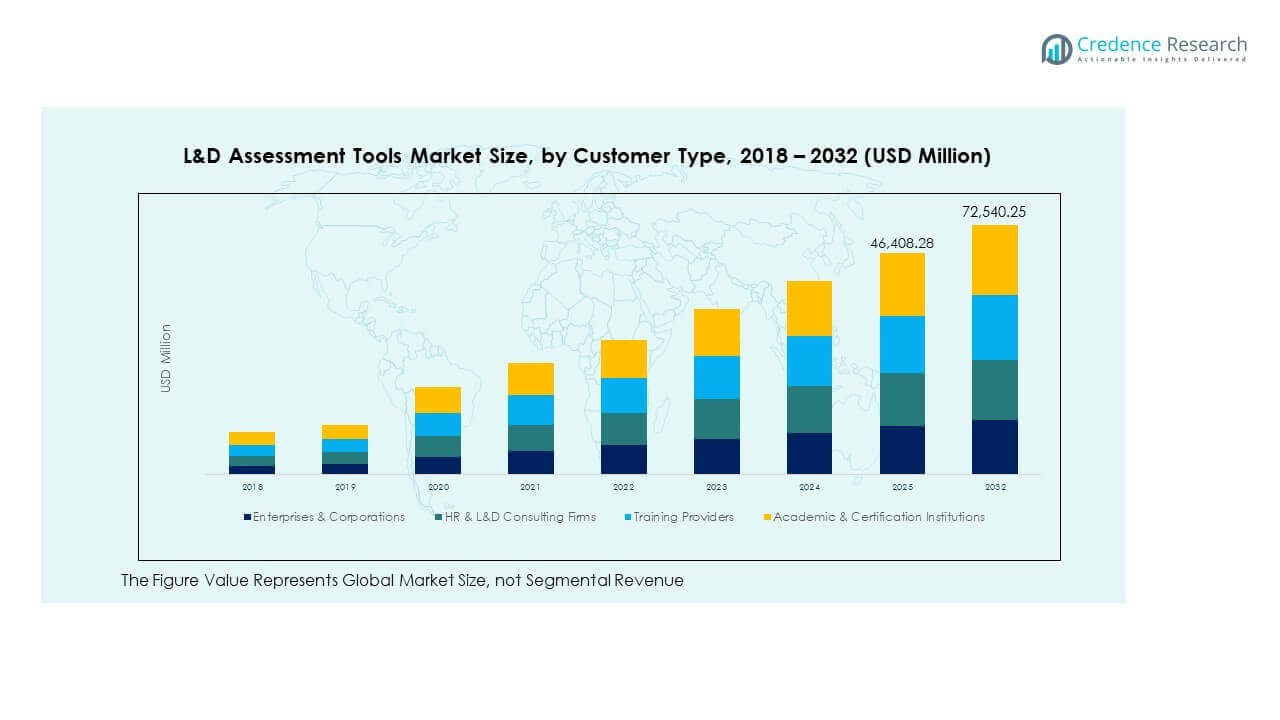
- By customer type, enterprises and corporations account for the largest share at roughly 40%, reflecting sustained investment in internal reskilling, leadership development, and performance-linked assessments.
- Training providers and HR & L&D consulting firms together represent about 45% of the market, with training providers near 25% and consulting firms around 20%, supported by certification demand, outsourced assessments, and client-driven talent development programs.
Market Drivers
Strong Corporate Focus on Employee Reskilling and Role-Based Capability Mapping
Enterprises invest in platforms that assess employees' skills for current and future roles. Rapid shifts in technology and business operations create urgent reskilling needs. HR leaders demand tools that map skill gaps and tailor learning paths. Personalized assessments support upskilling, succession planning, and internal mobility programs. The L&D Assessment Tools Market benefits from rising emphasis on continuous learning. Companies prefer analytics-driven systems that show measurable skill development. Assessment results guide content recommendations and certification pathways. Digital dashboards help HR teams report ROI to business units.
- For instance, IBM uses its SkillsBuild platform to assess and map employee skills against future job roles, supporting large‑scale reskilling programs in cloud, data, and AI domains.
Compliance Requirements and Standardized Evaluation Across Regulated Sectors
Highly regulated sectors require consistent employee evaluations tied to legal standards. Financial services, healthcare, and energy industries mandate regular knowledge checks. Compliance training includes real-time assessments with audit-friendly records. Employers adopt automated tools that timestamp and archive results. The L&D Assessment Tools Market sees growth where documentation is critical. Governments and global regulators expect proof of knowledge transfer. Platforms with secure logins and ID verification meet legal scrutiny. Digital compliance workflows reduce manual tracking and improve training accountability.
- For instance, SAP SuccessFactors provides audit‑ready compliance assessments with timestamped records and secure user authentication for regulated industries such as healthcare and financial services.
Demand for Agile Talent Development in Hybrid and Remote Work Models
Remote and hybrid models reshape corporate learning formats and evaluation timelines. Distributed teams need accessible platforms with scalable assessments. Mobile-friendly systems offer greater flexibility and usage rates. The L&D Assessment Tools Market grows as companies decentralize training operations. Talent leaders need tools that adapt quickly to business changes. Cloud-based assessments improve reach across time zones. Learning systems with real-time scoring support agile coaching. This flexibility accelerates skills validation in project-based workforces.
Integration of Learning Analytics to Enhance Feedback and Performance Outcomes
Real-time learning analytics drive continuous performance improvement across roles. Assessment platforms offer granular insights into learner strengths and weaknesses. Managers use performance dashboards to adjust learning plans. The L&D Assessment Tools Market gains value from outcome-focused metrics. Companies seek tools that correlate training with productivity outcomes. Personalized feedback loops enhance learner engagement and retention. HR analytics teams integrate test results with KPIs. These capabilities transform L&D from support function to strategic partner.
Market Trends
Adoption of AI-Powered Adaptive Assessments for Personalized Skill Evaluation
AI enables dynamic question sequencing based on individual responses and learning pace. Adaptive testing ensures fair evaluations across ability levels. Companies use it to identify high performers and learning needs early. The L&D Assessment Tools Market expands with tools offering AI-driven feedback. Advanced platforms adjust content difficulty in real time. Personalized question banks reduce test fatigue and boost accuracy. HR teams value adaptability for fast-growing and diverse teams. AI improves scalability for large-volume assessments without compromising quality.
- For instance, Pymetrics uses neuroscience‑based games and AI models to tailor question difficulty and recommend roles based on cognitive and emotional profiles. Its platform has been used by companies like Unilever to evaluate hundreds of thousands of applicants with dynamic content sequencing that adapts in real time.
Growing Use of Simulation-Based Assessments in Leadership and Soft Skill Development
Simulation tools mirror real-world workplace challenges and behaviors. Users interact with scenarios that test decision-making, communication, and leadership. The L&D Assessment Tools Market integrates simulation features in high-impact use cases. Role-based simulations help assess sales readiness, crisis response, and team management. Virtual environments improve learner confidence through practice and repetition. Companies track time to decision and reasoning patterns. Simulations offer more context than static MCQs. Enterprises value realism for senior roles and complex tasks.
- For instance, Capsim offers business simulation assessments that place learners in real decision‑making scenarios tied to revenue, marketing, and operations outcomes. Over 1,000 universities and corporate customers use its simulations to train leaders in strategic thinking and team management.
Expansion of API-First Architecture and Cross-Platform Integration Features
Assessment providers invest in interoperability with HRMS, LMS, and ATS platforms. Open APIs allow easy data flow and user sync across systems. The L&D Assessment Tools Market grows with plug-and-play functionality. Integration improves reporting, reduces duplication, and streamlines user onboarding. Cross-platform data feeds enable full learner lifecycle management. Vendors differentiate by offering scalable SDKs and white-labeled modules. CIOs prioritize secure and compliant integrations with enterprise IT ecosystems. It ensures smooth workflows across global L&D environments.
Adoption of Continuous Micro-Assessments Embedded Within Learning Content
Micro-assessments support knowledge checks after each module or concept. These short tests reinforce learning and provide instant feedback. The L&D Assessment Tools Market aligns with content-first models that embed evaluation. Platforms combine SCORM, video, and interactive content with inline questions. It reduces reliance on post-course testing alone. Frequent assessments build confidence and track real-time progress. Learners and managers access ongoing performance scores. This model supports spaced learning and just-in-time coaching.
Market Challenges Analysis
Fragmentation of Assessment Standards Across Regions, Job Roles, And Industries
Lack of global standardization in assessment formats creates inconsistencies in evaluation. Different industries define competencies in varied ways, limiting cross-sector use. The L&D Assessment Tools Market faces adoption barriers where content alignment is weak. Customization needs slow deployment and raise development costs. Companies operating in multiple countries must localize assessments by language and regulation. Inconsistent frameworks make benchmarking harder for HR leaders. Providers struggle to scale content across job roles without losing relevance. Interoperability with other systems also becomes complex.
Data Privacy, Cheating Prevention, and Authentication Remain Priority Concerns
Ensuring test integrity in remote environments requires advanced proctoring tools. Companies seek solutions with identity verification, browser lock, and AI flagging. The L&D Assessment Tools Market experiences hesitation where test cheating risks reputational damage. Data privacy rules like GDPR and HIPAA restrict cloud-hosted assessments in some regions. Enterprises need assurance that user data stays secure and compliant. Vendors must invest in encryption, access controls, and audit logs. Security concerns delay procurement decisions in regulated industries.
Market Opportunities
Rising Demand from Small and Mid-Sized Enterprises for Affordable Digital Assessment Tools
SMEs seek low-cost tools to digitize training without hiring dedicated L&D teams. The L&D Assessment Tools Market can expand by offering tiered pricing and modular features. Cloud-native platforms with easy setup appeal to resource-constrained businesses. White-labeling and language localization further increase reach. SMEs need quick ROI, and assessments support measurable skill gains.
Government-Led Workforce Skilling and Public Sector Training Initiatives
National skill development programs drive adoption in public agencies and educational institutions. The L&D Assessment Tools Market benefits from tenders tied to large-scale upskilling. Government funding supports procurement of adaptive testing and analytics tools. Platforms that meet open standards and integrate with learning portals gain advantage. Public-private partnerships expand vendor opportunities across sectors.
Market Segmentation Analysis:
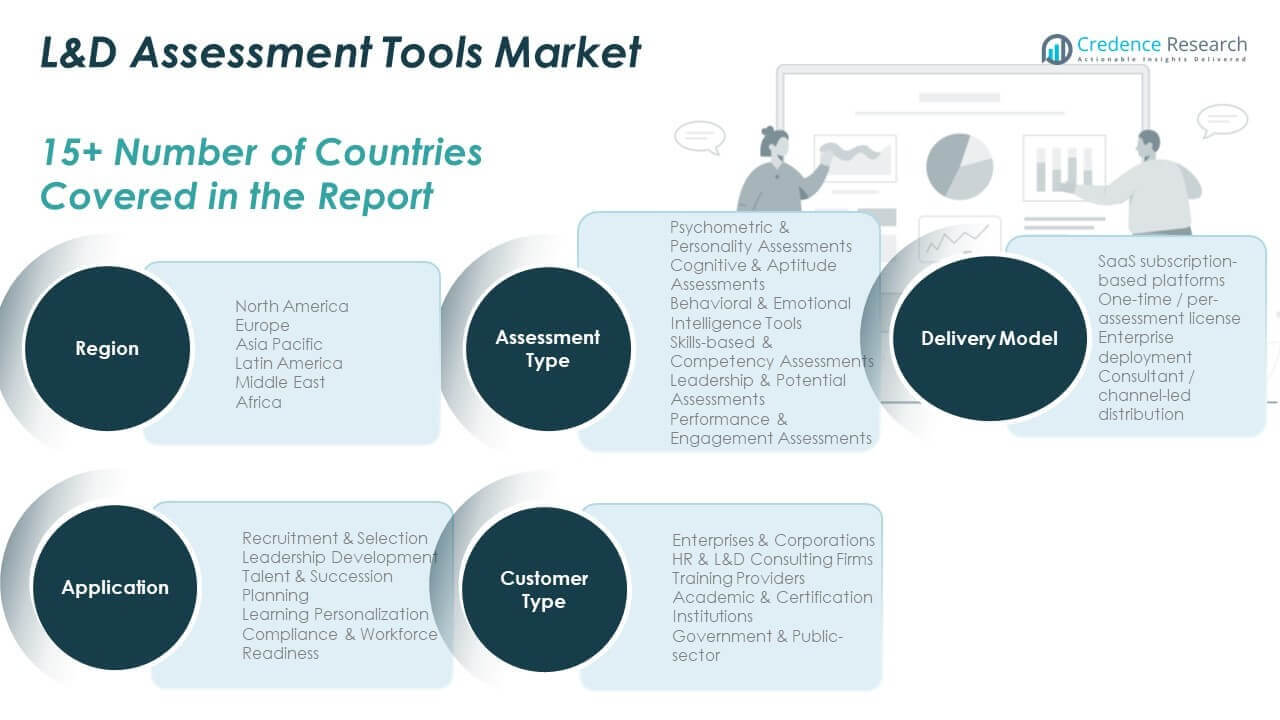
By assessment type, skills-based and competency assessments lead due to their role in job-role alignment and performance benchmarking. Psychometric and personality tools support recruitment and leadership profiling. Cognitive and aptitude assessments remain critical for campus hiring and entry-level filtering. Behavioral and emotional intelligence tools gain traction in soft-skill-heavy roles. Leadership and potential assessments serve succession planning, while performance and engagement tools support workforce optimization.
By delivery model, SaaS subscription-based platforms dominate due to ease of deployment and scalability. Enterprises prefer them for continuous learning cycles. One-time license models attract smaller firms with specific needs. Large organizations choose enterprise deployment for data control and integration. Consultant-led distribution supports customized implementation in complex environments.
- For instance, Mercer Mettl states that its cloud-based assessment platform supports more than 6,000 corporate clients and processes millions of assessments annually through subscription-led access models.
By application, recruitment and selection drive demand across high-volume hiring sectors. Leadership development and succession planning segments grow as companies prioritize internal mobility. Learning personalization improves engagement and retention. Compliance and workforce readiness assessments gain traction in healthcare, finance, and energy sectors.
By customer type, enterprises and corporations represent the largest share of the L&D Assessment Tools Market due to ongoing talent development initiatives. HR and L&D consulting firms use these tools for client delivery. Training providers and academic institutions adopt assessments for certification and skill verification. Government and public-sector organizations deploy standardized evaluations in workforce skilling programs.
- For instance, Hogan Assessments reports that its personality and leadership tools are used by more than half of Fortune 500 companies for executive assessment and development programs.
Segmentation:
By Assessment Type
- Psychometric & Personality Assessments
- Cognitive & Aptitude Assessments
- Behavioral & Emotional Intelligence Tools
- Skills-based & Competency Assessments
- Leadership & Potential Assessments
- Performance & Engagement Assessments
By Delivery Model
- SaaS subscription-based platforms
- One-time / per-assessment license
- Enterprise deployment
- Consultant / channel-led distribution
By Application
- Recruitment & Selection
- Leadership Development
- Talent & Succession Planning
- Learning Personalization
- Compliance & Workforce Readiness
By Customer Type
- Enterprises & Corporations
- HR & L&D Consulting Firms
- Training Providers
- Academic & Certification Institutions
- Government & Public-sector
By Region
- North America
- U.S.
- Canada
- Mexico
- Europe
- Germany
- France
- U.K.
- Italy
- Spain
- Rest of Europe
- Asia Pacific
- China
- Japan
- India
- South Korea
- South-east Asia
- Rest of Asia Pacific
- Latin America
- Brazil
- Argentina
- Rest of Latin America
- Middle East & Africa
- GCC Countries
- South Africa
- Rest of the Middle East and Africa
Regional Analysis:
North America
The North America L&D Assessment Tools Market size was valued at USD 12,720.15 million in 2018 to USD 15,923.08 million in 2024 and is anticipated to reach USD 26,390.27 million by 2032, at a CAGR of 6.6% during the forecast period. North America holds the largest market share, accounting for approximately 36.4% in 2024. It benefits from early adoption of SaaS-based platforms, AI-enabled assessments, and strong corporate L&D cultures. Enterprises prioritize structured learning paths tied to performance metrics. Large-scale users include financial services, tech firms, and healthcare institutions. Remote and hybrid workforce models push demand for scalable and secure tools. Regulatory focus on compliance training in industries like aviation and pharma increases adoption. Vendors headquartered in the U.S. drive innovation and ecosystem maturity. Market growth aligns with continued investment in internal talent development.
Europe
The Europe L&D Assessment Tools Market size was valued at USD 9,463.35 million in 2018 to USD 11,542.46 million in 2024 and is anticipated to reach USD 18,138.88 million by 2032, at a CAGR of 5.9% during the forecast period. Europe accounts for approximately 26.4% of the market share in 2024. Public sector digitization and vocational training reforms drive demand. Countries like Germany, the UK, and France lead in enterprise learning analytics. Data privacy laws influence deployment choices, with strong uptake of on-premise and GDPR-compliant solutions. Multilingual assessment support helps adoption across EU nations. Government-backed upskilling initiatives foster steady tool integration. Assessment providers expand localization to meet regional workforce needs. High demand arises from manufacturing, pharma, and public education sectors. Market growth remains steady, tied to compliance and workforce agility goals.
Asia Pacific
The Asia Pacific L&D Assessment Tools Market size was valued at USD 8,728.50 million in 2018 to USD 11,532.55 million in 2024 and is anticipated to reach USD 21,058.49 million by 2032, at a CAGR of 7.9% during the forecast period. Asia Pacific holds about 26.4% of the global market share in 2024. Rising digital transformation across India, China, Japan, and Southeast Asia supports rapid expansion. Governments invest in large-scale skilling programs, including public-private partnerships. Startups and academic institutions adopt low-cost, cloud-native platforms. Enterprises in IT, telecom, and BFSI lead adoption for recruitment and leadership development. Language diversity creates demand for localized content and UI. Mobile-first platforms gain traction among younger workforces. Increased remote hiring and internal mobility practices create consistent tool demand. Strong growth potential exists across both corporate and education segments.
Latin America
The Latin America L&D Assessment Tools Market size was valued at USD 2,111.40 million in 2018 to USD 2,648.35 million in 2024 and is anticipated to reach USD 4,067.33 million by 2032, at a CAGR of 5.6% during the forecast period. Latin America represents 6.1% of the global market share in 2024. Brazil and Mexico are the key demand centers, supported by corporate upskilling and academic expansion. Regional tech adoption and startup ecosystems influence learning platform usage. Cost-effective assessment solutions appeal to small and mid-sized companies. Language support in Spanish and Portuguese is critical for market penetration. Education reform in public institutions fuels digital assessment pilots. Vendors leverage channel partners and consultants for distribution. Growth accelerates where workforce modernization and industry certifications converge.
Middle East
The Middle East L&D Assessment Tools Market size was valued at USD 862.50 million in 2018 to USD 987.55 million in 2024 and is anticipated to reach USD 1,385.92 million by 2032, at a CAGR of 4.4% during the forecast period. The region holds a 2.3% share of the global market in 2024. Countries like the UAE and Saudi Arabia lead adoption through national skilling strategies. Government-led Vision 2030 programs emphasize digital learning and workforce readiness. Corporate demand rises in energy, aviation, and logistics sectors. Arabic-language support and right-to-left UI features influence vendor selection. Cloud-based platforms grow in popularity, especially with hosted data centers. Large enterprises prefer integrated talent development suites. Consultant-led deployments support implementation in regulated industries. Growth remains steady as digital learning becomes a strategic priority.
Africa
The Africa L&D Assessment Tools Market size was valued at USD 614.10 million in 2018 to USD 1,075.43 million in 2024 and is anticipated to reach USD 1,499.35 million by 2032, at a CAGR of 3.8% during the forecast period. Africa contributes about 2.5% to the global market share in 2024. South Africa, Nigeria, and Kenya lead adoption due to education digitization and private sector demand. NGOs and government projects fund large-scale workforce assessments. Mobile-based learning and offline-compatible tools see higher uptake. Connectivity gaps and infrastructure limitations pose challenges for full adoption. Cloud-native vendors targeting rural and semi-urban users gain traction. Talent management in mining, utilities, and banking drives enterprise use. Partnerships with universities support platform deployment. Growth potential remains high in Tier 2 and 3 cities.
Key Player Analysis:
- SHL
- Korn Ferry Assessments
- Hogan Assessments
- Talogy (formerly PSI Services)
- Thomas International
Competitive Analysis:
Leaders in the L&D Assessment Tools Market compete on platform breadth, analytics strength, and integration capabilities. Major players differentiate through AI-driven assessment engines that personalize evaluations and improve accuracy. It must support multiple delivery models, including SaaS, on-premise, and hybrid options to address varied customer needs. Vendors with strong global support and localized content maintain larger enterprise footprints. Partnership networks with HR and learning system providers enhance distribution reach. Innovation in user experience and mobile access increases adoption across remote workforces. Competitive pricing and modular feature sets attract small and mid-sized enterprises. Providers that offer deep reporting dashboards help HR teams link assessment outcomes to performance metrics. Customer service and training support remain key factors in buyer decisions.
Recent Developments:
- In May 2024, True launched a Talent Advisory practice with a strategic alliance involving Hogan Assessments, enhancing access to executive leadership tools and data insights. No further 2025-2026 specifics emerged for L&D tools.
- In January 2024, Lifelong Learner Holdings announced the sale of PSI Services, allowing focus on Talogy as a talent management leader, marking a key divestiture in the assessment space.
Report Coverage:
The research report offers an in-depth analysis based on Assessment Type, Delivery Model, Application, and Customer Type. It details leading market players, providing an overview of their business, product offerings, investments, revenue streams, and key applications. Additionally, the report includes insights into the competitive environment, SWOT analysis, current market trends, as well as the primary drivers and constraints. Furthermore, it discusses various factors that have driven market expansion in recent years. The report also explores market dynamics, regulatory scenarios, and technological advancements that are shaping the industry. It assesses the impact of external factors and global economic changes on market growth. Lastly, it provides strategic recommendations for new entrants and established companies to navigate the complexities of the market.
Future Outlook:
- Enterprises will increase demand for AI-powered assessment platforms to drive workforce readiness.
- Adaptive testing and skill-mapping tools will become core components of enterprise L&D strategies.
- SaaS-based delivery models will dominate due to their scalability, flexibility, and cost-efficiency.
- Integration with LMS, HRMS, and talent platforms will drive platform consolidation and vendor partnerships.
- Behavioral and emotional intelligence assessments will gain wider adoption across leadership roles.
- Micro-assessments and simulation tools will expand in response to real-time performance evaluation needs.
- Governments and public institutions will adopt standardized digital assessments for national skilling programs.
- Data privacy, security, and compliance will shape deployment models across regulated industries.
- SMEs will increasingly adopt modular, subscription-based tools that offer immediate ROI on training investments.
- Regional growth in Asia Pacific will outpace mature markets due to rapid enterprise digitization and workforce expansion.
Request a Free Sample
Fill in your details and we'll send you a free sample report.
- Sample data tables & charts
- Research methodology
Need a Custom Version of This Report?
Tailor the scope, geography, or segments to your exact requirements.
- Custom geography or segment scope
- Direct access to our analyst team
Frequently Asked Questions
What is the current market size for L&D Assessment Tools Market, and what is its projected size in 2032?
At what Compound Annual Growth Rate is the L&D Assessment Tools Market projected to grow between 2024 and 2032?
Which L&D Assessment Tools Market segment held the largest share in 2024?
What are the primary factors fueling the growth of the L&D Assessment Tools Market?
Who are the leading companies in the L&D Assessment Tools Market?
Which region commanded the largest share of the L&D Assessment Tools Market in 2024?
Table of Content
Chapter 1. Report Introduction
- 1.1 Report Description & Purpose
- 1.1.1 Report Title & Market Definition
- 1.1.2 Unique Selling Propositions (USP) & Key Differentiators
- 1.1.3 Value Proposition for Stakeholders
- 1.2 Research Objectives
- 1.2.1 Market Sizing Objectives (Volume & Revenue)
- 1.2.2 Segmentation Objectives
- 1.2.3 Competitive Intelligence Objectives
- 1.2.4 Forecast & Scenario Objectives
- 1.3 Report Scope
- 1.3.1 L&D Assessment Tools Scope – Types & Subtypes Covered
- 1.3.2 Geographic Scope – Regions & Countries Covered
- 1.3.3 Historical Period, Base Year & Forecast Period (2024; forecast to 2032)
- 1.3.4 Inclusions & Exclusions
- 1.4 HS Code & Classification Framework
- 1.5 Currency, Units & Pricing Basis
- 1.6 Target Stakeholders
- 1.7 Limitations & Assumptions
Chapter 2. Executive Summary
- 2.1 Global L&D Assessment Tools Market Snapshot
- 2.1.1 Market Size – Historical (2024) & Forecast (2024-2032) (2024: USD 43,709.42 million → 2032: USD 72,540.25 million)
- 2.1.2 Volume & Revenue – Global Totals
- 2.1.3 Key Market Highlights – Top Five Facts
- 2.2 L&D Assessment Tools Market Segmentation Snapshot
- 2.2.1 Market Split by Region – 2024 vs. 2032
- 2.3 Competitive Snapshot
- 2.3.1 Top 10 Players by Revenue Share – 2024
- 2.3.2 Top 10 Players by Volume Share – 2024
- 2.3.3 Recent Strategic Developments (18-Month Summary)
- 2.4 Key Investment Highlights & Strategic Conclusions
Chapter 3. L&D Assessment Tools Market Dynamics & Industry Analysis
- 3.1 Market Overview & Context
- 3.1.1 L&D Assessment Tools Market Position in the Broader Automotive Value Chain
- 3.1.2 OEM vs. Replacement Market Dynamics
- 3.1.3 Market Maturity & Development Stage by Region
- 3.2 L&D Assessment Tools Market Drivers
- 3.3 L&D Assessment Tools Market Restraints & Challenges
- 3.4 L&D Assessment Tools Market Opportunities
- 3.5 Porter's Five Forces Analysis
- 3.5.1 Threat of New Entrants
- 3.5.2 Bargaining Power of Suppliers
- 3.5.3 Bargaining Power of Buyers
- 3.5.4 Threat of Substitutes
- 3.5.5 Competitive Rivalry – Intensity Assessment
- 3.6 L&D Assessment Tools Value Chain Analysis
- 3.6.1 Upstream – Raw Material/Input Suppliers
- 3.6.1.1 Raw Material/Input 1
- 3.6.1.2 Raw Material/Input 2
- 3.6.1.3 Raw Material/Input 3
- 3.6.2 Midstream – Production/Manufacturing/Service Delivery
- 3.6.2.1 Production/Process Overview
- 3.6.2.2 Key Facility Locations & Capacity by Manufacturer
- 3.6.3 Downstream – Distribution & End Consumer
- 3.6.3.1 Primary Channel – B2B/OEM
- 3.6.3.2 Secondary Channels – Dealer, Retail, Online, Direct
- 3.6.4 Value Chain Profitability Analysis
- 3.6.1 Upstream – Raw Material/Input Suppliers
- 3.7 PESTEL Analysis
- 3.7.1 Political Factors
- 3.7.2 Economic Factors
- 3.7.3 Social Factors
- 3.7.4 Technological Factors
- 3.7.5 Environmental Factors
- 3.7.6 Legal Factors
- 3.8 L&D Assessment Tools Supply Chain Analysis
- 3.8.1 Raw Material/Input Supply Risk Assessment
- 3.8.2 Manufacturing Concentration Risk (Geographic Exposure)
- 3.8.3 Trade Disruption Impact Analysis
- 3.9 Regulatory & Policy Landscape
Note: The regulatory and policy landscape section covers regulations based on their applicability to the market, L&D Assessment Tools category, geography, and scope of the study. Only regulatory frameworks with a material impact on operations, compliance, trade, sustainability, or market access are analyzed in detail.
Chapter 4. Key Investment Pockets & Opportunity Analysis
- 4.1 L&D Assessment Tools Market Attractiveness Analysis
- 4.1.1 By Region – Investment Attractiveness Matrix (Volume × CAGR)
- 4.2 Absolute Revenue Growth Opportunity
- 4.2.1 By Region – Absolute USD Growth Through 2032
- 4.3 Incremental Volume Opportunity
- 4.3.1 By Region – Incremental Volume Through 2032
- 4.3.2 Segment – Incremental Volume
- 4.4 Emerging Submarket Opportunity Deep Dive (Subject to Applicability)
- 4.5 Emerging Market Opportunity Scorecards
- 4.5.1 United States
- 4.5.2 Europe
- 4.5.3 Asia
- 4.5.4 Middle East & Africa
Note: Emerging Market Opportunity Scorecards will be included based on relevance and strategic importance. Regions listed are indicative and may vary depending on data availability and market dynamics.
Chapter 5. L&D Assessment Tools Import-Export Analysis & Trade Flows
- 5.1 Global Trade Overview
- 5.1.1 Global Export Value by Country (2024)
- 5.1.2 Global Export Volume by Country (2024)
- 5.1.3 Global Import Value by Country (2024)
- 5.1.4 Global Import Volume by Country (2024)
- 5.1.5 Net Trade Balance by Country (2024)
- 5.2 Export Analysis – Segment
- 5.2.1 Type 1 (HS Code)
- 5.2.2 Type 2 (HS Code)
- 5.2.3 Type 3 (HS Code)
- 5.2.4 Type 4 (HS Code)
- 5.2.5 Type 5 (HS Code)
- 5.3 Import Analysis – Segment
- 5.3.1 Type 1 (HS Code)
- 5.3.2 Type 2 (HS Code)
- 5.3.3 Type 3 (HS Code)
- 5.3.4 Type 4 (HS Code)
- 5.3.5 Type 5 (HS Code)
- 5.4 Average Unit Trade Prices
- 5.4.1 Average Export Price – Segment & Country
- 5.4.2 Average Import Price – Segment & Source Country
- 5.4.3 Price Trends (2024)
- 5.5 Key Trade Route Analysis
- 5.5.1 Trade Route 1
- 5.5.2 Trade Route 2
- 5.5.3 Trade Route 3
- 5.5.4 Trade Route 4
- 5.5.5 Trade Route 5
- 5.6 Trade Policy Impact Assessment
- 5.6.1 US Anti-Dumping & Section 301 Tariffs
- 5.6.2 EU Customs Union Impact
- 5.6.3 Major Free Trade Agreements
- 5.6.4 USMCA Rules of Origin
Note: Trade policy analysis will be included only where relevant to the L&D Assessment Tools market.
Chapter 6. Competitive Landscape & Company Benchmarking
- 6.1 L&D Assessment Tools Market Concentration & Structure
- 6.1.1 Herfindahl-Hirschman Index (HHI) – vs. 2024
- 6.1.2 Tier 1, Tier 2 & Tier 3 Market Structure
- 6.1.3 Global, Regional & Local Player Dynamics
- 6.2 L&D Assessment Tools Market Share Analysis – 2024
- 6.2.1 Global Revenue Share by Company
- 6.2.2 Global Volume Share by Company
- 6.2.3 Regional Revenue Share
- 6.2.4 Market Share Evolution ( vs. 2024)
- 6.2.5 OEM Segment Share by Company
- 6.2.6 Replacement Segment Share by Company
- 6.3 Production/Delivery Capacity & Facility Analysis
- 6.3.1 Global Installed Capacity
- 6.3.2 Capacity Utilization Rates
- 6.3.3 Production/Output Volume
- 6.3.4 Facility Locations & Capacity Map
- 6.3.5 Planned Capacity Additions
- 6.4 L&D Assessment Tools Competitive Benchmarking Matrix
- 6.4.1 Revenue, Volume, CAGR & Profitability Comparison
- 6.4.2 Channel Revenue Mix
- 6.4.3 Geographic Revenue Exposure
- 6.4.4 R&D Intensity
- 6.4.5 Sustainability Maturity
- 6.5 Strategic Developments in L&D Assessment Tools (Last 24 Months)
- 6.5.1 Mergers, Acquisitions & Divestments
- 6.5.2 New L&D Assessment Tools Launches
- 6.5.3 Facility Expansions
- 6.5.4 Strategic Alliances, Joint Ventures & Partnerships
- 6.5.5 Distribution Expansion & Market Entry
- 6.5.6 Sustainability & ESG Initiatives
- 6.6 Competitive Strategy Mapping
- 6.6.1 Leader, Challenger, Follower & Niche Classification
- 6.6.2 Pricing Strategy Comparison
- 6.6.3 Channel Strategy Matrix
Note: Strategic developments are included based on their materiality and the availability of reliable information.
Chapter 7. Global L&D Assessment Tools Market – By Distribution Channel
- 7.1 Segment Overview
- 7.1.1 Volume & Revenue Split by Channel (2024 & 2032)
- 7.1.2 Channel Mix Evolution (2024-2032)
Chapter 8. Regional Market Analysis – Global Overview
- 8.1 Global Regional Overview
- 8.1.1 Regional Volume Share
- 8.1.2 Regional Revenue Share
- 8.1.3 Regional Volume by Region
- 8.1.4 Regional Revenue by Region
- 8.1.5 Regional Forecast Through 2032
- 8.2 Cross-Regional Segment Analysis
- 8.2.1 By Distribution Channel
- 8.2.2 By Brand/Price Tier
Chapter 9. North America L&D Assessment Tools Market
- 9.1 United States
- 9.2 Canada
- 9.3 Mexico
Chapter 10. Europe L&D Assessment Tools Market
- 10.1 Germany
- 10.2 France
- 10.3 Italy
- 10.4 United Kingdom
- 10.5 Spain
- 10.6 Poland
- 10.7 Russia
- 10.8 Netherlands
- 10.9 Belgium
- 10.10 Sweden
- 10.11 Denmark
- 10.12 Norway
- 10.13 Rest of Europe
Chapter 11. Asia Pacific L&D Assessment Tools Market
- 11.1 China
- 11.2 India
- 11.3 Japan
- 11.4 South Korea
- 11.5 Thailand
- 11.6 Indonesia
- 11.7 Vietnam
- 11.8 Malaysia
- 11.9 Australia
- 11.10 Rest of Asia Pacific
Chapter 12. Latin America L&D Assessment Tools Market
- 12.1 Brazil
- 12.2 Argentina
- 12.3 Colombia
- 12.4 Chile
- 12.5 Rest of Latin America
Chapter 13. Middle East L&D Assessment Tools Market
- 13.1 Saudi Arabia
- 13.2 United Arab Emirates
- 13.3 Turkey
- 13.4 Israel
- 13.5 Iran
- 13.6 Rest of the Middle East
Chapter 14. Africa L&D Assessment Tools Market
- 14.1 South Africa
- 14.2 Egypt
- 14.3 Nigeria
- 14.4 Morocco
- 14.5 Rest of Africa
Chapter 15. L&D Assessment Tools Company Profiles
- 15.1 [Company 01]
- 15.1.1 Company Overview
- 15.1.2 Key Management Personnel
- 15.1.3 Products & Services Portfolio
- 15.1.4 Financial Performance
- 15.1.5 Key Market Focus & Geographic Presence
- 15.1.6 Recent Developments & Strategic Initiatives
Note: The company profile list is preliminary and may change based on research findings, market developments, data availability, and client requirements.
Chapter 16. Appendices
- Appendix A – List of Abbreviations & Acronyms
- Appendix B – Industry Classification Code Reference – Full Series
- Appendix C – Production & Capacity Data Tables
- Appendix D – End-Use & Demand Base Tables
- Appendix E – Consumption & Replacement Rate Assumptions
- Appendix F – ASP Reference Tables
- Appendix G – Manufacturing & Facility Database
- Appendix H – Import-Export Data Tables
- Appendix I – Regulatory Summary Tables
- Appendix J – Primary Research Participant List (Anonymized)
- Appendix K – Primary Research Questionnaire Framework
- Appendix L – Data Sources & Bibliography
- Appendix M – Market Size Divergence & Source Comparison
Chapter 17. Research Methodology
- 17.1 Research Framework & Philosophy
- 17.2 Secondary Research – Sources, Hierarchy & Data Extraction
- 17.3 Data Modeling – Bottom-Up & Top-Down Market Sizing
- 17.4 Primary Research – Stakeholder Framework, LOI & Sample Sizes
- 17.5 Forecast Methodology – Regression, Scenario & Sensitivity Analysis
- 17.6 Quality Control – Four-Layer Validation Framework
- 17.7 Limitations & Standard Assumptions
- 17.8 Disclaimer
