
Market Overview:
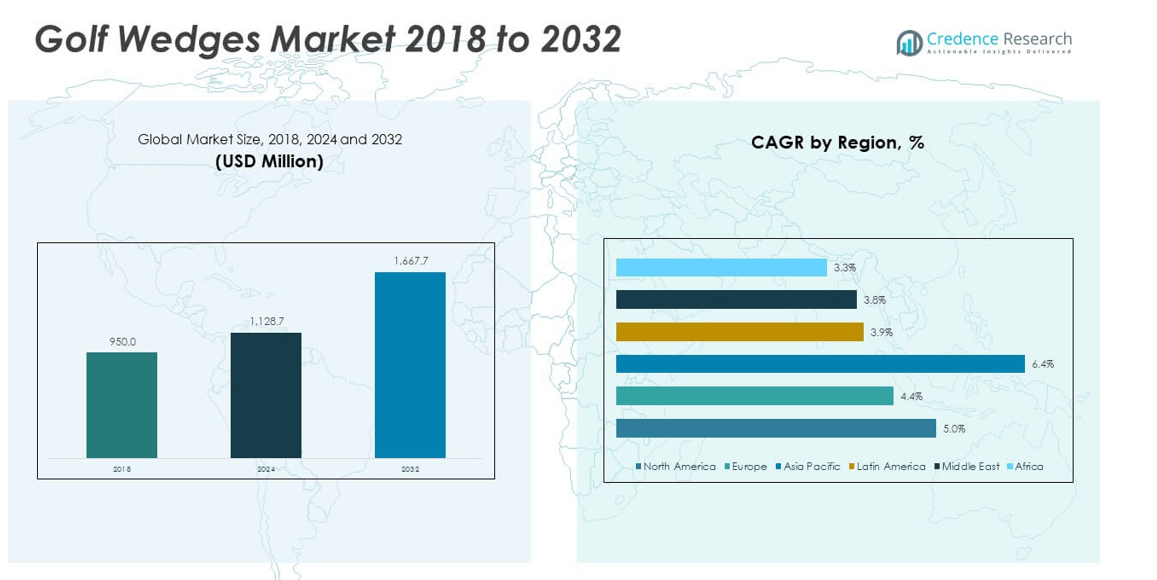
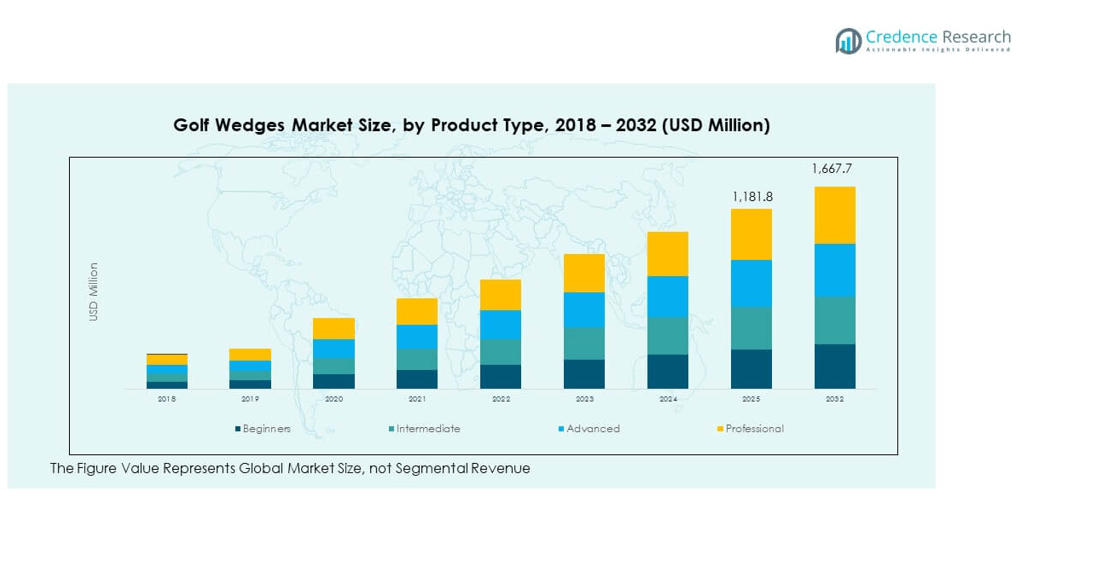
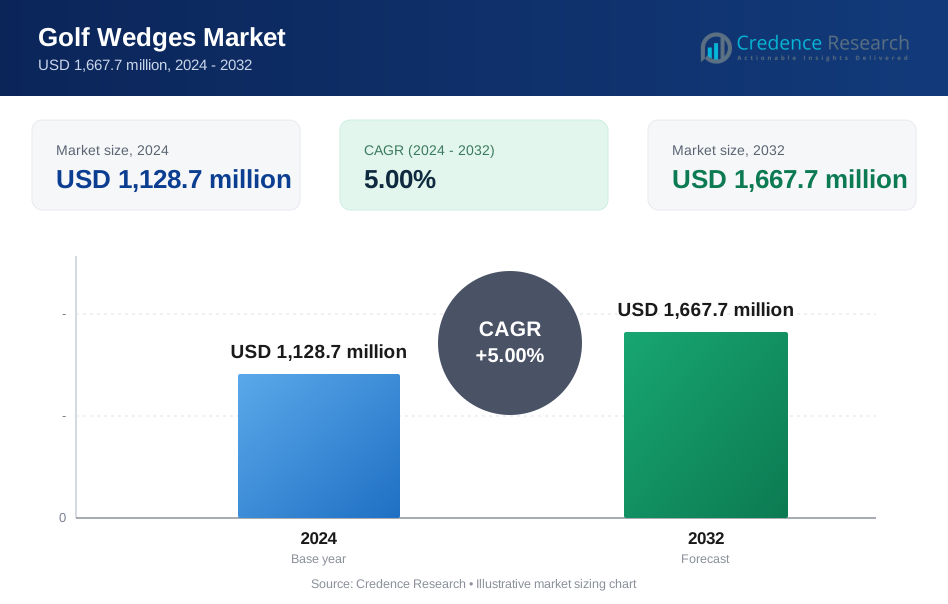
The Golf Wedges Market size was valued at USD 950.0 million in 2018 to USD 1,128.7 million in 2024 and is anticipated to reach USD 1,667.7 million by 2032, at a CAGR of 5.0% during the forecast period.
| REPORT ATTRIBUTE | DETAILS |
|---|---|
| Historical Period | 2020-2023 |
| Base Year | 2024 |
| Forecast Period | 2025-2032 |
| Golf Wedges Market Size 2024 | USD 1,128.7 million |
| Golf Wedges Market, CAGR | 5.0% |
| Golf Wedges Market Size 2032 | USD 1,667.7 million |
The golf wedges market is driven by the increasing popularity of golf as both a recreational and professional sport, supported by rising participation among younger demographics and women players. Technological advancements in wedge design, including precision milling, groove innovation, and custom fitting options, are enhancing player performance and fueling product demand. Additionally, golf tourism, expanding tournaments, and growing investments in golf courses worldwide are further strengthening the market outlook, creating opportunities for leading equipment manufacturers to introduce innovative, performance-driven wedges.
Geographically, North America leads the golf wedges market due to its established golfing culture, high participation rates, and presence of key manufacturers. Europe follows with strong growth fueled by prestigious tournaments and widespread golfing facilities. The Asia-Pacific region is emerging rapidly, driven by increasing disposable incomes, rising golf tourism in countries such as Japan, South Korea, and Thailand, and growing investments in golf infrastructure. Meanwhile, the Middle East is gaining traction as luxury golf resorts expand, positioning it as an attractive emerging market for wedge sales.
Market Insights:
- The Golf Wedges Market was valued at USD 950.0 million in 2018, reached USD 1,128.7 million in 2024, and is projected to hit USD 1,667.7 million by 2032 at a CAGR of 5.0%.
- Rising participation among younger players and women continues to fuel steady demand for wedges worldwide.
- Innovation in groove technology, spin control, and custom fitting strengthens product adoption among advanced and professional players.
- High pricing of premium wedges limits accessibility for beginners and casual golfers in several regions.
- North America dominates the Golf Wedges Market, driven by strong golfing culture and the presence of leading manufacturers.
- Europe shows stable growth supported by historic golfing traditions and established tournaments.
- Asia Pacific emerges as the fastest-growing region, fueled by expanding golf tourism and rising disposable incomes.
Market Drivers
Rising Popularity of Golf Across Professional and Recreational Segments
The Golf Wedges Market is driven by the growing participation in golf at both amateur and professional levels. Increasing interest among young players and female golfers is broadening the consumer base. It benefits from the expansion of golf clubs, academies, and training facilities that encourage new entrants. The influence of global tournaments such as the PGA Tour and European Tour further stimulates equipment purchases. Tourism-linked golfing destinations also encourage higher wedge demand. Manufacturers respond with tailored products designed for different skill levels. Custom fitting services enhance player confidence and encourage premium wedge adoption. The combination of cultural acceptance and institutional support strengthens long-term demand.
- For example, Club Champion has expanded its custom fitting network to more than 120 locations worldwide by mid-2025, offering comprehensive club-fitting services across multiple countries.
Technological Innovation and Product Performance Enhancement
It benefits from advanced material science, precise milling techniques, and groove optimization that directly improve player performance. Leading brands are investing in R&D to provide wedges with enhanced spin control and durability. The introduction of high-density weighting and variable bounce options gives golfers greater flexibility on different turf conditions. Consumers are more willing to upgrade equipment due to performance improvements. Tour professionals endorsing new technologies influence broader adoption among amateurs. Companies use player data and launch monitor analysis to refine designs. Enhanced personalization in wedges builds stronger brand loyalty. Innovation drives differentiation and sustains competitive advantage across the market.
Growth in Golf Tourism and International Course Development
Global expansion of golf tourism directly supports wedge sales. Countries in Asia-Pacific and the Middle East are building world-class courses, attracting both local and international players. It benefits from luxury resorts promoting golf as a premium recreational activity. Rising disposable incomes in emerging economies make golf more accessible to new demographics. Tourists purchasing wedges abroad contribute to revenue growth. Governments supporting tourism development indirectly stimulate equipment demand. Professional tournaments held in resort destinations create awareness for wedge brands. Stronger course infrastructure aligns with higher equipment sales across regions.
- For example, in 2024, Troon retained its position as the world’s largest golf club management company, managing an impressive network of 610 18-hole equivalent golf courses across its various brands.
Expansion of Retail and Digital Distribution Channels
The Golf Wedges Market is reinforced by the availability of equipment through multiple retail and online platforms. Dedicated sports outlets and golf-specific retailers enhance consumer engagement. It gains momentum from direct-to-consumer e-commerce models that increase brand reach. Online platforms allow players to compare, customize, and purchase wedges with ease. Widening access to product reviews and expert fittings builds confidence in purchases. Retailers offer demo sessions and trial fittings that encourage adoption. Partnerships with professional players in online campaigns raise product visibility. The shift in consumer preference toward digital engagement ensures consistent market expansion.
Market Trends
Increasing Preference for Custom Fitting and Personalization of Wedges
Golfers are seeking wedges designed to match their unique swing characteristics, turf conditions, and playing styles. The Golf Wedges Market responds by offering customization in loft, grind, and shaft composition. It encourages loyalty by creating a personal connection between golfers and their equipment. Retailers and online platforms promote virtual fitting tools to replicate in-person fitting experiences. Demand for adjustable options highlights the importance of flexibility. Premium players prefer wedges tailored to maximize short-game accuracy. Manufacturers position customization as a premium service that justifies higher pricing. Personalization creates differentiation in a competitive marketplace.
- For example, in conjunction with the S159 wedges, Ping introduced the WebFit Wedge app in 2024 a web-based tool that assists golfers in selecting the optimal grind and loft for their swing and playing conditions. It provides personalized recommendations within a few minutes without requiring user login or downloads.
Sustainable Manufacturing Practices and Eco-Conscious Materials
It is experiencing a gradual shift toward environmentally responsible production. Brands are using recycled metals, reduced-emission processes, and sustainable packaging. The Golf Wedges Market benefits from eco-conscious golfers prioritizing sustainability in purchase decisions. Companies communicate green credentials to strengthen consumer trust. Tournaments and golf clubs highlight sustainability programs, reinforcing awareness. Manufacturing innovation focuses on minimizing waste during milling and casting. Growing regulations in developed economies encourage compliance with environmental standards. Sustainability is evolving from a marketing strategy to an operational priority.
Integration of Data-Driven Design and Performance Analytics
Advanced data analytics now influence wedge design and testing. Companies use launch monitor feedback, spin rates, and turf interaction data to refine wedges. It ensures accuracy in production while meeting player performance expectations. The Golf Wedges Market incorporates biomechanical research to optimize usability. Partnerships with sports technology firms expand innovation potential. Data-driven insights accelerate product iterations and shorten design cycles. Professional endorsements using quantified performance outcomes increase credibility. Data integration strengthens alignment between consumer needs and final product features.
Expansion of Female and Youth-Centric Product Portfolios
Female and younger golfers represent a growing consumer segment for wedge manufacturers. It supports the introduction of wedges with lighter shafts, optimized grips, and tailored lofts. The Golf Wedges Market reflects rising inclusivity within the sport. Training academies and youth tournaments generate steady demand for beginner-friendly wedges. Female professionals endorsing specialized equipment influence broader adoption. Schools and sports clubs incorporating golf into programs expand wedge use among students. Retailers highlight accessible price ranges to attract entry-level players. Product diversification enhances inclusivity and secures long-term market growth.
- For example, Titleist launched its Vokey SM10 wedges in early 2024, featuring a progressive center of gravity design and advanced Spin Milled® grooves engineered for improved consistency, durability, and short-game control. The wedges debuted on the PGA TOUR at the start of the 2024 season, with many professionals immediately putting them into play.
Market Challenges Analysis
High Equipment Costs and Limited Accessibility for New Entrants
The Golf Wedges Market faces challenges due to premium pricing of advanced wedges. It restricts adoption among beginners and casual players with limited budgets. Luxury branding often creates a perception of exclusivity, reducing accessibility. Economic disparities in emerging regions hinder equipment penetration. Retailers struggle to maintain balanced inventories across price ranges. Consumer hesitation grows when alternatives such as second-hand equipment appear more affordable. Brands must address pricing strategies to widen their consumer reach. Lack of affordability continues to slow entry-level adoption in several markets.
Seasonal Dependence and Vulnerability to External Disruptions
It remains highly influenced by seasonal weather conditions, particularly in colder climates. Golf courses close during winter, directly reducing wedge demand. The Golf Wedges Market also faces disruptions from external factors such as global pandemics and travel restrictions. Tourism slowdowns negatively affect wedge sales in luxury destinations. Supply chain bottlenecks delay new product launches and availability. Retailers face challenges maintaining sales consistency throughout the year. Brands reliant on in-store fitting events encounter reduced engagement during disruptions. Seasonal fluctuations and external shocks remain key hurdles for market stability.
Market Opportunities
Rising Demand in Emerging Golf Nations and Growing Tourism Influence
The Golf Wedges Market holds opportunities in emerging economies where golf is gaining cultural acceptance. It benefits from governments investing in course construction and training facilities. Countries such as India, China, and South Korea present strong growth potential. Golf tourism in Southeast Asia supports steady wedge demand from international visitors. Affluent consumers in these regions are showing higher interest in premium wedge purchases. Regional tournaments enhance awareness of wedge brands. The alignment of infrastructure development and tourism expansion strengthens long-term prospects.
Digital Innovation in Retail Platforms and Direct-to-Consumer Engagement
It is presented with growth prospects through expanding e-commerce and digital marketing strategies. The Golf Wedges Market benefits from online fitting tools, 3D visualization, and interactive purchase platforms. Retailers invest in AI-driven recommendations to match wedges with player needs. Social media campaigns led by professionals encourage stronger brand trust. Companies can build stronger customer relationships through direct channels. Online communities and golf forums influence equipment adoption. Digital engagement creates visibility across international markets. The opportunity to merge technology with consumer outreach ensures growth potential.
Market Segmentation Analysis:
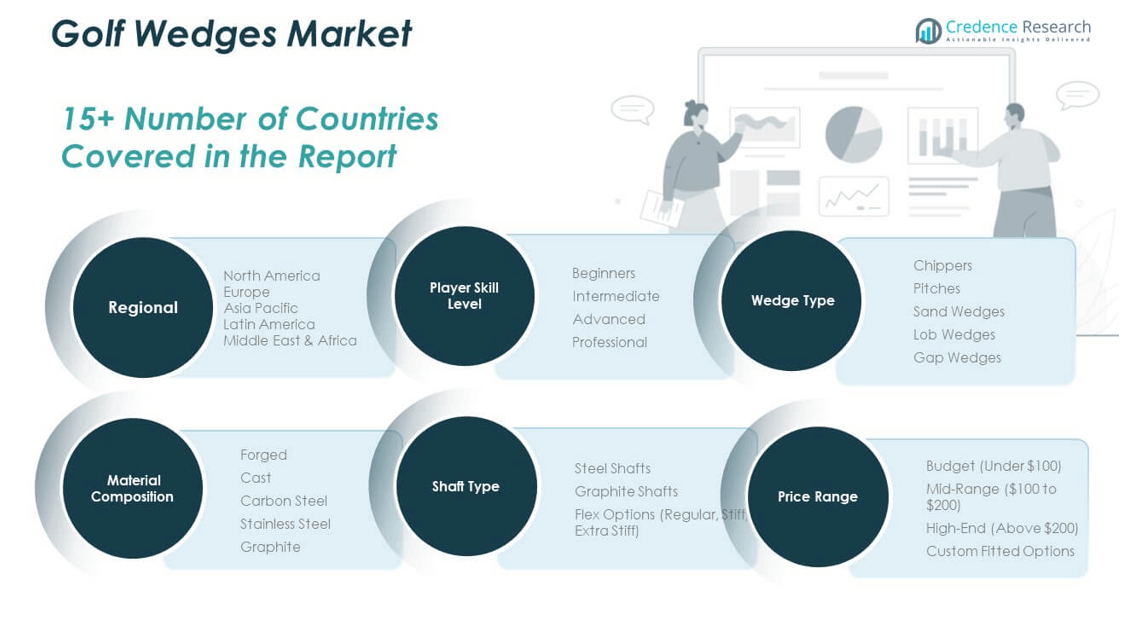
The Golf Wedges Market is segmented
By player skill level into beginners, intermediate, advanced, and professional categories. Beginners focus on wedges that offer forgiveness and affordability, while intermediate players seek a balance between control and price. Advanced and professional players demand premium wedges with precision milling, higher spin rates, and custom fitting, driving growth in the high-end product segment.
By wedge type, the market includes chippers, pitches, sand wedges, lob wedges, and gap wedges. Sand and lob wedges remain dominant due to their versatility in short-game situations, while gap wedges continue to gain attention for filling distance gaps. It also shows rising demand for chippers among recreational players seeking easier control around the greens.
- For example, Cleveland Golf introduced the Smart Sole 4 wedge line, including a chipper model, designed with a three-tiered sole, Feel Balancing Technology, and aggressive milled grooves to deliver enhanced forgiveness and consistency for recreational players.
By material composition covers forged, cast, carbon steel, stainless steel, and graphite wedges. Forged wedges appeal to professionals for their feel and consistency, while cast and stainless steel models dominate mass-market sales. Graphite wedges are niche but growing, driven by lightweight preferences among seniors and women golfers.
- Mizuno introduced its forged T24 wedge series in 2023, featuring enhanced QuadCut+ grooves and refined weight distribution for greater spin and control.
By shaft type, steel shafts remain the most widely adopted due to stability and affordability, while graphite shafts attract players seeking lighter alternatives. Flex options such as regular, stiff, and extra stiff allow personalization across player profiles.
By price range, budget wedges under $100 cater to beginners, mid-range between $100–$200 appeal to intermediates, and high-end wedges above $200 dominate the advanced and professional segments. Custom fitted options are expanding rapidly, reflecting the market’s shift toward personalization and premiumization.
Segmentation:
By Player Skill Level
- Beginners
- Intermediate
- Advanced
- Professional
By Wedge Type
- Chippers
- Pitches
- Sand Wedges
- Lob Wedges
- Gap Wedges
By Material Composition
- Forged
- Cast
- Carbon Steel
- Stainless Steel
- Graphite
By Shaft Type
- Steel Shafts
- Graphite Shafts
- Flex Options (Regular, Stiff, Extra Stiff)
By Price Range
- Budget (Under $100)
- Mid-Range ($100 to $200)
- High-End (Above $200)
- Custom Fitted Options
By Region
- North America
- U.S.
- Canada
- Mexico
- Europe
- UK
- France
- Germany
- Italy
- Spain
- Russia
- Belgium
- Netherlands
- Austria
- Sweden
- Poland
- Denmark
- Switzerland
- Rest of Europe
- Asia Pacific
- China
- Japan
- South Korea
- India
- Australia
- Thailand
- Indonesia
- Vietnam
- Malaysia
- Philippines
- Taiwan
- Rest of Asia Pacific
- Latin America
- Brazil
- Argentina
- Peru
- Chile
- Colombia
- Rest of Latin America
- Middle East
- UAE
- KSA
- Israel
- Turkey
- Iran
- Rest of Middle East
- Africa
- Egypt
- Nigeria
- Algeria
- Morocco
- Rest of Africa
Regional Analysis:
North America
The North America Golf Wedges Market size was valued at USD 365.0 million in 2018 to USD 428.7 million in 2024 and is anticipated to reach USD 632.5 million by 2032, at a CAGR of 5.0% during the forecast period. North America accounts for 38.0% of the global market in 2024, making it the largest regional contributor. The region benefits from a mature golfing culture supported by established tournaments such as the PGA Tour and LPGA Tour. It continues to see high equipment demand driven by strong participation across both amateur and professional levels. The presence of key manufacturers headquartered in the U.S. strengthens regional dominance. Consumers are highly receptive to advanced technologies and custom-fitted products, pushing premium wedge sales. Golf tourism in destinations like Florida, California, and Arizona adds to equipment purchases. The regional market remains competitive, with brands investing heavily in endorsements, innovation, and retail expansion.
Europe
The Europe Golf Wedges Market size was valued at USD 272.2 million in 2018 to USD 311.8 million in 2024 and is anticipated to reach USD 437.4 million by 2032, at a CAGR of 4.4% during the forecast period. Europe represents 27.6% of the global share in 2024, positioning it as a leading market after North America. Golf enjoys strong participation in countries such as the UK, Germany, and France. The region benefits from historic golf traditions and globally recognized tournaments including the Ryder Cup. Equipment demand is sustained by extensive golf course infrastructure across multiple countries. European players value high-quality craftsmanship and innovation, supporting demand for premium wedges. Rising participation of women and younger players broadens the consumer base. Sustainability initiatives adopted by European manufacturers also align with regional consumer preferences. The market shows stable growth fueled by both recreational players and competitive professionals.
Asia Pacific
The Asia Pacific Golf Wedges Market size was valued at USD 202.4 million in 2018 to USD 252.7 million in 2024 and is anticipated to reach USD 416.0 million by 2032, at a CAGR of 6.4% during the forecast period. Asia Pacific accounts for 22.3% of the global market in 2024, highlighting its rapid growth trajectory. Rising disposable incomes and expanding golf tourism drive wedge adoption in countries such as Japan, South Korea, and Thailand. China and India are emerging markets with growing interest in golf supported by new course development. Professional tours across the region, including the Japan Golf Tour, strengthen demand for advanced wedges. It also benefits from youth engagement programs and government-supported sports initiatives. Regional players are receptive to customization and technology-driven performance enhancements. Luxury resorts and destination golf courses attract international visitors who contribute to sales. The region shows the highest growth rate, positioning it as a future growth hub.
Latin America
The Latin America Golf Wedges Market size was valued at USD 50.5 million in 2018 to USD 59.4 million in 2024 and is anticipated to reach USD 80.2 million by 2032, at a CAGR of 3.9% during the forecast period. Latin America contributes 5.2% of the global share in 2024, making it a smaller but growing market. Brazil and Argentina lead regional participation with well-established golf communities. Mexico benefits from cross-border tourism with North America, boosting wedge sales in resort destinations. The market experiences growing interest from younger demographics exploring golf as a lifestyle sport. Limited infrastructure and affordability issues constrain widespread adoption. Brands rely on partnerships with local distributors to expand product accessibility. The region holds potential in resort-driven golf tourism that promotes higher equipment demand. It continues to represent an opportunity for manufacturers targeting niche premium buyers.
Middle East
The Middle East Golf Wedges Market size was valued at USD 38.1 million in 2018 to USD 42.5 million in 2024 and is anticipated to reach USD 57.0 million by 2032, at a CAGR of 3.8% during the forecast period. The region holds 3.8% of the global share in 2024, driven by luxury-driven golfing experiences. GCC countries, particularly the UAE and Saudi Arabia, invest heavily in golf infrastructure and premium resorts. International tournaments such as the Dubai Desert Classic elevate regional prominence. It attracts tourists who often purchase or rent wedges during stays at luxury golf destinations. Limited domestic participation restricts volume, but high-spending international visitors balance demand. Brands emphasize exclusive product lines and premium fitting services to cater to this segment. Growth is steady but tied strongly to tourism and hospitality. The Middle East remains an attractive high-value niche market.
Africa
The Africa Golf Wedges Market size was valued at USD 21.9 million in 2018 to USD 33.6 million in 2024 and is anticipated to reach USD 44.7 million by 2032, at a CAGR of 3.3% during the forecast period. Africa accounts for 2.9% of the global share in 2024, reflecting its status as a smaller developing market. South Africa dominates wedge sales due to its established golfing infrastructure and international tournaments. Egypt is emerging as a regional hub with golf tourism supported by resort development. The rest of Africa experiences limited participation due to economic and infrastructural constraints. It still attracts interest from expatriates and tourists playing at high-end courses. Regional growth is modest but steady, supported by hospitality and tourism sectors. Local demand remains low-volume, with imported products dominating sales. Africa presents opportunities for gradual expansion as awareness and infrastructure improve.
Key Player Analysis:
- Mizuno
- TaylorMade
- Callaway
- Titleist
- Cobra Golf
- Bridgestone Golf
- Honma Golf
- Wilson Staff
- Srixon
- Cleveland
- Ben Hogan Golf
- Bettinardi Golf
- Louisville Golf
- Miura Golf
Competitive Analysis:
The Golf Wedges Market is defined by intense competition among global and regional players that focus on performance innovation, brand loyalty, and professional endorsements. Leading companies such as Titleist, TaylorMade, Callaway, and Mizuno emphasize groove technology, precision milling, and advanced materials to strengthen their market positions. It remains shaped by frequent product launches that align with tour-level performance standards. Partnerships with professional golfers enhance visibility and accelerate adoption among amateurs. Smaller brands like Miura and Bettinardi target premium niches with craftsmanship-driven wedges. E-commerce expansion and custom fitting services further intensify rivalry, while strategic acquisitions and collaborations extend global reach. Competitive differentiation relies on balancing performance, personalization, and affordability to capture diverse consumer segments.
Recent Developments:
- In August 2025, Callaway launched its next-generation Opus SP wedges, which feature the new Spin Pocket construction designed to raise the center of gravity for lower flight and higher spin. The wedges are available for pre-sale starting August 22 and will hit retail locations on September 12.
- In May 2025, 2nd Swing, a prominent golf gear reseller, was officially named the PGA of America's Equipment Trade-In Partner. This partnership aims to streamline club trade-ins and expand access to pre-owned wedge products, enhancing the reach and convenience of the wedge market for both consumers and retailers.
- In Jan 2025, Mizuno launched the new Pro T-1 and Pro T-3 golf wedges, expanding their acclaimed Pro series with advanced features for enhanced control and spin. The Pro T-1 is forged using Mizuno’s Grain Flow Forged HD process and employs Quad Cut + Hydroflow Micro Grooves for superior spin in both wet and dry conditions.
- In Jan 2025, Cobra Golf launched its King and King-X wedges, using Metal Injection Molding (MIM) for tighter manufacturing tolerances and softer feel. The wedges incorporate Flight Window Technology for loft-optimized center of gravity positioning and Progressive Spin Technology for consistent spin across all lofts.
Market Concentration & Characteristics:
The Golf Wedges Market demonstrates moderate concentration, with a few multinational brands controlling significant revenue shares. It reflects strong brand recognition, consistent R&D investments, and premium pricing strategies. Niche manufacturers contribute by catering to specific consumer groups seeking exclusivity or craftsmanship. The market shows steady growth across both mass and luxury segments, supported by technological advancements and expanding retail platforms. Competitive intensity is reinforced by endorsements, digital marketing campaigns, and global distribution strategies. It is also influenced by consumer preference for custom-fitted products that enhance playing performance. Sustained innovation and differentiated branding continue to define long-term competitiveness.
Report Coverage:
The research report offers an in-depth analysis based on Player Skill Level, Wedge Type, Material Composition, Shaft Type and Price Range. It details leading market players, providing an overview of their business, product offerings, investments, revenue streams, and key applications. Additionally, the report includes insights into the competitive environment, SWOT analysis, current market trends, as well as the primary drivers and constraints. Furthermore, it discusses various factors that have driven market expansion in recent years. The report also explores market dynamics, regulatory scenarios, and technological advancements that are shaping the industry. It assesses the impact of external factors and global economic changes on market growth. Lastly, it provides strategic recommendations for new entrants and established companies to navigate the complexities of the market.
Future Outlook:
- The Golf Wedges Market will see sustained growth driven by rising participation among younger and female golfers.
- Custom fitting and personalization will gain traction, creating demand for premium wedge solutions.
- Sustainability initiatives in materials and manufacturing will influence consumer preferences.
- E-commerce platforms will expand market access, strengthening direct-to-consumer sales strategies.
- Technological innovations in groove design and spin optimization will enhance product differentiation.
- Golf tourism and resort-driven demand will boost wedge sales in emerging destinations.
- Professional endorsements and global tournaments will continue to shape brand visibility.
- Lightweight shafts and flexible designs will attract senior and recreational golfers.
- Expanding infrastructure in Asia Pacific and the Middle East will open new revenue streams.
- Competitive intensity will push brands toward mergers, partnerships, and product innovation to secure long-term advantage.
Request a Free Sample
Fill in your details and we'll send you a free sample report.
- Sample data tables & charts
- Research methodology
Need a Custom Version of This Report?
Tailor the scope, geography, or segments to your exact requirements.
- Custom geography or segment scope
- Direct access to our analyst team
Frequently Asked Questions
What is the current market size for Golf Wedges Market, and what is its projected size in 2032?
Which Golf Wedges Market segment held the largest share in 2024?
What are the primary factors fueling the growth of the Golf Wedges Market?
Who are the leading companies in the Golf Wedges Market?
Table of Content
Chapter 1. Report Introduction
- 1.1 Report Description & Purpose
- 1.1.1 Report Title & Market Definition
- 1.1.2 Unique Selling Propositions (USP) & Key Differentiators
- 1.1.3 Value Proposition for Stakeholders
- 1.2 Research Objectives
- 1.2.1 Market Sizing Objectives (Volume & Revenue)
- 1.2.2 Segmentation Objectives
- 1.2.3 Competitive Intelligence Objectives
- 1.2.4 Forecast & Scenario Objectives
- 1.3 Report Scope
- 1.3.1 Golf Wedges Scope – Types & Subtypes Covered
- 1.3.2 Geographic Scope – Regions & Countries Covered
- 1.3.3 Historical Period, Base Year & Forecast Period (2024; forecast to 2032)
- 1.3.4 Inclusions & Exclusions
- 1.4 HS Code & Classification Framework
- 1.5 Currency, Units & Pricing Basis
- 1.6 Target Stakeholders
- 1.7 Limitations & Assumptions
Chapter 2. Executive Summary
- 2.1 Global Golf Wedges Market Snapshot
- 2.1.1 Market Size – Historical (2024) & Forecast (2024-2032) (2024: USD 1,128.7 million → 2032: USD 1,667.7 million)
- 2.1.2 Volume & Revenue – Global Totals
- 2.1.3 Key Market Highlights – Top Five Facts
- 2.2 Golf Wedges Market Segmentation Snapshot
- 2.2.1 Market Split by Region – 2024 vs. 2032
- 2.3 Competitive Snapshot
- 2.3.1 Top 10 Players by Revenue Share – 2024
- 2.3.2 Top 10 Players by Volume Share – 2024
- 2.3.3 Recent Strategic Developments (18-Month Summary)
- 2.4 Key Investment Highlights & Strategic Conclusions
Chapter 3. Golf Wedges Market Dynamics & Industry Analysis
- 3.1 Market Overview & Context
- 3.1.1 Golf Wedges Market Position in the Broader Automotive Value Chain
- 3.1.2 OEM vs. Replacement Market Dynamics
- 3.1.3 Market Maturity & Development Stage by Region
- 3.2 Golf Wedges Market Drivers
- 3.3 Golf Wedges Market Restraints & Challenges
- 3.4 Golf Wedges Market Opportunities
- 3.5 Porter's Five Forces Analysis
- 3.5.1 Threat of New Entrants
- 3.5.2 Bargaining Power of Suppliers
- 3.5.3 Bargaining Power of Buyers
- 3.5.4 Threat of Substitutes
- 3.5.5 Competitive Rivalry – Intensity Assessment
- 3.6 Golf Wedges Value Chain Analysis
- 3.6.1 Upstream – Raw Material/Input Suppliers
- 3.6.1.1 Raw Material/Input 1
- 3.6.1.2 Raw Material/Input 2
- 3.6.1.3 Raw Material/Input 3
- 3.6.2 Midstream – Production/Manufacturing/Service Delivery
- 3.6.2.1 Production/Process Overview
- 3.6.2.2 Key Facility Locations & Capacity by Manufacturer
- 3.6.3 Downstream – Distribution & End Consumer
- 3.6.3.1 Primary Channel – B2B/OEM
- 3.6.3.2 Secondary Channels – Dealer, Retail, Online, Direct
- 3.6.4 Value Chain Profitability Analysis
- 3.6.1 Upstream – Raw Material/Input Suppliers
- 3.7 PESTEL Analysis
- 3.7.1 Political Factors
- 3.7.2 Economic Factors
- 3.7.3 Social Factors
- 3.7.4 Technological Factors
- 3.7.5 Environmental Factors
- 3.7.6 Legal Factors
- 3.8 Golf Wedges Supply Chain Analysis
- 3.8.1 Raw Material/Input Supply Risk Assessment
- 3.8.2 Manufacturing Concentration Risk (Geographic Exposure)
- 3.8.3 Trade Disruption Impact Analysis
- 3.9 Regulatory & Policy Landscape
Note: The regulatory and policy landscape section covers regulations based on their applicability to the market, Golf Wedges category, geography, and scope of the study. Only regulatory frameworks with a material impact on operations, compliance, trade, sustainability, or market access are analyzed in detail.
Chapter 4. Key Investment Pockets & Opportunity Analysis
- 4.1 Golf Wedges Market Attractiveness Analysis
- 4.1.1 By Region – Investment Attractiveness Matrix (Volume × CAGR)
- 4.2 Absolute Revenue Growth Opportunity
- 4.2.1 By Region – Absolute USD Growth Through 2032
- 4.3 Incremental Volume Opportunity
- 4.3.1 By Region – Incremental Volume Through 2032
- 4.3.2 Segment – Incremental Volume
- 4.4 Emerging Submarket Opportunity Deep Dive (Subject to Applicability)
- 4.5 Emerging Market Opportunity Scorecards
- 4.5.1 United States
- 4.5.2 Europe
- 4.5.3 Asia
- 4.5.4 Middle East & Africa
Note: Emerging Market Opportunity Scorecards will be included based on relevance and strategic importance. Regions listed are indicative and may vary depending on data availability and market dynamics.
Chapter 5. Golf Wedges Import-Export Analysis & Trade Flows
- 5.1 Global Trade Overview
- 5.1.1 Global Export Value by Country (2024)
- 5.1.2 Global Export Volume by Country (2024)
- 5.1.3 Global Import Value by Country (2024)
- 5.1.4 Global Import Volume by Country (2024)
- 5.1.5 Net Trade Balance by Country (2024)
- 5.2 Export Analysis – Segment
- 5.2.1 Type 1 (HS Code)
- 5.2.2 Type 2 (HS Code)
- 5.2.3 Type 3 (HS Code)
- 5.2.4 Type 4 (HS Code)
- 5.2.5 Type 5 (HS Code)
- 5.3 Import Analysis – Segment
- 5.3.1 Type 1 (HS Code)
- 5.3.2 Type 2 (HS Code)
- 5.3.3 Type 3 (HS Code)
- 5.3.4 Type 4 (HS Code)
- 5.3.5 Type 5 (HS Code)
- 5.4 Average Unit Trade Prices
- 5.4.1 Average Export Price – Segment & Country
- 5.4.2 Average Import Price – Segment & Source Country
- 5.4.3 Price Trends (2024)
- 5.5 Key Trade Route Analysis
- 5.5.1 Trade Route 1
- 5.5.2 Trade Route 2
- 5.5.3 Trade Route 3
- 5.5.4 Trade Route 4
- 5.5.5 Trade Route 5
- 5.6 Trade Policy Impact Assessment
- 5.6.1 US Anti-Dumping & Section 301 Tariffs
- 5.6.2 EU Customs Union Impact
- 5.6.3 Major Free Trade Agreements
- 5.6.4 USMCA Rules of Origin
Note: Trade policy analysis will be included only where relevant to the Golf Wedges market.
Chapter 6. Competitive Landscape & Company Benchmarking
- 6.1 Golf Wedges Market Concentration & Structure
- 6.1.1 Herfindahl-Hirschman Index (HHI) – vs. 2024
- 6.1.2 Tier 1, Tier 2 & Tier 3 Market Structure
- 6.1.3 Global, Regional & Local Player Dynamics
- 6.2 Golf Wedges Market Share Analysis – 2024
- 6.2.1 Global Revenue Share by Company
- 6.2.2 Global Volume Share by Company
- 6.2.3 Regional Revenue Share
- 6.2.4 Market Share Evolution ( vs. 2024)
- 6.2.5 OEM Segment Share by Company
- 6.2.6 Replacement Segment Share by Company
- 6.3 Production/Delivery Capacity & Facility Analysis
- 6.3.1 Global Installed Capacity
- 6.3.2 Capacity Utilization Rates
- 6.3.3 Production/Output Volume
- 6.3.4 Facility Locations & Capacity Map
- 6.3.5 Planned Capacity Additions
- 6.4 Golf Wedges Competitive Benchmarking Matrix
- 6.4.1 Revenue, Volume, CAGR & Profitability Comparison
- 6.4.2 Channel Revenue Mix
- 6.4.3 Geographic Revenue Exposure
- 6.4.4 R&D Intensity
- 6.4.5 Sustainability Maturity
- 6.5 Strategic Developments in Golf Wedges (Last 24 Months)
- 6.5.1 Mergers, Acquisitions & Divestments
- 6.5.2 New Golf Wedges Launches
- 6.5.3 Facility Expansions
- 6.5.4 Strategic Alliances, Joint Ventures & Partnerships
- 6.5.5 Distribution Expansion & Market Entry
- 6.5.6 Sustainability & ESG Initiatives
- 6.6 Competitive Strategy Mapping
- 6.6.1 Leader, Challenger, Follower & Niche Classification
- 6.6.2 Pricing Strategy Comparison
- 6.6.3 Channel Strategy Matrix
Note: Strategic developments are included based on their materiality and the availability of reliable information.
Chapter 7. Global Golf Wedges Market – By Distribution Channel
- 7.1 Segment Overview
- 7.1.1 Volume & Revenue Split by Channel (2024 & 2032)
- 7.1.2 Channel Mix Evolution (2024-2032)
Chapter 8. Regional Market Analysis – Global Overview
- 8.1 Global Regional Overview
- 8.1.1 Regional Volume Share
- 8.1.2 Regional Revenue Share
- 8.1.3 Regional Volume by Region
- 8.1.4 Regional Revenue by Region
- 8.1.5 Regional Forecast Through 2032
- 8.2 Cross-Regional Segment Analysis
- 8.2.1 By Distribution Channel
- 8.2.2 By Brand/Price Tier
Chapter 9. North America Golf Wedges Market
- 9.1 United States
- 9.2 Canada
- 9.3 Mexico
Chapter 10. Europe Golf Wedges Market
- 10.1 Germany
- 10.2 France
- 10.3 Italy
- 10.4 United Kingdom
- 10.5 Spain
- 10.6 Poland
- 10.7 Russia
- 10.8 Netherlands
- 10.9 Belgium
- 10.10 Sweden
- 10.11 Denmark
- 10.12 Norway
- 10.13 Rest of Europe
Chapter 11. Asia Pacific Golf Wedges Market
- 11.1 China
- 11.2 India
- 11.3 Japan
- 11.4 South Korea
- 11.5 Thailand
- 11.6 Indonesia
- 11.7 Vietnam
- 11.8 Malaysia
- 11.9 Australia
- 11.10 Rest of Asia Pacific
Chapter 12. Latin America Golf Wedges Market
- 12.1 Brazil
- 12.2 Argentina
- 12.3 Colombia
- 12.4 Chile
- 12.5 Rest of Latin America
Chapter 13. Middle East Golf Wedges Market
- 13.1 Saudi Arabia
- 13.2 United Arab Emirates
- 13.3 Turkey
- 13.4 Israel
- 13.5 Iran
- 13.6 Rest of the Middle East
Chapter 14. Africa Golf Wedges Market
- 14.1 South Africa
- 14.2 Egypt
- 14.3 Nigeria
- 14.4 Morocco
- 14.5 Rest of Africa
Chapter 15. Golf Wedges Company Profiles
- 15.1 [Company 01]
- 15.1.1 Company Overview
- 15.1.2 Key Management Personnel
- 15.1.3 Products & Services Portfolio
- 15.1.4 Financial Performance
- 15.1.5 Key Market Focus & Geographic Presence
- 15.1.6 Recent Developments & Strategic Initiatives
Note: The company profile list is preliminary and may change based on research findings, market developments, data availability, and client requirements.
Chapter 16. Appendices
- Appendix A – List of Abbreviations & Acronyms
- Appendix B – Industry Classification Code Reference – Full Series
- Appendix C – Production & Capacity Data Tables
- Appendix D – End-Use & Demand Base Tables
- Appendix E – Consumption & Replacement Rate Assumptions
- Appendix F – ASP Reference Tables
- Appendix G – Manufacturing & Facility Database
- Appendix H – Import-Export Data Tables
- Appendix I – Regulatory Summary Tables
- Appendix J – Primary Research Participant List (Anonymized)
- Appendix K – Primary Research Questionnaire Framework
- Appendix L – Data Sources & Bibliography
- Appendix M – Market Size Divergence & Source Comparison
Chapter 17. Research Methodology
- 17.1 Research Framework & Philosophy
- 17.2 Secondary Research – Sources, Hierarchy & Data Extraction
- 17.3 Data Modeling – Bottom-Up & Top-Down Market Sizing
- 17.4 Primary Research – Stakeholder Framework, LOI & Sample Sizes
- 17.5 Forecast Methodology – Regression, Scenario & Sensitivity Analysis
- 17.6 Quality Control – Four-Layer Validation Framework
- 17.7 Limitations & Standard Assumptions
- 17.8 Disclaimer
