
Market Overview:
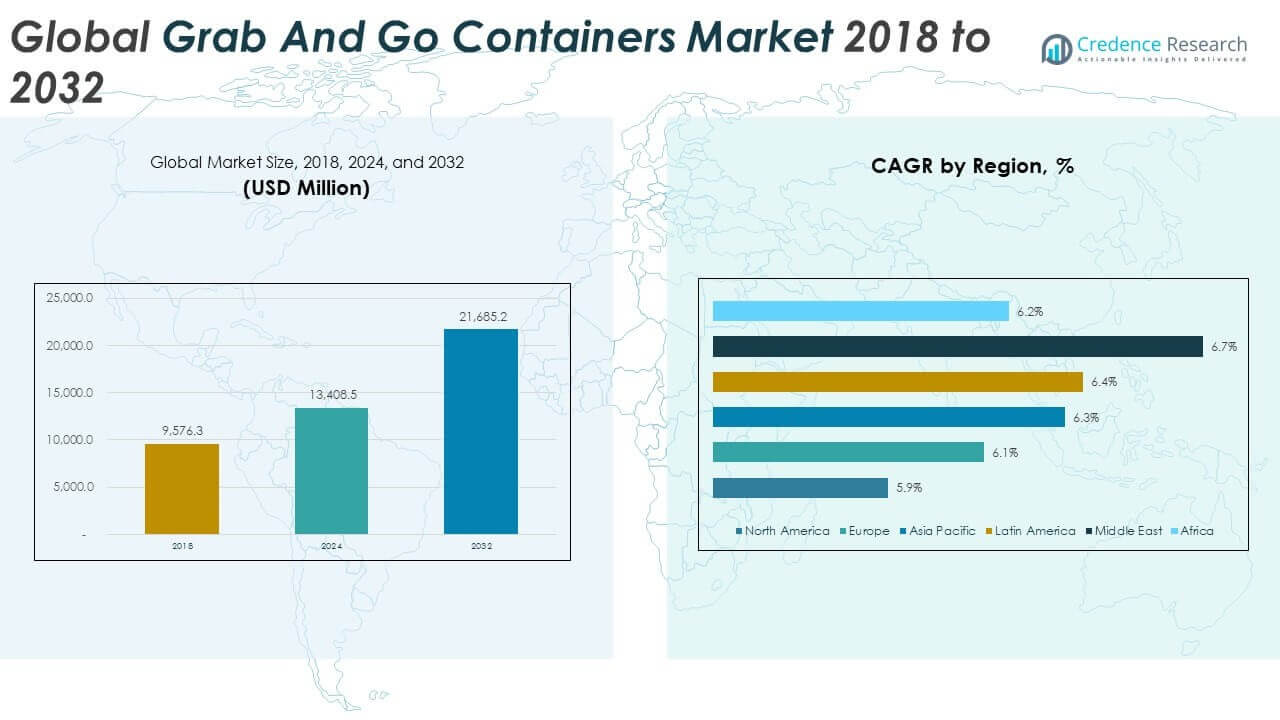
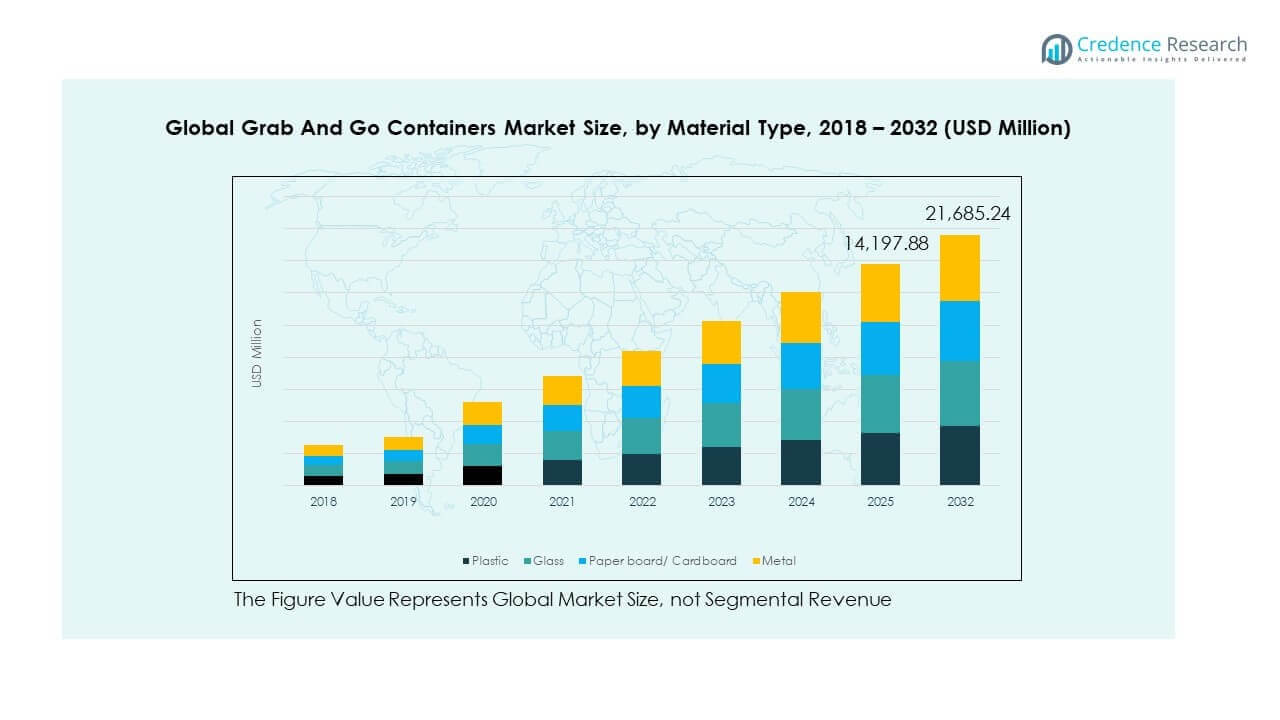
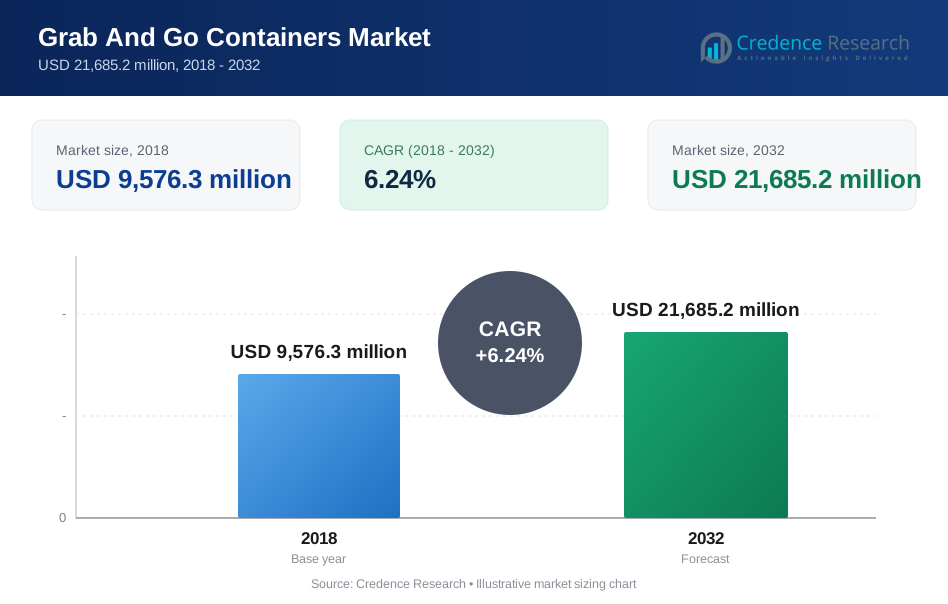
The Global Grab and Go Containers Market size was valued at USD 9,576.3 million in 2018 to USD 13,408.5 million in 2024 and is anticipated to reach USD 21,685.2 million by 2032, at a CAGR of 6.24% during the forecast period.
| REPORT ATTRIBUTE | DETAILS |
|---|---|
| Historical Period | 2020-2023 |
| Base Year | 2024 |
| Forecast Period | 2025-2032 |
| Grab and Go Containers Market Size 2024 | USD 13,408.5 million |
| Grab and Go Containers Market, CAGR | 6.24% |
| Grab and Go Containers Market Size 2032 | USD 21,685.2 million |
Growing demand for convenience packaging across foodservice, retail, and delivery platforms drives market expansion. Busy consumer lifestyles, rising urbanization, and the growth of single-person households increase the need for portable, ready-to-eat food solutions. Quick-service restaurants and online food delivery operators rely on tamper-evident, stackable, and leak-resistant containers to support operations. Environmental regulations and sustainability goals influence material choices, prompting manufacturers to adopt recyclable and compostable formats. Packaging that combines functionality with visual appeal gains traction in both premium and mass-market segments.
Asia Pacific leads the Global Grab and Go Containers Market due to large population centers, fast urban expansion, and the rise of mobile food delivery services. North America and Europe follow, supported by advanced retail infrastructure and strong regulatory focus on packaging waste reduction. Latin America and the Middle East are emerging markets, showing growth through rising foodservice penetration and changing dietary habits. Africa remains in the early stages but is showing potential through retail modernization and local manufacturing initiatives. Regional growth varies based on consumer preferences, income levels, and government policies on sustainability.
Market Insights:
- The Global Grab and Go Containers Market was valued at USD 9,576.3 million in 2018 and reached USD 13,408.5 million in 2024. It is projected to hit USD 21,685.2 million by 2032, growing at a CAGR of 6.24%.
- Asia Pacific leads the market with approximately 37.8% share in 2024, driven by urbanization and rising demand for food delivery. Europe ranks second at around 24.0%, supported by sustainability policies. North America holds about 18.5%, backed by QSR and retail demand.
- The Middle East is the fastest-growing region with a CAGR of 6.7%, fueled by hospitality sector growth, foodservice expansion, and regulatory shifts favoring sustainable packaging.
- Plastic remains the dominant material type, accounting for an estimated 36–38% of the total market size in 2024. It benefits from cost-effectiveness, versatility, and wide application across foodservice.
- Paperboard/Cardboard and molded fiber materials hold a combined share exceeding 30%, gaining traction due to sustainability mandates and growing adoption in premium and retail-ready food formats.
Market Drivers
Rising Demand for On-the-Go Lifestyles Across Urban and Suburban Consumers
Busy lifestyles and changing food habits drive the demand for convenient packaging formats. Consumers in urban regions prefer ready-to-eat meals that suit mobile routines and reduce prep time. The Global Grab and Go Containers Market benefits from this shift as restaurants and cafés design packaging for quick pickups and deliveries. Small portion packaging formats gain popularity among working professionals and students. Demand for portability, mess-free handling, and single-serve options accelerates sales. Food delivery apps amplify this demand by pushing packaging that supports transport and storage. Brands increasingly adopt functional containers to retain freshness and prevent leaks. This shift reshapes product designs and material choices across segments.
Expansion of the Global Foodservice Sector and Quick-Service Restaurant Chains
The growth of foodservice outlets significantly supports demand for grab and go containers. Fast-food chains, coffee shops, and bakeries prefer packaging that speeds up service and reduces labor. The Global Grab and Go Containers Market grows in parallel with QSR footprint expansion, especially in urban clusters. Chains seek packaging that aligns with branding, sustainability goals, and operational efficiency. Innovations in tamper-proof and stackable designs enhance delivery safety and storage. The surge in cloud kitchens and ghost restaurants further increases container consumption. Packaging becomes a key tool in customer experience and operational logistics. Brands invest in durable and cost-effective packaging to optimize workflows.
Government Regulations and Bans on Single-Use Plastic Products Globally
Stringent policies targeting plastic waste drive major shifts in packaging choices. Many governments implement restrictions on single-use plastics in retail and foodservice. The Global Grab and Go Containers Market sees rising demand for recyclable and compostable alternatives. Compliance with environmental standards pushes companies to rethink materials and production. Manufacturers invest in R&D to create biodegradable, reusable, and lightweight packaging formats. These changes create long-term structural shifts in design and procurement strategies. Foodservice chains integrate environmental impact into packaging evaluations. Brands adopting sustainable formats gain competitive advantage in regulated markets.
- For instance, Starbucks launched a major pilot of compostable, fiber-based cold cups in early 2024, expanding to 14 U.S. states by February 2025 as part of its verified commitment to reduce waste by 50% by 2030.
Retail Expansion and Growth of Supermarket Fresh-Food Sections Worldwide
Supermarkets and convenience stores continue to expand their ready-to-eat and pre-packed offerings. These retailers rely on reliable and visually appealing packaging to attract impulse buyers. The Global Grab and Go Containers Market benefits from growing demand for salads, fruits, and snacks in single-use formats. Stores prefer clear-lid containers that improve product visibility and freshness perception. Packaging plays a critical role in product merchandising and shelf impact. Cold-chain logistics and in-store packaging stations support large-volume usage. Retailers invest in tamper-proof formats to meet safety standards. This trend supports steady and recurring volume demand across global regions.
- For instance, Whole Foods expanded its prepared foods and grab-and-go offerings across its 500+ U.S. stores, using BPA-free PETE containers with clear lids to support product visibility and maintain freshness in refrigerated conditions.
Market Trends
Adoption of Smart Packaging Features to Enhance Food Safety and Consumer Experience
Smart packaging technologies continue gaining traction across foodservice applications. Brands integrate tamper-evident seals, freshness indicators, and QR codes into container designs. The Global Grab and Go Containers Market sees rising interest in packaging that supports traceability and hygiene. Embedded sensors or indicators enhance food safety perception, especially for perishable items. These features support customer trust and regulatory compliance in sensitive product categories. Innovations target both foodservice and retail applications, improving transparency across the supply chain. Startups enter the market with integrated tech-driven solutions tailored to short shelf-life products. These developments reshape packaging performance and consumer engagement.
Material Innovation Driving Lightweight, Compostable, and Bio-Based Alternatives
Sustainable material development shapes future growth across packaging segments. Manufacturers focus on producing bio-based materials from corn, sugarcane, and bamboo fibers. The Global Grab and Go Containers Market increasingly adopts molded fiber, bagasse, and PLA-based containers. These options meet regulatory standards while reducing environmental impact. Lightweight materials cut transportation costs and improve shelf handling. Brands seek materials that balance compostability with food-contact safety. Vendors promote performance features such as grease resistance, insulation, and heat-sealing compatibility. These trends unlock innovation opportunities across packaging formats and end-user segments.
- For instance, Sonoco Products developed its Natrellis® tray line using upcycled sugarcane and plant fibers, offering a compostable, dual-ovenable solution under FDA food-contact compliance for sustainable grab-and-go packaging.
Customization and Branding Through Innovative Printing and Structural Designs
Brands use containers not just for storage but as marketing tools to improve brand recall. Customized printing, embossing, and window designs enhance consumer engagement. The Global Grab and Go Containers Market sees strong interest in packaging that combines utility with aesthetics. Businesses invest in unique shapes, colors, and finishes to match brand identities. Packaging functions as a differentiator in crowded retail environments and food delivery apps. Small chains and premium cafés rely on packaging to communicate quality and values. Digital printing supports short runs with low setup costs, allowing seasonal and regional variants. Structural packaging innovation supports high-impact visual appeal and stackability.
Growth in Meal Kit, Deli, and Fresh Grab-and-Go Offerings in Non-Traditional Retail Channels
Gas stations, pharmacies, and bookstores increasingly stock fresh grab-and-go food. These new distribution points expand the addressable market for container manufacturers. The Global Grab and Go Containers Market responds to this trend with multipurpose and modular packaging formats. Smaller footprint retailers require stackable, tamper-proof, and temperature-friendly designs. Packaging formats must suit limited storage and refrigeration capabilities in these outlets. Growth in vending machines and micromarkets also supports innovation in portion control and seal integrity. New partnerships between packaging vendors and convenience channel operators drive targeted designs. This shift broadens market reach across geographies and retail categories.
- For instance, 7‑Eleven expanded its fresh food and grab-and-go offerings in nearly 5,000 U.S. stores by late 2024 through a food and beverage modernization program featuring upgraded cases, commissary-supplied meals, and healthier options like salads and wraps.
Market Challenges Analysis
High Cost of Sustainable Packaging Materials and Limited Global Supply Chains
Sustainable materials like bioplastics, PLA, and molded fiber cost significantly more than conventional plastics. Limited availability and regional disparities in production lead to higher procurement costs. The Global Grab and Go Containers Market faces margin pressures as raw material prices stay volatile. Small and mid-sized foodservice operators struggle to afford sustainable options in bulk. Logistics and shelf-life challenges further add to costs for biodegradable formats. Recycling infrastructure gaps in many countries restrict recovery and reuse. Vendors must manage price sensitivity while meeting sustainability expectations. These issues hinder mass adoption of green packaging in price-sensitive markets.
Performance Limitations in Emerging Materials and Changing Regulatory Frameworks
Bio-based and compostable materials often face limitations in heat resistance, durability, and shelf-life. The Global Grab and Go Containers Market must balance material innovation with functional performance. Leak-proof sealing, insulation, and microwave compatibility are harder to achieve with compostable formats. Regulations vary widely across geographies, making global compliance complex. Evolving guidelines on labeling, certification, and disposal affect packaging design. Manufacturers need continuous R&D and compliance support to meet changing standards. These barriers slow time-to-market for newer eco-friendly products. Long certification cycles and approval delays further reduce flexibility in fast-moving markets.
Market Opportunities
Growing Demand from Emerging Economies with Rapid Urbanization and Expanding QSR Presence
Urbanization and income growth in Asia Pacific, Latin America, and Africa drive consumption of packaged food. The Global Grab and Go Containers Market can expand by targeting fast-growing QSRs and modern retail outlets in these regions. Infrastructure development and mobile lifestyles support higher demand for portable packaging. Young populations adopt takeaway formats and delivery apps at scale. Brands offering affordable, eco-friendly containers will gain long-term foothold.
Innovation in Reusable, Returnable, and Smart Packaging Systems for Food Delivery and Retail
New business models based on reusability and reverse logistics create growth potential. Food delivery platforms pilot container return systems to cut waste. The Global Grab and Go Containers Market sees opportunities in hybrid solutions that combine durability with low cost. Smart packaging formats using embedded codes or chips can track container lifecycle. These models support closed-loop sustainability and customer retention strategies.
Market Segmentation Analysis:
By material type, plastic holds the largest share due to its cost-efficiency, flexibility, and light weight. It supports high-volume production and diverse formats. Paperboard/cardboard follows, driven by rising demand for sustainable and recyclable packaging. Glass appeals to premium segments where clarity, reusability, and hygiene are valued. Metal containers serve niche applications requiring extended durability or heat resistance.
By capacity, 250 ml to 500 ml dominates the Global Grab and Go Containers Market due to its suitability for single-serve meals and beverages. This range aligns with portion-control trends and foodservice standards. Up to 250 ml targets snacks and small drink servings, often used in vending and convenience stores. The 500 ml and above segment sees traction in multi-portion packaging and meal kits, where added capacity supports value offerings.
- For instance, Huhtamaki offers 16 oz PET cups under its foodservice portfolio, designed for cold beverages and optimized for stackability to reduce storage space and improve dispensing efficiency. These are distinct from the Chinet Crystal® line, which typically includes smaller retail-focused cups intended for special events.
By product type, clamshells lead the market, supported by versatility, secure sealing, and stackable design. Bowls are gaining traction in salad, noodle, and hot meal applications due to depth and microwave compatibility. Cups remain strong in beverages, yogurts, and cold snacks. Trays serve bakery, deli, and entrée categories with high visibility and easy handling. Other containers include modular or specialty formats addressing varied retail and delivery use cases. The Global Grab and Go Containers Market benefits from ongoing innovation across these segments, shaping buyer choices across foodservice and retail channels.
- For instance, Reynolds Kitchens® heavy-duty aluminum pans are rated to withstand oven temperatures up to 450°F and are designed to maintain structural integrity during extended baking or roasting, even under the weight of large meals.
Segmentation:
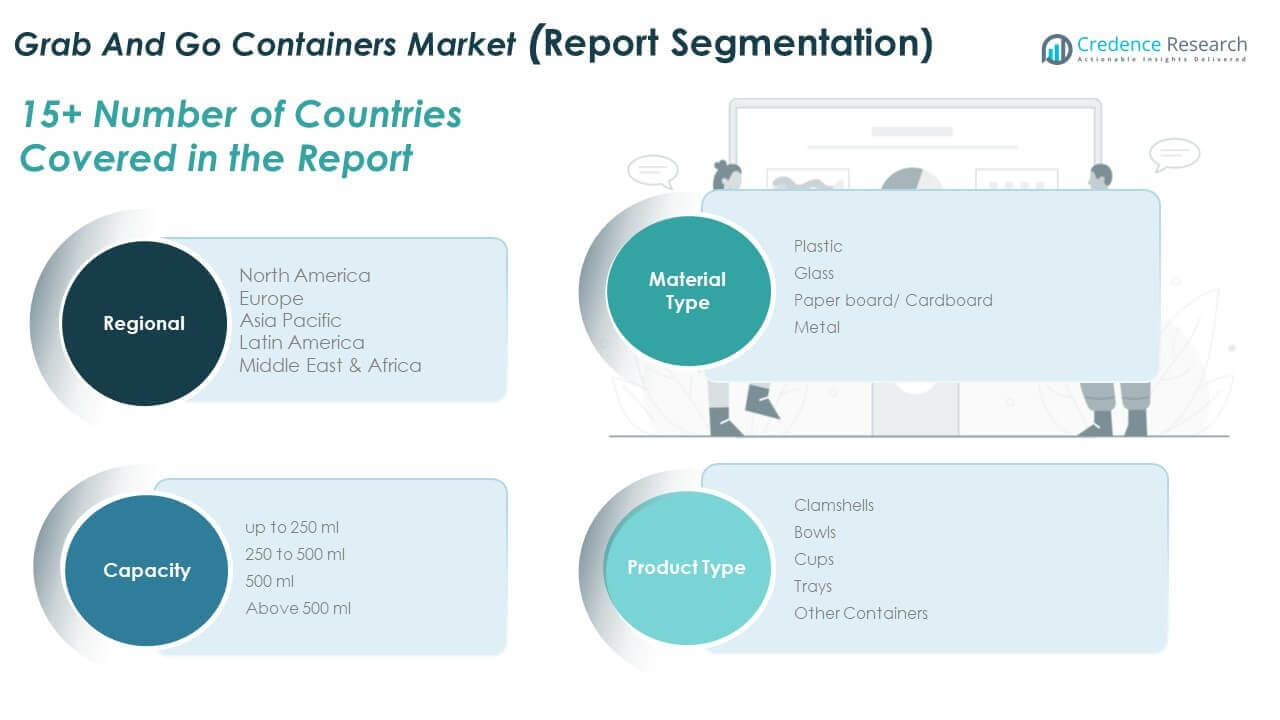
By Material Type
- Plastic
- Glass
- Paperboard / Cardboard
- Metal
By Capacity
- Up to 250 ml
- 250 ml to 500 ml
- 500 ml
- Above 500 ml
By Product Type
- Clamshells
- Bowls
- Cups
- Trays
- Other Containers
By Region
- North America
- U.S.
- Canada
- Mexico
- Europe
- Germany
- France
- U.K.
- Italy
- Spain
- Rest of Europe
- Asia Pacific
- China
- Japan
- India
- South Korea
- South-east Asia
- Rest of Asia Pacific
- Latin America
- Brazil
- Argentina
- Rest of Latin America
- Middle East & Africa
- GCC Countries
- South Africa
- Rest of the Middle East and Africa
Regional Analysis:
North America
The North America Global Grab and Go Containers Market size was valued at USD 1,809.93 million in 2018 to USD 2,483.63 million in 2024 and is anticipated to reach USD 3,907.68 million by 2032, at a CAGR of 5.9% during the forecast period. North America holds a market share of approximately 18.4%. The region leads in packaging innovation, driven by strong demand from QSR chains and food delivery platforms. The U.S. drives growth with high disposable income and widespread adoption of on-the-go consumption. Canada and Mexico contribute through expanding retail and convenience store formats. Sustainability concerns fuel the shift toward compostable and recyclable materials. Regulatory pressure on plastic use influences packaging choices. Brands in this region prioritize packaging that combines function, safety, and consumer appeal. It benefits from advanced supply chains and established foodservice ecosystems.
Europe
The Europe Global Grab and Go Containers Market size was valued at USD 2,309.81 million in 2018 to USD 3,214.58 million in 2024 and is anticipated to reach USD 5,156.75 million by 2032, at a CAGR of 6.1% during the forecast period. Europe holds a market share of approximately 24.5%. Strong environmental regulations accelerate demand for fiber-based and biodegradable packaging. Germany, the UK, and France dominate with high urban density and strong eco-packaging standards. Food retailers expand chilled ready-meal sections using premium containers. The market emphasizes plastic-free, microwave-safe, and reusable options. Packaging innovation focuses on aesthetics and traceability. Regional players lead with material science R&D and government-supported sustainability initiatives. It shows strong alignment between consumer awareness and regulatory frameworks.
Asia Pacific
The Asia Pacific Global Grab and Go Containers Market size was valued at USD 3,595.91 million in 2018 to USD 5,066.48 million in 2024 and is anticipated to reach USD 8,262.08 million by 2032, at a CAGR of 6.3% during the forecast period. Asia Pacific holds the largest market share at approximately 37.5%. Rapid urbanization and growing middle-class populations fuel consumption of packaged and ready-to-eat food. China, India, and Southeast Asia drive high-volume demand. E-commerce grocery platforms expand use of temperature-resistant and tamper-evident containers. Low-cost plastic dominates, but there is growing momentum for paperboard and molded fiber alternatives. Governments implement phased bans on single-use plastics. Local manufacturers scale operations to meet demand across informal and formal retail. It presents strong long-term opportunities through retail modernization and foodservice growth.
Latin America
The Latin America Global Grab and Go Containers Market size was valued at USD 1,032.33 million in 2018 to USD 1,458.65 million in 2024 and is anticipated to reach USD 2,387.55 million by 2032, at a CAGR of 6.4% during the forecast period. Latin America accounts for approximately 10.9% of the global market share. Brazil and Mexico are key contributors, supported by growing fast-food outlets and retail chains. Urban areas experience rising demand for quick-meal solutions, increasing need for practical packaging. Plastic containers lead, although paper-based formats are gaining traction in premium categories. Economic fluctuations affect pricing and material choices. Informal food sectors still rely on basic plastic packaging, limiting transition speed to sustainable options. Cross-border trade and regional integration influence packaging standards. It benefits from growing domestic manufacturing and regional distribution networks.
Middle East
The Middle East Global Grab and Go Containers Market size was valued at USD 649.27 million in 2018 to USD 934.95 million in 2024 and is anticipated to reach USD 1,567.84 million by 2032, at a CAGR of 6.7% during the forecast period. The region contributes approximately 7.2% to global market share. GCC countries lead, supported by tourism, hospitality, and modern food delivery systems. Saudi Arabia and UAE show strong demand for branded, tamper-proof packaging. Increasing health consciousness boosts demand for fresh, packaged foods in retail. Regulations encourage sustainable alternatives, yet plastic remains dominant. Retail expansions in malls and airports increase consumption of clamshells, trays, and cups. Packaging designs often focus on hygiene, luxury appeal, and portability. It shows resilience supported by infrastructure investments and high consumption per capita.
Africa
The Africa Global Grab and Go Containers Market size was valued at USD 179.08 million in 2018 to USD 250.16 million in 2024 and is anticipated to reach USD 403.35 million by 2032, at a CAGR of 6.2% during the forecast period. Africa holds the smallest share at approximately 3.5% of the global market. Growth is driven by urban expansion and rising foodservice activity in countries like South Africa, Nigeria, and Kenya. Informal markets dominate, but organized retail and QSR growth present packaging opportunities. Cost sensitivity limits widespread use of sustainable materials. Plastic remains the most used material due to affordability and availability. Regional food delivery platforms create demand for basic sealed containers. Manufacturing capabilities are improving, enabling local sourcing. It shows potential through retail formalization and evolving consumer habits.
Key Player Analysis:
- Dart Container Corporation
- Pactiv Evergreen
- Placon Corporation
- Smurfit Kappa Group
- Sonoco Products Company
- Biopac UK Ltd
- D&W Fine Pack
- Georgia-Pacific
- Other Key Players
Competitive Analysis:
The Global Grab and Go Containers Market shows a moderately consolidated competitive structure with the presence of established packaging manufacturers and regional specialists. Leading companies focus on scale, material innovation, and wide product portfolios to serve foodservice and retail clients. It favors players with strong distribution networks and long-term supply contracts with QSR chains and supermarkets. Major competitors invest in sustainable materials, lightweight designs, and improved sealing performance to meet regulatory and customer expectations. Product differentiation through clamshells, bowls, and cups supports brand positioning across end users. Strategic acquisitions and capacity expansions strengthen regional reach and cost efficiency. Competition also intensifies from local manufacturers that offer price advantages in emerging markets. It rewards firms that balance cost control with compliance and performance standards.
Recent Developments:
- In September 2024, Dart Container Corporation formed a strategic partnership with PulPac to advance sustainable packaging solutions, aiming to scale production of fiber-based grab‑and‑go containers that reduce plastic use and improve recycling efficiency.
- In August 2024, Pactiv Evergreen Inc. launched its Recycleware® Reduced‑Density Polypropylene (RDPP) meat trays, improving material efficiency and offering foodservice operators lighter, more recyclable grab‑and‑go container options that support sustainability goals.
- In April 2024, Amcor introduced a one‑liter polyethylene terephthalate (PET) bottle made from 100% post‑consumer recycled content, reinforcing its focus on recycled materials and broadening its sustainable packaging portfolio relevant to portable food and beverage containers.
Report Coverage:
The research report offers an in-depth analysis based on Material Type, Capacity, Product Type and Region. It details leading market players, providing an overview of their business, product offerings, investments, revenue streams, and key applications. Additionally, the report includes insights into the competitive environment, SWOT analysis, current market trends, as well as the primary drivers and constraints. Furthermore, it discusses various factors that have driven market expansion in recent years. The report also explores market dynamics, regulatory scenarios, and technological advancements that are shaping the industry. It assesses the impact of external factors and global economic changes on market growth. Lastly, it provides strategic recommendations for new entrants and established companies to navigate the complexities of the market.
Future Outlook:
- Urban lifestyles will continue to favor packaged meals, supporting steady demand for portable and single-serve container formats across foodservice and retail.
- Sustainability priorities will push manufacturers toward fiber-based, recyclable, and compostable materials without compromising durability or food safety.
- Food delivery and cloud kitchen expansion will strengthen demand for leak-resistant, tamper-evident, and stackable container designs.
- Retailers will invest more in visually appealing packaging to improve shelf impact and impulse purchases in fresh food sections.
- Innovation in lightweight materials will help reduce logistics costs and improve handling efficiency across supply chains.
- Emerging economies will see faster adoption as modern retail and quick-service restaurants expand in urban centers.
- Customization and branding on containers will gain importance as packaging acts as a direct consumer touchpoint.
- Regulatory pressure on single-use plastics will accelerate material substitution and design upgrades across regions.
- Automation in packaging production will improve scale, consistency, and cost control for large manufacturers.
- Strategic partnerships between packaging suppliers and foodservice brands will shape long-term product development paths.
Request a Free Sample
Fill in your details and we'll send you a free sample report.
- Sample data tables & charts
- Research methodology
Need a Custom Version of This Report?
Tailor the scope, geography, or segments to your exact requirements.
- Custom geography or segment scope
- Direct access to our analyst team
Frequently Asked Questions
What is the current market size for Global Grab and Go Containers Market, and what is its projected size in 2032?
At what Compound Annual Growth Rate is the Global Grab and Go Containers Market projected to grow between 2024 and 2032?
Which Global Grab and Go Containers Market segment held the largest share in 2024?
What are the primary factors fueling the growth of the Global Grab and Go Containers Market?
Who are the leading companies in the Global Grab and Go Containers Market?
Which region commanded the largest share of the Global Grab and Go Containers Market in 2024?
Table of Content
Chapter 1. Report Introduction
- 1.1 Report Description & Purpose
- 1.1.1 Report Title & Market Definition
- 1.1.2 Unique Selling Propositions (USP) & Key Differentiators
- 1.1.3 Value Proposition for Stakeholders
- 1.2 Research Objectives
- 1.2.1 Market Sizing Objectives (Volume & Revenue)
- 1.2.2 Segmentation Objectives
- 1.2.3 Competitive Intelligence Objectives
- 1.2.4 Forecast & Scenario Objectives
- 1.3 Report Scope
- 1.3.1 Grab And Go Containers Scope – Types & Subtypes Covered
- 1.3.2 Geographic Scope – Regions & Countries Covered
- 1.3.3 Historical Period, Base Year & Forecast Period (2018; forecast to 2032)
- 1.3.4 Inclusions & Exclusions
- 1.4 HS Code & Classification Framework
- 1.5 Currency, Units & Pricing Basis
- 1.6 Target Stakeholders
- 1.7 Limitations & Assumptions
Chapter 2. Executive Summary
- 2.1 Global Grab And Go Containers Market Snapshot
- 2.1.1 Market Size – Historical (2018) & Forecast (2018-2032) (2018: USD 9,576.3 million → 2032: USD 21,685.2 million)
- 2.1.2 Volume & Revenue – Global Totals
- 2.1.3 Key Market Highlights – Top Five Facts
- 2.2 Grab And Go Containers Market Segmentation Snapshot
- 2.2.1 Market Split by Region – 2018 vs. 2032
- 2.3 Competitive Snapshot
- 2.3.1 Top 10 Players by Revenue Share – 2018
- 2.3.2 Top 10 Players by Volume Share – 2018
- 2.3.3 Recent Strategic Developments (18-Month Summary)
- 2.4 Key Investment Highlights & Strategic Conclusions
Chapter 3. Grab And Go Containers Market Dynamics & Industry Analysis
- 3.1 Market Overview & Context
- 3.1.1 Grab And Go Containers Market Position in the Broader Automotive Value Chain
- 3.1.2 OEM vs. Replacement Market Dynamics
- 3.1.3 Market Maturity & Development Stage by Region
- 3.2 Grab And Go Containers Market Drivers
- 3.3 Grab And Go Containers Market Restraints & Challenges
- 3.4 Grab And Go Containers Market Opportunities
- 3.5 Porter's Five Forces Analysis
- 3.5.1 Threat of New Entrants
- 3.5.2 Bargaining Power of Suppliers
- 3.5.3 Bargaining Power of Buyers
- 3.5.4 Threat of Substitutes
- 3.5.5 Competitive Rivalry – Intensity Assessment
- 3.6 Grab And Go Containers Value Chain Analysis
- 3.6.1 Upstream – Raw Material/Input Suppliers
- 3.6.1.1 Raw Material/Input 1
- 3.6.1.2 Raw Material/Input 2
- 3.6.1.3 Raw Material/Input 3
- 3.6.2 Midstream – Production/Manufacturing/Service Delivery
- 3.6.2.1 Production/Process Overview
- 3.6.2.2 Key Facility Locations & Capacity by Manufacturer
- 3.6.3 Downstream – Distribution & End Consumer
- 3.6.3.1 Primary Channel – B2B/OEM
- 3.6.3.2 Secondary Channels – Dealer, Retail, Online, Direct
- 3.6.4 Value Chain Profitability Analysis
- 3.6.1 Upstream – Raw Material/Input Suppliers
- 3.7 PESTEL Analysis
- 3.7.1 Political Factors
- 3.7.2 Economic Factors
- 3.7.3 Social Factors
- 3.7.4 Technological Factors
- 3.7.5 Environmental Factors
- 3.7.6 Legal Factors
- 3.8 Grab And Go Containers Supply Chain Analysis
- 3.8.1 Raw Material/Input Supply Risk Assessment
- 3.8.2 Manufacturing Concentration Risk (Geographic Exposure)
- 3.8.3 Trade Disruption Impact Analysis
- 3.9 Regulatory & Policy Landscape
Note: The regulatory and policy landscape section covers regulations based on their applicability to the market, Grab And Go Containers category, geography, and scope of the study. Only regulatory frameworks with a material impact on operations, compliance, trade, sustainability, or market access are analyzed in detail.
Chapter 4. Key Investment Pockets & Opportunity Analysis
- 4.1 Grab And Go Containers Market Attractiveness Analysis
- 4.1.1 By Region – Investment Attractiveness Matrix (Volume × CAGR)
- 4.2 Absolute Revenue Growth Opportunity
- 4.2.1 By Region – Absolute USD Growth Through 2032
- 4.3 Incremental Volume Opportunity
- 4.3.1 By Region – Incremental Volume Through 2032
- 4.3.2 Segment – Incremental Volume
- 4.4 Emerging Submarket Opportunity Deep Dive (Subject to Applicability)
- 4.5 Emerging Market Opportunity Scorecards
- 4.5.1 United States
- 4.5.2 Europe
- 4.5.3 Asia
- 4.5.4 Middle East & Africa
Note: Emerging Market Opportunity Scorecards will be included based on relevance and strategic importance. Regions listed are indicative and may vary depending on data availability and market dynamics.
Chapter 5. Grab And Go Containers Import-Export Analysis & Trade Flows
- 5.1 Global Trade Overview
- 5.1.1 Global Export Value by Country (2018)
- 5.1.2 Global Export Volume by Country (2018)
- 5.1.3 Global Import Value by Country (2018)
- 5.1.4 Global Import Volume by Country (2018)
- 5.1.5 Net Trade Balance by Country (2018)
- 5.2 Export Analysis – Segment
- 5.2.1 Type 1 (HS Code)
- 5.2.2 Type 2 (HS Code)
- 5.2.3 Type 3 (HS Code)
- 5.2.4 Type 4 (HS Code)
- 5.2.5 Type 5 (HS Code)
- 5.3 Import Analysis – Segment
- 5.3.1 Type 1 (HS Code)
- 5.3.2 Type 2 (HS Code)
- 5.3.3 Type 3 (HS Code)
- 5.3.4 Type 4 (HS Code)
- 5.3.5 Type 5 (HS Code)
- 5.4 Average Unit Trade Prices
- 5.4.1 Average Export Price – Segment & Country
- 5.4.2 Average Import Price – Segment & Source Country
- 5.4.3 Price Trends (2018)
- 5.5 Key Trade Route Analysis
- 5.5.1 Trade Route 1
- 5.5.2 Trade Route 2
- 5.5.3 Trade Route 3
- 5.5.4 Trade Route 4
- 5.5.5 Trade Route 5
- 5.6 Trade Policy Impact Assessment
- 5.6.1 US Anti-Dumping & Section 301 Tariffs
- 5.6.2 EU Customs Union Impact
- 5.6.3 Major Free Trade Agreements
- 5.6.4 USMCA Rules of Origin
Note: Trade policy analysis will be included only where relevant to the Grab And Go Containers market.
Chapter 6. Competitive Landscape & Company Benchmarking
- 6.1 Grab And Go Containers Market Concentration & Structure
- 6.1.1 Herfindahl-Hirschman Index (HHI) – vs. 2018
- 6.1.2 Tier 1, Tier 2 & Tier 3 Market Structure
- 6.1.3 Global, Regional & Local Player Dynamics
- 6.2 Grab And Go Containers Market Share Analysis – 2018
- 6.2.1 Global Revenue Share by Company
- 6.2.2 Global Volume Share by Company
- 6.2.3 Regional Revenue Share
- 6.2.4 Market Share Evolution ( vs. 2018)
- 6.2.5 OEM Segment Share by Company
- 6.2.6 Replacement Segment Share by Company
- 6.3 Production/Delivery Capacity & Facility Analysis
- 6.3.1 Global Installed Capacity
- 6.3.2 Capacity Utilization Rates
- 6.3.3 Production/Output Volume
- 6.3.4 Facility Locations & Capacity Map
- 6.3.5 Planned Capacity Additions
- 6.4 Grab And Go Containers Competitive Benchmarking Matrix
- 6.4.1 Revenue, Volume, CAGR & Profitability Comparison
- 6.4.2 Channel Revenue Mix
- 6.4.3 Geographic Revenue Exposure
- 6.4.4 R&D Intensity
- 6.4.5 Sustainability Maturity
- 6.5 Strategic Developments in Grab And Go Containers (Last 24 Months)
- 6.5.1 Mergers, Acquisitions & Divestments
- 6.5.2 New Grab And Go Containers Launches
- 6.5.3 Facility Expansions
- 6.5.4 Strategic Alliances, Joint Ventures & Partnerships
- 6.5.5 Distribution Expansion & Market Entry
- 6.5.6 Sustainability & ESG Initiatives
- 6.6 Competitive Strategy Mapping
- 6.6.1 Leader, Challenger, Follower & Niche Classification
- 6.6.2 Pricing Strategy Comparison
- 6.6.3 Channel Strategy Matrix
Note: Strategic developments are included based on their materiality and the availability of reliable information.
Chapter 7. Global Grab And Go Containers Market – By Distribution Channel
- 7.1 Segment Overview
- 7.1.1 Volume & Revenue Split by Channel (2018 & 2032)
- 7.1.2 Channel Mix Evolution (2018-2032)
Chapter 8. Regional Market Analysis – Global Overview
- 8.1 Global Regional Overview
- 8.1.1 Regional Volume Share
- 8.1.2 Regional Revenue Share
- 8.1.3 Regional Volume by Region
- 8.1.4 Regional Revenue by Region
- 8.1.5 Regional Forecast Through 2032
- 8.2 Cross-Regional Segment Analysis
- 8.2.1 By Distribution Channel
- 8.2.2 By Brand/Price Tier
Chapter 9. North America Grab And Go Containers Market
- 9.1 United States
- 9.2 Canada
- 9.3 Mexico
Chapter 10. Europe Grab And Go Containers Market
- 10.1 Germany
- 10.2 France
- 10.3 Italy
- 10.4 United Kingdom
- 10.5 Spain
- 10.6 Poland
- 10.7 Russia
- 10.8 Netherlands
- 10.9 Belgium
- 10.10 Sweden
- 10.11 Denmark
- 10.12 Norway
- 10.13 Rest of Europe
Chapter 11. Asia Pacific Grab And Go Containers Market
- 11.1 China
- 11.2 India
- 11.3 Japan
- 11.4 South Korea
- 11.5 Thailand
- 11.6 Indonesia
- 11.7 Vietnam
- 11.8 Malaysia
- 11.9 Australia
- 11.10 Rest of Asia Pacific
Chapter 12. Latin America Grab And Go Containers Market
- 12.1 Brazil
- 12.2 Argentina
- 12.3 Colombia
- 12.4 Chile
- 12.5 Rest of Latin America
Chapter 13. Middle East Grab And Go Containers Market
- 13.1 Saudi Arabia
- 13.2 United Arab Emirates
- 13.3 Turkey
- 13.4 Israel
- 13.5 Iran
- 13.6 Rest of the Middle East
Chapter 14. Africa Grab And Go Containers Market
- 14.1 South Africa
- 14.2 Egypt
- 14.3 Nigeria
- 14.4 Morocco
- 14.5 Rest of Africa
Chapter 15. Grab And Go Containers Company Profiles
- 15.1 [Company 01]
- 15.1.1 Company Overview
- 15.1.2 Key Management Personnel
- 15.1.3 Products & Services Portfolio
- 15.1.4 Financial Performance
- 15.1.5 Key Market Focus & Geographic Presence
- 15.1.6 Recent Developments & Strategic Initiatives
Note: The company profile list is preliminary and may change based on research findings, market developments, data availability, and client requirements.
Chapter 16. Appendices
- Appendix A – List of Abbreviations & Acronyms
- Appendix B – Industry Classification Code Reference – Full Series
- Appendix C – Production & Capacity Data Tables
- Appendix D – End-Use & Demand Base Tables
- Appendix E – Consumption & Replacement Rate Assumptions
- Appendix F – ASP Reference Tables
- Appendix G – Manufacturing & Facility Database
- Appendix H – Import-Export Data Tables
- Appendix I – Regulatory Summary Tables
- Appendix J – Primary Research Participant List (Anonymized)
- Appendix K – Primary Research Questionnaire Framework
- Appendix L – Data Sources & Bibliography
- Appendix M – Market Size Divergence & Source Comparison
Chapter 17. Research Methodology
- 17.1 Research Framework & Philosophy
- 17.2 Secondary Research – Sources, Hierarchy & Data Extraction
- 17.3 Data Modeling – Bottom-Up & Top-Down Market Sizing
- 17.4 Primary Research – Stakeholder Framework, LOI & Sample Sizes
- 17.5 Forecast Methodology – Regression, Scenario & Sensitivity Analysis
- 17.6 Quality Control – Four-Layer Validation Framework
- 17.7 Limitations & Standard Assumptions
- 17.8 Disclaimer
